Showing posts sorted by relevance for query chuck hagel. Sort by date Show all posts

Saturday, September 21, 2013

Reflecting Heroism, September 2013

By Bill Doughty

This has been a month to reflect on the meaning of service, sacrifice and courage in the face of violence.

The week began with a terrible tragedy at the Washington Navy Yard at the Naval Sea Systems Command less than a week after 9/11.  It is ending with memorials, commemoration and more reflection.  

Throughout the week there have been expressions of grief and resolve.  Tomorrow, the nation will pause to honor those killed in the mass shooting last Monday.

Remembering POWs and MIAs  

In different ceremonies across the nation, DOD and Navy leaders paid respect to other patriots, including Prisoners of War and missing servicemembers.

Secretary of Defense Chuck Hagel speaks with Rolling Thunder Sept. 20, 2013.  
(Photo by Erin A. Kirk-Cuomo)
Yesterday, at a Pentagon ceremony, Secretary of Defense Chuck Hagel said, “Americans in uniform today are inspired by the fierce resolve of generations of American POWs.  We also draw inspiration from the bonds of camaraderie, compassion, and love that prompted our POWs to care for each other, and sustain each other, through terrible, terrible months and years of hardship.”

Addressing families and friends of missing servicemember, Hagel said, “Words and promises cannot make the lingering uncertainty and heartache go away.  But I hope it provides comfort to know that as long as members of our armed forces remain unaccounted for, the Department of Defense will do whatever we can to find them and bring them home.”

Portraits of Valor in War

In a ceremony at Naval Base San Diego yesterday, the Navy named three Arleigh-Burke class guided-missile destroyers for three heroes in three conflicts -- WWII, Vietnam and Operation Iraqi Freedom.  Named in the ceremony Sept. 20 were: USS John Finn (DDG 113), USS Ralph Johnson (DDG 114) and USS Rafael Peralta (DDG 115).  The names were selected by Secretary of the Navy Ray Mabus, who was unable to attend the ceremony because of the shooting tragedy at the Navy Yard.

The building of these ships has been overseen and coordinated by the men and women of Naval Sea Systems Command.

Beyond the Call of Duty

During this time of reflection, an inspiring book to pick up is “Medal of Honor: Portraits of Valor Beyond the Call of Duty” by photographer Nick Del Calzo and writer Peter Collier.

This large tabletop book gives a synopsis of the heroism of each Medal of Honor recipient living at the time it was published.

My copy is from 2003 and offers a forward by former President and WWII Veteran George H. W. Bush.

“The Medal of Honor pays homage to comrades who have given their lives for this great country.  These gallant souls, in their heroism and their humility, epitomize the nobility of service to country and of service above self,” Bush writes, concluding, “Americans for all times will treasure the gifts that these brave warriors have given to all of us so selflessly.”

John and wife Alice Finn in 1933.
John Finn was still living when this edition was published.  He is featured in photos in his beloved American West and as a young man with his sweetheart on a motorcycle.  The narrative in “Medal of Honor” recounts his courageous response on the morning of the attack on Oahu of Dec. 7, 1941.
“Finn found a mobile instruction stand on which guns were sometimes mounted to teach gunnery.  Although enemy planes continued to strafe the position, he moved the stand into a parking area where he would have clear visibility. Then he set a .50-caliber machine gun on it and began to shoot ... Finn had been hit by shrapnel in twenty-one places; several were serious wounds.  His left arm was numb, and a bullet had passed through one foot.  Following medical treatment, he returned to the squadron area and supervised the rearming of the remaining American planes.” 


Gen. (ret.) Richard B. Myers, then CJCS, and Lt. (ret.) John Finn look at
“Medal of Honor” book. (Photo by Mamie Mae Burke, Jan. 19, 2005.)
This book includes essays by Tom Brokaw and Senator John McCain, a POW during Vietnam who writes compellingly about owing his life to Medal of Honor recipient Air Force Maj. George “Bud” Day and Maj. Norris Overly.   Day is profiled in Del Cazo’s and Collier’s book.

McCain writes about fellow prisoners Rear Adm. Jim Stockdale and Captain Lance Sijan, both of whom showed how to live the principles of the Code of Conduct.

“As you read in these pages about Bud, Jim, and Lance, and Leo Thorsness and Jon Cavaiani, who were in prison with us, and about my friends Bob Kerrey and Dan Inouye, and all the other heroes whose extraordinary service to America is memorialized in this book you will be awed, as I am, not only by their courage and character, but by the country that produced such men and that was ennobled by the example they set for the rest of us.”

Included in the 2003 version of “Medal of Honor” are Eugene B. Fluckey, Hiroshi H. Miyamura, Donald E. Ballard, Robert E. Bush, Rodolfo P. Hernandez, George T. Sakato, William R. Charette and Ernest Childers, along with dozens of others.

A newer edition of this book includes an introduction from Brian Williams and letters from all living presidents, including President Barack Obama, who will be attending a memorial tomorrow, as announced Thursday by Press Secretary Jay Carney, “to mourn the loss of these innocent victims and share in the nation’s pain in the aftermath of another senseless mass shooting.”


Defense Secretary Chuck Hagel, right, Army Gen. Martin E. Dempsey, second from right, chairman of the Joint Chiefs of Staff, Navy Adm. Jonathan W. Greenert, chief of naval operations, and Navy Secretary Ray Mabus stand during the playing of taps at a wreath-laying at the Navy Memorial in Washington, D.C., Sept. 17, 2013. The defense leaders held the small ceremony to remember the 12 victims of the Sept. 16 shooting at the Washington Navy Yard. DOD photo by Erin A. Kirk-Cuomo

Saturday, November 13, 2021

A True Patriot and Statesman: Max Cleland

By Bill Doughty––

When Joseph Maxwell "Max" Cleland spoke at the 72nd Pearl Harbor Day commemoration ceremony, Dec. 7, 2013, with Pearl Harbor itself as a backdrop, he was nearly overcome with emotion. He saw the dozens of World War II veterans seated in the front rows of the audience, and he thought of his father. Cleland spoke without notes, from the heart, about the sacrifice of military service and the joy of homecomings.


Army CPT Max Cleland in Vietnam
Hugh Cleland, Max’s dad, joined the Navy after the attack on Oahu in 1941. In 1965, Max volunteered for the Army to serve in combat in Vietnam, where he earned the Silver Star and Bronze Star.

Cleland was severely wounded and nearly killed. Yet, he personified resilience to become head of the Veterans Administration and a U.S. Senator.

Cleland died earlier this week. He was a great statesman, military veteran, and advocate for veterans, especially those with lasting physical and mental wounds.


President Joe Biden issued a statement November 9 on Cleland’s passing:

“Max Cleland was an American hero whose fearless service to our nation, and to the people of his beloved home state of Georgia, never wavered.

As a 25-year-old serving in the 1st Cavalry Division of the U.S. Army during the Vietnam War, Max lost both of his legs and his right arm in a grenade explosion at Khe Sanh. After grueling months in the hospital, enduring multiple surgeries and a long road back to recovery, Max turned his pain into purpose. He continued his distinguished public service, becoming a lifelong champion of the dignity and rights of working people and America’s wounded veterans. His leadership was the essential driving force behind the creation of the modern VA health system, where so many of his fellow heroes have found lifesaving support and renewed purpose of their own thanks in no small part to Max’s lasting impact... He was a man of unflinching patriotism, boundless courage, and rare character... He will be remembered as one of Georgia’s and America’s great leaders.”

I was fortunate to help plan the Navy’s Pearl Harbor Day commemoration ceremony in 2013 and to hear Max Cleland speak about honor, courage, and commitment –– as well as true family values and patriotism.


In 2013 I posted a Navy Reads review featuring Cleland’s autobiography, “Heart of a Patriot.”

Cleland, who chaired the armed services subcommittee on personnel in the Senate, was known for working closely with both Democratic and Republican colleagues.


Cleland reads about JFK.
From Navy Reads: “His colleagues, mentors and friends in the Senate included fellow combat veterans Chuck Hagel, Dan Inouye, John Kerry and ‘my Vietnam veteran brother’ John McCain. Cleland describes the pride of wearing his dad's WWII Navy peacoat as a U.S. Senator during a presidential inauguration.”


Prior to serving in the Navy for three years during WWII, Max Cleland’s father, Hugh, had served in the Civilian Conservation Corps, an environmental infrastructure program created by President Franklin D. Roosevelt during the Great Depression. FDR was an inspiration to a young Max Cleland. Cleland loved books and reading. He authored several books.


Like Biden, Secretary of Defense Lloyd Austin issued a statement about Senator Cleland’s passing; fittingly, Austin includes references to literature.


In part, SECDEF Austin says:

“The Department of Defense stands united in mourning the loss of Senator Max Cleland, an extraordinary public servant and a great patriot…He served his country and his community from a wheelchair, following in the gallant tradition of his hero President Franklin Roosevelt.”


SECDEF Austin notes that as head of the Veterans Administration, Cleland “fought fiercely for his fellow veterans, made PTSD an official VA diagnosis, and helped create the groundbreaking Vet Centers program. Later, after being elected a U.S. senator from Georgia, he continued his passionate focus on defense and veterans' issues, serving with distinction on the Senate Armed Services Committee and leading on such issues as health care, bioterrorism preparedness, and homeland security. He also served on the 9/11 Commission before being nominated for the board of the Export-Import Bank. His final act of public service was leading the American Battlefield Monuments Commission. When battle maps of Vietnam were added to the National Memorial Cemetery of the Pacific in Hawaii, he asked to add an inscription from the poet Archibald MacLeish: ‘We leave you our deaths: give them their meaning.’

With courage and grit, Senator Cleland struggled with PTSD and depression—seeking help through counseling, medication, and attendance at a recovery group. He said that he drew strength from being around his fellow veterans and wounded warriors, including those from Iraq and Afghanistan. As the head of the VA, he made psychological counseling available to his fellow veterans. And I hope that his example will encourage others carrying unseen wounds to seek out the help they need and deserve. 

Senator Cleland liked to quote Hemingway, who wrote, ‘The world breaks everyone and afterward many are strong at the broken places.’ He surely was. Max Cleland's civic-minded spirit, optimism, and resilience will stand as an inspiration to every American.”

Funeral services are planned for early next week.


Senator Max Cleland, RIP.


Vietnam War veteran Max Cleland, a triple amputee, holds a photograph of himself as a child with his father, Hugh, and mother, Juanita, at the National Memorial Cemetery of the Pacific at Punchbowl in 2013. (Jamm Aquino, Honolulu Star-Advertiser)


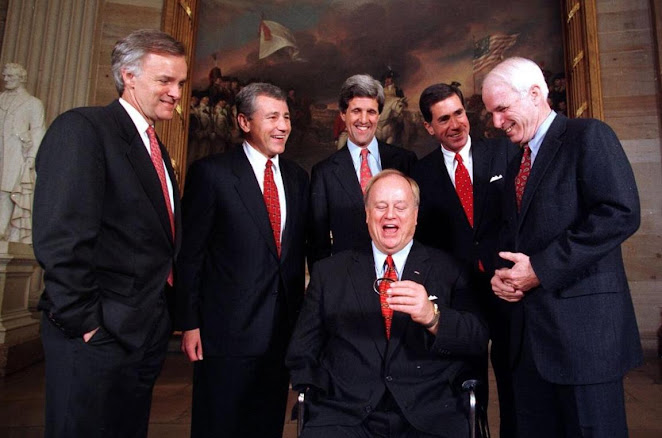
The Senate had six Vietnam combat veterans in January 1997. Sen. Max Cleland, D-Ga., is in the front. Behind him, from left: Bob Kerrey, D-Neb., Chuck Hagel, R-Neb., John Kerry, D-Mass., Chuck Robb, D-Va., and John McCain, R-Ariz. This photo was taken by The World-Herald during Senate orientation the previous month. (Kiley Cruse, The World-Herald)

Top photo: Secretary Max Cleland, American Battle Monuments Commission, delivers keynote remarks during the 72nd anniversary commemoration of the Dec. 7, 1941, attack on Oahu. This year’s commemoration theme, “Sound the Alarm,” examines how thousands of Americans answered the call to duty in the wake of the attack. More than 2,500 people attended the Pearl Harbor commemoration. (MC2 Nardel Gervacio)


Thursday, October 10, 2024

Who Could Be Against Trump?

By Bill Doughty

Hundreds of former national security leaders –– from both Republican and  Democratic administrations –– signed a stark warning letter to the nation last month, citing about ex-President Trump, “He has shown no remorse for trying to overturn the 2020 election on January 6th, promises to pardon the convicted perpetrators, and has made clear he will not respect the results of the 2024 election should he lose again. That alone proves Mr. Trump is unfit to be Commander-in-Chief.”


Project 2025 was the must-read of the summer, and now this letter is a must-read for autumn, just a few weeks before the election. The lead signature is from Rear Admiral Michael E. Smith, USN (Ret), President of National Security Leaders for America.


Signatories include former SECDEFs Chuck Hagel, William Cohen, Leon Panetta, and William Perry as well as seven Senate-confirmed military service secretaries. The officials and senior officers called former President Donald J. Trump "impulsive," "ill-informed" and “unfit” to serve again as commander in chief.


They condemn his promise to “terminate” parts of the Constitution, his constant lying, and his role in the January 6, 2021 attempt to overturn the previous election and his “promises to pardon the convicted perpetrators.”


The letter includes signatures from three former acting service secretaries, former Secretary of Homeland Security Jeh Johnson, former Secretary of State Hillary Clinton, and former Secretary of Homeland Security Janet Napolitano. Among the more than 740 Americans who signed the letter are service members, civilians, and military spouse representatives. There are at least 63 Navy and 18 Marine Corps retirees who endorse Harris over Trump


Many Republicans have denounced Trump, with most pledging support to Kamala Harris for President. Notably, former Vice President Dick Cheney and former Representative Liz Cheney announced their endorsement of Harris. Liz Cheney is former House GOP conference chair and was the #3 Republican in the House of Representatives until she turned against Trump and helped lead a congressional investigation into the January 6, 2001 (J6) insurrection, consequently becoming a victim of MAGA retaliation.


Now Liz Cheney joins former Trump White House aides Alyssa Farah Griffin, Cassidy Hutchinson and Sarah Matthews today in Pennsylvania to campaign against Trump, noting, according to reports, his threat to democracy, the rule of law, and the Constitution. Former Trump White House communications director Anthony Scaramucci has issued similar warnings about another Trump presidency, and is actively supporting Kamala Harris and Tim Walz.

Recently, retired U.S. Army General Stanley McChrystal endorsed Vice President Kamala Harris for president, writing in a New York Times OpEd, “Ms. Harris has the strength, the temperament and, importantly, the values to serve as commander in chief.” He added, “I have cast my vote for character, and that vote is for Vice President Kamala Harris.”


In 2020, Admiral William McRaven, former commander of the U.S. Special Operations Command, warned the nation about a second Trump administration and what it would mean for the future of the country: “When good men and women can't speak the truth, when facts are inconvenient, when integrity and character no longer matter, when presidential ego and self-preservation are more important than national security — then there is nothing left to stop the triumph of evil.”

In another editorial about Trump, McRaven addressed him directly and wrote, "Through your actions, you have embarrassed us in the eyes of our children, humiliated us on the world stage and, worst of all, divided us as a nation.” Both McRaven and Admiral James Stavridis, former NATO Supreme Allied Commander, condemn Trump for his lack of character, his failure to uphold his oath to the Constitution, his affection for dictators and autocrats, and his antagonism of Allies and alliances.


Late Senator John McCain’s family have joined former members of Trump’s own administration –– including VP Pence, SECDEF Gen. Mattis, SECDEF Esper, CoS Gen. Kelly, NSA John Bolton, and CJCS Gen. Milley –– in condemning Trump for his role in the J6 insurrection coup attempt, threat to national security, and lack of stability. For his part, Trump threatens to retaliate against his critics both in government and in the media.

Next week, Bob Woodward’s new book, “War,” will hit book shelves, reporting on Trump’s “romance” with Russia’s Putin expanding on allegations of Russia’s help in Trump’s 2016 election when Trump, “Russia if you’re listening…” and publicly siding with Putin over his own Intelligence officers. Woodward reports that Trump secretly sent Covid-19 testing equipment directly to Putin in the early weeks of the 2020 pandemic, even though there was a shortage and need for testing in the United States. Trump denied the report, but Kremlin spokesman Dmitry Peskov said yesterday that the tests had been sent to Putin. It seems Woodward has written another must-read for this year.

Sunday, October 6, 2013

Decisive Action: ‘Gravity’ & ‘Captain Phillips’

by Bill Doughty

Two movies this month offer thrill rides and edge-of-the-seat action: “Gravity” and “Captain Phillips.” Directors Alfonso Cuarón and Paul Greengrass and actors Sandra Bullock and Tom Hanks, respectively, will be up for top awards by the end of the year.  Supporting performances by George Clooney and Barkhad Abdi will likely be up for awards, too.

“Gravity” takes special effects to a new level, but the story and life-and-death performance by Bullock are grounded in humanity.  The whole world is an audience to the drama.  Some themes: cooperation in space, importance of STEM, faith in oneself, innovation, training, courage, rebirth from grief, and appreciation for the gift of life.  

The film brings out the stark challenges and deep desire to explore space and understand the universe.

Tom Hanks congratulates James Lovell on being
awarded the Lincoln Leadership Prize in 2010.
Coincidentally, this past week the U.S. Naval Institute held its 2013 annual history conference, “Past, Present, and Future of Human Space Flight,” with Capt. James A. Lovell, USN (Ret.), Capt. Robert L. Crippen, USN (Ret.), Col. Robert Cabana, USMC (Ret.) and Capt. Ken Ham, USN.  (Lovell, captain of the famed Apollo 13 mission, was portrayed by Tom Hanks in a movie about that mission.)

Ham, chair of the Aerospace Engineering Department at the Naval Academy, said he and astronauts and other aviators were influenced by the movie, “Top Gun.”  Ham commented, “When I look up into the sky at the moon, it’s epic. When I look at Mars, it’s epic. It seems to me to be completely obvious that we need to go there, and I think if we decide to do it, the American people will support it.”

There are similarities in the appeal of space and call of the sea.

“Captain Phillips,” based on the book “A Captain’s Duty” by Phillips with Stephan Talty, shows how uncompromising resolve, creative negotiation and decisive action can work against hostage-taking extortion and intimidation.  The U.S. Navy stands for freedom of commerce on the seas, and “Captain Phillips,” shows -- through blood, sweat and tears -- how that freedom is protected.  Once again, Navy SEALs are on the forefront but so are surface forces, naval aviation and hospital corpsmen.  The movie closely follows action described in the book, with an eye on accuracy.  Greengrass says he wanted the movie to seem like a documentary, and it does.

[ Coincidentally, today Secretary of Defense Chuck Hagel announced targeted operations by U.S. servicemembers against terrorists in Africa.  “These operations in Libya and Somalia send a strong message to the world that the United States will spare no effort to hold terrorists accountable, no matter where they hide or how long they evade justice. We will continue to maintain relentless pressure on terrorist groups that threaten our people or our interests, and we will conduct direct action against them, if necessary, that is consistent with our laws and our values.” ]

Barkhad Abdi as "Muse."
Building cooperative partnerships, providing humanitarian assistance and disaster relief, and enforcing international fishing laws with the U.S. Coast Guard are missions of the Navy as reflected in the Maritime Strategy and as touched on in “Captain Phillips.”  The Maersk Alabama ship was carrying relief supplies to Africa.  The pirates from Somalia claimed they were fishermen driven to piracy because of overfishing.  Their attack, however, was based on a flawed strategy from a position of weakness.

How can we preserve quality of life on the planet and protect natural resources?  How can we resolve conflict and uphold constitutional democracy?  How can we overcome fear and find the will to survive under the worst circumstances?  These are some of the questions prompted by these two movies.  On a practical level, “How did they film that?” is another question that comes to mind, especially during “Gravity.”  Amazing.

Saturday, March 8, 2014

In Shadow of ... America's Longest Wars

Review by Bill Doughty

Women and men of the Class of 2002 may think they are in the shadow of their grandparents -- "The Greatest Generation" who beat fascism, crushed nazism and crossed the Pacific to avenge Pearl Harbor and win the war in the Pacific in less than four years.

"In the Shadow of Greatness: Voices of Leadership, Sacrifice, and Service from America's Longest War" is a compilation by or about members of the U.S. Naval Academy Class of 2002. Put together with love and appreciation by Joshua Welle, John Ennis, Katherine Kranz and Graham Plaster -- and including a foreword by David Gergen -- the book is filled with essays and memories by and about members of the U.S. Naval Academy Class of 2002. The authors set the stage with a look back to the past:
"The magnitude of World War II provided the opportunity and experiences that shaped twentieth-century American leaders. As men served abroad, women provided support at home. All overcame great odds and faced adversity that gave them confidence and shaped their outlook in the decades to come. This 'greatest generation' returned from war, took advantage of the educational benefits offered through the GI Bill, and advanced the country's economy and transformed its society. World War II veterans, while fueling economic advancement, remained resolute in their  value system: service, sacrifice, and community."
Among "Shadow's" contributors are aviators, surface warfare officers, submariners, U.S. Marines and mothers of junior officers killed during training or in action.

The book is filled with first-person, heartfelt accounts of triumph and hardships: what it's like in humanitarian assistance missions, duty at sea, Search and Rescue operations, and combat; what it means to face family separation, "setting aside the comforts a normal life in service to our country and the Constitution. The dark sides of these sacrifices are broken marriages, post-traumatic stress disorder, depression, and estrangement."

But there is plenty of triumph here, too, focusing on why and how Navy and Marine Corps leaders choose to serve -- "not for self, but for country."

USS John Paul Jones (DDG 53)
A highlight is the account by Meghan Elger Courtney, who served aboard USS John Paul Jones (DDG 53) of her commitment to promote warfighting readiness for Sailors aboard the Arleigh Burke-class guided-missile destroyer. Courtney recognized a need to improve shipboard physical fitness opportunities to help Sailors who would deploy forward -- either aboard ship or as individual augmentees in Iraq and Afghanistan.

With the blessing of her commanding officer and strong support from the command master chief and Chief's Mess, j.o. Courtney planned for, procured and arranged for installation of a new fitness center that replaced outdated insufficient gear and space.  Courtney writes, "Almost immediately, I saw a positive renewal in people's attitude toward fitness, healthy eating, and incorporating workouts into their daily routine as a way to relieve stress and stay in shape."
"What some may have viewed as my silly pet project, the command master chief took seriously, and he became my closest ally in seeing it through. I never really knew how much the experience had impacted him until I saw him become visibly choked up recollecting it during his closing remarks when he transferred off the ship. I don't think he thought that a young officer like me could have cared about his crew so much, but I did, and I still do..."
Explorer Robert E. Perry
Courtney said she was inspired by a quote by explorer Robert E. Peary on a motivational placard in Halsey Field House at the academy: "I will find a way, or make one."

Other essayists share their sources of inspiration as President Teddy Roosevelt, President Dwight Eisenhower, President John F. Kennedy, Senator Daniel Inouye and Secretary of Defense Chuck Hagel, among others. 

One essayist quotes the last two lines of a poem by Mary Oliver, "The Summer Day" in pursuing a life of purpose, wanting to make a difference:

"Tell me, what is it you plan to do
with your one wild and precious life?"

The authors and essayists show how core values of honor, courage and commitment make up an ethos that "forms the fabric of people's personality and drives them to a life of service, in and out of uniform."
"'In the Shadow of Greatness' was envisioned to recognize and chronicle the service of brave men and women and through their stories establish connections with the broader, nonmilitary community. These first graduates of the Naval Academy after 9/11 entered a global war at sea, in the air, and on land. This war would last more than a decade and define the United States in the early part of the millennium. The actions of the select few profiled here represent those of a much broader spectrum of patriots."
Attacks on 9/11/2001 changed the lives of the Class of 2002.
In a short introductory piece, "Inside the Gates of Annapolis," Adm. Sam Locklear (now Commander, U.S. Pacific Command) writes about the investment the country makes in the women and men who attend service academies, including the Naval Academy, reflecting on the morning of September 11, 2001 when he sat at his desk as commandant of midshipmen.
"I recall vividly watching the al-Qaeda attacks on the World Trade Center and the Pentagon and the plane crash in Pennsylvania. When the images reached the Brigade, and the uncertainty of the events rapidly became reality, I asked myself, Are these men and women, these young patriots, ready for the challenges that most certainly lay ahead. A decade of war has proven that they were more than ready. Fortunately for us all, they remain ready today. We are extremely proud of all they have accomplished and thankful that we chose the right men and women to lead the next great generation."
The book, published by the Naval Institute Press, is a key title on the CNO's Professional Reading Program essential list.

Sunday, December 1, 2013

Max Cleland's 'Heart of a Patriot'

Review by Bill Doughty

"Heart of a Patriot" by Max Cleland with Ben Raines is a deeply personal and fearless account of a life of towering summits and dark valleys.

The former Army Airborne captain and decorated Vietnam combat veteran lost both legs and most of his right arm during the Battle of Khe Sanh in a grenade explosion.

In the book's foreword, "An Open Letter to America's Veterans," Cleland speaks candidly about his post-traumatic stress disorder and "a journey to the dark places of life -- terror, fear, death, wounding, loss, grief, despair and hopelessness."  

He writes for fellow veterans trapped in "a misery of memories" and offers light and hope.  "Recovery is possible," he writes.  "There are people who can help."
Max Cleland

Publisher SimonandShuster writes, "Max Cleland describes with love the ties America's soldiers forge with one another, along with the disillusionment many of them experience when they come home.  He spares no one his humiliations and setbacks in this gut-wrenching account of his life in the hope it will keep even one veteran from descending into darkness.  'Heart of a Patriot' is a story about the joy of serving the country you love, no matter the cost -- and how to recover from the deepest wounds of war."
Max Cleland is the keynote speaker at this year's Navy and National Park Service 72nd Pearl Harbor Day Ceremony, Dec. 7, 2013 near Joint Base Pearl Harbor-Hickam.

Cleland's father joined the Navy and shipped out to Pearl Harbor after war was declared.  His dad returned home Dec. 8, 1945 when Max was three and a half.

Cleland was inspired to public service and to join the military by President John F. Kennedy, especially in the wake of JFK's assassination 50 years ago.
In bed at Walter Reed in 1968, Cleland reads Arthur Schlesinger's
"A Thousand Days" about President John F. Kennedy.
After his promising future was "blown to bits" Capt. Cleland made a slow recovery at Walter Reed and then through the Veteran's Administration, getting a first-hand look at the institution he would run one day.

Later, after serving for more than a decade in state politics in Georgia he received an appointment as head of the VA by former Georgia Governor and newly elected President Jimmy Carter, a Navy veteran.

Cleland created VA centers to help millions of veterans, including returning service members from Iraq and Afghanistan.  "Their creation is one of the things I am most proud of," he writes.

Elected to the U.S. Senate, Cleland became chairman of the armed services subcommittee on personnel.  His colleagues, mentors and friends in the Senate included fellow combat veterans Chuck Hagel, Dan Inouye, John Kerry and "my Vietnam veteran brother" John McCain.  He describes the pride of wearing his dad's WWII Navy peacoat as a U.S. Senator during a presidential inauguration.

After the Al Qaeda attacks of Sept. 11, 2001 Cleland was appointed to the 9/11 Commission but said he was frustrated by a lack of access to key intelligence information leading up to the attacks.

In the chapter, "An Infamous Commission," he links aspects of the 9/11 Commission with the Warren Commission that investigated the JFK assassination.  He also compared the 9/11 lack of transparency with the investigation after the Pearl Harbor attack.
"Within the first week after that tragedy, Roosevelt had set up a commission to investigate it and all its ramifications.  Just 10 days after the attack, he relieved both the naval commander at Pearl Harbor, Admiral Husband E. Kimmel, and the army commander, General Walter Short, of their jobs based on the commission findings.  Every aspect of the government's inner workings, from diplomacy to military readiness and intelligence, was laid bare for the commission to examine. And in the end, Roosevelt got his man: Within three years, he had personally given the order to shoot down the plane carrying Admiral Yamamoto, the Harvard-educated enemy warrior who planned the attack."
The book describes in painful detail the bouts of depression that Max Cleland endured during his life of public service.  Poignantly, Cleland, who "grew up in the golden era of rock," describes a moment alone listening to the Beatles and Paul McCartney's "Yesterday," feeling like "half the man I used to be."

"Heart of a Patriot" concludes with another message directly for veterans, especially for those suffering from polytrauma. He imagines and then creates a better future.  Through faith and hope and the help of others, there is "something to stand on" and a way to fly out of the darkness, he writes.

Max Cleland is set to speak to the Greatest Generation and "the greatest of our generation" at Saturday's Pearl Harbor Day commemoration.  Max Cleland, a self-described "war baby" was born August 24, 1942.  Do the math, and he was conceived just prior to the attack on Pearl Harbor.

President Barack Obama appointed Cleland as Secretary of American Battle Monuments Commission in June 2009.

Max Cleland, Secretary American Battle Monuments Commission, gives remarks, Nov. 11, 2012, during a Veterans Day ceremony at the National Memorial Cemetery of the Pacific in Honolulu. (Department of Defense photo by U.S. Air Force Tech. Sgt. Michael R. Holzworth)

Friday, June 5, 2020

'To Unite Around a Common Purpose'

Trump and Mattis
By Bill Doughty––

This week, former Secretary of Defense retired Marine Corps General James Mattis spoke out against President Trump's threat to deploy militarized force against Americans peacefully protesting as part of their rights as guaranteed in the first amendment to the Constitution. 

In in op-ed for Foreign Policy and statement for other media outlets, Mattis wrote, "We do not need to militarize our response to protests. We need to unite around a common purpose. And it starts by guaranteeing that all of us are equal before the law." Protests throughout the United States and overseas are in the wake of the death of George Floyd, an African American, highlighting the need for greater equality and systemic police reforms.

Mattis joins a chorus of voices of respected leaders who are speaking out against misuse of the military and abuse of power by the commander in chief and his key staff. 

Trump –– along with his attorney general, secretary of defense and chairman of joint chiefs –– directed force be used to attack and remove peaceful protestors in and near Lafayette Park June 1 so the president could pose for pictures while holding a bible. Last week, Trump tweeted, "...Any difficulty and we will assume control but, when the looting starts, the shooting starts."

Prior to the photo-op, Trump spoke at the White House and threatened to "deploy the United States military" if mayors and governors didn't take brutal action to "dominate the streets." 

"As we speak," he said, "I am dispatching thousands and thousands of heavily armed soldiers, military personnel, and law enforcement officers to stop the rioting, looting, vandalism, assaults, and the wanton destruction of property."

Earlier in the day Trump held a phone call with governors in which he said, "General Milley is here, who's head of joint chiefs of staff, a fighter, a warrior, had a lot of victories and no losses ... And I just put him in charge." SECDEF Esper then told the governors, "We need to dominate the battle space."

In his op-ed, "In Union There Is Strength," Mattis wrote: "We must reject any thinking of our cities as a 'battlespace' that our uniformed military is called upon to 'dominate.' At home, we should use our military only when requested to do so, on very rare occasions, by state governors. Militarizing our response, as we witnessed in Washington, D.C., sets up a conflict —a false conflict — between the military and civilian society. It erodes the moral ground that ensures a trusted bond between men and women in uniform and the society they are sworn to protect, and of which they themselves are a part."

Mullen
His statement comes on the heels of a similar statement by former Chairman of the Joint Chiefs of Staff retired Navy Admiral Mike Mullen, published by The Atlantic the day after the incident in Lafayette Park. In an essay titled "I Cannot Remain Silent," Mullen wrote: "Our fellow citizens are not the enemy, and must never become so."

Mullen, a respected military leader, served as CNO and then as CJCS under both President George W. Bush and President Obama.

Mullen wrote, in part: "While no one should ever condone the violence, vandalism, and looting that has exploded across our city streets, neither should anyone lose sight of the larger and deeper concerns about institutional racism that have ignited this rage ... We must, as citizens, address head-on the issue of police brutality and sustained injustices against the African American community. We must, as citizens, support and defend the right—indeed, the solemn obligation—to peacefully assemble and to be heard. These are not mutually exclusive pursuits. And neither of these pursuits will be made easier or safer by an overly aggressive use of our military, active duty or National Guard."

Mullen’s successor as Joint Chiefs chairman, Army Gen. (ret.) Martin Dempsey, tweeted this week, “America is not a battleground. Our fellow citizens are not the enemy. #BeBetter.” Also speaking out on Twitter were retired Gen. Michael Hayden, former director of the CIA and NSA, and retired Gen. Tony Thomas, former head of Special Operations Command.

McRaven and Ash Carter
This morning, Adm. William H. McRaven, who served as the ninth commander of the United States Special Operations Command (2011-2014), spoke out on the "Morning Joe" show: “I was very pleased to see Jim Mattis, and obviously Adm. Mike Mullen, and today John Kelly come out and reinforce what we know to be the principles of the U.S. military,” McRaven said. “We all raise our right hand and swear an oath to the Constitution of the United States, it is not to the president of the United States, it is to the Constitution.”

“When you are in the military, there are three criteria for every decision we make: it has to be moral, legal and ethical,” McRaven said. “Ethical –– you have to follow the rules, legal –– you have to follow the law, and then moral –– you have to follow what you know to be right. And either way, that’s just not right.”

Allen
“You’re not going to use, whether it’s the military, or the National Guard, or law enforcement, to clear peaceful American citizens for the president of the United States to do a photo op,” McRaven said. “There is nothing morally right about that.”

Marine Corps General (ret.) John Allen, former commander of U.S. forces in Afghanistan, wrote in Foreign Policy this week, "To even the casual observer, Monday was awful for the United States and its democracy. The president's speech (calling for military deployment on American streets) was calculated to project his abject and arbitrary power, but he failed to project any of the higher emotions or leadership desperately needed in every quarter of this nation during this dire moment."

Among other leaders of character who are standing up and expressing their outrage about the events of June 1 is Steven J. Lepper, a retired Air Force major general, who served as Deputy Legal Counsel to the Chairman of the Joint Chiefs of Staff. Lepper wrote a thoughtful piece for The Hill about issuing and following unlawful orders and preventing misuse of the military.

Lepper
"Even before Monday," Lepper writes, "(Trump) has spent much of his time lavishing praise on the military, hailing himself as its savior, or pandering to it in ways that many have found embarrassing and, in some cases, abhorrent. Rather than treating the military as the professional organization it is and the element of national power it was intended to be, he seems to want it to be his friend. How else can anyone explain why he pardoned three accused American war criminals? By his own admission, he sought to shield these men — and, by extension, the rest of the military — from accountability on the battlefield. His 'I got your back' message was actually a slap in the face of every military professional who knows that right and wrong exist in combat."

Former defense secretaries Leon Panetta, Ash Carter and Chuck Hagel joined 86 other former Pentagon leaders in an open letter published in the Washington Post today. Yesterday, former SECDEF William Perry tweeted, "I am outraged at the deplorable behavior of our President and Defense Secretary Esper, threatening to use American military forces to suppress peaceful demonstrators exercising their constitutional rights. This is a deeply shameful moment for our nation."

Panetta and Stavridis
Navy Admiral (ret.) James Stavridis, former NATO Supreme Allied Commander Europe, wrote an essay for Time, saying, "The sweeping use of a combined civil-military force – D.C. police, Park Police, National Guard, and active duty military police – against the protesters to clear the way for a Presidential photo-op was beyond the pale of American norms. It was particularly ill-advised to include active duty military personnel in that event."

As usual, Stavridis puts recent events in the context of history: "Our founding fathers feared the use of a standing army that could be used to further the aims of a dictator."

"Our active duty military must remain above the fray of domestic politics, and the best way to do that is to keep that force focused on its rightful mission outside the United States," Stavridis writes. "Our senior active duty military leaders must make that case forcefully and directly to national leadership, speaking truth to power in uncomfortable ways. They must do this at the risk of their career. I hope they will do so, and not allow the military to be dragged into the maelstrom that is ahead of us, and which will likely only accelerate between now and November. If they do not stand and deliver on this vital core value, I fear for the soul of our military and all of the attendant consequences. We cannot afford to have a future Lafayette Square end up looking like Tiananmen Square."

In the book, "Civilian Control of the Military: Theory and Cases from Developing Countries," ed. by Claude E. Welch Jr. (State University of New York Press, Albany 1976), Welch warns against using the military in domestic civilian affairs. "Domestic violence tries the loyalty of the military to the government." Steps must be taken, he says, to "foster restraint on the part of civilian leaders." 

The book opens with advice from nearly two hundred years ago. General Maria von Clausewitz wrote that war is an instrument of state policy by an armed force created by the state, in our nation's case by "we, the people." Clausewitz writes what Welch calls "perhaps the strongest justification for civilian control over the military:
"The subordination of the political point of view to the military would be contrary to common sense, for policy has declared the war; it is the intelligent faculty, war only the instrument, and not the reverse. The subordination of the military point of view to the political is, therefore, the only thing which is possible."
Welch says that, in order to sustain civilian control over the armed forces, "Civilian politicians should follow policies of restraint in periods of domestic crisis." Policing should be left to police, including to quell the relatively few unfortunate violent and destructive acts in some cities. Also, Americans are smart enough to realize both: (1) the vast majority of law enforcement people are good and often heroic, and (2) due to systemic problems, there needs to be a fundamental reshaping of how "protect and serve" is carried out.

Mattis
Mattis's op-ed, like Mullen's and Stavridis's, leans heavily on history: "Instructions given by the military departments to our troops before the Normandy invasion reminded soldiers that "The Nazi slogan for destroying us...was 'Divide and Conquer.' Our American answer is 'In Union there is Strength.' We must summon that unity to surmount this crisis—confident that we are better than our politics."

Mattis concludes, "We can come through this trying time stronger, and with a renewed sense of purpose and respect for one another. The pandemic has shown us that it is not only our troops who are willing to offer the ultimate sacrifice for the safety of the community. Americans in hospitals, grocery stores, post offices, and elsewhere have put their lives on the line in order to serve their fellow citizens and their country. We know that we are better than the abuse of executive authority that we witnessed in Lafayette Square. We must reject and hold accountable those in office who would make a mockery of our Constitution. At the same time, we must remember Lincoln's 'better angels,' and listen to them, as we work to unite."