Showing posts with label MoH. Show all posts

Friday, January 14, 2022

I’ll Vote for That: ‘Race’ as ‘Caste’


Review by Bill Doughty––

Although science says there is no such thing as race, that doesn’t mean there is no “racism.”


Under a guise of racism, a dominant class can subjugate, discriminate, and try to control a subordinate class, including by suppressing or subverting their right to vote –– based on superficial differences.


Isabel Wilkerson
Isabel Wilkerson makes the case for recasting, so to speak, “racism” as “casteism” in her indispensable book for our time: “Caste: The Origins of Our Discontents” (Random House, 2020), an Oprah’s Book Club selection.

As for “no such thing as race…”


Scientists call ‘race’ an artificial construct. Wilkerson writes this, citing a great Navy veteran scientist:

“Two decades ago, analysis of the human genome established that all human beings are 99.9 percent the same. ‘Race is a social concept, not a scientific one,’ said J. Craig Venter, the geneticist who ran Celera Genomics when the mapping was completed in 2000. ‘We all evolved in the last 100,000 years from the small number of tribes that migrated out of Africa and colonized the world.’” (Venter is a former Navy corpsman and Vietnam War veteran; we have featured his work and his autobiography several times here on Navy Reads.)

Now DNA kits ordered by mail show “that race as we have come to know it is not real,” Wilkerson says. “It is a fiction told by modern humans for so long that it has come to be seen as a sacred truth.”


Wilkerson interviews a Nigerian-born playwright, who says, “You know that there are no black people in Africa. Africans are not black. They are Igbo and Yoruba, Ewe, Akan, Ndebele. They are not black. They are just themselves. They are humans on the land. That is how they see themselves, and that is who they are.”

Dr. Martin Luther King Jr., who embraced the nonviolent teachings of Mohandas Gandhi, saw the issue of racism framed as casteism. Sixty-three years ago, in February 1959, he and his wife, Coretta Scott King, traveled to and within India, where MLK self-identified as “an untouchable.” The Kings visited the grave of Gandhi, laid a wreath, and prayed.


In India, people are born into castes that are supposedly divinely dictated. Discrimination against people considered part of the lower classes was acceptable, lawful, institutional. While civil rights laws in India in the 1940s (and in the United States in the 1960s) have made it illegal to discriminate, "both countries still live with the residue of codes that prevailed for far longer than they have not."

Casteism in the U.S. began more than a century before we became a nation.


Actions 


Beginning in 1619, Europeans brought Africans to the English colonies as property and to the very bottom of a social hierarchy. Confronting the morality of the institution led eventually and with great upheaval to the Emancipation Proclamation and American Civil War nearly 250 years later. But like it or not, racism, constructed within a framework of casteism, had been already institutionalized.

“In the decades to follow, colonial laws herded European workers and African workers into separate and unequal queues and set in motion the caste system that would become the cornerstone of the social, political, and economic system in America. This caste system would trigger the deadliest war on U.S. soil, lead to the ritual killings of thousands of subordinate-caste people in lynchings, and become the source of inequalities that becloud and destabilize the country to this day.”

“After the Civil War, Confederates blamed the people they had once owned for the loss of the war,” Wilkerson writes. There was a backlash to “take our country back.” The Lost Cause. The Big Lie.

South Carolina's Hammond
Wilkerson contends, “Caste, along with its faithful servant race, is an x-factor in most any American equation, and any answer one might ever come up with to address our current challenge is flawed without it.”

She presents dozens of examples of the horrors inflicted by the dominant class in America over previous centuries, including torture, riots, and lynchings.


We learn of the horrid senator of South Carolina James Henry Hammon, who said, “God created slaves for us.” Hammon raped women, including his own daughter, and sexually assaulted four of his nieces. We also read the crushingly sad story of Willie James Howard, a 15-year-old black boy who made the fatal mistake of having a schoolboy crush on a white girl in 1943 in Grand Gulf, Mississippi. And, we hear of ludicrous practices under endogamy, miscegenation, and eugenics laws and theories.


A eugenics book published in 1916 by an American, Madison Grant, titled “The Passing of the Great Race,” became popular with white supremacists.


Adolf Hitler called it his bible.

The Nazis were inspired by how the American upper class treated blacks and especially indigenous peoples. But, fascist Germans of the 30s and 40s escalated and intensified the evil when they exterminated millions of people based on eugenics and claims of Aryan supremacy.


Hitler and Nazi casteism
A caste system set up by Hitler and the Nazis justified the torture and deaths of millions of Jews, homosexuals, Roma people, and people with disabilities. To the Nazis, it was “obvious Jews were a separate race.”

When Einstein, a Jew, escaped Germany as an immigrant to the United States, he was shocked to discover he had moved from a country of castes to another country where, this time, people of color were considered a subordinate class.


Once we accept the reality of caste systems, it helps us understand the point of view of others.


That includes many people in the privileged dominant class who feel fear and resentment when they start to lose their privileged position. “A caste system builds rivalry and distrust and lack of empathy,” Wilkerson contends.


Will the dominant class –– through fear, anger, and resentment –– do anything, accept anything, to try to retain the power hierarchy? Think: sedition, treason, secession.


This week, the U.S. Department of Justice announced the indictment of members of the Oath Keepers, including the far-right group’s Texas-based founder, on charges of seditious conspiracy related to the January 6, 2021, U.S. Capitol insurrection.

Oathkeepers stack into the U.S. Capitol, along with other Trump supporters, during the insurrection of Jan. 6, 2022.

Reactions


People confronted with scenes of outright violence respond in different ways. Some –– like those who attended lynchings of black people in the American South, or German citizens who swooned when Hitler’s stormtroopers returned from invading Poland –– react with joy. Other people may be outraged at first but later find justification for ignoring or even condoning the violence.


For example, despite being an advocate of slavery Secretary of the Navy James K. Paulding reacted strongly after he witnessed what Wilkerson describes as “barefoot men and women locked together with the weight of an ox-chain in the beating sun, forced to walk the distance to damnation in a state father south and riding behind them, ‘a white man on horse back, carrying pistols in his belt, and who, as we passed him, had the impudence to look us in the face without blushing.’” Paulding said he was outraged to see “such flagrant and indecent outrages upon humanity … a villain, in thus marching half naked women and men, loaded with chains, without being charged with a crime but that of being black…” [Paulding, SECNAV from 1838 to 1841, was a contemporary of David Dixon Porter, Isaac Hull, and John Rodgers, serving with them on the Board of Navy Commissioners. Paulding was an ardent defender of slavery and called abolitionists “satanic.” He is also remembered for being opposed to steamships and engineers in the Navy.]


The armed services have come a long way in promoting equality and dignity, especially since the 1960s; nevertheless, military readers will cringe at some of the lack of empathy and outright prejudice and bigotry in the past.


MA1 Laymoun Ferguson lights a candle on National Holocaust Remembrance Day at Commander, Fleet Activities Sasebo. (MC3 Mackenzie P. Adams)

Wilkerson reminds us that during World War I, black soldiers were segregated not only from their fellow white warfighters but also from their European counterparts in uniform.

“American military command informed the French of how they were to treat the black soldiers, clarified for them that these men were ‘inferior beings,’ no matter how well they performed on the front lines, that it was of the utmost importance’ that they be treated as inferior.

“The fact that military command would take the time in the middle of one of the most vicious wars in human history to instruct foreigners on the necessity of demeaning their own countrymen suggests that they considered adherence to caste protocols to be as important as conducting the war itself.”

Black American heroes like Pvt. Burton Holmes and Cpl. Freddie Stowers, both killed in action, were blocked from receiving the Medal of Honor, despite nominations by their white officers who witnessed their bravery and “broke with caste” to nominate them. [Holmes was awarded the Distinguished Service Cross posthumously in 1919; Stowers’s sisters accepted the MoH on their brother’s behalf in 1991, presented by Navy/WWII veteran President George H.W. Bush.]


Veterans of both world wars came back from the warfront to confront Jim Crow racism and the construction of more monuments to losing leaders of the Civil War.


The 90-foot tall, 17,000-square-foot carving at Stone Mountain, Kennesaw, Georgia, honoring the Confederacy. Carving began in 1964, the year of the Civil Rights Act and a year before the signing of the Voting Rights Act. The carving was dedicated by Vice President Spiro Agnew in 1970. It was completed in 1972.


Retractions


Confederates lost the war but won the peace, according to Wilkerson, especially when thousands of monuments, symbols, and namesakes to traitors who fought to defend slavery were set up throughout the United States.


Local governments removed statues of Robert E. Lee, including in Charlottesville and Richmond, Virginia, last summer, and in New Orleans, Louisiana, in 2017 after public hearings. In New Orleans:

“At one hearing, a Confederate sympathizer had to be escorted out by police after he cursed and gave the middle finger to the audience. A retired lieutenant colonel in the Marine Corps, Richard Westmoreland, came at it from the other side. He stood up and said that Erwin Rommel was a great general, but there are no statues of Rommel in Germany. ‘They are ashamed,’ he said. ‘The question is, why aren’t we?’”

Germany looks at its history “without blinking,” highlighting the shame of what the Nazis did –– and what good people failed to do; but, the Germans are neither ashamed nor too proud to confront their history. They reject the hate of the Nazis and honor the victims of the Third Reich.


Wilkerson notes that U.S. Confederacy monuments on pedestals such as those honoring Robert E. Lee –– as well as Georgia’s Stone Mountain, bigger than Mt. Rushmore, featuring Lee, Jefferson Davis, and Stonewall Jackson –– are up high so everyone has to literally look up at them. But in Germany, where there are numerous monuments to the victims but none to Nazis, people see stolpersteine, stumbling stones embedded in the cobblestones, each denoting a victim of the holocaust or other Nazi horrors. “Leaning over to read the names on the stumbling stones forces you to bow in respect,” Wilkerson observes.


Stolpersteine commemorate the victims of the Nazis, who receive no monuments in Germany for their lost cause. 


Traction


Sailors raise the flag on MLK Day in Yokosuka, Japan, Jan. 17, 2011.  (PO2 Devin Dow)
MLK’s famously said, “We shall overcome because the arc of the moral universe is long but it bends toward justice.” He marched in Selma for voting rights. He realized that voting rights in a full and open democracy were key to ending casteism.

Some of Wilkerson’s own personal first-hand examples of dealing with casteism, particularly in a restaurant, dealing with a plumber, or while flying first class, seem petty and unnecessary in the context of the moral universe presented in the bulk of her book. However, I can understand if others feel differently.


On the other hand, Wilkerson’s conclusions at the end of this great book are as big as an arc can be, and her optimism is inspiring:

“We look to the night sky and see the planets and stars, the distant lights as specks of salt, single grains of sand, and are reminded of how small we are, how insignificant our worries of the moment, how brief our time on this planet, and we wish to be part of something bigger than ourselves, to magnify our significance, to matter somehow as more than the dust that we are.

“Even the longest lived of our species spends but a blink of time in the span of human history. How dare anyone cause harm to another soul, curtail their life or life’s potential, when our lives are so short to begin with?”

                A view of our galaxy. (NASA)

Wilkerson concludes that the answer is in our hands: “We are responsible for our own ignorance or, with time and openhearted enlightenment, our own wisdom. We are responsible for ourselves and our own deeds or misdeeds in our time and in our own space and will be judged accordingly by succeeding generations.” Isn’t the answer truly in our hands when we hold a good book –– or a ballot?


Wilkerson, author of “The Warmth of Other Suns,” is a winner of the Pulitzer Prize. In 2016 President Barack Obama presented Wilkerson with the National Humanities Medal for "championing the stories of an unsung history."

Friday, January 15, 2021

The Long Arc: ’What Unites US’


Review by Bill Doughty

The long arc of history bends toward justice, as Martin Luther King observed, but the arc is jagged –– two steps forward, one step backward. Yet with age, education, and knowledge, often comes wisdom and a clear perspective of the way forward to a “more perfect union.”


Dan Rather acknowledges this in his heartwarming book, written with Elliot Kirschner, “What Unites Us: Reflections on Patriotism” (Algonquin Books of Chapel Hill: 2017). Rereading this quietly powerful book is a way to see clearly how we can heal and unite through truth, understanding, and accountability, especially after the attack on the Capitol by domestic terrorists and misguided believers.

Some key insights Rather shares: We can find strength through kindness and diversity. We can be patriotic through empathy and inclusion. We can be responsible citizens by caring for the environment, getting an education, and finding ways to serve. (At right: Service – Sailors aboard USNS Comfort (T-AH 20) evaluate a Guatemalan infant, June 27, 2007, during a humanitarian deployment, DVIDS).


And we can achieve greatness as individuals and as a nation by repairing our faults, to paraphrase de Tocqueville (who the author quotes in his epigraph). Another quote Rather shares is from George Washington, who “in his famous Farewell Address, warned future generations ‘to guard against the impostures of pretended patriotism.’”


What does it mean to love America and to be committed to moving forward along the arc toward justice? “It is important not to confuse patriotism with nationalism,” he writes. “Patriotism –– active, constructive patriotism –– takes work. It takes knowledge, engagement with those who are different from you, and fairness in law and opportunity. It takes coming together for good causes.”


Here’s a found haiku in “What Unites Us”:


We are a nation

not only of dreamers, but

also of fixers


“We have looked at our land and people, and said, time and again, this is not good enough; we can do better,” he writes.


Houston, circa 1935
Rather takes us back to his childhood in 1930s/40s Houston, Texas in “What Unites Us.” He weaves together themes of freedom, community, exploration, responsibility, and character –– in other words, cherished American values and ideals. 

As a child, Rather was an eyewitness to the Second World War on the Homefront. As a young man he enlisted in the Marine Corps. But he regretted having to be forced to leave boot camp after suffering health issues from having contracted rheumatic fever in childhood

Rather found another way to serve in war zones; he became a renowned reporter, following in the footsteps of his hero Edward R. Murrow. Now, at 89 years old, Rather reflects on the American history he has seen and experienced.


Rather shares anecdotes about people he knew on the Homefront after the traumas of the Great Depression in the 1930s and World War II in the early-to-mid 40s, and he explains how the war mobilized and united the nation, especially after Pearl Harbor.

“It is perhaps not surprising that Nazi Germany and Imperial Japan looked at a nation so traumatized and felt they could defeat us. Of course, history turned out differently. The same generation that had been driven to such depths in the 1930s rose up to push back the forces of totalitarianism in a two-ocean global war in the 1940s. Perhaps those authoritarians, who felt no empathy for their own people or those they conquered, underestimated the strength of our empathy. Empathy builds community. Communities strengthen a country and its resolve and will to fight back. We were never as unified in national purpose as we were in those days. What had weakened us had also made us stronger.”

WWII and Korea (“the forgotten war”), he says, were turning points for our nation.

“We have never fully regained the confidence we felt at the end of World War II, or the unity. Korea led to a long and arduous path of questioning our place in the world. We did not always win wars, as we would soon have to relearn in Vietnam. We could not take our destiny for granted, as we began to realize under the shadow of the Cold War. There were deep ruptures and injustices within our nation, as we would see when the national spotlight shifted from the fissures of McCarthyism to the difficult struggle for civil rights.”

Truman integrated the military in 1948
Peaceful demonstrations and street marches against poverty, racism, voter suppression, and the Vietnam War were part of the jagged arc toward justice in the 60s, but courageous decisions made decades earlier paved the way. “In 1948, President Harry Truman would desegregate the armed forces, six years before Brown v. Board of Education ended segregation in our public schools.”

“Indeed, this sweep of empathy continued after the war. One of the best foreign policy efforts in American history was to help rebuild Europe and Japan. Our enemies became our friends through acknowledgment of the common bonds of humanity. The postwar world order was built on that foundation. And when the GIs returned home, we treated them empathetically as well. The Servicemen’s Readjustment Act of 1944, more commonly known as the GI Bill, was one of the greatest pieces of social legislation in our nation’s history. Among other benefits, the GI Bill ensured that servicemen’s tuitions to college or technical school were fully paid. Empathy makes for wise foreign and domestic policy.”

Nixon is interviewed by Rather in the White House, Jan. 2, 1972.
Rather showcases the steady, courageous, and audacious leadership of Presidents Abraham Lincoln, Teddy Roosevelt, Truman, FDR, JFK, and LBJ. Those leaders stand in sharp contrast to any president who lies, cheats, threatens, and incites violence in order to get elected or try to stay in power.

Reflecting on the situation in the early 70s, after Nixon resigned in the face of impeachment and Navy veteran Vice President Gerald Ford assumed office, Rather writes, “The steadiness of the nation contrasted sharply with the increasing unsteadiness of President Nixon –– the full measure of which we would not comprehend until after he’d left office.”


“We would do well to study our history,” Rather observes. “For in it lies not only evidence of American greatness, but also the need for humility.”


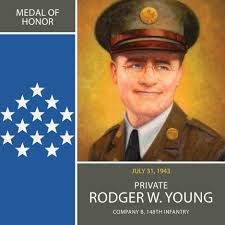
He reminds us of humble American hero Rodger Young, an Army soldier of the Ohio National Guard who fought and died in the Pacific War during the Battle of Munda Point in the Solomon Islands. 


In the Battle of Munda Point, Private Young, shot twice by machine gun fire, continued to move forward, firing his rifle and throwing hand grenades to take out an enemy pillbox and save his team. Young was posthumously awarded the Medal of Honor. 


Rather speaks with reverence about visiting cemeteries in Normandy and Honolulu. Rather's/Kirschner’s prose is crisp and unsentimental, but there are still glimmers of poetic insight.


Here is another found haiku in “What Unites Us”:


We live in debt to

those who have served and died, a

debt tallied in blood


Rather reveals truly patriotic American values –– perfect for this challenging time in the wake of a failed coup attempt, in the middle of a deadly pandemic, and as we confront an ongoing threat to our Constitution and democratic republic. Dan Rather provides a strong and hopeful commitment to truth, justice, and accountability in 2021 in this uplifting book. He helps smooth the jagged edges of the long arc of history.


National Memorial Cemetery of the Pacific, "Punchbowl Crater," Oahu, Hawaii, with Diamond Head in the background.

Panoramic view of the "National Memorial Cemetery of the Pacific" at Punchbowl Crater, Oahu, Hawaii, 2 September 1949, four years after the end of World War II. Fleet Admiral Chester W. Nimitz, USN, made a speech at the dedication ceremony.


Friday, May 15, 2020

Rediscovering Resilience – Finding USS Nevada

by Bill Doughty

According to U.S. Naval Institute and "Silver State Dreadnought," "USS Nevada (BB-36) was America's first modern battleship. When her keel was laid in 1912, kings and emperors still ruled much of the world. When she finally slipped beneath the waves in 1948, America was the undisputed global superpower."

Top of the foremast of USS Nevada (BB-36) (SEARCH)

This week the maritime team at SEARCH, a cultural resource management firm, announced discovery of USS Nevada, a warship "viewed as the epitome of American resilience and perseverance," according to a May 11 press release from SEARCH.

While the British Royal Navy had the first "dreadnought" and stayed ahead on developing mammoth battleships early in the century, the United States began catching up with the development of USS Oklahoma (BB-37) and USS Nevada during WWI. 

Crewmen exercising with one of the ship's casemate 5/51 guns, circa 1921. Taken by A.E. Wells, the Nevada's photographer. NHHC
USS Nevada's resilience and toughness are commemorated in a number of books.

John Keegan, in "The First World War" (Borzoi Book, Alfred A. Knopf, 1998), focuses primarily on British dreadnoughts, but writes, "Oklahoma and Nevada achieved a remarkable compromise between speed, hitting-power and protection."

USS Nevada (BB-36), photographed in 1944. (Naval History and Heritage Command)
According to Philippe Caresse, in his beautiful coffee table book "The Battleships of the Iowa Class: A Design and Operational History,"* USS Nevada and its new 14-inch caliber guns –– along with fifteen other dreadnoughts –– propelled the U.S. Navy to become a leading force on the seas. "The United States emerged from World War I as one of the great naval powers, second only to the Royal Navy."

From an overview of "Silver State Dreadnought: The Remarkable Story of Battleship Nevada" by Stephen M. Younger (U.S. Naval Institute Press, 2018): "Nevada was revolutionary for her time: the first 'superdreadnought,' the first U.S. warship to be oil-fired, the first to have a triple-gun main turret, the first to have all-or-nothing armor. In World War I, she was based in Queenstown, Ireland, to provide protection for American convoys bringing troops to Europe. She survived the naval reduction treaties of the 1920s and was rebuilt in 1928 with the latest technology."

By December 7, 1941, the once cutting-edge Nevada was the oldest active battleship in Pearl Harbor on the day the Imperial Japan attacked Oahu. [USS Utah (BB-31/ AG-16) was designated as a target training ship.]

Nevada had a prominent role in the attack. It was the one battleship that attempted to sortie, made it into the channel, and nearly got out of Pearl Harbor before having to beach at Hospital Point, near the harbor entrance.

The attack started as a shock early on a Sunday morning during colors.

"The first 'Kate' torpedo plane raced in so low over Nevada that it shredded the half-hoised ensign with cannon fire," Rear Adm. Edwin T. Layton writes in "And I was There" (Konecky & Konecky, 1985).

Ens. Joseph K. Taussig, Jr., 21, had the forenoon watch that day, and he had been responsible for ensuring the right size flag was flying. Now, with Lt. Cmdr. Francis J. Thomas the senior officer present, Taussig was the acting air defense officer. 

In "Dec. 7 1941: The Day the Japanese Attacked Pearl Harbor" (Wings Books, 1991) Gordon Prange (with Donald M. Goldstein and Katherine V. Dillon) describes early action:
Nevada heads down channel past Navy Yard's 1010 Dock, under air attack.
"The Nevada was preparing to get underway when a torpedo struck her port bow, at about frame 40 ... Taussig was at his battle station when a missile went through his thigh and hit the ballistics computer in front of him. In the shock, Taussig felt no pain. He observed in a detached way that his left foot had lodged under his left armpit. Despite all efforts to remove him to a battle dressing station, 'he refused to leave ... and insisted on continuing his control of the AA battery and the continuation of fire on enemy aircraft.' This promising young officer survived, but he spent the rest of World War II in the hospital recovering from his wounds received at Pearl Harbor."
Prange writes, "Very few ships could retaliate as promptly and effectively as the Nevada."

In "At Dawn We Slept" (Penguin Books, 1981) Prange writes, "Tales of heroism far beyond the call of duty abounded on Nevada, as on every ship in Pearl Harbor." Prange notes, "Nevada had been under partial steam when the first wave struck, and at 0850 the battleship got underway."


He describes the destruction along Battleship Row and out in the harbor:
"By now Pearl Harbor was a hellpit of smoke –– gray, brown, white, lemon yellow, black, and again black –– acrid, foul, mushrooming billows erupting skyward, folding in and opening out like a mass of storm clouds. Out of this pall came a sight so incredible that its viewers could not have been more dumbfounded had it been the legendary Flying Dutchman –– Nevada, heading into the channel, a hole the size of a house in her bow, her torn flag rippling defiance."
The action drew the attackers like murder hornets toward the battleship, away from the tanker USS Neosho (AO-23), which was escaping to Merry Point.

In his "Dec. 7, 1941," part of a Pearl Harbor trilogy, Prange recounts how the slow-moving Nevada attracted attackers as it "doggedly plunged toward escape. The opportunity not only to bag a battleship but to cork the channel made the Nevada the target of a lifetime."

USS Nevada (BB-36) beached and burning after being hit forward by Japanese bombs and torpedoes. The ship's pilothouse area is discolored by fires in that vicinity. The harbor tug Hoga (YT-146) is alongside Nevada's port bow, helping to fight fires on the battleship's forecastle. Note channel marker bouy against Nevada's starboard side. Official U.S. Navy Photograph, now in the collections of the U.S. National Archives.
The Sailors aboard Nevada, with help from two tugboats, helped beach the battleship, keeping the critical harbor open. Author Ian Toll describes how the ship's bow was "thrust into a grove of algaroba trees."

In the first chapter of his "Pacific Crucible: War at Sea in the Pacific, 1941-1942" (W.W. Norton & Company, 2012), Ian W. Toll describes the horrific aftermath and a growing resilience:
"Sailors returned to the stricken battleships with galvanized steel buckets, and began the grisly task of collecting the remains of their slain shipmates. 'I recall finding severed knee joints as well as shoulder fragments and torn, burning body torsos, all unidentifiable because of their burned.condition,' remembered Seaman Charles Sehe of the Nevada.
Though the shock of the raid was still fresh in everyone's minds, the survivors made a concerted effort to raise their collective morale. Music helped: on the waterfront at Ford Island, a jukebox blared 'I Don't Want to Set the World on Fire,' and on the battleship Maryland, the ship's band performed on deck while the repair teams worked. The crew of the Nevada agreed on a new nickname: the 'Cheer-Up Ship.' Signs on her deck proclaimed: 'We'll Fight Again' and 'Cheer Up the Cheer-Up Ship.' The crisis tended to bring out the best in the malingerers, the lazy men, even the prisoners in the brig, who were ordered out of their cells and put to work. Everyone pitched in. 'Things were so bad at Pearl Harbor,' Seaman Mason recalled, 'that even the chiefs were working.'"
Hole in the ship's port side from a Imperial Japan Type 91 aerial torpedo.
As a matter of fact, Navy chiefs were among the true heroes of USS Nevada as the Sailors "fought their ship" during the attack.

This is from the extensive U.S. Pacific Fleet Battle Force action report filed Dec. 15, 1941: "Chief Boatswain E. J. Hill, U.S. Navy, killed in action, is deserving of the highest commendation possible to be given for his skill, leadership and courage. At the height of the attack he led his line handling details to the quays, cast off the lines under fire, and then swam back to the ship. Later, while on the forecastle attempting to let go the anchors, he was blown overboard and killed by the explosion of several bombs. His performance of duty and devotion to duty was outstanding."

Chief Hill was awarded the Medal of Honor posthumously.

The battle force action report described some of the damage: "... It is apparent that the Nevada suffered at least six (6) bomb hits and one torpedo hit. It is possible that as many as ten bomb hits may have been received by the Nevada, as certain damaged areas are of sufficient size to indicate that they were struck by more than one bomb. However, direct evidence is not available to determine the exact number."

Entering Drydock # Two, at Pearl Harbor Navy Yard, 18 February 1942. Sunk as a result of damage received in the 7 December 1941 Japanese air raid, she was refloated on 12 February 1942. Note oil staining along her hull, marking her waterline while she was sunk. (NHHC
After Sailors, salvage teams and shipyard workers performed miracles, BB-36 was temporarily repaired. The battleship made it to the West Coast in April 1942 to receive "permanent repairs and improvements, including a greatly enhanced anti-aircraft gun battery," according to the Naval History and Heritage Command.

After assisting in the Attu landings in May 1943, Nevada steamed to the Atlantic to provide firepower for the Normandy Invasion in June 1944 and Europe operation in the summer and fall. "The battleship then returned to the Pacific, where she assisted with the invasions of Iwo Jima and Okinawa in 1945. Though damaged by a suicide plane on 27 March and by an artillery shell on 5 April, Nevada remained in action off Okinawa until June 1945," according to NHHC.

Forward 14/45 guns of USS Nevada (BB-36) fire on positions ashore, during the landings on Utah Beach, 6 June 1944. (National Archives)
With the end of the war came the end of Nevada's active service as a combat warship, and the resilient unsinkable "Cheer-Up ship" headed back to Hawaii. "She was too old for retention in the post-war fleet, and was assigned to serve as a target during the July 1946 atomic bomb tests at Bikini, in the Marshall Islands," NHHC reports. "That experience left her damaged and radioactive, and she was formally decommissioned in August 1946."

In "Silver State Dreadnought," Stephen Younger writes, “On a sunny day in 1948, Nevada was towed off the coast of Oahu and used for target practice. After five days of pounding by everything the Navy could throw her, Nevada was dispatched by a torpedo.”

Director of the Naval History and Heritage Command Rear Adm. (ret.) Samuel Cox, quoted in the SEARCH press release, said, "USS Nevada serves a reminder that our sailors have a long, terrific tradition; her fighting spirit proved the U.S. Navy remains tough in difficult times. When the circumstances appear to be at their worst, our Navy remains at their best.” Cox gave a keynote address at the commemoration ceremony at the USS Nevada memorial at Pearl Harbor, Dec. 8, 2016.

Allen Bodenlos, then 90, a Pearl Harbor survivor who served on the battleship USS Nevada, salutes during the National Anthem, Dec. 8, 2010. Pearl Harbor survivors gathered with sailors, families and friends at the Nevada Memorial at Hospital Point, Joint Base Pearl Harbor-Hickam. (Photo by MC2 Mark Logico)
According to SEARCH, USS Nevada was located 65 nautical miles southwest of Pearl Harbor at a depth of over 15,400 feet. "The mission was jointly coordinated between SEARCH’s operations center and one of Ocean Infinity’s vessels, Pacific Constructor. Pacific Constructor set sail for a range of commercial tasks in the Pacific in early 2020, ahead of the COVID-19 pandemic. As a result of the global health crisis, the ship has remained at sea on a range of taskings."

British author Ed Nash posted this tribute video of the discovery and brief history of USS Nevada on YouTube:


“The physical reality of the ship, resting in the darkness of the great museum of the sea, reminds us not only of past events but of those who took up the challenge of defending the United States in two global wars,” James Delgado, SEARCH’s senior vice president and the lead maritime archeologist on the mission, said. “This is why we do ocean exploration, to seek out these powerful connections to the past.”


* Caresse's loving tribute to Iowa Class Battleships honors "these marvels of naval technology from another age" with fascinating facts and hundreds of photos. The careers of USS New Jersey (BB-62), USS Iowa (BB-61), USS Missouri (BB-63) and USS Wisconsin (BB-64) –– younger cousins of Nevada –– are standout chapters in this book that explores armament, power and propulsion, technical characteristics, battle honors, and other topics. USS Nevada, once the height of modern maritime innovation, was replaced by newer battleships that became obsolete as naval aviation, other surface ships and submarines played a more prominent role.

Sunday, October 22, 2017

John Finn / Seton's Halloween Story

Review by Bill Doughty
World War II's first Medal of Honor recipient (former Navy Chief and Lieutenant) John Finn came to Pearl Harbor Dec. 6, 2009 to ride in a whiteboat named for him. He was 100.

Ernest Thompson Seton
I had the special privilege of interviewing John Finn that day during his boat ride. He told me his favorite author, beginning early in his life, was Ernest Thompson Seton, the naturalist, artist, writer, adventurer and Native American Indian advocate.
Finn said Seton was a great writer who captured his imagination and influenced his love of the West.

Seton had a significant role in the birth of Scouting in the United States. He is the reason there are such strong ties with Scouting and Native American culture.
Recently I read Seton's "The Arctic Prairies: A Canoe-Journey of 2,000 Miles in Search of the Caribou; Being the Account of a Voyage to the Region North of Aylmer," first published in 1911 – when John Finn was nearly two years old – and reprinted in 1917 in the version I held. The subject of the book, the journey itself, started in 1907.
Seton recounts stories, does science experiments, makes sketches of wildlife and narrates the journey to "unbroken forest and prairie leagues." This richly rewarding book follows the six-month journey Seton made with Edward A. Preble.
Preble was a naturalist whose bloodline included a distant great-great-great grandfather, the brother of Commodore Edward Preble, who defeated the Barbary Pirates in the Mediterranean on orders of President Thomas Jefferson.
It was naturalist Preble who became the center of a campfire Halloween story just as the journey was coming to a close, after various adventures with lynxes, buffaloes, musk-ox, caribou, wolves, bears, coyotes, Arctic foxes and a myriad of birds. Many of the creatures in the cold North were hungry, some dying of starvation in the early winter.
One particular animal became the focus of October 28, leading up to the end of the Seton-Preble journey on Halloween 1907.
"On that same night we had a curious adventure with a weasel. All were sitting around the camp-fire at bed-time, when I heard a distinct patter on the leaves. 'Something coming,' I whispered. All held still, then out of the gloom came bounding a snow-white weasel. Preble was lying on his back with his hands clasped behind his head and the weasel fearlessly jumped on my colleague's broad chest, and stood peering about. In a flash Preble's right elbow was down and held the weasel prisoner, his left hand coming to assist. Now, it is pretty well known that if you and a weasel grab each other at the same time he has choice of holds. 'I have got him,' said Preble, then added feelingly, 'but he got me first. Suffering Moses! The little cuss is grinding his teeth in deeper.' The muffled screaming of the small demon died away as Preble's strong left hand crushed out its life, but as long as there was a spark of it remaining, those desperate jaws were grinding deeper into his thumb. It seemed a remarkably long affair to us, and from time to time, as Preble let off some fierce ejaculation, one of us would ask, 'Hello! Are you two still at it,' or 'How are you and your friend these times, Preble?' In a few minutes it was over, but that creature in his fury seemed to have inspired himself with lock-jaw, for his teeth were so driven in and double-locked, that I had to pry the jaws apart before the hand was free. The weasel may now be seen in the American Museum, and Preble in the Agricultural Department at Washington, the latter none the worse. So wore away the month, the last night came, a night of fireside joy at home (for was it not Hallowe'en?), and our celebration took the form of washing, shaving, mending clothes, in preparation for our landing in the morning."
Seton admitted to a wanderlust desire to go to unexplored regions. He traveled the Nyarling River and camped at the Great Slave Lake, White Fish River, Salt River, Athabska River and Little Buffalo River. He met with Native Americans he called Cree, Chipewyan, Grand Lake Algonquin and Blackfoot Indians.
He describes – and sketches drawings of – dozens of fauna and flora, presented in scientific sketches. Black-and-white photos show the beautiful desolation of the open country.
In the final chapter, "The End," Seton writes:
"All that night of Hallowe'en, a partridge drummed near my untented couch on the balsam boughs. What a glorious sound of woods and life triumphant it seemed; and why did he drum at night? Simply because he had more joy than the short fall day gave him time to express. He seemed to be beating our march of victory, for were we not in triumph coming home? The gray firstlight came through the trees and showed us lying each in his blanket, covered with leaves, like babes in the woods. The gray jays came wailing through the gloom, a faroff cock-of-the-pines was trumpeting in the lovely, unplagued autumn woods; it seemed as though all the very best things in the land were assembled and the bad things all left out, so that our final memories should have no evil shade. The scene comes brightly back again, the sheltering fir-clad shore, the staunch canoe skimming the river's tranquil reach, the water smiling round her bow, as we push from this, the last of full five hundred camps. The dawn fog lifts, the river sparkles in the sun, we round the last of a thousand headlands. The little frontier town of the Landing swings into view once more – what a metropolis it seems to us now!"
We can picture a young John Finn reading this book rapturously and enjoying the photos and drawings by the author.

USS John Finn (DDG 113) in Pearl Harbor. (Photo by Ens. Britney Duesler.
Last summer, in Pearl Harbor the Navy commissioned a new guided-missile destroyer: USS John Finn (DDG 113). The ship is homeported in San Diego.

Meanwhile, the John Finn whiteboat, one of several in Pearl Harbor with Sailors at the helm, is used nearly every day to take about 150 visitors per trip to the USS Arizona Memorial – more than a million-and-a-half people per year from throughout the world. 

Among the groups who visit Pearl Harbor each year are Boy Scouts and Girl Scouts. Interestingly, Ernest Thompson Seton is considered to one of the "fathers" of Scouting. 
Politics, patriotism and even spirituality/religion are intertwined in a fascinating essay by David C. Scott and presented by Johnny Walker about Seton's role in the early days of Scouting.
Ernest Thompson Seton founded The Woodcraft Movement in 1901 and wrote the first Boy Scouts of America handbooks. The original 1910 BSA manual is subtitled "A Handbook of Woodcraft, Scouting, and Life-craft" (Seton and Baden-Powell, 1910). Seton also wrote "The Woodcraft Manual for Girls" in 1916. 
For perspective on Seton, consider that he was born in England in April 14, 1860, nearly one year to the day before the start of America's Civil War. He moved to Canada, where he lived and studied, before eventually moving to the United States and becoming a U.S. citizen, settling near Santa Fe, New Mexico – in the heart of his (and Finn's) beloved West.

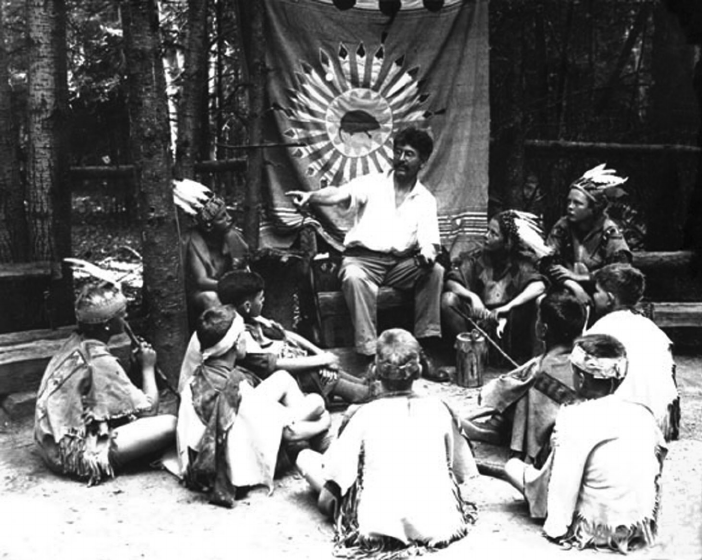
Seton teaches young people about Indian culture as part of his Woodcraft Movement, 1903.
A complicated individual, Seton became enmeshed in an early 20th century controversy that ended up putting him somewhat at odds with his President Theodore Roosevelt over anthropomorphic portrayals of animals in nature. TR reportedly advised Seton to back up his views with facts, leading to volumes of academic and scientific investigations about animals.

Though apparently hobbled by his own ego and patriarchal thinking toward other races, he was an early champion of equal rights for women, and he had deep respect for Native American Indian culture.

Seton also reached across the Atlantic to his native England and sought to strengthen ties in World War I, reinforcing the ideal of service. 

In his "The Gospel of the Redman: An Indian Bible" Seton writes: "The culture of the Redman is fundamentally spiritual; his measure of success is, 'How much service have I rendered to my people?' His mode of life, his thought, his every act are given spiritual significance, approached and colored with complete realization of the spirit world."

Seton died 71 years ago on Oct. 23, 1946, one year after the end of the war John Finn helped win. Today the Navy remembers the service of John Finn, who, though wounded and vulnerable, fought back, firing his mounted machine gun at attacking enemy planes on December 7, 1941 at Naval Station Kaneohe Bay, now Marine Corps Base Hawaii. We can imagine Finn's spirit aboard USS John Finn, at MCBH and in Pearl Harbor.


Extended family members and friends of the late John Finn visit his namesake whiteboat in Pearl Harbor July 17, 2017. (Photo by Ens. Britney Duesler)