Showing posts with label Arleigh Burke. Show all posts

Sunday, September 11, 2022

September Remember: USS Midway in Japan

by Bill Doughty––

I was attending school in Tokyo and living in Yokosuka in 1973 when USS Midway (CV-41) arrived in Yokosuka –– the first U.S. aircraft carrier to be stationed in Japan as part of the Forward-Deployed Naval Forces. It was a big deal, less than thirty years after World War II, and just months after the U.S. military departed Vietnam.


Midway was commissioned 77 years ago, Sept. 10, 1945, just eight days after Imperial Japan surrendered. Stationing the ship in Japan was hugely symbolic; Midway is named for the historic and pivotal battle in 1943 that turned the tide in WWII.


USS Midway (CV-41) arrives in Yokosuka, Oct. 7, 1973. Photo from Midway cruise book. (Ryo Isobe, DVIDS)
But that’s only one reason the carrier’s arrival in Yokosuka was opposed by many Nihonjin, sometimes violently.

Hundreds of Japanese citizens, loudly opposed to America’s war in Vietnam, came to Yokosuka in 1973 to protest the arrival of Midway.

I remember scores of demonstrators in headbands and helmets, faces covered, white-knuckled fists gripping bamboo poles. The demonstrators assembled by the Yokosuka JNR station and marched to the closed gates of the base. Japanese police in riot gear formed a human shield. Marine guards stood ready behind them. Some radical demonstrators attacked the police and were repelled with fire hoses.


Midway had been a recent (and repeated) participant in what was then called the Vietnam Conflict, a war for which the ship received the Presidential Unit Citation from President Nixon in early 1973.


Two years later, Midway would join with other ships of the U.S. 7th Fleet in Operation Frequent Wind, the evacuation of Saigon.


Three years after Midway’s arrival in Yokosuka, the United States celebrated its bicentennial, 1776-1976. By then, I was just out of college and contributing stories to the Seahawk base newspaper on my way to becoming editor and eventually a public affairs officer.

Early in its career, Midway participated in historic operations in the Caribbean, near the Arctic, throughout the Mediterranean, and in both the Atlantic and Pacific, including near North Korea.

Midway would go on to participate in various peacekeeping operations, including Operation Desert Shield and Desert Storm, after Iraq failed to obey a United Nations ultimatum to withdraw from its invasion of Kuwait.


Just as it did in the evacuation of refugees after the fall of Saigon, Midway played a key role with other ships in rescuing evacuees from the Philippines in Operation Fiery Vigil after the eruption of Mt. Pinatubo. That was in June of 1991.


I was still living in Yokosuka and working for the Navy when USS Midway departed Yokosuka for the final time in August 1991. The workhorse aircraft carrier was headed to retirement 31 years ago this month –– via Pearl Harbor, Seattle, and Bremerton –– eventually to San Diego.


USS Midway arrives in Pearl Harbor, August 23, 1991.
By 1991, more Japanese people came to realize the value of having a strong U.S. Navy presence, working cooperatively with the Japan Maritime Self-Defense Force to maintain freedom of the seas. 

Just as the United States Constitution was a model for Japan’s form of government, the United States Navy served as a model for the JMSDF –– with direct help and guidance from Adm. Arleigh A. Burke.


Over many years, Yokosuka has held hugely popular base open-house events, inviting tens of thousands of Japanese citizens onto the base to participate in games, enjoy food booths, attend concerts, and go aboard U.S. Navy ships.


The most popular draw at base open-house events? Tours of an aircraft carrier.


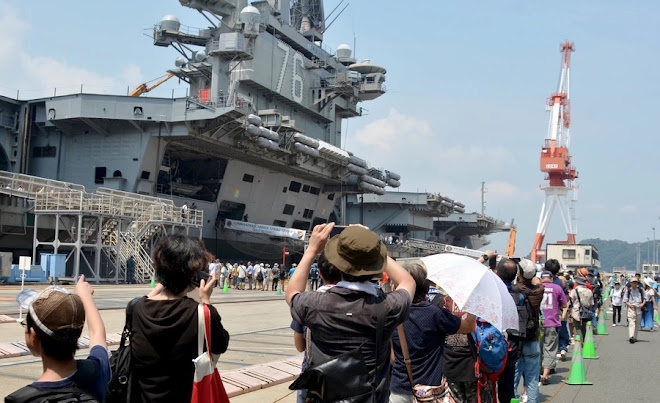
After Midway’s departure, other carriers followed its lead to become forward-deployed in Japan: USS Independence (CV-62), USS Kitty Hawk (CV-63), USS George Washington (CVN-73), and USS Ronald Reagan (CVN-76).


Japanese guests line up to board USS Ronald Reagan (CVN-76), October 10, 2015, during Yokosuka's Friendship Day open-base event. (MC1 Peter Burghart)

Open-base events were suspended for a time in the aftermath of attacks on the United States by religious zealots –– Islamist terrorists –– on September 11, 2001. (I remember the gates being locked down for weeks. Everyone who lived off base were required to park a few miles away and were offered rides to work or schools on base in carefully screened shuttle buses.)


In September 2003, USS Midway departed its temporary home of Bremerton, WA, to become a museum and memorial in San Diego. It welcomes an average of more than one million visitors per year. As with the USS Arizona Memorial in Pearl Harbor, many of the visitors to the USS Midway Museum include people from Japan who come to pay respect and learn about history.


Operation Sandy (Midway Museum Archives)
The museum offers a robust website highlighting the ship’s proud legacy, including operations in the Arctic, Taiwan Strait, and Vietnam, among others. I found some fascinating Midway photos available for download from Flikr, courtesy of the Museum. Some of the photos on the museum’s site include ringside views of Operation Sandy, the world’s first test-firing of a ballistic missile from a ship at sea.

There are numerous resources on the museum’s website, including videos and first-person accounts. This line stands out: “When history speaks, turn up the volume.”


In reading the history of the USS Midway, we can see the evolution of the modern Navy, from the immediate postwar, through the entire Cold War, and operations in Vietnam. But the ship is remembered most fondly, perhaps, for its role in helping people and promoting peaceful protection, especially for eighteen years in Yokosuka, Japan.


USS Midway’s strategic role in the Cold War, is a key part of James D. Hornfischer’s fascinating “Who Can Hold the Sea: The U.S. Navy in the Cold War, 1945-1960” (Bantam Books, 2022).


I have a two-part review of Hornfischer's final work posted in recent weeks. Hornfischer has been a favorite over the years. In May 2012, he offered a guest mini-review of five books he recommended to Navy Reads.


Tuesday, September 6, 2022

Part II: Hornfischer’s One Ocean…

Review by Bill Doughty––

James D. Hornfischer’s final book, “Who Can Hold the Sea,” opens with a poignant message from Jim’s widow, Sharon Hornfischer.


Sharon includes this advice:

“Jim believed, as I also do, that others of this generation and future generations will carry on telling the stories of our great nation’s history. Share your stories with your children and grandchildren, nieces and nephews, so that they are engaged in our nation’s history and our country’s continued fight for freedom and democracy. Encourage our next generation, take them to air shows, museums, and libraries; ignite the spark of curiosity in our future historians and writers so that they can continue to tell stories for us all to read.”

Hornfischer
It’s both sad and inspiring to read Jim Hornfischer’s final work. As both a gifted writer and historian, he created vivid true stories of Sailors and Marines and their leaders. This book’s preface, introduction, and acknowledgements bookend the story of the Cold War with tender personal messages.

Hornfischer’s “Who Can Hold the Sea” (Bantam Books, 2022) opens in the gray aftermath of World War II.


After confronting and defeating fascism, the United States and most of the Allies moved toward greater democracy, peacekeeping, rule of law, and liberty for all. The Soviet Union, on the other hand, held on to autocracy, aggression, violations of laws, and control of its citizens’ freedoms.


“For Truman,” Hornfischer observes, “the Soviet Union was a treacherous and malignant betrayer.”


Americans adjusted to postwar realities –– not only fear of spreading communism and Soviet expansion, but also budgetary turmoil that reached into the military. Some politicians proposed doing away with the Marine Corps and Navy and merging the service branches.


None other than Adm. William “Bull” Halsey spoke out against the merger in a speech thankfully excerpted by Hornfischer.


Halsey said, in part:

“Merger is not necessary. It is not desirable. It is plainly dangerous. It would destroy the initiative of individual services. It would hamstring their right to advance. It would deprive them of representation before Congress and the people. It would substitute military for civilian control. It might lead to military dictatorship.”

Admirals Chester Nimitz, Ernest J. King, Marc Mitscher, and Edward L. Cochrane –– along with Secretary of the Navy (and first Secretary of Defense) James V. Forrestal –– persuaded President Truman and others that the Navy had a strategic role in the Atomic Age; merger of the services, along with loss of the Marine Corps, would be a bad idea.


President Truman is welcomed aboard USS Franklin D. Roosevelt (CV-42) by SECNAV Forrestal and Adm. Nimitz. Adm. Leahy pictured in background. (NHHC)
Truman visited Norfolk, Virginia, in April 1946 at the invitation of Commander in Chief, U.S. Atlantic Fleet Adm. Mitscher. Truman witnessed the power of naval aviation and capabilities of aircraft carriers USS Franklin D. Roosevelt (CV-42) and the seemingly ubiquitous USS Midway (CV-41). Mitscher’s chief of staff was Capt. Arleigh Burke.

Then-SECNAV Forrestal was one of the principal architects of the post-war modern Navy. His global vision was based on peace through freedom and democracy, not communism or autocracy. Hornfischer writes, “If that world was to become a community, it would be possible, Forrestal thought, only with U.S. leadership, the victorious democracy investing its credibility and standing in the world to promote self-determination and freedom wherever it showed aspiration.” Hornfischer explores the role Forrestal played and delves into Forrestal’s controversial death at Bethesda Naval Hospital.


“Who Can Hold the Sea” vividly covers how Burke, Nimitz and Forrestal shaped the Navy during the Cold War. And strategic thinker and diplomat George Frost Kennan influenced the influencers, as Mahan had done for the first half of the century. Kennan recognized early the “perverse brutality and terror” of Joseph Stalin and Communism’s threat to Capitalism and democracy.


Watercolor of scorched USS Nevada (BB-36) as Nagato and Sakawa sink.. (Arthur Beaumont, 1946)
As a result of those fears, including the real fear that the Soviets were developing nuclear weapons, the United States rushed to conduct atomic bomb tests in the Pacific just a year after the war. In Operation Crossroads, the Navy positioned hundreds of pigs and goats, as well as 4,000 rats, aboard a target ship to test the results of radiation from a nuclear “cauliflower head.” The results were staggering and crippling.

The flagship of Adm. William H. “Spike” Blandy, who headed up Operation Crossroads, was contaminated with radiation, so “hot” it needed to “cool down” before it could be boarded.


After "Able" and "Baker," Blandy had to cancel a third "Charley" stage of the test, Hornfischer notes. “The radioactive mess had become impossible to manage.”


Later, he would celebrate the operation with a bizarre cake-cutting ceremony.


Vice Adm. Blandy and his wife cut into an Operation Crossroads cake shaped to look like a radioactive geyser, as Rear Adm. Frank J. Lowry looks on, Nov. 7, 1946.

The Navy forged forward in developing deployable nuclear weapons, supported by John L. Sullivan, Secretary of the Navy.

“The atomic bomb would shape the entire forty-four-year span of the Cold War. Made even smaller and more easily deployable, with larger and larger payloads, it would place every crook and crevice of the world under threat of ruin. War planners schemed to win atomic exchanges, even as they and every policy maker had no sense of consequences, and prudence demanded keeping the weapon in Pandora’s box. Humility, terror, curiosity, eager innovation, and abject paranoia would be the diverse by-products of the bomb.”

Louis A. Johnson
Sullivan would fight for the Navy but would resign in the face of cutbacks, cancellation of construction of the CVA-58 class aircraft carrier USS United States, and favoritism for the Air Force by SECDEF Louis A. Johnson. “The new defense secretary was an equal opportunity irritant, abrasive and arrogant and making no effort to filter it,” Hornfischer writes. “Johnson’s animus toward the Navy was an open secret.”

Despite obstacles, the Navy forged ahead in developing deployable nuclear weapons and nuclear-powered ships, including submarines. 


Hornfischer reveals how close the world came to nuclear war in the decade-and-a-half after bombs were dropped on Hiroshima and Nagasaki.


Leaders contemplated using nuclear weapons after Communist China threatened Formosa (Taiwan), after Communist North Korea invaded the South, and after Communists took power in French Indochina (Vietnam). Eisenhower was a voice of reason in nixing the idea of using the Bomb. Though not covered in this book, the Bay of Pigs incident comes to mind, when President John F. Kennedy, Navy veteran and WWII hero, proved to be the voice of reason in preventing nuclear war after the Soviet Union threatened to position nuclear weapons in Cuba.


Admittedly incomplete and somewhat unfinished, Hornfischer’s history of the Cold War is a compelling book thanks to the author’s distinctive style and grace. His writing shines in descriptions of not only events but also people, such as the great Arleigh Burke, “the son of a humble Colorado farmer,” a leader who embraced an ethos of good leadership.

“[Burke] had taken integrity, self-discipline, and strong principles from his father and mother, a teacher. In 1923, the year he graduated from the U.S. Naval Academy, the faculty had just compiled the first textbook on naval leadership. It listed the ‘essential qualities’ of a naval officer as personal dignity, honor, courage, truthfulness, faith, justice, earnestness, assiduity, judgment, perseverance, tact, self-control, simplicity, and loyalty –– to country and to service, to both one’s seniors and juniors. ‘Loyalty up and down was important because of the natural independence and self-reliance of the American sailor,’ and naval officers had to earn the respect of their men [and women] through their personal merit and example. Burke had been trained as a specialist in ordnance, earning a master’s degree in chemical engineering and becoming a design and production specialist in explosives. This background exposed Burke to the most advanced naval technologies of his time and would prepare him as CNO to promote the development of nuclear weapons, nuclear power, and guided and ballistic missiles.”

Burke helped guide the Navy through rough seas during the Cold War.


CNO Arleigh Burke on the bridge of USS Forrestal (CVA-59) March 12, 1956 as ship's CO Capt. Roy L. Johnson points out distant aircraft. (NHHC)

It’s bittersweet to read this excellent book about the Cold War knowing that Hornfischer is gone. He died last summer after a valiant fight with cancer. As mentioned, his wife Sharon offers a beautiful tribute to him and his legacy in the book’s preface.

Both Jim and Sharon offer acknowledgements at the end of this book. They thank retired Navy Admiral “Fox” Fallon, former commander of both U.S. Pacific Command and Fleet Forces Command and current board chairman of the Naval Historical Foundation. They also acknowledge and thank other graybeards, including retired Rear Admiral Samuel Cox, director of Naval History and Heritage Command and Curator of the Navy. The Hornfischers pay special tribute to the Nimitz Museum in Fredericksburg, Texas, hometown of the great admiral who led the winning strategy in the Pacific War.


This terrific book brought other books to mind that would make good companion reading: “Atlantic” and “Pacific” by Simon Winchester; "The Second Most Powerful Man in the World: The Life of Admiral William D. Leahy, Roosevelt's Chief of Staff" by Phillips Payson O'Brien; “Revolt of the Admirals: The Fight for Naval Aviation, 1945-1950” by Jeffrey G. Barlow; "The Silent War: The Cold War Battle Beneath the Sea” by John Piña Craven; “This Kind of War: The Classic Korean War History” by T. R. Fehrenbach; “Gangsters of Capitalism: Smedley Butler, the Marines, and the Making and Breaking of America’s Empire” by Jonathan M. Katz; “Opening the Great Depths: The Bathyscaph Trieste and Pioneers of Undersea Exploration” by Norman Polmar and Lee J. Mathers; and “The Blue Age: How the US Navy created Global Prosperity –– and Why We’re in Danger of Losing It” by Gregg Easterbrook. It goes without saying that every book by Hornfischer should be on the reading list for anyone interested in American maritime history.


The Hornfischers valued libraries, museums, research institutes, and, of course, books. As Jim writes, “Those interested in national and maritime affairs ought to be mindful of the major events of the past.”


Top Photo: Operation Crossroads "Baker Day" A-bomb underwater explosion, seen from shore of Bikini Atoll, 25 July 1946. NHHC


(In Part I of this review, we presented Hornfischer's view of "one global ocean." We also compared Gorbachev and Putin, discussed the rise of NATO, and presented some coincidental milestones that happened in August and September decades ago.)

Saturday, July 10, 2021

‘Opening the Great Depths’ for What?

Review by Bill Doughty

At the end of John Piña Craven’s masterful memoir, “The Silent War,” Craven praises the team of military and civilian warriors who supported the silent service and helped win the Cold War: “They taught us that eternal vigilance is not enough. They taught us that society must organize for the deterrence of nuclear war and the preservation of world peace. These are still missions of the people of the world’s free democracies, and we must again organize a band of individuals whose lives are dedicated to these missions.”


I reached for Craven’s book, subtitled “The Cold War Battle Beneath the Sea,” after reading a new comprehensive history of deep-sea exploration: “Opening the Great Depths: The Bathyscaph Trieste and Pioneers of Undersea Exploration” by Norman Polmar and Lee J. Mathers (Naval Institute Press, 2021).


Polmar and Mathers credit Craven’s innovative role in leading key Cold War tactics including creating systems to “rescue trapped crewmen in sunken submarines down to crush depth, allow divers to work at 600 feet, and locate and recover small objects down to 20,000 feet.” The Navy deployed Craven’s brainstorming ideas in classified intelligence missions, according to the authors. In 1964 “Craven had succinctly defined a program that the Navy would pursue until the end of the Cold War and beyond.”

The first practicable idea for a vessel capable of reaching the bottom of the ocean came from an eccentric European scientist who served as a balloonist in the Swiss Army in the First World War. Auguste Piccard was at the center of the “excitement and turmoil that physics was experiencing” one hundred years ago. Piccard “rubbed elbows with” Albert Einstein, Max Born, and Marie Curie, among other revolutionary scientists and explorers.


“Opening the Great Depths” opens with a get-together in New York hosted by Amelia Earhart, where Piccard meets fellow adventurer Charles Lindbergh. Piccard envisioned a metal “balloon” that could sink to the bottom of the ocean and then –– with a system of lead pellets and petroleum as ballast –– be able to float back to the surface.


Auguste Piccard’s development of the first bathyscaphe, spelled “bathyscaph” by Polmar and Mathers (who also present measurements the English rather than metric system), is a story of international cooperation. The first working bathyscaphe was funded by King Leopold of Belgium. Development was led by scientists in Switzerland and supported by the French Navy. It was built in Italy and tested in Portuguese territorial waters and near the Horn of Africa.


Lieutenant Larry Shumaker, Assistant Officer in Charge; Lieutenant Donald Walsh, Officer in Charge; Dr. Andreas B. Rechnitzer, Scientist in Charge; Jacques Piccard, Co-Designer and Technical Advisor of Bathyscaphe Trieste, Nov. 16, 1959.

Jacques Piccard, Auguste’s son, took over for his father and accelerated development of Trieste, named for the town in Italy where it was built. The younger Piccard, who stood 6’5” according to John Craven, reached out to coordinate directly with the United States Navy in further development of the new technology. The Navy acquired Trieste in the mid 1950s through the new Office of Naval Research.


ONR was created after the end of World War II and the beginning of the Cold War. With a bathyscaphe, the “Navy would gain the capability to operate in the deepest ocean depths.” Exploration of the ocean’s depths would be spurred by the Soviet Union’s advances in space, leading to the launch of Sputnik in 1957.


In late 1958, a young submarine officer who saw himself stuck behind a desk in an administrative billet at Submarine Flotilla 1, volunteered to oversea, operate, and maintain Trieste. Lt. Don Walsh conducted the first dives near San Diego. Trieste was “re-welded to Navy standards” and readied for deep dives off Guam. Other key members of the early dives were Dr. Andy Rechnitzer, Navy Lt. Lawrence Shumaker, Giuseppe Buono, and Jacques Piccard.


Polmar and Mathers provide a brief history of discovery of the deepest trenches in the ocean. Their book is comprehensive and detailed, often reading like a logbook filled with names of personnel, places, support ships, and missions. The authors describe “white” and “black” operations, focused on finding either U.S. or Soviet debris or equipment on the ocean bottom.


Walsh and Piccard aboard Trieste
The Navy first deployed the Trieste, in part, to search for life at the deepest part of the ocean for a specific purpose: “Was there a depth below which complex life could not survive? The answer to that question might determine whether the deep-ocean trenches would be used for the long-term disposal of radioactive and other hazardous waste material.”

In the best chapter in the book, Polmar and Mathers describe the tension as Piccard and Walsh took a long “elevator ride” through the thermocline, passing two layers of phosphorescent plankton, and heading into the hadal depths for the first time. The bathyscaphe suffered small leaks and a cracked entry tube window. The temperature inside the bathyscaphe was 45 degrees Fahrenheit. Piccard and Walsh ate chocolate bars and peered out as best as they could, unsure when the bottom would appear. After more than four and half hours they reached the “six-three hundred fathoms” –– 37,800 feet, significantly deeper than anticipated.


Their discovery of “a shrimp and a fleet of madusae proved that the ocean’s deepest depths contain complex life forms.” Piccard thought he saw a "sole" on the bottom, but that sighting was unlikely a fish.


The team received a heroes’ welcome  in Guam, Hawaii, and Washington D.C. President Eisenhower presented Piccard, Walsh, Rechnitzer and Shumaker with awards in the presence of Chief of Naval Operations Adm. Arleigh Burke. Lt. Walsh received the Legion of Merit. He would go on to have a distinguished naval career, retiring as a Navy captain. Jacques Piccard, a non-citizen, was awarded the Navy’s Distinguished Public Service Award.

“Piccard was especially proud of a White House letter dated 9 February 1960 that stated in part, ‘As a citizen of Switzerland, a country admired by all the free world for its love of freedom and independence, you have the gratitude of all the people of the United States for helping to further open the doors of this important scientific field. Sincerely, Dwight D. Eisenhower.”

As the general who led the liberation of Europe from Nazi fascism in WWII, Eisenhower was revered in the free world. America’s commitment to international cooperation –– along with a “major influx of American dollars through the U.S. government’s Marshall Plan” –– led directly and indirectly to the development of shipyards, refineries, and research that helped build the Trieste bathyscaphe.

President Eisenhower dines in the crew's mess aboard USS Seawolf (SSN-575) off Newport, Rhode Island, Sept. 26, 1957. With him are Chief Hospital Corpsman Milton W. Tucker; Press Secretary James Hagerty (partially visible); and Seaman Apprentice W.J. Dooling, the youngest man in Seawolf's crew. (NHHC)

Meantime, the Cold War and space race were heating up at the end of the 1950s and through the 1960s, where relations with the Soviet Union were about competition, not cooperation.


The Navy saw that “advancing undersea technology was vital to the security of the United States,” according to Polmar and Mathers. “Classified operations for the Trieste were suggested in the summer of 1961.” The Navy, Air Force, and CIA reportedly considered using Trieste to locate and retrieve debris from the ocean floor. 


Trieste was deployed for the search of the USS Thresher (SSN-593), a nuclear-powered submarine lost 220 miles east of Boston on Apr. 10, 1963. The Navy was concerned about the sub’s nuclear reactor “potentially contaminating waters close to the U.S. eastern seaboard,” according to the authors. “And, the Navy had to examine the wreckage in an effort to determine the cause of her loss.”


"Overhaul and Refiitting Bathyscaphe Trieste," painting, watercolor on paper, Salvatore Indiviglia, 1961. (NHHC)

Unfortunately, the Trieste itself was subject to numerous casualties and limitations over the years, including fires, leaks, corrosion, mechanical failures, insufficient battery power, and propulsion motor issues –– a “maintenance nightmare.” Mare Island Naval Shipyard architects, under the supervision of chief design engineer Herbert L. Graybeal, designed a more advanced float that was stronger and safer. The Trieste II was born. Eventually three versions of Trieste would serve, but nomenclature was (perhaps deliberately) confusing for what would be Trieste, Trieste II, Trieste III, and/or DSV-1. For simplicity, I’ll refer to all versions of the Trieste bathyscaphe throughout this review as “Trieste.”

As the Cold War heated up, on May 28, 1964, Secretary of the Navy Paul H. Nitze assigned Trieste and the Deep Submergence Program to the Special Projects Office. The “Deep Submergence Systems Project” became a separate agency under the direction of chief scientist Dr. John Piña Craven. (Craven is a descendant of a long line of Navy officers; he served as an enlisted battleship sailor in World War II, and he earned his PhD with help from the G.I. Bill. Craven's Special Projects team developed the Polaris Fleet Ballistic Missile.)


Among other duties leading DSSP, Dr. Craven headed the recovery effort for a hydrogen bomb that had fallen near Palomares after a U.S. Air Force B-25G strategic bomber collided with a refueling tanker off Spain’s Mediterranean coast on January 17, 1966.


USS Scorpion (SSN-589) outside Claywall Harbor, Naples, Italy, 10 April 1968, one of the last known photos of Scorpion before the submarine was lost with all hands in May 1968 while returning to the U.S. from this Mediterranean deployment (NHHC).

Chapter 14 of “Opening the Great Depths” begins with this chilling line: “The year 1968 was a very bad year for submarines.” The authors refer to the losses of Israel’s diesel-electric submarine Dakar and France’s Minerve, both lost in the Mediterranean; the Soviet Golf II ballistic missile submarine K-129, lost in the Pacific; and the USS nuclear-propelled submarine Scorpion (SSN-589), lost in the North Atlantic. Even the U.S. Navy’s deep submersible Alvin, operated by Woods Hole Oceanographic Institution, was lost off the coast of Massachusetts in October, 1968. Response to any recovery operations was complicated by events on the world’s stage involving the Navy: the War in Vietnam and North Korea’s seizure of the U.S. intelligence ship USS Pueblo (AGER-2).


Polmar and Mathers present the history of Trieste’s role in the late 60s matter-of-factly with emphasis on personnel, dates, stats, and details. For a more personal account and for context, readers may want to do what I did and turn to Craven’s “The Silent War.” Craven writes about his lead role in the search for USS Scorpion and then the clandestine search for the missing Soviet submarine.


Always the innovative thinker, Craven proposed a way to go inside a sunk submarine. According to Polmar and Mathers, “Dr. Craven’s idea was that a vehicle small enough to enter one of the Scorpion’s 21-inch torpedo tube might help to determine if her loss had been caused by an internal or external torpedo explosion.” That idea resulted in “flying eyeballs” developed by the Naval Undersea Center in San Diego.


USS Ruchamkin (APD-89) in Hampton Roads, Virginia, with USS Mountrail (APA-213) beyond, Jan. 16, 1967. (NHHC)


Fifty-three years ago this month, above the site of the USS Scorpion, Craven and his team were aboard the support ship
USS Ruchamkin (APD-89) when Neil Armstrong stepped onto the moon, July 20, 1968. They listened to Voice of America's report and thought of how their efforts at reaching the limits of inner space coincided with what was happening in outer space. After all, their team had reached the deepest part of the ocean less than ten years earlier.

“Dr. Craven recorded that when Armstrong placed his foot onto the Moon’s surface everyone in the wardroom thrust their hands above their head –– a sporting celebration for ‘score!’ An anonymous voice shouted out, ‘No, dammit, no! Two small steps!,’ referring to Trieste’s simultaneous work at a depth of 11,100 feet.”

On July 30, the team retrieved some debris from the Scorpion, including the ship’s sextant. Subsequent testing showed that the main battery had exploded; the submarine was not torpedoed.


Trieste and the Deep Submergence Program entered the 1970s in “neglect and decline,” a period when funding trickled away, support evaporated, and billets dwindled. The future would be with unmanned vessels. Nevertheless, Trieste and other submersibles were used in recovery operations off Hawaii as well as monitoring for radiation contamination from transponders near Midway Atoll.


The Navy’s eccentric and ubiquitous Adm. Hyman G. Rickover, who headed the Naval Reactors Directorate, had the bathyscaphe deployed in response to the Marine Protection, Research and Sanctuaries Act of 1972. The mission: investigate USS Seawolf’s nuclear reactor, which had been dumped in 1959 in 9,000 feet of ocean 120 nautical miles off the East Coast.


Among Trieste’s last missions was a series of dives in the eastern Pacific off Acapulco, southern Mexico at a depth of 16,141 feet. The expedition was part of an effort to investigate plate tectonic dynamics, according to Polmar and Mathers. “The effort sought to identify a permanent disposal site for high-grade nuclear waste –– radioactive waste with half-lives in hundreds or thousands of years.”


Acclaimed filmmaker James Cameron, left, and Dr. Don Walsh, a retired U.S. Navy captain, stand at the Trieste research bathyscaphe, which reached the deepest known part of the earth's oceans, the Challenger Deep in the Mariana Trench near Guam, on Jan. 23, 1960. Lt. Don Walsh and scientist Jacques Piccard were original pilots of Trieste, which is now at the National Museum of the United States Navy at the Washington Navy Yard. Cameron piloted his Deepsea Challenger nearly seven miles to Challenger Deep on March 26, 2012. Cameron donated Deepsea Challenger to the Woods Hole Oceanographic Institute in Massachusetts. (MC1 Gina K Morrissette)

Polmar and Mathers wrap up their book with a "post script" mentioning the recent history of deep submersibles, where unmanned vessels have taken over but where people still have a role, including filmmaker James Cameron, astronaut Kathryn D. Sullivan, scientist Howard P. Talkington, and explorer Cmdr. Victor Vescovo, USNR (Ret.).


The authors provide an important history for readers interested in undersea research. This book includes a personal perspective in its foreword by “U.S. Submersible Pilot No. 1” Don Walsh, Captain, U.S. Navy (Ret.), PHD. It also has an introduction from author Polmar; glossaries of abbreviations and designations; comprehensive notes, a bibliography, and two indexes.


"Opening's" dedication, which is similar to the conclusion of Craven’s indispensable “The Silent War,” reads: “This book is dedicated to the adventurers and scientists, both military and civilian, who in frail craft challenge the Earth’s most inhospitable environment –– the deep ocean.”

Wednesday, March 24, 2021

‘British Naval Intelligence’ and 007

Review by Bill Doughty

British Royal Navy Commander James Bond, Agent 007, enters the battle space, impeccably dressed. Trained to defend himself, he carries the latest hidden weapons and devices. Bond gets the best intelligence and communication technology. He trusts his American friend Felix Leiter of the CIA, and they often work together. James Bond (almost) always has secret information to be one step ahead of his enemies. He is licensed to kill.


Commander Ian Fleming
It’s not surprising that 007 is a creation of imaginative thinker Ian Fleming, who served in British naval intelligence during the Second World War.

Fleming’s real world contributions during and after the war, along with those of dozens of other personnel, are featured in “British Naval Intelligence” by Andrew Boyd (Seaforth Publishing, 2020). Fleming was the “most visible example of an extraordinary range of recruits” in British Intelligence at the beginning of World War II as Hitler threatened the world.


This book details the strategies, tactics, and methods developed from the late 19th century through two world wars. It concludes with Britain’s war in the Falklands and the end of the Cold War. Understandably, much of the book is devoted to operations, equipment, leaders, events, and policy during WWII.


One through-line is the Anglo-American intelligence relationship between the two navies. Boyd examines a “difficult” partnership early on, but shows how key leaders came together to build trust and confidence as both the Royal Navy and U.S. Navy evolved, built alliances, and confronted enemies like Nazi Germany, Imperial Japan, and the Soviet Union.


Vice Adm. Ghormley confers with Adm. Nimitz, circa 1943. (NHHC)
American readers will be interested in Nimitz’s “logical and generous” leadership in integrating intelligence operations, as well as in the roles of Adm. Harold Stark, Rear Adm. Robert Ghormley’s, and Capt. Carl Holden’s roles. Boyd describes a “notoriously anglophobic Adm. Ernest King,” Chief of Naval Operations during WWII.

Boyd shows how intelligence teams developed aerial photographic surveillance, codebreaking, prisoner-of-war interrogations, shoreline intelligence, Secret Intelligence Service monitoring of ports, other signals intelligence, and “operational research” – both successes and failures throughout the 20th century.  Over time, submarines, satellites, and towed array technology became invaluable to both British and American efforts.


“British Naval Intelligence” naturally spotlights operations and issues from a Royal Navy perspective, with a heavy emphasis on the North Atlantic, Barents Sea, and Mediterranean. Boyd writes this about Operation Torch, the allied amphibious invasion of Northwest Africa, pictured below: “Torch was the first British-American combined operation undertaken before D-Day, and it had consequences that remain underestimated.”


Boyd also describes the importance of shared intelligence at turning points: Battle of the Coral Sea, Battle of Midway, and Operation Overlord, the Normandy landings.


As WWII ended, Britain and the United States adapted to a “new world order” in facing new Soviet threats. Once again, Ian Fleming played a key role, helping to create the Joint Intelligence Bureau in August 1945.


The Cold War saw a continued warm and collaborative relationship between the two navies. British intelligence succeeded by “fostering an effective post-war relationship with the American intelligence agencies and leveraging the vastly greater American collection capability.”


Lord Mountbatten (second from left)..
On the American side, Bill Donovan, who had led the Office of Strategic Services, helped create the CIA. Across the Atlantic, Rear Adm. John Inglis became director of Naval Intelligence, colloquially known as “Room 39.” The allies focused on “the ever-growing threat posed by the Soviet submarine force.”

Cooperation was, as always, dependent on personalities – “notably the personal relationships between Lord Louis Mountbatten, who became First Sea Lord in 1955, and his American opposite number, Admiral Arleigh Burke, and the fanatical eccentric architect of the US Navy nuclear submarine programme, Rear Admiral Hiram Rickover.”


Boyd concludes his massive, 776-page book with the Falklands War, where “the strengths and weaknesses of British intelligence were evident in the only major engagement between the Argentine navy and the British task force, which led to the sinking of the Argentine cruiser Belgrano by the SSN Conqueror.”

Boyd’s comprehensive history of British naval intelligence in the previous century brings rich insights into the important Anglo-American relationship, both good and bad.


Weaknesses of American intelligence were personified during that era by Chief Warrant Officer John Walker, communication watch officer at COMSUBLANT in Norfolk, Virginia. Walker, Boyd shows, was a wannabe 007 James Bond spy who set up an espionage ring of associates (including his son) and sold out his country by providing “a vast amount of communications and cryptographic data, giving access to strategic plans, intelligence assessments, day-to-day operations, and technical capability.” Walker conspired and colluded with the Soviets starting in 1967 and then with the Russians through the 70s into the 80s, creating untold damage to the West’s anti-submarine warfare efforts.


Even 007’s creator, Ian Fleming, might have difficulty contemplating the depth, breadth, and depravity of the Walker spy debacle.


“British Naval Intelligence” adds new information to the history of the British navy and to the development of war-winning naval intelligence. This short and admittedly U.S.-centric Navy Reads review can only scratch the surface of this important and enlightening book.