Showing posts sorted by relevance for query John kerry. Sort by date Show all posts

Thursday, February 21, 2019

John Kerry's Character Forged in Vietnam

Review by Bill Doughty

After returning to the States, decorated Swift Boat skipper John Forbes Kerry took a stand against the Vietnam War nearly 50 years ago. Some fellow veterans of the "America, Love It or Leave It / America, Right or Wrong" mindset never forgave him.

On the other hand, Kerry believed this about America: "When right, keep it right, and when wrong, make it right."

He believes the truth, like freedom and democracy, is worth fighting for.

"Every Day is Extra" (Simon & Schuster, 2018) is a remarkably readable and compelling personal journey of a life dedicated to service, honor, diplomacy and keeping America great.

Kerry, like most Americans, is from an extended family of immigrants. "Perhaps the sea was in our blood," he writes. "Not only did our passions always stay connected to the ocean, but the original journey by which we came to America (was also) by sea..." Kerry's love of the sea informed his choice on which service he joined. 

"On February 18, 1966 I raised my right hand and took the oath to enlist in the U.S. Naval Reserve." Kerry prepared to attend Officer Candidate School in Newport Rhode Island.

But he remembered Mark Twain's admonition: "Never let school get in the way of an education."

Kerry's Naval Education

His first ship was USS Gridley (DLG 21), which was "an introduction to hands-on responsibility. The first thing I noticed when I stepped aboard was how big and clean it was."
"I took the Gridley responsibilities seriously. One of the most important lessons learned in OCS is that you don't walk in as the new kid with a pair of bars on your shoulder and start ordering people around. I've seen so many guys screw up, thinking that just because they're an officer, they're automatically in charge. Wrong. The bars represent an opportunity to learn how to be an officer. Some guys don't see it that way, and folks resent the hell out of them. The sergeants in the Marines and the chief petty officers in the Navy are the guys who know the ropes. You just have a college degree and four months of OCS; you really don't know anything, especially compared with the chief petty officers twice your age who have been in the Navy for twenty years. To be successful, listen to them."
Kerry in Vietnam
Another thing Kerry learned in the Navy is "that no one prospered unless everyone prospered. One of the great lessons of the service is that no one does well or right by doing alone."

He recounts his first full deployment:
"When we set out from San Diego in February 1968, I was full of anticipation for the adventure. We sailed away from the California coast in a four-ship group – one frigate, Gridley, and three destroyers – steaming in formation to Pearl Harbor. Just getting one or two nights away from the coast was magical. In all our training runs we had stayed pretty close to California. Now we were cranking up speed, heading west across the Pacific Ocean, honking along with the ship plowing through rolling waves as the sunset lit us up in bursts of crimson and orange. We created an enormous wake. I stood on the fantail feeling the ship vibrate and churn beneath my feet, watching the ocean race by at a pretty good clip."We were the squadron flagship for this convoy, so we took the lead position in a diamond formation. Standing on the bridge on a 535-foot Navy frigate moving at over 20 knots; sensing the harmony of ship, ocean and sky; feeling the ship shudder as it rises and falls with the waves; and watching the sun set into the horizon and looking for a green flash is a pretty damn good sight. It's why people go to sea and never get over it, why, as John Masefield wrote, men 'must go down to the seas again, for the call of the running tide, / Is a wild call and a clear call that may not be denied.'"
Kerry takes us aboard his swift boat and into bone-jarring combat in 1969, including a heart-pounding description of how he chased and killed an enemy combatant.


Admiral Elmo Zumwalt, future Chief of Naval Operations, then-commander of all naval forces in Vietnam, said Kerry's mission that day, "stood out among heroes as acts of total heroism."
Lt.j.g. Kerry stands with his swift boat crew in Vietnam.

In Vietnam, Kerry remembers how he received news of the deaths of friends and the assassinations of Bobby Kennedy and Martin Luther King Jr. in 1968. MLK's self-described "maladjusted" stand for justice – and against the war in Indochina – influenced Kerry's thinking.
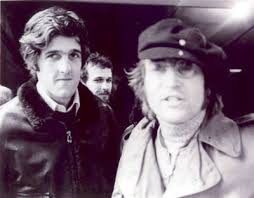
At a peace rally, young John Kerry introduced John Lennon.
The mid to late 60s was a watershed time for the United States as the nation dealt with Civil Rights, the Vietnam War and "electrifying change" in culture brought about by Dylan, the Beatles and the Rolling Stones.

Kerry's "maladjustment" flowered after his return Stateside. 

John Kerry's Found Haiku

Remembering his fallen comrades and the service members still serving in Vietnam, he marched, spoke and eventually testified to Congress against the war, offering this "found" double haiku:

How do you ask a
man to be the last man to
die in Vietnam?

How do you ask a
man to be the last man to
die for a mistake?

His leap into politics eventually led to a successful campaign to become the junior senator of Massachusetts.

Kerry was sworn in to the Senate by then-Vice President George H. W. Bush, who "loved the Navy as I did," Kerry remembers.

Kerry and McCain
He describes the vivid characters he worked with as a fellow senator: Max Cleland, Ted Kennedy, John McCain, John C. Stennis, Joe Biden, Robert Byrd, Jesse Helms, Strom Thurmond and John Glenn, among many others.

He remembers a time of collaboration, cooperation and compromise in Congress, when senators placed the needs of the nation above their own, including during investigations. He also relearned lessons from Vietnam: to compartmentalize in order to stay on track.

An Early Mueller Prosecution

Oliver North, USMC
Kerry, along with Senators Inouye, Mitchell, Nunn and Sarbanes, served at the heart of the Senate's Iran-Contra investigation during President Reagan's second term. Col. Oliver North had arranged for arms sales to Iran to fund military support to the cocaine-growing Contras in Nicaragua's civil war.
"I knew of Oliver North. We were the same generation and had both fought in Vietnam. He had come home from the war a decorated combat vet, with a Silver Star, Bronze Star, and two Purple Hearts. I didn't know what his politics were, but I respected his service and his courage. I wondered how someone with his credentials could be led down a path of illegality. The Marines live by a code. If what we were hearing was true, a Marine should have been horrified."
As part of the investigation, Kerry followed the money.

Robert Mueller, USMC
"We discovered a shady and unsavory bank with an innocuous acronym: BCCI. It stood for the Bank of Commerce and Credit International. BCCI was a dream for criminals and money launderers, and it was hiding in plain sight ... We learned that the CIA had prepared hundreds of reports outlining the criminal connections of BCCI. Thankfully, the Department of Justice soon had a new head of its criminal division: my St. Paul's classmate, a Vietnam veteran and a diligent law enforcement professional named Bob Mueller. Our subcommittee's two staffers had exposed the perfidy of BCCI, and I felt vindicated when Mueller assigned thirty-seven prosecutors to the case. By July 1991, regulators had seized the bank. BCCI was dead."
The ghost of BCCI would later come back a decade later in the wake of 9/11 in how al-Qaeda funded its terrorism. "When my investigation and Robert Mueller's prosecution shut down BCCI, it cut off Osama bin Laden's foothold in Sudan; now we needed to go after the entire dirty financial network that operated in the shadows," Kerry writes.

Smears and Retaliation

In 1996, Kerry was challenged for reelection by William Weld, former governor of Massachusetts. During the campaign, political operatives and a reporter, who was classmate of Weld, questioned Kerry's military record.

Kerry and Zumwalt.
In response, Admiral Zumwalt led a contingent of commanders who had oversight of swift boat shoreline operations to set the record straight. They conducted a press conference at the Charleston Navy Yard, "where USS Constitution stands as a reminder of our country's naval origins."

"Every Day Is Extra," includes a contemporaneous message about Kerry's key swift boat operation from then-Capt. Roy Hoffmann commending the mission: "The extremely successful raid and land sweep conducted along the Rach Dong Cung which demonstrated superb coordination and aggressive tactics stands as a shining example of completely overwhelming the enemy."

Decades later, when Kerry ran for president against George W. Bush, Hoffmann was recruited by anti-Kerry forces. Those forces were led by several principals: Ted Sampley, a "self-appointed POW activist (who) profited grossly" from myths and lies about POW/MIAs; John O'Neill, an ally of Nixon and Chuck Colson; and Jerome Corsi, an anti-Obama birther theorist and close associate of Roger Stone.

Kerry visits Afghanistan April 9, 2016. (Photo by SSgt Tony Coronado, USAF)
O'Neill and Corsi wrote the smear-book, "Unfit for Command," which was discredited by Zumwalt's previous statements, Navy and Coast Guard records, John McCain's testimony, and Sailors who served with Kerry during the missions for which he was decorated.

"It was extraordinary," Kerry writes about Hoffman, Sampley, O'Neill and Corsi. "They were lying about me, lying about themselves, lying about history – a history they knew was documented, in some cases by themselves, but always by the Navy they purported to love and respect."

To Tell the Truth

Respect for truth, honor and justice is a theme that runs through Kerry's life and this book.

For example, he explains why he felt it was important to take on BCCI with Robert Mueller:
"Because if you start backsliding and trimming on the rule of law, you contribute to the inexorable deterioration of democracy. Corruption is cumulative. I believed the rule of law has to mean something in the United States. If we knowingly turn a blind eye on the rich and powerful, enabling them to escape accountability while two-bit criminals go to jail for years, we create a tiered system of justice. That is no justice at all."I had learned a great deal as an investigator, both in Iran-Contra and in BCCI. I'd been reminded that when you push hard for truth, people who are invested in lies or in convenient avoidance resist, and they retaliate. But truth is worth fighting for; truth is the American bottom line."
"Every Day Is Extra" opens with a poignant recounting of the death of Kerry's father. Scattered throughout the book are the shadows of combat deaths, cancer diagnoses and the losses of friends and family members "...so many of life's sad, sudden turns."

Senator John Kerry participates in a remembrance ceremony at Utah Beach, June 6, 2011. Kerry joined paratroopers from the U.S. Army, U.K, Germany, and France in honoring those who fought and died in Operation Overlord, the D-day landings. Senator John Kerry, chairman of the Senate Armed Force Committee, was the senior U.S. representative at the ceremony. (Photo by Staff Sgt. Felix Fimbres, U.S. Army)
A deeply personal encounter comes with Kerry and Teresa Heinz Kerry visiting Normandy Beach. I won't ruin the experience, made better with Kerry's context and nuanced prose, but you can find the passage on page 209 of the 2018 hardbound edition.

A thorough report of John Kerry's time in Vietnam and his journey to warrior diplomat and healing with friend and colleague John McCain is presented in Douglas Brinkley's "Tour of Duty: John Kerry and the Vietnam War" (HarperCollins, 2004).

According to Thomas Cutler, author of "Brown Water, Black Berets," "Douglas Brinkley's vivid rendition of brown-water operations in 'Tour of Duty' rings true, with all the sights, the sounds, and the smells that make it such a unique experience. But this is far more than another war story. It is an account of a young man's journey through his own 'heart of darkness,' ultimately emerging with his soul intact and his need to serve undiminished, ready to wage a different kind of war."

U.S. Secretary of State John Kerry crosses the brow of the Avenger-class Mine Countermeasures ship USS Devastator (MCM 6) April 7, 2016 at Naval Support Activity Bahrain in the U.S. 5th Fleet area of operations. (U.S. Navy photo by Mass Communication Specialist 2nd Class Ryan D. McLearnon)

Secretary of State John Kerry lays a wreath Aug. 13, 2014 at the USS Arizona Memorial. Kerry visited U.S. Pacific Command to discuss cooperation strategy in the Asia-Pacific region. (U.S. Navy photo by Mass Communication Specialist 1st Class Jay M. Chu)

Kerry signs the Paris Climate Agreement while holding his granddaughter, Apr. 22, 2016.

Monday, February 18, 2019

Green New Deal Imagined in 'This Moment on Earth'

Review by Bill Doughty

Vietnam branded John Kerry. His missions in the Navy, as a senator and as Secretary of State informed his life. And his confrontation with mortality brought insight and wisdom.
Kerry focuses that perspective on his most important mission on "protecting the planet." That's the last chapter in his new autobiography, "Every Day is Extra," and it's the subject of a book he and wife Teresa Heinz Kerry wrote in 2007, "This Moment on Earth" (PublicAffairs, Perseus Books).

Kerry and Gore at Yale University.
If the seeds for the Green New Deal were first planted by Ralph Waldo Emerson, Theodore Roosevelt, Marjory Stoneman Douglas and Rachel Carson – and in 1970 with the world's first "Earth Day" – those seeds were certainly watered and given sunshine by Bill McKibben (350.org), Al Gore ("An Inconvenient Truth") and the Kerrys.

"This Moment on Earth" is a call for action, acknowledging the reality of global climate change, the hazards of relying on fossil fuels for our energy, and the poisoning of earth's air and water. The authors offer a number of examples of individuals and communities – from Pittsburgh and the Carolinas to New Mexico, Washington State and Portland – taking responsibility and action.

United States Marines to the Rescue

Former Marine Bob Boyle organized fellow fishermen and helped clean up the Hudson Bay, inspired "by their growing disgust about the deterioration of the environment and our poor stewardship," demonstrating how Americans are a government of, by and for the people.

Former United States Marine Rick Dove, a Riverkeeper enforcer.
Another Marine, Rick Dove, a retired colonel, took on the unregulated hog farming industry and their political supporters.
"Listening to Rick talk about his work is inspirational. Sixty-seven years old – a marine – he could have been doing almost anything else; he'd earned it. But his personal sense of responsibility and love for the river kept him on the job. 'Semper Fi' – 'Always faithful' – the motto of the Marines, was his for life. His story conclusively demonstrates the connection between the choices we make and health of our communities. Few of us likely give much consideration to how our everyday choices – such as the seemingly straightforward decisions we make at the grocery store to provide food for our families – may have an impact on people we will never meet, in places we may never visit."
Americans Connected
"In recent times, particularly since the 2000 presidential election, we have generally bought into the idea of blue states and red states. But it takes people like Rick to remind us that, regardless of how we vote or which party we align ourselves with, we all share many very basic ideals. All of us certainly want clean water. No fisherman should be sickened by toxins in the water. No mother should worry that her child will become sick from swimming at the local beach. Nobody among us – young or old, farmer or artist, Democrat or Republican – should demand anything less than safe, available water. This is not a matter of politics; it is a matter of common sense, morality, and responsibility."
True conservatives are conservationists, by their very name. "Evangelicals talk of "creation-care" – that any damage that we do to God's world is an offense against God," an idea that "appeals to all religions of the world and to anyone with a moral guidepost."

President John F. Kennedy and First Lady Jacqueline Kennedy watch the first race of the 1962 America's Cup from aboard the USS Joseph P. Kennedy, Jr. Also pictured: Hugh D. Auchincloss; Under Secretary of the Navy, Paul "Red" Fay; Jamie Auchincloss; Janet Auchincloss; John Forbes Kerry; Press Secretary, Pierre Salinger; Naval Aide to the President, Captain Tazewell Shepard; Rep. Fernand St. Germain (Rhode Island). Newport, Rhode Island. (JFK Library)
In his recent autobiography, "Every Day Is Extra," Kerry reprises a JFK quote also published in "This Moment on Earth" in a chapter called "The Water of Life." 
"As (Navy veteran) President John F. Kennedy said in a speech he gave in Newport, Rhode Island, in 1962: 'All of us have in our veins the exact same percentage of salt in our blood that exists in the ocean, and therefore, we have salt in our blood, in our sweat, in our tears. We are tied to the ocean. And when we go back to the sea – whether it is to sail or to watch it – we are going back from whence we came.' Water accounts for up to 90 percent of the weight of cells in the human body and three-fourths of the body's total weight. Essential to our survival, so powerfully linked to our history and culture, such a precious resource ought to receive the highest level of protection – nothing short of uncompromising stewardship."
John Kerry speaks of books and "storytellers of the sea" and rivers that influenced him over the years: Herman Melville's "Moby Dick," Rudyard Kipling's "Captains Courageous," Sebastian Junger's "The Perfect Storm," Richard Henry Dana's "Two Years Before the Mast," and Mark Twain's "Huckleberry Finn."

A Call for Boldness: 'The Green Rush is On'

John Kerry and Teresa Heinz Kerry
Kerry's "This Moment on Earth" with Teresa Heinz Kerry – along with the final chapter of "Every Day Is Extra" – calls for the acknowledgment, will and action to combat climate change. His call, to include "an innovative and strategic national energy policy," is reflected in calls for a Green New Deal.
"There's no excuse for inertia. Even if, contrary to all science, the proponents of action on global climate change were proven wrong, what harm would the actions to combat global warming cause? We would have produced healthier people with cleaner air, sustainable farming and fishing practices, more healthful food, and more effective sources of cleaner energy, all of which adds to greater security. But if those who deny climate change get their way and then are proved wrong, we will suffer catastrophe beyond description."
The U.S. Army Corps of Engineers uses solar energy at a remediation project at the former Nebraska
Ordnance Plant – energy-saving technology to treat groundwater and power equipment. (U.S. Army)
A Green New Deal would push innovation and ingenuity. "That ingenuity is alive and well among individuals and corporations engaged in the discovery of new and better ways to address our energy challenges" in a "post-carbon period," Kerry writes. "Americans have always pushed the frontier of discovery. We didn't become the most powerful economy on Earth by holding back. Innovation after innovation has unfolded because the American spirit has always pushed the limits. Innovation is in the American DNA."

The Kerrys call for individual action and offer to appendices: "The Energy Plan" and "What You Can Do," with a list of sites to get more information and get involved.

Saturday, November 13, 2021

A True Patriot and Statesman: Max Cleland

By Bill Doughty––

When Joseph Maxwell "Max" Cleland spoke at the 72nd Pearl Harbor Day commemoration ceremony, Dec. 7, 2013, with Pearl Harbor itself as a backdrop, he was nearly overcome with emotion. He saw the dozens of World War II veterans seated in the front rows of the audience, and he thought of his father. Cleland spoke without notes, from the heart, about the sacrifice of military service and the joy of homecomings.


Army CPT Max Cleland in Vietnam
Hugh Cleland, Max’s dad, joined the Navy after the attack on Oahu in 1941. In 1965, Max volunteered for the Army to serve in combat in Vietnam, where he earned the Silver Star and Bronze Star.

Cleland was severely wounded and nearly killed. Yet, he personified resilience to become head of the Veterans Administration and a U.S. Senator.

Cleland died earlier this week. He was a great statesman, military veteran, and advocate for veterans, especially those with lasting physical and mental wounds.


President Joe Biden issued a statement November 9 on Cleland’s passing:

“Max Cleland was an American hero whose fearless service to our nation, and to the people of his beloved home state of Georgia, never wavered.

As a 25-year-old serving in the 1st Cavalry Division of the U.S. Army during the Vietnam War, Max lost both of his legs and his right arm in a grenade explosion at Khe Sanh. After grueling months in the hospital, enduring multiple surgeries and a long road back to recovery, Max turned his pain into purpose. He continued his distinguished public service, becoming a lifelong champion of the dignity and rights of working people and America’s wounded veterans. His leadership was the essential driving force behind the creation of the modern VA health system, where so many of his fellow heroes have found lifesaving support and renewed purpose of their own thanks in no small part to Max’s lasting impact... He was a man of unflinching patriotism, boundless courage, and rare character... He will be remembered as one of Georgia’s and America’s great leaders.”

I was fortunate to help plan the Navy’s Pearl Harbor Day commemoration ceremony in 2013 and to hear Max Cleland speak about honor, courage, and commitment –– as well as true family values and patriotism.


In 2013 I posted a Navy Reads review featuring Cleland’s autobiography, “Heart of a Patriot.”

Cleland, who chaired the armed services subcommittee on personnel in the Senate, was known for working closely with both Democratic and Republican colleagues.


Cleland reads about JFK.
From Navy Reads: “His colleagues, mentors and friends in the Senate included fellow combat veterans Chuck Hagel, Dan Inouye, John Kerry and ‘my Vietnam veteran brother’ John McCain. Cleland describes the pride of wearing his dad's WWII Navy peacoat as a U.S. Senator during a presidential inauguration.”


Prior to serving in the Navy for three years during WWII, Max Cleland’s father, Hugh, had served in the Civilian Conservation Corps, an environmental infrastructure program created by President Franklin D. Roosevelt during the Great Depression. FDR was an inspiration to a young Max Cleland. Cleland loved books and reading. He authored several books.


Like Biden, Secretary of Defense Lloyd Austin issued a statement about Senator Cleland’s passing; fittingly, Austin includes references to literature.


In part, SECDEF Austin says:

“The Department of Defense stands united in mourning the loss of Senator Max Cleland, an extraordinary public servant and a great patriot…He served his country and his community from a wheelchair, following in the gallant tradition of his hero President Franklin Roosevelt.”


SECDEF Austin notes that as head of the Veterans Administration, Cleland “fought fiercely for his fellow veterans, made PTSD an official VA diagnosis, and helped create the groundbreaking Vet Centers program. Later, after being elected a U.S. senator from Georgia, he continued his passionate focus on defense and veterans' issues, serving with distinction on the Senate Armed Services Committee and leading on such issues as health care, bioterrorism preparedness, and homeland security. He also served on the 9/11 Commission before being nominated for the board of the Export-Import Bank. His final act of public service was leading the American Battlefield Monuments Commission. When battle maps of Vietnam were added to the National Memorial Cemetery of the Pacific in Hawaii, he asked to add an inscription from the poet Archibald MacLeish: ‘We leave you our deaths: give them their meaning.’

With courage and grit, Senator Cleland struggled with PTSD and depression—seeking help through counseling, medication, and attendance at a recovery group. He said that he drew strength from being around his fellow veterans and wounded warriors, including those from Iraq and Afghanistan. As the head of the VA, he made psychological counseling available to his fellow veterans. And I hope that his example will encourage others carrying unseen wounds to seek out the help they need and deserve. 

Senator Cleland liked to quote Hemingway, who wrote, ‘The world breaks everyone and afterward many are strong at the broken places.’ He surely was. Max Cleland's civic-minded spirit, optimism, and resilience will stand as an inspiration to every American.”

Funeral services are planned for early next week.


Senator Max Cleland, RIP.


Vietnam War veteran Max Cleland, a triple amputee, holds a photograph of himself as a child with his father, Hugh, and mother, Juanita, at the National Memorial Cemetery of the Pacific at Punchbowl in 2013. (Jamm Aquino, Honolulu Star-Advertiser)


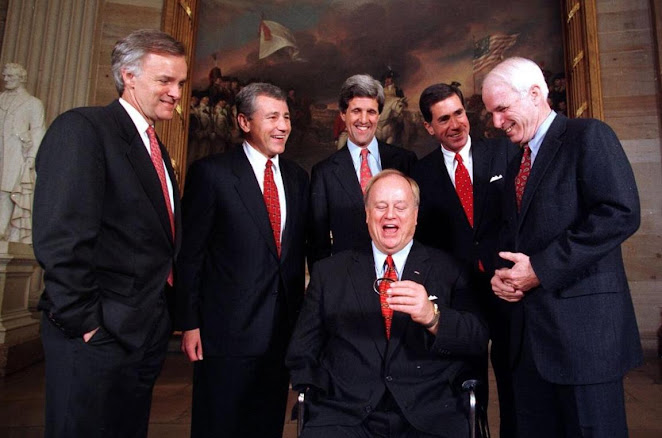
The Senate had six Vietnam combat veterans in January 1997. Sen. Max Cleland, D-Ga., is in the front. Behind him, from left: Bob Kerrey, D-Neb., Chuck Hagel, R-Neb., John Kerry, D-Mass., Chuck Robb, D-Va., and John McCain, R-Ariz. This photo was taken by The World-Herald during Senate orientation the previous month. (Kiley Cruse, The World-Herald)

Top photo: Secretary Max Cleland, American Battle Monuments Commission, delivers keynote remarks during the 72nd anniversary commemoration of the Dec. 7, 1941, attack on Oahu. This year’s commemoration theme, “Sound the Alarm,” examines how thousands of Americans answered the call to duty in the wake of the attack. More than 2,500 people attended the Pearl Harbor commemoration. (MC2 Nardel Gervacio)


Sunday, July 3, 2016

The U.S. Constitution's Amazing 'Visionary'

Review by Bill Doughty

"John Quincy Adams: American Visionary" (2014, HarperCollins)

This book was recommended recently by John Kirby, spokesman for Secretary of State John Kerry and former Chief of Navy Information.

Like his father, John Quincy Adams was a complicated hero of a young nation. A voracious reader, world-traveler and deep-thinking moralist, JQA recognized the sin of slavery and saw the need for a strong navy and army.

In "American Visionary" we get an international perspective at a time when "The United States still had no army or navy of consequence."

John Quincy Adams – and books – in 1843.
JQA had a front-row seat to French and British confiscation of American ships, British impressment of American sailors (which brought about the War of 1812), the return of Napoleon in France, and the effects of a trade embargo. He was intimately involved in the nation's response of the British warship Leopold agains USS Chesapeake, and he was intensely interested in the inventions of Robert Fulton, including the steamboat and torpedo.

Adams was an early proponent of strength through national inclusion, innovation and infrastructure-building. He "strongly believed that the roads, canals and harbors were essential to the future prosperity of the country and the promotion of national unity."

Two hundred years ago, just after the War of 1812, John Quincy Adams served as a diplomatic envoy in London. A lover of poetry and literature, he immersed himself in the evenings in reading, reciting and studying William Shakespeare and attending theatrical performances of Shakespeare's work.

During the day he worked to represent the interests of the United States in Europe, including negotiating trade agreements, and  helped the needs of American citizens abroad. Here's a very early look at veteran homelessness from Kaplan's and Adams's description:
"And there was constant applications from American sailors, often reduced to begging, who had been impressed (forced) into the British Navy, and from American prisoners of war released from the infamous Dartmouth prison ... British poverty was palpably visible. Hungry wanderers begged for food at the door of Little Boston House, 'each with a different hideous tale of misery ... The extremes of opulence and of want are more remarkable and more constantly obvious in this country than in any other that I ever saw.' ... That there were beggars in America John Quincy knew from experience. But the numbers in Great Britain made American poverty seem minuscule and easily managed. In the United States there was more work to be had, even in hard times. It pained Adams to see starving Americans, many able-bodied, some damaged by war and imprisonment, forced to beg in the streets of a foreign country. He worked tirelessly, and stretched his own and the embassy's resources to assist them."
Adams had a long and distinguished career as a statesman even at an early age. He had lived throughout Europe. He played a role in patching up misunderstandings, reaching compromises and building peace.

In 1817 President Monroe appointed him Secretary of State.

That pivot point in JQA's life ignites Fred Kaplan's biography.

Adams's journey from England to the United States in July and August of 1817 to accept appointment as Secretary of State took 51 days, a time to consider challenges with France, Britain and Spain over the Great Lakes, Louisiana and Florida, among other areas and territories.
"On shipboard, he pondered his and his country's future. As much as he worried about foreign affairs, he had an even more pervasive anxiety: the internal health of the nation. Like both his parents, he believed as deeply in the union as he believed in his life. During his father's presidency, both Republicans and Federalists had threatened disunion. After the passage of the Alien and Sedition Acts, Jefferson and Madison had claimed the right to secession. Now the South as demanding that new states allow slavery. Whether they had moral objections or not, Northern states objected to the additional congressional and electoral votes that the South would have. The British could be handled, though there would be difficulties. So too could Spain, which Adams had reason to believe would in the end capitulate. There were trade issues with France, though at their worst they were not not likely to result in armed conflict. To Adams, domestic tensions seemed most threatening in the long run. The Declaration of Independence and slavery were, he believed, incompatible. Still, maintaining the union was paramount. 'Much as I must disapprove of the general tenor of Southern politics I would rather even yield to their unreasonable pretensions, and suffer much for their wrongs, than break the chain that binds us altogether ... if it is once broken we shall soon divide into a parcel of petty tribes at perpetual war with one another.' The War of 1812 had 'revealed our darkest side, or tendency to faction, sectionalism, and disunion.' The future contained the threat of 'the dissolution of the Union and a civil war.'"
Adams saw the Sandy Hook lighthouses as his ship came close to the American shore. He visited officials in New York, going aboard the first steam frigate that used both sail and steam, USS John Adams, before heading to see his parents in Quincy, Massachusetts aboard the steamship Fulton. In a visit to Boston he boarded both the the USS Constitution and USS Guerriere.

Kaplan reveals the internecine political thorns Adams faced close to the seat of power as Secretary of State, a position both Jefferson and Monroe had held. "More so than Monroe, Adams believed that American prosperity required greater power for the federal government to promote internal improvements and a modern banking system, encourage manufacturing, advance education and science, and strengthen the military."

"Slaves Waiting for Sale" first sketched by British artist Eyre Crowe ten years after Adams died.
Kaplan shows us his strong aversion to slavery and so-called "divine rights," a full generation before the nation plunged into the War Between the States.

His one term as president was followed by service in the House of Representatives, where he became a strong and committed voice for abolition, "proposing a constitutional amendment 'abolishing hereditary slavery in the United States, prohibiting admission of new slave states, and abolishing slavery and the slave trade in the District of Columbia.' He had moved from discreet tactfulness to outspoken radicalism," writes Kaplan. Congress voted 114 to 108 for a continuing gag rule to prevent voting on the amendment, and Adams earned countless death threats from slavery proponents.

He stepped up before the Supreme Court to successfully defend  imprisoned Africans aboard the Amistad after the slave ship was rescued and recovered by USS Washington, when "racism, proslavery sentiment and national politics were a toxic mix."

Kaplan presents Adams as a respected statesman who was selected to present the nation's eulogy for Lafayette, help establish the Smithsonian Institution and protect the rights of American Indian tribes. His position against annexation of Texas in support of  Great Britain in the opium war in China – not to mention women's rights – are perplexing until we consider his circumstances.

Human nature dictates that people are often limited in their imagination by their place in space and time. JQA was no different, believing women were denied the right to vote, for example, because of "nature's foundation in natural law and God's will" and that "the preservation of the values of the Declaration and the Constitution did not require it."

Nevertheless, Adams argued for progress in the nullification of slavery using founding documents. Kaplan writes:
"The values that should shape the present, he argued, as he had done many times before, were those inherent in the history of the nation and in its foundational documents. His major target was the doctrine of nullification, its arbitrary and willful insult to the facts and values of American history. The history he summarized was, of course, Adams' version, with its emphasis on the rationale for the revolution in specific events and natural law. Freedom was everything. Liberty and morality were the highest values. The Declaration of Independence provided the principles, the Constitution the implementation. The brilliance of the Constitution was that it was both stable and elastic – it was both stable and elastic – it was a living document. The Bill of Rights, he observed, had corrected a flaw. More corrections were necessary. The Constitution mandated that the federal government 'promote the general welfare.' That meant new initiatives, such as public improvements, that the authors could not have anticipated but had made provision for in general terms. And its most precious gift was union. It was a sacred contract."
Sailors present a wreath at the tomb of John Quincy Adams in 2009. (Photo by Lt. Chad Murphy)
Kaplan gives us details of the challenges, triumphs and failures in Adams's long life, a life filled with illness and injury, including a hand seriously hurt by a misfiring handgun leading to infections, and problems with his eyes – extreme problems for a poet, writer and reader. In addition to Shakespeare, Adams read Plutarch, Cicero, Voltaire, Hume, Samuel Johnson, Edmund Burke, Lord Byron, Alexander Pope, John Milton, the Bible and a French translation of the Koran (Quo'ran).

A theme of JQA's life was "stoic courage and acceptance of adversity and death." He experienced the death of most of his immediate and extended family, often at an early age. One son, George Washington Adams was "erratic and unstable" and committed suicide. Another son, John Adams II, died from the effects of alcoholism at 31.

The book opens with his father's death, as Quincy Adams hurries home, hoping in vain to see his beloved father before he died.

Both John Adams and Thomas Jefferson passed away hours apart on July 4th, 1826.

Sunday, February 14, 2021

McCarthyism/Trumpism III: Endless ‘Anxiety’

Review by Bill Doughty

In this third book review (in a Navy Reads trilogy) about Senator Joe McCarthy and his legacy, author Haynes Johnson provides more unintended parallels and links to Trumpism in “The Age of Anxiety: McCarthyism to Terrorism” (Harcourt, 2005).

Anxiety at the time this book was written came from the smoldering memories of 9/11 and fear of ongoing terrorism as the American military waged war in Afghanistan and in Iraq. Haynes makes a connection from 9/11 to the anxiety of communism in the 50s –– which would lead to the Vietnam War debacle.


Today, there are still fears of socialism and communism, as well as anxiety about fascism in the aftermath of a failed insurrection Jan. 6 at the Capitol by Trump supporters.


Presciently, Haynes writes this more than fifteen years ago: “The age of anxiety has not ended, nor is it likely to end soon.”


Here are some more parallels and links, including page numbers in the first edition version of this insightful book:


Like Trump, McCarthy tried to paint his opponents, including democrats, as unpatriotic, irreligious and unAmerican. Both Trump and McCarthy warned of “godless communism” in their speeches calling for their version of patriotism. (p.314)


After an earlier hearing in the Senate in the wake of the Tydings report (somewhat comparable to Trump’s first impeachment hearing) “McCarthy was rebuked, but not rejected. From then until the November elections, he became the Republican Party’s most tireless, sought-after, and effective campaigner.” (p. 188)


“The Democrats remained clueless. They believed that McCarthy’s falsehoods were so transparent and outrageous that they would emerge victorious from any encounter with him.” “McCarthy had poked the tigers of the Senate and showed them to be toothless.” (p.159)


McCarthy sued opponents, including a $2M libel suit against Sen. William Benton, admittedly for intimidation purposes and to “force him to spend money to defend himself.” (p.221)

Eisenhower makes a point with McCarthy
President Eisenhower, who is considered a moderate –– or even liberal –– Republican, worked behind the scenes to fight McCarthy. He “was becoming so frustrated with the obstructionism of McCarthy and other ultraconservatives, [he] … was considering the formation of a new party bringing together all the sensible people in the great middle of American life.” (p.260)

Haynes writes, “Over the decades, a more rigidly ideological Republican Party has emerged, forged by many of the forces McCarthy unleashed or harnessed.” (p.461) 


Navy readers will find a fascinating parallel between the swift-boating of John Kerry  and the smear of another Vietnam veteran Max Cleland, both former Senators who had been awarded multiple Purple Heart medals. (p.498)


In Kerry’s case, in which wealthy Texas Republicans funded TV ads with false claims that Kerry falsely received his combat medals, including the Silver Star. “Constant repetition over cable outlets had an echo chamber effect the greatly magnified the ads’ false charges.” (p.499)


Here’s some irony: McCarthy lied about his service in the Marine Corps, and he falsified records after the war to get Distinguished Flying Cross and Air Medal commendations. “The deceit was breathtaking,” Haynes writes. A later investigation revealed McCarthy had apparently drafted his own letter praising his war record and forged the signature of his CO, Maj. Glenn A. Todd. McCarthy then forwarded the letter to be countersigned by Admiral Chester Nimitz, commander of the U.S. Pacific Fleet, as a matter of routine. (p. 53)


The McCarthy “hearings were a landmark in American History. They were consequential, and they stamped indelible images in the public mind.” (p.388) So was the second impeachment of Donald J. Trump, which included indelible images of bloodthirsty Trump supporters attempting to overturn an election and transfer of power. Rioters were summoned to D.C., incited to fight, directed toward the Capitol, and allowed to attack police and the Capitol itself for hours.


Are McCarthyism and Trumpism names for the same phenomenon, describing ultranationalism, patriarchy, racism, and misguided patriotism? Examples in American history abound: slavery, actual witch hunts, Alien and Sedition Acts, loyalty tests, disallowing women the right to vote, civil rights violations, and family child separations, and others.

Haynes reports about the first Great Red Scare just over 100 years ago as World War 1 was about to end and Lenin and Trotsky came to power in the Russian Revolution. Bombings and riots shook the United States. In 1919, in the middle of the Great Influenza Pandemic, soldiers and sailors stormed the office of a Cleveland socialist newspaper. In Chicago, a sailor shot a man for not standing and removing his hat for the Star Spangled Banner. (p.102)


SECDEF Lloyd J. Austin III
A century later: A remarkable number (reports say 12 percent or more) of insurrectionists and rioters who stormed the Capitol last month had served in the military. New Secretary of Defense Lloyd J. Austin III ordered a 60-day stand-down to confront extremism.

Endless vigilance against violence is required of those who take an oath to protect and defend the Constitution against all enemies, foreign and domestic. As Edward R. Murrow said, “We cannot defend freedom abroad by deserting it at home.”


Haynes gives an excellent presentation of the Army hearings in which the Army's lead defense attorney Joseph Welch confronted and ended McCarthy’s reign of terror with the immortal rebuke: “… You have done enough. Have you no sense of decency at long last ? Have you left no sense of decency?”


Haynes concludes, “McCarthyism remains a story without an ending.” “Extremism –– and the suspicion and hatred it engenders –– may be Joe McCarthy’s most lasting legacy.”


A Presidents Day Postscript:


Haynes writes, “As a way of indicating his own model for statesmanship, McCarthy posted on the wall of his Senate office a copy of Lincoln’s famous remark: ‘If the end brings me out all right, what is said against me won’t amount to anything. If the end brings me out wrong, ten angels swearing I was right would make no difference.’” (p.79)


Conservative anti-communists prevented the performance of “Lincoln Portrait” at Eisenhower’s inauguration, because the composer, Aaron Copland, was loosely associated with “radical causes,” although he did not belong to the Communist Party. “Portrait” includes Lincoln’s memorable and still relevant words, “Fellow citizens, we cannot escape history. We of this Congress and this Administration will be remembered in spite of ourselves.” (p.300)


Democratic presidential candidate in 1952, Adlai Stevenson, echoed Lincoln in a speech about the Republican Party divide over McCarthyism: “A political party divided against itself, half McCarthy and half Eisenhower, cannot produce national unity.” (p.375)


Just a reminder: Navy Reads is an unofficial blog of book reviews and personal views on critical thinking, core values, Constitutional issues, and political-military-diplomatic philosophy.


WASHINGTON (April 15, 2015) -- Aviation Maintenance Administrationman Airman Apprentice Zaine Ahringhoff, assigned to the Nimitz-class aircraft carrier USS Abraham Lincoln (CVN 72), admires the Lincoln Monument during a trip to Washington, D.C. to commemorate the 150th anniversary of President Abraham Lincoln's assassination, April 15.  (MC3 Brenton Poyser)