Showing posts with label Maritime Strategy. Show all posts

Saturday, June 17, 2023

Navy Good, Future Unraveling

Review by Bill Doughty––

Geopolitical strategist Peter Zeihan expresses high regard for the United States Navy as a global force for good. He says the U.S. is “primarily a naval power,” and it is America’s Navy that has protected sea lanes and global commons, allowing what could be the greatest period of peace and prosperity in the history of the world.


That peace was guaranteed after the Second World War and the defeat of Japanese and German imperialism and fascism, when the Americans “offered their wartime allies a deal.”

“The Americans would use their navy –– the only navy of size to survive the war –– to patrol the global ocean and protect the commerce of all. The Americans would open their market –– the only market of size to survive the war –– to allied experts so that all could export their way back to wealth. The Americans would extend a strategic blanket over all, so that no friend of America need ever fear invasion again.”

But in Zeihan’s now-dystopian view of the future, that era of peace and prosperity is over.

In “The End of the World Is Just the Beginning: Mapping the Collapse of Globalization” (HarperCollins, 2022) Zeihan presents extensive data, charts, and demographic analysis showing evidence of de-globalization, less world trade, and aging populations in many countries:

  • This is the “best it will ever be in our lifetime.”
  • “The world –– our world –– is breaking apart.”
  • China is aging “into demographic obsolescence.”
  • “We are entering a period of extreme transformation, with our strategic, political, economic, technological, demographic, and critical norms all in flux at the same time.”
  • “Everything is going to change” and “the process will be the definition of traumatic.”
  • “Living through history is messy.”

“De-globalization,” Zeihan writes, “doesn’t simply mean a darker, poorer world; it means something far worse. An unraveling.”


If he’s right, the United States will be able to weather the storm that will overcome other nations and territories, especially in Asia and Europe. Unlike those countries, America has the resources, relatively younger population, protective geography (including rivers and protected deep-water ports), and friendly next-door neighbors.


Justin Taschek, the Senior Maritime Projects Administrator for the Port of Oakland, California, gives a tour of the port to Chief of Navy Air Training Rear Adm. Daniel Dwyer, Feb. 12, 2020. Dwyer visited Oakland as part of a Navy Executive Engagement Visit designed to help educate the American public about the capability, importance and value of today's Navy to national security, global communication and trade. Oakland is a deep-water port. (MC1 Aaron Chase)

In “The End of the World…” Zeihan predicts countries are “likely to brawl over the shattered remnants of a collapsed economic system.” Just months after he wrote those lines and after the final manuscript of his book went to the publisher, Putin’s Russia launched a full invasion of  Ukraine. Zeihan and HarperCollins added a one-page note at the end of a chapter about the invasion. Perhaps his predictions –– although imperfect –– are already coming true.


He examines transportation, finance and currencies, energy, industrial materials, manufacturing, and agriculture, showing how each pillar of civilization has evolved over time and predicting the future based on current trends.


For example, he shows how Admiral (Commodore) Matthew C. Perry ignited the start of a global capital financial system when he opened Japan to trade, redefining the role of debt and unleashing “the Asian Financial Model.” In a section called “A Credit Compendium,” Zeihan gives diverse examples of “extravagances and exaggerations” and “excesses and eruptions” comparing Greece, Germany, UK, Hungary, Australia, Colombia, Indonesia, Brazil, Saudi Arabia, India, Turkey, Russia, and China.


In the final, and one of the longest sections in the book, he examines agriculture and “the geopolitics of vulnerability,” including the challenges of feeding the world amid climate change, water shortages, and his prediction of reduced global trade. The thing that keeps him up at night the most, he says, is the threat of coming famine in the world.


Service members hold the national flags of participating nations during the opening ceremony for Exercise Saber Strike at the Pabrade Training Area, Lithuania, June 8, 2015. The exercise provides an opportunity for a multilateral force to conduct operations side by side. (USMC Sgt. Paul Peterson)

As the world changes and globalization ends, what is the role of the military, especially the Navy, with its power projection capabilities?

“Expect the Navy and Marines both to be assigned a set of secondary tasks that include aggressive sanctions enforcement. Perhaps the most jarring issue all countries and companies must adapt to is the Americans not simply giving up their role as the global guarantor of order, but transforming into active agents of disorder.”

Zeihen predicts more future disorder on the seas, including the return of piracy and militarized merchant marines.


Will the nations of the world be forced to become inward looking turtles? Head-in-the-sand ostriches? Will self-interest, self-aggrandizement, greed and authoritarianism win the day? Whether he is completely correct or not, Zeihan deserves to be read and heard in what could be an unraveling world. Perhaps the U.S. Navy, “forged by the sea,” will be even more relevant and necessary as a global force for good.
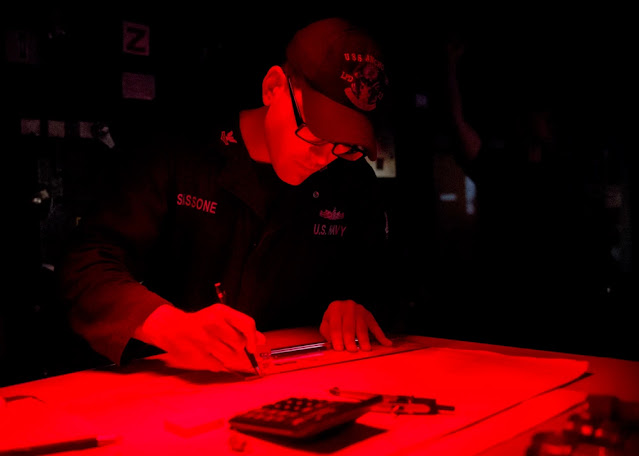


Above: Quartermaster 2nd Class Brandon Sassone, from Plainview, N.Y., plots ship position in the pilot house aboard the San Antonio-class amphibious transport dock ship USS Anchorage (LPD 23) during a scheduled deployment of the Essex Amphibious Ready Group (ARG) and the 13th Marine Expeditionary Unit (MEU), Sept. 2, 2018. They were deployed to the 5th Fleet area of operations in support of naval operations to ensure maritime stability and security in the Central Region, connecting the Mediterranean and the Pacific through the western Indian Ocean and three strategic choke points. (MC3 Ryan M. Breeden)


Top photo: The Arleigh-Burke class guided-missile destroyer USS Michael Murphy (DDG 112) participated in Australia’s Kakadu exercise in August 2018 in Darwin to enhance maritime security skills with participating nations, which highlighted information sharing and multilateral coordination. (MC3 Morgan K. Nall)

Tuesday, February 14, 2023

Frederick Douglass Speaks to Us in 2023: Part 1, Liberty


By Bill Doughty––

As a former slave, Frederick Douglass stood on a righteous stage when he observed, documented, and commented on history in the mid-to-late 1800s. Nearly two centuries later, his voice is still relevant in addressing our own controversial issues.


Here are some examples of that relevance from Douglass’s “Speeches and Writings” (Library of America, 2022, edited by David W. Blight.


On Liberty –– Consider why Ukraine fights for freedom and why we support their fight:

  • “The existence of this right is self evident. It is written upon all the powers and faculties of man. The desire for it  is the deepest and strongest of all the powers of the human soul. Earth, sea and air –– great nature, with her thousand voices proclaims it.” (12/08/1850)
  • “I have said that the right to liberty is self evident No argument, no researches into mould records, no learned disquisition, are necessary to establish it. To assert it, is to call forth a sympathetic response from every human heart, and to send a thrill of joy and gladness round the world. Tyrants, oppressors and slaveholders are stunned by its utterance; while the oppressed and enslaved of all lands hail it as an angel of deliverance. Its assertion in Russia, in Austria, in Egypt, in fifteen states of the American Union, is a crime. In the harems of Turkey, and on the Southern plantations of Carolina, it is alike prohibited; for the guilty oppressors of every clime understand its truth, and appreciate its electric power.” (12/08/1850)
  • “Americans! your republican politics, not less than your republican religion, are flagrantly inconsistent. You boast of your love of liberty, your superior civilization, and your pure Christianity, while the whole political power of the nation (as embodied in the two great political parties) is solemnly pledged to support and perpetuate the enslavement of three millions of your countrymen. You hurl your anathemas at the crowned headed tyrants of Russia and Austria, and pride yourselves on your Democratic institutions, while you yourselves consent to be the mere tools and bodyguards of the tyrants of Virginia and Carolina …You glory in your refinement and your universal education yet you maintain a system as barbarous and dreadful as ever stained the character of a nation—a system begun in avarice, supported in pride, and perpetuated in cruelty. (07/05/1852)
  • “Those who have undertaken to suppress and crush out this agitation for Liberty and humanity, have been most woefully disappointed. Many who have engaged to put it down, have found themselves put down. The agitation has pursued them in all their meanderings, broken in upon their seclusion, and, at the very moment of fancied security, it has settled down upon them like a mantle of unquenchable fire.” (05/1857)
  • “Man is man, the world over. This fact is affirmed and admitted in any effort to deny it. The sentiments we exhibit, whether love or hate, confidence or fear, respect or contempt, will always imply a like humanity A smile or a tear has not nationality; joy and sorrow speak alike to all nations, and they, above all the confusion of tongues, proclaim the brotherhood of man.” (12/07/1869)
  • “I, therefore, leave off where I began, with hope. While drawing encouragement from the Declaration of Independence, the great principles it contains, and the genius of American Institutions, my spirit is cheered by the obvious tendencies of the age. Nations do not now stand in the same relation to each other that they did ages ago. No nation can now shut itself up from the surrounding world, and trot round in the same old path of its fathers without interference. The time was when such could be done. But a change has now come over the affairs of mankind. Walled cities and empires have become unfashionable. The arm of commerce has borne away the gates of the strong city. Intelligence is penetrating the darkest corners of the globe. Wind, steam, and lightning are its chartered agents. Oceans no longer divide, but link nations together. From Boston to London is now a holiday excursion. Space is comparatively annihilated. Thoughts expressed on one side of the Atlantic are, distinctly heard on the other.” (07/051852)

Think about that line above: “Oceans no longer divide, but link nations together.”


That concept is at the heart of the U.S. Navy’s Maritime Strategy for generations, protecting liberty and ensuring freedom on the global commons. Douglass delivered the line in one of his quintessential speeches, Our Composite Nationality: An Address, in Boston, Massachusetts on December 7, 1869. On that date, the great naval strategist Alfred Thayer Mahan was a 29-year-old lieutenant commander. Mahan’s influential books on the influence of sea power and the need for a strong American Navy on the world’s oceans would be written more than two decades later.


Mahan and Douglass came from wildly different origins toward a common point of view about the moral imperative of liberty for all humanity.


For nearly 14 years Navy Reads has offered many reviews and commentary about both Mahan and Frederick Douglass, including Douglass’s ties to the Navy and the sea.

Sunday, January 30, 2022

Blue Age II: China, Russia, Mahan & Law

Review by Bill Doughty––

In Part I of our review of Gregg Easterbrook’s “The Blue Age: How the US Navy Created Global Prosperity –– and Why We’re in Danger of Losing It” we explored his thesis that the United States Navy is a force for good, keeping peace and stability on the seas, promoting prosperity, and reducing worldwide poverty.


Easterbrook says, “The United States would do well to recognize how many of its advantages are gifts of the sea.” Keeping sea lanes open the global commons from other nations’ ill intent and also from piracy means “open highways without trolls or tolls.”

Then-CNO Adm. Gary Roughead visits PLAN hospital ship Daishandao in Qindao, China in 2009,
Former Chief of Naval Operations Adm. Gary Roughead is quoted twice in “The Blue Age.” Roughead says, “Land and air forces can win disputes, but it is the Navy that keeps disputes far from our shores.” Easterbrook quips, “Keeping disputes far from our shores looks better all the time.

In Part I of our review of “The Blue Age,” we also presented Easterbrook’s conclusion that thinker-strategist Alfred Thayer Mahan was fundamentally wrong in some of his beliefs that, in fact, may have led to two world wars –– and may be influencing China today in the PRC’s expansionist policies, which parrot some of Mahan’s own views.

We also touched on Easterbrook’s conclusion that a continued era of peace and prosperity requires nations' commitment to following international laws, which will lead to more international cooperation. That’s especially important for the world’s two biggest powers.


“The question of whether the blue age will continue comes down to this: whether the United States and China, the two most important nations of history, can get along,” Easterbrook writes. Can maritime cooperation be achieved on the “outlaw ocean” through empathy and mutual respect?


“Walking in another’s shoes is the essence of human understanding,” Easterbrook contends. 


So, what is it like in China’s shoes?


Lights of Beijing and Tianjin, captured by the International Space Station orbiting 264 miles above, May 1, 2021. (NASA)
Evidence of China's rapid rise within one generation can be seen from space. But the affluence comes with effluence. "China must control its greenhouse emissions, the worst in the world." Easterbrook says, “Life is stressful in China, corruption permeates government, elections are rigged, and there is no freedom of speech or religion. These said, China’s living-standards, improvements and poverty reduction from 1995 to 2020 rank high in any accounting of the human family’s great accomplishments.”

In a deceptively easy style but with academic rigor, Easterbrook explains some of China’s feelings of victimization, its previous isolation, and its lack of enlightenment about human rights. He looks at the history of East/West interaction over centuries in or affecting China. And he shows some of the hypocrisy in dealing with the Middle Kingdom, including in recent history.

For example, President Trump’s second Secretary of State, Mike Pompeo, lectured Chinese leaders about their lack of democracy, then –– in an attack on our own democracy –– “told the world from the podium of the Department of State that the [U.S.] election outcome would be ignored and Trump would remain president.” Then there's the January 6, 2021 insurrection, seen by the world.

“Walking in China’s shoes does not mean excusing failings, including oppression of the Uighurs and Tibetans, betrayal of Hong Kong, stifling of free speech, ‘labor camps’ that are actually prisons, no constitutional rights, corruption top to bottom. In China there is plenty of disgrace to go around. 

“Above all these, 1.4 billion human beings are living close together in a place that’s polluted and depleting its aquifers at an alarming rate. Modern China may not remain stable. Unstable societies may lash out. If China lashes out, the sea is the most likely setting.”

Easterbrook reminds his readers, “Capital C Communism has not failed some of the time; it has failed all of the time.” In large part, because the individual has a need to live free, not as vassals of an authoritarian state.

“The Western view of the world –– unbraced by the United States, the European Union, the United Kingdom, Canada, Australia, New Zealand, Norway, and increasingly by Japan and South Korea –– is the Enlightenment conclusion that the individual is more important than the state. The view is morally correct, is self-evident under natural law, is true in a metaphysical sense that exists independent of the empirical. The individual is more important than the state. That’s five hundred years of Western thought in one sentence.”

And individuals, once recognized as such, have rights, including the right to own property.

“The right to property is deceptively important, as it has been contested by many social systems, including fascist, autocratic, and communist. If at root your property is yours, just as your thoughts are yours, you have an incentive to build, create, and trade, profiting while helping others. If at root your property belongs to the commissar, prince, or Gauleiters, why work hard? That far-left and far-right nations are economically sluggish compared with the for-profit nations is explained in this way.”

Easterbrook warns against “fear of outsiders and assumption that change is automatically bad. Whatever might be true in a perfect world, in the actual world, opposition to change is a formula for being left behind.”


Ukraine President V. Zelensky meets Cmrs. John D. John, CO of USS Ross (DDG 71) during Exercise Sea Breeze 2021, Odessa, Ukraine. (MC2 Grosvenor)
Enlightened change is needed in strengthening international codes and conventions governing the world’s oceans. For example, there is a need for enforcing laws, including “against naval assaults, such as the one Russia staged in 2014 at Crimea.”

And what about Russia?


Then-Supreme Allied Commander Europe, Adm. James Stavridis holds a press conference with Russia Chief of Defense, Nov. 1, 2010. (Sebastian Kelm)
“Blue Age” evaluates the threat posed by Putin’s Russia as it also tries to build a modernized fleet as it rattles its scimitar at its neighbors, especially now against Ukraine.

“Since Russia about a decade ago gave up its hope of European Union membership, turning cold to the West, the Kremlin has resumed longing for the kind of maritime power that great nations possess. Russia’s moves against Crimea and Ukraine were seen in the West as owing to Putin’s ego. To the Kremlin, they were an attempt to fulfill centuries of Slavic desire for year-round access to warm waters.”

But intrusions into another nation is just one issue.

“A true global governance system for the blue water would eliminate flag-of-convenience loopholes, protect workers in fishing and shipping, impose strict antipollution rules, and create clear agreements about the mining of minerals on the seafloor. Prototype vessels that vacuum up nodules from the seabed discharge effluent that can pollute the towering deepwater columns essential to marine life, including the marine plants that release oxygen. If sea mining is to become common, a much better system, with close supervision, is required.”

Hope for better oversight rests in a document that is already in front of the international community, the “Law of the Sea.”


“No matter what, we need America to ratify the Convention on the Law of the Sea,” Easterbrook pleads. “The US position on this treaty is irrational. Irrational has been doing quite well in Washington, D.C., lately. But there must be international consensus on how to govern the seas. The sooner the world acts on this, the better.” International agreement and enforcement would protect fishing grounds and habitats, energy resources, and internet communication cables.


Easterbrook notes, “Since 1994 nearly every member of the Joint Chiefs of Staff, the leadership committee for the US military, has expressed support for the Law of the Sea.”


As for nuclear arms control:

“When he was president, Jimmy Carter, a former navy officer who had been the XO of a submarine, joined the Soviet Union in signing the treaty called SALT II, which aimed to reduce strategic nuclear weapons. SALT II begat an arms control regime now called NEW START. At the end of the Carter presidency, the United States and Soviet Union possessed about 54,000 nuclear bombs, according to the Federation of American Scientists; today the total is down to about 9,900. In 2009, Barack Obama won the Nobel Peace Prize for advocating elimination of nuclear explosives.”

After Trump took the United States out of the 1987 Intermediate-Range Nuclear Forces Treaty in 2018, the Russian Federation also withdrew. China was not a signatory.


Easterbrook says, “Full elimination of nuclear arms might backfire by allowing great-power fighting to resume –– but the smaller the inventory the better.”


Regarding submarines armed with such weapons, he writes, “Having them underwater and constantly changing position tells any leader that a nuclear first strike will fail. At least, any rational leader.”


“For now, nuclear deterrence clearly discourages war.”

Mahan (September 27, 1840 – December 1, 1914) died decades before nuclear weapons were developed. He was an extremely devout orthodox Christian who believed humans were preordained toward violence and war, as shown by Susanne Geissler, author of “God and Sea Power: The Influence of Religion on Alfred Thayer Mahan” (Naval Institute Press, 2015).


Geissler writes, “It is important to grasp that because of his theological views, Mahan did not view human nature as constantly improving … Therefore, he thought war never could or would be eliminated.” Geissler’s biography is indispensable in helping understand Mahan’s linear thinking and inability to consider a world at peace.


Alfred Thayer Mahan attended the First Hague Conference in 1899.
Mahan was against international “universal arbitration,” even after attending the First Hague Conference in the summer of 1899 as a member of President McKinley’s U.S. delegation. “The idea was that if international disputes could be arbitrated, war could be avoided,” Geissler writes. “In Mahan’s view, arbitration was even worse than war in that it coerces the conscience and binds it ahead of time to unforeseen situations.”

[Of note, the League of Nations created the not-so-permanent “Permanent Court of International Law,” known as the "World Court,” in 1920; the court held its first session exactly one hundred years ago today, January 30, 1922 at the Hague, Netherlands. The United States never joined the World Court, and the court disbanded one year after WWII ended.]


Mahan’s beliefs were anchored in his interpretation of the Bible, sticking with Genesis but also solidly in the New Testament. “Based on his belief in original sin and the innate depravity of humankind, he believed that war was intrinsic to the human condition.”


Captain Mahan, front row, fifth from left, was CO of USS Chicago, circa 1893-95. (NHHC)
Among other revelations from Geissler, Mahan was against women’s rights to vote or hold political office, based on his belief in scripture. He supported annexation of Hawaii near the turn of the century but “also expressed concern about the ‘great number of Chinese’ who lived in Hawaii and whether the islands would become ‘an outpost of European civilization or of the comparative barbarism of China,’” in his words.

Geissler’s “God and Sea Power” is a compelling read, especially helpful in further explaining Easterbrook’s critique of Mahan in “The Blue Age.”


Easterbrook has his own list of related and recommended books. And there are a number we’ve featured here on the Navy Reads blog, including Robert Kaplan’s “Monsoon,” James Stavridis’s “Seapower,” Eri Hotta’s “Japan 1941,” Evan Thomas’s “Sea of Thunder,” and Hampton Sides’s “In the Kingdom of Ice.”


Like Steven Pinker, author of "The Better Angels of Our Nature," Easterbrook is an optimist. After all, he is the author of "The Progress Paradox" and "It's Better Than It Looks." He notes how the United States has a vast array of strong allies, while Russia and China have only a handful of friends; in Russia's case: Iran, Syria, and Venezuela. Easterbrook lauds the fact that at least until 2016 China had been previously invited to the Rim of the Pacific exercise at Pearl Harbor, Hawaii, and PLA(N) ships were welcomed with a spirit of aloha.


U.S. and Chinese leaders watch as Keiki Hula dancers perform during an arrival ceremony for three People's Liberation Army-Navy ships, Luhu-class destroyer Qingdao (DDG 113), Jiangkai-class frigate Linyi (FFG 547) and a Fuqing-class fleet oiler as they arrive in Hawaii for a scheduled port visit, Sept. 6, 2013. Over the weekend, Chinese and U.S. leaders conducted dialogues to build confidence and mutual understanding between the two nations. The port visit was part of the U.S. Navy's ongoing effort to maximize opportunities for developing relationships with foreign navies to build trust, encourage multilateral cooperation, enhance transparency, and avoid miscalculation in the Pacific. (MC2 Nardel Gervacio)

Easterbrook is hopeful for a true win-win in the future, where cooperation can be achieved and conflict can be prevented, thanks to a strong U.S. Navy and "gifts of the sea."

Friday, January 21, 2022

Blue Age I: ’Global Prosperity’ Ignoring Mahan

Review by Bill Doughty––

“The United States Navy –– A Global Force for Good.”


There was a time –– and it doesn’t seem that long ago –– when that message, a former recruiting slogan, came on TV in commercial breaks during NFL games.


For some, it was controversial. Anyone who misunderstood the meaning of the word “force” could misconstrue the message. Should the United States, through its surface ships, submarines, aircraft carriers, and Navy SEALs, be “forcing” its way? So, another way to look at the former Navy slogan is, “A Global Enforcer for Good.


Gregg Easterbrook makes the case for the Navy’s role as “a force for good” –– enforcing free trade on the world’s oceans and seas –– in “The Blue Age: How the US Navy created Global Prosperity –– and Why We’re in Danger of Losing It” (Public Affairs, Hachette Book Group, 2021). The result of such enforcement is peace, prosperity, and an amazing decline in extreme poverty, especially in China.

“Nearly all the decline of extreme poverty occurred in the trade-focused nations of Asia. Max Roser, an economist at the University of Oxford, has noted that China’s trade-based improvement of living standards in the last two decades works out to about 130,000 people escaping poverty each day. Roser calls this ‘the leading achievement in human history,” greater than the Apollo missions, greater than the European Enlightenment, greater than independence for the United States or India.”

“We are living in the blue age. Many generations of our ancestors, up to our grandparents, could only have dreamt of a time when a guardian navy eliminated nearly all risk involving sea lanes, anyone anywhere can sell to or buy from anyone else, anyone anywhere can sail anywhere.”


Mahan
Someone who did imagine it in our grandparents’ and great-grandparents’ time was Alfred Thayer Mahan. He foresaw a strong U.S. Navy on two oceans, and he greatly influenced President Theodore Roosevelt to build battleships and achieve naval hegemony under Manifest Destiny "moral" justification.

But, according to Easterbrook, Mahan, though still revered in many circles and right about the importance of the oceans, was devastatingly and fundamentally wrong then and now about some key theories.


Among Mahan’s failed theories were that bigger platforms are always better, a big navy could deter war just by being built and kept in port, and “that if sent into action, a navy should concentrate all force into a single, decisive battle.” Mahan’s theories enticed not just T.R. but also Kaiser Wilhelm, Führer Hitler, and Emperor Hirohito. Today, Mahan is read and cited by military leaders in the Communist Chinese Party, according to Easterbrook.


Mahan’s theories led Wilhelm and his navy leader Adm. Alfred von Tirpitz to build a big fleet but leave it in port until a decisive battle and defeat at Scapa Flow. “Unable to make Mahan’s theoretical notions work in the real world, Tirpitz pressured the kaiser to allow unrestricted submarine warfare against American merchantmen. This decision, taken in winter 1917, brought the United States into the Great War. “By drawing in the United States, strongest nation in the world, Mahan’s theories converted German military advantage into utter ruin.”


Imperial Japan made the same mistake less than a generation later when the attack on Pearl Harbor, instead of striking decisive blow, brought America into World War II. Japan built super-sized battleships Yamato and Musashi, and aircraft carrier Shinano, that were quickly sunk by the U.S. Navy.


After the British government appeased Hitler in the late 1930s, the Nazi’s were unleashed. “Hitler conceived a pure Mahan strategy, with he ominous label Plan Z, of building supergiant battleships, aircraft carriers, and long-range cruisers, all of which never would leave port: the ultimate fleet-in-being, to use Mahan’s terminology.”


The world has moved away from military conquest and toward greater international cooperation and trade by sea. But what about China’s plans?

“Today, Alfred Thayer Mahan is admired in China. Officers of the Chinese maritime force –– officially the People’s Liberation Army Navy, the existence of an organization called the Army Navy being delightful –– are required to read ‘The Influence of Sea Power Upon History.’ A documentary about how the upstart Tudor fleet brought great-power status to England in 1588 by defeating the Spanish Armada in decisive battle is shown on state-controlled Chinese television, followed by a talk-show format discussion of the genius of Mahan.”

Easterbrook observes, “Should China make a Mahan-style move, the harm to international trade will send the entire world spiraling backward.” He examines the current situation in Taiwan and the ways in which forces on all sides are monitored so as to create less uncertainty.


Easterbrook says that though Mahan was right about a nation’s coastline being its most valuable natural resource, he was wrong in arguing for the right of America to use its naval force “outward” to seize power over developing nations –– or otherwise Germany would do so.


One of the problems of building bigger and more and more ships, as Mahan advised, is that it gives powerful leaders more hammers, and you know what they say about hammers.

“Peace on the waters is both invisible to most of humanity and tenuous. For decades the US Navy has been so strong that no other nation tried to contest its ensign. Recently, China has engaged in a clipped naval buildup. The saying ‘When you have a hammer, every problem looks like a nail’ can apply to military affairs. Soon China will possess maritime hammers, and the world’s oceans may begin to seem like nails.

“The Russian Federation is improving its navy, while India, the United Kingdom, Japan, and other nations are adding warships. Destructive, almost continuous novelist military buildup was a distinguishing feature of the world from about 1500 to the 1950s. The English-German naval arms race that began in 1909 engaged the momentum of World War I. The reprise English-German naval arms race that began in 1936, coupled with Japan’s preparations to sink the American Pacific fleet at Pearl Harbor, were major factors in the impetus for World War II. Should a new naval arms race commence, the impacts will be global and entirely negative. Americans ignore the prospect at our peril.”

The world cannot ignore what Easterbrook considers the two greatest threats to continued prosperity: a renewed arms race (more hammers) and global climate change.


He explores how the Arctic is creating new challenges but also new opportunities for international cooperation, including new trade routes as long as sea lanes are unrestricted.


Special attention is given to contested areas and expanded sweeping claims by the PRC in the South China Sea.


Yesterday, the United States showed how it “will continue to defend the rights and freedoms of the sea guaranteed to all,” according to a statement on Navy.mil.


Logistics Specialist Joshua Green, from New Orleans, stands lookout watch on the bridgewing as Arleigh Burke-class guided-missile destroyer USS Benfold (DDG 65) conducts routine underway operations, Jan. 20, 2022. Benfold is forward-deployed to the U.S. 7th Fleet area of operations in support of a free and open Indo-Pacific. (MC2 Class Arthur Rosen)

From the Navy: “On Jan. 20, USS Benfold (DDG 65) asserted navigational rights and freedoms in the vicinity of the Paracel Islands, consistent with international law. At the conclusion of the operation, USS Benfold exited the excessive claim and continued operations in the South China Sea. This freedom of navigation operation (‘FONOP’) upheld the rights, freedoms, and lawful uses of the sea recognized in international law by challenging restrictions on innocent passage imposed by the People's Republic of China (PRC), Taiwan, and Vietnam and also by challenging the PRC’s claim to straight baselines enclosing the Paracel Islands.”


Easterbrook
The Navy is still “a global force for good” if you believe Easterbrook’s contention that free and open trade between nations helps prevent wars.

“For present generations, a world without war is too distant to represent a practical goal,” Easterbrook writes.


“Disincentives to war are more pragmatic. The strongest disincentive to war on the blue water –– and, thereby, the best protection for trade that benefits nearly everyone on earth –– is the strength, scope, and forward placement of American naval power.”


In Part II of our review of “The Blue Age,” we will dive deeper into Easterbrook’s observations about China as well as the need for enforcing international laws, including especially, as the Navy notes, “international law of the sea as reflected in the 1982 Law of the Sea Convention provides for certain rights and freedoms and other lawful uses of the sea to all nations.”


Top photo: Arleigh Burke-class guided-missile destroyer USS Benfold (DDG 65) conducts routine underway operations in the South China Sea, Jan. 20, 2022. (MC2 Arthur Rosen)

Monday, December 6, 2021

Stavridis’s 50: ‘The Sailor’s Bookshelf’

Review by Bill Doughty––

The FedEx van pulled up in front of my home as I backed into my driveway. It’s a special feeling when a wished-for book arrives. I carefully sliced through the padded mailer and there it was: “The Sailor’s Bookshelf: Fifty Books to Know the Sea” by Admiral James Stavridis, arriving just days before Pearl Harbor Remembrance Day. This year’s commemoration comes on the 80th anniversary of the attack on Oahu of Dec. 7, 1941.


Stavridis gives a very personal reflection of some of the favorite books on his bookshelf, and some relate to Pearl Harbor, Hawaii, and the Pacific, which he calls “the mother of all oceans.” Others center on Europe and his favorite ocean, the Atlantic. Still others offer a diverse window into the art of reading, the lure of history –– and the terrible yet tempting beauty of the sea.


Some of the books in his collection go back to Stavridis's childhood. Many were influential in his choosing to apply to the U.S. Naval Academy or were part of his life throughout his distinguished careers both in and after the Navy.


Retired Adm. James Stavridis, former supreme allied commander, Europe, gives the keynote speech during the Armed Forces Communication and Electronics Association-U.S. Naval Institute (AFCEA/USNI) West 2016 conference. (MC2 Liam Kennedy)

His midshipman cruise in 1972 was to Pearl Harbor.

So was his first cruise as an ensign and anti-submarine warfare officer aboard USS Hewitt (DD-996), in which Stavridis sailed first to Hawaii and then westward across the Pacific in some of the same waters once explored by Capt. James Cook. 


Cook’s voyages come to life in one of Stavridis’s recommendations, “Blue Latitudes: Boldly Going Where Captain Cook Has Gone Before.” The book follows Cook’s “three epic cruises in the mid-1700s” when only about a third of the world globe was known and mapped for navigation.


The flag flies at half mast while Marines of 3rd Marine Regiment "man the rails" of the USS Arizona Memorial in 2011. (Maj. Alan Crouch)

In the Explorers section of his book, Stavridis also features James P. Delgado’s “Across the Top of the World: The Quest for the Northwest Passage.” Delgado is a maritime archeologist and veteran diver who has explored hundreds of shipwrecks, including USS Arizona (BB-39) and USS Nevada (BB-36), both hit in the attack on Pearl Harbor. Delgado goes far, far north to present a history and heritage of exploration of the Arctic region. Sir John Franklin’s perilous journey in 1845 is at the heart of the story.

Rear Adm. Fiske (NHHC)
Another intrepid explorer of a sort is a “consummate seaman” and commander who invented technology in the late 1800s and turn of the century to help sailors on steam vessels and promote sea control and sea power. Admiral Bradley A. Fiske is author of “The Navy as a Fighting Machine.” Like Alfred Thayer Mahan, who is also featured in this collection, Fiske lobbied for and helped establish the position of Chief of Naval Operations. 

He was a champion for readiness as “a persuasive and thoughtful operational maritime thinker and writer.”


Exactly one hundred years ago, Fiske was president of USNI.


Stavridis writes:

“He was also a prescient strategic analyst. He served as president of the U.S. Naval Institute, the intellectual heart of the naval profession, for eleven years, 1912-1923, thinking, writing, and publishing constantly. As late as 1924 he was commenting on international affairs, correctly predicting the inevitability of a U.S.-Japanese war. He lived to see that dire proclamation come to pass with the 1941 attack on Pearl Harbor in his eighty-seventh year but sadly not quite long enough to see the pivotal battle of Midway in the early summer of 1942 turn the tide in the Pacific.”

Speaking of heroes and Pearl Harbor, Stavridis features a book in the “Oceans” section co-authored by Adm. Chester W. Nimitz, along with Professor E.B. Potter, titled “Sea Power: A Naval History.” Nimitz, of course, commanded the Pacific Fleet from Pearl Harbor and led the effort to defeat Imperial Japan in less than four years. In this classic 932-page book, first published in 1960, Potter and Nimitz provide a history of the American and world navies and how naval warfare has evolved to become a fundamental part of national power.


Stavridis, who was a student of Potter’s at the Naval Academy, wrote his own book with the same name but “different in tone and style” and in homage to his former professor. Adm. Stavridis’s “Sea Power: The History and Geopolitics of the World’s Oceans” is one of many of his works I’ve featured on Navy Reads over the past decade. 


Stavridis acknowledges he could have chosen to showcase many other books about the War in the Pacific in addition to the Potter-Nimitz “Sea Power.” He considered Samuel Eliot Morison’s multi-volume “History of Naval Operations in World War II” and Craig L. Symonds’s single-volume “World War II at Sea: A Global History."


Lt. Cmdr. Ernest E. Evans, at commissioning ceremonies of USS Johnston (DD-557), Seattle, WA, 27 October 1943. He was Johnston's commanding officer from then until she was sunk in the Battle off Samar, 25 October 1944, and was lost with the ship. (U.S. Naval History and Heritage Command)


The “cornerstone book about the naval war in the Pacific during World War II” he chooses, however, is the captivating “Sea of Thunder: Four Commanders and the Last Great Naval Campaign, 1941-1945.” The book centers on the Battle of Leyte Gulf in October 1944 and, as the subtitle says, four commanders:

“Admiral William ‘Bull’ Halsey, a swaggering (and deeply racist) commander of the American fleet for much of the combat; the elegant Japanese admiral Takeo Kurita, a battleship force commander who launched a near-suicidal attack on the American forces poised to retake the Philippine Islands; another Japanese admiral, Matome Ugaki, who saw himself as the purest of samurai and led the kamikaze forces at the end of the war; and –– the most appealing of the four –– the relatively junior Navy commander Ernest Evans, captain of USS Johnston (DD-557), a small destroyer that undertook a deeply heroic attack on a far larger Japanese force … In the course of telling the story of the battle, Thomas takes the reader through the vast U.S. maritime strategy to reconquer to Pacific Ocean and its hundreds of atolls, islands, barrier reefs, and littoral nations after the Japanese offensive wave of conquest had swept over much of it in the early days of the war” [in the aftermath of Pearl Harbor]

Pearl Harbor is just one of the many themes touched on in this wonderful collection that also includes diverse works by Rachel L. Carson, Simon Winchester, Thomas J. Cutler, Caroline Alexander, Nathan Philbrick, Herman Wouk, Patrick O’Brian, Sebastian Junger, and Joan Druett.


Throughout the collection, Stavridis shares personal joys and discoveries through reading. He expresses his deep love for the sea, starting in childhood. “What fascinated me then, and still does so many decades later, was the unpredictability of the ocean. It could change color, smell, wave pattern, surface condition, and a dozen other variables in an hour. It was a chameleon…”


The admiral’s curiosity also drives unpredictability in his selection of books in this collection, which features a book of poetry (“Moods of the Sea: Masterworks of Sea Poetry” by George C. Solley and Eric Steinbaugh), a book about art (“Turner & the Sea” by Christine Riding and Richard Johns, about artist J. M. W. Turner, who painted "The Battle of Trafalgar" and "The Fighting termeraire tugged to her last Berth to be broken up," pictured above), and a book of magical fiction (“Life of Pi” by Yann Martel), requiring the reader to suspend the constraints of science.

“I have always loved magical realism in the world of literature. This is a strain of fiction writing in which things exist in a novel or short story (or even a poem) that cannot quite be squared with the real world. The most famous writer of magical realism, who is especially prominent in the literature of Latin America, is the Nobel Prize-winner Gabriel García Márquez. His extraordinary novel “One Hundred Years of Solitude” is widely regarded as the classic example of magical realism. Some other authors who deal in this style of writing include Toni Morrison (“Beloved”), Salman Rushdie (“Midnight’s Children”), Haruki Murakami (“IQ84”), Günter Grass (“The Tin Drum”), and Neil Gaiman (“The Ocean at the End of the Lane”). In such novels there are often ghostly visitations, dreamlike sequences, mythological gods, talking animals, imagined events, and unreliable narrators.”

Stavridis is a most-reliable narrator and navigator as he takes us on his voyage to “The Sailor’s Bookshelf” and a journey of self discovery. “I’ve always believed that reading allows an individual to essentially expand their life every time they open a book,” he writes in the book’s preface.


U.S. Navy Airman Benjamin Adams, from Panama City, Fla., reads a book on the fantail of the aircraft carrier USS Nimitz (CVN 68), July 5, 2017, in the South China Sea. Nimitz was on deployment in the U.S. 7th Fleet area of operations. The U.S. Navy has patrolled the Indo-Asia Pacific routinely for more than 70 years promoting regional peace and security. (MC3 Ian Kinkead)

While he provides ample inclusion of fiction titles, most of the selections in “The Sailor’s Bookshelf” are nonfiction and history. Based on his recommendation, I added this title to my to-read list: “Empires of the Sea: The Siege of Malta, the Battle of Lepanto, and the Contest for the Center of the World,” a book about the Battle of Lepanto, and a book that had special meaning to Stavridis when he was the Supreme Allied Commander of NATO.

“For a sailor to read ‘Empires of the Sea’ is to almost feel the ships under way and hear the sails snapping in the breeze. You can smell the gunpowder and hear the crack of cannons over the waves and wind. Crowley focuses on the geopolitics as backdrop, but the great strength of this book is a realistic focus on war at sea. It includes descriptions of the sea battles and sieges against the islands of Cyprus and Malta as well as the more or less constant activities of pirates. The centerpiece, of course, is Lepanto, and there is not a better description written. The entire book is truly an engrossing read, and one that keeps the reader’s sensibility under way with every page.”

The subtitle of “The Sailor’s Bookshelf” says “50 books,” but the author can’t help himself. Readers will find hundreds of titles of great books tucked inside “bonus” suggestions, lists, and notes as well as the fifty essays themselves.


                                                                                                                                         (PO2 Patrick Kelly)
Among the recommended reads are titles of books that were read by Pearl Harbor Survivors and other World War II veterans. I’ve had the honor to meet and interview many Pearl Harbor Survivors, most of whom are gone. Before and after and sometimes even during the war they read Jules Verne, Herman Melville, and Ernest Hemingway, all featured in this collection. Stavridis’s “The Sailor’s Bookshelf” is a labor of love.

It is dedicated “To my parents who taught me to love reading, To my teachers who taught me to love writing, To my shipmates who taught me to love the sea, and To my wife and daughters who taught me to love life.”


I will revisit this collection for a future Navy Reads “Bookshelf Part II.”


-----------------------------------------------------------------------


RIP Senator Robert J. Dole


American statesman Sen. Bob Dole of Kansas died yesterday, Dec. 5, 2021, after a long bout with lung cancer. Like another of his colleagues, late Sen. Daniel K. Inouye of Hawaii, Dole wanted to become a doctor prior to the attack on Oahu and the start of American involvement in World War II. And like Inouye, Dole joined the Army shortly after Pearl Harbor and was severely, nearly mortally, wounded but recovered and dedicated his life to continued public service.


Senator Bob Dole and President Gerald Ford, Oval Office, 1976. (Bob and Elizabeth Dole Archives, KU)

While in Congress, Dole helped bring about the Civil Rights Act, the Voting Rights Act, and the Americans with Disabilities Act. He helped save Social Security when it came under threat in 1983, and he was a lifelong strong supporter of national defense.


Dole, known for his dry-wit sense of humor, support for the Constitution, and general grace in defeat, was vice presidential running mate to Navy/WWII Veteran President Gerald Ford in the 1976 U.S. campaign; Dole became the Republican nominee for president in 1996. President Bill Clinton presented Dole with the Presidential Medal of Freedom in 1997 (pictured below).


Flags are flying at half-staff to honor both Dole and Pearl Harbor Remembrance Day on the 80th anniversary of the attack.