Showing posts with label POW. Show all posts

Wednesday, December 21, 2022

A POW Forgives But Does Not Forget

Review by Bill Doughty––

Christmas time in a Hanoi POW camp could be an especially desolate time, but American prisoners had innovative ways to cope. POWs secretly shared memories, stories, “imaginary gifts,” and even Christmas carols secretly through their tap code or other innovative ways to communicate. A pair of bright red socks became a treasured gift. Chewing gum –– among the rare items not confiscated by the guards –– was like a gift from Santa.


Porter Halyburton recounts, “I shared the gum with others, but I managed to keep my piece of gum going for nearly a month until it disintegrated.”


Two years into his imprisonment at Hoa Lo Prison and the “Hanoi Hilton,” Halyburton received his first care package from home. His devoted wife Marty, who at first had no idea he was alive, sent a hand-knitted green sweater. It was Christmas 1969.

“I also got a new ‘towel’ –– actually a large washcloth –– from the Vietnamese, since mine had become threadbare over the years. It was dark green and perfect for a Christmas tree when it was draped into a cone shape and supported by a stick. Silver gum wrappers were used to make tiny balls for the tree as well as a star on the top, and the red socks became Christmas stockings hanging below the tree, which was placed on a platform below the window in the back of the cell. The window could be opened from the outside by the roving guards but, because the walls were double with an airspace between and quite thick, the guards could not see the tree and decorations below the window. We took it down during the day, but it was a magical sight during the night.”

Lt. Cmdr. Porter Alexander Halyburton was captured in 1967 after his F-4B fighter-bomber went down in North Vietnam. He was released, along with other POWs, in February, 1973, shortly after the United States and North Vietnam signed a Peace Agreement on January 27. (The war wouldn’t end for another two years until the fall of Saigon, April 30, 1975).

His “Reflections on Captivity: A Tapestry of stories by a Vietnam War POW” (Naval Institute Press, 2022), is a gift of memories, reflections, and insights. It evokes both tears of sadness and of joy. Readers will cringe at the torture, depravity, and pain endured by prisoners. But there are also stories of pure genius in the ways the POWs overcame cruelty through resilience, innovation, and sheer grit.


Examples of their innovative inventions include making playing cards, dice, and even a slide rule from bread dough and “ink” from cigarette ashes and pig fat. The men memorized names and details of their fellow POWs for future accountability. They developed amazing ways to communicate through their tap code –– sometimes done through coughing, sweeping, or other ways of making sound. And, when vision wasn’t blocked, they communicated through a “deaf-mute” hand signal code. In “Reflections,” Halyburton shows how in descriptive passages and diagrams.
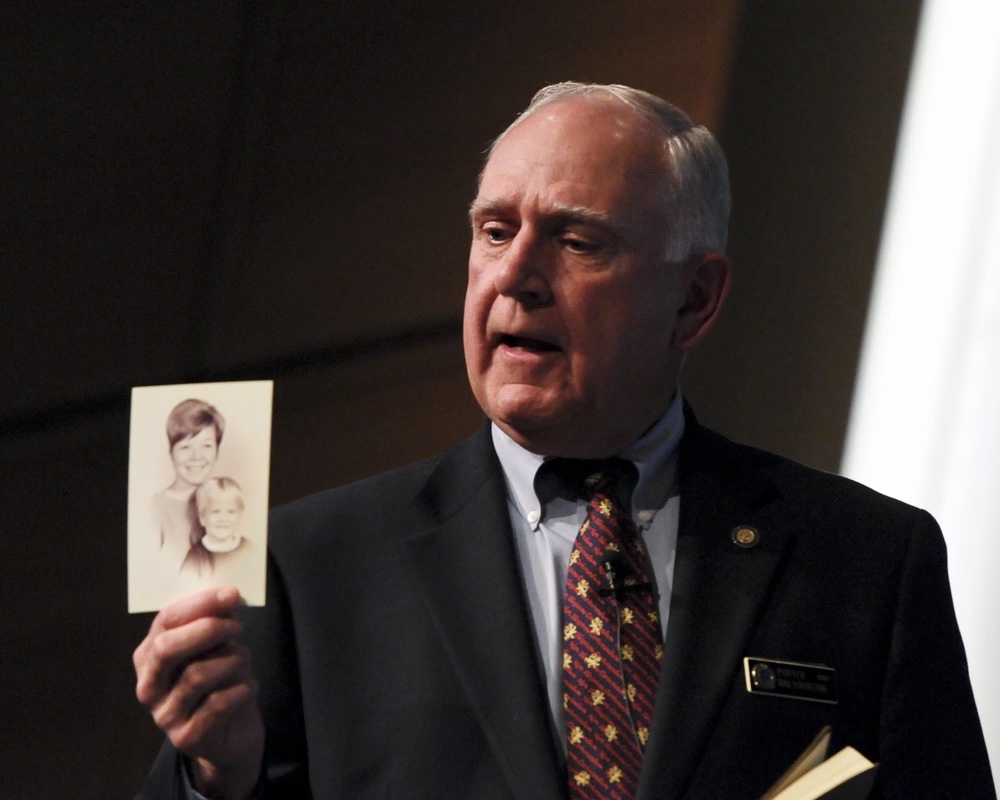

His most precious gift from home was a photo sent to him in 1969 of Marty and their daughter, Dabney.

He describes living in the past and future to avoid the present, yet ironically the prisoners who survived captivity did so by facing and overcoming their present circumstances with communication, creativity, mutual support, subtle subversion, and a sense of humor.


I laughed out loud at some of the antics Halyburton describes: tricking the guards with American slang, sing-songing and dancing their roll call. But the most shockingly funny story in the book involves a perverted guard and a duck. Guaranteed to crack you up. “Quack, Quack!”


With a generous sharing of his poetry, private thoughts, and journal entries, Halyburton achieves a deep introspection and personal history that helps us understand the experience of prisoners of war in Vietnam. Readers and lovers of books will be pleased to see his references to authors John M. McGrath, Edgar Allan Poe, Jim and Sybil Stockdale, George Hayward, and Viktor Frankl.


Frankl’s “Man’s Search for Meaning” helped Halyburton put his POW experience and survival into context in its examination of human suffering at the hands of others and what it reveals about ourselves, how we react, and whether we have free will and the freedom to choose. “I realized that our lives were determined more by the choices that we made rather than the circumstances of our captivity."

That, he says, was “the first great lesson” he learned from his captivity.

“I learned a second great lesson from my experience, but it did not come until the very end. As I wrote in my journal, when I walked through the gates of the Hanoi Hilton on February 12, 1973, as we were leaving the prison the had symbolized all the misery and hatred that we had endured over those many years, I turned to face the compound and said, ‘I forgive you.’ I did that because I knew I could not and should not carry that hatred back home with me, back to my family and my life of freedom. I realized during the last few hours of my captivity that although hatred had been useful as part of the armor that had protected me from the influence of my captors, it was no longer needed. Hatred is a poison to the soul, mind, and body, and it has been the source of many of the ills in the world throughout most of our history … One must choose to forgive.” 
Reuniting with family, hugging Dabney, in 1973.
The concept of “freedom” is so cherished, we are willing to fight to defend it. Freedom demands responsibility, accountability, and ultimately a reckoning with the truth. In Halyburton’s case, the truth involved forgiveness and letting go of hate.


Speaking of which…


In 2022, we’ve seen a thriving democracy –– Ukraine –– under attack by Putin’s Russia, and we wonder if the world can forgive the unforgettable murder, terrorism, and destruction Putin continues to unleash out of pure hate.


Today, Ukraine’s President Zelensky visits the United States to express his thanks to Americans for our defensive military support, in the name of freedom.


Top photo: U.S. Naval War College Professor Emeritus Porter Halyburton shows a photo of his wife and daughter during a lecture at the Naval War College about his time as a prisoner of war in North Vietnam during the Vietnam War. Halyburton was held captive for seven years in a number of prisons, including the infamous “Heartbreak Hotel” and “Hanoi Hilton.” (MC2 Eric Dietrich)

Friday, April 19, 2019

Bill Nye Wants Your Help


Review by Bill Doughty

Nye reflects on the "overview effect" in his mind-opening "Everything All at Once," (Rodale, 2017). He offers a cool perspective on how we can help heal the world. That perspective comes from space, from inside the human psyche and the down-to-earth reality of the greatest threat facing our planet.

Nye is another critical thinker who calls for a Green New Deal for current and future generations: infrastructure and support for renewable energy, clean water and internet connectivity. Last month he formally endorsed the idea at SXSW.

"Everything All at Once" is a good Earth Day read with some strong Navy ties and with a fascinating insight on how his father survived as a prisoner of war in WWII.

Bill Nye's mom, Lt. Jacquie Jenkins, served in WWII.
In remarks at the Reason Rally in Washington D.C. in the late spring of 2016 he reminds us what the Second World War generation achieved:
"To those who think we can't get renewable sources in place quickly enough, I give you this response ... Both my parents were in World War II; their ashes are interred across the river from here (the Lincoln Memorial) in the Arlington National Cemetery. My father survived nearly 4 years as a prisoner of war captured from Wake Island. My mother was recruited by the U.S. Navy to work deciphering the Nazi Enigma code. They were part of what came to be called the Greatest Generation, but they didn't set out to be great. They just played the hand they were dealt. In barely 5 years, their generation resolved a global conflict and started building a new, democratic, technologically advancing world. With and emphatic sense of purpose, they embraced progress."The current generation must employ critical thinking and our powers of reason just as they did. This time, the global challenge is climate change. We also must play the hand we have been dealt and get on with it. Together we can change the world."
Self-described nerd, Bill Nye, also offers pun-ishing humor throughout, balancing irony and serious reality. He writes with a light yet respectful touch, open to other voices, always seeking to understand.

Nye shows the power of strong parents instilling core values, including honesty, courage and commitment. He notes, "there are such things as inviolable truth and facts."

His father, Ned Nye, and his dad's fellow prisoners witnessed a sailor "beheaded with a sword in a weird reenactment of a 17th-century Edo ceremony, just to show the prisoners that their captors meant business." 

How did the prisoners deal with physical and mental abuse? He writes, "Every day these guys were subjected to beatings. Every day they were hungry. Every day they were exhausted. In summer, they worked in oppressive heat. In winter, they were chilled to the bone." The prisoners created a fake language they called "Tut" to communicate privately. 

The prisoners found pleasure in recognizing and highlighting the absurdity of their situation, including the actions of a swaggering martinet in their own ranks who tried to impress them by "peppering his sentences with the term 'disirregardless.'" Being able to self-reflect, shift perspective and find humor in any situation helped is dad survive as a POW. The nonword "disirregardless" became an "essential distraction" and part of Nye family lore that lives on to this day for Bill and his sister. When a pompous leader takes himself too seriously and loses humanity he can become the butt of a joke.

But Nye says the threats to our climate are no joking matter.

As far back as the nation's first Earth Day, April 22, 1970, Nye was motivated. "I was convinced that we were headed for trouble as a species," he writes, "unless we could start using our brains more rationally, and it shaped how I approach my own environmental impact and goals for the future."

Bill Nye (The Science Guy) talks about the LC-130 with its navigator, Air Force Maj. Amanda Coonradt, during a visit to Antarctica. (Photo by Katie Lange)
Nye reflects on the global commons, the fact that Richard Nixon created the Environmental Protection Agency, Carl Sagan's warning of a "nuclear winter," the human impact to the planet as shown in Kentucky and Greenland, and the fact that carbon dioxide in the atmosphere moved beyond 400 parts per million in 2016.

He calls for shared action to address the dangers of global climate change. "To save the planet for us humans, we have to pay attention to our shared interests rather than stumble into chaos as unconnected, self-interested individuals. We have to harness both knowledge and responsibility," he advises.

"Everybody knows something you don't," he says. It's a profound and humbling concept. And it's a call for cooperation.

Finding answers in a collective consciousness, he says, helps us design practical solutions to face fear and confront challenges, including climate change.
"Instead of running around in circles, waving our arms – or, worse, going about our business in willful ignorance – we could get to work know. We could erect wind turbines off the east coast of the United States, Canada, and Mexico. We could install photovoltaic panels practically everywhere the Sun shines. We could heat and cool a lot of our dwellings, offices, and factories using geothermal sources. We'd create jobs, boost the economy, clean the air, and address climate change. If you really want to make America great (and the rest of the world, too), these are the main things you, I mean we, need to do. It sounds like an enormous undertaking, and it is, but we've seen again and again, the enormous ones begin with small perceptual shifts."
The blueprint for coming together to create and sustain a better world for children and grandchildren occurred in Europe and Asia/Pacific in the last century:
"World War II showed the terrifying possibility of global self-destruction; its aftermath inspired new institutions to promote constructive collaboration on a world-wide scale. Some of it appeared in the form of international treaties. Some of it appeared as networks of related science, technology, and environmental-research programs. The United Nations, despite its limits and shortcomings, provides a forum for international discussion and decision-making. Doctors Without Borders engages physicians from all over to provide medical services to those in need. The Convention on International Trade in Endangered Species (CITES) and Conservation International work to stop poaching and conserve threatened species. The Conference of Parties in Paris in 2015, known as COP21, produced the most meaningful international agreement yet on reducing greenhouse gases."
Even if progress is not linear or the horizon seems too far, "The longest journey begins with but a single step," Nye says.

How big a nerd is he? Bill Nye gets tied in knots in his excitement about knot-tying, and gives an interesting twist on the joys of physics. He speaks of the joys of the square knot, the square bow, two half-hitches, bowline, clove hitch and sheepshank, among others.

Bill Nye talks with 14-year-ole Joey Hudy about his Extreme Marshmallow Cannon at
a science fair held at the White House on Feb. 7, 2012 (NASA/Bill Ingalls)
This book is a treasure-trove for critical thinkers and nerds, with discussion on the scientific method, Occam's razor, entropy, anti-vaxxers, high school physics, electric vehicles, James Cameron, GMOs, the National Archives, and confirmation bias – "the tendency to confirm our our assumptions as valid and true."

Nye relates a wonderful story about a flight attendant and an unruly passenger; it's another call for shifting perspective and showing respect for one another. He reflects on what it was like working at Boeing, tells how he helped his parents quit smoking (using exploding cigarettes), writes about his grandfather fighting (on horseback) in the World War I, and challenges us to rediscover missions in space, including a possible journey to Europa and continued journeys to Mars.

Curiosity journeyed to Mars. Another more advanced rover is planned in the months ahead. (NASA)
With respect and awe, Nye writes about how the scientists at NASA created previous Mars rovers, especially Curiosity. NASA teams are working to send an "even more advanced rover, currently called Mars 2020. Both rovers are about the size and mass of a Chevrolet Spark automobile. So how are they going to do it?"
"If you have the naive confidence of a budding engineer, you might think, 'It can't be all that hard. We just have to slow down enough to roll or skid to a stop. We land airplanes all over the place every day. We landed all sorts of things on the Moon.. Surely we've got the basics of that figured out by now.' In other words, you'd start with the problem you know ... But it turns out that this business of setting down intact on the surface of Mars is some kinda crazy complicated. On Earth you have a lot of air to work with, and even the fastest fighter jets are dealing with much, much lower speeds. When the probe carrying the Curiosity rover approached Mars, it was moving at more than six times as fast as an F-35, with the throttle at the firewall – going all out. That's a lot of energy to dissipate."
Tackling problems starts with good design, ideals and values. That includes running a government. Nye shows reverence to the canon of our nation in the Declaration of Independence, Constitution, and Bill of Rights. Notably, these founding documents are in the Canon of the CNO's Professional Reading Program.

Our founders, he says, put us on a path toward a more perfect union. "Just as science doesn't claim to attain absolute truth, the Constitution does not claim to achieve the utopian ideal of government," Nye writes. "Fortunately, the founders embraced a never-ending search for better ideas and better solutions."

This review of "Everything All at Once" just scratches the surface of what is a fun, thoughtful and compelling read, especially for Earth Day. Highly recommended.


Bill Nye, left, executive director of The Planetary Society, and science educator, gets excited as the Chief of Naval Research Rear. Adm. Nevin Carr presents him with a powered by Naval Research pocket protector during the Navy Office of General Counsel Spring 2011 Conference. (Photo by John Williams)

Sunday, September 16, 2018

McRaven's Relative Superiority / Six Principles

Review by Bill Doughty

Adm. (ret.) William H. McRaven believes in six special warfare principles of success. His theory of special operations, based on the six principles, can achieve "relative superiority" in combat.

Forty years ago – 1978 – McRaven became a Navy SEAL. He achieved a pinnacle as a special operations warrior as commander of the United States Special Operations Command in August 8, 2011. That year he oversaw Operation Neptune's Spear that captured and killed Osamu bin Laden. 

Fifteen years before that operation McRaven wrote "Spec Ops: Case Studies in Special Operations Warfare, Theory and Practice" (Presidio Press, 1995).

The book uses six World War II case studies and two events in the 70s, written with clarity, detail and suspense, Tom Clancy-like, to illustrate how and why the theory of special ops works. Small teams, following the six principles, can prevail despite fortifications, in the face of greater numbers, and despite the inevitable hardships and challenges facing attackers.
"The theory states that special operations forces are able to achieve relative superiority over the enemy if they prepare a special plan, which is carefully concealed, repeatedly and realistically rehearsed, and executed with surprise, speed and purpose. Once relative superiority is achieved, the attacking force is no longer at a disadvantage and has the initiative to exploit the enemy's defenses and secure victory. Although gaining relative superiority does not guarantee success, no special operation can succeed without it. Consequently, by demonstrating how special operations forces achieve relative superiority, the theory can help explain the success or failure of a mission."
McRaven channels thinkers and theorists like Herman Kahn, B.H. Liddell Hart and especially Carl von Clausewitz. Frictions, as described by Clausewitz, can be minimized if a team applies McRaven's six principles: simplicity, security, repetition, surprise, speed and purpose.

  • Simplicity: Less is more. Limit objectives. Incorporate intelligence and be agile and open to innovation.
  • Security: Conceal timing and details/methods of the operation.
  • Repetition: "Routine hones those tactical skills to a degree that allows quick reaction to a threat..."
  • Surprise: Deception causes confusion. Timing needs to be carefully planned to take maximum advantage of the enemy's vulnerabilities. 
  • Speed: Relative superiority is achieved in the first few minutes of an operation. Time is measured in seconds and minutes.
  • Purpose: "Purpose is understanding and then executing the prime objective of the mission regardless of emerging obstacles or opportunities." Two aspects of purpose: It's clearly defined (focused) and there's personal commitment by all participants.

A German DFS 230 glider, used in special operations in World War II.
"The case studies span time and nationality and are not subject to trends in military thought or practice," writes McRaven. The principles are organized in three phases: planning, preparation and execution.

In the execution phase he takes us inside British X-craft midget submarines, aboard German WWII giant glider planes and into dictator Idi Amin's Uganda.

The Raid on Entebbe and the attack on Germany's battleship Tirpitz, are edge-of-the-seat highlights in this book that demonstrates the need for reasoning and critical thinking.

We read about Adm. John S. McCain II being notified of a raid on Son Tay POW camp on Nov. 21, 1970, during the Vietnam War. One hundred and sixteen aircraft participated in the attempt to rescue POWs thought to be at the camp just west of Hanoi. U.S. Navy ships of Carrier Task Force 77 provided a textbook diversionary raid:

"It is estimated that twenty SAMs (Surface to Air Missiles) were fired at the force, but no casualties were sustained. It was later reported that 'the density of the Navy operations in the Gulf of Tonkin [during the Son Tay raid] was the most extensive Navy night operation of the SEA [Southeast Asia] conflict.'"

Yoni Netanyahu, hero of Entebbe rescue.
Israel's bold extraction of more than 100 hostages, led by brave Lt. Col. Jonathan Netanyahu, is considered the "best example yet of how the principles of special operations are used to achieve relative superiority," McRaven concludes. The account is dramatic:
"One of the Israelis, Amir, was the first man into the terminal. He penetrated through the second door of the main hall. inside was a large, well-lit room where all the hostages were lying on the floor. A terrorist, who had been lying on the other side of the door, fired a burst from his Kalashnikov but miraculously missed Amir. Amir returned fire. His rounds sliced through the door and killed the terrorist instantly. As trained, Amir turned right and cleared his side of the room. Behind Amir came another commando, who turned left and picked up coverage on the other side of the room. As the second commando entered, he saw two terrorists lying on the floor to his left, their rifles trained on Amir. Immediately he fired and both terrorists were killed."
A British captain aboard an austere X-craft mini submarine.
Loaded with maps, diagrams, photos (including collected by the author), and crisp prose, this book is a highly recommended textbook on strategy for military leaders. 

Early in "Spec Ops" he makes a key point about sustaining relative superiority. "The ability to sustain relative superiority frequently requires the intervention of courage, intellect, boldness and perseverance, or what Clausewitz calls the moral factors."

McRaven shows how the lessons of history apply to strategy and tactics to educate future generations.

After his distinguished career, Adm. McRaven served from 2015 to 2018 as the chancellor of The University of Texas System. He is the author of "Make Your Bed," featured last year on Navy Reads.

Sunday, August 12, 2018

John McCain: The Bell Tolls

Review by Bill Doughty

The bell tolls for John McCain.

He says so in "The Restless Wave: Good Times, Just Causes, Great Fights, and Other Appreciations" (Simon & Schuster, 2018), a book mentioned last May in "The Found Haiku of John McCain."

Senator McCain, a Navy veteran and former POW, calls for civility, humility and compassion in this heartfelt memoir. He opens the book with "accumulated memories" while attending the Pearl Harbor Remembrance ceremony on December 7, 1991 on the 50th anniversary of the attack; he attended with fellow senators Bob Dole and Dan Inouye. President George H. W. Bush delivered remarks.

Among Bush's remarks were these words: "World War II also taught us that isolationism is a bankrupt notion. The world does not stop at our water's edge. And perhaps above all, that real peace, real peace, the peace that lasts, means the triumph of freedom, not merely the absence of war."

Vice Adm. John S. McCain Sr., the senator's grandfather.
"That day, we watched two thousand Pearl Harbor survivors march to honor their fallen," McCain writes. In recent years only a relative handful of survivors are able to attend the ceremony in Pearl Harbor.

Among his accumulated memories: the service and sacrifices of his grandfather, father, mother (matriarch of a military family) and other family members and friends. Many of his closest friends were fellow prisoners of war and other Vietnam veterans.

"I feel the weight of memories even more now, of course," he writes in "The Restless Wave."

John Donne
Written with long-time collaborator Mark Salter, McCain cites several times both Hemingway's war novel "For Whom the Bell Tolls" and the lines of prose by John Donne that inspired Hemingway's title:
"No man is an island, entire of itself; every man is a piece of the continent, a part of the main. If a clod be washed away by the sea, Europe is the less, as well as if a promontory were... Any man's death diminishes me, because I am involved in mankind, and therefore never send to know for whom the bells tolls; it tolls for thee."
Hemingway received the Nobel Prize in 1954 for "For Whom the Bell Tolls."
John McCain will turn 82 this August 29. Now, as he reflects on a life well-lived in "The Restless Wave," he calls for greater concern for the civil rights of those he considers less fortunate than himself.
"I believe the United States has a special responsibility to champion human rights in all places, for all peoples, and at all times. I've believed that all my life. I was raised to believe it, to see it in the examples of gallantry put before me, in the histories and novels and poems I was encouraged to read, in the conduct of the heroes I admired, those to whom I was related or knew personally, and those who were commended to me. I am a democratic internationalist, a proud one, and have been all my public life. I could have been nothing else given my role models and influences. I took from Hemingway's 'For Whom the Bell Tolls' that defending the dignity of others is never a lost cause whether you succeed or not. And I thrill to the exhortation in the poem that inspired the novel, to be 'part of the main,' to be 'involved in mankind.'"
McCain reflects on his experience in the Senate – as the Navy's liaison while still on active duty – to his fights "with and against" Ted Kennedy. He recounts his stand against torture,  experiences in Iraq and Afghanistan, position on Putin and pivotal vote to save the Affordable Care Act.

Senators John McCain and Ted Kennedy.
Defending dignity is at the core of Americans' national identity, McCain writes. "The right to life and liberty, to be governed by consent and ruled by laws, to have equal justice and protection of property ... and it is fidelity to them – not ethnicity or religion, culture or class – that makes one an American." Our creed "gave us a purpose in the world greater than self-interest."

Consider that perspective this weekend on the first anniversary of the murder of a civil rights activist by a white supremacist in Charlottesville, Virginia.

"Humility," McCain writes, "is the self-knowledge that you possess as much inherent dignity as anyone else, and not one bit more." He approaches the issue of immigration with humility, offering practical and compassionate solutions as he acknowledges the problems of illegal immigration and the challenges of border control but balanced with an understanding of the causes and a humane response.

Common themes throughout "Wave" are reasoned humility and a principled tough stand for human rights.
"Human rights are not our invention. They don't represent standards from which particular cultures or religions can be exempted. They are universal. They exist above the state and beyond history. They cannot be rescinded by one government any more than they can be granted by another ... Human rights advocacy isn't naive idealism. It's the truest kind of realism. Statesmen who think that all that really matters in international relations is how governments treat each other are wrong. The character of states can't be separated from their conduct in the world. Governments that protect the rights of their citizens are more likely to play a peaceful, constructive role in world affairs. Governments that are unjust, that cheat, lie, steal, and use violence against their own people are more likely to do the same to other nations."
McCain talks tough about the dangers posed by authoritarian leaders, including Russia's Putin, who he met and spoke with several times over the years. McCain warns specifically of "Russia's nostalgia for empire" after the Cold War and collapse of the Soviet Union.

"Resentment and humiliation spread in Russia in the chaos, dislocation, and corruption of the erratic Yeltsin years, and eased the way for that striving, resentful KGB colonel, who seems to feel those emotions sharply and, to borrow an observation from 'Game of Thrones,' used chaos as a ladder," he writes.

McCain describes a fascinating interaction with Putin at the Munich Security Conference in 2007. While still on active duty, McCain first attended the conference in 1970 when he was Navy liaison to the Senate. In 2007, in the face of a fiery rhetorical attack on the United States, McCain responded with quiet resolve: "The United States did not singlehandedly win the Cold War in some unilateral victory," he told Putin and the European conference attendees. "The transatlantic alliance won the Cold War."

In "Wave" McCain recounts his interaction with Bill Browder, whose Russian lawyer, Sergei Manitsky, 37-year-old father of two, was arrested under Putin's orders and beaten to death by eight prison guards and orderlies. McCain, along with Representative Jim McGovern, Senator Ben Cardin and "a long list of co-sponsors," introduced what would become the Global Magnitsky Act calling for sanctions against Russian oligarchs, among others.

Profiles in Courage: Sen. John McCain meets with Secretary of Defense James Mattis.
Putin's reaction to the Magnitsky Act likely contributed directly to Russia's interference in the 2016 U.S. presidential election.

McCain reflects on human rights in his discussion of Ukrainian independence and threats to Balkan states by Putin's Russia.

He invokes Martin Luther King's "'the fierce urgency of now,' the transformational moment when aspirations for freedom must be realized, when the voice of a movement can't be stilled, when the heart's demands will not stand further delay."  Human rights is at the forefront in his interactions with leaders and dissidents in dozens of countries:
"I have done what little I can to stand in solidarity with forces of change in countries aligned with us and opposed to us, in Russia, in Ukraine, in Georgia and Moldova, in China, in Serbia, Kosovo, Montenegro, in Egypt, Libya, Tunisia, Syria, Saudi Arabia, and Turkey, in Iran, Uzbekistan, Kazakhstan, in Cuba, Nicaragua, in Zimbabwe and South Africa, [in Burma (Myanmar)], and wherever else people fighting for their human rights wanted our help. I've protested killings, torture, and imprisonments. I worked to sanction oppressive regimes. I've encouraged international pressure on the worst offenders. I've helped secure support for people building the framework of an open society. I've monitored elections, consoled the families of political prisoners, worried about the risk-takers and mourned their deaths. I've gotten more from them than they've gotten from me. I've gotten their hope, their faith, and their friendship."
He devotes one of his ten chapters to the Arab Spring and laments the situation in Syria:
"As of today, as the Syrian war continues, more than 400,000 people have been killed, many of them civilians. More than five million have fled the country and more than six million have been displaced internally. A hundred years from now, Syria will likely be remembered as one of the worst humanitarian catastrophes of the twenty-first century, and an example of human savagery at its most extreme. But it will be remembered, too, for the invincibility of human decency and the longing for freedom and justice evident in the courage and selflessness of the White Helmets and the soldiers fighting for their country's freedom from tyranny and terrorists. In that noblest of human conditions is the eternal promise of the Arab Spring, which was engulfed in flames and drowned in blood, but will, like all springs come again."
One of the best parts of this memoir is the final chapter, where McCain reflects with humble poetic insight about family, home, friendship, service and true patriotism as the bell tolls:

"'The world is a fine place and worth the fighting for and I hate very much to leave it,' spoke my hero, Robert Jordan, in 'For Whom the Bell Tolls.' And I do, too. I hate to leave it. But I don't have a complaint. Not one. It's been a great ride," McCain writes.

Saturday, January 27, 2018

Bond of 'Jersey Brothers'

Review by Bill Doughty

After Imperial Japan attacked Oahu, three brothers serving in the Navy experienced the war and witnessed history from distinct vantage points: one aboard USS Enterprise (CV 6), one as an aide to President Franklin D. Roosevelt, and one as a Prisoner of War in the Philippines.
Barton, Bill and Benny before the war

Prior to the war, big brothers Benny Mott (gunnery officer aboard Enterprise) and Bill Mott (a naval intelligence officer) hoped to keep their younger brother, Barton Cross, safe, so Bill recommended Barton become a Supply Corps officer and serve in the  Philippines.

But then, nine hours after Pearl Harbor was attacked, the Japanese bombed and strafed U.S. forces in the Philippine Islands. Barton was wounded and hospitalized in the air attack.
"Their opening salvos went to the heart of the island's air defenses, which proved an easy mark. Despite Washington's urgent, repeated orders to General Douglas MacArthur – at the time the U.S. Army Forces Commander in the Far East – to launch his planes and initiate air operations, beginning minutes after the start of the attack on Pearl Harbor, he did not respond. Nor did he ever issue the order. As a consequence, virtually every U.S. plane at Luzon's primary airfields, Clark Field and Nichols Field, was bombed on the ground, wingtip to wingtip. The army's entire staple of bombers, their payloads full, was wiped out in a matter of hours."
With Army Air Corps protection gone, Navy submarines of the U.S. Asiatic Fleet were vulnerable and had to sortie to Darwin, Australia. 

When it came time for MacArthur to retreat from the Philippines, he ordered the evacuation of Army casualties – but not the Navy's wounded – hospitalized in Manila.

Jersey Brother Barton became a POW, subjected to marches, deprivation and atrocities documented by eye witnesses and other records cited by author Sally Mott Freeman in "The Jersey Brothers: A Missing Naval Officer in the Pacific and His Family's Quest to Bring Him Home" (Simon & Schuster, 2017).

Escape was foremost in POWs' minds, but Imperial Japanese guards had ways of preventing escape:
"Nothing focused the mind on the perils of escape more than the particular return of three prisoners – two army colonels and a navy lieutenant – who were summarily stripped naked, marched across the camp to the entrance, tied up, and flogged to insensibility. They were kicked to their feet, led out the front gate with their hands tied behind them, and strung up to hang from cross-pieces of wood several feet above their heads. A two-by-four was placed beside them, and when any Filipinos passed by on the road, they were summoned by the Japanese guards to pick up the timber and smash each of the hanging prisoners in the face. Then the guards would follow up and lay on their whips."
All three POWs lived for three days before two were shot and the third was beheaded.

Meanwhile, Barton's brothers did everything they could to try to locate him and learn his fate.

Oldest brother, Benny, served aboard Enterprise with Adm. "Bull" Halsey, another native of New Jersey.

Years earlier, when Benny was a midshipman at the U.S. Naval Academy, Halsey commanded the USS Reina Mercedes, the Annapolis station ship, and the two established a relationship at social gatherings for upperclassmen. Both were proud of their state:
"During those more relaxed affairs, Benny and Captain Halsey often discussed navy football and another common passion: the underappreciated virtues of their shared home state of New Jersey. Halsey had relished these chest-beating interludes about the state: 'The home of Alexander Hamilton, Thomas Edison, and Albert Einstein!' he would crow in mock exasperation, drawing wide grins from Benny every time. At Annapolis, Benny and Bill were both known for their proud defense of the Garden State – against routine mockery. They even embraced their nickname, 'the Jersey Brothers,' despite its implicit derision. Was it Halsey who started that? Benny couldn't remember, but it stuck ... Halsey always appreciated Benny's family high notes including the Motts' ancestral link to members of the iconic fraternal order that boarded the tea-laden vessels Dartmouth, Eleanor and Beaver in Boston Harbor in 1773."
USS Enterprise and USS South Dakota engage Japanese ships and planes on Oct. 26, 1942. NHHC.
Benny was aboard Enterprise for the Doolittle Raid on Tokyo and in the Battle of Santa Cruz Islands during the Guadalcanal campaign, described graphically in "The Jersey Brothers." Benny's quarters were destroyed in the attack. "His old surroundings were barely recognizable; the room was a smoky tumult of wet, scorched debris." Other gunners and other ships were not so lucky.
"The reality stunned: at the conclusion of the Battle of Santa Cruz, the USS Enterprise was now the only operational American aircraft carrier in the hostile waters of the Pacific. One by one, every other prewar flattop had either been lost in battle or forced to withdraw for lengthy repairs. Lexington had gone down in May at the Coral Sea battle. Yorktown was lost at Midway less than a month later. On the last day of August in the Eastern Solomons, Saratoga had taken a second devastating torpedo hit and retired to drydock at Pearl Harbor. Wasp, en route to Guadalcanal two weeks later, was fatally struck by three torpedoes. And now Hornet's pyre burned over the horizon."


Using "industrial-grade paint" Sailors aboard "The Big E" painted and erected a large, defiant sign: "Enterprise vs. Japan." 
"Over the course of 1942, Enterprise had been struck a total of six times by Japanese bombs or torpedoes and had suffered hundreds of casualties. The painted sign reflected both the grimness of the situation and the grit of a determined crew: this sole surviving American aircraft carrier in the seventy-million-square-mile Pacific war front was in no mood for backing down."
Benny had a ringside seat to the war in the Pacific. Jersey Brother Bill was an eyewitness to history at FDR's side, principally in the White House Map Room. Bill developed a connection with WInston Churchill and Eleanor Roosevelt. He had to inform the president of the death of the Sullivan brothers, five brothers lost in November 1943 aboard the light cruiser USS Juneau off Guadalcanal.

Adm. Richmond Kelly Turner
Earlier, Bill followed Station Hypo's progress leading to the Battle of Midway. Later, after successfully lobbying to be stationed in the Pacific – closer to his brothers – Bill integrated Navajo Code Talkers so they would be "coordinated properly with their multiple constituents in the amphibious forces complex communication chain."

Bill was there when Adm. Spruance approved the firing of Army Maj. Gen. Ralph Smith in coordination with Adm. Richmond Kelly Turner and Marine Gen. Holland "Howlin' Mad" Smith.

Bill's relationship with the "famously abrasive" Adm. Turner was deep and lasting. We get an insight into the character of Turner, who led amphibious assaults at Guadalcanal and Iwo Jima. Turner supported Bill's efforts to locate his POW brother, Barton, just as Halsey supported Benny's efforts to try to find his Jersey brother.

As a Navy captain and CO of USS Astoria (CA-34) in 1939, Turner visited Japan to return the ashes of Japan's ambassador to the United States and meet with Foreign Minister Arita Hachiro. After the Japan's surrender in 1945, Turner went to the Togo shrine in Tokyo, which he had visited in that diplomatic mission.
"Standing at the Togo shrine, Admiral Turner made this prescient observation: 'If we play our cards well, the Japanese will become our best and most worthwhile friends. They have certain fundamental virtues in their character, which in time, I hope, will be appreciated by all worthwhile Americans. We should be most careful to respect their gods and their traditions, and I hope they will come in time to respect ours.'"
Records retrieved from the Philippines and made available by the Navy's Bureau of Medicine and Surgery, as well as interviews and letters, helped Freeman piece together life for Barton as a prisoner of the Japanese. She recites how prisoners were mistreated, how they survived sometimes for years, and how they made tough choices – whether to attempt escape or remain as prisoners and prevent repercussions on fellow prisoners.

Freeman explores the tensions and turmoil of interservice rivalry during the war, with Gen. MacArthur front and center, saying "The Navy fails to understand the strategy in the Pacific." Much of the author's source material comes directly from the MacArthur Memorial Archives.

Commander in Chief Pacific Fleet and Pacific Ocean Areas Adm. Nimitz confers with south Pacific area officers, possibly aboard USS Argonne (AG-31) at Noumea, New Caledonia, Sept. 28, 1942: Army MGen Richard K. Sutherland, Chief of Staff to General MacArthur; (Nimitz); VADM Robert L. Ghormley, Commander South Pacific Force; and USAAF MGen Millard F. Harmon, CO of U.S. Army Forces South Pacific Area. (Naval History and Heritage Command)
Author Sally Mott Freeman
MacArthur bristled under the shared leadership of Adm. Nimitz in the Pacific. Readers will enjoy a fascinating explanation of the command and control relationship in Chapter 14 (pages 174-5). Chief of Naval Operations Adm. E.J. King considered MacArthur a megalomaniac, according to Freeman, a general who rewarded flattery and other sycophantic behavior by his staff. "It is said that a fool flatters himself, but a wise man flatters the fool."

This book shows us many sides of the war – including a family's deep struggle on the homefront during and after the war. This is a highly recommended, multidimensional study of the Pacific War, which was won by superior sea power. "Without sea power," said Nimitz, we would not have advanced at all."

The afterward and epilogue to this book are well-written, well-researched and personal accounts worth reading and re-reading for anyone interested in treatment of POWs and in the way war can affect families.

Saturday, May 30, 2015

Catching Up on Names, Namesakes

by Bill Doughty
New Jersey, John Finn, Midway and Craig Symonds, Mary Roach, Jimmy Carter and John S. McCain – all in the news recently and each with featured spots in Navy Reads. Make the connections...

A state of the Navy is New Jersey. Secretary of the Navy Ray Mabus announced this week that the newest Virginia-class attack submarine to be named after the Garden State would be SSN 796, USS New Jersey. A DOD story this week reminds us that the Navy’s first submarine, USS Holland, was designed and built in New Jersey in 1900.

Medal of Honor recipient John Finn, Dec. 7, 2006.
In Mabus's home state of Mississippi, at the beginning of this month, USS John Finn was christened at Ingalls Shipbuilding in Pascagaoula. According to an informative post about John Finn on Navy Live Blog, "The future USS John Finn is the 63rd Arleigh Burke class destroyer, and the first of the DDG 51 Flight IIA restart ships."

John Finn passed away five years ago this week, May 27, 2010. We interviewed him for Navy Reads in late 2009, when he told us his favorite author prior to World War II was Ernest Thompson Seton – author, artist and naturalist. “I always loved books about wildlife,” he said. 

Finn was a hero who fought back against Imperial Japanese Navy planes attacking Oahu, Hawaii on December 7, 1941.

Craig Symonds
On Oahu next week Craig L. Symonds will be featured speaker at the Pacific Aviation Museum on Ford Island, Pearl Harbor to commemorate the 73rd anniversary of the Battle of Midway, which became the namesake for a great aircraft carrier, USS Midway (CV 41), now a museum in San Diego. The battle is considered the turning point of the war in the Pacific, just six months after the attack on Pearl Harbor and Oahu.
Dr. Symonds, a scholar of naval history and the Civil War, will conduct several book-signing events and interviews during the week leading up to the event at PAM, Saturday, June 6, 2015.

Mary Roach
Meanwhile, another gifted author who has contributed to Navy Reads, Mary Roach, is up in Skagway, Alaska this week as keynote speaker for "Exploring the Frontiers of Language / Let Skagway Inspire You," sponsored by North Word Writers Symposium. Roach – a champion of science, humor and critical thinking – is author of the New York Times bestsellers "Gulp: Adventures on the Alimentary Canal," "Packing for Mars: The Curious Science of Life in the Void," "Stiff: The Curious Lives of Human Cadavers," "Bonk: The Curious Coupling of Science and Sex," and "Spook: Science Tackles the Afterlife." 

Yesterday, 90-year-old Navy veteran and former U.S. President Jimmy Carter – author of numerous books on human rights, history, international relations and peace – attended a change of command ceremony for his namesake submarine, Seawolf-class attack submarine USS Jimmy Carter (SSN 23) during a ceremony at Naval Base Kitsap, Bangor, Wash.

Cmdr. Melvin Smith (right) assumes command of USS Jimmy Carter.
Cmdr. Melvin Smith relieved Cmdr. Brian Elkowitz as commanding officer.


A Navy.mil story noted that "the 39th president and 2002 Nobel Peace Prize winner is the only U.S. president to graduate from the Naval Academy and the only one to qualify on submarines."

Carter, who graduated from the Naval Academy in 1946 and served in the Navy until 1953, said: "Of all the honors I have ever received, I've never had anything of greater honor than the chance to be the namesake of USS Jimmy Carter."

Vice Adm. John S. McCain Sr. and Cmdr. John S. McCain Jr. in 1945.
In a ceremony May 28 in Yokosuka Japan, the forward-deployed Arleigh Burke-class USS John S. McCain conducted a change of command ceremony. Cmdr. Chad Graham relieved Cmdr. Chase Sergeant as CO. McCain is named for Admirals John S. McCain Sr. and John S. McCain Jr., both WWII veterans and leaders, grandfather and father to Senator John McCain, Vietnam veteran, Navy pilot and former POW.

Sen. McCain's book "Character is Destiny" was featured on Navy Reads last year. The book, written with Mark Salter, is filled with short biographies and inspirational stories about core values, leadership, and the importance of good character.