Showing posts with label President Obama. Show all posts

Tuesday, July 16, 2024

Interesting Situation…

Review by Bill Doughty––

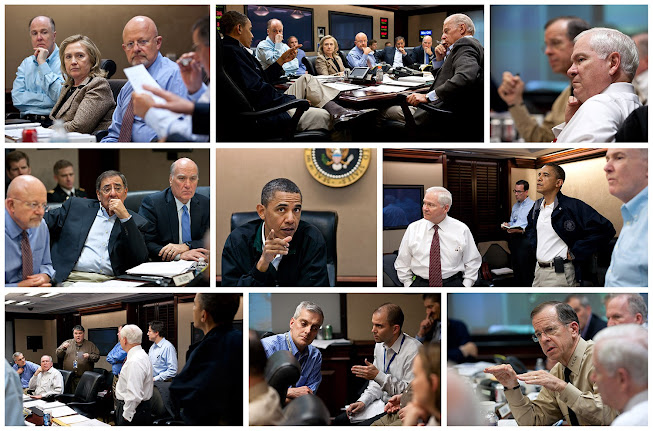
George Stephanopoulos pulls back the curtains of secrecy surrounding one of the most important rooms in the world: The White House Situation Room is his momentous and relevant book for the “interesting times” in which we live.


Through vignettes, descriptions, and photos, we get to look into the room where key decisions are made and history is forged.


In “The Situation Room” (Hachette Books, 2024), author and pundit Stephanopoulos shows its creation by JFK during the Cold War, its role in the infamous Iran-Contra affair under Reagan and Bush Sr., and its iconic place in history during killing of Osama bin Laden under leadership of Obama, Biden, Gates and McRaven.


The book weaves together the importance of an integrated military-civilian team as part of the federal government, especially in intelligence. Stephanopoulos describes the importance of open and honest discussion in which every voice is heard, and no one is afraid to speak truth to power.

“This is the Situation Room at its best: a place of sober discussion, informed thinking, apolitical attitudes and an absence of grandstanding,” he writes. There is no place for loyalty tests or fear of retribution. The room was critical in the wake of 9/11 and dozens of other crises. In recent years the Situation Room was used by Vice President Pence and Drs. Fauci and Birx during the Covid pandemic under President Trump.


Repeatedly, we see the important tenet of good leadership: surround yourself with good people who can help shape good decision-making, especially in a crisis situation. We also see the opposite.


“This book examines crisis management in the modern presidency. During the Trump administration, the president was the crisis to be managed.

It took a toll on those who had to do it. Trump tore through and wore out his national security team: Four secretaries of defense. Four directors of national intelligence. Four White House chiefs of staff and five secretaries of homeland security. The most damning judgments of his competence and character come from those he appointed to these most sensitive positions. His first secretary of state, Rex Tillerson, famously told colleagues that Trump was a ‘moron.’ James Mattis, the former Marine Corps general who served as Trump’s first secretary of defense, described him as a threat to the Constitution ‘who does not try to unite the American people –– does not even pretend to try.’ Fellow Marine general and White House chief of staff John Kelly called Trump ‘the most flawed person I have ever met in my life.’”


Tillerson, Mattis and Kelly

Now, in the wake of the tragic attempted assassination of the former president, the situation may have changed, according to some pundits who hope for more understanding, unity, and comity. Yet, this week’s Republican National Convention showcases the rise of Christian Nationalism as many of Trump’s loyal associates and January 6 insurrectionists are in prison or under a cloud of indictments and accountability. That includes Trump himself. It’s a strong contrast to Biden, most of his associates, and particularly his national security team.


Stephanopoulos and Lester Holt recently interviewed President Biden in the wake of Biden’s abysmal debate performance. The interviews have apparently not allayed concerns about Biden’s ability to communicate effectively, fight threats to the Constitution, or defend his record of achievements on behalf of the middle class, women’s rights, bipartisan infrastructure, environmental issues, CHIPS and Science Act, reduced unemployment, and gun safety. This reality magnifies the importance of Biden's ability to surround himself with good people of honor, compassion, integrity, and dedication.

That is the current situation and the curse we are under: living in “interesting times.”

Wednesday, September 13, 2023

McRaven’s ‘Simple’ Bullfrog Advice

Review by Bill Doughty––

Seventy-three years ago, September 15, 1950, Gen. Douglas MacArthur landed at Inchon, Korea. In the following weeks, U.S. forces began to rout the communist North Korean army and push them almost to the Yalu River near China. Then, in November the Americans encountered well-armed Chinese interventionists supporting the North Koreans.


“Hill 205 seemed an unlikely place for an Army legend to be born,” writes Admiral William H. McRaven (U.S. Navy, Ret.) at the beginning of chapter 7 of “The Wisdom of the Bullfrog: Leadership Made Simple (But Not Easy). McRaven recounts the actions of Army Ranger First Lieutenant Ralph Puckett, who in 2021 received the Medal of Honor, presented by President Joe Biden for actions in Korea. At great personal risk, Puckett helped his Rangers locate and attack camouflaged Chinese machine gun nests and mortar teams that pinned them down.

“Puckett, who had positioned himself at the front of the advancing Rangers, knew there was only one thing he could do. With complete disregard for his own life, Ralph Puckett rose from his foxhole and dashed out into the open field, forcing the Chinese to take aim at the young lieutenant. As the machine gunners began to fire a the sprinting Puckett, the Rangers spotted their positions and engaged them. Puckett returned to his foxhole only to catch his breath, and then leaped out and ran into the open again. With each dash by Puckett into the exposed terrain, the Rangers were able to isolate and destroy more enemy machine gunners.

“Having suppressed the small arms fire, the Rangers proceeded to take Hill 205. History would show that over the next two days, the Rangers under the command of Ralph Puckett would fight off wave after wave of Chinese assaults that took the lives of ten Rangers and left thirty-one wounded, including Puckett.”

Puckett would again serve with honor in Vietnam, where he earned the Distinguished Service Cross and two Silver Stars and was personally recognized by President Lyndon B. Johnson.


McRaven uses the story of Puckett’s heroism at Hill 205 to illustrate the Ranger motto “Sua Sponte” (“Of Your Own Accord”).  “In other words, doing what needs to be done without being told to do so,” McRaven explains.

“There is often the misguided belief that soldiers only follow orders, but the strength of the American military is that the great soldiers, the truly great leaders, do what is right without being told. They do what is right to protect their men and women.”


Senior military leaders expect even young and relatively junior service members to take the initiative when necessary. Such integrated empowerment is a cornerstone of leadership, and can be effective not only in the military but also in business, sports, medicine, citizenship, and developing a healthy family.


A simple, powerful concept. Which is also a good descriptor for this small but excellent book.


Memorial statue of Basilone in New Jersey
“Sua Ponte” is just one of the ideas presented here by the author of “Make Your Bed,” “The Hero Code,” and “Sea Stories.”

McRaven opens his latest book with a discussion with the most important aspects of being a good leader: Honor and integrity, captured in legendary United States Marine hero Sgt. John Basilone’s motto: “Death before Dishonor.” Honor and integrity are the foundation of a trustworthy leader.


Another motto explored in “Bullfrog” is the British Special Air Service’s Qui Audet adipiscitur: "Who dares, wins."


An honorable leader who demonstrates commitment, hard work, and initiative, will earn the trust of their followers, according to McRaven. Stamina, a willingness to sacrifice, and confidence, along with humility and the ability to make hard choices, are also important leadership qualities. Commanders “must have perseverance and, above all, confidence in ourselves.”


All the above qualities and more were personified by Adm. Chester W. Nimitz in World War II, particularly in the Battle of Midway: The great admiral faced a difficult choice about whether to ambush the Imperial Japanese Navy at Midway. “The fate of the entire Navy, and perhaps our nation, rested on this decision,” McRaven writes. “But history would show that the Battle of Midway was the single most decisive naval battle of the war and turned the tide in the Pacific.


Other legendary leaders highlighted in this outstanding book include father of the Navy SEALs, Adm. Chuck LeMoyne; WWII British officer and father of the SAS, Col. David Stirling; U.S. Special Operations leader Gen. Stanley McChrystal; Air Force visionary Billy Michell; Vietnam War hero Col. Elliot “Bud” Sydney; and former president Barack Obama, who, like Nimitz and Midway, faced a difficult decision, with uncertain information, about launching the mission to capture Osama bin Laden.


“It was an enormous risk, but one the president knew he had to take. I admired his guts –– Who Dares Wins –– but more importantly,” McRaven reflects about Obama, “I admired his intellect for understanding the nature of the risks he was assuming.”

Good leaders attack problems aggressively. “Mistakes of action are far less consequential than mistakes of inaction,” he notes. Hope, luck, and desire are important, but they are not a strategy. “Be a risk-taker, but manage the risk through extensive planning, preparation, and proper execution.”

All Hands: McRaven speaks to service members at Bagram Air Field, Afghanistan, Thanksgiving Day, 2013. (Army Staff Sgt. Osvaldo Equite)
Each chapter features an insightful epigram quotation by well-known and sometimes surprising people: Abraham Lincoln, Marie Curie, Alvin Toffler, Oprah Winfrey, Michael Jordan, William Shakespeare, Tacitus, Booker T. Washington, Coach Mike Krzyzewski, and Taylor Swift.

Yes, Taylor Swift.


In fact, her epigram quote for chapter ten, titled “No Plan Survives First Contact with the Enemy,” is a found haiku:


Just because you made

a good plan doesn’t mean that’s

what’s gonna happen


McRaven discusses the importance of planning, inspecting, and always having a plan B.

When one of their helicopters became damaged in the bin Laden raid, the well-trained and ready SEALs adjusted, overcame, and accomplished their mission. Training mitigates risk and saves lives.

Importantly, McRaven notes that even the best leaders will have setbacks and seemingly insurmountable challenges. But how they deal with failures and obstacles makes all the difference.

This is a great book for any new leader, would-be commander, and anyone interested in the importance of character, competence, and ethical behavior –– integrity –– in military and national leadership.


There are many references in “Bullfrog” to Basic Underwater Demolition/SEAL training, Coronado, and San Clemente. But there is an unexpected thread throughout the book leading through Hawaii, which help illustrate key leadership principles.


“The Wisdom of the Bullfrog” concludes with a spotlight on Navy SEAL Lt. Michael Murphy’s favorite book, “Gates of Fire” by Steven Pressfield"Gates of Fire" is also a favorite of Gen. James Mattis (USMC, Ret.) and is a recommendation by Adm. James Stavridis (USN, Ret.). The novel is or has been on the reading lists of many military leaders, including the Commandant of the Marine Corps (currently a vacant position).


Pressfield speaks to Marines and fellow veterans at Camp Pendleton in 2011. (Sgt. Skyler Tooker)
“Gates of Fire” imagines the 300 Spartans who fought valiantly in the Battle of Thermopylae in 480 BCE. In the fictionalized account, Pressfield, a former Marine, channels what the last Spartan may have said about his king, King Leonidas, and what made his king such a great leader: “A king does not abide within his tent while his men bleed and die upon the field. A king does not dine while his men go hungry, nor sleep when they stand at watch upon the wall, A king does not command his men’s loyalty through fear nor purchase it with gold; he earns their love by the sweat of his own back and the pains he endures for their sake. That which comprises the harshest burden, a king lifts first and sets down last. A king does not require service of those he leads but provides it to them…”

While not always easy –– and often extremely hard to live by –– McRaven’s leadership principles are actually “simple” he says. He offers a list of sayings taken from his chapter headings and a QR code at the end of the book for readers to obtain a printable version of the “Wisdom of the Bullfrog.” (The term Bullfrog refers to the the longest serving Navy SEAL on active duty, which McRaven once was for nearly 40 years.)


Sometimes advanced age has its leadership advantages.
Friday, February 24, 2023

Frederick Douglass Speaks to Us in 2023: Part 4, Unity

Review by Bill Doughty––

After finishing the recent compilation “Douglass: Speeches & Writings” by Frederick Douglass (edited by David W. Blight, Library of America, 2022), I came away with an even deeper appreciation for the great thinker and activist. Douglass, a man who bore the scars on his back of whippings as a former slave, steered away from grievance and toward justice as promised in the Constitution, Bill of Rights, and Declaration of Independence. He authored essays, commentaries, and speeches that inspired free-thinking Americans as well as people in other nations.

“Douglass: Speeches & Writings” delivered remarks in and about Great Britain. He described the horrors of “the monster slavery.” And he spoke about the need for greater diversity, voting rights, integration, and equality.


Douglass examined American ideals, leaders, and the reality of caste over the concept of “race.” One of the best essays in this compilation is "Our Composite Nationality," which deserves this extended excerpt, as Douglass speaks to national division and the healing he hopes for even as he predicts more division along lines of race and religion.


On Unity –– What is Real American Exceptionalism?

“Without undue vanity or unjust depreciation of others, we may claim to be, in many respects, the most fortunate of nations. We stand in relation to all others, as youth to age. Other nations have had their day of greatness and glory; we are yet to have our day, and that day is coming. The dawn is already upon us. It is bright and full of promise. Other nations have reached their culminating point. We are at the beginning of our ascent. They have apparently exhausted the conditions essential to their further growth and extension, while we are abundant in all the material essential to further national growth and greatness.

The resources of European statesmanship are now sorely taxed to maintain their nationalities at their ancient height of greatness and power.

American statesmanship, worthy of the name, is now taxing its energies to frame measures to meet the demands of constantly increasing expansion of power, responsibility and duty.

Without fault or merit on either side, theirs or ours, the balance is largely in our favor. Like the grand old forests, renewed and enriched from decaying trunks once full of life and beauty, but now moss-covered, oozy and crumbling, we are destined to grow and flourish while they decline and fade.

This is one view of American position and destiny. It is proper to notice that it is not the only view. Different opinions and conflicting judgments meet us here, as elsewhere.

It is thought by many, and said by some, that this Republic has already seen its best days; that the historian may now write the story of its decline and fall.

Two classes of men are just now especially afflicted with such forebodings. The first are those who are croakers by nature—the men who have a taste for funerals, and especially National funerals. They never see the bright side of anything and probably never will. Like the raven in the lines of Edgar A. Poe they have learned two words, and these are ‘never more.’ They usually begin by telling us what we never shall see. Their little speeches are about as follows: You will never see such Statesmen in the councils of the nation as Clay, Calhoun and Webster. You will never see the South morally reconstructed and our once happy people again united. You will never see the Government harmonious and successful while in the hands of different races. You will never make the negro work without a master, or make him an intelligent voter, or a good and useful citizen. The last never is generally the parent of all the other little nevers that follow.

During the late contest for the Union, the air was full of nevers, every one of which was contradicted and put to shame by the result, and I doubt not that most of those we now hear in our troubled air, will meet the same fate.

It is probably well for us that some of our gloomy prophets are limited in their powers, to prediction. Could they command the destructive bolt, as readily as they command the destructive world, it is hard to say what might happen to the country. They might fulfill their own gloomy prophesies. Perfection is an object to be aimed at by all, but it is not an attribute of any form of Government. Neutrality is the law for all. Something different, something better, or something worse may come, but so far as respects our present system and form of Government, and the altitude we occupy, we need not shrink from comparison with any nation of our times. We are today the best fed, the best clothed, the best sheltered and the best instructed people in the world …


“There was a time when even brave men might look fearfully at the destiny of the Republic. When our country was involved in a tangled network of contradictions; when vast and irreconcilable social forces fiercely disputed for ascendancy and control; when a heavy curse rested upon our very soil, defying alike the wisdom and the virtue of the people to remove it; when our professions were loudly mocked by our practice and our name was a reproach and a by word to a mocking earth; when our good ship of state, freighted with the best hopes of the oppressed of all nations, was furiously hurled against the hard and flinty rocks of derision, and every cord, bolt, beam and bend in her body quivered beneath the shock, there was some apology for doubt and despair. But that day has happily passed away. The storm has been weathered, and portents are nearly all in our favor.

There are clouds, wind, smoke and dust and noise, over head and around, and there always will be; but no genuine thunder, with destructive bolt, menaces from any quarter of the sky.

The real trouble with us was never our system or form of Government, or the principles underlying it; but the peculiar composition of our people, the relations existing between them and the compromising spirit which controlled the ruling power of the country.

We have for along time hesitated to adopt and may yet refuse to adopt, and carry out, the only principle which can solve that difficulty and give peace, strength and security to the Republic, and that is the principle of absolute equality.

We are a country of all extremes—, ends and opposites; the most conspicuous example of composite nationality in the world. Our people defy all the ethnological and logical classifications. In races we range all the way from black to white, with intermediate shades which, as in the apocalyptic vision, no man can name a number.

In regard to creeds and faiths, the condition is no better, and no worse. Differences both as to race and to religion are evidently more likely to increase than to diminish.” (12/07/1869)

Douglass’s speech, excerpted above, was delivered just four years after the end of the Civil War and 73 years to the day before the attack on Pearl Harbor and Oahu. During the Pearl Harbor attack, as every Sailor knows, African American Mess Attendant Doris “Dorie” Miller of USS West Virginia (BB-48) took charge of a machine gun and fired back at attacking planes. That was nearly 83 years ago.


The future USS Doris Miller (CVN 81) –– the first aircraft carrier named for an enlisted Sailor and the first named for an African American –– is expected to be launched 8 years from now in 2036, 90 years after Miller’s heroic action at Pearl Harbor.

Two hundred years prior to CVN 81’s expected launch, Frederick Douglass was still enslaved in Maryland but would soon escape in 1838 to the North in a sailor’s uniform.


Today, men and women of many ethnicities and backgrounds serve in the U.S. military, ready to defend the United States. Today, former President Barack Obama and First Lady Michelle Obama are among the most respected people in America. Former Senator Kamala Harris, a woman of African and Asian descent, is the Vice President of the United States, Retired General Lloyd Austin leads the Department of Defense, Hakeem Jeffries is Minority Leader in the House of Representatives, and there are two African American Justices on the Supreme Court. The advances of African Americans, especially since President Truman integrated the military and LBJ championed the Civil Rights Act and Voting Rights Act, would be nearly unimaginable to Frederick Douglass and his contemporaries.

This series of Frederick Douglass Speaks to Us is dedicated to the celebration of African American History Month, the commitment to greater national unity, and the ongoing commitment to study the past in order to understand the present and predict the future.

In 2023 some people attempt to ban books and sanitize history, including Black History. The history of the United States is filled with promise, struggle, and progress. Book-banning autocrats who try to white-wash history have an opposite effect: They highlight the ongoing struggle for civil rights, right to a full education, and need for civility. And, ironically, they dilute the fact that the United States has made great positive strides to live up to its ideals.

Monday, July 4, 2022

Exceptional When United

Review by Bill Doughty––

Liz Cheney and her dad, former Vice President Dick Cheney, show unbridled passion for their country in “Exceptional: Why the World Needs a Powerful America” (Threshold Editions, Simon & Schuster, 2015).


Published a year before Donald J. Trump became president, the Cheneys slam both President Barack Obama and Secretary of State Hillary Clinton throughout this book and conclude, “Our next president must be committed to restoring America’s power and strength.”

The Cheneys blame Obama and Clinton for alienating allies, weakening the military, and failing at nuclear arms control. “Maintaining America’s nuclear superiority is more important than ever, but President Obama has abandoned this goal.” He should not have signed the New START Treaty with the Russians or agreed to terms with Iran to prevent development of nuclear weapons, they say.


As for weakening the military: In 2011 Obama “announced a broad shift in American policy, a ‘pivot to Asia” … Particularly on the military front, however, there was a decided lack of follow through.”


Furthermore, Obama did not confront China strongly enough, in the Cheneys’ opinion. "Exceptional" predicts China would have a stronger navy than the U.S. Navy in the Pacific by 2020.


“Ignoring international law, the Chinese have claimed sovereignty over most of the South China Sea and are embarked upon a massive land reclamation and construction program to bolster these claims.” The U.S. Navy conducted six Freedom of Navigation Operations (FONOPS) during President Obama’s presidency.


Seaman Malik Flynn transfers a pallet aboard the Ticonderoga-class guided-missile cruiser USS Antietam (CG 54) during a replenishment-at-sea with dry cargo ship USNS Amelia Earhart (T-AKE-6) in the Philippine Sea, June 29, 2022, underway in support of a free and open Indo-Pacific. (MC3 Santiago Navarro)

‘Exceptional’ History Lessons


“Exceptional” opens with a jolt in the late 1930s with the rise of Hitler and Roosevelt’s resolve to wake up U.S. citizens to the threat of fascism and ethno-nationalism in Europe.

“Roosevelt’s determination to mobilize the nation was crucial to the success of the effort he knew we needed to mount. It had not been an easy or clear path getting to this point. The American people were war-weary and isolationist sentiment was strong. In the aftermath of World War I we had demobilized and retreated behind our oceans, hoping, as George Washington had advised, to avoid entangling our ‘peace and prosperity’ in the fortunes of Europe. While we were turned inward, Adolf Hitler began his Blitzkrieg.”

In rapid time, readers receive a history of World War II –– with emphasis given to the Lend-Lease Act (where we see parallels to current support to Ukraine), Battle of Midway, and D-Day.

“June 6, 1944, was a day when America’s greatness was on full display, from the unparalleled heroism of the soldiers who stormed the beaches; to the ingenuity of men like Henry Higgins, who invented the landing craft that made the invasion possible; to the courage and fortitude of the Rangers who took the cliffs at Pointe du Hoc; to the business leaders like Bill Knudsen and Henry Kaiser who had driven American industry to turn out the thousands of ships ad planes necessary to win the war; to the commanders like Marshall, Eisenhower, and Omar Bradley who built the force and planned and commanded the invasion. The world had never seen anything like it.”

The history lessons continue through the Cold War: “the triumph of freedom over tyranny, of the courage of millions who fought the oppression of Soviet dictatorship around globe, and of the importance of achieving peace through strength.


Liz and Dick Cheney, 2015
Naturally, the Cheneys defend invading Iraq in the aftermath of the attacks of 9/11: “We did the right thing.” And they say it was a mistake to remove troops from Iraq and Afghanistan.

They devote several pages to Benghazi, the need for the Guantanamo detention camp, justification for “enhanced interrogation,” and recommendations to continue increased funding to fight ISIS.


Father and daughter denigrate Obama and Clinton dozens of times in this book after their presentation of post-WWII history.


Their vitriol seems boundless. They accuse Obama of having a “prominent” role, along with others, who “want us to see the United States as having had and continuing to have a malign role in the world … In the books they are assigned, in the tests they take, and in the instruction they receive, our children and grandchildren are too often being told that the legacy they ave inherited is a shameful one.”


Yet, they admit:

 “Neither we nor our children and grandchildren should be uncritical of our country. Despite the self-evident truth that ‘all men are created equal,’ slavery continued after we declared our independence. The Constitution, signed in 1787, failed to end the system of slavery nor did it address the oppression of women. Among the wonders of this country, however, is that that document, our Constitution, was the instrument for remedying our failure, for abolishing slavery, granting women the right to vote, and working to ensure equality of opportunity for all. That we are a resilient country, able to correct wrongs, is among the lessons we should embrace and our children should learn. We have worked to make ourselves better –– and we have succeeded. No nation has ever been freer or more prosperous. No nation has ever worked so successfully to extend freedom to others. No nation, in the history of mankind, has ever been such a force for good.”

The Cheneys denigrate Obama for his nuanced view of America’s exceptionalism, including what Obama calls, the “distortions of politics, the sins of hubris, (and) the corrupting effects of fear.”


Then-Senator Barack Obama is sworn in by then-Vice President Dick Cheney, Jan. 3, 2005, as the Obama family look on.
Obama and Exceptionalism

The Cheneys had to admit that Obama said in a NATO meeting in Afghanistan, “I believe in American exceptionalism.” Obama said the same thing March 7, 2015, in his speech at the Edmund Pettus Bridge, Selma, Alabama, for the 50th Anniversary of the Selma to Montgomery Marches.


Obama compared Selma to other significant historical and historic sites such as Concord and Lexington, Independence Hall, Appomattox, Gettysburg, Seneca Falls, Kitty Hawk, and Cape Canaveral. A willingness to risk everything (personified by Liz Cheney in 2022) in order to protect the republic, ensure justice, and bring about positive change is what makes the United States exceptional, according to Obama.


The most recent Sisters In Law podcast recommended listening to Obama’s Selma speech for Independence Day, July 4th.


The Obamas and Congressman John Lewis lead the 50th anniversary commemoration in Selma, March 7, 2015.
Here’s an excerpt related to Obama’s view of American exceptionalism, starting with our collective duty to recognize how far our country has evolved and improved over time:

“We do a disservice to the cause of justice by intimating that bias and discrimination are immutable, that racial division is inherent to America. If you think nothing’s changed in the past 50 years, ask somebody who lived through the Selma or Chicago or Los Angeles of the 1950s. Ask the female CEO who once might have been assigned to the secretarial pool if nothing’s changed. Ask your gay friend if it’s easier to be out and proud in America now than it was thirty years ago. To deny this progress, this hard-won progress -– our progress –- would be to rob us of our own agency, our own capacity, our responsibility to do what we can to make America better.

“We know the march is not yet over. We know the race is not yet won. We know that reaching that blessed destination where we are judged, all of us, by the content of our character requires admitting as much, facing up to the truth. ‘We are capable of bearing a great burden,’ James Baldwin once wrote, ‘once we discover that the burden is reality and arrive where reality is.’ There’s nothing America can’t handle if we actually look squarely at the problem. And this is work for all Americans, not just some. Not just whites. Not just blacks. If we want to honor the courage of those who marched that day, then all of us are called to possess their moral imagination. All of us will need to feel as they did the fierce urgency of now. All of us need to recognize as they did that change depends on our actions, on our attitudes, the things we teach our children. And if we make such an effort, no matter how hard it may sometimes seem, laws can be passed, and consciences can be stirred, and consensus can be built.”

Obama spoke about the importance of voting and voting rights in order to bring about change and protect our democracy from authoritarian aristocracy and autocracy.

“Fellow marchers, so much has changed in 50 years. We have endured war and we’ve fashioned peace. We’ve seen technological wonders that touch every aspect of our lives. We take for granted conveniences that our parents could have scarcely imagined. But what has not changed is the imperative of citizenship; that willingness of a 26-year-old deacon, or a Unitarian minister, or a young mother of five to decide they loved this country so much that they’d risk everything to realize its promise.

“That’s what it means to love America. That’s what it means to believe in America.

"That’s what it means when we say America is exceptional.

“For we were born of change. We broke the old aristocracies, declaring ourselves entitled not by bloodline, but endowed by our Creator with certain inalienable rights. We secure our rights and responsibilities through a system of self-government, of and by and for the people. That’s why we argue and fight with so much passion and conviction –– because we know our efforts matter. We know America is what we make of it.”

His speech only gets better as he shows how much we all have in common, again recognizing how much our nation has improved over time.


The Last Word –– July 4th

During an appearance on The Last Word with Lawrence O’Donnell this week, Isabel Wilkerson, author of “Caste,” spoke about how this Independence Day is a watershed year.

“This particular Fourth of July is a very significant one, because this is the year when the United States will finally have been a free and independent nation for as long as slavery lasted on this soil. It`s humbling, and it is really staggering to think about the fact that we are alive at this inflection point, this moment, where the United States, we think of it as, you know, 1776 is a long time ago. We think about the country as being here for a very long time. And this is a sobering reminder of exactly how long slavery lasted, it lasted for 246 years from 1619 until 1865, with the 13th Amendment that finally ended legal slavery. And then the United States, it`s 246 years, and the United States turns 246 on Monday.”

Perhaps Wilkerson is right, and this exceptional watershed Independence Day will mark an epochal shift of positive change in 2022. “Caste” is one of the best books I’ve read in the past year, hopeful, powerful, and inspiring. “Exceptional,” by comparison –– while at times celebrating America’s greatness –– falls unfortunately into bitterness, pettiness, and disunited negativity. Quite a contrast.


Thursday, May 26, 2022

Enough: Justice takes on Gun Safety


By Bill Doughty––

What did a former Supreme Court justice –– a Navy veteran of World War II –– have to say about gun safety regulations and mass shootings? In “The Making of a Justice,” published in 2019, just before he died at age 99, Justice John Paul Stevens noted that “Throughout most of our history there was no federal objection to laws regulating the civilian use of firearms.”


Ens. Stevens, circa 1942-1945.
Stevens was not a stranger to guns. He served in the Navy and as an ensign was stationed in Washington D.C. (on Constitution Avenue), where he carried a .45 caliber handgun and guarded intelligence traffic in the aftermath of Imperial Japan's attack on Pearl Harbor, Oahu, Dec. 7. He was later stationed in Pearl Harbor, near Adm. Nimitz's Makalapa headquarters, and he was serving as an intelligence officer during the Battle of Midway and when Adm. Yamamoto was killed. Navy Reads reviewed Stevens's memoir three years ago: “Justice: Battle of Midway and the Constitution.”

After the Navy, Justice Stevens served in various positions in the private sector and in government service. President Gerald Ford, another World War II Navy veteran, nominated Stevens to the Supreme Court when Justice William O. Douglas stepped down in November, 1975.


Stevens said that when he joined the Court, “both state and federal judges accepted the Court’s unanimous decision in United States v. Miller as having established that the Second Amendment’s protection of the right to bear arms was possessed only by members of the militia and applied only to weapons used by the militia.” In the Miller case, the Court upheld an indictment restricting a man from owning a short-barreled shotgun.


The common sense of Miller, was replaced with a Supreme Court decision in District of Columbia v. Heller in 2007.


Heller opened the floodgates for the proliferation of firearms, including weapons of war with large-capacity magazines. These weapons can be sold to people in many states with few or no background checks or other regulations.


“Heller is unquestionably the most clearly incorrect decision that the Court announced during my tenure on the bench,” Stevens wrote. “The text of the Second Amendment unambiguously explains its purpose: ‘A well regulated Militia being necessary to the security of a free State, the right of the people to keep and bear Arms, shall not be infringed.’”

Stevens examined original context and founders’ intent, including Madison’s draft, as well as an established history of some gun control in the United States.


After presenting colleague Justice Breyer’s dissent in Heller –– in which Breyer discusses early colonial history of firearms regulations in the three largest cities at the time: Boston, Philadelphia, and New York –– Stevens expounded on the history of gun safety laws in the past hundred years.

“For most of our history, the invalidity of Second Amendment-based objections to firearms regulations had been well settled and uncontroversial. The first two federal laws directly restricting the civilian use and possession of firearms –– the 1927 act prohibiting mail delivery of handguns and the 1934 act prohibiting the possession of sawed-iff shotguns and machine guns –– were enacted over minor Second Amendment objections that were dismissed by the vast majority of legislators participating in the debates. After reviewing many of the same sources that are discussed at greater length by [Justice] Nino Scalia in his majority opinion in Heller, the Miller Court unanimously concluded that the Second Amendment did not apply to the possession of a firearm that did not have ‘some relationship to the preservation or efficiency a well regulated militia.’ ‘ So well settled was the issue that, speaking on the PBS NewsHour in 1991, the retired Chief Justice Warren Burger described the National Rifle Association’s lobbying in support of an interpretation of the Second Amendment as a limitation regulation of the civilian uses of firearms in these terms: ‘One of the greatest pieces of fraud, I repeat the word ‘fraud,’ on the American public by special interest groups that I have ever seen in my lifetime.’”

Stevens SCOTUS portrait, 2006
Stevens called for an amendment to the Constitution to overrule Heller “to prevent tragedies such as the massacre of twenty grammar schoolchildren at Sandy Hook Elementary School on December 14, 2012, from ever happening again." Stevens added, "Yet, in the course of writing this chapter, on October 1, 2017, a gunman fired from the thirty-second floor of a hotel in Las Vegas, killing at least fifty-eight people and injuring over five hundred more who were attending an outdoor concert.”

In “Making” Stevens recounted the NRA’s seeming concession in the wake of the Las Vegas massacre, agreeing to a prohibition of bump stocks, which allowed shooters to convert semi-automatic rifles into machine guns.


However, the NRA’s Institute for Legislative Action denied their support for a prohibition of bump stocks: “Some have used our October 2017 statement to claim that NRA supports ATF’s final rule, but as NRA-ILA’s Executive Director Chris Cox noted only days after our statement was issued, “‘We don’t believe that bans have ever worked on anything.’” Against any “bans … on anything,” the NRA, like many gun manufacturers and some politicians, wants more guns in people’s hands, including in schools.


But In the United States there are already 120 guns for every 100 citizens, more guns than automobiles. And, New England Journal of Medicine notes that the leading cause of death of American children is no longer car accidents –– it is death by firearms.

While seatbelts, airbags, carseats, and many other features and regulations save countless children’s lives, some politicians won’t pass laws to restrict weapons of war, huge magazines, or the proliferation of handguns. Some don’t want background checks,“red flag” laws, age restrictions until 21, storage requirement laws, or similar common sense safety protections.


Stevens lamented the lack of progress in making schools, concerts, churches, and even guns themselves safer, especially semiautomatic military-style weapons, such as those used in Las Vegas (and last week in Buffalo, NY, and this week in Uvalde, TX). In “Making” he wrote:

“Devices that make such deadly weapons even deadlier should be banned. But prohibiting bump stocks alone will do little to curtail the scourge of gun violence plaguing this country. (Indeed, I could not even finish writing this chapter before another mass shooting occurred, this one involving the the death of twenty-six people –– including three generations of a single family –– at a church on November 5, 2017.)”

Stevens saw the Heller case’s negative consequences arising from what he considered “a radical change in the law that would greatly tie the hands of state and national lawmakers endeavoring to find solutions to the gun problem in America."


He said it was a twin failure: first, the misreading of the Second Amendment and, second, the failure to respect settled precedent (stare decisis) in Miller, relaxing in “the worst self-inflicted wound in the Court’s history.”

The Supreme Court’s handling of the right to an abortion is another contentious issue that might be a significant self-inflicted wound.


But both explosive issues of gun safety and abortion can be framed in the right to “life, liberty, and the pursuit of happiness.”


Whose liberty and freedom takes precedent: The angry young man with an AR-15 or dozens of school children? The self-righteous individual or the family of a raped pregnant teenager? The self-serving politician or voters in a rules-based society?


With some similarity to the gun safety controversy, Stevens saw the issue of abortion as one framed in “liberty” rather than “privacy.” He looked at Roe v. Wade and related cases, including Griswold v. Connecticut (which protects the right of married couples to use contraceptives) beginning on page 149 of “The Making of a Justice.” Highly recommended reading.


By the way, here’s a relevant Found Haiku, from a twitter post this week by actor George Takei, Star Trek’s Mr. Sulu:


“Ban assault rifles,

not books. Regulate firearms,

not women’s bodies.”


“The Making of a Justice” continues to be a source of wisdom and historical context for some of the most controversial issues of our time.


Stevens closes his memoir by sharing a personal letter from 2014 on White House stationery from President Barack Obama, sending warm wishes for Stevens’s 94th birthday. Obama wrote: “With unwavering integrity, you have stood as an impartial guardian of the law and protected the principles enshrined in our founding documents. Your steadfast commitment to justice and your understanding of how the law affects the lives of ordinary Americans have set a proud example and built a legacy worthy of celebration.”

Pres.-elect Barack Obama and VP-elect Joe Biden with Justices during a visit to the U.S. Supreme Court, Jan. 14, 2009: Obama, Chief Justice John Roberts, John Paul Stevens, Ruth Bader Ginsburg, Clarence Thomas, David Souter, and Biden. (Pete Souza)