Showing posts with label Vietnam. Show all posts

Friday, October 17, 2025

Andrew Young ‘An Easy Burden’

Review by Bill Doughty

He was a lieutenant to Dr. Martin Luther King Jr. In fact, he was by his side not only in life but also at King’s death at the hands of an assassin.


Andrew Young, now in his 90s, has had many titles in his lifetime: UN Ambassador, Mayor of Atlanta, Congressional Representative, Co-chair of Olympic Games, Executive Director of the Southern Christian Leadership Conference, and ordained minister of the United Church of Christ. His other titles include: civil rights leader, peacemaker, family man, and author.


Young’s “An Easy Burden: The Civil Rights Movement and the Transformation of America” (HarperCollins, 1996) is as relevant today as it was when written nearly 30 years ago.

Need a jolt of hope? This is a good book filled with optimism in the face of pessimism, love in a time of hate, and unity despite efforts at creating division and inequality.


Andrew Young shows how the American civil rights movement arose largely as a result of World War II and the resultant Marshall Plan. The military provided proof and a blueprint for the success of diversity, inclusion, meritocracy, and equality.


Young’s perspective is rooted in a post-colonial world and his religious faith and commitment to nonviolence.

“There were many who made the American civil rights movement possible: men and women, preachers and laypeople, students and workers, young and old. But in the 1960s, the Southern Christian Leadership Conference (SCLC), the organization I was involved with during the civil rights movement, was largely made up of thirtyish, Southern-born, Negro preachers. We were children of the New Deal of Franklin Delano Roosevelt. We spent our adolescence enjoying the rise of the United States as a defender of liberty and democracy in World War I. Our high school and university life was defined and colored by the social responsibility of the Marshall Plan, a sense of world community signaled by the founding of the United Nations and, yes, the successful liberation of India from British colonialism— without violence.”

Despite growing up in a segregated and racist South, Young and his compatriots committed themselves to finding the “better angels of our nature,” as Lincoln called for.

Young writes, “The former slave and abolitionist Frederick Douglass described the effort to end slavery as a struggle to save "black men's bodies and white men's souls." It was in this tradition that the preachers who founded the Southern Christian Leadership Conference decided its mission was "to redeem the soul of America."

“That soul we saw less in America's actions than in its ideals: freedom, equality, justice. While we endured segregation, we knew that America had shed the blood of hundreds of thousands of its sons and daughters in a war that ended slavery. We knew that America had risen up out of the depths of a Great Depression to defeat fascism. We had cheered the exploits of Dorie Miller and the Tuskegee Airmen and other colored soldiers who refused to let racial segregation prevent them from offering their lives for freedom and for America, and we were inspired by their example. Dorie Miller was told he could only be a cook's helper, but he dared to believe he could shoot down enemy aircraft [at Pearl Harbor]. The Tuskegee Airmen dared to believe black men could fly. 

We were thought to be naive, but in truth we were visionary. We dared to believe that America could be healed of the gangrene of racism. We saw America as we could become, not just as we were.

We believed that people could change, because we were constantly aware of how far we had come, personally. But most of all, we believed that a free society was constantly changing and that we could influence those changes to accommodate the needs and aspirations of all of our citizens, and that race, creed, gender, and national origin could be strengths rather than problems.

We began with the limited goal of ending racial segregation. But we came to understand segregation as just one aspect of the barrier confronting black Americans in American society.

The March on Washington became a march for jobs and freedom, because in a nation based on free enterprise, access to jobs and money are an essential component of freedom. We came to see the war in Vietnam as a symbol of the destructive role America was playing in suppressing the cause of freedom for people of color not just at home, but around the world.

As America made the world safe for democracy, we had to make America's democracy safe for the world.

Racism, war, and poverty were anchors dragging on our society, preventing us from reaching our full potential, as if anchors from a nineteenth-century sailing ship had been attached to the space shuttle. We accepted the challenges of detaching those anchors.

We knew it was a burden, but we believed it was an easy burden in a country as great as ours. We believed that God didn't give anyone more burden than he or she had the strength to bear. Our faith made our burdens light, because we never carried them alone. Our understanding and clarity of vision was a blessing, and I was taught that God requires us to use the gifts that we have been given. Racism, war, and poverty were heavy burdens, to challenge injustice was an easy burden.

We possessed a fundamental faith in democracy and free enterprise. We learned to address the nation through a free press; we made our claims on the economy by word and deed. We believed in our American heritage-a great people in a great nation that was ready to lead humankind in a new way of thinking and working. We believed in a future that we would help to create from our faith in spite of very real fears. Martin expressed it for all of us when he constantly reminded us that ‘the moral arc of the universe is long, but it bends toward justice.’"

In protests and marches for freedom, against poverty, and “against fear,” Young lived and preached a code of nonviolence as learned from MLK who learned it from Ghandi.

Young’s view is one with a wide-aperture –– focused on the whole world and also into the future. And his love for America as well as his hope and optimism are at the center.

“America is so important to the world at this moment in history as we seek a new vision for our world. As I travel around the globe, I am reminded that the heads of state and people of nearly every country look to America for leadership. Yet, the poverty in our midst undermines our will and ability to respond to the call to global leadership and to meet the challenge of global poverty and environmental degradation—a far greater threat to future generations than even the Cold War. When I served as United States Ambassador to the United Nations, I became aware of the intense appreciation that the Japanese delegation had for the U.S. role in rebuilding Japan after World War II. That experience led many Japanese businessmen to advocate a global fund for strategic infrastructure projects that would improve the environment, facilitate sustainable development, and generate jobs. They identified fifty such strategic projects, including the English Channel Tunnel (which the British built themselves), a natural gas pipeline across Africa from the Nigerian oil fields to the Mediterranean, and a sea level canal through Nicaragua. Without enthusiastic backing from the United States, a new global infrastructure fund could not move past the visioning stage, yet no nation would benefit more from such projects than the United States. For example, the practical benefits of a canal across Nicaragua to accommodate modern supertankers are at least twofold: given the cost and dangers associated with the long voyage around South America from the Atlantic to the Pacific, the canal would pay for itself in short order. Moreover, a canal under international governance would provide the basis for long-term economic growth and resulting political stability for U.S. neighbors and trading partners in Central America.

Investing in development in Central America would produce far better results in reversing the immigration flow than the punitive measures presently finding political favor.

This is the kind of forward thinking that is required from American leadership today: investing in the future to solve problems and prevent problems. How much better to build a canal than to build a wall. How much more effective to support the creation of jobs in their own regions for workers who presently risk life and limb in pursuit of a better life in the United States, rather than to put forward yet another plan for making illegal immigrants' lives only more miserable once they're here. Our nation's prosperity rests on the vision of leaders who invested in and built bridges, roads, canals, communication networks, and national parks. These are the things that make for peace.

In an expanding economy people are too busy making money and accumulating material goods to fight over ancient prejudices.

Had there been growth rather than recession in Europe when Bosnia and Serbia became independent of the former Yugoslavia, I doubt we would have seen the kind of bitter carnage that we have witnessed in that region of the world. The frustration that erupted in riots in South Central Los Angeles were rooted as much in the steady withdrawal of jobs and resources from that community as in the tragic beating of Rodney King.

Our own budget deficit has become the new excuse for ignoring growing problems in our midst and shirking our global responsibilities. But America does not have the luxury of attempting to shrink its way out of deficits; we only enlarge our problems when we withdraw resources from cities, schools, rural communities, infrastructure, parks, health care, and environmental protection. We undermine the integrity and vitality of our communities and we trigger dangerous recessions that breed conflict and violence. Surely responsible and dedicated Americans of all races can, based on the dictates of our minds as well as our hearts, pull together to meet the present challenge of poverty in all its complex manifestations both at home and

I am considerably older than I was in 1961, and I hope I'm wiser and certainly much more experienced after having moved through the Congress, the United Nations, the city of Atlanta, and the private sector. I have yet to find a reason to question or doubt the faith that we had in America then. Everything I know now convinces me that the struggle to eliminate racism, war, and poverty is a burden, but in America, with all the freedom and opportunity afforded us under our Constitution, in the most productive society in human history, it is an easy burden if we undertake it together.”

For much more about Andrew Young, readers may want to watch Rachel Maddow’s new film: “Dirty Work.” From the MSNBC website: “This gripping documentary reveals the untold story of Andrew Young — a behind-the-scenes force of the Civil Rights Movement and a quiet giant of international diplomacy. A master negotiator, strategist, and bridge-builder, Young was the man who did the essential, often thankless ‘dirty work’ that changed history, operating in the shadows while others stood in the spotlight.” Young considers the “dirty work” he did as “an easy burden.

Andrew Young celebrates black history with First Army, Fort Gillem, Georgia, in 2009 (Gayle Johnson, First Army Public Affairs Office)

Wednesday, December 21, 2022

A POW Forgives But Does Not Forget

Review by Bill Doughty––

Christmas time in a Hanoi POW camp could be an especially desolate time, but American prisoners had innovative ways to cope. POWs secretly shared memories, stories, “imaginary gifts,” and even Christmas carols secretly through their tap code or other innovative ways to communicate. A pair of bright red socks became a treasured gift. Chewing gum –– among the rare items not confiscated by the guards –– was like a gift from Santa.


Porter Halyburton recounts, “I shared the gum with others, but I managed to keep my piece of gum going for nearly a month until it disintegrated.”


Two years into his imprisonment at Hoa Lo Prison and the “Hanoi Hilton,” Halyburton received his first care package from home. His devoted wife Marty, who at first had no idea he was alive, sent a hand-knitted green sweater. It was Christmas 1969.

“I also got a new ‘towel’ –– actually a large washcloth –– from the Vietnamese, since mine had become threadbare over the years. It was dark green and perfect for a Christmas tree when it was draped into a cone shape and supported by a stick. Silver gum wrappers were used to make tiny balls for the tree as well as a star on the top, and the red socks became Christmas stockings hanging below the tree, which was placed on a platform below the window in the back of the cell. The window could be opened from the outside by the roving guards but, because the walls were double with an airspace between and quite thick, the guards could not see the tree and decorations below the window. We took it down during the day, but it was a magical sight during the night.”

Lt. Cmdr. Porter Alexander Halyburton was captured in 1967 after his F-4B fighter-bomber went down in North Vietnam. He was released, along with other POWs, in February, 1973, shortly after the United States and North Vietnam signed a Peace Agreement on January 27. (The war wouldn’t end for another two years until the fall of Saigon, April 30, 1975).

His “Reflections on Captivity: A Tapestry of stories by a Vietnam War POW” (Naval Institute Press, 2022), is a gift of memories, reflections, and insights. It evokes both tears of sadness and of joy. Readers will cringe at the torture, depravity, and pain endured by prisoners. But there are also stories of pure genius in the ways the POWs overcame cruelty through resilience, innovation, and sheer grit.


Examples of their innovative inventions include making playing cards, dice, and even a slide rule from bread dough and “ink” from cigarette ashes and pig fat. The men memorized names and details of their fellow POWs for future accountability. They developed amazing ways to communicate through their tap code –– sometimes done through coughing, sweeping, or other ways of making sound. And, when vision wasn’t blocked, they communicated through a “deaf-mute” hand signal code. In “Reflections,” Halyburton shows how in descriptive passages and diagrams.


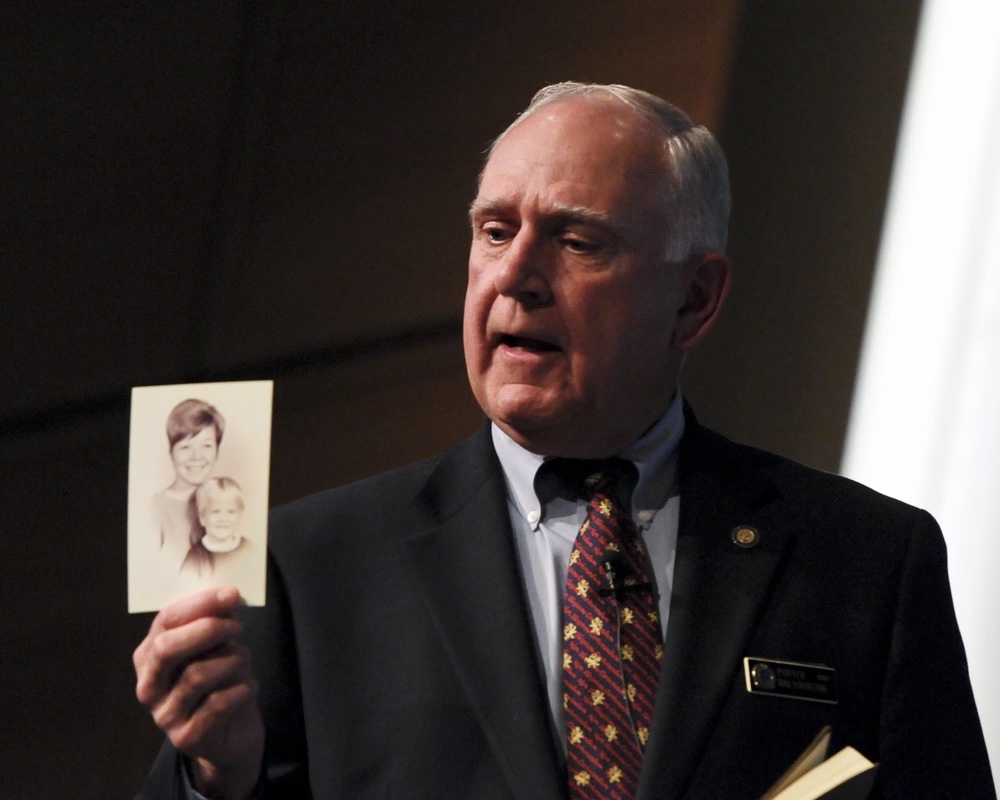
His most precious gift from home was a photo sent to him in 1969 of Marty and their daughter, Dabney.

He describes living in the past and future to avoid the present, yet ironically the prisoners who survived captivity did so by facing and overcoming their present circumstances with communication, creativity, mutual support, subtle subversion, and a sense of humor.


I laughed out loud at some of the antics Halyburton describes: tricking the guards with American slang, sing-songing and dancing their roll call. But the most shockingly funny story in the book involves a perverted guard and a duck. Guaranteed to crack you up. “Quack, Quack!”


With a generous sharing of his poetry, private thoughts, and journal entries, Halyburton achieves a deep introspection and personal history that helps us understand the experience of prisoners of war in Vietnam. Readers and lovers of books will be pleased to see his references to authors John M. McGrath, Edgar Allan Poe, Jim and Sybil Stockdale, George Hayward, and Viktor Frankl.


Frankl’s “Man’s Search for Meaning” helped Halyburton put his POW experience and survival into context in its examination of human suffering at the hands of others and what it reveals about ourselves, how we react, and whether we have free will and the freedom to choose. “I realized that our lives were determined more by the choices that we made rather than the circumstances of our captivity."

That, he says, was “the first great lesson” he learned from his captivity.

“I learned a second great lesson from my experience, but it did not come until the very end. As I wrote in my journal, when I walked through the gates of the Hanoi Hilton on February 12, 1973, as we were leaving the prison the had symbolized all the misery and hatred that we had endured over those many years, I turned to face the compound and said, ‘I forgive you.’ I did that because I knew I could not and should not carry that hatred back home with me, back to my family and my life of freedom. I realized during the last few hours of my captivity that although hatred had been useful as part of the armor that had protected me from the influence of my captors, it was no longer needed. Hatred is a poison to the soul, mind, and body, and it has been the source of many of the ills in the world throughout most of our history … One must choose to forgive.” 
Reuniting with family, hugging Dabney, in 1973.
The concept of “freedom” is so cherished, we are willing to fight to defend it. Freedom demands responsibility, accountability, and ultimately a reckoning with the truth. In Halyburton’s case, the truth involved forgiveness and letting go of hate.


Speaking of which…


In 2022, we’ve seen a thriving democracy –– Ukraine –– under attack by Putin’s Russia, and we wonder if the world can forgive the unforgettable murder, terrorism, and destruction Putin continues to unleash out of pure hate.


Today, Ukraine’s President Zelensky visits the United States to express his thanks to Americans for our defensive military support, in the name of freedom.


Top photo: U.S. Naval War College Professor Emeritus Porter Halyburton shows a photo of his wife and daughter during a lecture at the Naval War College about his time as a prisoner of war in North Vietnam during the Vietnam War. Halyburton was held captive for seven years in a number of prisons, including the infamous “Heartbreak Hotel” and “Hanoi Hilton.” (MC2 Eric Dietrich)

Sunday, September 11, 2022

September Remember: USS Midway in Japan

by Bill Doughty––

I was attending school in Tokyo and living in Yokosuka in 1973 when USS Midway (CV-41) arrived in Yokosuka –– the first U.S. aircraft carrier to be stationed in Japan as part of the Forward-Deployed Naval Forces. It was a big deal, less than thirty years after World War II, and just months after the U.S. military departed Vietnam.


Midway was commissioned 77 years ago, Sept. 10, 1945, just eight days after Imperial Japan surrendered. Stationing the ship in Japan was hugely symbolic; Midway is named for the historic and pivotal battle in 1943 that turned the tide in WWII.


USS Midway (CV-41) arrives in Yokosuka, Oct. 7, 1973. Photo from Midway cruise book. (Ryo Isobe, DVIDS)
But that’s only one reason the carrier’s arrival in Yokosuka was opposed by many Nihonjin, sometimes violently.

Hundreds of Japanese citizens, loudly opposed to America’s war in Vietnam, came to Yokosuka in 1973 to protest the arrival of Midway.

I remember scores of demonstrators in headbands and helmets, faces covered, white-knuckled fists gripping bamboo poles. The demonstrators assembled by the Yokosuka JNR station and marched to the closed gates of the base. Japanese police in riot gear formed a human shield. Marine guards stood ready behind them. Some radical demonstrators attacked the police and were repelled with fire hoses.


Midway had been a recent (and repeated) participant in what was then called the Vietnam Conflict, a war for which the ship received the Presidential Unit Citation from President Nixon in early 1973.


Two years later, Midway would join with other ships of the U.S. 7th Fleet in Operation Frequent Wind, the evacuation of Saigon.


Three years after Midway’s arrival in Yokosuka, the United States celebrated its bicentennial, 1776-1976. By then, I was just out of college and contributing stories to the Seahawk base newspaper on my way to becoming editor and eventually a public affairs officer.

Early in its career, Midway participated in historic operations in the Caribbean, near the Arctic, throughout the Mediterranean, and in both the Atlantic and Pacific, including near North Korea.

Midway would go on to participate in various peacekeeping operations, including Operation Desert Shield and Desert Storm, after Iraq failed to obey a United Nations ultimatum to withdraw from its invasion of Kuwait.


Just as it did in the evacuation of refugees after the fall of Saigon, Midway played a key role with other ships in rescuing evacuees from the Philippines in Operation Fiery Vigil after the eruption of Mt. Pinatubo. That was in June of 1991.


I was still living in Yokosuka and working for the Navy when USS Midway departed Yokosuka for the final time in August 1991. The workhorse aircraft carrier was headed to retirement 31 years ago this month –– via Pearl Harbor, Seattle, and Bremerton –– eventually to San Diego.


USS Midway arrives in Pearl Harbor, August 23, 1991.
By 1991, more Japanese people came to realize the value of having a strong U.S. Navy presence, working cooperatively with the Japan Maritime Self-Defense Force to maintain freedom of the seas. 

Just as the United States Constitution was a model for Japan’s form of government, the United States Navy served as a model for the JMSDF –– with direct help and guidance from Adm. Arleigh A. Burke.


Over many years, Yokosuka has held hugely popular base open-house events, inviting tens of thousands of Japanese citizens onto the base to participate in games, enjoy food booths, attend concerts, and go aboard U.S. Navy ships.


The most popular draw at base open-house events? Tours of an aircraft carrier.


After Midway’s departure, other carriers followed its lead to become forward-deployed in Japan: USS Independence (CV-62), USS Kitty Hawk (CV-63), USS George Washington (CVN-73), and USS Ronald Reagan (CVN-76).


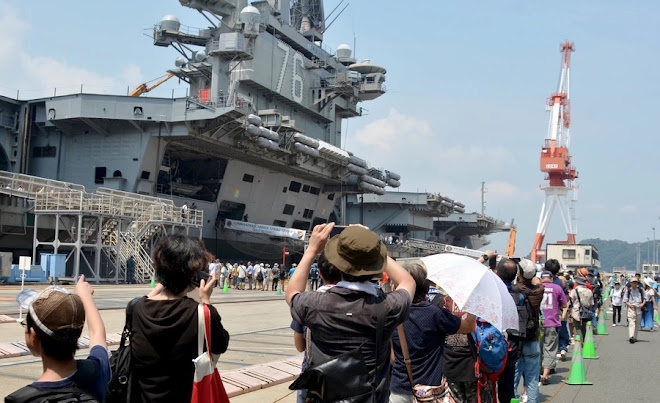
Japanese guests line up to board USS Ronald Reagan (CVN-76), October 10, 2015, during Yokosuka's Friendship Day open-base event. (MC1 Peter Burghart)

Open-base events were suspended for a time in the aftermath of attacks on the United States by religious zealots –– Islamist terrorists –– on September 11, 2001. (I remember the gates being locked down for weeks. Everyone who lived off base were required to park a few miles away and were offered rides to work or schools on base in carefully screened shuttle buses.)


In September 2003, USS Midway departed its temporary home of Bremerton, WA, to become a museum and memorial in San Diego. It welcomes an average of more than one million visitors per year. As with the USS Arizona Memorial in Pearl Harbor, many of the visitors to the USS Midway Museum include people from Japan who come to pay respect and learn about history.


Operation Sandy (Midway Museum Archives)
The museum offers a robust website highlighting the ship’s proud legacy, including operations in the Arctic, Taiwan Strait, and Vietnam, among others. I found some fascinating Midway photos available for download from Flikr, courtesy of the Museum. Some of the photos on the museum’s site include ringside views of Operation Sandy, the world’s first test-firing of a ballistic missile from a ship at sea.

There are numerous resources on the museum’s website, including videos and first-person accounts. This line stands out: “When history speaks, turn up the volume.”


In reading the history of the USS Midway, we can see the evolution of the modern Navy, from the immediate postwar, through the entire Cold War, and operations in Vietnam. But the ship is remembered most fondly, perhaps, for its role in helping people and promoting peaceful protection, especially for eighteen years in Yokosuka, Japan.


USS Midway’s strategic role in the Cold War, is a key part of James D. Hornfischer’s fascinating “Who Can Hold the Sea: The U.S. Navy in the Cold War, 1945-1960” (Bantam Books, 2022).


I have a two-part review of Hornfischer's final work posted in recent weeks. Hornfischer has been a favorite over the years. In May 2012, he offered a guest mini-review of five books he recommended to Navy Reads.


Friday, November 19, 2021

Eddie Gallagher & Alpha ‘Loyalty’

Review by Bill Doughty––

David Philipps gives a passionate and compassionate profile of a case that hit the U.S. Navy like a “missile” –– that of former U.S. Navy SEAL Chief Petty Officer Eddie Gallagher, accused of war crimes after his deployment with the Alpha platoon of SEAL Team 7 in “ALPHA: Eddie Gallagher and the War for the Soul of the Navy SEALS” (Penguin Random House, 2021).


This is a book about accountability and justice. And karma.


SEALs in Alpha Platoon, wearing their tridents and under the logo of the “Bad Karma Chick,” saw their role as the embodiment of bad karma: “Alpha was there to make sure that bad things happened to bad people.”

“ALPHA” reads less like a book about war and more like a Shakespearean tragedy of an elite American warfighter who chose a noble journey but somehow took a wrong path. Eddie Gallagher began his career as a Hospital Corpsman and tried in vain to become a SEAL until the Afghanistan and Iraq wars opened a sudden need for more of the Navy’s special operations warfare specialists and Gallagher was accepted. He deployed seven times overseas in the so-called war on terror.


Philipps describes the warfighter after seventeen years of service this way:

“Eddie looked like a Navy SEAL poster boy. He had close-cropped blond hair, glacier-like blue eyes, a strong, square jaw, the shoulders of a lion, and a lion’s killer instinct. He was fast, agile, strong, and a dead shot. But a closer look revealed a face deeply lined from years in the desert sun. After so many deployments, the mileage was starting to show. He was thirty-nine years old. In the military, where the average age is twenty-seven, he was closing in on obsolescence. His back hurt. His neck hurt. His shoulders hurt. He had ringing in his ears from too many gunfights. Sometimes he had trouble remembering  things. Not that he regretted any of it. For all the talk about post-traumatic stress disorder and the unfair burden the nation had put on its warfighters, Eddie never once saw combat as a hardship. He had chosen it. He was good at it. He thrived on it. Truth be told, it was cool as hell. He loved the heart-pounding exhilaration of gunfights. He loved the simple intensity of war. Sometimes he felt it was the only thing that made sense. If there were bad guys out there looking to take on the United States and become martyrs, he was happy to punch their ticket.”

But –– “Beneath that SEAL veneer was a history of disappointments and screw-ups that had dogged him for much of his life,” Philipps writes later in “ALPHA.”


This book reveals a tectonic struggle: rule-of-law ethos exemplified by Adm.(Ret.) William McRaven versus a no-rules “pirate” death-cult personified by former Vietnam-era SEAL Cmdr.(Ret.) Richard “Demo Dick” Marcinko –– and Gallagher.

One side prefers to be quiet, humble, and righteous in their work. The other side is all bravado, might-makes-right, and anything goes, including killing unarmed civilians and prisoners when necessary.


One side meant it when they took their oath to support and defend the Constitution; they are loyal to each other and to the mission. The other side abuses power and demands loyalty in a cult of personality, often putting the mission and team in unnecessary danger.


One side has to work silently within the constraints of the Uniformed Code of Military Justice, committed to truth and justice. The other side uses TV, radio, and social media to bend information, threaten opponents, and smear the Navy chain of command.


One side lives by the SEAL Ethos. The other does not.

“…My loyalty to Country and Team is beyond reproach. I humbly serve as a guardian to my fellow Americans always ready to defend those who are unable to defend themselves. I do not advertise the nature of my work, nor seek recognition for my actions. I voluntarily accept the inherent hazards of my profession, placing the welfare and security of others before my own. 

I serve with honor on and off the battlefield. The ability to control my emotions and my actions, regardless of circumstance, sets me apart from others. Uncompromising integrity is my standard. My character and honor are steadfast. My word is my bond…”

Gallagher stood trial for allegedly murdering a defenseless Iraqi teenager aligned with ISIS by stabbing him with a knife. Gallagher was turned in by a number of his SEAL teammates, who also claimed to have witnessed him shooting indiscriminately into civilian areas as well as deliberately shooting an unarmed girl and an old man.


Philipps provides damning information about Gallagher’s character, including allegations of stealing from the Navy as well as fellow SEALs, illegal habitual drug use, false claims for a Purple Heart and other medals, lying and putting SEALs in harms way for personal gain, and threatening murder in an attempt to cover up his crimes.


The truth emerges thanks to information from key members of the Alpha Team as well as evidence gathered by NCIS and New York Times, where Philipps is a Pulitzer Prize winning national correspondent.


“ALPHA”
presents a brief history of the Navy SEALs, from their founding by Navy WWII veteran President John F. Kennedy, through Vietnam and into the 21st century. Philipps describes the rigorous body-breaking BUD/S training SEALS undergo in Coronado, San Diego –– a crucible where instructors are “striking down hubris like ancient gods.”

He introduces readers to a fascinating cast of characters, each on a spectrum of loyalty to each other, to Navy core values, and to the Constitution. There’s LPO (now Chief) Craig Miller, in many ways the hero of this tragedy; CAPT Matt Rosenbloom, a leader of leaders who put his SEALs ahead of outside threats, including to his career; and Secretary of the Navy Richard Spencer, who, like other characters in this story, tries to build a bridge to what was right, only to see his infrastructure crumble under politics and undue influence by the commander in chief.


When SECNAV Spencer was fired for appearing to disobey the president’s bidding immediately, Spencer said it was “just politics,” but was it “just” –– in both meanings of the word? Spencer, a former Marine whose mentor was SECDEF James Mattis, believed in strong standards and values. He tried to allow the SEALs to conduct an ethical review. Philipps writes, “Civilian rule of the military was a delicate thing. It required respect, deference, and a mutual understanding.” It did not do well with heavy-handed tipping of the scale of justice.


Trump and Gallagher
Philipps shows former President Trump’s role in the Gallagher case; disgraced Trump acolytes Bernard Kerik and Duncan Hunter as well as Trump lawyer Marc Mukasey helped Gallagher. Later, Gallagher hobnobbed with Michael Flynn, Erik and Donald Trump Jr., and Rudy Giuliani. Gallagher endorsed and campaigned for Donald Trump, and was feted at Mar a Lago. Trump granted clemency to Gallagher and pardoned two other service members who had been found guilty of war crimes.

The dark side of “loyalty” can be seen in the insurrection of Jan. 6, 2021. It can be seen in the code of silence over police brutality and killings that prompted the BLM protests and riots in the summer of 2020. The dark side of “loyalty” can be found in grievance and resentment and fear of the Other. It can be seen in anyone forgetting their oath to the Constitution and pledging their loyalty to a Big Lie and cult of personality that rejects democracy and embraces fascism and autocracy.


Facebook provides a platform for SEALs to express their support of Gallagher and the “pirate” ethos. “None of the SEALs on Facebook seemed to care that a chief had targeted civilians,” Philipps says. “They were just mad that guys in Alpha had said anything about it.”


"ALPHA" tells the story of true loyalty. Some characters, notably another former corpsman and SEAL, Corey Scott, fail in their commitment to the truth. Others, like Chief Craig Miller, rise to the challenge and stand tall.


Karma is on their side.


Miller, the leading petty officer of Alpha platoon during the Iraq deployment of 2017, uses his experience to teach young SEAL leaders about ethical choices, norms and virtues. Philipps describes Miller’s view: “In real ways, the future of humanity was built by the small actions of millions of everyday folks, and it could be torn down the same way.”


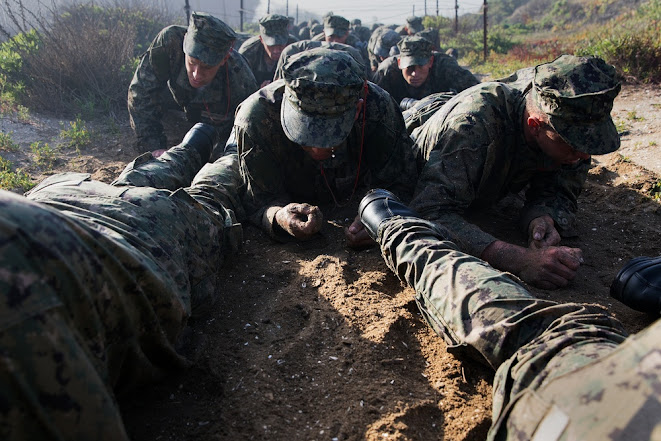
U.S. Navy SEAL candidates participate in Basic Underwater Demolition/SEAL (BUD/S) training. SEALs are the maritime component of U.S. Special Forces and are trained to conduct a variety of operations from the sea, air and land. (U.S. Navy photo by Petty Officer 1st Class Abe McNatt)

(This year a podcast called “The Line” explored various sides of the Eddie Gallagher saga and his war crimes trial in 2019 based on witness reports that he stabbed the ISIS teenager to death. In the podcast Gallagher says, “We killed that guy. Our intention was to kill him. Gallagher admits. It was to do medical scenarios on him until he died,” adding He was going to die regardless. ... We weren't taking any prisoners.

Speaking of karma: 

A new four-part documentary video series on Apple+, also called "The Line,” airs starting today.

"The Line" is by a team led by filmmaker Alex Gibney, Oscar winner for 2007’s Afghanistan War documentary "Taxi to the Dark Side." Directors Doug Shultz and Jeff Zimbalist obtained the participation of Gallagher; his wife, Andrea; and the members of SEAL Team 7 who stepped forward to accuse Gallagher of war crimes, and all appear on camera.)


Saturday, November 13, 2021

A True Patriot and Statesman: Max Cleland

By Bill Doughty––

When Joseph Maxwell "Max" Cleland spoke at the 72nd Pearl Harbor Day commemoration ceremony, Dec. 7, 2013, with Pearl Harbor itself as a backdrop, he was nearly overcome with emotion. He saw the dozens of World War II veterans seated in the front rows of the audience, and he thought of his father. Cleland spoke without notes, from the heart, about the sacrifice of military service and the joy of homecomings.


Army CPT Max Cleland in Vietnam
Hugh Cleland, Max’s dad, joined the Navy after the attack on Oahu in 1941. In 1965, Max volunteered for the Army to serve in combat in Vietnam, where he earned the Silver Star and Bronze Star.

Cleland was severely wounded and nearly killed. Yet, he personified resilience to become head of the Veterans Administration and a U.S. Senator.

Cleland died earlier this week. He was a great statesman, military veteran, and advocate for veterans, especially those with lasting physical and mental wounds.


President Joe Biden issued a statement November 9 on Cleland’s passing:

Max Cleland was an American hero whose fearless service to our nation, and to the people of his beloved home state of Georgia, never wavered.

As a 25-year-old serving in the 1st Cavalry Division of the U.S. Army during the Vietnam War, Max lost both of his legs and his right arm in a grenade explosion at Khe Sanh. After grueling months in the hospital, enduring multiple surgeries and a long road back to recovery, Max turned his pain into purpose. He continued his distinguished public service, becoming a lifelong champion of the dignity and rights of working people and America’s wounded veterans. His leadership was the essential driving force behind the creation of the modern VA health system, where so many of his fellow heroes have found lifesaving support and renewed purpose of their own thanks in no small part to Max’s lasting impact... He was a man of unflinching patriotism, boundless courage, and rare character... He will be remembered as one of Georgia’s and America’s great leaders.”

I was fortunate to help plan the Navy’s Pearl Harbor Day commemoration ceremony in 2013 and to hear Max Cleland speak about honor, courage, and commitment –– as well as true family values and patriotism.


In 2013 I posted a Navy Reads review featuring Cleland’s autobiography, “Heart of a Patriot.”

Cleland, who chaired the armed services subcommittee on personnel in the Senate, was known for working closely with both Democratic and Republican colleagues.


Cleland reads about JFK.
From Navy Reads: “His colleagues, mentors and friends in the Senate included fellow combat veterans Chuck Hagel, Dan Inouye, John Kerry and ‘my Vietnam veteran brother’ John McCain. Cleland describes the pride of wearing his dad's WWII Navy peacoat as a U.S. Senator during a presidential inauguration.”


Prior to serving in the Navy for three years during WWII, Max Cleland’s father, Hugh, had served in the Civilian Conservation Corps, an environmental infrastructure program created by President Franklin D. Roosevelt during the Great Depression. FDR was an inspiration to a young Max Cleland. Cleland loved books and reading. He authored several books.


Like Biden, Secretary of Defense Lloyd Austin issued a statement about Senator Cleland’s passing; fittingly, Austin includes references to literature.


In part, SECDEF Austin says:

“The Department of Defense stands united in mourning the loss of Senator Max Cleland, an extraordinary public servant and a great patriot…He served his country and his community from a wheelchair, following in the gallant tradition of his hero President Franklin Roosevelt.”


SECDEF Austin notes that as head of the Veterans Administration, Cleland “fought fiercely for his fellow veterans, made PTSD an official VA diagnosis, and helped create the groundbreaking Vet Centers program. Later, after being elected a U.S. senator from Georgia, he continued his passionate focus on defense and veterans' issues, serving with distinction on the Senate Armed Services Committee and leading on such issues as health care, bioterrorism preparedness, and homeland security. He also served on the 9/11 Commission before being nominated for the board of the Export-Import Bank. His final act of public service was leading the American Battlefield Monuments Commission. When battle maps of Vietnam were added to the National Memorial Cemetery of the Pacific in Hawaii, he asked to add an inscription from the poet Archibald MacLeish: ‘We leave you our deaths: give them their meaning.’

With courage and grit, Senator Cleland struggled with PTSD and depression—seeking help through counseling, medication, and attendance at a recovery group. He said that he drew strength from being around his fellow veterans and wounded warriors, including those from Iraq and Afghanistan. As the head of the VA, he made psychological counseling available to his fellow veterans. And I hope that his example will encourage others carrying unseen wounds to seek out the help they need and deserve. 

Senator Cleland liked to quote Hemingway, who wrote, ‘The world breaks everyone and afterward many are strong at the broken places.’ He surely was. Max Cleland's civic-minded spirit, optimism, and resilience will stand as an inspiration to every American.”

Funeral services are planned for early next week.


Senator Max Cleland, RIP.


Vietnam War veteran Max Cleland, a triple amputee, holds a photograph of himself as a child with his father, Hugh, and mother, Juanita, at the National Memorial Cemetery of the Pacific at Punchbowl in 2013. (Jamm Aquino, Honolulu Star-Advertiser)


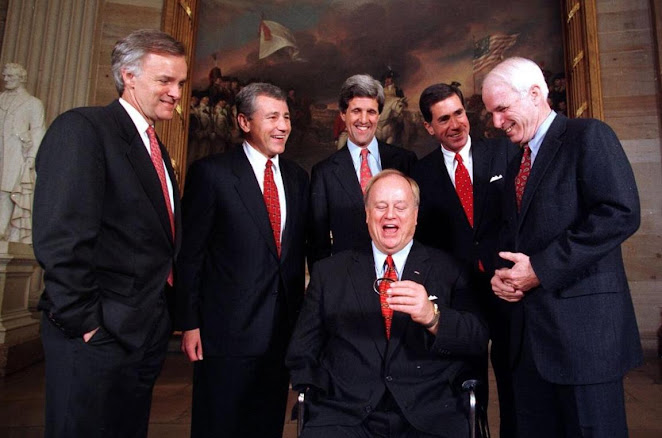
The Senate had six Vietnam combat veterans in January 1997. Sen. Max Cleland, D-Ga., is in the front. Behind him, from left: Bob Kerrey, D-Neb., Chuck Hagel, R-Neb., John Kerry, D-Mass., Chuck Robb, D-Va., and John McCain, R-Ariz. This photo was taken by The World-Herald during Senate orientation the previous month. (Kiley Cruse, The World-Herald)

Top photo: Secretary Max Cleland, American Battle Monuments Commission, delivers keynote remarks during the 72nd anniversary commemoration of the Dec. 7, 1941, attack on Oahu. This year’s commemoration theme, “Sound the Alarm,” examines how thousands of Americans answered the call to duty in the wake of the attack. More than 2,500 people attended the Pearl Harbor commemoration. (MC2 Nardel Gervacio)