Showing posts with label STEM. Show all posts

Friday, March 31, 2023

‘Lethal Tides,’ Lifesaving WAVES and Science


Review by Bill Doughty––

Two western Pacific storms –– one in 1274 CE and another seven years later –– saved Japan from conquest by Kublai Khan and the Mongol Fleet.  The invading wooden ships were crushed by typhoons as they neared the Japanese coast. Tens of thousands of Mongols were killed in the invasion attempts.


Raijin
Back then, most Japanese people believed that a god or gods, including Raijin, had intervened on their behalf and had ordained the storms.

Superstition reined in Asia, as it did throughout most of the world for centuries. God or gods were the reasons for the actions of nature and of humans.


More than six hundred years after the storms, Imperial Japan, became the invader.  Headed by a revered god-like emperor, Nippon’s military invaded its neighbors, including Korea, Mongolia, and Indochina. On December 7, 1941, Imperial Japan attacked U.S. territories, including Pearl Harbor and other bases on Oahu.


But…


The United States Navy, Marine Corps, and Army/Air Force, with help from Allies, used science instead of superstition to win the war in the Pacific in World War II. How they did it is at the heart of “Lethal Tides: Mary Sears and the Marine Scientists Who Helped Win World War II” by Catherine Musemeche (HarperCollins, 2022).


Early in the last century, women had to fight against prejudice, discrimination, and another type of superstition: the belief that if women served aboard ships –– even aboard scientific research vessels –– it could bring about storms, shipwreck, pirates, or other calamities.

“The prohibition of women sailing on oceanographic vessels grew out of ancient taboos that originated in myths and legends, like Homer’s Odyssey, where after the Trojan War, Odysseus sails home with his all-male crew. Although he encounters numerous female characters during his stops along the way, nary a one dares to set foot on his ships. Ships are where men exercise their manly skills like war mongering and fending off monsters while simultaneously battling storms and rogue waves. Allowing women on board would only distract the crew from their duties and incite the wrath of an angry sea, leading to certain misfortune. For hundreds of years sailors clung to these beliefs and preserved the all-male domain at sea even while perpetuating the striking paradox that a female body carved into the bow of a ship would bring good luck on a voyage.”

“But not every woman was willing to adhere to this nonsensical restriction,” Musemeche writes. She presents a brief but good history of women breaking barriers on behalf of science, for greater equality, and to have opportunities for careers, including in the nascent field of oceanography.


Mary Sears
Fortunately, the hero of this story, Mary Sears, achieved quiet greatness thanks to her initiative, expertise, and record of achievement. She was helped indirectly by pioneers and champions of equality, including Naval Officer Joy Bright Hancock, Representative Edith Nourse Rogers, and First Lady Eleanor Roosevelt. Male mentors gave her a chance to excel. But she had to pay her dues at Woods Hole Oceanographic Institute, with opportunity ultimately provided by Lt. Robert Revelle, an oceanographer from Scripps Institute in San Diego.

Other men, though, stuck with old-fashioned views of “a woman’s place.” Senator David I. Walsh, chairman of the Senate Naval Affairs Committee, for example, declared “that to permit women to become members of the armed forces would destroy their femininity and futures as ‘good mothers.’” As a result, the Navy was slow to fully accept help from women who wanted to serve but eventually turned toward actively recruiting women for non-combat roles.

Sears persisted in her work and earned a leadership position at the Hydrographic Office during World War II, where, with other WAVES (Women Accepted for Volunteer Emergency Service) and scientists, she provided mapping, analysis, and much-needed intelligence, especially helpful to submariners and amphibious assault operations. “Her colleagues realized Sears could be depended on to provide the answers the military needed to wage war in the oceans.”


Though her background was anchored in biology, she and her team provided key and essential information about tides, waves, surf zones, reefs, currents, underwater obstructions, and the composition of shorelines –– analyzing “a fusion of hazards” for the military.


Such information, formulated in Joint Army Navy Intelligence Studies (JANIS) reports, was found to be much needed after the Battle of Tarawa, which revealed flaws in planning. “The resulting lack of preparation manifested on the blood-stained beaches of Tarawa,” Musemeche writes.


Marines wade ashore at Tinian, July-August 1944. (NHHC)
The Oceanographic Unit team Sears led became indispensable to war planners in the Palaus (Peleliu), Philippines (Luzon), and Marianas (Tinian was “a model amphibious assault”). Sears and her mixed gender team –– especially stalwarts Fenner Chace, Dora Henry, Mary Grier, and Roger Revelle –– helped guide ship captains who navigated unknown offshore waters and warned "of every possible danger to the troops risking their lives to go ashore in hazardous waters.”

“As the Pacific Campaign unspooled, getting the troops to shore presented a range of problems, confirming what Sears had said about the Navy’s lack of preparation. They had gone to war knowing very little about the ocean, at least about the offshore challenges of launching amphibious landings. But there was no stopping the action so American forces could rehearse and get better. The march to Japan would not wait.

The Americans had not fought this way or at this pace before. In World War I troops had sailed across the Atlantic into welcoming harbors, docked at piers, and unloaded without enemy resistance. Those operations were easily achieved without oceanographic information. The Allies rarely had such advantages in World War II. Harbors, if they existed at all at island targets, were not welcoming. There were no piers at which to dock. There was nothing simple about dropping marines into boats and tractors bucking in the grasp of heaving waves and sending them over jagged coral reefs, under a barrage of machine-gun fire and artillery shells toward plunging waves. The problem was, there didn’t appear to be any other way to win the war in the Pacific.

The success of the Pacific Campaign mandated capturing one island after another in far-reaching locales, as the military worked its way toward Japan.”

Musemeche tells of a set-back in planning for the assault of Iwo Jima. She writes of the hardship of rationing on the homefront, which impact the ability to do research. And, she shows how the war impacted everyone as the loss of loved ones in the Pacific and in Europe touched the lives of colleagues and friends.


Her description of the action on Palau is heart-pounding and searing. Admiral William H. McRaven endorsed the book: “Magnificently researched, brilliantly written, Lethal Tides is immensely entertaining and reads like an action novel.” (The book is lovingly dedicated, by the way, to Musemeche’s father, QM3 Frank M. Musemeche, who served in WWII.)


USNS Mary Sears (T-AGS-65) at Yokosuka, Japan. (MC2 Travis Bailey)
While Iwo Jima was a setback thanks to the special challenge of the volcanic island’s geography, the Battle of Okinawa demonstrated the team’s success at innovative research and applied science.

Imperial Japan’s military refused to surrender, with many leaders and troops and even some civilians preferring to commit suicide.


The kamikaze pilots who crashed their planes into U.S. Navy ships, were named “divine winds” after the storms that superstition said were brought about by the gods to protect Japan from invasion. It took the science of the atom to finally bring forth a surrender after the President Truman authorized nuclear attacks on Hiroshima and Nagasaki.


Fleet Admiral Chester Nimitz credited Lt. Cmdr. Mary Sears and her team more than once for contributing to successes in the Pacific War.


In 1946, Nimitz issued a postwar commendation crediting her “technical knowledge and administrative skill.” Sears’s use of science, data, and analysis, provided exceptional assistance to warfighters.


USNS Mary Sears, the first oceanographic survey ship named for a woman, was christened in 2000 by Mary’s younger sister Leila, who herself served as a WAVE in the Navy’s code decryption department.


Packed with under-reported facts, compelling photos, and actual data reports, this is a wonderful book for anyone interested in appreciating the depth of women’s history, the power of science and technology, and the strength of diversity and inclusion. BZ!


Pathfinder-class oceanographic survey ship USNS Mary Sears (T-AGS 65) hosted U.S. Ambassador to Australia Caroline Kennedy during the ship’s scheduled visit to Sydney, Australia, Nov. 8, 2022. Ambassador Kennedy toured USNS Mary Sears and received a Naval Oceanography overview from Commander Jonathan Savage during her time aboard. The visit was Ambassador Kennedy’s first to an oceanographic survey vessel and her first visit to a U.S. Navy ship since taking office as U.S. Ambassador to Australia in July 2022. Kennedy is former U.S. Ambassador to Japan. She is the daughter of Navy hero President John F. Kennedy. (Photo by Lt. Cmdr. Bobby Dixon)

Monday, March 29, 2021

‘Gutsy’ Women Knocking on the Door

Review by Bill Doughty

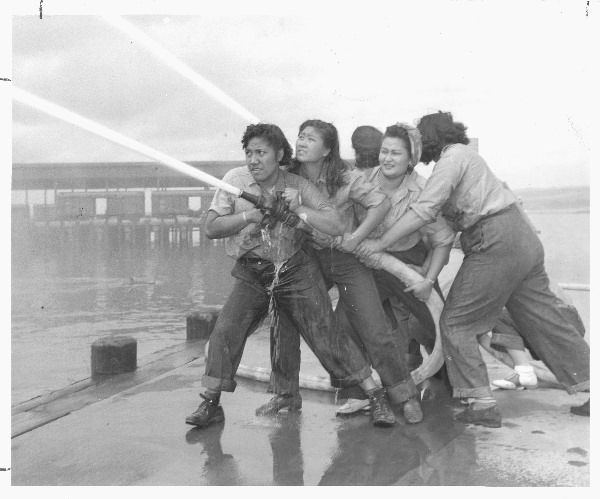
In an iconic photo, four Asian American Pacific Islander women at the Pearl Harbor Naval Shipyard train in firefighting. Long mislabeled as taken during the attack of Dec. 7, 1941, the photo in fact portrays some of  the strong women who applied to support the Navy’s war efforts in the wake of that attack. From left to right: Elizabeth Moku, Alice Cho, Katherine Lowe, and Hilda Van Gieson.


Over time, history usually has a way of sorting out fact from fiction.


Rear Adm.Grace Hopper, "Mother of Computing"
The facts and highlights of strong women of grit and grace are spotlighted in a book recommended for Women’s History Month. Profiles of more than 100 women come to life in “The Book of Gutsy Women” by Hillary Rodham Clinton and Chelsea Clinton (Simon & Schuster, 2019).

Among the women profiled are some we featured in Navy Reads posts: Rear Adm. Grace Hopper, Ada Lovelace, Rachel Carson, Marjory Stoneman Douglas, Margaret Chase Smith, Malala Yousafzai, and Maya Angelou. This book includes mini-biographies of both famous (Clara Barton, Helen Keller, Ida B. Wells, Maya Lin, Gabby Giffords, Greta Thunberg, and Venus and Serena Williams) as well as less-well-known women (Rigoberta Menchu Tum, Dr. Gao Yaojie, Nelba Marquez-Greene, Wangari Maathai, and Jineth Bedoya Lima).


Chelsea and Hillary Clinton, 2011
Hillary and Chelsea each provide essays about their subjects. They also offer personal perspectives about the women who have inspired and enlightened them – women who have made a difference in the world. The book is organized in sections: early inspirations, education pioneers, earth defenders, explorers and inventors, healers, athletes, advocates and activists, storytellers, elected leaders, groundbreakers, and women’s rights champions.

Chelsea writes, “I learned of Grace (Hopper) in 1996, when the navy named a new ship the USS Hopper (DDG 70) in her honor … I learned even more about her when I spoke many years later at the Grace Hopper celebration, the largest gathering of women technologists in the world.”


Former First Lady, senator, and Secretary of State Hillary Clinton reflects about the suffragists who knocked on the door, marched in the street, and fought for women to be able to vote in the United States one hundred years ago. That right was guaranteed with the passing of the Nineteenth Amendment to the U.S. Constitution, but it was a right that took decades to apply to women of color:

“Reading the words of the Nineteenth Amendment today, it’s hard not to wonder why it took so long” ‘The right of citizens of the United States to vote shall not be denied or abridged by the United States or by any State on account of sex. Congress shall have the power to enforce this article by appropriate legislation.’ But, of course, it was a long struggle because it was about so much more than the right of women to vote. It was about race, class, and deeply held cultural and religious views about women’s subordinate roles to men in society. It was about men’s –– and some women’s –– insecurities and fears of the unknown. These challenges are still present today.

The franchise –– the basic right of citizenship –– is still being fought over between those of us who believe every citizen should be able to vote and have that vote counted, and those who want to restrict the vote by erecting barriers against people, largely still based on race.”

Celia Ou, a graduate student at Scripps Institution of Oceanography, monitors computer screens displaying detailed sonar imaging of the ocean floor aboard the Auxiliary General Oceanographic Research (AGOR) vessel R/V Sally Ride, Dec. 15, 2016. (John F. Williams)


Nearly all the Gutsy women featured in this book faced and overcame some kind of obstacles of discrimination. Chelsea Clinton says this about space pioneer astronaut Sally Ride, the first American woman in space (in 1983) and a champion of STEM education for young people worldwide:

“Even after her death in 2012, Sally Ride kept breaking barriers. She came out as a lesbian quietly, without fanfare … Not long after her death, Tam [O’Shaughnessy, her partner of 27 years] received a call that surprised her, from Ray Mabus, then secretary of the navy. The navy hoped to honor Sally by naming a research vessel after her. Secretary Mabus was calling to ask whether Tam would be the ship’s sponsor – a role that had, up until that point, been filled by the wife of the man for whom the ship was named. ‘I think it is fitting the the celebration of Sally’s legacy as a pioneering space explorer and a role model includes an acknowledgment of who she really was and what she cared about,’ said Tam. The R/V Sally Ride, commissioned in 2016, is the first navy research ship named for a woman. Her legacy lives on in the scientific curiosity sparked in the girls and boys she continues to inspire, the ship that bears her name, and a spot on the moon named after her by NASA.”

Military readers may find fascinating nuggets of history in the essays about Sylvia Earle, Mary McLeod Bethune, Florence Nightingale, Eleanor Roosevelt, and Mary Edwards Walker. Chelsea writes this about Walker:

“…Dr. Mary Edwards Walker, the only woman in her medical school class at Syracuse Medical College in 1855. She was a practicing physician when the Civil War broke out. She desperately wanted to enlist in the Union Army as a surgeon but wasn’t allowed to because she was a woman. Initially she was called a nurse, since women generally weren’t considered doctors. Because women were not allowed to enlist, Mary had to volunteer, working for free at a temporary hospital, first in Washington and then in Virginia, where she traveled to Union field hospitals across the commonwealth … When her medical credentials were finally accepted she moved to Tennessee and became a War Department surgeon – a paid position that was the equivalent of a lieutenant in status.”


Dr. Sylvia Earle became chief scientist at the National Oceanic and Atmospheric Administration in 1990. She pioneered research in preserving 
and protecting the ocean, including the study of damage to coral reefs. Her inspiring TED talk, above, is a call to action. Hillary writes:

“When I think of Sylvia’s work, I am reminded how important it is for all of us to peruse and consider what we want to leave to the generations who come after us –– how they’ll honor the past, imagine the future, and give gifts to those who will live out their lives long after we’re gone. That’s exactly what Sylvia’s life as a scientist, an engineer, a teacher, and an explorer should inspire all of us to do: we must preserve our oceans for the future.”

Last year, this book generated controversy because of the women who were not included. For example, there is an unfortunate dearth of women who have served in or with the military. Surely, the authors could have included a “protectors” section filled with inspiring women who served in uniform.


Despite the intriguing photo on the cover, there is little focus on the women who served on the Homefront during the Second World War. In fact, there’s no explanation of the colorized photo of the women firefighters at the Pearl Harbor Naval Shipyard.

Yet, considering the general lack of attention toward the achievements of women in American and world history for many generations, it is refreshing to see a book of this scope. Women continue to knock on the door, push through the glass ceiling, and demand equality.


“The Book of Gutsy Women” illustrates the strengths of women throughout history, often in the face of sexism, misogyny, harassment, and patriarchy. It highlights the facts of women’s history and showcases women’s contributions to creating a better world now and in the future.

Tuesday, March 24, 2020

'Deadliest Plague in History'

Review by Bill Doughty

In the first week of February, we published a review of John M. Barry's "The Great Influenza." Barry shows how fear became terror, how healthcare workers were affected, and how the Navy was center-stage as the disease changed the course of the world 100 years ago. Today the Navy is once again facing and helping defend against a global pandemic.

HN K. Kavanagh sanitizes medical equipment aboard USNS Mercy March 24. (MC2 R.Breeden)
In this follow-up Great Influenza blogpost, we offer some more important points from Barry's now-classic report.

His book has special resonance today in the wake of the current COVID-19 pandemic, where New York is again an epicenter. 

One hundred years ago, "New York City was panicking, terrified," Barry writes, after a politically appointed health commissioner named Royal Copeland – "a man with no belief in modern scientific medicine and whose ambitions were not in public health" – failed to respond or take the initial outbreak seriously, calling for a quarantine only after it was too late.
"There were literally hundreds of thousands of people sick simultaneously, many of them desperately sick. The death toll ultimately reached thirty-three thousand for New York City alone, and that understated the number considerably since statisticians later arbitrarily stopped counting people as victims of the epidemic even though people were still dying of the disease at epidemic rates – still dying months later at rates higher than anywhere else in the country. It was impossible to get a doctor, and perhaps more impossible to get a nurse."
Barry relates how nationwide "physicians attempted everything – everything – to save lives." The desperate attempts to find a cure led them to try "atropine, digitalis, strychnine, and epinephrine as stimulants."
"Physicians injected people with typhoid vaccine, thinking – or simply hoping – it might somehow boost the immune system in general even though the specificity of the immune response was well understood... Quinine worked on one disease: malaria. Many physicians gave it for influenza with no better reasoning than desperation... One physician gave hydrogen peroxide intravenously to twenty-five patients in severe pulmonary distress, believing that it would get oxygen into the blood. Thirteen recovered; twelve died. This physician, too, claimed success."
Barry writes, "No medicine and none of the vaccines developed than could prevent influenza. The masks worn by millions were useless as designed and could not prevent influenza. Only preventing exposure to the virus could." Quarantine, isolation and what we now call social distancing was the only way to slow the scourge.

Those areas that acted swiftly had less of an adverse impact. Meanwhile, Navy scientists played a key role in searching for a pathogen, vaccine and cure.

As a result of the 1918 pandemic and other smaller outbreaks – including H7N7 and SARS – over the past 25 years, the World Health Organization advised all nations to be watchful, prepared, staged and ready to respond to another pandemic.

Barry says there are two main lessons to learn: "The first involves threat assessment, planning, and allocating resources." "A centralized system should exist to allocate all resources," he writes. 

"But there is another lesson from 1918 that is clear. It is also less tangible. It involves fear and the media and the way authorities deal with the public."

In other words, tell the truth. The media and public officials made the problem worse when they downplayed the realities of the epidemic. "In 1918, the lies of officials and of the press never allowed the terror to condense into the concrete. The public could trust nothing and so they knew nothing."
"So the final lesson, a simple one yet one most difficult to execute, is that those who occupy positions of authority must lessen the panic that can alienate all within a society. Society cannot function if it is every man for himself. By definition, civilization cannot survive that. Those in authority must retain the public's trust. They way to do that is to distort nothing, to put the best face on nothing, to try to manipulate no one."
Well-written and fast-paced, this is a must-read now for everyone. For a full review of "The Great Influenza: The Epic Story of the Deadliest Plague in History" – including the key role the Navy played during and after the pandemic – visit the Navy Reads review of February 6, 2020. The review was written before the current novel coronavirus strain, originating in Wuhan, China, was given a proper name: COVID-19.

In one of several appearances over the years on C-SPAN, Barry gave a keynote address to a Pandemic Preparedness and Response forum on November 13, 2017. The Johns Hopkins meeting was attended by leading epidemiologists, other scientists and health experts, including Dr. Anthony Fauci, director of the National Institute of Allergy and Infectious Diseases.

Barry focused his remarks on the imperative for honesty and trust in a crisis, saying he despises the term "risk communication" because "it implies managing the truth, and I don't think you manage the truth; I think you tell the truth."

He concludes, "Planning does not equal preparation. I think maybe the biggest challenge to the public health community is to get political leaders to make rational decisions in crisis situations."

The Navy hospital ship USNS Mercy deployed to Los Angeles this week. USNS Comfort is scheduled to deploy to New York in the weeks ahead.

SAN DIEGO (March 23, 2020) -- Military Sealift Command hospital ship USNS Mercy (T-AH 19) navigates the San Diego channel March 23. Mercy deployed in support of the nation’s COVID-19 response efforts, and will serve as a referral hospital for non-COVID-19 patients currently admitted to shore-based hospitals. This allows shore base hospitals to focus their efforts on COVID-19 cases. One of the Department of Defense’s missions is Defense Support of Civil Authorities. DOD is supporting the Federal Emergency Management Agency, the lead federal agency, as well as state, local and public health authorities in helping protect the health and safety of the American people. (U.S. Navy photo by Mass Communication Specialist 3rd Class Lasheba James/Released)


Thursday, February 6, 2020

Navy and 'Great Influenza' Changed the World

Review by Bill Doughty

One hundred years ago another wave of an influenza epidemic crashed on America's shores.
(Illustration from Penn Medicine News)

"By February 7, 1920, Influenza had returned with enough ferocity that the Red Cross declared, 'Owing to the rapid spread of influenza, the safety of the country demands, as a patriotic duty, that all available nurses or anyone with experience in nursing ... (offer) their services," according to John M. Barry, author of "The Great Influenza: The Epic Story of the Deadliest Plague in History" (Viking/Penguin, 2014).

Courage in the Face of Fear

Fortunately, the epidemic did not hit with the same deadly force throughout 1920 that it had in the previous two years. 

The epidemic of 1918 erupted with such speed and scope that it created worldwide fear and terror. This influenza seemed to target young, otherwise healthy, adults as well as people with vulnerable immune systems.
"In 1918 fear moved ahead of the virus like the bow wave before a ship. Fear drove the people, and the government and the press could not control it. They could not control it because every true report had been diluted with lies. And the more the officials and newspapers reassured, the more they said, 'There is no cause for alarm if proper precautions are taken,' ... the more people believed themselves cast adrift, adrift with no one to trust, adrift on an ocean of death."
The misnamed "Spanish Flu" of 1918 (Barry makes a strong case that it originated in Kansas) took more American lives in the first year (675,000) than all the U.S. service members who died fighting in WWI, WWII, the Korean War and Vietnam War combined. In one week in October, 4,597 Philadelphians died of the disease.

Paul Lewis
On the front lines of the war against the killer influenza epidemic – in laboratories and medical facilities – U.S. Navy and other military and civilian researchers searched for the pathogen as well as a vaccine and a cure.

This book is dedicated, in part, to one of those Navy warriors, and opens with a scene about him: "The Great War had brought Paul Lewis into the navy in 1918 as a lieutenant commander ..." Lewis had previously helped prove that a virus caused polio, "a discovery still considered a landmark achievement in the history of virology."

Lewis saw the early signs of disease in sailors in Philadelphia, where the virus was killing five percent of Sailors who showed any symptoms of influenza. 

In Boston, another Navy medical warrior, Lieutenant Commander Milton Rosenau at the Chelsea Naval Hospital, mobilized to fight the epidemic.

(Photo from Bureau of Medicine and Surgery)
"Rosenau too was a scientist who had chosen to leave a Harvard professorship for the navy when the United States entered the war, and his textbook on public health was called 'The Bible' by both army and navy military doctors."

Other military doctors and researchers who raced against the disease included William Henry Welch, Simon Flexner, Victor Vaughn and William Gorgas. Oswald Avery went from Army private to captain; he would eventually make "the most profound discovery of all" in his search for the cause of the disease.

The enemy in 1918 was not only the epidemic of disease, but also a pandemic of fear. "Uncertainty follows distrust, fear follows uncertainty, and, under conditions such as these, terror follows fear." Truth matters.

Emergency hospital in Funston, Kansas.
A Maritime Component

Author-historian Barry profiles each of these courageous warriors as well as dozens of other people who faced the crisis. He reveals the strong maritime component to its global spread.

(Photo from Naval History and Heritage Command)
The pandemic of 1918-1920 was fueled by WWI fervor and war mobilization – in crowded barracks and aboard ships, including international steamers and U.S. Navy vessels. Dozens of shipyards were hit and had to close. Naval hospitals were overwhelmed. Navy brig prisoners volunteered as test subjects for Lt. Cmdr. Lewis and other scientists.

Sailors unintentionally brought deadly influenza to Great Lakes Naval Training Center and Newport Naval Base in Rhode Island; to New Orleans and Puget Sound; back-and-forth to Europe; as well as across the Pacific aboard USS Logan to Guam. Adm. Albert Gleaves and his captains dealt with effects of the pandemic, including aboard USS Leviathan.

Navy collier USS Brutus carried a relief expedition to Juneau, Alaska. "They found terrible things. Terrible things," Barry writes. "In Nome, 176 of 300 Eskimos had died. But it would get worse." Other Red Cross relief teams to the Aleutian Islands found devastation caused first by the disease, then by starvation and finally by starving dogs.

Nineteen U.S. Navy nurses died on active duty during the war, more than half from influenza. One of the survivors was the second superintendent of the Navy Nurse Corps, Chief Nurse Lenah H. Sutcliffe Higbee, recipient of the Navy Cross and namesake of the first USS Higbee, commissioned in 1945. The keel was laid for the future USS Lenah H Sutcliffe Higbee (DDG 123) in November 2017.


Changing the World

The epidemic of 1918-1920 occurred at a time when women increased demands for the right to vote, a right won 100 years ago. Women had supported the war effort in Europe, and they served on the front lines in the fight against the epidemic.

The nation and world changed in other ways too in those first decades of the 20th century. 

President Woodrow Wilson's physician, Navy Rear Adm. Cary Grayson (who had served as presidential physician to Presidents Teddy Roosevelt and William Howard Taft) accompanied Wilson to the peace conference in Paris in 1919. Both Wilson and Grayson, as well as Wilson's wife and others, contracted influenza while in Paris.

President Wilson and Rear Adm. Grayson
Barry contends that the disease caused physical weakness and some mental lapses in the commander-in-chief and may have led to his stroke four months later. But the devastating effects of Wilson's bout with influenza also may have led to his concessions to the allied enemies of Germany in order to save his League of Nations.

"Historians with virtual unanimity agree that the harshness toward Germany of the Paris peace treaty helped create the economic hardship, nationalistic reaction, and political chaos that fostered the rise of Adolf Hitler," Barry writes. Feelings of persecution and resentment in Nazi Germany led to another world war.

Other ways the epidemic changed the world but for the better: Science, as represented by medical centers and researchers, triumphed over superstition. Corrupt local authoritarian governments in Philadelphia (the Vare political machine) and New York (Tammany Hall) were exposed and impeached in the court of public opinion. Truth and ethics were shown to be supremely important in the face of fear and terror.
"The media and public officials helped create that terror – not by exaggerating the disease but by minimizing it, by trying to reassure.Terror rises in the dark of the mind, in the unknown beast tracking us in the jungle. The fear of the dark is an almost physical manifestation of that. Horror movies build upon the fear of the unknown, the uncertain threat that we cannot see and do not know and can find no safe haven from. But in every horror movie, once the monster appears, terror condenses into the concrete and diminishes. Fear remains. But the edge of panic created by the unknown dissipates. The power of the imagination dissipates."
Cmdr. Richard Shope
Meanwhile, researcher Paul Lewis had remained perpetually restless both during and after the epidemic. The microscope was his periscope searching for an enemy lurking in his laboratory – "the mysteries he embraced. He settled into them like a man casting off into an impenetrable ocean fog, a fog that made one feel both alone in and part of the world.

"Among the warriors against fear was Paul Lewis's protege and assistant, Richard Shope. 

Shope investigated swine flu in the 1920s and by 1931 published his papers showing his discoveries. He included Lewis's name as an author on one of his papers.

Shope's research was successful. "He had found the cause of influenza, at least in swine," Barry writes. "We now know that the virus he found in swine descended directly from the 1918 virus, the virus that made all the world a killing zone."

In 1928, in England, Alexander Fleming serendipitously discovered penicillin while researching influenza. Oswald Avery's work on influenza led directly to the discovery of DNA, further changing the world.

Applied Science: Coronaviruses

Barry provides more than a history of the epidemic. He also explains coronaviruses, Acute Respiratory Distress Syndrome, and the science of the influenza virus at the cellular level, including the difference between a slower mutating DNA virus and a faster mutating RNA virus.

"Influenza is an RNA virus. So is HIV and the coronavirus. And of all the RNA viruses, influenza and HIV are among those that mutate the fastest," Barry writes.
"[O]ne cannot leave this subject without speaking to other questions: the likelihood and potential danger of another influenza pandemic, what we can learn from the one of 1918-1919, and how we can apply those lessons to the emergence of a new pathogen, whether that pathogen is a weapon of terror or a new natural menace – such as Severe Acute Respiratory Syndrome, SARS, the disease which spread from animals to man in the spring of 2003 and threatened to become a major pandemic.The answer to the first question – the likelihood and potential danger of another influenza pandemic – is not very reassuring. Every expert on influenza agrees that the ability of the influenza virus to reassort genes means that another pandemic not only can happen. It almost certainly will happen."
Barry offers a special discussion of the coronavirus SARS – Severe Acute Respiratory Syndrome – that appeared in China in 2003 and spread quickly across borders bringing with it susceptibility to ARDS. The Navy forward deployed to the western Pacific was concerned about the possibility of SARS outbreaks in 2004. The Navy maintains a preventive medicine SARS webpage as part of Ready Navy. 

The Navy (Navy and Marine Corps Public Health Center), DoD and Centers for Disease Control are leaning forward to provide information and prevention tips regarding the newly emerged novel coronavirus (2019-nCoV) that reportedly originated in Wuhan, China.

Today, unlike 100-plus years ago, scientists throughout the world are able to communicate and collaborate within seconds. They can, if allowed, share information and assistance across borders. An informed public can make rational decisions and not succumb to fear. Medical scientists have more tools and information to fight against pandemics.

Read this book to see the fate of Paul Lewis after the war. 

Right up there with McCullough's sweeping history books, Barry's "The Great Influenza" is a masterpiece. This is a great Navy read.

Camp Lemonnier’s medical team gives influenza vaccinations to service members, Oct. 28-30, 2019. (U.S. Navy photo by MC2 Marquis Whitehead)

Sunday, April 22, 2018

Nainoa Thompson & Planet Earth, 'Hawaiki Rising'

Review by Bill Doughty

When Pwo (Master) Navigator Nainoa Thompson brought the voyaging canoe Hōkūle`a into Pearl Harbor in February of this year, he spoke in part about harnessing fear, overcoming the dangers of complacency, embracing diversity as a strength, and passing knowledge and wisdom to the next generation.

Thompson addressed the Navy and local civilian audience during his visit – part of a statewide "Mahalo Hawaii" tour of thanks to everyone for their support of Hōkūle`a's Malama Honua (caring together for Island Earth) circumnavigation of the planet completed in 2017.

Sam Low's "Hawaiki Rising: Hōkūle`a, Nainoa Thompson, and the Hawaiian Renaissance" (Island Heritage Publishing, 2013) provides a fascinating history of the beloved canoe, the revival of Hawaiian culture beginning in the 1970s, and how dedicated individuals inspired others to become aware of the need to respect and care for our environment, including our oceans.

Renaissance man Herb Kane at work in his Chicago studio.
Low served in the United States Navy in the Pacific in the mid-1960s. He introduces us to iconic individuals who brought Hōkūle`a ("Star of Joy") to life, including Herb Kane, and artist, sailor and thinker who was inspired by a book, "Canoes of Oceania" and by Polynesian culture, in general. Kane worked in Chicago but dreamed of the Pacific, learning all he could of voyaging canoes.

Kane created14 paintings of Polynesian canoes in the 1960s. The Hawaii State Foundation of Culture and the Arts purchased the paintings in 1969, making it possible for Kane to move to Hawaii to continue his studies and setting the stage for the revival of Hawaiian culture in the 1970s. 

At the time the foundation that purchased Kane's art was headed by its first director, Alfred Preis, architect of the USS Arizona Memorial in Pearl Harbor.

The late Daniel Inouye, United States Senator from Hawaii, once said, “When you saw a Herb Kane painting, you were energized and motivated to learn about the past. …His artwork captured both ancient and modern-day Hawaii and help preserve Hawaii's unique culture for future generations.”

Nainoa Thompson called Kane, who was a Navy veteran, "father of the Hawaiian Renaissance.”


In 1973 Kane envisioned construction of a voyaging canoe that would inspire that renaissance. He met with University of Hawaiʻi anthropologist Ben Finney and Tommy Holmes, author of The Hawaiian Canoe. Together they founded the Polynesian Voyaging Society and began work on the Hōkūle‘a, capable of sailing between Hawaii and Tahiti. One day, their canoe would sail around the world on a mission to bring awareness about earth's ecology.

Kane lived in East Oahu, which is where he met a young man who was serious, quiet and young enough to be imprinted with a love of the stars, the sea and sailing.

Nainoa Thompson
That young man was Nainoa Thompson, whose father, Myron "Pinky" Thompson was a World War II Army veteran, a strong supporter of Hawaiian culture, and a foundation for Nainoa's philosophy of life. Pinky told his son "Ninety percent of success is preparing for it." He helped Nainoa overcome his fears and learn values shared by the U.S. Navy: the importance of discipline, training and having a vision.

Nainoa writes this in the book's foreword:
"Our canoe, Hōkūle`a, and our dreams have now carried us ... (following) in the wake of our ancestors who discovered and settled Polynesia. It has been a process of finding ourselves not only as Hawaiians, as native to these islands, but also as native to planet Earth. On all of our voyages, we have been guided by the wisdom of our elders, our kupuna. Among them is my father, Myron "Pinky" Thompson, who understood that voyaging is a process in which we are guided by values that are universal. 'Before our ancestors set out to find a new island,' my father told me, 'they had to have a vision of that island over the horizon. They made a plan for achieving that vision. They prepared themselves physically and mentally and were willing to experiment, to try new things. They took risks. And on the voyage they bound each other with aloha so they could together overcome those risks and 'seeking, planning, experimenting, taking risks, and caring for each other. The same principles that we used in the past, are the ones that we use today and that we will use into the future. No matter what race we are or what culture we carry, these are values that work for us all."
Nainoa learned some values the hard way aboard Hōkūle`a: the importance of good seamanship, communication and the courage to assume command at sea.

Nainoa went to Bishop Museum's planetarium, studied at Willamette College in Oregon after attending Punahou School, and was inspired by a book called "The Stars: A New Way to See Them" by H. A. Rey, author of "Curious George." 

Low introduces us to another earlier influencer in Nainoa's life: Yoshio Kawano, who lived in traditional Japanese style and taught the young Nainoa how to fish and make connections with nature. Nainoa says, "Yoshi may have been my most important teacher of all. I didn't know it then, and certainly he didn't either, but he was preparing me for my life."

Pwo Navigator Mau Piailug
Through Low's insightful narrative we get to know others who worked with or inspired Nainoa and who have strong ties to Hōkūle`a: Mau Piailug, Eddie Aikau, Lacy Veach, Snake Ah Hee, Sam Ka'i, Chad Bayaban, Will Kyselka, Gordon Pi'ianapa'a, Shorty Bertelmann, Kimo Lyman, Dave Lyman, Wally Froiseth, Bruce Blankenfeld, Tava Taupa and Kawika Kapahulehua, among others.

We get an intimate view of life aboard Hōkūle`a, including on two roundtrip journeys to Tahiti in this book, published just before Malama Honua. We relive the heartbreaking loss of Eddie Aikau in 1978 and the rescue of the capsized Hōkūle`a, thanks to an observant Hawaiian Airlines pilot and a ready response from the U.S. Coast Guard.

Eddie ("Eddie Would Go") Aikau
Eddie's loss strengthened Nainoa's resolve. He pledged to fulfill Aikau's dream on his behalf, to see "Tahiti rising," coming up on the horizon as the voyaging canoe approached.

Using charts and simple explanations, Low shows some of the how-to of wayfinding. "The concept was straightforward – stars rise in the east, arc overhead, and set in the west, defining points on the horizon to steer by, or 'houses,' as Nainoa called them." Data becomes knowledge and, over time, knowledge becomes intuitive wisdom.

Author Sam Low blends science with art in his presentation, explaining some of the fundamentals of Nainoa's wayfinding using stars, constellations, ocean swells, birds, the moon and other means – using science and all the senses plus a spiritual dimension that defies explanation.

On one key night in the doldrums, confused about their direction, Nainoa "sensed" the moon before he saw it. He turned the canoe and when the clouds parted he saw the light shine through and knew he made the right decision.
"'I can't explain it,' Nainoa continues, 'there was a connection between something in my abilities and my senses that went beyond the analytical, beyond seeing with my eyes. It was something very deep inside. Before that happened, I relied on math and science because it was so much easier to understand things that way. I didn't know how to trust my instincts. My instincts were not trained enough to be trusted. That night, I learned there are levels of navigation that are realms of the spirit. Hawaiians call it na'au – knowing through your instincts, your feelings, rather than your mind or your intellect. It's like new doors of knowledge open and you learn something new But before the doors open you don't even know that such knowledge exists.'"
"Hawaiki Rising" is about discovering new knowledge, moving from anger and fear to love and courage, and rediscovering a culture of sustainable living on "Island Earth," showing how one person can make a profound difference. It's a good read for Earth Day 2018.