Showing posts with label McCain. Show all posts

Thursday, October 10, 2024

Who Could Be Against Trump?

By Bill Doughty

Hundreds of former national security leaders –– from both Republican and  Democratic administrations –– signed a stark warning letter to the nation last month, citing about ex-President Trump, “He has shown no remorse for trying to overturn the 2020 election on January 6th, promises to pardon the convicted perpetrators, and has made clear he will not respect the results of the 2024 election should he lose again. That alone proves Mr. Trump is unfit to be Commander-in-Chief.”


Project 2025 was the must-read of the summer, and now this letter is a must-read for autumn, just a few weeks before the election. The lead signature is from Rear Admiral Michael E. Smith, USN (Ret), President of National Security Leaders for America.


Signatories include former SECDEFs Chuck Hagel, William Cohen, Leon Panetta, and William Perry as well as seven Senate-confirmed military service secretaries. The officials and senior officers called former President Donald J. Trump "impulsive," "ill-informed" and “unfit” to serve again as commander in chief.


They condemn his promise to “terminate” parts of the Constitution, his constant lying, and his role in the January 6, 2021 attempt to overturn the previous election and his “promises to pardon the convicted perpetrators.”


The letter includes signatures from three former acting service secretaries, former Secretary of Homeland Security Jeh Johnson, former Secretary of State Hillary Clinton, and former Secretary of Homeland Security Janet Napolitano. Among the more than 740 Americans who signed the letter are service members, civilians, and military spouse representatives. There are at least 63 Navy and 18 Marine Corps retirees who endorse Harris over Trump


Many Republicans have denounced Trump, with most pledging support to Kamala Harris for President. Notably, former Vice President Dick Cheney and former Representative Liz Cheney announced their endorsement of Harris. Liz Cheney is former House GOP conference chair and was the #3 Republican in the House of Representatives until she turned against Trump and helped lead a congressional investigation into the January 6, 2001 (J6) insurrection, consequently becoming a victim of MAGA retaliation.


Now Liz Cheney joins former Trump White House aides Alyssa Farah Griffin, Cassidy Hutchinson and Sarah Matthews today in Pennsylvania to campaign against Trump, noting, according to reports, his threat to democracy, the rule of law, and the Constitution. Former Trump White House communications director Anthony Scaramucci has issued similar warnings about another Trump presidency, and is actively supporting Kamala Harris and Tim Walz.

Recently, retired U.S. Army General Stanley McChrystal endorsed Vice President Kamala Harris for president, writing in a New York Times OpEd, “Ms. Harris has the strength, the temperament and, importantly, the values to serve as commander in chief.” He added, “I have cast my vote for character, and that vote is for Vice President Kamala Harris.”


In 2020, Admiral William McRaven, former commander of the U.S. Special Operations Command, warned the nation about a second Trump administration and what it would mean for the future of the country: “When good men and women can't speak the truth, when facts are inconvenient, when integrity and character no longer matter, when presidential ego and self-preservation are more important than national security — then there is nothing left to stop the triumph of evil.”

In another editorial about Trump, McRaven addressed him directly and wrote, "Through your actions, you have embarrassed us in the eyes of our children, humiliated us on the world stage and, worst of all, divided us as a nation.” Both McRaven and Admiral James Stavridis, former NATO Supreme Allied Commander, condemn Trump for his lack of character, his failure to uphold his oath to the Constitution, his affection for dictators and autocrats, and his antagonism of Allies and alliances.


Late Senator John McCain’s family have joined former members of Trump’s own administration –– including VP Pence, SECDEF Gen. Mattis, SECDEF Esper, CoS Gen. Kelly, NSA John Bolton, and CJCS Gen. Milley –– in condemning Trump for his role in the J6 insurrection coup attempt, threat to national security, and lack of stability. For his part, Trump threatens to retaliate against his critics both in government and in the media.

Next week, Bob Woodward’s new book, “War,” will hit book shelves, reporting on Trump’s “romance” with Russia’s Putin expanding on allegations of Russia’s help in Trump’s 2016 election when Trump, “Russia if you’re listening…” and publicly siding with Putin over his own Intelligence officers. Woodward reports that Trump secretly sent Covid-19 testing equipment directly to Putin in the early weeks of the 2020 pandemic, even though there was a shortage and need for testing in the United States. Trump denied the report, but Kremlin spokesman Dmitry Peskov said yesterday that the tests had been sent to Putin. It seems Woodward has written another must-read for this year.

Monday, September 18, 2023

Rise and Fall and Rise of John Birchers

Review by Bill Doughty––

Welch with portrait of Birch
Robert W. Welch Jr. attended both the U.S. Naval Academy and Harvard Law School, but finished neither. He abandoned careers in the Navy and in law and became a wealthy candy manufacturer. He also started one of the most divisive groups in American history, the John Birch Society. Welch named JBS for Christian missionary and U.S. Army Air Forces Capt. John Birch, who was killed by Chinese communists in 1945 –– what the society considered the start of a “Holy War.”

Emerging from the ashes of a long history of racist, nationalist, and populist movements, including 1950s McCarthyism, the John Birch Society dedicated itself to defeating global communism, propagating Christianity, countering civil and women’s rights, and promoting an America First agenda. The JBS latched onto the GOP like a sea lamprey and did not let go.


“By the early 60s Birchers had settled on the course they would follow in the decades to come. They would operate on the fringe of the conservative movement and, episodically and erratically, within the Republican Party,” according to Matthew Dallek, author of “Birchers: How the John Birch Society Radicalized the American Right” (Hachette, 2022)


“Ideologically, the society flaunted its antiestablishment sensibility and pumped hot-button cultural issues –– patriotic eduction, moral library books, an end to teaching sex education in schools –– into local debates over their communities’ most valued and non-partisan institutions.” Past is prologue, as the saying goes.


After President Eisenhower appointed Earl Warren as chief justice of the Supreme Court, the Warren Court ruled progressively in favor of integration in Brown v. Board of Education. SCOTUS also upheld the wall of separation between state and church in banning prayer in public schools. So the Birchers targeted and smeared Earl Warren and called for his impeachment.


At the 1964 GOP Convention, Michigan Governor George Romney warned his colleagues and electors about the rise of populism and radicalism within the Republican Party, calling for more tolerance, inclusion, and respect for diversity in the Republican platform under Goldwater. "The strongest personality on earth cannot deal with the problems of this nation except upon the basis of correct principles. Our party was founded at a time of grave national crisis," Romney said, noting Abraham Lincoln's role in saving the Union. "The nation and its destinies were in peril, not only by the irreconcilable conflict between slavery and freedom, but also by the extremism of that time. And the extremism and lily-white Protestantism destroyed the Whig Party and brought the Republican Party into being."


Senator George Romney at the GOP Convention, 1968

But for most of the past six decades, according to Dallek, “Birch ideas were hardly dominant in the Republican Party.” Those ideas –– anti immigration, anti world alliances, anti feminism, anti abortion, anti gun safety, and anti integration –– were on the rise with Barry Goldwater and in reaction to the civil rights movement.

“In some communities, the society was very much in the ascendant. Its influence in the GOP in 1963 was also greater than at any time since its inception. But most Birchers had lost their elections, they failed to stop candidates such as (George) Romney from winning their races, and numerous Republicans from the Northeast to the Midwest to the West Coast remained vigorously opposed to their ideology and political style. Unbeknownst to the society, in the summer of 1963 the White House was preparing to launch an all-out assault that had the potential to knock the Birch movement to the ground. The society’s prospect remained uncertain and contingent. The struggle for power in the Republican Party –– and in the United States –– was heating up. Birchers warned of Armageddon, cast critics as traitors and degenerates, disrupted civic meetings, harassed teachers and principals, and hinted at physical violence. More than any other movement of the 1960s, the Birch Society ignited what they described as an end-times contest for the very soul of the United States.”

“The ideas, activism, and style that Birchers helped pioneer has continued to drive well into the twenty-first century.” George Romney’s speech in 1964 –– really a warning –– is chillingly relevant today.


The JBS wanted to ban alcohol, according to Dallek. They were also against Hollywood, the media, school integration, fluoridation of water, and teaching of evolution instead of creationism. “They sought to use the power of government to enforce Christian identity in American culture while repudiating allegedly alien values like pluralism and tolerance.” Dallek contends they “helped launch a culture war that reverberates today.”


Maddox and Wallace
One of the stars of intolerance and the culture war in the 1960s and 70s was Georgia Governor Lester Maddox, who became popular by wielding axe handles to chase black people out of his restaurant. Maddox was befriended and supported by JBS founder Robert Welch.

Welch endorsed Alabama Governor George Wallace’s run for president in 1968. Wallace was an avowed segregationist and racist. He chose as his running mate retired Air Force General Curtis LeMay, who Dallek describes as “the real-life inspiration for the cigar-smoking General Jack D. Ripper” of Stanley Kubrick’s film Dr. Strangelove.


“An architect of firebombing in World War II, LeMay had a fascination with nuclear weapons and drew howls of outrage when he endorsed their use while on the campaign trail. Although LeMay had a record of innovative military leadership, Wallace’s choosing him was a running mate was perceived as empowering Birchers and the far-right fringe.”


Dallek writes:

“Haltingly, over decades, this fringe usurped the party’s center. The trajectory was alterable, not inevitable, contingent rather than certain. Many Republican leaders worked to stop it, until they didn’t. The society fostered apocalyptic thinking about the country’s direction, mistrusted elites as traitors, and raised the specter that only drastic remedies, including violence, could save the country. Its brand of mass politics fed money, energy, and ideas to conservative Republicans. And by offering a home for conspiracy theorists, racists, and antisemites, some Republican leaders emboldened the rights most noxious and violent bigots. The GOP establishment’s effort to court this fringe and keep it in the coalition allowed it to gain a foothold and eventually cannibalize the entire party, Over time, this uneasy alliance came to seem commonplace, part of the zeitgeist –– more and more alarming yet no longer shocking.”

On the other hand…


Clinton and Carter
A goal of liberals and other anti-Birchers was “to build the world they wanted –– a world where pluralism trumped hate, science trounced unreason, and democracy conquered fascism.” Progressives witnessed how an “America First” fascist-friendly and non-interventionist approach, including appeasement, led to the Second World War.

Those on the Left also saw how the Birchers’ fervent and feverish anti-Communism and white Christian nationalism led the nation into the war in Vietnam, invasion of Iraq, and a culture war at home. By the early 1990s, the us-and-them influence of the Birchers, personified by politicians Pat Buchanan and Newt Gingrich, was rejected with the election of Navy Veteran Georgia Governor Jimmy Carter in 1976 and Arkansas Governor Bill Clinton in 1992.

“Clinton used his bully pulpit to tie the GOP to far-right militants like Timothy McVeigh, the Oklahoma City mass murderer, and Randy Weaver, the white separatist who triggered a bloody confrontation with the FBI at Ruby Ridge. After McVeigh’s powerful homemade bomb tore through the Murrah Federal Building in Oklahoma City in 1995, Clinton attended a memorial service in Oklahoma City and urged Americans ‘to purge ourselves of the dark forces which gave rise to this evil. They are forces that threaten our common peace, our freedom, our way of life,’ and, he vowed, ‘we will stand against the forces of fear.’ Some right-wing talk show hosts and politicians, he added, had to realized that their ‘incendiary talk’ moved fanatics to action. Their ‘constant bashing of government, and relentless assumption that forces beyond our control run our government’ had spread dark views of federal employees and could trigger more bloodshed.”

That warning was nearly 30 years ago!


In the yin-yang of the American republic’s elections under the constraints of the Electoral College, George W. Bush was elected president. Bush’s presidency was the “most consequential chapter yet in the Birchification of the American right and the GOP.” Bush, whose father appointed Clarence Thomas to the Supreme Court, chose John Ashcroft as his first attorney general. Ashcroft expressed his belief, shared by many on the far-right, that “Jesus is king,” reigning above the Constitution and civil authority.


During Bush’s presidency, another politician, far more conservative than Bush, made a name for himself. Ron Paul (father or currently serving Senator Rand Paul) marked the time when, Dallek says, the fringe became mainstream. “Paul’s influence was substantial, opening the Republican Party to previously unthinkable views.”

The senior Paul as countered, however, by statesman and Republican standard-bearer John McCain, a Navy veteran and former POW, who said those who engage “in the politics of division and slander” are “corrupting influences on religion and politics, and those who practice them in the name of religion or in the name of the Republican Party or in the name of America shame our faith, our party and our country.” Although McCain called out Pat Robertson and Jerry Falwell as “agents of intolerance,” he would later backtrack and reconcile with Falwell, hoping to woo Christian fundamentalists.


Ultimately, according to Dalleck, “McCain saw that it was no longer possible to navigate the tension between the far right and the mainstream because by 2008, in the Republican Party, the fringe had begun to gain the upper hand. If he wanted to win, McCain had little choice but to violate his own principles.” He selected Sarah Palin as his running mate.


With Obama’s election, gun sales rose dramatically, militia membership increased, and “the far right was now entering the mainstream of the Republican Party, bringing with it the legacy of the John Birch Society.” Along with Pat Buchanan and Rand Paul, politicians supporting or condoning extremism in the GOP included Senators Ted Cruz, Mike Lee, and Ron Johnson as well as “fringe” Representatives Jim Jordan and Michelle Bachman, according to Dallek.


Alex Jones
“Unlike in the mid-1960s, the Republican Party of the early 2010s failed to check the extreme right,” Dallek says. Instead, “social media and the ubiquitous, sophisticated right-wing amplified the far right’s most inflammatory claims.”

Media stars arose to spread the authoritarian populism of the far right: The Drudge Report, FOX News, Rush Limbaugh, Glenn Beck, Laura Ingraham, Sean Hannity, Tucker Carlson, and “breakout media star of the far right” Alex Jones, who as a young teen was influenced by John Birch Society PR director Gary Allen’s book “None Dare Call It Conspiracy.” Jones aligned with Roger Stone, a massive influencer of the extremist fringe right, even as Jones capitalized on conspiracies. Jones spread falsehoods related to the the 9/11 attacks, the Sandy Hook massacre, and supposed cannibalization of children by Democrats, including Hillary Clinton.


Conspiracies became part of the right’s bloodstream as it had been in the 1960s.


Just as the Birchers feared communists were in control of the civil rights movement, MAGA followers believed America’s first black president was born overseas and was not eligible to serve. While JBS followers feared adding fluoride in water as a government conspiracy, sixty years later many far right extremists feared COVID vaccinations and believed various pandemic-related conspiracies.

“Trump drew energy, as Birchers had, from white supremacists, militias, and nativists and brought them into his coalition. His alliances with the white nationalists who rioted in Charlottesville (‘fine people’), with the far-right, all-male Proud Boys (‘stand back and stand by’), and with the deep-state-obsessed, conspiratorial QAnon (‘people that love our country’) blended racism and conspiracy theories in ways that harked back to the mix of racism, antisemitism, and conspiracy theories that drew many Birchers to their movement.”

And Dallek contends, “Just as Birchers took a dim view of democracy, Trump questioned the integrity of elections in which millions of people of color voted.” The conspiracy theory of a stolen election, though disproven in dozens of court cases and denied by sane Republicans in many states, led to the tragedy of the insurrection of January 6.


Dallek may be right in his overall thesis, that the United States is still under the influence of the John Birch Society. He believes the Bircher years/epoch/era started in 1958 and continues through today. On the other hand, it may have been with us for for far longer –– perhaps for centuries under different names: Slavery, Manifest Destiny, Know Nothings, Lost Cause, America First, and White Christian Nationalism.


Three events in the news coalesced over the past week or so as I finished this important book, bringing some of the book's points home:
First, President Joe Biden visited a memorial in Vietnam that honors a great American, late Senator John S. McCain III; when all is said and done McCain stood up for the Constitution.  McCain also stood up for democracy and against autocracy and theocracy. He conceded his election loss to President Obama in 2008. McCain even asked Obama to offer a eulogy at his funeral.
Second, last week I watched another Republican – American statesman Mitt Romney – announce he would not seek reelection. Romney is a former Republican nominee for the Presidency who won 47 percent of the popular vote but lost – and conceded gracefully – to President Obama in 2012. Romney acknowledges in a forthcoming biography by McKay Coppins, “Romney: A Reckoning,” that he does not recognize today’s GOP, where many of his Republican colleagues, he says, no longer support the Constitution.
Finally, I read with sadness that President Biden has called to offer his final good-bye to a dying former president with gold standard ethics and integrity: Navy veteran Jimmy Carter, despite being a victim of Birchers and their ilk more than four decades ago, conceded to President Ronald Reagan in 1980. During his naval career and presidency, Carter, a Navy submariner and commander in chief, literally protected and defended the U.S. Constitution from all enemies, foreign and domestic.

Thursday, April 13, 2023

Jimmy Carter Paradox Part 1: Guns

Review by Bill Doughty––


In “Our Endangered Values: America’s Moral Crisis” (Simon & Schuster, 2005) former President Jimmy Carter credits Presidents Ronald Reagan and George H. W. Bush, as well as Bill Clinton, with supporting legislation passed by Congress in 1994 that reduced deaths in the United States caused by military-style assault weapons.


“For ten years,” the legislation “prohibited the manufacture, transfer, and possession of nineteen specific semiautomatic assault weapons, including AK-47s, AR-15s, and UZIs” designed not for hunting but for killing other humans. Carter laments that after a decade of reduced mass shootings, George W. Bush and Congress, with pressure from gun lobbyists, allowed the ban to expire.

He makes common sense arguments for preserving the Second Amendment while at the same time protecting human life. “This is not a controversy that involves homeowners, hunters, or outdoorsmen,” Carter writes. “I have owned and used weapons since I was big enough to carry one, and now own a handgun, four shotguns, and two rifles.” 


Hunters, he says, don’t need weapons of war.


Carter targets the NRA and firearms industry who “mislead many gullible people into believing that our weapons are going to be taken away from us.” Gun lobbyists spends millions of dollars on stoking fear and paying politicians directly or indirectly who do their bidding.


Paradoxically…

  • Such politicians generally claim to be “pro-life,” yet they promote powerful weapons that cause more deaths –– opposing sensible gun reforms, including background checks, red flag laws, and curbs on assault weapons and magazine sizes, etc. 
  • Some say they are pro-police, but they allow a proliferation of weapons of war that are used against law enforcement, such as happened last year in Uvalde, Texas, last month in Nashville, Tennessee, and this week in Louisville, Kentucky.
  • They are generally against big government but want to create a more heavily armed police state, even hoping to arm teachers in schools.

Last year was the worst year for school shootings: 34, with nearly three dozen students and adults killed and 43,000 students exposed to gunfire, according to the Washington Post. Death by guns is the leading cause of death for children in the United States, where there are many more guns than people. In 2022, 6,542 guns were intercepted by TSA and airport security, an average of 18 per day.


For some Americans, the gun culture is like a cult religion, and the AR-15 is like a sacred and holy icon. These self-proclaimed patriots are often fundamentalists whose religious beliefs and political principles are “inextricably entwined,” Carter observes.


“I have experienced the intensity of patriotism as a submarine officer, the ambitions of a competitive businessman, and the intensity of political debate,” Carter writes. “As a Southern moderate and former career naval officer, I espoused a conservative fiscal policy and a strong defense.” His devout Christian beliefs, he says, are not in conflict with his desire for protection over proliferation, stewardship over rapaciousness, humility over hubris, and diplomacy over unprovoked military action.


Carter and McCain
“Commitment to peace and diplomacy does not imply a blind or total pacifism,” Carter says.

In addition to lamenting the passing of the ten-year assault weapons ban, Carter expresses disappointment with the rise of neoconservatism.


Neocons, personified by former Vice President Dick Cheney, led to the end of international arms control efforts, a stall in normalizing relations with Cuba, an invasion of Iraq twenty years ago, and the use of state-sponsored torture that broke the Geneva Conventions.


Carter lauds fellow Navy veteran Senator John McCain for his stand against torture and for international human rights.

“Republican Senator John McCain, who was a prisoner of war in Vietnam, has criticized the way detainees have been treated by U.S. forces, and he, Armed Forces Committee Chairman John Warner, and other Republican senators have proposed legislation that would prohibit the U.S. military from engaging in ‘cruel, inhuman or degrading treatment or punishment’ of detainees, or from hiding prisoners from the Red Cross, and would set uniform standards for interrogating anyone detained by the Defense Department. These powerful Republican seniors have quoted comments from fifteen top-ranking military officers: ‘The abuse of prisoners hurts America’s cause in the war on terror, endangers U.S. service members who might be captured by the enemy, and is anathema to the values Americans have held dear for generations.’ McCain said, ‘The enemy we fight has no respect for human life or human rights. They don’t deserve our sympathy. But this isn’t about who they are. This is about who we are.’”

Carter makes a passionate plea throughout “Our Endangered Values” for a return away from fundamentalism toward a more reasoned, compassionate, and understanding America.


He decries “both Democratic and Republican Parties” for “vituperative” approaches, “partisan animosity,” and an adoption of “‘red’ and ‘blue’ as habitual descriptive phrases within and between states.” Carter advises us to build bridges toward greater understanding and a commitment to equality, justice, and human rights.


Photo courtesy Patrick Gregerson, Pixabay
“Only the American people can redirect our government’s legal, religious, and political commitments to these ancient and unchanging moral principles,” Carter writes.

Instead of only proclaiming “thoughts and prayers” in the wake of gun violence, a new generation of Americans is approaching the issue with thoughts and action.


Carter walked the path of other civil rights pioneers including Mahatma Gandhi and Martin Luther King Jr.


King said, “We must come to see that the end we seek is a society at peace with itself, a society that can live with its conscience.”

Wednesday, March 29, 2023

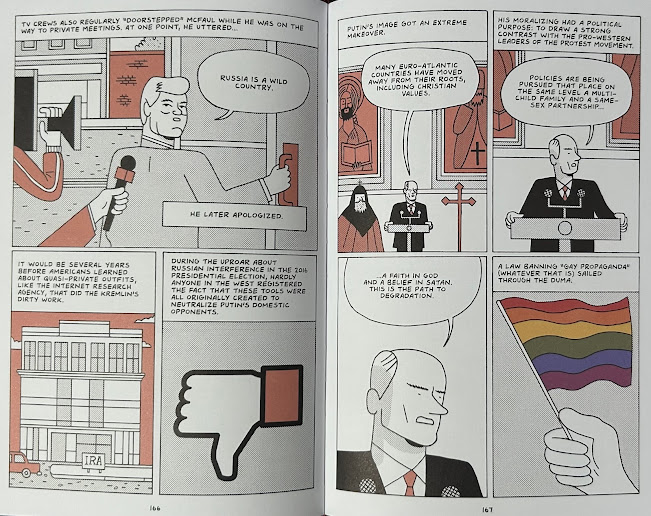
Putin is a Cartoon. Literally

Review by Bill Doughty––

Russia’s President Putin is a cartoon in the seriously insightful “Accidental Czar: The Life and Lies of Vladimir Putin” by Andrew S. Weiss and Brian “Box” Brown, First Second, 2022).


Like the best graphic novels and graphic nonfiction, much is communicated in few words. For example ––

  • “For Russia, geography is destiny”: With no natural defenses including oceans, unlike the United States, “Russia safeguarded its security through conquest and territorial expansion.”
  • Quoting Gene Sharp, author of “The Politics of Nonviolent Action”: “Dictators are never as strong as they tell you they are, and people are never as weak as they think they are.”
  • Fomenting fear, conspiracies, and disinformation: “Russian leaders simply can’t accept that brave people sometimes shape history all on their own.”
  • Again quoting Sharp: “The extreme repression comes when a dictatorship really is frightened and therefore they act ruthlessly.”
  • Irony: In May 2007 in a Victory Day speech in Moscow, Putin said, “We have a duty to remember that the causes of any war lie above all in the mistakes and miscalculations of peacetime.”
  • Putin compared the United States to Nazi Germany and said, “These new threats, just as under the Third Reich, show the same contempt for human life.” Irony meets hypocrisy (condemning “contempt for human life”) when considering what Putin is doing to the people of Ukraine.

Weiss’s insights are succinct but deep. Brown’s simple art is both evocative and informative.


This book follows the rise of Putin from childhood to KGB apparatchik in East Germany, to Communist Party hack, to opportunistic sycophant, to power-mad leader. Picturing Russian history, Weiss and Brown show how Putin put forth grandiose ideas for restoring the “glory” of the Russian Empire and Russian Orthodox Christianity. Nearly 40 years ago, in 1989, Russian territory covered “one-sixth of the earth’s landmass.”


Faith in Russia’s system of nepotism, cronyism, and corruption is baked into its history, where serfdom was a close equivalent to slavery. The czar and the State were held above the individual or rule of law.

Putin’s invasion of Georgia in 2008 and Crimea in 2014 were telling signs that he would commit further international crimes. “Territorial expansion is at the core of Russia’s national identity,” according to Weiss.


We learn about the roles of a whole host of characters who endorsed Putin: former Russian President Boris Yeltsin, former Ukrainian President Viktor Yanukovych, Alexandr Torshin and Maria Butina, retired Lt. Gen. Michael Flynn, evangelist Franklin Graham, actor Steven Seagal, Republican representative Steve King, and Trump advisor Steve Bannon.


Putin v. McCain
On the other side, we see Putin’s nemeses, including former President Barack Obama, entertainers Pussy Riot, philanthropist George Soros, and late Senator John McCain, who was a “perennial nemesis of Putin.” Navy hero McCain was pro-Ukraine and pro-democracy; he saw Putin as an autocratic war criminal.

The late former Secretary of State Madeleine K. Albright endorsed: “Accidental Czar is an absorbing and visually stunning account of Vladimir Putin’s rise and take-no-prisoners approach to wielding power on the world stage. Andrew S. Weiss and Brian Brown have made one of the most consequential stories of our time more accessible and engaging for readers of all backgrounds. I would urge anyone who wants to better understand the forces shaping modern Russia, and disrupting our world, to open up this extraordinary book.”


Fiona Hill offers this endorsement: “This biography of Vladimir Putin deftly combines entertainment and serious analysis. Renowned Russia scholar Andrew S. Weiss and artist Brian Brown have found the perfect means to introduce the complexities of Russian politics and Putin’s peculiarities to a new set of audiences. Everyone should have a copy of Accidental Czar on their bookshelf.” Hill is senior fellow at the Brookings Institution and co-author of "Mr. Putin: Operative in the Kremlin." (She also authored the brilliant “There Is Nothing for You Here: Finding Opportunity in the 21st Century.”)

“Accidental Czar” is also blurbed by other notable thinkers, including former ambassador to Russia Michael McFaul, former President Bush speechwriter David Frum, conservative historian Max Boot, and New Yorker staff writer Susan B. Glasser. Author Gary Shteyngart blurbs: “A witty and comprehensive takedown of the annoying Putin-is-a-genius myth.”


In fact, Weiss and Brown show how Putin the cartoon is actually a deranged, dangerous, and destructive war criminal.

Saturday, November 13, 2021

A True Patriot and Statesman: Max Cleland

By Bill Doughty––

When Joseph Maxwell "Max" Cleland spoke at the 72nd Pearl Harbor Day commemoration ceremony, Dec. 7, 2013, with Pearl Harbor itself as a backdrop, he was nearly overcome with emotion. He saw the dozens of World War II veterans seated in the front rows of the audience, and he thought of his father. Cleland spoke without notes, from the heart, about the sacrifice of military service and the joy of homecomings.


Army CPT Max Cleland in Vietnam
Hugh Cleland, Max’s dad, joined the Navy after the attack on Oahu in 1941. In 1965, Max volunteered for the Army to serve in combat in Vietnam, where he earned the Silver Star and Bronze Star.

Cleland was severely wounded and nearly killed. Yet, he personified resilience to become head of the Veterans Administration and a U.S. Senator.

Cleland died earlier this week. He was a great statesman, military veteran, and advocate for veterans, especially those with lasting physical and mental wounds.


President Joe Biden issued a statement November 9 on Cleland’s passing:

“Max Cleland was an American hero whose fearless service to our nation, and to the people of his beloved home state of Georgia, never wavered.

As a 25-year-old serving in the 1st Cavalry Division of the U.S. Army during the Vietnam War, Max lost both of his legs and his right arm in a grenade explosion at Khe Sanh. After grueling months in the hospital, enduring multiple surgeries and a long road back to recovery, Max turned his pain into purpose. He continued his distinguished public service, becoming a lifelong champion of the dignity and rights of working people and America’s wounded veterans. His leadership was the essential driving force behind the creation of the modern VA health system, where so many of his fellow heroes have found lifesaving support and renewed purpose of their own thanks in no small part to Max’s lasting impact... He was a man of unflinching patriotism, boundless courage, and rare character... He will be remembered as one of Georgia’s and America’s great leaders.”

I was fortunate to help plan the Navy’s Pearl Harbor Day commemoration ceremony in 2013 and to hear Max Cleland speak about honor, courage, and commitment –– as well as true family values and patriotism.


In 2013 I posted a Navy Reads review featuring Cleland’s autobiography, “Heart of a Patriot.”

Cleland, who chaired the armed services subcommittee on personnel in the Senate, was known for working closely with both Democratic and Republican colleagues.


Cleland reads about JFK.
From Navy Reads: “His colleagues, mentors and friends in the Senate included fellow combat veterans Chuck Hagel, Dan Inouye, John Kerry and ‘my Vietnam veteran brother’ John McCain. Cleland describes the pride of wearing his dad's WWII Navy peacoat as a U.S. Senator during a presidential inauguration.”


Prior to serving in the Navy for three years during WWII, Max Cleland’s father, Hugh, had served in the Civilian Conservation Corps, an environmental infrastructure program created by President Franklin D. Roosevelt during the Great Depression. FDR was an inspiration to a young Max Cleland. Cleland loved books and reading. He authored several books.


Like Biden, Secretary of Defense Lloyd Austin issued a statement about Senator Cleland’s passing; fittingly, Austin includes references to literature.


In part, SECDEF Austin says:

“The Department of Defense stands united in mourning the loss of Senator Max Cleland, an extraordinary public servant and a great patriot…He served his country and his community from a wheelchair, following in the gallant tradition of his hero President Franklin Roosevelt.”


SECDEF Austin notes that as head of the Veterans Administration, Cleland “fought fiercely for his fellow veterans, made PTSD an official VA diagnosis, and helped create the groundbreaking Vet Centers program. Later, after being elected a U.S. senator from Georgia, he continued his passionate focus on defense and veterans' issues, serving with distinction on the Senate Armed Services Committee and leading on such issues as health care, bioterrorism preparedness, and homeland security. He also served on the 9/11 Commission before being nominated for the board of the Export-Import Bank. His final act of public service was leading the American Battlefield Monuments Commission. When battle maps of Vietnam were added to the National Memorial Cemetery of the Pacific in Hawaii, he asked to add an inscription from the poet Archibald MacLeish: ‘We leave you our deaths: give them their meaning.’

With courage and grit, Senator Cleland struggled with PTSD and depression—seeking help through counseling, medication, and attendance at a recovery group. He said that he drew strength from being around his fellow veterans and wounded warriors, including those from Iraq and Afghanistan. As the head of the VA, he made psychological counseling available to his fellow veterans. And I hope that his example will encourage others carrying unseen wounds to seek out the help they need and deserve. 

Senator Cleland liked to quote Hemingway, who wrote, ‘The world breaks everyone and afterward many are strong at the broken places.’ He surely was. Max Cleland's civic-minded spirit, optimism, and resilience will stand as an inspiration to every American.”

Funeral services are planned for early next week.


Senator Max Cleland, RIP.


Vietnam War veteran Max Cleland, a triple amputee, holds a photograph of himself as a child with his father, Hugh, and mother, Juanita, at the National Memorial Cemetery of the Pacific at Punchbowl in 2013. (Jamm Aquino, Honolulu Star-Advertiser)


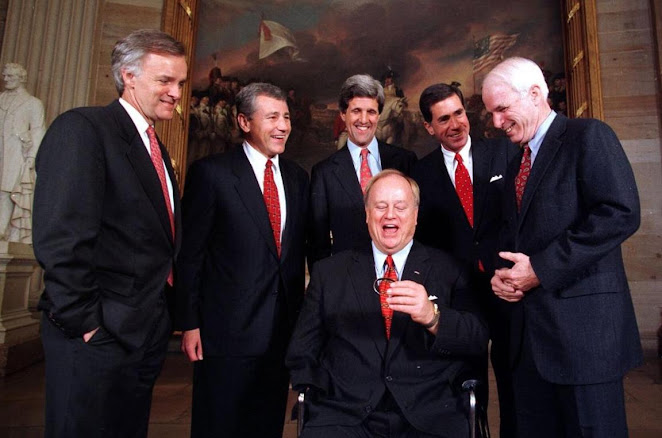
The Senate had six Vietnam combat veterans in January 1997. Sen. Max Cleland, D-Ga., is in the front. Behind him, from left: Bob Kerrey, D-Neb., Chuck Hagel, R-Neb., John Kerry, D-Mass., Chuck Robb, D-Va., and John McCain, R-Ariz. This photo was taken by The World-Herald during Senate orientation the previous month. (Kiley Cruse, The World-Herald)

Top photo: Secretary Max Cleland, American Battle Monuments Commission, delivers keynote remarks during the 72nd anniversary commemoration of the Dec. 7, 1941, attack on Oahu. This year’s commemoration theme, “Sound the Alarm,” examines how thousands of Americans answered the call to duty in the wake of the attack. More than 2,500 people attended the Pearl Harbor commemoration. (MC2 Nardel Gervacio)