Showing posts with label Russia. Show all posts

Thursday, October 10, 2024

Who Could Be Against Trump?

By Bill Doughty

Hundreds of former national security leaders –– from both Republican and  Democratic administrations –– signed a stark warning letter to the nation last month, citing about ex-President Trump, “He has shown no remorse for trying to overturn the 2020 election on January 6th, promises to pardon the convicted perpetrators, and has made clear he will not respect the results of the 2024 election should he lose again. That alone proves Mr. Trump is unfit to be Commander-in-Chief.”


Project 2025 was the must-read of the summer, and now this letter is a must-read for autumn, just a few weeks before the election. The lead signature is from Rear Admiral Michael E. Smith, USN (Ret), President of National Security Leaders for America.


Signatories include former SECDEFs Chuck Hagel, William Cohen, Leon Panetta, and William Perry as well as seven Senate-confirmed military service secretaries. The officials and senior officers called former President Donald J. Trump "impulsive," "ill-informed" and “unfit” to serve again as commander in chief.


They condemn his promise to “terminate” parts of the Constitution, his constant lying, and his role in the January 6, 2021 attempt to overturn the previous election and his “promises to pardon the convicted perpetrators.”


The letter includes signatures from three former acting service secretaries, former Secretary of Homeland Security Jeh Johnson, former Secretary of State Hillary Clinton, and former Secretary of Homeland Security Janet Napolitano. Among the more than 740 Americans who signed the letter are service members, civilians, and military spouse representatives. There are at least 63 Navy and 18 Marine Corps retirees who endorse Harris over Trump


Many Republicans have denounced Trump, with most pledging support to Kamala Harris for President. Notably, former Vice President Dick Cheney and former Representative Liz Cheney announced their endorsement of Harris. Liz Cheney is former House GOP conference chair and was the #3 Republican in the House of Representatives until she turned against Trump and helped lead a congressional investigation into the January 6, 2001 (J6) insurrection, consequently becoming a victim of MAGA retaliation.


Now Liz Cheney joins former Trump White House aides Alyssa Farah Griffin, Cassidy Hutchinson and Sarah Matthews today in Pennsylvania to campaign against Trump, noting, according to reports, his threat to democracy, the rule of law, and the Constitution. Former Trump White House communications director Anthony Scaramucci has issued similar warnings about another Trump presidency, and is actively supporting Kamala Harris and Tim Walz.

Recently, retired U.S. Army General Stanley McChrystal endorsed Vice President Kamala Harris for president, writing in a New York Times OpEd, “Ms. Harris has the strength, the temperament and, importantly, the values to serve as commander in chief.” He added, “I have cast my vote for character, and that vote is for Vice President Kamala Harris.”


In 2020, Admiral William McRaven, former commander of the U.S. Special Operations Command, warned the nation about a second Trump administration and what it would mean for the future of the country: “When good men and women can't speak the truth, when facts are inconvenient, when integrity and character no longer matter, when presidential ego and self-preservation are more important than national security — then there is nothing left to stop the triumph of evil.”

In another editorial about Trump, McRaven addressed him directly and wrote, "Through your actions, you have embarrassed us in the eyes of our children, humiliated us on the world stage and, worst of all, divided us as a nation.” Both McRaven and Admiral James Stavridis, former NATO Supreme Allied Commander, condemn Trump for his lack of character, his failure to uphold his oath to the Constitution, his affection for dictators and autocrats, and his antagonism of Allies and alliances.


Late Senator John McCain’s family have joined former members of Trump’s own administration –– including VP Pence, SECDEF Gen. Mattis, SECDEF Esper, CoS Gen. Kelly, NSA John Bolton, and CJCS Gen. Milley –– in condemning Trump for his role in the J6 insurrection coup attempt, threat to national security, and lack of stability. For his part, Trump threatens to retaliate against his critics both in government and in the media.

Next week, Bob Woodward’s new book, “War,” will hit book shelves, reporting on Trump’s “romance” with Russia’s Putin expanding on allegations of Russia’s help in Trump’s 2016 election when Trump, “Russia if you’re listening…” and publicly siding with Putin over his own Intelligence officers. Woodward reports that Trump secretly sent Covid-19 testing equipment directly to Putin in the early weeks of the 2020 pandemic, even though there was a shortage and need for testing in the United States. Trump denied the report, but Kremlin spokesman Dmitry Peskov said yesterday that the tests had been sent to Putin. It seems Woodward has written another must-read for this year.

Wednesday, March 29, 2023

Putin is a Cartoon. Literally

Review by Bill Doughty––

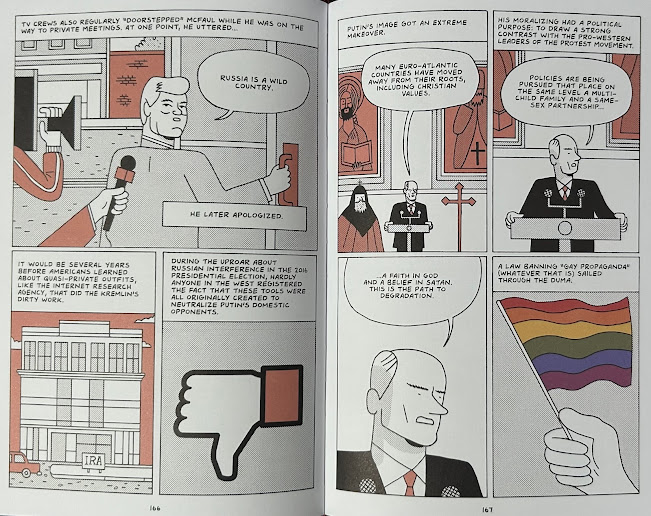
Russia’s President Putin is a cartoon in the seriously insightful “Accidental Czar: The Life and Lies of Vladimir Putin” by Andrew S. Weiss and Brian “Box” Brown, First Second, 2022).


Like the best graphic novels and graphic nonfiction, much is communicated in few words. For example ––

  • “For Russia, geography is destiny”: With no natural defenses including oceans, unlike the United States, “Russia safeguarded its security through conquest and territorial expansion.”
  • Quoting Gene Sharp, author of “The Politics of Nonviolent Action”: “Dictators are never as strong as they tell you they are, and people are never as weak as they think they are.”
  • Fomenting fear, conspiracies, and disinformation: “Russian leaders simply can’t accept that brave people sometimes shape history all on their own.”
  • Again quoting Sharp: “The extreme repression comes when a dictatorship really is frightened and therefore they act ruthlessly.”
  • Irony: In May 2007 in a Victory Day speech in Moscow, Putin said, “We have a duty to remember that the causes of any war lie above all in the mistakes and miscalculations of peacetime.”
  • Putin compared the United States to Nazi Germany and said, “These new threats, just as under the Third Reich, show the same contempt for human life.” Irony meets hypocrisy (condemning “contempt for human life”) when considering what Putin is doing to the people of Ukraine.

Weiss’s insights are succinct but deep. Brown’s simple art is both evocative and informative.


This book follows the rise of Putin from childhood to KGB apparatchik in East Germany, to Communist Party hack, to opportunistic sycophant, to power-mad leader. Picturing Russian history, Weiss and Brown show how Putin put forth grandiose ideas for restoring the “glory” of the Russian Empire and Russian Orthodox Christianity. Nearly 40 years ago, in 1989, Russian territory covered “one-sixth of the earth’s landmass.”


Faith in Russia’s system of nepotism, cronyism, and corruption is baked into its history, where serfdom was a close equivalent to slavery. The czar and the State were held above the individual or rule of law.

Putin’s invasion of Georgia in 2008 and Crimea in 2014 were telling signs that he would commit further international crimes. “Territorial expansion is at the core of Russia’s national identity,” according to Weiss.


We learn about the roles of a whole host of characters who endorsed Putin: former Russian President Boris Yeltsin, former Ukrainian President Viktor Yanukovych, Alexandr Torshin and Maria Butina, retired Lt. Gen. Michael Flynn, evangelist Franklin Graham, actor Steven Seagal, Republican representative Steve King, and Trump advisor Steve Bannon.


Putin v. McCain
On the other side, we see Putin’s nemeses, including former President Barack Obama, entertainers Pussy Riot, philanthropist George Soros, and late Senator John McCain, who was a “perennial nemesis of Putin.” Navy hero McCain was pro-Ukraine and pro-democracy; he saw Putin as an autocratic war criminal.

The late former Secretary of State Madeleine K. Albright endorsed: “Accidental Czar is an absorbing and visually stunning account of Vladimir Putin’s rise and take-no-prisoners approach to wielding power on the world stage. Andrew S. Weiss and Brian Brown have made one of the most consequential stories of our time more accessible and engaging for readers of all backgrounds. I would urge anyone who wants to better understand the forces shaping modern Russia, and disrupting our world, to open up this extraordinary book.”


Fiona Hill offers this endorsement: “This biography of Vladimir Putin deftly combines entertainment and serious analysis. Renowned Russia scholar Andrew S. Weiss and artist Brian Brown have found the perfect means to introduce the complexities of Russian politics and Putin’s peculiarities to a new set of audiences. Everyone should have a copy of Accidental Czar on their bookshelf.” Hill is senior fellow at the Brookings Institution and co-author of "Mr. Putin: Operative in the Kremlin." (She also authored the brilliant “There Is Nothing for You Here: Finding Opportunity in the 21st Century.”)

“Accidental Czar” is also blurbed by other notable thinkers, including former ambassador to Russia Michael McFaul, former President Bush speechwriter David Frum, conservative historian Max Boot, and New Yorker staff writer Susan B. Glasser. Author Gary Shteyngart blurbs: “A witty and comprehensive takedown of the annoying Putin-is-a-genius myth.”


In fact, Weiss and Brown show how Putin the cartoon is actually a deranged, dangerous, and destructive war criminal.

Tuesday, February 14, 2023

Frederick Douglass Speaks to Us in 2023: Part 1, Liberty


By Bill Doughty––

As a former slave, Frederick Douglass stood on a righteous stage when he observed, documented, and commented on history in the mid-to-late 1800s. Nearly two centuries later, his voice is still relevant in addressing our own controversial issues.


Here are some examples of that relevance from Douglass’s “Speeches and Writings” (Library of America, 2022, edited by David W. Blight.


On Liberty –– Consider why Ukraine fights for freedom and why we support their fight:

  • “The existence of this right is self evident. It is written upon all the powers and faculties of man. The desire for it  is the deepest and strongest of all the powers of the human soul. Earth, sea and air –– great nature, with her thousand voices proclaims it.” (12/08/1850)
  • “I have said that the right to liberty is self evident No argument, no researches into mould records, no learned disquisition, are necessary to establish it. To assert it, is to call forth a sympathetic response from every human heart, and to send a thrill of joy and gladness round the world. Tyrants, oppressors and slaveholders are stunned by its utterance; while the oppressed and enslaved of all lands hail it as an angel of deliverance. Its assertion in Russia, in Austria, in Egypt, in fifteen states of the American Union, is a crime. In the harems of Turkey, and on the Southern plantations of Carolina, it is alike prohibited; for the guilty oppressors of every clime understand its truth, and appreciate its electric power.” (12/08/1850)
  • “Americans! your republican politics, not less than your republican religion, are flagrantly inconsistent. You boast of your love of liberty, your superior civilization, and your pure Christianity, while the whole political power of the nation (as embodied in the two great political parties) is solemnly pledged to support and perpetuate the enslavement of three millions of your countrymen. You hurl your anathemas at the crowned headed tyrants of Russia and Austria, and pride yourselves on your Democratic institutions, while you yourselves consent to be the mere tools and bodyguards of the tyrants of Virginia and Carolina …You glory in your refinement and your universal education yet you maintain a system as barbarous and dreadful as ever stained the character of a nation—a system begun in avarice, supported in pride, and perpetuated in cruelty. (07/05/1852)
  • “Those who have undertaken to suppress and crush out this agitation for Liberty and humanity, have been most woefully disappointed. Many who have engaged to put it down, have found themselves put down. The agitation has pursued them in all their meanderings, broken in upon their seclusion, and, at the very moment of fancied security, it has settled down upon them like a mantle of unquenchable fire.” (05/1857)
  • “Man is man, the world over. This fact is affirmed and admitted in any effort to deny it. The sentiments we exhibit, whether love or hate, confidence or fear, respect or contempt, will always imply a like humanity A smile or a tear has not nationality; joy and sorrow speak alike to all nations, and they, above all the confusion of tongues, proclaim the brotherhood of man.” (12/07/1869)
  • “I, therefore, leave off where I began, with hope. While drawing encouragement from the Declaration of Independence, the great principles it contains, and the genius of American Institutions, my spirit is cheered by the obvious tendencies of the age. Nations do not now stand in the same relation to each other that they did ages ago. No nation can now shut itself up from the surrounding world, and trot round in the same old path of its fathers without interference. The time was when such could be done. But a change has now come over the affairs of mankind. Walled cities and empires have become unfashionable. The arm of commerce has borne away the gates of the strong city. Intelligence is penetrating the darkest corners of the globe. Wind, steam, and lightning are its chartered agents. Oceans no longer divide, but link nations together. From Boston to London is now a holiday excursion. Space is comparatively annihilated. Thoughts expressed on one side of the Atlantic are, distinctly heard on the other.” (07/051852)

Think about that line above: “Oceans no longer divide, but link nations together.”


That concept is at the heart of the U.S. Navy’s Maritime Strategy for generations, protecting liberty and ensuring freedom on the global commons. Douglass delivered the line in one of his quintessential speeches, Our Composite Nationality: An Address, in Boston, Massachusetts on December 7, 1869. On that date, the great naval strategist Alfred Thayer Mahan was a 29-year-old lieutenant commander. Mahan’s influential books on the influence of sea power and the need for a strong American Navy on the world’s oceans would be written more than two decades later.


Mahan and Douglass came from wildly different origins toward a common point of view about the moral imperative of liberty for all humanity.


For nearly 14 years Navy Reads has offered many reviews and commentary about both Mahan and Frederick Douglass, including Douglass’s ties to the Navy and the sea.

Friday, January 27, 2023

Navy Reads Holocaust Remembrance

By Bill Doughty

Over the years, we’ve offered a number of reviews and commentaries about anti-semitism, Nazism, fascism, and the holocaust. Today, we remember the victims, warning signs, and parallels today on Holocaust Remembrance Day, January 27, 2023.


Among the champions of critical thinking we have featured on Navy Reads who have addressed the horrors of the Holocaust: Hannah Arendt, author of "The Origins of Totalitarianism;” Diane Ackerman, author of “The Zookeeper’s Wife: A War Story;” and Timothy Snyder, author of “On Tyranny;” among others.


Snyder observes similarities between Russia’s aggression and “genocide” in Ukraine with Nazi Germany’s targeting of Jews in the Holocaust. He warns that it could happen here; the rise of Nazism began with a Big Lie, too, that Jews were responsible for Germany losing the First World War. Feelings of victimization can lead to disorder, violence, authoritarianism, and terrorism.


Snyder says U.S. military contributions to the defense of Ukraine, confronting Putin's terrorism and genocide are an investment in peace – both in Europe and as prevention of war in Asia. China, he notes, is watching the resolve of free nations in the West to help support the people of Ukraine.

Thursday, November 17, 2022

‘Zookeeper’s Wife’ and Shipwrecked Souls

Review by Bill Doughty––

In a village a circus lion suddenly died…

“The circus director asked a poor old Jewish man if he would pretend to be the lion, and the man agreed since he needed the money. The director said: ‘All you have to do is wear the lion’s fur and sit in the cage, and people will believe you’re a lion.’ And so the man did, muttering to himself, ‘What strange jobs I’ve had in my life,’ when his thoughts were interrupted by a noise. He turned just in time to see another lion creeping into his cage and fixing him with a hungry stare. Trembling, cowering, not knowing how to behave himself, the man did the only thing he could think of –– vociferously chant a Hebrew prayer. No sooner had he uttered the first desperate words, Shema Yisroel (Hear O Israel) … than the other lion lined in with adonai elohenu (The Lord our God), and the two would-be lions finished the prayer together.”

Zookeeper Jan Żabiński and real lion.
It’s an old folk story that Diane Ackerman heard as a young girl and shares in an introductory Author’s Note. And it’s a tale that became “oddly relevant” to the true story she tells in her amazing book, where art and storytelling come alive to become history.

“The Zookeeper’s Wife: A War Story” (W. W. Norton,  2007) is based on a true story in which brave people in Poland risked everything to help protect Polish Jews in World War II from the Nazis and the Holocaust. Like the lion-man in the folk story, “shipwrecked souls” eventually make their way to a zoo outside Warsaw for sanctuary.


And regarding relevance: Though the book was written in 2007 –– one year before Russia's Vladimir Putin invaded Georgia, seven years before he invaded Crimea, and 15 years before he began waging war in Ukraine –– readers in 2022 will likely think of Poland's role in Putin's current war in Ukraine as they read about what happened in Warsaw eight decades ago.


At first Ackerman lulls readers with her depiction of an idyllic human-animal bond, one of understanding, love, and respect for life. Innocence. Nature. Nurture. Peace. The pursuit of happiness in pre-war Warsaw. Ackerman beautifully depicts that world before the storm clouds of war start to destroy the way of life of the Żabiński family.


Antonina and family pet badger
Antonina Żabiński is the Zookeeper’s wife and a hero of this tale along with her husband, Jan, who served secretly with the Polish Underground to fight the Nazis. Ackerman dedicated the book “For Antonina and her family, human and animal.” The Żabiński matriarch helps manage the improbable zoo as well as schemes to hide and feed Jews they call “Guests.”

With the arrival of the Nazis, the sometimes-normal-occasional-calm of the zoo is shattered. Fascism brings iron-fisted and racist “law and order.” The Nazis build walls and deny freedom based on differences of religion and ethnicity. Casual cruelty leads inexorably to calculated genocide.


Ackerman depicts the banal evil of Adolf Hitler, Heinrich Himmler, Hermann Goring, Eugene Fischer, and others who valued the lives of other animals over the humans they condemned to camps, ovens, and mass graves.


Ackerman writes in a “narrative history” style. Her embellishments are sometimes well beyond David McCullough’s interpretive style. Yet, like McCullough, she imparts cold hard history. In "The Zookeeper's Wife" she builds her storytelling around actual facts published or contained in interviews, news stories, and diaries, including the diary of Antonina.


“‘How can this barbarity be happening in the twentieth century?!!!!!!’ Antonina asked herself, an outcry of disbelief with no fewer than six exclamation points.” Antonina saw the war as a return to the Dark Ages. She and her family counter their horrors with efforts to help those who were targeted by the Nazis for destruction. Along with housing and feeding castaways, the Żabińskis participated in a plot to feed Jewish residents in the Ghetto.


The Warsaw zoo helped make animal-human connections in 1938, before the arrival of the Nazis.

After most of the animals in their zoo were removed, released, or killed by the Nazis, the Żabińskis turned their enterprise into a pig farm. They secretly transported meat into the Ghetto. “If it felt a little off-color giving Jews pork, a taboo food, dietary laws had long since been waived, and everyone was grateful for protein, a scarce gift on either side of the wall,” Ackerman observes.


Such humanism and such audacity –– helping targeted victims of the Nazis –– was extremely risky.

“Unlike other occupied countries, where hiding Jews could land you in prison, in Poland harboring a Jew was punishable by immediate death to the rescuer and also to the rescuer’s family and neighbors, in a death-frenzy deemed ‘collective responsibility.’ Nonetheless, many hospital workers disguised adult Jews as nurses, drugged small children to quiet them before smuggling them out in knapsacks, and planted people in funeral carts under a heap of corpses. Many Christian Poles hid Jewish friends for the whole length of the war, even though it meant reduced rations and relentless vigilance and ingenuity. Any extra food entering the house, unfamiliar silhouettes, or whispers seeping from a cellar or closet might inspire a visiting neighbor to notify the police or tip off the city’s underbelly of blackmailers. The wayfarers often spent years in the dark, barely able to move, and when they finally emerged, unfolding their limbs, their weak muscles failed and they needed to be carried like a ventriloquist’s dummies.”
Diane Ackerman
Ackerman, author of “The Whale by Moonlight,” “Natural History of the Senses,” and “Dawn Light,” writes with heartbreaking brilliance of “The unbearable weight of Ghetto life.” Not surprisingly, her words include these metaphors of nature and the sea.

“During this time of seismic upheaval, more and more Ghetto dwellers washed up on the deck of the villa, arriving weatherbeaten, ‘like shipwrecked souls,’ Antonina wrote in her diary. ‘We felt that our house wasn’t a light, flimsy boat dancing on high waves, but a Captain Nemo’s submarine gliding through deep ocean on its journey to a safe port.’ Meanwhile, the war storm blew violently, scaring all, and ‘casting a shadow on the lives of our Guests, who fled from the entrance of crematoriums and the thresholds of gas chambers,’ needing more than refuge. ‘They desperately needed hope that a safe haven even existed, that the war’s horrors would one day end,’ while they drifted along in the strange villa even its owners referred to as an ark.”

Navy readers and their families who choose to read this book will identify with the core values of the Żabiński family: honor, courage, and commitment.


There is a familiar ethos in the character of the men, women, and children who participated in rescuing victims of the Nazis. Ackerman writes:

“Rescuers tended to be decisive, fast-thinking, risk-taking, independent, adventurous, openhearted, rebellious, and usually flexible –– able to switch plans, abandon habits, or change ingrained routines at a moment’s notice. They tended to be nonconformists, and though many rescuers held solemn principles worth dying for, they didn’t regard themselves as heroic. Typically, one would say, as Jan did: ‘I only did my duty –– if you can save somebody’s life, it’s your duty to try.’ Or: ‘We did it because it was the right thing to do.'"

Antonina had to deal with Nazis who invaded her home and threatened her; then she had to confront Russians who came to liberate Poland but tried to take what wasn’t theirs. Her inner strength, voice, and instincts proved to be all too powerful.


This is another treasured find I discovered in a used book store. It is also a book that gives a hopeful view of the human spirit, strength in resilience, and the power of righteousness in time of war.

Ackerman and W. W. Norton include comprehensive “details,” a bibliography, and index. The paperback version I scored comes with a “reading group guide” and list of other books with similar group guides. Blurbs are from an impressive list of reviewers, with standouts for me by Dava Sobel (“Longitude”), Jared Diamond (“Guns, Germs, and Steel”), and Donna Seaman of Los Angeles Times.


The Żabińskis in Warsaw, Poland, saved 300 Jews.


As of the autumn of 2022, Poland has accepted at least 1.4 million refugees who fled Ukraine due to Putin’s war and campaign of terrorism against civilians. This week, during a Russian missile onslaught against Ukraine, a Ukrainian defensive missile exploded on a grain farm in the rural village of Przewodow, five miles within Poland's border, killing two people. NATO nations, including the United States, met to consider additional options to deal with Russia’s continued aggression.

Sunday, October 16, 2022

Mahan the Realist / ‘Proud Tower’ 1

Review by Bill Doughty––

In “The Proud Tower: A Portrait of the World Before the War: 1890-1914,” (MacMillan, 1966) author Barbara W. Tuchman describes U.S. Navy Adm. Alfred Thayer Mahan as “a quiet, tight-lipped naval officer with one of the most forceful minds of this time.” Tuchman paints her description of Mahan this way:

“Well over six feet tall, wiry, thin and erect, he had a long, narrow face with narrowly placed pale-blue eyes, a long, straight, knifelike nose, a Sandy mustache blending into a closely trimmed beard over an insignificant chin. All the power of the face was in the upper part, in the eyes and domed skull and the intellectual bumps over the eyebrows … He had little sense of humor, a high moral tone … So precise were his scruples that when living on naval property at the War College he would not allow his children to use the government pencils.”

Mahan embraced his moment in time and was a driving force in turning the growing power of the United States toward expansion. He told others he could prove he was not anti-semitic: “That Jesus Christ was a Jew,” he said, “covers his race for me.”

Tuchman writes that among history’s many turning points at the end of the 19th and beginning of the 20th centuries, was “the last armed conflict between Indians and whites” at Wounded Knee Creek, South Dakota. (Although not detailed in Tuchman’s book, the “conflict” was, in fact, an atrocity –– the massacre of 300 Lakota men, women and children by the U.S. Army in 1890.)


The massacre was a turning point for the United States. “In that year [then] Captain A.T. Mahan, president of the Naval War College, announced in the Atlantic Monthly, ‘Whether they will or no, Americans must now begin to look outward.’”


Mahan saw the Pacific as America’s destiny. Expansion westward, he thought, must continue in the name of Manifest Destiny –– what Rudyard Kipling would call “the White Man’s Burden.”

“The immediate issue was Annexation of Hawaii. A naval coaling base at Pearl Harbor had been acquired in 1887, but the main impulse for annexation of the Islands came from American property interests which were dominated by Judge Dole and the sugar trust. With the support of the United States Marines they engineered a revolt against the native Hawaiian government in January 1893…”

In “The Proud Tower” Tuchman describes the political challenges and opportunities involved in Hawaii becoming a territory of the United States.


It was a time of tumult and war for the U.S. military in Cuba, the Philippines, and China. War continued to flair between other countries, as well.

Japan’s victory over China in 1895 –– not to mention Japan’s success in the Russo-Japanese War several years later –– reinforced Mahan’s published opinions about America’s continued need to look outward to defend its interests in a dangerous world through power. That power could only be achieved with a strong navy, which was “moribund” at the time, according to Tuchman. 

With strong support from Assistant Secretary of the Navy Theodore Roosevelt and allies in the U.S. Congress, it wouldn’t be long before shipbuilding in the United States was revitalized.


Meanwhile, Mahan’s classic “The Influence of Seapower on History” “had an effect that was epochal on world history,” according to Tuchman. The book was a favorite of Kaiser Wilhelm in Germany, and was high on the reading list for naval officers in Japan. She notes that another remarkable book published in that period also influenced the course of history: Charles Darwin’s “The Origin of the Species.”


Darwin’s conclusions about the animal kingdom were twisted to apply to human society so that Darwinism “acquired a moral imperative,” Tuchman writes. “Darwin’s indirect effects reached apotheosis in Captain Mahan. It’s no coincidence that science’s rise in the late 1800s came at the same time as the waning of the influence of religion. People needed to believe in something, Tuchman said, and that something was either nationalism, socialism, or anarchy –– or some combination of the above.

The world also experienced a revolution in art around the turn of the century. Picasso and Braque created expressionist Cubism. Richard Strauss experimented with formless new music with Also Spruce Zarathustra. The title of Tuchman’s book comes from a poem by Edgar Allan Poe, “The City in the Sea,”* written in the mid-1800s. By the first decade of the 1900s, playwrights, composers, painters, and writers, including Friedrich Nietzsche, tinkered with ideas that both reflected society and influencing it.


Mahan, a stubborn realist, continued to be a firm believer in the necessity of war and the right of a nation, at least his nation, to expand its interests through belligerence, even at the expense of others.


Mahan was chosen as a key U.S. representative at the Hague Convention of 1899 in the Netherlands. Tsar Nicholas II of Russia called leading nations to the convention to try to curb a global arms race. Mahan’s “rectitude and assuredness” led to his rejection to proposals to limit the calibre of guns and other restrictions. He even voted against limiting use of weapons of mass destruction, including chemical weapons such as “asphyxiating gas.”


Barbara Tuchman
It’s ironic (thinking of Vladimir Putin’s invasion of Ukraine) to consider that it was Russia that proposed the Hague talks in 1899 and later in 1907. The Hague Conventions wanted to prevent or at least lessen the impacts of war through limitations in armaments, adoption of laws of war, and acceptance of rules of arbitration. To Russian thinkers, the thought was that war had become “impossible except at the price of suicide,” as stated in the six-volume “The Future or War,” published by Ivan Bloch, who believed “Limited war was no longer possible.”

Despite any meager agreements between nations, the “Great War” came to the world as Anarchists, Socialists, Ultra-Nationalists, and anti-Socialists prevailed in their assassinations, bomb-throwing, and revanchism in the second decade of the 20th century, culminating with the assassination of Franz Ferdinand and Jean Jaurés.


Tuchman laments the loss of the Old World and “much that has since been lost.” Touching on the imagery in Poe’s maritime-themed “The City in the Sea,” Tuchman writes, “Illusions and enthusiasm slowly sank beneath a sea of massive disillusionment.”


“For the price it paid, humanity’s gain was a painful view of its own limitations.”


*The City in the Sea


By Edgar Allan Poe


Lo! Death has reared himself a throne
In a strange city lying alone
Far down within the dim West,
Where the good and the bad and the worst and the best
Have gone to their eternal rest.
There shrines and palaces and towers
(Time-eaten towers and tremble not!)
Resemble nothing that is ours.
Around, by lifting winds forgot,
Resignedly beneath the sky
The melancholy waters lie.

No rays from the holy Heaven come down
On the long night-time of that town;
But light from out the lurid sea
Streams up the turrets silently—
Gleams up the pinnacles far and free—
Up domes—up spires—up kingly halls—
Up fanes—up Babylon-like walls—
Up shadowy long-forgotten bowers
Of sculptured ivy and stone flowers—
Up many and many a marvellous shrine
Whose wreathed friezes intertwine
The viol, the violet, and the vine.
Resignedly beneath the sky
The melancholy waters lie.
So blend the turrets and shadows there
That all seem pendulous in air,
While from a proud tower in the town
Death looks gigantically down.

There open fanes and gaping graves
Yawn level with the luminous waves;
But not the riches there that lie
In each idol’s diamond eye—
Not the gaily-jewelled dead
Tempt the waters from their bed;
For no ripples curl, alas!
Along that wilderness of glass—
No swellings tell that winds may be
Upon some far-off happier sea—
No heavings hint that winds have been
On seas less hideously serene.

But lo, a stir is in the air!
The wave—there is a movement there!
As if the towers had thrust aside,
In slightly sinking, the dull tide—
As if their tops had feebly given
A void within the filmy Heaven.
The waves have now a redder glow—
The hours are breathing faint and low—
And when, amid no earthly moans,
Down, down that town shall settle hence,
Hell, rising from a thousand thrones,
Shall do it reverence.

Saturday, October 8, 2022

Zelensky the Artist

Review by Bill Doughty––

There are some obvious signs this book was rushed into print to meet the moment in trying to answer key questions. Would Zelensky be able to stay alive to lead his brave country in the fight against Putin’s invasion? Would Ukraine be overrun? Could Russia be stopped?


Rushed as it is, nonetheless this book is an important tool to examine how Zelensky became “Churchill in a T-shirt.” Also, it encapsulates history, context, and personalities to provide context for Putin’s invasion and war against Ukraine.


The book is “Zelensky: The Unlikely Ukranian Hero Who Defied Putin and United the World” by Andrew L. Urban and Chris McLeod, with a foreword by Rebekah Koffler (Regency Publishing, 2022). Urban and McLeod look into the Ukranian President Zelensky’s early life, rise to the presidency, and use of his art as a communicator and performer to become an inspirational leader.

U.S. military readers would benefit from the book’s concise presentation of the history of Ukraine and the demise of the USSR, presented in timelines, statistics, and data.


Readers can appreciate the inclusion of some extras in this book that make it more than just a biography or compilation of statistics and news reports. The authors include historical timelines about Ukraine and the “demise” of the Soviet Union. They present a short chapter on the alliances of Europe, including NATO, the Warsaw Pact, European Union, the Baltic States, and the Commonwealth of Independent States.


Urban and McLeod examine NATO and other strategic alliances and show clearly how Putin and Russia have violated the rule of law, spelled out in the Budapest Memorandum, which calls for nations “to respect the independence and sovereignty and the existing borders of Ukraine.”


Using more statistics, the authors examine the disparity between Russian and Ukrainian forces. They show how and perhaps why the Russians paint the “Z” symbol on their tanks and trucks. They explain the make-up of the Wagner Group, a Russian mercenary paramilitary group, named for the German composer as a nod to one of its organizer’s “passion for the Third Reich.”


President Zelensky aboard USS Ross (DDG-71)
The authors shoot down Putin’s excuses for his invasion of Ukraine, especially the pretext of the need to attack Nazi forces in control of Russia’s neighbor. We are reminded several times in this book that Zelensky is of Jewish heritage. His great grandfather and other family members were murdered in World War II in the Holocaust.

Readers are told of some uncomfortable ties between Putin’s aggression in Ukraine and some Americans of influence; some who have spoken out against U.S. support and involvement include (now former) Representative Madison Cawthorn, Senate Candidate J.D. Vance, and Fox TV anchor Tucker Carlson. 


Urban and McLeod report how in 2020 former Navy SEAL Erik Prince, founder of the Blackwater paramilitary group, “sought to provide military services to the Wagner Group in its operations in Libya and Mozambique.” (Prince is the brother of President Trump’s former U.S. Secretary of Education Betsy DeVos.) In one of the book’s timelines we are reminded of Trump’s call with Zelensky three years ago this month in which he tried to leveraged military support to Ukraine in an attempt to get political dirt on his opponent, leading to Trump’s first impeachment by the U.S. House of Representatives.


Such indirect support to Putin’s regime and against Ukraine is counterbalanced by the heavy direct support by Western Allies, especially by President Biden and the United States Congress, in providing weapons and ammunition to Zelensky and Ukraine. As of this book’s publication, the United States had provided $1.38 billion in military aid. But, according to Secretary of State Tony Blinken, as of Oct. 4, 2022 the United States has provided $17.5 billion in U.S. military assistance to Ukraine.


This relatively small book is a snapshot from the opening months of the war. Who knows how history will unfold in the weeks and months to come? What seems clear now is Putin is backed into a corner, and the shadow of nuclear escalation and even Armageddon seems bigger and darker. But, Ukraine is showing much of the world that freedom-loving democracy is worth fighting for.


A map in the opening pages purports to show contested areas in eastern Ukraine overrun by Russia; of course, any map older than a week would be inaccurate. 


With no index, no notes, and plenty of repetition and lack of coherence, this book was obviously rushed into print. Still, the good content outweighs the shortcomings.


The book concludes with a transcription of Zelensky’s inspiring address to the U.S. Congress on March 16, 2022, for which he received standing ovations.

His art as a communicator and motivating leader, reminiscent of Churchill, shines through.


In his remarks, Zelensky spoke passionately about need to protect the people in his country who want to live free and under the rule of law. “Americans,” he said, “in your great history, you have patriots that would allow you to understand Ukranians, understand us now when we need you right now. Remember Pearl Harbor…”


Top photo: Ukraine President Volodymyr Zelensky is welcomed aboard USS Ross (DDG-71) by Vice Adm. Gene Black, commander, U.S. Sixth Fleet, and Ross commanding officer Cmdr. John D. John in Odessa, Ukraine, during Exercise Sea Breeze 2021, July 4, 2021. Exercise Sea Breeze is a multinational maritime exercise cohosted by U.S. Sixth Fleet and the Ukrainian Navy in the Black Sea since 1997. Sea Breeze 2021 is designed to enhance interoperability of participating nations and strengthen maritime security and peace within the region. (MC2 Trey Fowler)

Tuesday, September 6, 2022

Part II: Hornfischer’s One Ocean…

Review by Bill Doughty––

James D. Hornfischer’s final book, “Who Can Hold the Sea,” opens with a poignant message from Jim’s widow, Sharon Hornfischer.


Sharon includes this advice:

“Jim believed, as I also do, that others of this generation and future generations will carry on telling the stories of our great nation’s history. Share your stories with your children and grandchildren, nieces and nephews, so that they are engaged in our nation’s history and our country’s continued fight for freedom and democracy. Encourage our next generation, take them to air shows, museums, and libraries; ignite the spark of curiosity in our future historians and writers so that they can continue to tell stories for us all to read.”

Hornfischer
It’s both sad and inspiring to read Jim Hornfischer’s final work. As both a gifted writer and historian, he created vivid true stories of Sailors and Marines and their leaders. This book’s preface, introduction, and acknowledgements bookend the story of the Cold War with tender personal messages.

Hornfischer’s “Who Can Hold the Sea” (Bantam Books, 2022) opens in the gray aftermath of World War II.


After confronting and defeating fascism, the United States and most of the Allies moved toward greater democracy, peacekeeping, rule of law, and liberty for all. The Soviet Union, on the other hand, held on to autocracy, aggression, violations of laws, and control of its citizens’ freedoms.


“For Truman,” Hornfischer observes, “the Soviet Union was a treacherous and malignant betrayer.”


Americans adjusted to postwar realities –– not only fear of spreading communism and Soviet expansion, but also budgetary turmoil that reached into the military. Some politicians proposed doing away with the Marine Corps and Navy and merging the service branches.


None other than Adm. William “Bull” Halsey spoke out against the merger in a speech thankfully excerpted by Hornfischer.


Halsey said, in part:

“Merger is not necessary. It is not desirable. It is plainly dangerous. It would destroy the initiative of individual services. It would hamstring their right to advance. It would deprive them of representation before Congress and the people. It would substitute military for civilian control. It might lead to military dictatorship.”

Admirals Chester Nimitz, Ernest J. King, Marc Mitscher, and Edward L. Cochrane –– along with Secretary of the Navy (and first Secretary of Defense) James V. Forrestal –– persuaded President Truman and others that the Navy had a strategic role in the Atomic Age; merger of the services, along with loss of the Marine Corps, would be a bad idea.


President Truman is welcomed aboard USS Franklin D. Roosevelt (CV-42) by SECNAV Forrestal and Adm. Nimitz. Adm. Leahy pictured in background. (NHHC)
Truman visited Norfolk, Virginia, in April 1946 at the invitation of Commander in Chief, U.S. Atlantic Fleet Adm. Mitscher. Truman witnessed the power of naval aviation and capabilities of aircraft carriers USS Franklin D. Roosevelt (CV-42) and the seemingly ubiquitous USS Midway (CV-41). Mitscher’s chief of staff was Capt. Arleigh Burke.

Then-SECNAV Forrestal was one of the principal architects of the post-war modern Navy. His global vision was based on peace through freedom and democracy, not communism or autocracy. Hornfischer writes, “If that world was to become a community, it would be possible, Forrestal thought, only with U.S. leadership, the victorious democracy investing its credibility and standing in the world to promote self-determination and freedom wherever it showed aspiration.” Hornfischer explores the role Forrestal played and delves into Forrestal’s controversial death at Bethesda Naval Hospital.


“Who Can Hold the Sea” vividly covers how Burke, Nimitz and Forrestal shaped the Navy during the Cold War. And strategic thinker and diplomat George Frost Kennan influenced the influencers, as Mahan had done for the first half of the century. Kennan recognized early the “perverse brutality and terror” of Joseph Stalin and Communism’s threat to Capitalism and democracy.


Watercolor of scorched USS Nevada (BB-36) as Nagato and Sakawa sink.. (Arthur Beaumont, 1946)
As a result of those fears, including the real fear that the Soviets were developing nuclear weapons, the United States rushed to conduct atomic bomb tests in the Pacific just a year after the war. In Operation Crossroads, the Navy positioned hundreds of pigs and goats, as well as 4,000 rats, aboard a target ship to test the results of radiation from a nuclear “cauliflower head.” The results were staggering and crippling.

The flagship of Adm. William H. “Spike” Blandy, who headed up Operation Crossroads, was contaminated with radiation, so “hot” it needed to “cool down” before it could be boarded.


After "Able" and "Baker," Blandy had to cancel a third "Charley" stage of the test, Hornfischer notes. “The radioactive mess had become impossible to manage.”


Later, he would celebrate the operation with a bizarre cake-cutting ceremony.


Vice Adm. Blandy and his wife cut into an Operation Crossroads cake shaped to look like a radioactive geyser, as Rear Adm. Frank J. Lowry looks on, Nov. 7, 1946.

The Navy forged forward in developing deployable nuclear weapons, supported by John L. Sullivan, Secretary of the Navy.

The atomic bomb would shape the entire forty-four-year span of the Cold War. Made even smaller and more easily deployable, with larger and larger payloads, it would place every crook and crevice of the world under threat of ruin. War planners schemed to win atomic exchanges, even as they and every policy maker had no sense of consequences, and prudence demanded keeping the weapon in Pandora’s box. Humility, terror, curiosity, eager innovation, and abject paranoia would be the diverse by-products of the bomb.”

Louis A. Johnson
Sullivan would fight for the Navy but would resign in the face of cutbacks, cancellation of construction of the CVA-58 class aircraft carrier USS United States, and favoritism for the Air Force by SECDEF Louis A. Johnson. “The new defense secretary was an equal opportunity irritant, abrasive and arrogant and making no effort to filter it,” Hornfischer writes. “Johnson’s animus toward the Navy was an open secret.”

Despite obstacles, the Navy forged ahead in developing deployable nuclear weapons and nuclear-powered ships, including submarines. 


Hornfischer reveals how close the world came to nuclear war in the decade-and-a-half after bombs were dropped on Hiroshima and Nagasaki.


Leaders contemplated using nuclear weapons after Communist China threatened Formosa (Taiwan), after Communist North Korea invaded the South, and after Communists took power in French Indochina (Vietnam). Eisenhower was a voice of reason in nixing the idea of using the Bomb. Though not covered in this book, the Bay of Pigs incident comes to mind, when President John F. Kennedy, Navy veteran and WWII hero, proved to be the voice of reason in preventing nuclear war after the Soviet Union threatened to position nuclear weapons in Cuba.


Admittedly incomplete and somewhat unfinished, Hornfischer’s history of the Cold War is a compelling book thanks to the author’s distinctive style and grace. His writing shines in descriptions of not only events but also people, such as the great Arleigh Burke, “the son of a humble Colorado farmer,” a leader who embraced an ethos of good leadership.

“[Burke] had taken integrity, self-discipline, and strong principles from his father and mother, a teacher. In 1923, the year he graduated from the U.S. Naval Academy, the faculty had just compiled the first textbook on naval leadership. It listed the ‘essential qualities’ of a naval officer as personal dignity, honor, courage, truthfulness, faith, justice, earnestness, assiduity, judgment, perseverance, tact, self-control, simplicity, and loyalty –– to country and to service, to both one’s seniors and juniors. ‘Loyalty up and down was important because of the natural independence and self-reliance of the American sailor,’ and naval officers had to earn the respect of their men [and women] through their personal merit and example. Burke had been trained as a specialist in ordnance, earning a master’s degree in chemical engineering and becoming a design and production specialist in explosives. This background exposed Burke to the most advanced naval technologies of his time and would prepare him as CNO to promote the development of nuclear weapons, nuclear power, and guided and ballistic missiles.”

Burke helped guide the Navy through rough seas during the Cold War.


CNO Arleigh Burke on the bridge of USS Forrestal (CVA-59) March 12, 1956 as ship's CO Capt. Roy L. Johnson points out distant aircraft. (NHHC)

It’s bittersweet to read this excellent book about the Cold War knowing that Hornfischer is gone. He died last summer after a valiant fight with cancer. As mentioned, his wife Sharon offers a beautiful tribute to him and his legacy in the book’s preface.

Both Jim and Sharon offer acknowledgements at the end of this book. They thank retired Navy Admiral “Fox” Fallon, former commander of both U.S. Pacific Command and Fleet Forces Command and current board chairman of the Naval Historical Foundation. They also acknowledge and thank other graybeards, including retired Rear Admiral Samuel Cox, director of Naval History and Heritage Command and Curator of the Navy. The Hornfischers pay special tribute to the Nimitz Museum in Fredericksburg, Texas, hometown of the great admiral who led the winning strategy in the Pacific War.


This terrific book brought other books to mind that would make good companion reading: “Atlantic” and “Pacific” by Simon Winchester; "The Second Most Powerful Man in the World: The Life of Admiral William D. Leahy, Roosevelt's Chief of Staff" by Phillips Payson O'Brien; “Revolt of the Admirals: The Fight for Naval Aviation, 1945-1950” by Jeffrey G. Barlow; "The Silent War: The Cold War Battle Beneath the Sea” by John Piña Craven; “This Kind of War: The Classic Korean War History” by T. R. Fehrenbach; “Gangsters of Capitalism: Smedley Butler, the Marines, and the Making and Breaking of America’s Empire” by Jonathan M. Katz; “Opening the Great Depths: The Bathyscaph Trieste and Pioneers of Undersea Exploration” by Norman Polmar and Lee J. Mathers; and “The Blue Age: How the US Navy created Global Prosperity –– and Why We’re in Danger of Losing It” by Gregg Easterbrook. It goes without saying that every book by Hornfischer should be on the reading list for anyone interested in American maritime history.


The Hornfischers valued libraries, museums, research institutes, and, of course, books. As Jim writes, “Those interested in national and maritime affairs ought to be mindful of the major events of the past.”


Top Photo: Operation Crossroads "Baker Day" A-bomb underwater explosion, seen from shore of Bikini Atoll, 25 July 1946. NHHC


(In Part I of this review, we presented Hornfischer's view of "one global ocean." We also compared Gorbachev and Putin, discussed the rise of NATO, and presented some coincidental milestones that happened in August and September decades ago.)