Showing posts with label Commitment. Show all posts

Thursday, November 17, 2022

‘Zookeeper’s Wife’ and Shipwrecked Souls

Review by Bill Doughty––

In a village a circus lion suddenly died…

“The circus director asked a poor old Jewish man if he would pretend to be the lion, and the man agreed since he needed the money. The director said: ‘All you have to do is wear the lion’s fur and sit in the cage, and people will believe you’re a lion.’ And so the man did, muttering to himself, ‘What strange jobs I’ve had in my life,’ when his thoughts were interrupted by a noise. He turned just in time to see another lion creeping into his cage and fixing him with a hungry stare. Trembling, cowering, not knowing how to behave himself, the man did the only thing he could think of –– vociferously chant a Hebrew prayer. No sooner had he uttered the first desperate words, Shema Yisroel (Hear O Israel) … than the other lion lined in with adonai elohenu (The Lord our God), and the two would-be lions finished the prayer together.”

Zookeeper Jan Żabiński and real lion.
It’s an old folk story that Diane Ackerman heard as a young girl and shares in an introductory Author’s Note. And it’s a tale that became “oddly relevant” to the true story she tells in her amazing book, where art and storytelling come alive to become history.

“The Zookeeper’s Wife: A War Story” (W. W. Norton,  2007) is based on a true story in which brave people in Poland risked everything to help protect Polish Jews in World War II from the Nazis and the Holocaust. Like the lion-man in the folk story, “shipwrecked souls” eventually make their way to a zoo outside Warsaw for sanctuary.


And regarding relevance: Though the book was written in 2007 –– one year before Russia's Vladimir Putin invaded Georgia, seven years before he invaded Crimea, and 15 years before he began waging war in Ukraine –– readers in 2022 will likely think of Poland's role in Putin's current war in Ukraine as they read about what happened in Warsaw eight decades ago.


At first Ackerman lulls readers with her depiction of an idyllic human-animal bond, one of understanding, love, and respect for life. Innocence. Nature. Nurture. Peace. The pursuit of happiness in pre-war Warsaw. Ackerman beautifully depicts that world before the storm clouds of war start to destroy the way of life of the Żabiński family.


Antonina and family pet badger
Antonina Żabiński is the Zookeeper’s wife and a hero of this tale along with her husband, Jan, who served secretly with the Polish Underground to fight the Nazis. Ackerman dedicated the book “For Antonina and her family, human and animal.” The Żabiński matriarch helps manage the improbable zoo as well as schemes to hide and feed Jews they call “Guests.”

With the arrival of the Nazis, the sometimes-normal-occasional-calm of the zoo is shattered. Fascism brings iron-fisted and racist “law and order.” The Nazis build walls and deny freedom based on differences of religion and ethnicity. Casual cruelty leads inexorably to calculated genocide.


Ackerman depicts the banal evil of Adolf Hitler, Heinrich Himmler, Hermann Goring, Eugene Fischer, and others who valued the lives of other animals over the humans they condemned to camps, ovens, and mass graves.


Ackerman writes in a “narrative history” style. Her embellishments are sometimes well beyond David McCullough’s interpretive style. Yet, like McCullough, she imparts cold hard history. In "The Zookeeper's Wife" she builds her storytelling around actual facts published or contained in interviews, news stories, and diaries, including the diary of Antonina.


“‘How can this barbarity be happening in the twentieth century?!!!!!!’ Antonina asked herself, an outcry of disbelief with no fewer than six exclamation points.” Antonina saw the war as a return to the Dark Ages. She and her family counter their horrors with efforts to help those who were targeted by the Nazis for destruction. Along with housing and feeding castaways, the Żabińskis participated in a plot to feed Jewish residents in the Ghetto.


The Warsaw zoo helped make animal-human connections in 1938, before the arrival of the Nazis.

After most of the animals in their zoo were removed, released, or killed by the Nazis, the Żabińskis turned their enterprise into a pig farm. They secretly transported meat into the Ghetto. “If it felt a little off-color giving Jews pork, a taboo food, dietary laws had long since been waived, and everyone was grateful for protein, a scarce gift on either side of the wall,” Ackerman observes.


Such humanism and such audacity –– helping targeted victims of the Nazis –– was extremely risky.

“Unlike other occupied countries, where hiding Jews could land you in prison, in Poland harboring a Jew was punishable by immediate death to the rescuer and also to the rescuer’s family and neighbors, in a death-frenzy deemed ‘collective responsibility.’ Nonetheless, many hospital workers disguised adult Jews as nurses, drugged small children to quiet them before smuggling them out in knapsacks, and planted people in funeral carts under a heap of corpses. Many Christian Poles hid Jewish friends for the whole length of the war, even though it meant reduced rations and relentless vigilance and ingenuity. Any extra food entering the house, unfamiliar silhouettes, or whispers seeping from a cellar or closet might inspire a visiting neighbor to notify the police or tip off the city’s underbelly of blackmailers. The wayfarers often spent years in the dark, barely able to move, and when they finally emerged, unfolding their limbs, their weak muscles failed and they needed to be carried like a ventriloquist’s dummies.”
Diane Ackerman
Ackerman, author of “The Whale by Moonlight,” “Natural History of the Senses,” and “Dawn Light,” writes with heartbreaking brilliance of “The unbearable weight of Ghetto life.” Not surprisingly, her words include these metaphors of nature and the sea.

“During this time of seismic upheaval, more and more Ghetto dwellers washed up on the deck of the villa, arriving weatherbeaten, ‘like shipwrecked souls,’ Antonina wrote in her diary. ‘We felt that our house wasn’t a light, flimsy boat dancing on high waves, but a Captain Nemo’s submarine gliding through deep ocean on its journey to a safe port.’ Meanwhile, the war storm blew violently, scaring all, and ‘casting a shadow on the lives of our Guests, who fled from the entrance of crematoriums and the thresholds of gas chambers,’ needing more than refuge. ‘They desperately needed hope that a safe haven even existed, that the war’s horrors would one day end,’ while they drifted along in the strange villa even its owners referred to as an ark.”

Navy readers and their families who choose to read this book will identify with the core values of the Żabiński family: honor, courage, and commitment.


There is a familiar ethos in the character of the men, women, and children who participated in rescuing victims of the Nazis. Ackerman writes:

“Rescuers tended to be decisive, fast-thinking, risk-taking, independent, adventurous, openhearted, rebellious, and usually flexible –– able to switch plans, abandon habits, or change ingrained routines at a moment’s notice. They tended to be nonconformists, and though many rescuers held solemn principles worth dying for, they didn’t regard themselves as heroic. Typically, one would say, as Jan did: ‘I only did my duty –– if you can save somebody’s life, it’s your duty to try.’ Or: ‘We did it because it was the right thing to do.'"

Antonina had to deal with Nazis who invaded her home and threatened her; then she had to confront Russians who came to liberate Poland but tried to take what wasn’t theirs. Her inner strength, voice, and instincts proved to be all too powerful.


This is another treasured find I discovered in a used book store. It is also a book that gives a hopeful view of the human spirit, strength in resilience, and the power of righteousness in time of war.

Ackerman and W. W. Norton include comprehensive “details,” a bibliography, and index. The paperback version I scored comes with a “reading group guide” and list of other books with similar group guides. Blurbs are from an impressive list of reviewers, with standouts for me by Dava Sobel (“Longitude”), Jared Diamond (“Guns, Germs, and Steel”), and Donna Seaman of Los Angeles Times.


The Żabińskis in Warsaw, Poland, saved 300 Jews.


As of the autumn of 2022, Poland has accepted at least 1.4 million refugees who fled Ukraine due to Putin’s war and campaign of terrorism against civilians. This week, during a Russian missile onslaught against Ukraine, a Ukrainian defensive missile exploded on a grain farm in the rural village of Przewodow, five miles within Poland's border, killing two people. NATO nations, including the United States, met to consider additional options to deal with Russia’s continued aggression.

Tuesday, August 16, 2022

Chilling with ‘Icebound’

Review by Bill Doughty––

As the summer heats up literally, here’s a way to cool off literarily: Andrea Pitzer’s goosebumps-inducing history-science-adventure true story, “Icebound: Shipwrecked at the Edge of the World” (Scribner, Simon & Schuster, 2021).


It’s the otherworldly true story of Dutch sailors, led by navigator William Barents, as they attempt to find an open polar sea in the Arctic in the age of sail.

Barents, who pioneered map-making in the Mediterranean, made three voyages for the Dutch Republic in the 1590s. This book covers all three ventures, but zeroes in on the third and final fraught attempt. The Dutch, along with other nations, wanted to discover a northern trade route to China.


It was time of growing empires and growing sea trade in slaves and spices.


It was also a time of war between Spain (Catholic and monarchistic) and the Netherlands (Protestant and based in liberty). While war raged in western Europe, Barents and other Dutch sailors headed East and North, hoping to find a warm sea beyond the ice.


Barents was considered a “magician” for his ability at celestial navigation. “He could look into the sun and fix their ship’s position not he globe. He could watch the stars and tell them the day of the year.”


Though no navigable route was found, the young Dutch Republic would continue to expand over the next hundred years –– thanks to the slave trade, spice trade, exploration, and art –– to become the largest economy and naval power in the world at the time, according to Pitzer.


“William Barents would play a role in that drama, but as he readied himself for his first voyage into the Arctic, his country was a blank slate, its sins and achievements still unwritten,” she writes.

Navy readers will appreciate Pitzer’s recounting of history and science, naval lore, and the courage and commitment of sailors in the face of seemingly impossible odds.


For example, as regards history and science…


We are reminded that Vikings “discovered” Ukraine and that the science of navigation relied on the discovery of trigonometry in 1080 by Arab Astronomers, as well as inventions by Babylonians, Egyptians, Indians, Chinese, Greeks, and Scandinavians. What they knew in the late 16th century, though, was dwarfed by what Barents and the sailors didn’t know. Many great scientific discoveries were yet to be made.

“As they set forth, they knew some things. They knew how to set the sails on the ship to catch the wind. They knew how to steer. They knew how to work wood, and hunt, and trap. Barents could reckon latitude and knew the stars, and those he didn’t know, he had charts for. Sailors understood that icebergs haunted the northern regions and could stretch for miles. Sometimes rising more than two hundred feet above the waterline, they were capable of rewarding vessels and the tiny human presence guiding them.

“Barents and his fellow crew members knew some things, but it wasn’t enough. They possessed no scientific understanding of gravity, no telescopes, and no calculus. Though they could find their latitude, they couldn’t yet determine longitude from aboard a ship. They were centuries away from deciphering the germ theory of disease. More than a hundred years could pass before humanity would discover that lightning was electricity. Decades remained before doctors would realize that blood circulates in the body, and that a cell is the unit of life. As he sailed into the Arctic, Barents would, in time encounter wonders and terrors without understanding most of the forces at play in his universe.”

Nenets idols, Vaigach Island.
Naturally, in the absence of information and in the embrace of superstition, early sailors believed good –– and bad –– fortune was the will of God. They believed their religion condoned slavery, for example, and ordained “man” to overcome and rule over nature.

Pitzer describes interactions with indigenous people in the far north, including the Sami and Nenets, who worshipped wooden idols, which fascinated the sailors. One sailor stole an idol and took it aboard ship only to be forced to return it later.


As the Scientific Revolution was beginning to blossom in Europe with Copernicus, Descartes, Francis Bacon, Barents and his crew were collecting and measuring polar bear pelts and walrus tusks and studying flora and fauna –– three hundred years before Darwin. Barents explained mirages, experienced the gap between Earth’s magnetic pole and true polar north, and mapped the geography at the edge of the Arctic. He also resolved a centuries-old superstition about barnacle geese: that they did not spontaneously hatch from barnacles (because no one had previously seen their nests and eggs).


Pitzer hides her history and science within harrowing tales of survival aboard their ship, at Vaigach Island, on boats, and at then-ice-covered Nova Zembla.


We feel the cold chill the crew to the bone. We hear chunks of ice hit the hull of the ship, see the men fend off frequent attacks by polar bears, smell the stink of sickness, and taste the desperation as the men are trapped in the ice over the winter: “Shipwrecked at the Edge of the World.”

Arctic fox
Navy history readers will appreciate passages about sails, masts, knees, joint pegs, and planks; scurvy; mutiny; keelhauling; and generally what life was like for age-of-sail sailors at sea –– endless routines, fear of storms, and trying to thrive in a crowded space.

Ultimately, this is a story of perseverance, the strength of the human spirit, and the will to survive.


The sailors relied on trapping Arctic foxes and finding birds and eggs. They rationed what food they could salvage from their ship. And they built a cabin and collected drift wood to keep warm.


Hampton Sides, author of the great In the Kingdom of Ice,” blurbs: “Engrossing … Andrea Pitzer brings Barents’s three harrowing expeditions to vivid life –– while giving us fascinating insight into one of history’s most intrepid navigators.”


Pitzer visits Nova Zembla in 2019.
Pitzer bases her research on journals, material in museums, and interviews with scholars. She relies on entries in the original diary of Gerrit de Veer, one of the sailors who returned to tell the story.

She also makes a remarkable visit in August 2019 to Nova Zembla, “a numbing, desolate place,” near the ruins of Barents’s cabin. The land is now a Russian Arctic preserve.


The book concludes with a sobering account of the effects of global warming in the Arctic and the loss of ice during summer and over recent decades. Pitzer gives a stunning conclusion about the intersection of Barents’s exploration, our understanding and acceptance of science, and a context for how humans impact the planet.


Survival of individuals, and perhaps the species, depends on the will to endure, adapt, and overcome.


“Icebound” can be a springboard to confront cold, inconvenient truths.


The Arleigh Burke-class guided-missile destroyer USS Ross (DDG 71) prepares to replenish stores and fuel with the Henry J. Kaiser-class replenishment oiler USNS Laramie (T-AO-203) in the Barents Sea, Oct. 29, 2020. Ross is currently on its 10th Forward Deployed Naval Forces-Europe (FDNF-E) patrol in the U.S. Sixth Fleet area of operations in support of U.S. national security interests in Europe and Africa. (MCSN Christine Montgomery)

Tuesday, May 17, 2022

‘American Buffalo’ by Steven Rinella

Review by Bill Doughty––

America’s most famous living hunter-conservationist is Steven Rinella. He is the brain and heart of the MeatEater Netflix show, podcast, and franchise. Rinella believes in respect for nature, conservation, and the environment. And he sees a deep connection between us and our food.


On one of his shows Rinella takes former Navy SEAL and Navy Reservist Cmdr. Rorke Denver, for a hunt in Alaska for black bear.* Denver is a fellow author who starred in “Act of Valor.” They eventually find a bear, and when he looks through the rifle’s scope at the bear now coming closer, Denver pauses to appreciate the beauty and power of the life he is about to take.


Rinella has a similar moment when he sights a buffalo, as described in gripping detail in “American Buffalo: In Search of a Lost Icon” (Spiegel & Grau, Doubleday, Random House; 2008).


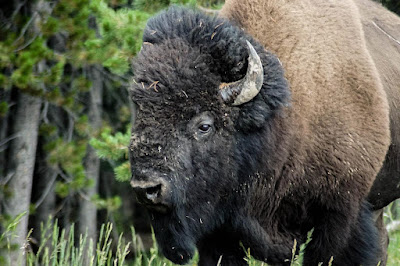
A North American buffalo.
Lucky to have won a lottery for a hunting permit for wild buffalo, Rinella is luckier still to be one of a few who actually finds and shoots one. His journey in Alaska, eluding bears and other predators, battling the elements, and navigating dangerous waterways, is compelling. So is his moment of truth as he prepares to shoot. His careful butchering of the animal is presented in precise detail. Though written fourteen years ago –– before Rinella became a world-renowned figure –– this book reveals the talents of a gifted writer and outdoorsman.

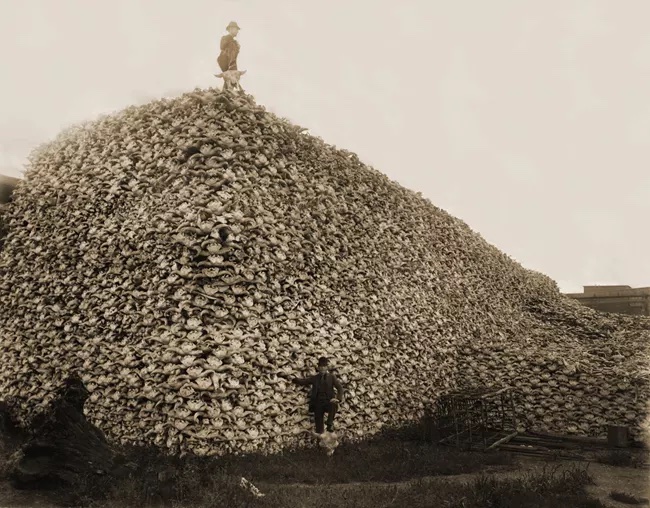
But what makes “American Buffalo” truly great and lasting is the author’s panoramic view of time and a philosophical connection to nature and life. He looks unblinkingly at the devastating destruction and near extinction of bison and other species in North America, lamenting the wanton greed and shortsightedness of people who killed only for profit and trophy. Rinella eats what he kills.


In this photo from 1892, men stand next to and atop a pile of American bison skulls waiting to be ground up for fertilizer.

Like other hunters, he sees the animal’s skull as a kind of connection to life’s mysteries.

“Buffalo skulls were put to various uses by Indians, most of a spiritual or metaphysical nature. The buffalo skull was an especially potent symbol to many Plains Indians tribes, but not because it equaled death. Rather, a skull represented a form of rebirth to many tribes. To reduce a buffalo to its skeleton was like ushering the animal back to a sort of primordial starting line, or beginning. The clean skull allowed for continuity, like a blank canvas upon which future buffalo could be created…

“I’m not a particularly religious person, though I do sense an inkling of the spiritual when I look at this buffalo skull. Many people have tried to explain to me what they feel when they look at a crucifix of Torah scroll; it’s an emotion often described as a mixture of gratitude, devotion, continuity, and awe. Looking at a buffalo skull is probably the closest I’ll ever come to experiencing those feelings, however faintly, and I’m glad to have a taste of that…”

Rinella describes how he embraces the privilege of being alive for the relatively short time we have.


Alaska's Copper River Valley
He searches for meaning and symbols. He calls the landscape he hunts in a "trophy."

And he questions the connection between his reverence for the animal he hunts and his commitment to killing and eating it.

“In a historical sense, I suppose that my confused and convoluted relationship to the buffalo is nothing new. For the entirety of man’s existence in North America, we’ve struggled with the meaning of this animal, with the ways in which its life is intertwined with our own. I think of the first hunters who walked through some long-ago gap between glaciers and stumbled onto a landscape populated with strange and massive creatures. The buffalo was just one of many then, a giant among a host of other giants, but over time these many animals were whittled away by the forces of man and nature. Eventually the buffalo stood alone, like the winning contestant in a game show.

“The prize was humanity’s never-ending attention, which was ultimately a bittersweet award. For thousands of years, the first people of North America fed on the buffalo’s meat and wore the buffalo’s skin, and then made a deity of the animal as a way of reconciling their need to slaughter the thing that granted them life. My own European ancestors came to the New World and scoffed at the heathen nature of the Indians’ ideas, then stood by as the buffalo nearly vanished from the earth beneath their notion that the animal was an expendable gift of their own God, a commodity meant to get them started before stepping aside and letting ‘civilization’ bloom in the wilderness.”

Throughout this book, Rinella blends spirituality with superstition, history with mystery, and his own life’s experiences within the context of our shared science and reality.


“American Buffalo” opens with an extended soliloquy about Neil Young and his early band Buffalo Springfield.

In a fun and mind-bending “association game,” he links “For What It’s Worth," a song against the Vietnam War ; Dances with Wolves, filmed in Canada; Hernando Cortéz of Spain; Crazy Horse of the Oglala Sioux; Springfield rifles; the Civil War; Black Diamond, the buffalo on the American nickel coin; President Theodore Roosevelt, hunter and conservationist; and the city of Buffalo, New York.

"Buffalo," is the name of cities in eighteen states. But, Rinella notes, no wild buffalo lived near Buffalo, New York.


On Saturday, Buffalo was the site of another race-based mass shooting by a white supremacist with an AR-15 "assault-style" rifle. Today, President Biden and First Lady Jill Biden visited Buffalo. Biden, a lifelong supporter of the Second Amendment, has asked Congress to pass legislation to require new background checks for gun buyers, and ban military-style "weapons of war" and large-capacity ammunition magazines.


Steven Rinella
Rinella does not hunt with AR-15s. He uses bolt-action rifles, pump shotguns, and bows and arrows for hunting. Rinella is an ethical hunter who calls himself “an evironmentalist with a gun.”

He became interested in environmental issues, according to a profile earlier this year in The New York Times by Malia Wollan, when one of his big brothers gave him a paperback of Aldo Leopold’s “A Sand County Almanac.”According to Wollan, “Most people read Leopold as belonging to the pantheon of American environmental writers, with the likes of Henry David Thoreau, Rachel Carson and John Muir. Rinella reads Leopold as a fellow hunter.” (Marjory Stoneman Douglas is another great environmentalist in that pantheon.)


On his latest podcast, Rinella discusses hunting, fishing, and books. He talks to Cameron Hanes about Hanes’s new book, “Endure: How to Work Hard, Outlast, and Keep Hammering,” with a foreword by Joe Rogan and afterword by David Goggins. Hanes says, “If you wish you could run farther and shoot straighter, this book is for you.”


Rinella, himself, is the author of a half-dozen books, with more planned for release in coming months and years, including books for children, outdoor cooking, and an “atlas for the outdoors.”


Steven Rinella, the “environmentalist with a gun,” is also a philosopher with a pen and a voice.

Some people, especially vegans and those who prefer not to think about where their super market food comes from, will be turned off by the whole MeatEater oeuvre. But that’s the beauty of American freedom, diversity, and the right to choose.


In the MeatEater episode with former Navy SEAL Rorke Denver, after Denver bags his bear, and just before he and Rinella skin and butcher it, Rinella expresses his appreciation for the service and sacrifice of Denver and other veterans who serve in the nation’s defense.


In “American Buffalo: In Search of a Lost Icon” readers can discover an ethos of honor, courage, and commitment.


*(Top photo: Denver and Rinella trek their bear meat and fur out of the Alaskan wilderness in a scene from MeatEater, YouTube.)

Saturday, November 13, 2021

A True Patriot and Statesman: Max Cleland

By Bill Doughty––

When Joseph Maxwell "Max" Cleland spoke at the 72nd Pearl Harbor Day commemoration ceremony, Dec. 7, 2013, with Pearl Harbor itself as a backdrop, he was nearly overcome with emotion. He saw the dozens of World War II veterans seated in the front rows of the audience, and he thought of his father. Cleland spoke without notes, from the heart, about the sacrifice of military service and the joy of homecomings.


Army CPT Max Cleland in Vietnam
Hugh Cleland, Max’s dad, joined the Navy after the attack on Oahu in 1941. In 1965, Max volunteered for the Army to serve in combat in Vietnam, where he earned the Silver Star and Bronze Star.

Cleland was severely wounded and nearly killed. Yet, he personified resilience to become head of the Veterans Administration and a U.S. Senator.

Cleland died earlier this week. He was a great statesman, military veteran, and advocate for veterans, especially those with lasting physical and mental wounds.


President Joe Biden issued a statement November 9 on Cleland’s passing:

Max Cleland was an American hero whose fearless service to our nation, and to the people of his beloved home state of Georgia, never wavered.

As a 25-year-old serving in the 1st Cavalry Division of the U.S. Army during the Vietnam War, Max lost both of his legs and his right arm in a grenade explosion at Khe Sanh. After grueling months in the hospital, enduring multiple surgeries and a long road back to recovery, Max turned his pain into purpose. He continued his distinguished public service, becoming a lifelong champion of the dignity and rights of working people and America’s wounded veterans. His leadership was the essential driving force behind the creation of the modern VA health system, where so many of his fellow heroes have found lifesaving support and renewed purpose of their own thanks in no small part to Max’s lasting impact... He was a man of unflinching patriotism, boundless courage, and rare character... He will be remembered as one of Georgia’s and America’s great leaders.”

I was fortunate to help plan the Navy’s Pearl Harbor Day commemoration ceremony in 2013 and to hear Max Cleland speak about honor, courage, and commitment –– as well as true family values and patriotism.


In 2013 I posted a Navy Reads review featuring Cleland’s autobiography, “Heart of a Patriot.”

Cleland, who chaired the armed services subcommittee on personnel in the Senate, was known for working closely with both Democratic and Republican colleagues.


Cleland reads about JFK.
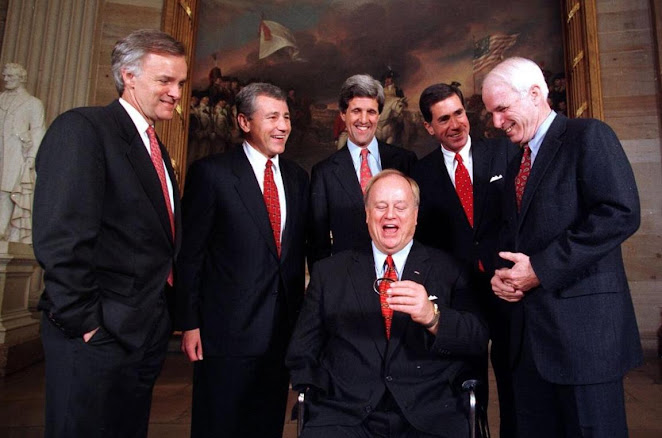
From Navy Reads: “His colleagues, mentors and friends in the Senate included fellow combat veterans Chuck Hagel, Dan Inouye, John Kerry and ‘my Vietnam veteran brother’ John McCain. Cleland describes the pride of wearing his dad's WWII Navy peacoat as a U.S. Senator during a presidential inauguration.”


Prior to serving in the Navy for three years during WWII, Max Cleland’s father, Hugh, had served in the Civilian Conservation Corps, an environmental infrastructure program created by President Franklin D. Roosevelt during the Great Depression. FDR was an inspiration to a young Max Cleland. Cleland loved books and reading. He authored several books.


Like Biden, Secretary of Defense Lloyd Austin issued a statement about Senator Cleland’s passing; fittingly, Austin includes references to literature.


In part, SECDEF Austin says:

“The Department of Defense stands united in mourning the loss of Senator Max Cleland, an extraordinary public servant and a great patriot…He served his country and his community from a wheelchair, following in the gallant tradition of his hero President Franklin Roosevelt.”


SECDEF Austin notes that as head of the Veterans Administration, Cleland “fought fiercely for his fellow veterans, made PTSD an official VA diagnosis, and helped create the groundbreaking Vet Centers program. Later, after being elected a U.S. senator from Georgia, he continued his passionate focus on defense and veterans' issues, serving with distinction on the Senate Armed Services Committee and leading on such issues as health care, bioterrorism preparedness, and homeland security. He also served on the 9/11 Commission before being nominated for the board of the Export-Import Bank. His final act of public service was leading the American Battlefield Monuments Commission. When battle maps of Vietnam were added to the National Memorial Cemetery of the Pacific in Hawaii, he asked to add an inscription from the poet Archibald MacLeish: ‘We leave you our deaths: give them their meaning.’

With courage and grit, Senator Cleland struggled with PTSD and depression—seeking help through counseling, medication, and attendance at a recovery group. He said that he drew strength from being around his fellow veterans and wounded warriors, including those from Iraq and Afghanistan. As the head of the VA, he made psychological counseling available to his fellow veterans. And I hope that his example will encourage others carrying unseen wounds to seek out the help they need and deserve. 

Senator Cleland liked to quote Hemingway, who wrote, ‘The world breaks everyone and afterward many are strong at the broken places.’ He surely was. Max Cleland's civic-minded spirit, optimism, and resilience will stand as an inspiration to every American.”

Funeral services are planned for early next week.


Senator Max Cleland, RIP.


Vietnam War veteran Max Cleland, a triple amputee, holds a photograph of himself as a child with his father, Hugh, and mother, Juanita, at the National Memorial Cemetery of the Pacific at Punchbowl in 2013. (Jamm Aquino, Honolulu Star-Advertiser)


The Senate had six Vietnam combat veterans in January 1997. Sen. Max Cleland, D-Ga., is in the front. Behind him, from left: Bob Kerrey, D-Neb., Chuck Hagel, R-Neb., John Kerry, D-Mass., Chuck Robb, D-Va., and John McCain, R-Ariz. This photo was taken by The World-Herald during Senate orientation the previous month. (Kiley Cruse, The World-Herald)

Top photo: Secretary Max Cleland, American Battle Monuments Commission, delivers keynote remarks during the 72nd anniversary commemoration of the Dec. 7, 1941, attack on Oahu. This year’s commemoration theme, “Sound the Alarm,” examines how thousands of Americans answered the call to duty in the wake of the attack. More than 2,500 people attended the Pearl Harbor commemoration. (MC2 Nardel Gervacio)


Thursday, October 14, 2021

Filling in Gaps in ‘How the Word Is Passed’

Review by Bill Doughty––

At the beginning of “How the Word Is Passed: A Reckoning with the History of Slavery across America” (Hachette Book Group, 2021) author Clint Smith introduces us to Navy veteran David Thorson.


Thorson serves as a tour guide and teacher at Thomas Jefferson’s plantation home outside Charlottesville, Virginia. Smith learns that “prior to becoming a tour guide at Monticello, David served for more than thirty years in the U.S. Navy.”


Monticello
David Thorson’s “peach face, reddened from all the hours spent standing in the sun, was clean-shaven … He spoke with a calm evenhandedness that invited people into discussion, like a professor.”

According to Smith, Thorson became a docent and tour guide at Monticello after retiring from the Navy because of his love of history and interest in Thomas Jefferson.


While giving a tour focusing on Jefferson’s relationship to slavery, Thorson addresses the visitors:

“Slavery’s an institution. In Jefferson’s lifetime it becomes a system. So what is this slave system? It is a system of exploitation, a system of inequality and exclusion, a system where people are owned as property and held down by physical and psychological force, a system being justified even by people who know slavery is morally wrong. By doing what? Denying the very humanity of those who are enslaved solely on the basis of the color of their skin.”

Smith recounts, “In just a few sentences, David had captured the essence of chattel slavery in a way that few of my own teachers ever had.”


During the tour Smith notices how Thorson chooses to refer to the enslaved black people as “human beings” rather than “slaves.” Smith writes, “What reverberated throughout was the humanity of the enslaved people –– their unceasing desire to live a full life, one that would not be defined simply by their forced labor.”

Frederick Douglass
For his part in “How the Word Is Passed,” Smith brings in luminaries from history such as Frederick Douglass and W.E.B. DuBois, as well as respected historians Eric Foner, Annette Gordon-Reed, and Kenneth M. Stampp, to fill in some of the gaps of enslaved people’s lives. Smith presents information to settle debates about the impact of slavery on African Americans, from the founding of the nation through the Civil War and Emancipation and even through the era of Jim Crow, when many whites in southern states still longed for the Lost Cause of the Confederacy.

When it comes to debates about critical race theory or Big Lie / Lost Cause –– and even anti-vaccination stances –– it’s important to not only present facts and tell the truth but also be understanding and empathetic in how you talk to people. According to Smith:

“David sees it as essential that a guide be able to find the balance of telling the truth and not pushing people so much that they shut down. He told me that when you challenge people, specifically white people’s conception of Jefferson, you’re in fact challenging their conception of themselves. ‘I’ve come to realize that there’s a difference between history and nostalgia, and somewhere between those two is memory,’ he said. ‘I think that history is the story of the past, using all the available facts, and that nostalgia is a fantasy about the past using no facts, and somewhere in between is memory, which is kind of this blend of history and a little bit of emotion … I mean, history is kind of about what you need to know … but nostalgia is what you want to hear.'

“What would it take –– what does it take –– to confront a false history even if it means shattering the stories you have been told throughout your life?” Smith asks. “Even if it means having to fundamentally reexamine who you are and who your family has been?”


Smith says the search for truth is worth the pain. “Just because something is difficult to accept doesn’t mean you should refuse to accept it. Just because someone tells you a story doesn’t make that story true.”

In the 1930s and 40s, black men dressed as slaves conducted tours of Monticello, so hearing about David Thorson is evidence of progress, but Smith is careful about too much celebrating about that progress.


“When I think about the history of slavery and racism in this country, I think about how quick we are to expose notions of progress without accounting for its uncertain and serpentine path,” Smith says, reflecting on a visit with his grandparents to the National African American History and Culture Museum. 

In this thought-provoking book Clint Smith travels from Monticello to the Smithsonian’s NAAHCM in Washington, D.C. And he also visits the Whitney Plantation in Wallace, Louisiana; Angola Prison in Louisiana; Blandford Cemetery in Petersburg, Virginia; Monument Avenue in Richmond, Virginia; Galveston Island, Texas; Wall Street and Ellis Island, New York City; and Gorée Island, Dakar, Senegal, Africa.

His journey backtracks the route black Africans took as chattel slaves brought to the colonies in the Americas to create and maintain an economy based largely on cotton, tobacco, and sugar.


Smith’s goal on his trip is to fill in the blanks of history and gaps that separate people. He fills in those blanks and gaps with information, truth, and understanding.


With a journalist’s ear and poet’s eye, he takes readers to uncomfortable places and truths.

  • We confront the fact that Thomas Jefferson kept hundreds of humans enslaved; he also separated families, removing children even under the age of ten from their mothers and fathers.
  • We go to the Whitney Plantation, site of a slave revolt in 1811 on the heels of the Haitian Revolution of 1803; at Whitney, whites decapitated 55 slaves and displayed their heads on posts.
  • We ride to Galveston, Texas, considered by some as the site of the end of slavery and beginning of celebrations now known as Juneteenth.
  • We take a behind-the-scenes tour of Angola, where Smith reveals how mass incarcerations have roots in slavery.
  • We get a comparison of the now-removed Robert E. Lee statue in Richmond with the Statue of Liberty, designed by a French abolitionist –– and we’re reminded that Lady Liberty stands on broken chains as she stands for truth, justice, and democracy.
  • Finally, Clint invites readers with him for an emotional return to Africa as he examines remnants of colonialism and the role of history in accurately reflecting what was once a “system of plunder,” slavery and colonial rule, where “white sugar [and white cotton] means black misery.”

The Statue of Liberty stands for freedom from slavery and the promises of July 4, 1776. (NPS)

Clint Smith
Along Smith’s remarkable journey, he introduces us to individuals who earned their right to provide perspective and context, people like Angola’s Norris Henderson, NYC’s Damara Obi, Dakar’s Hasan Kane, Smith’s grandparents, and Monticello’s David Thorson.

Near the end of his visit to Jefferson’s plantation, Smith seeks out Thorson to get more insight and fill in more gaps.


Smith is intrigued by Thorson’s wisdom about the reality of human imperfection and Thorson’s view on “an idea worth fighting for.”


Smith writes:

“Before I left, I wanted to understand how much David’s role as a former military officer –– responsible for protecting and promoting this country’s foreign policy agenda at home and abroad –– was something that felt, if at all, in tension with his role now. ’I was born in the United States of America. I served the country for thirty years, so I actually believe in the idea of America,’ he said, straightening up in his chair. ‘Are we exceptional? No. Have we had unique advantages based on geography, based on a whole host of factors? Yes. Did a group of people come together in 1776 and conceive of an idea that was pretty radical in its time and then create a system of government, through the Constitution and its amendments, that was pretty radical and pretty novel? Yeah. Have other countries found their own way? Sure. So I believe in the idea of America. I don’t believe that this country was perfect. I don’t believe it is perfect. I don’t believe it’s going to be perfect. I believe that the journey to make this a better place is worth the effort and that the United States, if you conceive it not so much as a place to be in but an idea to believe in, it is worth fighting for.'

Democracy is safe when it’s protected. Truth, honest reflection, and the pursuit of justice must be at the heart of “how the word is passed.”


President Barack Obama and President François Hollande of France tour Monticello, the home of Thomas Jefferson in Charlottesville, Va., with Leslie Bowman, President of the Thomas Jefferson Foundation, Feb. 10, 2014 (Official White House Photo by Chuck Kennedy)