Showing posts with label lincoln. Show all posts

Wednesday, August 19, 2026

Hertling’s Dedication to Planning

Review by Bill Doughty


Most career Sailors and military veterans know this phrase: “Proper prior planning prevents piss-poor performance.” The “seven Ps” is a distant cousin of “measure twice and cut once.”


And ongoing planning is more important than just having a plan.


That’s the perspective of Lt. General Mark Hertling, U.S. Army (Retired), author of “If I Don’t Return: A Father’s Wartime Journal” (Ballast Books, 2026).


In planning to deal with his own angst about heading into combat in 1990, Hertling started a journal to his sons, writings he hoped would help them know him even if he were no longer in their lives. In his journal he shares observations, beliefs, lessons, and hopes for his young sons.


“Like so many soldiers, I once hoped I was fighting so that my sons would never have to.”


 He expresses that sentiment in the journal several times.

“That hope, noble as it was back then, proved naive. My sons did go to war. Multiple times. Always in Iraq, save two of those tours for our oldest son, Todd. So did one of our daughters-in-law. And for all practical purposes, while they didn't deploy, my wife and the spouse of our other son went to war too. All of them did so with honor, courage, humility, selfless service, and empathy for both their own soldiers and their enemies. Even knowing that, I offer this same hope once again—this time so that our grandchildren, and others who read this book, find that same grace with this wish:

“May you never face combat. But if you do, or if life ever tests you — whether in war, in family, in leadership, or in moments when character, integrity, values, and personal courage matter most — I hope you'll find strength in these pages. Strength in values. In character. In purpose. In love. In the stories and thoughts of this old soldier who wrote some random thoughts down for his family –– now also for you.”


Throughout this memoir/journal he praises his family, friends, and selfless soldiers he’s known throughout an illustrious career. He has special praise for key senior leaders he worked for as well as command sergeants major who worked for him, SNCO leaders “whose wisdom, loyalty, and fierce dedication helped shape my view of true leadership. They weren't just senior enlisted advisors. They were battle buddies, they were partners in command –– they were friends I could count on, without question,” Hertling writes.

“Many of these military friendships were forged in combat. And that matters. War, in all its chaos and clarity, forces you to strip away the unimportant and rely on the person beside you. You see people not for their rank but for their soul. That crucible of shared danger and absolute dependence creates a bond that outlasts distance, time, and even silence. These are life-bonds-brotherhoods and sisterhoods born of trust under fire. They are evergreen. 

But most people, thankfully, won't need war to discover those kinds of relationships. They find true and trusted friends in the combat of daily life. The crucible doesn't have to be courage shown in combat. 

Sometimes it's just the courage to give of yourself to others-truthfully and with candor-trusting someone else with your thoughts, sharing the parts of your heart that you can only share with a friend.”

He offers gifts of advice throughout the book.


For example…

  • It’s OK to cry. “Here’s the deal: Emotion is the full spectrum of what it means to be alive –– and to love others more than yourself.”
  • “Self-awareness and empathy aren’t soft skills, they’re core skills.”
  • “Be a friend to all by being yourself –– no false airs.”
  • “Leadership, like war, is a cumulative endeavor. You don't arrive on the battlefield—or at any new job—with a blank slate. You bring everything with you—the training, the scars, the questions you asked and the ones you were too afraid to. And if you're lucky, you bring the wisdom earned through experience and some of the scar tissue you've endured.”
  • Hertling asserts, “Leadership is love in public. It is the steady choice to put people and purpose ahead of ego. It is the discipline of humility and the courage of beliefs. It is the willingness to widen the circle of responsibility until it includes not only ‘your’ people but the ones you once called ‘other.’”
  • On what it means to be a man, Hertling writes, “A real man proves his masculinity by being considerate, protective, concerned, and confident –– and by demonstrating it.” [Core values > Testosterone tests.]
  • A military career usually affords many moves, including often to foreign cultures, which is a gift in itself: an opportunity to experience diversity in life. “Differences are not threats to be judged –– they are windows into the should of different and unique people.”
  • Hertling observes, “Humans are astonishingly diverse yet fundamentally similar.” He notes that Shalom and Salaam mean the same thing: “Peace be unto you.”
  • He quotes Mark Twain with this advice: “Travel is fatal to prejudice, bigotry, and narrow-mindedness.” Travel, Hertling says helps you “begin to appreciate, nuance, complexity, and the truth that your way is not the only way.”

Hertling says self-reflection is the key to personal development. He reflects further on life lessons and the importance of military families’ dedication:

“Looking back across the arc of my tours, as well as the continuous wars we fought at the beginning of the twenty-first century, I'm struck by how much changed—in me, in our army, and in our families. And how much good leadership and caring for each other mattered. Desert Storm taught me how to fight. The time in Baghdad taught me how much I didn't know. The surge taught me how to lead through complexity—how to integrate force with purpose, how to trust partners, how to adapt daily to the terrain of war and the human terrain of recovery. Those conflicts also taught military families a lot. It was the most challenging thing in my life and in the lives of most of the soldiers and family members I know. And it remains the most defining for all of us. All this taught me something about trust about purpose and about the quiet burden of leadership. But I also learned a lot about resilience and the power of families.”

Good leaders never dismiss the concerns of military families for their service members.


Hertling riffs briefly on President George Washington’s “Rules of Civility and Decent Behavior in Company and Conversation,” seeing the same humor along with some still-timely truths in George’s advice just as we saw in an earlier Navy Reads post.


Included in his sometimes random thoughts are extended discourses on MREs (Meals Ready to Eat) and music appreciation: He loves the Eagles but New Kids on the Block … not so much.


On the serious side, he reflects on the importance of ongoing planning instead of relying just on a plan [some advice that seems very pertinent to whatever “planning” went into the Iran War.]

“What I've learned, and what I hope shows in this reflection, is something even more profound: Sometimes the plans don't matter— but the planning always does. 

There's a story I like that captures this lesson. In the early 1960s, President John F. Kennedy suspected the Soviets were preparing some type of provocation in Berlin. Concerned but unsure of what was coming, he asked the Pentagon to develop a series of potential responses, what the military calls an action-reaction-counteraction series of drills. 

When those potential action-reaction-counteraction plans were complete and briefed to the President, Kennedy—aware of his own limitations as a junior naval officer during WWII –– asked the planners to brief someone with deeper experience in strategic decision-making: former President Dwight D. Eisenhower. 

So, the planners went to Gettysburg. 


In Ike's quiet farmhouse near a battlefield where another kind of crisis had once played out during the Civil War, these senior officers briefed Eisenhower on their assumptions and options. They laid out potential Soviet scenarios: an armored push through the Fulda Gap, economic pressure, nuclear signaling, political propaganda campaigns.
 

At the end of the briefing, one of the officers asked, ‘Mr. President, based on what we've told you, what do you think the Soviets are going to do?’ Eisenhower, the Supreme Allied Commander who’d planned D-Day and led Allied forces in WWII, and who had been the president for eight years, paused. Then, he reportedly replied succinctly, ‘I don't really know what they're going to do. But remember—your plans mean nothing, but your planning means everything.’ 

One of the plans the Pentagon officers hadn't considered was that the Soviets would build a wall around Berlin.”

EiOn the need for planning instead of reliance on intelligence and plans, Hertling writes, “(Clausewitz) said that the smart Soldier does not put any faith in the intelligence by staff officers about the progress of the battle because most times it’s just flat wrong!”


Yesterday, Hertling wrote for the Bulwark in response to President Trump’s threat expressed to a FOX News reporter, “If Oman gets in the way, we'll bomb the shit out of them,” Trump said. 


Hertling’s essay of August 18, 2026 is titled, “Who Would Want to Be Friends with America Now,” written in the wake of Trump’s threat to Oman, his directive to cancel Ulchi Freedom Shield exercises with South Korea, his embrace of North Korea’s dictator, and his tariffs against key allies (not to mention his threats to invade Greenland, take over Canada and make the Strait of Hormuz "new American territory").


In part, Hertling writes this about Trump’s vulgar threat to Oman: "The president is threatening to bomb a country that for nearly half a century has quietly provided the United States with military access, logistical support, diplomatic assistance, and something increasingly rare in the Middle East: the ability to communicate with friends as well as enemies. For decades, Oman hasn’t been in the way, it has often been the way.


Hertling warns about a president’s power to destroy alliances. “That destruction rarely occurs with a formal announcement. More often, trust corrodes incrementally. An exercise is canceled. An ally is publicly berated. An adversary is praised. A partner wonders whether Washington will respond to help during a crisis. Another begins looking elsewhere for security or diplomatic support. And America loses a partner, an ally, or a friend.”

Questions:

  • Will Congress or the 25th Amendment stop Trump from losing allies and friends?
  • Why did Donald Trump say recently that families are not concerned about their Sailors welfare?
  • Why did he say the USS Lincoln’s Carrier Strike Group 3 (CSG-3) deployment was “not nearly long enough”?
  • Why does Secretary Pete Hegseth say the Navy can remain near the Hormuz Strait “indefinitely”?
  • Did Trump and Hegseth plan for destruction of logistics basing in the region?
  • Why is Trump praising North Korea’s leader –– a dictator who is helping Russia against Ukraine, who supports Iran, and who once called Trump a “dotard”?

Most importantly, What trust is there in the quality of Trump’s “proper prior planning”?


Black-and-white photo above: Former President Dwight Eisenhower (right) meets with Republican leaders at his farm at Gettysburg. Future president Gerald Ford (a Navy World War II Veteran), who was then the Minority Leader in the House of Representatives, sits far left. (Eisenhower National Historic Site)

Wednesday, May 31, 2023

Abraham Lincoln & January 6th

Review by Bill Doughty––

This “found haiku” comes from Abraham Lincoln’s Lyceum Address in Springfield, Illinois on January 27, 1838:

Reason must furnish

all the materials for

our future support


The speech is quoted in one of the four forewords in the massive “The January 6th Report: Findings from the Select Committee to Investigate the January 6th Attack on the United States Capitol” (December 2022, U.S. Government Publishing Office).


In fact, Lincoln appears on the very first page of the report.

Representative Adam Schiff, author and finisher of the J6 Report, recounts how Lincoln –– then a state legislator in Illinois –– addressed young men about a rebellious time of mob violence, including lynchings, general crimes, and disregard for the rule of law. Lincoln chose to speak about "The Perpetuation of Our Political Institutions.”

In Schiff’s words, Lincoln spoke about internal threats “not the threat of foreign invasion, even though the War of 1812 was only two decades past. It was the danger from within that a young Lincoln identified as our gravest threat.”


Lincoln is also quoted in the second foreword to the book by former Speaker of the House Nancy Pelosi: “Let us always honor our oath to, as Abraham Lincoln said, ‘nobly save or meanly lose, the last best hope of earth.’ So help us God.”


In the third foreword to the book, chairman of the committee Rep. Bernie Thompson says he was advised to remove his lapel pin so he wouldn’t be identified and targeted by attackers who threatened to kill legislators and the vice president. He chose not to remove his pin and thereby showed support for the defenders of the Capitol and against the attackers.


“We can never surrender to democracy’s enemies,” Thompson writes. “We can never allow America to be defined by forces of division and hatred. We can never go backward in the progress we have made through the sacrifice and dedication of true patriots. We can never and will never relent in our pursuit of a more perfect union, with liberty and justice for all Americans.”


Former Representative Liz Cheney, vice chair of the committee, opens the report’s fourth and final foreword with a story about Abraham Lincoln issuing the first call for volunteers for the Union Army in April 1861 and how her great-great grandfather, Samuel Fletcher Cheney signed up for the 21st Ohio Volunteer Infantry.

Cheney, a Republican like Lincoln, writes: “I have found myself thinking often, especially since January 6th, of my great-great grandfather, and all those in every generation who have sacrificed so much for (quoting OVI’s regimental historian Silas Canfield) “the unity of our Nation and the perpetuity of our institutions.”


Cheney says, “At the heart of our republic is the guarantee of the peaceful transfer of power.”


Cheney notes how General George Washington resigned his commission and handed control of the Continental Army back to Congress. (When Washington’s term as president ended, he rejected calls by some to remain in office as dictator.)

This bipartisan report features a comprehensive Executive Summary that encapsulates the main thrust of the investigation and its findings in the report. Within the summary is a list of witnesses, nearly five dozen of whom are registered Republicans. Only one witness, the Secretary of State of Michigan, is identified as a Democrat.


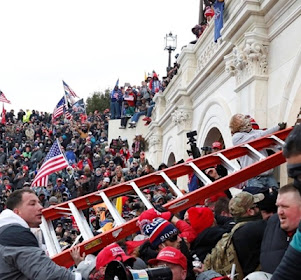
Most of the report, itself, is a “Narrative” in 8 chapters that explores: the Big Lie of a stolen election, the scheme of fake electors, the plan to block certification of the election by the vice president, the invitation of then-President Trump to come to D.C. and march to the Capitol to “fight like hell,” an examination of the role of far right extremists in the insurrection, and “187 minutes of dereliction” in which the commander in chief chose not to call off the rioters nor order DOD to send the national guard to defend the Senate and House of Representatives.

The long “narrative” is excellent writing: True historical storytelling in the tradition of David McCullough; careful citing of facts and sources in the vein of Craig Symonds; and drama and suspense –– especially during the actual lead-up and breaching of the Capitol –– in the style of Tom Clancy. As with the Executive Summary, there are extensive endnotes throughout.


Military readers will be interested in reading two of the appendices: Government Agency Preparation for and Response to January 6th, and DC National Guard Preparation for and Response to January 6th.


The report cites what one witness called “decision paralysis” and “decision avoidance.” Army leaders were “sensitive to the sight of troops near the site of the congressional certification of electoral votes.” The report examines “fears of politicizing the military in an anti-democratic manner” in the wake of the heavy handed National Guard confrontation with protesters in the summer of 2020, which included low-flying military helicopters. The Guard was deployed and used chemical agents to clear Lafayette Square for Trump’s photo-op holding up a Bible at St. John’s Church.


While the report has been criticized by some progressives for not examining the motivation and role of Christian Nationalism specifically, the report does mention QAnon Shaman Jacob “Angeli” Chansley’s leading of a “conspiracy-laden prayer session” at the Senate dais after shouting “Mike Pence is a f—ing traitor” at the spot where Pence had been presiding. Chansley left a note that read: “It’s only a matter of time. Justice is coming.”


The committee thoroughly investigated the actions of other QAnon conspiracy believers and white nationalists. Chapter 6, “Be There, Will Be Wild,” examines extremist militia groups such as The Proud Boys, The Oath Keepers, and The Three Percenters.”

More than 1,000 rioters have been indicted since the insurrection. Many remain in jail and many more have been stained with a criminal record. While some have had their lives ruined, others, like Chansley, who has already been released from prison, are cashing in on their fame and hardening their support with the far right. Some key leaders and planners of the attack are facing much longer prison terms.


Since publication of The January 6th Report, the most serious convictions have occurred among military veterans who in many ways led the attack. On May 4, five members of the Proud Boys were convicted of various charges, including four members convicted of seditious conspiracy.


Last week, on May 25, the Department of Justice announced: “Elmer Stewart Rhodes III, the founder and leader of the Oath Keepers, and Kelly Meggs, the leader of the Florida chapter of the organization, were sentenced today for seditious conspiracy and other charges related to the breach of the U.S. Capitol on Jan. 6, 2021.”

Rhodes, an Army veteran from Texas, was sentenced to 18 years in prison, “the longest sentence, to date, related to the January 6 attack on the Capitol.” Fellow militia leader Meggs received a sentence of 12 years. “This is the first time a court has found that a defendant’s conduct related to the January 6 attack was tantamount to terrorism warranting an upward departure under the sentencing guidelines,” according to DOJ.


“Today’s sentences reflect the grave threat the actions of these defendants posed to our democratic institutions,” said Attorney General Merrick B. Garland. “The United States proved at trial that the Oath Keepers plotted for months to violently disrupt the peaceful transfer of power from one administration to the next. The Justice Department will continue to do everything in our power to hold accountable those criminally responsible for the January 6th attack on our democracy.” 


It’s becoming clear that there is a litmus test for who will be elected as the next President and commander in chief of the military next year: Voters will choose between those who believe in accountability for those who stormed the Capitol and those who promise pardons for the seditionists and rioters such as the Proud Boys and Oath Keepers.


Rep. Adam Schiff
The “Oath Keepers” name seems Orwellian when one considers the actual oath all military service members take to support and defend the Constitution –– and a similar oath civilian leaders take to support the Constitution –– the foundational document that outlines the peaceful transfer of power.

Representative Schiff said this about the Constitution and the oath:

“Even the most brilliant Constitution cannot protect us if the people sworn to uphold it do not give meaning to their oath of office, if that oath is not informed by ideas of right and wrong, and if people are unwilling to accept the basic truth of things. None of it will be enough.

But if we allow ourselves to be guided by facts –– not faction –– if we choose our representatives based on their allegiance to the law and the Constitution, then we should have every confidence that our proud legacy of self-government will go on.”

That’s the accountability, respect for truth and justice, and faith in the rule of law Lincoln spoke about in the Lyceum Address, “The Perpetuation of Our Political Institutions.”


Lincoln believed in an informed electorate, honest leaders, and support for the Constitution and rule of law, which he called “the political religion of our nation.”


with other pillars,

hewn from the solid quarry

of sober reason


Pillars of logic and reason found in the Constitution support our democracy.


There's more “found haiku” from Abe Lincoln and others on Navy Reads.

Thursday, March 31, 2022

‘Insurrection’ (& Creation of Military)

Review by Bill Doughty––

When Chairman of the Joint Chiefs of Staff Gen. Mark Milley testified to Congress and defended the study of racism, hatred, and rage, he could have been speaking about the people involved in key incidents depicted in “Insurrection: Rebellion, Civil Rights, and the Paradoxical State of Black Citizenship” by Hawa Allan (W.W. Norton & Company, 2022).


This timely book examines the history of insurrections in the America. Insurrections and riots began in the 1600s, continued through the Civil War, and kept occurring in a plague of lynchings and riots, often after KKK political rallies. “Insurrection” also briefly contextualizes the J6 insurrection of the Capitol. And some of its insights even apply, unintentionally, to the current catastrophe of Putin’s invasion and war in Ukraine.

The U.S. Insurrection Act got is start even before there was a United States. Variations of early insurrection acts were instituted to repress rebellions against slavery. But there have been other reasons to call up responses to restore “order.”


The Founders created the military, in part, to respond to insurrections, without relying solely on state militias and federalism (power dispersed primarily within the states), yet state militias were still needed as part of a balance-of-power equation. Allan explains:

“As elaborated in The Federalist Papers, Alexander Hamilton advocated for ‘a force constituted differently from the militia to preserve the peace of the community and to maintain the just authority of the laws against those violent invasions of them which amount to insurrections and rebellions.’ In other words, framers advocated for the establishment of a federal military force, which was eventually enumerated in Article 1, referring to the power of Congress to 'raise and support Armies’ and ‘provide and maintain a Navy.’ The concerns raised at the time about establishing federal military forces –– the modern-day equivalent to the federal military corps that includes the Army, Navy, and Coast Guard –– had less to do with the enslaved and seemed to generally arise from that threat that such an armed body could pose to white citizens themselves.

“To dispel concerns about any abuse of federal military power, James Madison surmised in The Federalist Papers that the state militia together with armed civilians would be sufficiently numerous to repel a federal army. In other words, federal military forces could be easily repelled by the ‘people.’ Hamilton, however, also sought to quell fears about the federal military by assuring doubters that the federal military would, in fact, be constituted by the ‘people.’ ‘Where in the name of common sense are our fears to end if we may not trust our sons, our brothers, our neighbors, our fellow-citizens?’ Hamilton rhetorically asked in The Federalist Papers. ‘What shadow of danger can there be from men who are daily mingling with the rest of their countrymen and who participate with them in the same feelings, sentiments, habits, and interests?’”

The military and/or militias have been on both ends of insurrection acts, both as responders and as perpetrators. In 1786-7, veterans of the Revolutionary War, stormed court houses and attempted to take over a federal arsenal in what’s known as Shay’s Rebellion.


A sea change occurred during the Civil War and especially after the Emancipation Proclamation and during the years of Reconstruction. No longer was there a federal effort to repress slave rebellions; instead, riots arose from racism, hatred, and rage of white supremacists against fellow free black citizens.


A "KKK Services" 1929 rally. National Photo Company Collection (Library of Congress)

President Ulysses S. Grant, top former Union General during the Civil War, initiated actions to quell uprisings by groups, including especially the Ku Klux Klan. Insurrection acts and riot acts have been called up most often in former Confederate states, including Mississippi, Alabama, and Virginia.


The U.S. military has always had a role in suppressing insurrection, but Congress put guard rails on that role under the Posse Comitatus Act of 1878, which “heralded the end of the Reconstruction era by formally prohibiting the deployment of federal troops to enforce the law –– that is unless otherwise authorized by the Constitution or Congress.”


[Of note, this week President Biden signed the Emmitt Till anti-lynching bill in belated response to the killing of an African American teenager by a white mob in 1955.]


Gov. Orval Faubus calls for rejecting integration at Little Rock State Capitol, Arkansas, in 1959. (John T. Bledsoe; LOC)
President Eisenhower deployed the 101st Airborne Division and federalized the entire Arkansas National Guard in the face of Gov. Faubus's blockade of schools. Faubus fomented a white supremacist crowd against school integration.

Many white citizens in the South were rallied to oppose integration and "race mixing" in the name of Christianity and anti-Communism. Faubus contended that Arkansas had sovereignty, and that the federal government was "occupying Arkansas." Parents should have rights over schools and the government, including the right to segregation.


White segregationists demonstrate, calling race mixing "Communism" and "march of the Anti-Christ." (John T. Bledsoe; LOC)
The Insurrection Act was invoked many times in U.S. history, including during the Civil Rights era. Navy veteran Presidents John F. Kennedy and Lyndon B. Johnson used it to help continue desegregating schools after the Supreme Court’s “Brown v. Board of Education” ruling.

Throughout her presentation of the history of U.S. insurrections, Allan scatters anecdotes of personal experience dealing with issues of race. She contemplates the meaning of dreams, silence, rage, and peace as she explores concepts from psychology, sociology, and philosophy..


Frederick Douglass
Among the philosophers, writers, and historians quoted are Georg Hegel, Gustave Le Bon, Toni Morrison, Abraham Lincoln, Hanna Arendt, and Frederick Douglass. We’ve spotlighted Douglass in several posts here on Navy Reads. He was “a vocal proponent of the enlistment of Negroes into the Union Army, and agitated for an end to the formal exclusion of Negro soldiers from service.”

Douglass, “a fugitive slave turned grand orator and editor,” said, “No man can put a chain around the ankle of his fellow man without at last finding the other end fastened around his own neck.”


That particular Douglass quote brings to mind the tragedy of Putin’s terror campaign in Ukraine and how it’s also affecting the people of Russia. Putin’s expanded kinetic war in Ukraine began three weeks ago. Brave Russians are risking their lives stand up and speak out against the war.


Citing the findings of Le Bon, Allan talks about the psychology of crowds –– and dangers of being a bystander who acquiesces or, worse, supports a deranged leader of their country or party.


These insights apply to the Lost Cause of the Civil War, lies by Hitler and Nazi Germany, and falsehoods and pretexts by Putin to justify invading Ukraine. Unfortunately, albeit on a smaller scale, the insights also apply to the Big Lie of a “stolen” 2020 U.S. election and resultant coup attempt at the U.S. Capitol, January 6, 2021.

“If the crowd is vulnerable to suggestion –– to having its collective unconscious tapped into and its drives channeled into unified action –– then who, exactly, is doing the hypnotizing? Le Bon puts forth a charismatic leader who, through his projection of strength and confidence, can transform a mere group of individuals into a crowd at his command. Such a charismatic leader can, perhaps, also transfer a government of laws into a government of men. Yet, as Le Bon suggests, this charismatic leader alone may not have the influence to muster a crowd. Though largely parroting the repetitive slogans of a strongman, the crowd also tends to be formed by members primed to defend their long-standing beliefs …

“The crowd, as Le Bon says, is inherently conservative, and seeks to either preserve the present or reinstate the conditions of the past. Only the crowd’s erratic violence might cause its members to be mischaracterized as revolutionary instead of what they actually are, which is reactionary. ‘It is precisely crowds that cling most tenaciously to traditional ideas and oppose their being changed with the most obstinacy,’ Le Bon writes. ‘The crowd does not usher in the new, but, instead, clears the way for the reinstatement of the old, and such beliefs, once finally implanted in the crowd, are difficult to uproot, and can only ‘be changed at the cost of violent revolutions.’ As Le Bon also writes, ‘The beginning of a revolution is in reality the end of a belief.’”

Allan assesses how populations are impacted by disasters, including in the aftermaths of hurricanes Hugo, Andrew, and Katrina. But the storm of war also applies, and our thoughts turn to Ukraine, especially as the toll of war dehumanizes people.


Hawa Allan
Allan admits to feeling uncomfortable and embarrassed in high school learning about the ultimate dehumanization of slavery –– people owning other people. But, even though it made her and other students feel uncomfortable, she notes the importance of learning history that is not selectively imparted and fearfully sanitized, the need to learn the “why,” not just the who, what, when, where, and what.

How the Insurrection Act and related acts were used in history is told in black and white by Hawa Allan, who takes into account the motives of those who called for the Act and those who were impacted by it –– as well as the anger and rage they lived through.


Allan’s writing is well-paced and balanced, although some readers may find her style to be a bit scattered and off-point. I would have liked to see discussion of Milley’s rejection (along with other military leaders) of former President Trump’s threats and attempts to deploy the military against civilian protests, especially in the summer of 2020.

In the name of "law and order," Trump often threatened to enact the Insurrection Act during riots and protests after the murder of George Floyd and various police shootings of African Americans.


Yet, on January 6, 2021, “As commander in chief of the D.C. National Guard, it is clear that Trump and his administration could have authorized its deployment –– that is, if they actually interpreted the riot to be a threat to law and order.”


[Public hearings of the U.S. Congress’s J6 Select Committee could begin in April or May 2022, and the committee announced it intends to release an interim report in June.]

This is another worthwhile book by a gifted woman writer and yet another recommended read for Women’s History Month. General Milley would no doubt appreciate the wisdom Allan shares.


Top Photo: Army Gen. Mark A. Milley (chairman of the Joint Chiefs of Staff), then-Army Chief of Staff in 2016. (Sgt. 1st Class Jim Greenhill)