Showing posts with label Iraq. Show all posts

Monday, August 17, 2026

Hertling on Trust: ‘If I Don’t Return’

Review by Bill Doughty––

Hertling
Hertling’s book “If I Don’t Return” is much more than its meaningful subtitle: “A Father’s Wartime Journal.” The war journal is a vital part, but this book is also about history, philosophy,  self-reflection, self-help, and –– most especially –– leadership. It’s also about building character based on trust.

His book for everyone, because nearly everyone understands and values the importance of trust. Hertling shares many personal lessons and beliefs, including this gem:


“…Over the years, I've come to believe one thing. That life and leadership are forged by one's character. And character is molded by experiences but defined by integrity, shared trust, enumerated values, honest humility, and different kinds of love.” Shared trust!


“Trust,” along with the other qualities he lists, is a foundation of core values and good leadership. Hertling saw the value of trust in 1990/1991 during the First Gulf War, when he helped kick Saddam Hussein’s Iraqi army out of Kuwait.


Trust in Unity

George H. W. Bush
“Looking back now at Desert Storm, I see how trust was the thread running through it all. At the unit level, trust was instinctive and immediate. We built it in our squadron, and President George H.W. Bush [Navy World War II Veteran, left*] generated it in our citizens. Chairman Powell and Secretary of Defense Cheney reinforced it in their conversations with politicians and the American people. We often didn't have the same in our later conflicts.

In combat, you cannot hedge or calculate trust—it must be whole. 

On a Bradley or Abrams tank crew, drivers trust commanders to navigate through the night; gunners trust leaders to identify targets; wingmen trust each other to cover their flanks. Once proven, that trust became indestructible. That was what carried us through exhaustion, confusion, and chaos. Desert Storm also enjoyed broad trust at home: 

Its objectives were clear, the coalition strong, the war short. That was due, at least in part, to the fact that Desert Storm was a quick war, and Americans like quick wars, with a lot of explosions shown on TV. 

By contrast, trust would not be as stable during our later counterinsurgency and counterterrorism wars. Soldiers in combat zones continued to trust what they could see: their buddies beside them, their leaders in the field, their sense of mission, and their practiced competency. But they couldn’t personally affect the shifting political calculations in Washington, the support of the citizenry of the country, or the intelligence that shaped actions. The disadvantages of long wars — counterinsurgencies and counterterrorism fights that took much longer to generate success-and the fleeting attention span of our citizenry caused a loss of interest in what the professional military force (less than 1 percent of our nation) was accomplishing. And the results of Operation Iraqi Freedom (and Operation Enduring Freedom in Afghanistan) stretched that trust thin, often to the breaking point. The false intelligence about chemical weapons, the changing conditions and mission creep, and the president's advice to citizens to keep going to the malls contributed to that deterioration of interest and trust.”

Trust in Your Eyes and Ears

When a reporter told President Trump (left) the other day that Navy families are concerned about their Sailors because of deteriorating conditions aboard USS Abraham Lincoln (CVN-72), he replied, “No they’re not.” When the reporter asked if the carrier was deployed too long, he replied, “No, no, no. Not nearly long enough.”

Defense Secretary Pete Hegseth expressed gratitude to the Sailors aboard the carrier, but claimed news reports detailing poor living conditions and mental health struggles on the carrier were false or distorted and “completely misrepresented.”


But after a visit to USS Abraham Lincoln, Admiral Brad Cooper, Commander, U.S. Central Command, who is the top U.S. commander in the war with Iran, said, “I applaud Lincoln’s leadership –– the senior enlisted leaders in the Chief Petty Officers Mess in particular –– for stepping up and making mental health and crew resilience a leadership priority.”


In the face of rising prices and Americans’ concerns about the economy, Trump –– who along with his family is making billions of dollars while in office –– said several weeks ago, “I don't think about Americans' financial situation, I don't think about anybody.”


Opinion polls show most Americans hear that lack of care and so have a lack of trust.


Trust in ‘Johari’


In “If I Don’t Return,” Hertling refers to more than a dozen other thinkers and authors. One of those authors is emergency medicine physician Dr. Omayra Mansfield, who wrote "The Trust Transformation."

"In her book, Dr. Mansfield relayed a core message that is simple but profound: Before you can build trust in others  –– your patients, their families, your colleagues and leaders — you must first trust yourself. Leadership requires clarity of individual values, consistency of action, and authenticity of presence. She knows this is true in an emergency room, and I know it is true in a combat zone. It is something that must also remain true for citizens and policymakers. When trust is absent –– when leaders are inconsistent, opaque, or self-deceiving, and when employees or citizens don't feel a part of the team — trust quickly collapses. 


Many of those who study trust often revert to a model called the ‘Johari Window.’ It's a rhetorical tool used to explain self-awareness and trust between individuals. In combat, soldiers operate almost entirely in the ‘open quadrant’ of that theoretical window — we depend on what we know about each other, gained from close connection, shared hardship, and repetitive experiences that all lead toward trust. There are no illusions about fear, courage, or capabilities. But in other groups— larger teams in different situations — the Johari Window posits that participants often exist in the ‘hidden’ or ‘blind’ quadrants. Some individuals often withhold their full motives (hidden), fail to see their own limitations (blind), or are misled by information that is just not true.
 

The result is a breakdown in trust … I’m convinced that trust is the building block of relationships, leadership ... and life. Trust is gained in myriad ways, and, as I once heard someone say, trust is earned in drops but lost in buckets. Trust is relatively easy to build in small teams, if one knows what it takes to build it. But it is much harder to sustain when hidden motives, blind spots, egos, and personal agendas that are often present in larger teams enter the equation. 

Interestingly, military theoretician Carl Von Clausewitz described something similar in broader terms for warfare. He wrote of war as a paradoxical ‘trinity’ — a  balance of passion, chance, and reason — that found its practical expression in the relationship between the government, its army, and its people. Each had to trust the other. Citizens had to believe their government's cause was just. Armies had to believe their political leaders would use their sacrifices wisely. And governments had to trust their soldiers to execute with discipline and competence. If one leg of that triangle fails or is even oft kilter, if confidence collapses, the nation that goes to war will suffer significant consequences. Ukraine's resistance to Russias invasion in 2022 illustrated this perfectly: Ukraine's people trusted their government, its army trusted both the people and their leaders, and the government trusted the army enough to unleash it with broad support. That synergy sustained Ukraine when the odds seemed impossible. Trust, in that sense, is not just personal — it is strategic. 

As a nation — as a government, as citizens, and as an army — we were successful in building the trust needed to execute Desert Storm inside our units, between the government and the people, and between the people and the army. But during later wars, we found ourselves in a place where no military leader, and certainly no government, wants to be. Despite tough fighting by courageous soldiers, competent diplomacy of the State Department, and the desire of governmental officials to achieve stated goals, three of the other wars — Vietnam, Operation Enduring Freedom in Afghanistan, and Operation Iraqi Freedom — were failures. In my view, a big part of the reason boiled down to an unbalanced Clausewitzian triangle. A lack of trust. 

To me, the lesson is simple. Trust is critical between people, between the citizenry of a nation and its government, and between governmental officials and their army. Find ways to build trust — improve communication, eliminate misinformation, define the mission, maintain humility, ensure competency and integrity, create understanding — and it will bring you closer to success. All seemingly easy, but to paraphrase Clausewitz, the simplest things are often the most difficult.”


Trust in Truth

Hertling writes, “What I learned from both Iraq and Ukraine is that opportunism thrives in the vacuum left by failed institutions. People who have no faith that their government will provide food, water, fuel, or security will take matters into their own hands.”


In the United States, great social change has been brought about both violently (the Civil War) and nonviolently (FDR’s New Deal after the Great Depression). MLK’s Civil Rights Movement in the 1950s and 60s achieved integration and LBJ’s Civil Rights Act and Voting Rights Act through a non-violent strategy but with violent repercussions


Hertling warns:

“In America, we've seen moments when institutions faltered and riots turned cities into places of fear and lawlessness. In those moments, ordinary people are swept up in mob behavior that tears at the fabric of community and civility.

The lesson is stark: Without trusted institutions, the human condition bends toward chaos. Leaders — whether military or civilian — must not only prepare to confront that chaos but also work tirelessly to prevent it by ensuring their people are cared for, protected, and respected. A government that cares for its people will always be more resilient than one that leaves them desperate.”

On a hopeful note, he writes, “… Chaos, if left unchecked, will consume everything. But with strong leadership, institutions built on trust, and the kind of professionalism modeled by leaders like Henadii Vorobiov in Ukraine, and later Barham Salih in Iraq, societies can resist the pull of opportunism and corruption and instead move toward stability and hope for the future.”


Trust in Communication


Hertling’s life’s path has led him into public affairs and journalism as a national security analyst. Again, “trust” is at the ore of communication with the public.


While serving in Iraq again in 2003 as an assistant division commander in the 1st Armored Division, his commanding general, Marty Dempsey, directed him to communicate with three distinct audiences in three very different ways. Above all, to do so with honesty and integrity, especially when communicating with the American people. Hertling received this directive: “Expand information operations, public affairs, and command information.”

“At the time, those three terms had distinct doctrinal meanings. Information operations referred to the full spectrum of activities designed to influence our enemies and protect our own decision-making. IO consisted of psychological operations, electronic warfare, deception, and information security. Public affairs was the communication of facts to the public, usually through the media, and it focused on telling the army's story truthfully and effectively. We were not allowed to use information operations against journalists. Finally, command information referred to internal communication within the force: that is, messaging that kept soldiers, families, and the army community informed so rumors didn't fill gaps.

Dempsey understood something few others did: In modern conflict, these three were interconnected. If we wanted to stabilize Iraq, we couldn't just fight insurgents; we had to protect information from the enemy, but we also had to win narratives, build trust, and tell the truth.”

Telling the truth is the foundation of building trust. And trust is, again, “earned in drops but lost in buckets.” The three pillars of communication may be interconnected, but they must be distinct to their audience. That’s why public affairs interaction to the public or internal communication with troops must never include lies or disinformation of “information operations,” strictly used against bonafide enemies. And the media are not "enemies of the people."


In 2026, we are right to demand leaders of good character who tell the truth and build trust.


[This is the second in a three-part series of reviews of this important book.]


*Former President George H.W. Bush departs the aircraft carrier George H.W. Bush (CVN 77) at Naval Station Norfolk, Va., Jan. 8, 2009.  (U.S. Navy photo by Mass Communication Specialist Seaman Joel S. Kolodziejczak)


Tank photo: BAGHDAD, Iraq An M1 Abrams Tank from B Company 1st Battalion 37th Infantry, attached to 1st Battalion,, 36th Infantry, 1st Brigade, 1st Armored Division as part of Task Force 1/36 maintains perimeter security inside a traffic circle in the Rusafa district of Baghdad, April 2004. (Cpl. Benjamin Cossel)

Tuesday, January 6, 2026

'Americas' First?

Review by Bill Doughty


In the days following Trump’s military attack on Venezuela, he threatened Colombia and its president, described Cuba as “ready to fall,” and saber-rattled about our southernmost neighbor: “You have to do something with Mexico,” Trump said. “We’re going to have to do something." He also restated his desire to take control of Greenland. Canada is still on his wish-list, as well.


Has "America First" become The Americas first?


The current commander-in-chief who promised an “America First” non-interventionist foreign policy started in Venezuela what he calls the biggest military intervention since the Second World War:


On Jan. 3, 2026, at a Mar-a-Lago press conference, Trump said, “This is big stuff. We appreciate you being here. Late last night and early today, at my direction, the United States Armed Forces conducted an extraordinary military operation in the capital of Venezuela. Overwhelming American military power, air, land, and sea was used to launch a spectacular assault, and it was an assault like people have not seen since World War II.”


In less than one full year in office Trump has bombed Iraq, Syria, Yemen, Somalia, Iran, Nigeria, and Venezuela. And he has deployed the military into U.S. cities, something the founders and framers of the Constitution, not to mention historians, would call an abuse of power.


Trump’s military action against Venezuela wipes away attention and scrutiny of some big issues. Among them: the Tariff economy, J6 five-year anniversary (today), the Jack Smith testimony, ICE violence, failure to achieve peace in Ukraine, healthcare costs, lowest presidential poll numbers, crypto-corruption, and Epstein-gate.

Heady with what seems like an easy win against Venezuela thanks to the skill of the military, Trump sees his power only growing, especially his power over the armed forces.


“Drift: The Unmooring of American Military Power”
by Rachel Maddow (Crown Random House, 2012) examines a history of military interventions including in Vietnam, Central and South America, and the Middle East. Maddow outlines the views of founders who foresaw the misuse and abuse of the military by power-hungry or misguided leaders.


For example, the book opens with an excerpt by James Madison, who warned against war because it leads to more debts, taxes, “inequality of fortunes and the opportunities of fraud,” and “degeneracy.”


This is from Madison’s “Political Observations” of April 20, 1795:

“Of all the enemies to public liberty, war is, perhaps, the most to be dreaded, because it comprises and develops the germ of every other.

War is the parent of armies; from these proceed debts and taxes; and armies, and debts, and taxes are the known instruments for bringing the many under the domination of the few. In war, too, the discretionary power of the Executive is extended; its influence in dealing out offices, honors, and emoluments is multiplied; and all the means of seducing the minds are added to those of subduing the force of the people. The same malignant aspect in republicanism may be traced in the inequality of fortunes and the opportunities of fraud growing out of a state of war, and in the degeneracy of manners and of morals engendered by both. No nation could reserve its freedom in the midst of continual warfare.

Those truths are well established. They are read in every page which records the progression from a less arbitrary to a more arbitrary government, or the transition from a popular government to an aristocracy or a monarchy."

Maddow presents the views of various framers of the Constitution as well as the words of seminal American leaders such as President Lincoln. Maddow writes:

“The framers had been voluble in their rationale for and in their defense of Article 1, Section 8. ‘The Constitution supposes, what the History of all Governments demonstrates,’ wrote James Madison, ‘that the Executive is the branch of power most interested in war, and most prone to it. It has accordingly with studied care vested the question of war in the Legislature.' Even that suspected monarchist Alexander Hamilton saw the wisdom of keeping the power to declare war out of the hands of a single executive. Madison, Hamilton, and their fellow framers were building structural barriers against what they saw as the darker aspects of human nature. The lures to war –– personal hatreds, political glory, material spoils, and the simple atavistic enthusiasm for violence –– might be too enticing for one man to resist, and might be too easy to promote ‘by fixing the public gaze upon the exceeding brightness of military glory,’ as a later congressman, Abraham Lincoln, put it, ‘that attractive rainbow that rises in showers of blood –– that serpent's eye that charms to destroy.’”


“Drift”
spotlights the Executive branch’s circumvention of the Constitution and Congress by Presidents Johnson, Reagan, Clinton, Bush 1 and Bush 2, among others. This never-more-relevant book includes the history of the murky “unified executive theory,” which ostensibly gives the president unfettered power –– the theory Reagan employed in his arms-for-hostages scheme in the Iran-Contra scandal.

We read about misadventures in Vietnam, Grenada, Iraq, and Afghanistan and circumstances where military service members are put in positions of carrying out unlawful orders or otherwise violating international rules of law and rules of war.


Maddow wrote the book three years before Trump first declared his candidacy for the presidency, so there is no mention of the 45th and 47th commander in chief.


U.S. Marine Barracks, Beirut
There is, however, a prescient quote about Reagan by then-Speaker of the House Tip O’Neill, who pushed Congress to invoke the War Powers Act that forced the troops to leave Grenada after 60 days without congressional approval.

O’Neill recognized that Reagan went to war in Grenada as a stain-remover in the post-Vietnam era and in the wake of the October 23, 1983, suicide bombing of the U.S. Marine Barracks in Beirut, Lebanon (which killed 241 service members, mostly Marines and Navy Corpsmen).


O’Neill decried Reagan’s invasion of Grenada. “You can’t justify any government, whether it’s Russia or the United States, trampling on another nation,” he said to New York Times reporter Scotty Reston. “I’m worried about the effects of this.”


Maddow then captures more of what Tip O’Neill told Reston about Reagan:

“And that was just on policy; then O'Neill got personal: ‘He only works three and a half hours a day. He doesn't do his homework. He doesn't read his briefing papers. It's sinful that this man is President of the United States. He lacks the knowledge that he should have, on every sphere, whether it's the domestic or whether it's the international sphere.’ It was time for Reagan to pack it in and take Nancy back home where she could be the ‘Queen of Beverly Hills,’ he told Reston. Damn.”

O’Neill was angry that Reagan acted unilaterally and against the Constitution. The War Powers Resolution compels the president to consult Congress and “secure specific statutory authority for the war” unless there is a “national emergency created by an attack upon the United States, its territories or possessions, or its armed forces.”


Wyoming Representative at the time, Dick Cheney, former chief of staff to President Gerald Ford and future future VP to President George W. Bush, defended Reagan’s use of executive power (including in Lebanon), as did other republicans –– just as republicans in Congress publicly defend most of Trump’s actions and criticize the Biden Administration's withdrawal from Afghanistan and loss of 13 U.S. service members.


Rachel Maddow interviews International Security Assistance Force Command Sgt. Maj. Michael T. Hall on "The Rachel Maddow Show," July 8, 2010. (DVIDS)

Trump ridiculed the Bush administration’s decision to not claim Iraq’s oil reserves after the administration removed Saddam Hussein from power. He did the same after Obama attacked Libya and deposed Gaddafi. Now, Trump claims Venezuela’s oil and says he, himself, runs the South American country and will support rebuilding the oil infrastructure there for American oil corporations.


Maddow’s epilogue in “Drift” is titled “You Build It, You Own It,” a variant of the Powell Doctrine and Pottery Barn adage, “you break it, you buy it.’”


In the epilogue Maddow presents 8 points as recommendations, such as recognizing the cost of war, ensuring Congress is made aware of military actions, deploying the military for military operations only, and shrinking the nuclear infrastructure to fit a realistic nuclear mission.

But the key point is saved for last:

“And finally, there's the Gordian knot of executive power. It needs a sword something fierce. The glory of war success will always attach itself to the president, so presidents are always going to be prey to the temptation to make war. That's a generic truth of power, and all the more reason to take decision making about war out of the hands of the executive. It is not one man's responsibility. The ‘imperial presidency’ malarkey that was invented to save Ronald Reagan's neck in Iran-Contra, and that played as high art throughout the career of Richard Cheney, is a radical departure from previous views of presidential power, and it should be taught and understood that way. This isn't a partisan thing –– constitutionalists left and right have equal reason to worry over the lost constraint on the executive. Republicans and Democrats alike have options to vote people into Congress who are determined to stop with the chickenshittery and assert the legislature’s constitutional prerogatives on war and peace. It would make a difference and help reel us back toward balance and normalcy.”

Maddow writes, “None of this is impossible. This isn't bigger than us. Decisions about national security are ours to make.”


She concludes, “We just need to revive that old idea of America as a deliberately peaceable nation. That's not simply our inheritance, it's our responsibility.” We have a right and need and freedom to speak –– and then vote. It’s literally in the Constitution as the preeminent amendment.


Americans’ "First."

Saturday, December 2, 2023

Best Friend, Worst Enemy: WWJD?

Review by Bill Doughty––

A Marine with a warrior heart must also have a trained mind, according to General James Mattis –– one of the key U.S. military leaders of this century. Among his many assignments, Mattis commanded the U.S. Joint Forces Command and U.S. Central Command. He led Marines in combat in Operations Iraqi Freedom and Enduring Freedom in the Middle East. And he served as the first Secretary of Defense in the Trump administration.


In his combat operations, Mattis faced jihadist enemies who ignored the rules and laws of war and put innocent civilians at risk, hiding behind women and children.

So, WWJD? What would Jim Mattis do –– if able –– about the situation now in Israel and Gaza? In “No Better Friend, No Worse Enemy: The Life of General James Mattis” (HarperCollins, 2018) author Jim Proser gives us a clue.


Mattis learned valuable lifelong lessons in Vietnam and its aftermath, as Marines and Sailors rescued refugees fleeing on small boats from Laos, Cambodia, and South Vietnam.

“The human aftermath of US political defeat in Vietnam and the ensuing political instability crowds every available inch of deck space around Mattis. They fill the seats hold of the ship, clutching their children and meager possessions, often shaking with fear and trauma. This is Mattis’s first real-world experience of war as a Marine. As soldiers of the navy, the first in and often the last out of smaller, third-world conflicts, Marines frequently end up with the responsibility for evacuation of war victims.”

Proser traces the arc of Mattis’s life, one dedicated to service, philosophy, and his fellow Marines and other service members. “No Better Friend” was published just months before Mattis resigned as SECDEF over differences with Trump (who later falsely claimed he fired Mattis).


The book concentrates on Mattis’s role in military operations, where we see his ethical leadership and humanism. The “Warrior Monk” –– callsign Chaos –– is against wholesale and indiscriminate warfare that ignores the effect on noncombatants. For example, after the Islamist attack of Sept. 11, 2001, Mattis recognized the danger of the Bush Administration’s race to invade Iraq under the pretense that Saddam Hussein was producing weapons of mass destruction.

“This rushed strategy by the Pentagon planners lacked deep thinking about the needs of the Iraqi people beyond their basic survival and provided few details on what Iraq’s tribes, communities, and cities would need after their country was invaded and their government overtaken. Mattis’s lifelong devotion to the study of philosophy and experience in occupied territories gave him a much keener sense of human needs, particularly in times of war. He could no more overlook the humanity of the Iraqis he would become responsible for under the rules of war than he could that of his own troops. In Mattis’s educated view, Iraqis and his occupying troops would have to form a community with specific physical, emotional, and spiritual needs.”

For Mattis, innocent families caught in the middle of war must have access to water, food, medicine, trash removal, and –– importantly –– education.


To some, "Peace through strength" means more violence and lethality; to Mattis and other thinking leaders, true strength rests in restraint, diplomacy, and ethical behavior and a clear warning to enemies against escalation.


Outside a medical clinic at Joint Security Station Douro, Iraq, Aug. 28, 2008. (PO2 Joan Kretschmer)

In the face of distrust and mistrust by local citizens in Iraq, Mattis instructed his Marines to show compassion and a helping hand, “first do no harm.” Proser says the general gave his Marines an extensive reading assignment leading up to engagement with the enemy. Mattis insisted “his Marines engage their minds before they engage their weapons.”


In a PBS interview in 2003, then-Major General Mattis said, “In other words, if the enemy tried to provoke us into a fight and that fight would cause innocent people to die, then we would forgo the fight. We would try to find a way to get them another day.”


In his “commander’s intent” instruction to troops on the eve of battle in Afghanistan, Mattis echoed lessons learned in Beirut and Baghdad: “We will be compassionate to all the innocent and deadly only to those who insist on violence, taking no ‘sides’ other than to destroy the enemy.”


“Show the people respect,” Mattis told his Marines.


At a school in Kandahar, Afghanistan, April 16, 2014 (Spc. Sara Wakai)
The least desirable outcome of war against an enemy is causing more animosity, hatred, and radicalization of the populace –– what Proser calls “a full-blown blood vendetta.”

The common enemy in the war on terrorism is Islamist extremism, which goes by many names: ISIS, ISIL, al-Qaeda, Hamas, and Hezbollah (literally, “the party of God”). A common denominator in the support of violent extremism is Iran. In an interview with MIHS Islander in 2017, Mattis said:

“Until the Iranian people can get rid of this theocracy, these guys who think they can tell the people even which candidates they get a choice of, it’s going to be very, very difficult. This is a regime that employs surrogates, like Lebanese Hezbollah to threaten Israel…

“The Iranian people are not the problem. The Iranian people are definitely not the problem; it’s the regime that sends agents around to murder ambassadors in Pakistan or in Washington DC. It’s the regime that provides missiles to Lebanese Hezbollah or the Houthi in Yemen…

“So, somehow, you don’t want to unite the Iranian people with that unpopular regime because if you pressure them both then they will grow together. We’ve got to make certain that the Iranian people know that we don’t have any conflict with them.”

Mattis says that if the people have economic and political alternatives and “a stake in the future” they will be less likely to pick up a gun and lash out.


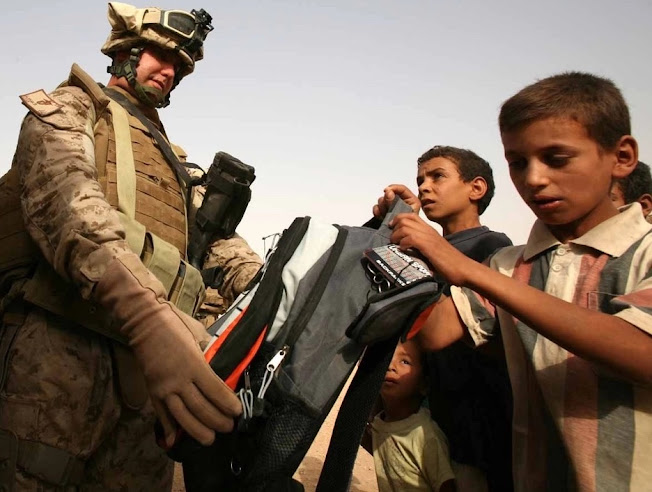
Staff Sgt. James Altman hands out book bags filled with school supplies to Iraqi children in Sahl, Al Assad, Iraq (Cpl. George Papastrat)
I finished this book in the midst of a pause in Israel’s war in Gaza against Hamas and heightened calls by President Biden for more restraint by Israel in its bombing campaign, which has been killing hundreds of civilians in Gaza. Unfortunately, as I write this, Israel has apparently ended the truce and ceasefire, and is bombing military and civilian targets again. Hostage negotiators in Qatar are suspending talks for now. Hamas seems to be succeeding in its efforts to create more violence and division in the region and beyond.

This week, the New York Times published a devastating report that Prime Minister Netanyahu’s government knew details about Hamas’s plan for an attack more than a year ago. Israel named the 40-page plan “Jericho Wall.” [It's a fraught name. Leading up to the attempted coup of at the U.S. Capitol of January 6, 2001, white Christian nationalists participated in Jericho Marches.]


Pre-MAGA conspiracist Proser is a gifted writer. His descriptions of the heat, stink, and noise of combat in Iraq and Afghanistan are gripping and powerful. Intentionally or not, readers get a nuanced view of what General Jim Mattis would do to achieve actual "peace through strength."


Proser, by the way, avidly promotes the Big Lie about elections, vaccination misinformation, and gender indoctrination conspiracies. His writings and repostings downplay the January 6, 2001, insurrection of the Capitol by white Christian nationalists and Trump supporters.


Trump, Mattis, and then-CJCS Joseph Dunford host a ceremony at Arlington National Cemetery, Virginia, for Memorial Day, May 28, 2018. (Sgt. Amber I. Smith)

In contrast, Mattis and retired General Joseph Dunford, former CJCS, each spoke out against the Big Lie and the J6 coup attempt on the same day of the insurrection.


Here's how CNN reported Mattis's and Dunford's position on J6:


"Trump's first secretary of defense, James Mattis, charged that Wednesday's 'violent assault on our Capitol, an effort to subjugate American democracy by mob rule, was fomented by Mr. Trump,' while Retired Gen. Joseph Dunford, the former chairman of the Joint Chiefs of Staff, told CNN that he believes 'our leaders who have continued to undermine a peaceful transition in accordance with our Constitution have set the conditions for today's violence.'"


Overall, Proser’s biography of Mattis is a rewarding read, although it unsurprisingly lacks the political analysis of the Mattis versus Trump relationship and Mattis’s unambiguous warning that Trump and Trumpism are a real and growing threat to the U.S. Constitution and the nation.


Top photo: Afghan civilians and Cpl. William C. Kaylor, 3rd Battalion, 3rd Marine Regiment, watch an MV-22 Osprey land at Forward Operating Base Geronimo, Helmand province, Afghanistan, July 14, 2010. (Sgt. Mark Fayloga)