Showing posts with label Afghanistan. Show all posts

Tuesday, January 6, 2026

'Americas' First?

Review by Bill Doughty


In the days following Trump’s military attack on Venezuela, he threatened Colombia and its president, described Cuba as “ready to fall,” and saber-rattled about our southernmost neighbor: “You have to do something with Mexico,” Trump said. “We’re going to have to do something." He also restated his desire to take control of Greenland. Canada is still on his wish-list, as well.


Has "America First" become The Americas first?


The current commander-in-chief who promised an “America First” non-interventionist foreign policy started in Venezuela what he calls the biggest military intervention since the Second World War:


On Jan. 3, 2026, at a Mar-a-Lago press conference, Trump said, “This is big stuff. We appreciate you being here. Late last night and early today, at my direction, the United States Armed Forces conducted an extraordinary military operation in the capital of Venezuela. Overwhelming American military power, air, land, and sea was used to launch a spectacular assault, and it was an assault like people have not seen since World War II.”


In less than one full year in office Trump has bombed Iraq, Syria, Yemen, Somalia, Iran, Nigeria, and Venezuela. And he has deployed the military into U.S. cities, something the founders and framers of the Constitution, not to mention historians, would call an abuse of power.


Trump’s military action against Venezuela wipes away attention and scrutiny of some big issues. Among them: the Tariff economy, J6 five-year anniversary (today), the Jack Smith testimony, ICE violence, failure to achieve peace in Ukraine, healthcare costs, lowest presidential poll numbers, crypto-corruption, and Epstein-gate.

Heady with what seems like an easy win against Venezuela thanks to the skill of the military, Trump sees his power only growing, especially his power over the armed forces.


“Drift: The Unmooring of American Military Power”
by Rachel Maddow (Crown Random House, 2012) examines a history of military interventions including in Vietnam, Central and South America, and the Middle East. Maddow outlines the views of founders who foresaw the misuse and abuse of the military by power-hungry or misguided leaders.


For example, the book opens with an excerpt by James Madison, who warned against war because it leads to more debts, taxes, “inequality of fortunes and the opportunities of fraud,” and “degeneracy.”


This is from Madison’s “Political Observations” of April 20, 1795:

“Of all the enemies to public liberty, war is, perhaps, the most to be dreaded, because it comprises and develops the germ of every other.

War is the parent of armies; from these proceed debts and taxes; and armies, and debts, and taxes are the known instruments for bringing the many under the domination of the few. In war, too, the discretionary power of the Executive is extended; its influence in dealing out offices, honors, and emoluments is multiplied; and all the means of seducing the minds are added to those of subduing the force of the people. The same malignant aspect in republicanism may be traced in the inequality of fortunes and the opportunities of fraud growing out of a state of war, and in the degeneracy of manners and of morals engendered by both. No nation could reserve its freedom in the midst of continual warfare.

Those truths are well established. They are read in every page which records the progression from a less arbitrary to a more arbitrary government, or the transition from a popular government to an aristocracy or a monarchy."

Maddow presents the views of various framers of the Constitution as well as the words of seminal American leaders such as President Lincoln. Maddow writes:

“The framers had been voluble in their rationale for and in their defense of Article 1, Section 8. ‘The Constitution supposes, what the History of all Governments demonstrates,’ wrote James Madison, ‘that the Executive is the branch of power most interested in war, and most prone to it. It has accordingly with studied care vested the question of war in the Legislature.' Even that suspected monarchist Alexander Hamilton saw the wisdom of keeping the power to declare war out of the hands of a single executive. Madison, Hamilton, and their fellow framers were building structural barriers against what they saw as the darker aspects of human nature. The lures to war –– personal hatreds, political glory, material spoils, and the simple atavistic enthusiasm for violence –– might be too enticing for one man to resist, and might be too easy to promote ‘by fixing the public gaze upon the exceeding brightness of military glory,’ as a later congressman, Abraham Lincoln, put it, ‘that attractive rainbow that rises in showers of blood –– that serpent's eye that charms to destroy.’”


“Drift”
spotlights the Executive branch’s circumvention of the Constitution and Congress by Presidents Johnson, Reagan, Clinton, Bush 1 and Bush 2, among others. This never-more-relevant book includes the history of the murky “unified executive theory,” which ostensibly gives the president unfettered power –– the theory Reagan employed in his arms-for-hostages scheme in the Iran-Contra scandal.

We read about misadventures in Vietnam, Grenada, Iraq, and Afghanistan and circumstances where military service members are put in positions of carrying out unlawful orders or otherwise violating international rules of law and rules of war.


Maddow wrote the book three years before Trump first declared his candidacy for the presidency, so there is no mention of the 45th and 47th commander in chief.


U.S. Marine Barracks, Beirut
There is, however, a prescient quote about Reagan by then-Speaker of the House Tip O’Neill, who pushed Congress to invoke the War Powers Act that forced the troops to leave Grenada after 60 days without congressional approval.

O’Neill recognized that Reagan went to war in Grenada as a stain-remover in the post-Vietnam era and in the wake of the October 23, 1983, suicide bombing of the U.S. Marine Barracks in Beirut, Lebanon (which killed 241 service members, mostly Marines and Navy Corpsmen).


O’Neill decried Reagan’s invasion of Grenada. “You can’t justify any government, whether it’s Russia or the United States, trampling on another nation,” he said to New York Times reporter Scotty Reston. “I’m worried about the effects of this.”


Maddow then captures more of what Tip O’Neill told Reston about Reagan:

“And that was just on policy; then O'Neill got personal: ‘He only works three and a half hours a day. He doesn't do his homework. He doesn't read his briefing papers. It's sinful that this man is President of the United States. He lacks the knowledge that he should have, on every sphere, whether it's the domestic or whether it's the international sphere.’ It was time for Reagan to pack it in and take Nancy back home where she could be the ‘Queen of Beverly Hills,’ he told Reston. Damn.”

O’Neill was angry that Reagan acted unilaterally and against the Constitution. The War Powers Resolution compels the president to consult Congress and “secure specific statutory authority for the war” unless there is a “national emergency created by an attack upon the United States, its territories or possessions, or its armed forces.”


Wyoming Representative at the time, Dick Cheney, former chief of staff to President Gerald Ford and future future VP to President George W. Bush, defended Reagan’s use of executive power (including in Lebanon), as did other republicans –– just as republicans in Congress publicly defend most of Trump’s actions and criticize the Biden Administration's withdrawal from Afghanistan and loss of 13 U.S. service members.


Rachel Maddow interviews International Security Assistance Force Command Sgt. Maj. Michael T. Hall on "The Rachel Maddow Show," July 8, 2010. (DVIDS)

Trump ridiculed the Bush administration’s decision to not claim Iraq’s oil reserves after the administration removed Saddam Hussein from power. He did the same after Obama attacked Libya and deposed Gaddafi. Now, Trump claims Venezuela’s oil and says he, himself, runs the South American country and will support rebuilding the oil infrastructure there for American oil corporations.


Maddow’s epilogue in “Drift” is titled “You Build It, You Own It,” a variant of the Powell Doctrine and Pottery Barn adage, “you break it, you buy it.’”


In the epilogue Maddow presents 8 points as recommendations, such as recognizing the cost of war, ensuring Congress is made aware of military actions, deploying the military for military operations only, and shrinking the nuclear infrastructure to fit a realistic nuclear mission.

But the key point is saved for last:

“And finally, there's the Gordian knot of executive power. It needs a sword something fierce. The glory of war success will always attach itself to the president, so presidents are always going to be prey to the temptation to make war. That's a generic truth of power, and all the more reason to take decision making about war out of the hands of the executive. It is not one man's responsibility. The ‘imperial presidency’ malarkey that was invented to save Ronald Reagan's neck in Iran-Contra, and that played as high art throughout the career of Richard Cheney, is a radical departure from previous views of presidential power, and it should be taught and understood that way. This isn't a partisan thing –– constitutionalists left and right have equal reason to worry over the lost constraint on the executive. Republicans and Democrats alike have options to vote people into Congress who are determined to stop with the chickenshittery and assert the legislature’s constitutional prerogatives on war and peace. It would make a difference and help reel us back toward balance and normalcy.”

Maddow writes, “None of this is impossible. This isn't bigger than us. Decisions about national security are ours to make.”


She concludes, “We just need to revive that old idea of America as a deliberately peaceable nation. That's not simply our inheritance, it's our responsibility.” We have a right and need and freedom to speak –– and then vote. It’s literally in the Constitution as the preeminent amendment.


Americans’ "First."

Saturday, December 2, 2023

Best Friend, Worst Enemy: WWJD?

Review by Bill Doughty––

A Marine with a warrior heart must also have a trained mind, according to General James Mattis –– one of the key U.S. military leaders of this century. Among his many assignments, Mattis commanded the U.S. Joint Forces Command and U.S. Central Command. He led Marines in combat in Operations Iraqi Freedom and Enduring Freedom in the Middle East. And he served as the first Secretary of Defense in the Trump administration.


In his combat operations, Mattis faced jihadist enemies who ignored the rules and laws of war and put innocent civilians at risk, hiding behind women and children.

So, WWJD? What would Jim Mattis do –– if able –– about the situation now in Israel and Gaza? In “No Better Friend, No Worse Enemy: The Life of General James Mattis” (HarperCollins, 2018) author Jim Proser gives us a clue.


Mattis learned valuable lifelong lessons in Vietnam and its aftermath, as Marines and Sailors rescued refugees fleeing on small boats from Laos, Cambodia, and South Vietnam.

“The human aftermath of US political defeat in Vietnam and the ensuing political instability crowds every available inch of deck space around Mattis. They fill the seats hold of the ship, clutching their children and meager possessions, often shaking with fear and trauma. This is Mattis’s first real-world experience of war as a Marine. As soldiers of the navy, the first in and often the last out of smaller, third-world conflicts, Marines frequently end up with the responsibility for evacuation of war victims.”

Proser traces the arc of Mattis’s life, one dedicated to service, philosophy, and his fellow Marines and other service members. “No Better Friend” was published just months before Mattis resigned as SECDEF over differences with Trump (who later falsely claimed he fired Mattis).


The book concentrates on Mattis’s role in military operations, where we see his ethical leadership and humanism. The “Warrior Monk” –– callsign Chaos –– is against wholesale and indiscriminate warfare that ignores the effect on noncombatants. For example, after the Islamist attack of Sept. 11, 2001, Mattis recognized the danger of the Bush Administration’s race to invade Iraq under the pretense that Saddam Hussein was producing weapons of mass destruction.

“This rushed strategy by the Pentagon planners lacked deep thinking about the needs of the Iraqi people beyond their basic survival and provided few details on what Iraq’s tribes, communities, and cities would need after their country was invaded and their government overtaken. Mattis’s lifelong devotion to the study of philosophy and experience in occupied territories gave him a much keener sense of human needs, particularly in times of war. He could no more overlook the humanity of the Iraqis he would become responsible for under the rules of war than he could that of his own troops. In Mattis’s educated view, Iraqis and his occupying troops would have to form a community with specific physical, emotional, and spiritual needs.”

For Mattis, innocent families caught in the middle of war must have access to water, food, medicine, trash removal, and –– importantly –– education.


To some, "Peace through strength" means more violence and lethality; to Mattis and other thinking leaders, true strength rests in restraint, diplomacy, and ethical behavior and a clear warning to enemies against escalation.


Outside a medical clinic at Joint Security Station Douro, Iraq, Aug. 28, 2008. (PO2 Joan Kretschmer)

In the face of distrust and mistrust by local citizens in Iraq, Mattis instructed his Marines to show compassion and a helping hand, “first do no harm.” Proser says the general gave his Marines an extensive reading assignment leading up to engagement with the enemy. Mattis insisted “his Marines engage their minds before they engage their weapons.”


In a PBS interview in 2003, then-Major General Mattis said, “In other words, if the enemy tried to provoke us into a fight and that fight would cause innocent people to die, then we would forgo the fight. We would try to find a way to get them another day.”


In his “commander’s intent” instruction to troops on the eve of battle in Afghanistan, Mattis echoed lessons learned in Beirut and Baghdad: “We will be compassionate to all the innocent and deadly only to those who insist on violence, taking no ‘sides’ other than to destroy the enemy.”


“Show the people respect,” Mattis told his Marines.


At a school in Kandahar, Afghanistan, April 16, 2014 (Spc. Sara Wakai)
The least desirable outcome of war against an enemy is causing more animosity, hatred, and radicalization of the populace –– what Proser calls “a full-blown blood vendetta.”

The common enemy in the war on terrorism is Islamist extremism, which goes by many names: ISIS, ISIL, al-Qaeda, Hamas, and Hezbollah (literally, “the party of God”). A common denominator in the support of violent extremism is Iran. In an interview with MIHS Islander in 2017, Mattis said:

“Until the Iranian people can get rid of this theocracy, these guys who think they can tell the people even which candidates they get a choice of, it’s going to be very, very difficult. This is a regime that employs surrogates, like Lebanese Hezbollah to threaten Israel…

“The Iranian people are not the problem. The Iranian people are definitely not the problem; it’s the regime that sends agents around to murder ambassadors in Pakistan or in Washington DC. It’s the regime that provides missiles to Lebanese Hezbollah or the Houthi in Yemen…

“So, somehow, you don’t want to unite the Iranian people with that unpopular regime because if you pressure them both then they will grow together. We’ve got to make certain that the Iranian people know that we don’t have any conflict with them.”

Mattis says that if the people have economic and political alternatives and “a stake in the future” they will be less likely to pick up a gun and lash out.


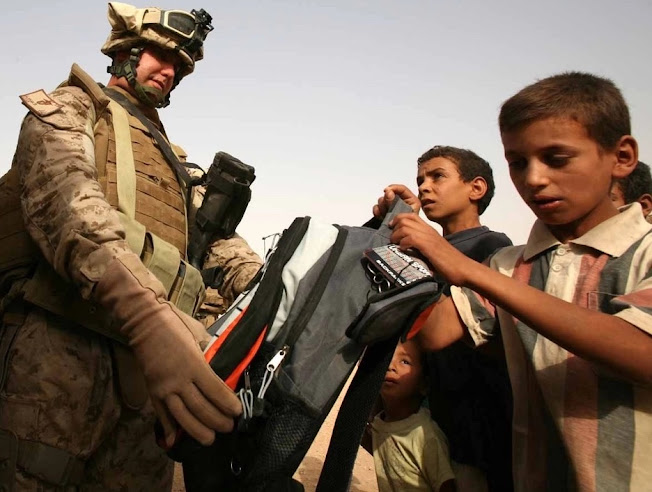
Staff Sgt. James Altman hands out book bags filled with school supplies to Iraqi children in Sahl, Al Assad, Iraq (Cpl. George Papastrat)
I finished this book in the midst of a pause in Israel’s war in Gaza against Hamas and heightened calls by President Biden for more restraint by Israel in its bombing campaign, which has been killing hundreds of civilians in Gaza. Unfortunately, as I write this, Israel has apparently ended the truce and ceasefire, and is bombing military and civilian targets again. Hostage negotiators in Qatar are suspending talks for now. Hamas seems to be succeeding in its efforts to create more violence and division in the region and beyond.

This week, the New York Times published a devastating report that Prime Minister Netanyahu’s government knew details about Hamas’s plan for an attack more than a year ago. Israel named the 40-page plan “Jericho Wall.” [It's a fraught name. Leading up to the attempted coup of at the U.S. Capitol of January 6, 2001, white Christian nationalists participated in Jericho Marches.]


Pre-MAGA conspiracist Proser is a gifted writer. His descriptions of the heat, stink, and noise of combat in Iraq and Afghanistan are gripping and powerful. Intentionally or not, readers get a nuanced view of what General Jim Mattis would do to achieve actual "peace through strength."


Proser, by the way, avidly promotes the Big Lie about elections, vaccination misinformation, and gender indoctrination conspiracies. His writings and repostings downplay the January 6, 2001, insurrection of the Capitol by white Christian nationalists and Trump supporters.


Trump, Mattis, and then-CJCS Joseph Dunford host a ceremony at Arlington National Cemetery, Virginia, for Memorial Day, May 28, 2018. (Sgt. Amber I. Smith)

In contrast, Mattis and retired General Joseph Dunford, former CJCS, each spoke out against the Big Lie and the J6 coup attempt on the same day of the insurrection.


Here's how CNN reported Mattis's and Dunford's position on J6:


"Trump's first secretary of defense, James Mattis, charged that Wednesday's 'violent assault on our Capitol, an effort to subjugate American democracy by mob rule, was fomented by Mr. Trump,' while Retired Gen. Joseph Dunford, the former chairman of the Joint Chiefs of Staff, told CNN that he believes 'our leaders who have continued to undermine a peaceful transition in accordance with our Constitution have set the conditions for today's violence.'"


Overall, Proser’s biography of Mattis is a rewarding read, although it unsurprisingly lacks the political analysis of the Mattis versus Trump relationship and Mattis’s unambiguous warning that Trump and Trumpism are a real and growing threat to the U.S. Constitution and the nation.


Top photo: Afghan civilians and Cpl. William C. Kaylor, 3rd Battalion, 3rd Marine Regiment, watch an MV-22 Osprey land at Forward Operating Base Geronimo, Helmand province, Afghanistan, July 14, 2010. (Sgt. Mark Fayloga)

Sunday, May 8, 2022

‘A Short [Bloody] History of Russia’ – Part II

Review by Bill Doughty––

Over the centuries, the Russian people turned to autocrats and tyrants when faced with seemingly endless invasions and conquests: Scandinavians, Normans, Mongols, Golden Horde, Khanates, Ottomans, French, Germans, and others. And authoritarian Russian leaders waged war over centuries to capture territory, subjugate neighbors, or put down revolts.

This is the second of a two-part review of Mark Galeotti’s short-but-deep “A Short History of Russia: How the World’s Largest Country Invented Itself, from the Pagans to Putin.” We continue to see how the shadow of Russian history frames Putin’s actions and how Russia sees itself compared with the West. [Top photo: Russia's President Vladimir Putin speaks at the St. Vladimir Monument in Moscow.]


In 1831, Russia's Tsar Nicholas took away constitutional rights of people in Poland. The Poles revolted, and Nicholas's army crushed the revolution.


Facing other revolutions in Europe in 1848, “even though Russia was suffering from famine caused by unusually poor harvests and a cholera epidemic, Nicholas’s troops would again march in the name of the status quo.” They moved against free thinkers in Hungary, Krakow, and the Moldavian movement and fought Persians, Turks, Brits, and French armies.

“Again, the double-headed eagle looked both ways. Nicholas was at once committed to –– as he saw it –– saving Europe from its own ungodly and illegitimate dalliance with liberalism, as well as protecting Russia from European ideas. Aware of the advances in West from European ideas. Aware of the advances in Western science and technology, he wanted to adopt the elements of the West that looked useful, while ignoring the social, political and legal contexts from which they sprang. Without a thriving mercantile class to generate investment capital, without free and open debate in universities and educated circles to generate ideas, and without greater social mobility to generate new cohorts of innovators and skeptics, Russia would always remain backward, desperately trying to adopt and adapt the inventions of others.”

Tsar Alexander II, Alexander II, Empress Maria, 1870
Differences in the interpretation of orthodox Christianity and a desire to keep and control Crimea continued to fuel conflict between Russia and the West.

Despite the skill of some tsarist generals and the bravery of Russia’s serf army, they were outgunned and out-modernized by British and French forces in Crimea. But the war was a catalyst for “arguably the most ambitious social engineering project Russia had yet to see” under Nicholas’s son, Alexander II –– in effect moving out of feudalism. Reforms, however, triggered protests for more freedoms, leading to the state’s response: more repression.


Alexander’s son and heir, Alexander III, proved to be “that most terrible of leaders, both foolish and dutiful” with no answers to new challenges facing Russia in the modern age with growing imperial powers, including in Asia.


“Russia’s eastward expansion had brought it into conflict over Manchuria and Korea with a rising and aggressive Japan.”


A surprise attack by Japan at Port Arthur ignited the Russo-Japanese war that the Russians thought, wrongly, they could win quickly, bringing a sense of victory home to reunite the country. “It soon became clear that this would be anything but (quick). Japan had, after all, been modernizing rapidly and was fighting closer to home.”


Imperial Russian cruiser Jemchug (Zemstchug), interned by the Imperial Japanese Navy in Manila, Philippines, 1905, following Battle of Tsushima. (NHHC)
Galeotti describes the Battle of Tsushima in 1905, which marked the end of the war, as “an expensive and humiliating defeat.” The tsar was still considered “God’s chosen representative” by the people, but 150,000 protesters turned out for a peaceful demonstration, singing hymns and holding religious icons.

But Imperial Guards fired at them and killed hundreds, triggering the 1905 Revolution and leading inexorably to the revolutions of 1917 and Russian Civil War, 1918-22 and the rise of Communism.


World War I is described as a cataclysm that finally ended Russia’s “zombie regime’s existence.” 


Stalin and Lenin busts
Lenin killed off his rivals to rise to power. After he died, his body was mummified and put on display to be deified by the public. The Communist Party continued a form of imperialism, expanding its borders, promoting authoritarianism, and (ironically) establishing a hierarchy of rapacious aristocrats –– now oligarchs.

Stalin took Lenin’s viciousness to a new level. Stalin was “willing to think own a scale which none of his predecessors had the callous coldheartedness to dream.” Land was confiscated and nationalized. Stalin's collectivization of farmlands brought devastation to Ukraine, where three million people died of famine in 1932-3.


Socialism at any cost was another form of “the age-old Russian dilemma,” Galeotti says, which “after all, had been how to modernize while maintaining state power.”


Stalin turned to terror –– even against his own Communist Party. He purged three quarters of representatives to the Party Congress, ninety percent of military generals, and three of the five Red Army marshals. “He understood power at a visceral level, and kept firm control of the political police.” And he understood the power of propaganda, playing to myths, misinformation, and the Big Lie of the father-like “Good Tsar” to justify autocracy.

“As fascism rose in Europe (in the 1930s), Stalin had first hoped to use it to reach some common cause with Britain and France, then opportunistically made his own deals with Hitler’s Germany, leading to their joint partition of Poland in 1939 … Stalin had hoped to postpone war against Germany to give him as much time as possible to prepare.

“When in June 1941, Hitler launched Operation Barbarossa, the invasion of the Soviet Union, it came as a devastating strategic surprise.”

Russia became a superpower as the "USSR" on the crucible of World War II, subsuming Latvia, Lithuania, and Estonia, with East Germany, Poland, Czechoslovakia, Hungary, Bulgaria, and Romania becoming its vassal states.

Brave Russians, Ukranians, and others fought for their survival and not only turned the Nazis away, as they’d done to Napoleon, but also marched from the east into Germany and Berlin itself.


“No wonder the Russians still call this the Great Patriotic War,” Galeotti observes. “It is impossible to underestimate its importance. More than 20 million died in the war, and everybody suffered.”


After Germany’s signing of surrender, while the rest of the Allies recognized May 8 as VE (Victory in Europe Day), Russia chose May 9 as their own exclusive Victory Day to commemorate their role in defeating the Nazis.


Russian soldiers celebrate the defeat of the Nazis in Berlin in May 1945.

But, “the Great Patriotic War represented the apotheosis of a long-standing Russian messianism,” Galeotti writes. Was Russia really a unique entity? Shrouded in a cloak of Sovietism, was it a true defender of orthodoxy and the West, as it seemed to be in helping defeat Nazism? “The irony is that the savior of Europe then became the occupier of half the continent and the threat to the rest, and the Iron Curtain not only locked Russia away from Europe, it made it more ‘other’ than ever.”


The truth hurt. “Horrific details of Stalinist terror challenged the heroic narrative of Soviet industrialization, and even the triumph of the Second World War was undermined by accounts of bad generalship and a callous disregard for the lives of soldiers,” Galeotti observes.


History was not on the side of the Communist Party or of Russia in the 20th century. So, for the most part, Soviet and Russian leaders have tried to erase or rewrite parts of their history they don’t like.


Afghan resistance fighters observe damage to a village caused by Soviet bombing. (DoD)
Despite some blips to the contrary, Khrushchev and Brezhnev maintained a coexistent detente with the West, but by the time of Brezhnev’s death in 1982, “The Soviet Union was mired in a vicious conflict in Afghanistan in which boys were coming home in zinc coffins while the official media still claimed there was no war there.”

Gorbachev was the reformer who brought about the end of the Soviet Union. “His ambition was to save the soviet system. Instead he was to kill it.”


Gorbachev questioned the tsarist system and dogmatic central planning through “perestroika” (restructuring) and “glasnost” (openness). As a result, he helped burn down the house of cards and end the Soviet Union. Fifteen new nations arose from the ashes, including the Russian Federation.


Gorbachev’s successor, Boris Yeltsin, proved to be a poor leader, overcome by alcohol, health issues, painkillers, and self-indulgence, according to Galeotti. Under Yeltsin, Russia saw a rise in oligarchs, corruption, and organized crime. But with military failures in Chechnya, the Kremlin looked for a new authoritarian leader as a successor to Yeltsin.


KGB agent Putin
“They settled on a relatively unknown figure, a certain Vladimir Putin.” Putin, the “new tsar” and “henchman of choice” promised a return to orthodoxy and order, a “dictatorship of the law. Putin had been a KGB officer before becoming a politician, Yeltsin’s deputy chief of staff, and head of the Federal Security Service (successor to the KGB).

Galeotti says Putin’s vision for his country had three points: (1) Russia is prey when divided, strong when united; (2) Russia is (supposedly) not an aggressor but won’t be a victim of the West; and (3) Neither Asiatic nor Eurasian, Russia “it is European but proper European.” “Its orthodox faith is the genuine form of Christianity.”


“A Short History of Russia” includes some good photos and some great maps by Helen Stirling. One of the maps is labeled “Putin’s Wars” and shows locations for the Second Chechen War, 1999-2009; Cyberattack on Estonia, 2007; Invasion of Georgia, 2008; Annexation of Crimea, 2014; Intervention of Donbas, 2014-; Covert ‘political war’ against West, 2014-; and Intervention into Syria, 2015-.


The Kremlin’s effort to convince the world that the Russians are exceptional and better than the West is belied by Putin’s actions in 2022. The attempt to “persuade Russians that they are a special people, apart from Europe and embattled by its malign cultural and geopolitical forces, demonstrates that they are swimming against the tide,” Galeotti concludes.


“This has become a country in which reimagining history has become not just a national pastime but an industry.”

Galeotti evaluates Putin compared with other Russian leaders of the past, including Ivan the Terrible, Stalin (“the much more terrible”), Peter the Great, Lenin, Catherine the Great, and others. And he concludes, perhaps incorrectly, that Putin is largely just a transitional figure.


He also concludes (albeit from a 2020 perspective) that Russia is moving closer to Europe.


Goya's Saturn (Cronus)
Not under Putin. Not in 2022.


Since Putin’s bloody invasion of Ukraine beginning February 24, Professor Galeotti has provided invaluable assessments, including in The Spectator last month where he observes how Putin is floundering and “seems determined to turn against those he was once closest to –– out of fear, anger and hubris. In the process, he is only further weakening his regime.”

Galeotti compares Putin to the bloodthirsty Greek titan Cronos, which is appropriate considering Russia’s early history of patricide, fratricide, siblicide, filicide and various other -cides.

“Cronos thought that by devouring his children he would be safe. He actually drove the last [his sixth offspring], Zeus, to slay him. We are a long way from any such potential parricide, but it seems fitting that the very agency which did the most to encourage and benefit from Putin's increasing paranoia and isolation is also the first to suffer from it.”

The Cronos comparison brings us back to the beginning of Russia’s long and bloody history –– starting with pagans and ancient, discredited, and messianic wars of aggression.


Add “genocide” to Putin’s record of homicidal mania. Are we also witnessing Russia’s suicide at the hand of a “weak strongman”?