Showing posts with label Inouye. Show all posts

Monday, June 14, 2021

Tammy Duckworth: Life’s Whole “Gift”


Review by Bill Doughty

I have a good American friend in Japan who bristles when people call his sons “hah-fu” –– half Japanese, half “gaijin” (foreigner).


“They’re not half,” he explains. “They’re doubles!”


The first chapter of “Every Day Is a Gift: A Memoir” by Tammy Duckworth (Hachette Book Group, 2021) is titled “Half Child.”


As a mixed race child, Tammy Duckworth was bullied by Thai kids (and even her cousins) for being larger and whiter and freckled –– a “half,” a “less-than.” She was called “farang” (“whitey”). But that would be one of the least of the problems she would face –– as presented in her deeply personal story of overcoming discrimination, disability, and disappointment.


Duckworth’s mom is Chinese by birth; mom’s family escaped Mao’s persecutions in Communist China by immigrating to Thailand. Duckworth’s dad is a former United States Marine who became an officer in the Army and eventually a federal civilian worker. The family lived in Bangkok and Jakarta as well as Phnom Penh, Cambodia, during the Vietnam War.


Tammy and her family escaped Cambodia in 1975. She remembers vividly watching Operation Frequent Wind on TV from the safety of Bangkok –– the evacuation of Saigon by American helicopters to U.S. Navy aircraft carriers in the South China Sea.

Tammy, age 3, in Bangkok
Later, nearly penniless, she and her brother and father came to Honolulu. Like many DoD brats, Duckworth had to move a lot. Eventually she would live in Winchester, Virginia; Washington, D.C.; and DeKalb, Illinois.

In “Every Day Is a Gift” Duckworth shares both her adventures and her many difficulties growing up with a patriarchal and domineering father and devoted but sometimes distant mother.


After her father lost his job and the family’s savings, Tammy lived a harrowing life as a teenager in Hawaii. Her first Thanksgiving in the States was at the Waialana Coffee House (which closed down during the COVID-19 pandemic).


As for prejudice and discrimination in her new home, fortunately in Hawaii people embrace the concept of “hapa” for mixed race people, but of course in Hawaii most folks aren’t “halfs” or “doubles”; they’re “multiples.”


Duckworth attended McKinley High School, whose alumni include multi-talented Dwayne “The Rock” Johnson and legendary Senator Daniel K. Inouye. In high school she met Inouye, whose arm was blown off by a Nazi soldier in World War II. Tammy had no idea that one day she, too, would be a wounded warrior and, in her case, a double amputee.


Her association with the military started tangentially when she got a temporary position with the U.S. Naval Institute, famous for publishing Tom Clancy’s first blockbuster, “The Hunt for Red October.”


She attended ROTC for a summer at George Washington University and was propelled to enroll full time in ROTC at Georgetown University. That’s where she fell in love with military life in general and the Army specifically. She met her future husband in uniform in a humorous encounter highlighted in the book.


At 23 she pursued international diplomacy studies at Northern Illinois University and found her home.
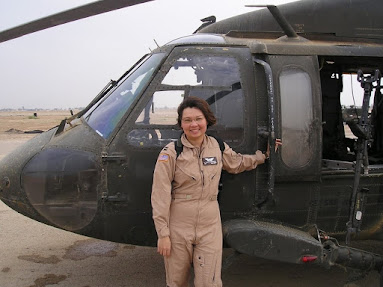
In the National Guard as an Army Reservist, Duckworth was able to follow her passion, pursue post-graduate studies, and work while serving her country. She says this about the sacrifices and service of Guardsmen and Reservists:

“There are several reasons people prefer the Reserve forces. Some don’t want to give up civilian jobs that pay better than military service. Some don’t want to commit to moving around every two or three years, which active duty servicemembers have to do. Some of them have already served on active duty and enter the Reserves after finishing their commitment.

One thing we all have in common, though, is our desire to serve. Being a member of the United States military is a privilege and an honor. When our country calls us to undertake a mission, we stop up, even if there’s a personal and professional cost to us. Citizen Soldiers do this over and over and over again –– and nonmilitary people don’t even know about it.”

Lt. Col. Duckworth joined the military before women were authorized to serve in combat, but she got as close as she could by becoming a helicopter pilot. She describes flying over the Egyptian desert and passing the Great Pyramid of Giza in Operation Bright Star. She flew low over the Amazon rainforest in Guyana  in Operation New Horizon. And she piloted missions in Iceland to clear glaciers of rusting equipment from World War II in Operation Northern Viking.


But the most harrowing experience, of course, was what happened on Nov. 12, 2004, when Duckworth’s Black Hawk was shot down in the Iraqi desert.


Both of her legs gone. Her arm badly mangled. Shrapnel in her face and body. Her fellow soldiers thought she was dead, but they refused to leave her body behind.


U.S. Army Warrior Ethos comes alive in the aftermath of the shootdown as Duckworth’s teammates extract her nearly lifeless torso and arrange for a medieval to Baghdad, where troops lined up to give blood. She needed 40 units of blood, plasma, and platelets.


Duckworth’s recovery at Walter Reed Army Medical Center is told in painful detail –– how she bore a “wall of pain,” learned to walk with two prosthetic legs, and came to terms with her new circumstances after the tragedy in Iraq, where she says, “There’s a piece of me there, both literally and figuratively.”

At Walter Reed she had to have parts of her body surgically removed and used to repair her mangled arm. She showed unimaginable grit and toughness, mixed with typical wounded warrior morbid humor and resolve.


Duckworth’s story is one of superior resilience. “I had no choice but to power through,” she writes. “It made no sense to lie around and feel sorry for myself. I had to accept my situation, then start working to change it.”


Found Haiku in “Every Day Is a Gift”:


When the obstacle

is effort, then there is no

obstacle (at all)


Something bad happens

you can either let it own

you, or you own it


(And) no matter how

grievous the wound, healing is

always possible


I found this book at Barnes & Noble bookstore on Memorial Day. It is a perfect companion book to one recently featured in Navy Reads: James Patterson’s “Walk in my Combat Boots.”


In fact, Duckworth’s missing combat boot is symbolically returned to her by fellow soldiers in a pivotal part of her story.

During her recovery and after meeting Illinois Senators Dick Durbin and Barack Obama, Duckworth resolved to enter politics. 

She was influenced personally by wounded warrior public servants Senators Bob Dole and Max Cleland, who helped her confront post-traumatic stress disorder.

“Senator Max Cleland, who lost his legs and an arm in Vietnam, sought treatment for PTSD three decades after his injury, when he lost an election in 2002. I met Max while at Walter Reed, and talking to him helped me to truly understand that the best we can do is take life one day at a time.

In the summer of 2005, when I realized I would never fly for the Army again, that advice from Max helped save me. I was no longer sure what my purpose in life would be, but I had to just take it one day at a time, and be open to whatever came my way.”

Obama, Akaka, and Duckworth
She fought for reforms at Walter Reed and the Veterans Administration, first in Illinois and then in President Barack Obama’s administration. She fought to make a national difference, first as a representative in the U.S. Congress and then as a senator. And she fought to become a parent.

Lt. Col. Duckworth’s struggle to become a mother and her realization that there is no such thing as “work-life balance” can be an inspiration to women and a revelation to men.


In Congress Duckworth was helped by Senators Kristen Gillibrand and Amy Klobuchar, among others. The late Senator Daniel K. Akaka honored her by bestowing Hawaiian names for her two daughters.


Her choice to enter politics so she could help people is not surprising.


Early in her life she saw first-hand the need for a social safety net and equal opportunity for people of color. Fifty-four years ago, in June 1967, the Supreme Court ruled in Loving v. Virginia that interracial couples, like Duckworth’s parents, could marry.


Her father’s hero was President Ronald Reagan. In the aftermath of the Vietnam War, Reagan signed the AmerAsian Immigration Act that allowed many Southeast Asian “half-children” into the United States. Of course, they were not “halfs.”

In “Every Day Is a Gift” Senator Tammy Duckworth, who lost nearly half her body in combat, shows that every person can be part of a greater whole. She lives the teamwork ethos –– no one left behind.


This is a marvelous and powerful book filled with tears, smiles, revelations, and inspiration. Like “Walk in My Combat Boots,” this book comes with an endorsement from Adm. William H. McRaven (U.S. Navy, Ret.)


“Raw, unfiltered, powerful –– a compelling story of courage and determination against overwhelming odds. Tammy Duckworth is a true warrior who overcame a difficult upbringing, a glass ceiling, and a horrific helicopter shootdown to become one of the most respected senators on Capitol Hill. Nothing can stop her.”

Sunday, August 12, 2018

John McCain: The Bell Tolls

Review by Bill Doughty

The bell tolls for John McCain.

He says so in "The Restless Wave: Good Times, Just Causes, Great Fights, and Other Appreciations" (Simon & Schuster, 2018), a book mentioned last May in "The Found Haiku of John McCain."

Senator McCain, a Navy veteran and former POW, calls for civility, humility and compassion in this heartfelt memoir. He opens the book with "accumulated memories" while attending the Pearl Harbor Remembrance ceremony on December 7, 1991 on the 50th anniversary of the attack; he attended with fellow senators Bob Dole and Dan Inouye. President George H. W. Bush delivered remarks.

Among Bush's remarks were these words: "World War II also taught us that isolationism is a bankrupt notion. The world does not stop at our water's edge. And perhaps above all, that real peace, real peace, the peace that lasts, means the triumph of freedom, not merely the absence of war."

Vice Adm. John S. McCain Sr., the senator's grandfather.
"That day, we watched two thousand Pearl Harbor survivors march to honor their fallen," McCain writes. In recent years only a relative handful of survivors are able to attend the ceremony in Pearl Harbor.

Among his accumulated memories: the service and sacrifices of his grandfather, father, mother (matriarch of a military family) and other family members and friends. Many of his closest friends were fellow prisoners of war and other Vietnam veterans.

"I feel the weight of memories even more now, of course," he writes in "The Restless Wave."

John Donne
Written with long-time collaborator Mark Salter, McCain cites several times both Hemingway's war novel "For Whom the Bell Tolls" and the lines of prose by John Donne that inspired Hemingway's title:
"No man is an island, entire of itself; every man is a piece of the continent, a part of the main. If a clod be washed away by the sea, Europe is the less, as well as if a promontory were... Any man's death diminishes me, because I am involved in mankind, and therefore never send to know for whom the bells tolls; it tolls for thee."
Hemingway received the Nobel Prize in 1954 for "For Whom the Bell Tolls."
John McCain will turn 82 this August 29. Now, as he reflects on a life well-lived in "The Restless Wave," he calls for greater concern for the civil rights of those he considers less fortunate than himself.
"I believe the United States has a special responsibility to champion human rights in all places, for all peoples, and at all times. I've believed that all my life. I was raised to believe it, to see it in the examples of gallantry put before me, in the histories and novels and poems I was encouraged to read, in the conduct of the heroes I admired, those to whom I was related or knew personally, and those who were commended to me. I am a democratic internationalist, a proud one, and have been all my public life. I could have been nothing else given my role models and influences. I took from Hemingway's 'For Whom the Bell Tolls' that defending the dignity of others is never a lost cause whether you succeed or not. And I thrill to the exhortation in the poem that inspired the novel, to be 'part of the main,' to be 'involved in mankind.'"
McCain reflects on his experience in the Senate – as the Navy's liaison while still on active duty – to his fights "with and against" Ted Kennedy. He recounts his stand against torture,  experiences in Iraq and Afghanistan, position on Putin and pivotal vote to save the Affordable Care Act.

Senators John McCain and Ted Kennedy.
Defending dignity is at the core of Americans' national identity, McCain writes. "The right to life and liberty, to be governed by consent and ruled by laws, to have equal justice and protection of property ... and it is fidelity to them – not ethnicity or religion, culture or class – that makes one an American." Our creed "gave us a purpose in the world greater than self-interest."

Consider that perspective this weekend on the first anniversary of the murder of a civil rights activist by a white supremacist in Charlottesville, Virginia.

"Humility," McCain writes, "is the self-knowledge that you possess as much inherent dignity as anyone else, and not one bit more." He approaches the issue of immigration with humility, offering practical and compassionate solutions as he acknowledges the problems of illegal immigration and the challenges of border control but balanced with an understanding of the causes and a humane response.

Common themes throughout "Wave" are reasoned humility and a principled tough stand for human rights.
"Human rights are not our invention. They don't represent standards from which particular cultures or religions can be exempted. They are universal. They exist above the state and beyond history. They cannot be rescinded by one government any more than they can be granted by another ... Human rights advocacy isn't naive idealism. It's the truest kind of realism. Statesmen who think that all that really matters in international relations is how governments treat each other are wrong. The character of states can't be separated from their conduct in the world. Governments that protect the rights of their citizens are more likely to play a peaceful, constructive role in world affairs. Governments that are unjust, that cheat, lie, steal, and use violence against their own people are more likely to do the same to other nations."
McCain talks tough about the dangers posed by authoritarian leaders, including Russia's Putin, who he met and spoke with several times over the years. McCain warns specifically of "Russia's nostalgia for empire" after the Cold War and collapse of the Soviet Union.

"Resentment and humiliation spread in Russia in the chaos, dislocation, and corruption of the erratic Yeltsin years, and eased the way for that striving, resentful KGB colonel, who seems to feel those emotions sharply and, to borrow an observation from 'Game of Thrones,' used chaos as a ladder," he writes.

McCain describes a fascinating interaction with Putin at the Munich Security Conference in 2007. While still on active duty, McCain first attended the conference in 1970 when he was Navy liaison to the Senate. In 2007, in the face of a fiery rhetorical attack on the United States, McCain responded with quiet resolve: "The United States did not singlehandedly win the Cold War in some unilateral victory," he told Putin and the European conference attendees. "The transatlantic alliance won the Cold War."

In "Wave" McCain recounts his interaction with Bill Browder, whose Russian lawyer, Sergei Manitsky, 37-year-old father of two, was arrested under Putin's orders and beaten to death by eight prison guards and orderlies. McCain, along with Representative Jim McGovern, Senator Ben Cardin and "a long list of co-sponsors," introduced what would become the Global Magnitsky Act calling for sanctions against Russian oligarchs, among others.

Profiles in Courage: Sen. John McCain meets with Secretary of Defense James Mattis.
Putin's reaction to the Magnitsky Act likely contributed directly to Russia's interference in the 2016 U.S. presidential election.

McCain reflects on human rights in his discussion of Ukrainian independence and threats to Balkan states by Putin's Russia.

He invokes Martin Luther King's "'the fierce urgency of now,' the transformational moment when aspirations for freedom must be realized, when the voice of a movement can't be stilled, when the heart's demands will not stand further delay."  Human rights is at the forefront in his interactions with leaders and dissidents in dozens of countries:
"I have done what little I can to stand in solidarity with forces of change in countries aligned with us and opposed to us, in Russia, in Ukraine, in Georgia and Moldova, in China, in Serbia, Kosovo, Montenegro, in Egypt, Libya, Tunisia, Syria, Saudi Arabia, and Turkey, in Iran, Uzbekistan, Kazakhstan, in Cuba, Nicaragua, in Zimbabwe and South Africa, [in Burma (Myanmar)], and wherever else people fighting for their human rights wanted our help. I've protested killings, torture, and imprisonments. I worked to sanction oppressive regimes. I've encouraged international pressure on the worst offenders. I've helped secure support for people building the framework of an open society. I've monitored elections, consoled the families of political prisoners, worried about the risk-takers and mourned their deaths. I've gotten more from them than they've gotten from me. I've gotten their hope, their faith, and their friendship."
He devotes one of his ten chapters to the Arab Spring and laments the situation in Syria:
"As of today, as the Syrian war continues, more than 400,000 people have been killed, many of them civilians. More than five million have fled the country and more than six million have been displaced internally. A hundred years from now, Syria will likely be remembered as one of the worst humanitarian catastrophes of the twenty-first century, and an example of human savagery at its most extreme. But it will be remembered, too, for the invincibility of human decency and the longing for freedom and justice evident in the courage and selflessness of the White Helmets and the soldiers fighting for their country's freedom from tyranny and terrorists. In that noblest of human conditions is the eternal promise of the Arab Spring, which was engulfed in flames and drowned in blood, but will, like all springs come again."
One of the best parts of this memoir is the final chapter, where McCain reflects with humble poetic insight about family, home, friendship, service and true patriotism as the bell tolls:

"'The world is a fine place and worth the fighting for and I hate very much to leave it,' spoke my hero, Robert Jordan, in 'For Whom the Bell Tolls.' And I do, too. I hate to leave it. But I don't have a complaint. Not one. It's been a great ride," McCain writes.

Sunday, April 22, 2018

Nainoa Thompson & Planet Earth, 'Hawaiki Rising'

Review by Bill Doughty

When Pwo (Master) Navigator Nainoa Thompson brought the voyaging canoe Hōkūle`a into Pearl Harbor in February of this year, he spoke in part about harnessing fear, overcoming the dangers of complacency, embracing diversity as a strength, and passing knowledge and wisdom to the next generation.

Thompson addressed the Navy and local civilian audience during his visit – part of a statewide "Mahalo Hawaii" tour of thanks to everyone for their support of Hōkūle`a's Malama Honua (caring together for Island Earth) circumnavigation of the planet completed in 2017.

Sam Low's "Hawaiki Rising: Hōkūle`a, Nainoa Thompson, and the Hawaiian Renaissance" (Island Heritage Publishing, 2013) provides a fascinating history of the beloved canoe, the revival of Hawaiian culture beginning in the 1970s, and how dedicated individuals inspired others to become aware of the need to respect and care for our environment, including our oceans.

Renaissance man Herb Kane at work in his Chicago studio.
Low served in the United States Navy in the Pacific in the mid-1960s. He introduces us to iconic individuals who brought Hōkūle`a ("Star of Joy") to life, including Herb Kane, and artist, sailor and thinker who was inspired by a book, "Canoes of Oceania" and by Polynesian culture, in general. Kane worked in Chicago but dreamed of the Pacific, learning all he could of voyaging canoes.

Kane created14 paintings of Polynesian canoes in the 1960s. The Hawaii State Foundation of Culture and the Arts purchased the paintings in 1969, making it possible for Kane to move to Hawaii to continue his studies and setting the stage for the revival of Hawaiian culture in the 1970s. 

At the time the foundation that purchased Kane's art was headed by its first director, Alfred Preis, architect of the USS Arizona Memorial in Pearl Harbor.

The late Daniel Inouye, United States Senator from Hawaii, once said, “When you saw a Herb Kane painting, you were energized and motivated to learn about the past. …His artwork captured both ancient and modern-day Hawaii and help preserve Hawaii's unique culture for future generations.”

Nainoa Thompson called Kane, who was a Navy veteran, "father of the Hawaiian Renaissance.”


In 1973 Kane envisioned construction of a voyaging canoe that would inspire that renaissance. He met with University of Hawaiʻi anthropologist Ben Finney and Tommy Holmes, author of The Hawaiian Canoe. Together they founded the Polynesian Voyaging Society and began work on the Hōkūle‘a, capable of sailing between Hawaii and Tahiti. One day, their canoe would sail around the world on a mission to bring awareness about earth's ecology.

Kane lived in East Oahu, which is where he met a young man who was serious, quiet and young enough to be imprinted with a love of the stars, the sea and sailing.

Nainoa Thompson
That young man was Nainoa Thompson, whose father, Myron "Pinky" Thompson was a World War II Army veteran, a strong supporter of Hawaiian culture, and a foundation for Nainoa's philosophy of life. Pinky told his son "Ninety percent of success is preparing for it." He helped Nainoa overcome his fears and learn values shared by the U.S. Navy: the importance of discipline, training and having a vision.

Nainoa writes this in the book's foreword:
"Our canoe, Hōkūle`a, and our dreams have now carried us ... (following) in the wake of our ancestors who discovered and settled Polynesia. It has been a process of finding ourselves not only as Hawaiians, as native to these islands, but also as native to planet Earth. On all of our voyages, we have been guided by the wisdom of our elders, our kupuna. Among them is my father, Myron "Pinky" Thompson, who understood that voyaging is a process in which we are guided by values that are universal. 'Before our ancestors set out to find a new island,' my father told me, 'they had to have a vision of that island over the horizon. They made a plan for achieving that vision. They prepared themselves physically and mentally and were willing to experiment, to try new things. They took risks. And on the voyage they bound each other with aloha so they could together overcome those risks and 'seeking, planning, experimenting, taking risks, and caring for each other. The same principles that we used in the past, are the ones that we use today and that we will use into the future. No matter what race we are or what culture we carry, these are values that work for us all."
Nainoa learned some values the hard way aboard Hōkūle`a: the importance of good seamanship, communication and the courage to assume command at sea.

Nainoa went to Bishop Museum's planetarium, studied at Willamette College in Oregon after attending Punahou School, and was inspired by a book called "The Stars: A New Way to See Them" by H. A. Rey, author of "Curious George." 

Low introduces us to another earlier influencer in Nainoa's life: Yoshio Kawano, who lived in traditional Japanese style and taught the young Nainoa how to fish and make connections with nature. Nainoa says, "Yoshi may have been my most important teacher of all. I didn't know it then, and certainly he didn't either, but he was preparing me for my life."

Pwo Navigator Mau Piailug
Through Low's insightful narrative we get to know others who worked with or inspired Nainoa and who have strong ties to Hōkūle`a: Mau Piailug, Eddie Aikau, Lacy Veach, Snake Ah Hee, Sam Ka'i, Chad Bayaban, Will Kyselka, Gordon Pi'ianapa'a, Shorty Bertelmann, Kimo Lyman, Dave Lyman, Wally Froiseth, Bruce Blankenfeld, Tava Taupa and Kawika Kapahulehua, among others.

We get an intimate view of life aboard Hōkūle`a, including on two roundtrip journeys to Tahiti in this book, published just before Malama Honua. We relive the heartbreaking loss of Eddie Aikau in 1978 and the rescue of the capsized Hōkūle`a, thanks to an observant Hawaiian Airlines pilot and a ready response from the U.S. Coast Guard.

Eddie ("Eddie Would Go") Aikau
Eddie's loss strengthened Nainoa's resolve. He pledged to fulfill Aikau's dream on his behalf, to see "Tahiti rising," coming up on the horizon as the voyaging canoe approached.

Using charts and simple explanations, Low shows some of the how-to of wayfinding. "The concept was straightforward – stars rise in the east, arc overhead, and set in the west, defining points on the horizon to steer by, or 'houses,' as Nainoa called them." Data becomes knowledge and, over time, knowledge becomes intuitive wisdom.

Author Sam Low blends science with art in his presentation, explaining some of the fundamentals of Nainoa's wayfinding using stars, constellations, ocean swells, birds, the moon and other means – using science and all the senses plus a spiritual dimension that defies explanation.

On one key night in the doldrums, confused about their direction, Nainoa "sensed" the moon before he saw it. He turned the canoe and when the clouds parted he saw the light shine through and knew he made the right decision.
"'I can't explain it,' Nainoa continues, 'there was a connection between something in my abilities and my senses that went beyond the analytical, beyond seeing with my eyes. It was something very deep inside. Before that happened, I relied on math and science because it was so much easier to understand things that way. I didn't know how to trust my instincts. My instincts were not trained enough to be trusted. That night, I learned there are levels of navigation that are realms of the spirit. Hawaiians call it na'au – knowing through your instincts, your feelings, rather than your mind or your intellect. It's like new doors of knowledge open and you learn something new But before the doors open you don't even know that such knowledge exists.'"
"Hawaiki Rising" is about discovering new knowledge, moving from anger and fear to love and courage, and rediscovering a culture of sustainable living on "Island Earth," showing how one person can make a profound difference. It's a good read for Earth Day 2018.

Saturday, March 8, 2014

In Shadow of ... America's Longest Wars

Review by Bill Doughty

Women and men of the Class of 2002 may think they are in the shadow of their grandparents -- "The Greatest Generation" who beat fascism, crushed nazism and crossed the Pacific to avenge Pearl Harbor and win the war in the Pacific in less than four years.

"In the Shadow of Greatness: Voices of Leadership, Sacrifice, and Service from America's Longest War" is a compilation by or about members of the U.S. Naval Academy Class of 2002. Put together with love and appreciation by Joshua Welle, John Ennis, Katherine Kranz and Graham Plaster -- and including a foreword by David Gergen -- the book is filled with essays and memories by and about members of the U.S. Naval Academy Class of 2002. The authors set the stage with a look back to the past:
"The magnitude of World War II provided the opportunity and experiences that shaped twentieth-century American leaders. As men served abroad, women provided support at home. All overcame great odds and faced adversity that gave them confidence and shaped their outlook in the decades to come. This 'greatest generation' returned from war, took advantage of the educational benefits offered through the GI Bill, and advanced the country's economy and transformed its society. World War II veterans, while fueling economic advancement, remained resolute in their  value system: service, sacrifice, and community."
Among "Shadow's" contributors are aviators, surface warfare officers, submariners, U.S. Marines and mothers of junior officers killed during training or in action.

The book is filled with first-person, heartfelt accounts of triumph and hardships: what it's like in humanitarian assistance missions, duty at sea, Search and Rescue operations, and combat; what it means to face family separation, "setting aside the comforts a normal life in service to our country and the Constitution. The dark sides of these sacrifices are broken marriages, post-traumatic stress disorder, depression, and estrangement."

But there is plenty of triumph here, too, focusing on why and how Navy and Marine Corps leaders choose to serve -- "not for self, but for country."

USS John Paul Jones (DDG 53)
A highlight is the account by Meghan Elger Courtney, who served aboard USS John Paul Jones (DDG 53) of her commitment to promote warfighting readiness for Sailors aboard the Arleigh Burke-class guided-missile destroyer. Courtney recognized a need to improve shipboard physical fitness opportunities to help Sailors who would deploy forward -- either aboard ship or as individual augmentees in Iraq and Afghanistan.

With the blessing of her commanding officer and strong support from the command master chief and Chief's Mess, j.o. Courtney planned for, procured and arranged for installation of a new fitness center that replaced outdated insufficient gear and space.  Courtney writes, "Almost immediately, I saw a positive renewal in people's attitude toward fitness, healthy eating, and incorporating workouts into their daily routine as a way to relieve stress and stay in shape."
"What some may have viewed as my silly pet project, the command master chief took seriously, and he became my closest ally in seeing it through. I never really knew how much the experience had impacted him until I saw him become visibly choked up recollecting it during his closing remarks when he transferred off the ship. I don't think he thought that a young officer like me could have cared about his crew so much, but I did, and I still do..."
Explorer Robert E. Perry
Courtney said she was inspired by a quote by explorer Robert E. Peary on a motivational placard in Halsey Field House at the academy: "I will find a way, or make one."

Other essayists share their sources of inspiration as President Teddy Roosevelt, President Dwight Eisenhower, President John F. Kennedy, Senator Daniel Inouye and Secretary of Defense Chuck Hagel, among others. 

One essayist quotes the last two lines of a poem by Mary Oliver, "The Summer Day" in pursuing a life of purpose, wanting to make a difference:

"Tell me, what is it you plan to do
with your one wild and precious life?"

The authors and essayists show how core values of honor, courage and commitment make up an ethos that "forms the fabric of people's personality and drives them to a life of service, in and out of uniform."
"'In the Shadow of Greatness' was envisioned to recognize and chronicle the service of brave men and women and through their stories establish connections with the broader, nonmilitary community. These first graduates of the Naval Academy after 9/11 entered a global war at sea, in the air, and on land. This war would last more than a decade and define the United States in the early part of the millennium. The actions of the select few profiled here represent those of a much broader spectrum of patriots."
Attacks on 9/11/2001 changed the lives of the Class of 2002.
In a short introductory piece, "Inside the Gates of Annapolis," Adm. Sam Locklear (now Commander, U.S. Pacific Command) writes about the investment the country makes in the women and men who attend service academies, including the Naval Academy, reflecting on the morning of September 11, 2001 when he sat at his desk as commandant of midshipmen.
"I recall vividly watching the al-Qaeda attacks on the World Trade Center and the Pentagon and the plane crash in Pennsylvania. When the images reached the Brigade, and the uncertainty of the events rapidly became reality, I asked myself, Are these men and women, these young patriots, ready for the challenges that most certainly lay ahead. A decade of war has proven that they were more than ready. Fortunately for us all, they remain ready today. We are extremely proud of all they have accomplished and thankful that we chose the right men and women to lead the next great generation."
The book, published by the Naval Institute Press, is a key title on the CNO's Professional Reading Program essential list.

Sunday, December 1, 2013

Max Cleland's 'Heart of a Patriot'

Review by Bill Doughty

"Heart of a Patriot" by Max Cleland with Ben Raines is a deeply personal and fearless account of a life of towering summits and dark valleys.

The former Army Airborne captain and decorated Vietnam combat veteran lost both legs and most of his right arm during the Battle of Khe Sanh in a grenade explosion.

In the book's foreword, "An Open Letter to America's Veterans," Cleland speaks candidly about his post-traumatic stress disorder and "a journey to the dark places of life -- terror, fear, death, wounding, loss, grief, despair and hopelessness."  

He writes for fellow veterans trapped in "a misery of memories" and offers light and hope.  "Recovery is possible," he writes.  "There are people who can help."
Max Cleland

Publisher SimonandShuster writes, "Max Cleland describes with love the ties America's soldiers forge with one another, along with the disillusionment many of them experience when they come home.  He spares no one his humiliations and setbacks in this gut-wrenching account of his life in the hope it will keep even one veteran from descending into darkness.  'Heart of a Patriot' is a story about the joy of serving the country you love, no matter the cost -- and how to recover from the deepest wounds of war."
Max Cleland is the keynote speaker at this year's Navy and National Park Service 72nd Pearl Harbor Day Ceremony, Dec. 7, 2013 near Joint Base Pearl Harbor-Hickam.

Cleland's father joined the Navy and shipped out to Pearl Harbor after war was declared.  His dad returned home Dec. 8, 1945 when Max was three and a half.

Cleland was inspired to public service and to join the military by President John F. Kennedy, especially in the wake of JFK's assassination 50 years ago.
In bed at Walter Reed in 1968, Cleland reads Arthur Schlesinger's
"A Thousand Days" about President John F. Kennedy.
After his promising future was "blown to bits" Capt. Cleland made a slow recovery at Walter Reed and then through the Veteran's Administration, getting a first-hand look at the institution he would run one day.

Later, after serving for more than a decade in state politics in Georgia he received an appointment as head of the VA by former Georgia Governor and newly elected President Jimmy Carter, a Navy veteran.

Cleland created VA centers to help millions of veterans, including returning service members from Iraq and Afghanistan.  "Their creation is one of the things I am most proud of," he writes.

Elected to the U.S. Senate, Cleland became chairman of the armed services subcommittee on personnel.  His colleagues, mentors and friends in the Senate included fellow combat veterans Chuck Hagel, Dan Inouye, John Kerry and "my Vietnam veteran brother" John McCain.  He describes the pride of wearing his dad's WWII Navy peacoat as a U.S. Senator during a presidential inauguration.

After the Al Qaeda attacks of Sept. 11, 2001 Cleland was appointed to the 9/11 Commission but said he was frustrated by a lack of access to key intelligence information leading up to the attacks.

In the chapter, "An Infamous Commission," he links aspects of the 9/11 Commission with the Warren Commission that investigated the JFK assassination.  He also compared the 9/11 lack of transparency with the investigation after the Pearl Harbor attack.
"Within the first week after that tragedy, Roosevelt had set up a commission to investigate it and all its ramifications.  Just 10 days after the attack, he relieved both the naval commander at Pearl Harbor, Admiral Husband E. Kimmel, and the army commander, General Walter Short, of their jobs based on the commission findings.  Every aspect of the government's inner workings, from diplomacy to military readiness and intelligence, was laid bare for the commission to examine. And in the end, Roosevelt got his man: Within three years, he had personally given the order to shoot down the plane carrying Admiral Yamamoto, the Harvard-educated enemy warrior who planned the attack."
The book describes in painful detail the bouts of depression that Max Cleland endured during his life of public service.  Poignantly, Cleland, who "grew up in the golden era of rock," describes a moment alone listening to the Beatles and Paul McCartney's "Yesterday," feeling like "half the man I used to be."

"Heart of a Patriot" concludes with another message directly for veterans, especially for those suffering from polytrauma. He imagines and then creates a better future.  Through faith and hope and the help of others, there is "something to stand on" and a way to fly out of the darkness, he writes.

Max Cleland is set to speak to the Greatest Generation and "the greatest of our generation" at Saturday's Pearl Harbor Day commemoration.  Max Cleland, a self-described "war baby" was born August 24, 1942.  Do the math, and he was conceived just prior to the attack on Pearl Harbor.

President Barack Obama appointed Cleland as Secretary of American Battle Monuments Commission in June 2009.

Max Cleland, Secretary American Battle Monuments Commission, gives remarks, Nov. 11, 2012, during a Veterans Day ceremony at the National Memorial Cemetery of the Pacific in Honolulu. (Department of Defense photo by U.S. Air Force Tech. Sgt. Michael R. Holzworth)

Saturday, May 25, 2013

The Eclectic, Electric and Heroic


by Bill Doughty

It’s been a few weeks since I’ve posted to Navy Reads. Been too busy reading an eclectic list of books: Mary Roach’s “Gulp: Adventures on the Alimentary Canal” (sickeningly good), Scott McGaugh’s “Midway Magic” (long live CV-41), and several books that may help explain the violent extremist insanity that led to the Boston Marathon bombings (to try to understand the “why”).  

These books include “Chechen Jihad” by Yossef Bodansky, “8 Pieces of Empire” by Lawrence Scott Sheets, “The Lone Wolf and the Bear” by Moshe Gammer, and “The Black Banners” by Ali Soufan.  All provide insights into Chechnya, “Chechenization” and the twisted currents of Islamist-Jihadists.

Reviews of any of the above titles are on hold, though.  I also picked up a copy of “The Orphan Master’s Son” by Adam Johnson, a work of colorful imagination set in and around North Korea.  So far, this stark thriller is a work of art and beauty with ties to both the sea and Japan.

Speaking of novels... Coming soon, a very special post courtesy of retiring Adm. James Stavridis who stepped down this month as NATO Supreme Allied Commander.
ADM Stavridis is honored after stepping down at NATO May 13, 2013.

Stavridis has an electrifying intellect.  Watch his TED Talk on global security  -- building bridges, not walls, and protecting sea lanes -- to understand the U.S. Navy’s raison d’etre.


As secretary of the Navy it is my privilege to name these ships to honor a respected naval leader and a true American hero." Mabus said. "For decades to come, the future USS Paul Ignatius and USS Daniel Inouye will represent the United States and enable the building of partnerships and projection of power around the world." 
Sen. Inouye speaks with a Navy Captain aboard USS Midway, year unknown.

Former Navy leader Paul Ignatius served as secretary of the Navy in the late 1960s under President Lyndon Johnson.  Inouye earned the Medal of Honor for his heroism in battle with the 442nd Regimental Combat Team in Italy. First elected to the U.S. House of Representatives when Hawaii became a state in 1959, he was elected to the U.S. Senate in 1963 and served there until his death at age 88.

This will be the first Memorial Day since Sen. Inouye’s passing last December.  He was a great American hero, consensus builder and forward-thinking visionary who, decades ago, understood the importance of rebalancing to the Pacific.


070505-N-3642E-385 GROTON, Conn. (May 5, 2007) – Sen. Daniel Inouye prepares to speak at the commissioning of USS Hawaii (SSN 776). Hawaii is the third Virginia-class submarine to be commissioned and the first major Navy combatant vessel class designed with the post-Cold War security environment in mind. U.S. Navy photo by Chief Mass Communication Specialist Shawn P. Eklund (RELEASED)