By Bill Doughty

By Bill Doughty
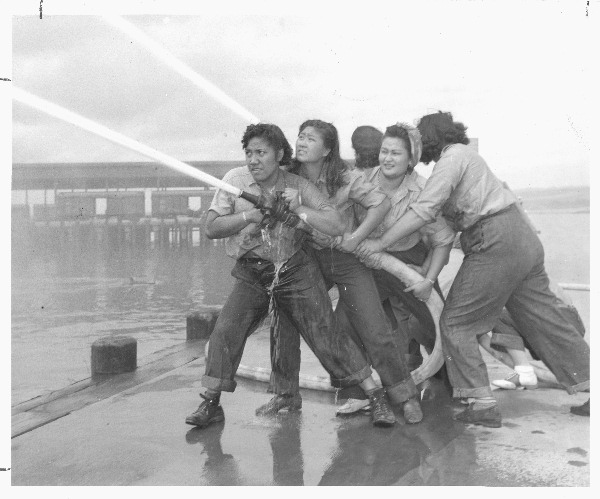
In an iconic photo, four Asian American Pacific Islander women at the Pearl Harbor Naval Shipyard train in firefighting. Long mislabeled as taken during the attack of Dec. 7, 1941, the photo in fact portrays some of the strong women who applied to support the Navy’s war efforts in the wake of that attack. From left to right: Elizabeth Moku, Alice Cho, Katherine Lowe, and Hilda Van Gieson.
Over time, history usually has a way of sorting out fact from fiction.
 |
| Rear Adm.Grace Hopper, "Mother of Computing" |
Among the women profiled are some we featured in Navy Reads posts: Rear Adm. Grace Hopper, Ada Lovelace, Rachel Carson, Marjory Stoneman Douglas, Margaret Chase Smith, Malala Yousafzai, and Maya Angelou. This book includes mini-biographies of both famous (Clara Barton, Helen Keller, Ida B. Wells, Maya Lin, Gabby Giffords, Greta Thunberg, and Venus and Serena Williams) as well as less-well-known women (Rigoberta Menchu Tum, Dr. Gao Yaojie, Nelba Marquez-Greene, Wangari Maathai, and Jineth Bedoya Lima).
 |
| Chelsea and Hillary Clinton, 2011 |
Chelsea writes, “I learned of Grace (Hopper) in 1996, when the navy named a new ship the USS Hopper (DDG 70) in her honor … I learned even more about her when I spoke many years later at the Grace Hopper celebration, the largest gathering of women technologists in the world.”
Former First Lady, senator, and Secretary of State Hillary Clinton reflects about the suffragists who knocked on the door, marched in the street, and fought for women to be able to vote in the United States one hundred years ago. That right was guaranteed with the passing of the Nineteenth Amendment to the U.S. Constitution, but it was a right that took decades to apply to women of color:
“Reading the words of the Nineteenth Amendment today, it’s hard not to wonder why it took so long” ‘The right of citizens of the United States to vote shall not be denied or abridged by the United States or by any State on account of sex. Congress shall have the power to enforce this article by appropriate legislation.’ But, of course, it was a long struggle because it was about so much more than the right of women to vote. It was about race, class, and deeply held cultural and religious views about women’s subordinate roles to men in society. It was about men’s –– and some women’s –– insecurities and fears of the unknown. These challenges are still present today.
The franchise –– the basic right of citizenship –– is still being fought over between those of us who believe every citizen should be able to vote and have that vote counted, and those who want to restrict the vote by erecting barriers against people, largely still based on race.”
 |
Celia Ou, a graduate student at Scripps Institution of Oceanography, monitors computer screens displaying detailed sonar imaging of the ocean floor aboard the Auxiliary General Oceanographic Research (AGOR) vessel R/V Sally Ride, Dec. 15, 2016. (John F. Williams)
Nearly all the Gutsy women featured in this book faced and overcame some kind of obstacles of discrimination. Chelsea Clinton says this about space pioneer astronaut Sally Ride, the first American woman in space (in 1983) and a champion of STEM education for young people worldwide:
“Even after her death in 2012, Sally Ride kept breaking barriers. She came out as a lesbian quietly, without fanfare … Not long after her death, Tam [O’Shaughnessy, her partner of 27 years] received a call that surprised her, from Ray Mabus, then secretary of the navy. The navy hoped to honor Sally by naming a research vessel after her. Secretary Mabus was calling to ask whether Tam would be the ship’s sponsor – a role that had, up until that point, been filled by the wife of the man for whom the ship was named. ‘I think it is fitting the the celebration of Sally’s legacy as a pioneering space explorer and a role model includes an acknowledgment of who she really was and what she cared about,’ said Tam. The R/V Sally Ride, commissioned in 2016, is the first navy research ship named for a woman. Her legacy lives on in the scientific curiosity sparked in the girls and boys she continues to inspire, the ship that bears her name, and a spot on the moon named after her by NASA.”
Military readers may find fascinating nuggets of history in the essays about Sylvia Earle, Mary McLeod Bethune, Florence Nightingale, Eleanor Roosevelt, and Mary Edwards Walker. Chelsea writes this about Walker:
“…Dr. Mary Edwards Walker, the only woman in her medical school class at Syracuse Medical College in 1855. She was a practicing physician when the Civil War broke out. She desperately wanted to enlist in the Union Army as a surgeon but wasn’t allowed to because she was a woman. Initially she was called a nurse, since women generally weren’t considered doctors. Because women were not allowed to enlist, Mary had to volunteer, working for free at a temporary hospital, first in Washington and then in Virginia, where she traveled to Union field hospitals across the commonwealth … When her medical credentials were finally accepted she moved to Tennessee and became a War Department surgeon – a paid position that was the equivalent of a lieutenant in status.”
“When I think of Sylvia’s work, I am reminded how important it is for all of us to peruse and consider what we want to leave to the generations who come after us –– how they’ll honor the past, imagine the future, and give gifts to those who will live out their lives long after we’re gone. That’s exactly what Sylvia’s life as a scientist, an engineer, a teacher, and an explorer should inspire all of us to do: we must preserve our oceans for the future.”
Last year, this book generated controversy because of the women who were not included. For example, there is an unfortunate dearth of women who have served in or with the military. Surely, the authors could have included a “protectors” section filled with inspiring women who served in uniform.

Yet, considering the general lack of attention toward the achievements of women in American and world history for many generations, it is refreshing to see a book of this scope. Women continue to knock on the door, push through the glass ceiling, and demand equality.
“The Book of Gutsy Women” illustrates the strengths of women throughout history, often in the face of sexism, misogyny, harassment, and patriarchy. It highlights the facts of women’s history and showcases women’s contributions to creating a better world now and in the future.


Review by Bill Doughty––
“Why do we struggle? Why must we, as members of the human family, immerse ourselves in the agency of turmoil and unrest to affect the evolution of humankind? Why participate in the work of justice at all?” With those words, the late U.S. Representative John Lewis frames the big picture of life. And he answers those questions in an illuminating way, filled with hope.

“Thus, our purpose while we are here, in the most basic sense, is to be a light that shines –– to fully express our gifts so that others might see. When they witness our splendor, when we show them it is possible to shine radiantly even in the darkest night, they begin to remember that they are stars also, meant to light up the world. And if we are brilliant, like a Bobby Kennedy, a Martin Luther King Jr., a Jim Lawson, or a Fannie Lou Hamer, then the intensity of our flame can light the path of freedom for others.”
Lewis says we can "smolder with imagination, burn with creativity, reverberate with love, oneness, and peace. The infinite is possible, but this beauty can only manifest through us.”
Lewis calls for “forgiveness and compassion” in his message of hope, light, and unity. This is an inspiring autobiography of faith, patience, action and love –– which are just some of the chapter names. This book is a great companion to the graphic biography trilogy, “March,” and offers more than a dozen photos along Lewis’s enlightened life’s path.

Meacham dedicates the book “for all who toil and fight and live and die to realize the true meaning of America’s creed.” Like Lewis in “Across That Bridge,” Meacham lauds heroes of the civil rights movement and contextualizes Lewis’s life in the promises of the Declaration of Independence, Constitution, and Bill of Rights, acknowledging the founders’ limitations in their space and time.
“If the framers were about limits, Lewis was about horizons. The men who wrote the Constitution believed that human appetites and ambitions were the controlling forces of history. Lewis believed hope shaped history –– the hope that Lincoln’s better angels could prevail if men and women heeded the still, small voice of conscience that suggested the country, and the world, would be better off if Jefferson’s assertion of human equality were truly universal.”
Meacham’s book opens in a terror-filled South of rape, beatings, lynchings, and other forms of dehumanizing African Americans, in a nation overcoming a depression and focused on a world war.
“Blood and death, pain and loss, sacrifice and the hope of redemption: Lewis was coming of age in the most intense of eras, an era the made this young black man in the South something of a child of wartime. George H.W. Bush –– who joined the U.S. Navy on his eighteenth birthday, married when he was twenty, and had his first child by the time he was twenty-two –– once explained the urgency of his generation of World War II veterans as a result of ‘heightened awareness, a sense that everything mattered, that life was to be lived, in Bush’s phrase, ‘on the edge.’ ‘It was a time of uncertainty,’ Bush recalled.”
 |
| Civil Rights icons and touchstones Rosa Parks and Emmitt Till |
As shown in this biography and in “March,” the highlight of Lewis’s life was attending the inauguration of Barack Obama and receiving the Presidential Medal of Freedom from the first African American U.S. president.
Meacham does a thorough job of showing Lewis’s struggles and achievements. His epilogue, “Against the Rulers of the Darkness,” seems to be a nod to Lewis’s own call for people to find their own inner light.
Meacham’s book is good, but the hope and light shine brightest in Lewis’s own words.
 |
WASHINGTON (Jan. 6, 2016) Secretary of the Navy (SECNAV) Ray Mabus signs a graphic representation of the future fleet replenishment oiler USNS John Lewis (T-AO 205) after naming the ship in honor of U.S. Representative John Lewis, a civil rights movement hero. USNS John Lewis will be the first ship of the Navy's newest generation of fleet replenishment oilers. (U.S. Navy photo by Mass Communication Specialist 2nd Class Armando Gonzales/Released) |

 Chapter One opens with a Senate Armed Service Committee hearing of April 9, 2013, in which then Commander, U.S. Pacific Command Adm. Samuel J. Locklear testified about the threat of not only China and North Korea, but also climate change: "Increasingly severe weather patterns and rising sea levels threaten lives and property," Locklear said, "and could even threaten the loss of low-lying nations."
"A similar assessment was provided in 2019 by one of Locklear's successors at what had been rechristened the Indo-Pacific Command. Asked by Senator Elizabeth Warren of the Senate Armed Services Committee to discuss the impact of climate change on operational readiness in his area of responsibility, Admiral Philip S. Davidson replied: 'The immediate manifestation, ma'am, is the number of ecological disaster events that are happening.' In just the past few months, he indicated, the Indo-Pacific Command had been called on to assist with emergency relief operations in the U.S.-administered Northern Mariana Islands after they were struck by Super Typhoon Yutu. 'Our assistance in terms of humanitarian assistance and disaster relief, our ability to command and control, to marshal troops, to deliver logistics, is important training for the region.'"Klare shows how training and warfighting are negatively impacted by more frequent heatwaves, when it becomes too deadly to operate. Conversely, the military is also challenged in super-cold environments such as Red Dawn-like exercises in Norway in sub-Arctic terrain, in which hundreds of U.S. Marines must train in amphibious assaults. There are "distinctive challenges in fighting in snow-covered sub-zero conditions," according to Klare.
 "Climate change," he says, "will make itself felt in multiple situations, increasing the risk that long-standing hostilities will erupt into full-scale war." Another likely scenario: millions of displaced people as mega-fires, freshwater shortages, monster storms and rising sea levels cause mass migration.
 |
| U.S. Navy Lt. Jose Garcia inactivates Ebola virus at Bushrod Island, Liberia, Oct. 2014. |
 |
| Rear Adm. Bolivar gives thumbs up prior to surveying damage from Hurricane Michael, Oct. 2018. |
"When Hurricane Florence shifted course and headed to the Carolinas instead of the Norfolk area in September 2018, those bases were severely impacted; normal operations were suspended and nonessential personnel ordered to evacuate. Camp Lejuene, a major Marine training center, was especially hard hit by Florence, with some nine hundred buildings damaged or destroyed. As sea levels rise, flooding of Lejeune's low-lying areas is likely to occur on a daily basis and large parts of it can expect to be fully inundated during future hurricanes. Parris Island, the Marines' main East Coast recruit training facility, and MCAS Beaufort, home to six Marine F/A-18 fighter squadrons, are equally at risk of inundation. At present, a storm surge of five to ten feet induced by a Category 1 hurricane would cover some 90 percent of Parris Island; by 2100, almost the entire base would be covered by ten to fifteen feet of water. MCAS Beaufort faces similar risks." (Klare cites Union of Concerned Scientists studies and reports.)We read how Naval Base Coronado in San Diego is at risk, as is fire-prone Marine Corps Base Camp Pendleton, also in California. Wildfires threaten bases throughout the Southwest, and Alaska military facilities are in danger from shoreline erosion and/or thawing permafrost. Offutt Air Force Base near Omaha, Nebraska, home of the U.S. Strategic Command, is seriously affected by flooding due to storms.
 |
| Aircrewmen load an Air-Deployable Expendable Ice Buoy onto a Royal Danish Air Force C-130 aircraft at Thule Air Force Base in Greenland Sept. 7, 2017, in preparation for deployment in the high Arctic as part of the International Arctic Buoy Program (IABP). (U.S. Navy photo by John F. Williams) |
"Elsewhere in the region, the DoD faces a substantial climate threat to its cluster of air and naval bases in Japan. These installations, including the naval base at Yokosuka on Japan's main island of Honshu, and Kadena Air Force Base, on Okinawa, are among the most important U.S. military facilities in Asia. Yokosuka, located on the mouth of Tokyo Harbor, hosts the USS Ronald Reagan (America's only forward-deployed carrier) and its supporting vessels; Kadena is the largest Air Force facility in East Asia, housing the 18th Air Wing and a host of other units. Both of these bases, and many others nearby, are located on or close to the Pacific Ocean and are regularly menaced by typhoons. As global warming proceeds, these facilities – like their counterparts in the estern United States – will be exposed to rising seas and an ever-increasing risk of extremely powerful storms."
 Using science-based research and common sense, the Navy has shown significant leadership in the approach to climate change for more than ten years, with admirals and civilian leaders unafraid to speak truth to power.
 |
| Then SECNAV Ray Mabus talks Navy sustainability at the greengov symposium, June 2015. |
"Equally insightful is the U.S. military's emphasis on cooperation with the militaries of friendly nations in addressing the perils of climate change. From the very beginning, senior officials have stressed the need to work with other countries in reducing their own climate change vulnerabilities, thereby enhancing regional and international stability. In accordance with this precept, U.S. services have collaborated with foreign militaries in preparing for extreme event, for example, by stockpiling emergency relief supplies, conducting joint disaster relief drills, and helping to harden critical facilities. Although modest in comparison to what is actually needed to protect the world from warming's severe effects, these endeavors demonstrate a basic understanding that human survival at this perilous moment will require international collaboration of just this sort."
 The Pentagon has confronted the issue of climate change in various publications and plans: DoD's "Climate Change Adaptation Roadmap;" Quadrennial Defense Reviews over the past ten years; DoD Directive 4715.21, "Climate Change Adaptation and Resilience;" 2019's "Report on Effects of A Changing Climate to the Department of Defense;" and Naval Facilities and Engineering Command's "Climate Change Installation Adaptation and Resilience Planning Handbook."
 |
| Medal of Honor recipient John Finn, Dec. 7, 2006. |
 |
| Craig Symonds |
 |
| Mary Roach |
 |
| Cmdr. Melvin Smith (right) assumes command of USS Jimmy Carter. |
 |
| Vice Adm. John S. McCain Sr. and Cmdr. John S. McCain Jr. in 1945. |


 |
| Author David Zweig |
 |
| Add caption |
 |
| John Paul Jones met by President Obama after Kennedy Center Honors in 2012. |
 |
| "Earthrise" in 1968. Photo courtesy of NASA. |

 |
| Akkadian victory stele of Ram-Sin |
"Keys does not shy away from big ideas. In 'Catastrophe' he argues that by unleashing the plague from the south and causing barbarians to move westward from Asia, the climate upheavals of 536 played a key role in the end of the Roman Empire, the rise of Islam, and other events that marked the end of ancient times and set the stage for the emergence of the modern world. It's a sweeping claim, so bold that it almost begs contradiction, even from those willing to posit the consequential role of climate in human affairs. When a civilization is in decline, after all, the agent of its end might be entirely different from the cause of its decline. When pneumonia kills an aged patient in failing health, is pneumonia the killer, or merely the final nudge? As Keys exhaustively documents, by the sixth century, the Roman Empire was senescent, with little sense of purpose, kept together principally by the fear of the gathering barbarians at the gates who were constantly probing for opportunities and signs of weakness."
 |
| Bruegel's Triumph of Death |
 |
| Preparing a gravity core for deployment. (Photo by Mary Carman, Woods Hole) |

"Where are we headed? Is climate changing? If so, are we causing these changes? What changes lie in the future? Are we better prepared to deal with climate change? Can we do anything to halt climate change or ameliorate its effects?"Navy leaders recognize that climate change can accelerate instability and conflict, degrade the environment and cause food and water scarcity, disruption and migration – requiring significant humanitarian assistance.
 |

