Showing posts sorted by relevance for query max cleland. Sort by date Show all posts

Saturday, November 13, 2021

A True Patriot and Statesman: Max Cleland

By Bill Doughty––

When Joseph Maxwell "Max" Cleland spoke at the 72nd Pearl Harbor Day commemoration ceremony, Dec. 7, 2013, with Pearl Harbor itself as a backdrop, he was nearly overcome with emotion. He saw the dozens of World War II veterans seated in the front rows of the audience, and he thought of his father. Cleland spoke without notes, from the heart, about the sacrifice of military service and the joy of homecomings.


Army CPT Max Cleland in Vietnam
Hugh Cleland, Max’s dad, joined the Navy after the attack on Oahu in 1941. In 1965, Max volunteered for the Army to serve in combat in Vietnam, where he earned the Silver Star and Bronze Star.

Cleland was severely wounded and nearly killed. Yet, he personified resilience to become head of the Veterans Administration and a U.S. Senator.

Cleland died earlier this week. He was a great statesman, military veteran, and advocate for veterans, especially those with lasting physical and mental wounds.


President Joe Biden issued a statement November 9 on Cleland’s passing:

“Max Cleland was an American hero whose fearless service to our nation, and to the people of his beloved home state of Georgia, never wavered.

As a 25-year-old serving in the 1st Cavalry Division of the U.S. Army during the Vietnam War, Max lost both of his legs and his right arm in a grenade explosion at Khe Sanh. After grueling months in the hospital, enduring multiple surgeries and a long road back to recovery, Max turned his pain into purpose. He continued his distinguished public service, becoming a lifelong champion of the dignity and rights of working people and America’s wounded veterans. His leadership was the essential driving force behind the creation of the modern VA health system, where so many of his fellow heroes have found lifesaving support and renewed purpose of their own thanks in no small part to Max’s lasting impact... He was a man of unflinching patriotism, boundless courage, and rare character... He will be remembered as one of Georgia’s and America’s great leaders.”

I was fortunate to help plan the Navy’s Pearl Harbor Day commemoration ceremony in 2013 and to hear Max Cleland speak about honor, courage, and commitment –– as well as true family values and patriotism.


In 2013 I posted a Navy Reads review featuring Cleland’s autobiography, “Heart of a Patriot.”

Cleland, who chaired the armed services subcommittee on personnel in the Senate, was known for working closely with both Democratic and Republican colleagues.


Cleland reads about JFK.
From Navy Reads: “His colleagues, mentors and friends in the Senate included fellow combat veterans Chuck Hagel, Dan Inouye, John Kerry and ‘my Vietnam veteran brother’ John McCain. Cleland describes the pride of wearing his dad's WWII Navy peacoat as a U.S. Senator during a presidential inauguration.”


Prior to serving in the Navy for three years during WWII, Max Cleland’s father, Hugh, had served in the Civilian Conservation Corps, an environmental infrastructure program created by President Franklin D. Roosevelt during the Great Depression. FDR was an inspiration to a young Max Cleland. Cleland loved books and reading. He authored several books.


Like Biden, Secretary of Defense Lloyd Austin issued a statement about Senator Cleland’s passing; fittingly, Austin includes references to literature.


In part, SECDEF Austin says:

“The Department of Defense stands united in mourning the loss of Senator Max Cleland, an extraordinary public servant and a great patriot…He served his country and his community from a wheelchair, following in the gallant tradition of his hero President Franklin Roosevelt.”


SECDEF Austin notes that as head of the Veterans Administration, Cleland “fought fiercely for his fellow veterans, made PTSD an official VA diagnosis, and helped create the groundbreaking Vet Centers program. Later, after being elected a U.S. senator from Georgia, he continued his passionate focus on defense and veterans' issues, serving with distinction on the Senate Armed Services Committee and leading on such issues as health care, bioterrorism preparedness, and homeland security. He also served on the 9/11 Commission before being nominated for the board of the Export-Import Bank. His final act of public service was leading the American Battlefield Monuments Commission. When battle maps of Vietnam were added to the National Memorial Cemetery of the Pacific in Hawaii, he asked to add an inscription from the poet Archibald MacLeish: ‘We leave you our deaths: give them their meaning.’

With courage and grit, Senator Cleland struggled with PTSD and depression—seeking help through counseling, medication, and attendance at a recovery group. He said that he drew strength from being around his fellow veterans and wounded warriors, including those from Iraq and Afghanistan. As the head of the VA, he made psychological counseling available to his fellow veterans. And I hope that his example will encourage others carrying unseen wounds to seek out the help they need and deserve. 

Senator Cleland liked to quote Hemingway, who wrote, ‘The world breaks everyone and afterward many are strong at the broken places.’ He surely was. Max Cleland's civic-minded spirit, optimism, and resilience will stand as an inspiration to every American.”

Funeral services are planned for early next week.


Senator Max Cleland, RIP.


Vietnam War veteran Max Cleland, a triple amputee, holds a photograph of himself as a child with his father, Hugh, and mother, Juanita, at the National Memorial Cemetery of the Pacific at Punchbowl in 2013. (Jamm Aquino, Honolulu Star-Advertiser)
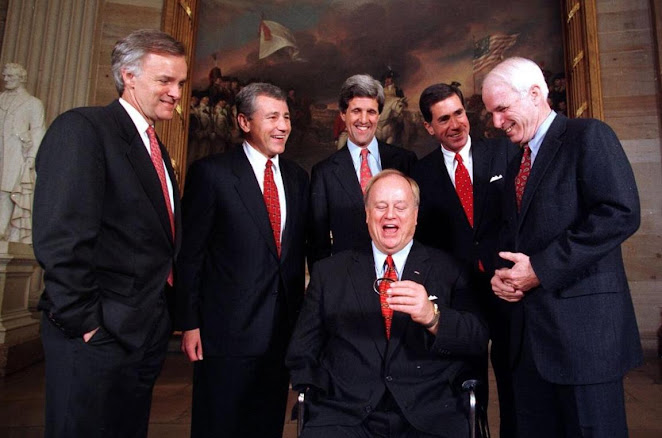

The Senate had six Vietnam combat veterans in January 1997. Sen. Max Cleland, D-Ga., is in the front. Behind him, from left: Bob Kerrey, D-Neb., Chuck Hagel, R-Neb., John Kerry, D-Mass., Chuck Robb, D-Va., and John McCain, R-Ariz. This photo was taken by The World-Herald during Senate orientation the previous month. (Kiley Cruse, The World-Herald)

Top photo: Secretary Max Cleland, American Battle Monuments Commission, delivers keynote remarks during the 72nd anniversary commemoration of the Dec. 7, 1941, attack on Oahu. This year’s commemoration theme, “Sound the Alarm,” examines how thousands of Americans answered the call to duty in the wake of the attack. More than 2,500 people attended the Pearl Harbor commemoration. (MC2 Nardel Gervacio)


Sunday, December 1, 2013

Max Cleland's 'Heart of a Patriot'

Review by Bill Doughty

"Heart of a Patriot" by Max Cleland with Ben Raines is a deeply personal and fearless account of a life of towering summits and dark valleys.

The former Army Airborne captain and decorated Vietnam combat veteran lost both legs and most of his right arm during the Battle of Khe Sanh in a grenade explosion.

In the book's foreword, "An Open Letter to America's Veterans," Cleland speaks candidly about his post-traumatic stress disorder and "a journey to the dark places of life -- terror, fear, death, wounding, loss, grief, despair and hopelessness."  

He writes for fellow veterans trapped in "a misery of memories" and offers light and hope.  "Recovery is possible," he writes.  "There are people who can help."
Max Cleland

Publisher SimonandShuster writes, "Max Cleland describes with love the ties America's soldiers forge with one another, along with the disillusionment many of them experience when they come home.  He spares no one his humiliations and setbacks in this gut-wrenching account of his life in the hope it will keep even one veteran from descending into darkness.  'Heart of a Patriot' is a story about the joy of serving the country you love, no matter the cost -- and how to recover from the deepest wounds of war."
Max Cleland is the keynote speaker at this year's Navy and National Park Service 72nd Pearl Harbor Day Ceremony, Dec. 7, 2013 near Joint Base Pearl Harbor-Hickam.

Cleland's father joined the Navy and shipped out to Pearl Harbor after war was declared.  His dad returned home Dec. 8, 1945 when Max was three and a half.

Cleland was inspired to public service and to join the military by President John F. Kennedy, especially in the wake of JFK's assassination 50 years ago.
In bed at Walter Reed in 1968, Cleland reads Arthur Schlesinger's
"A Thousand Days" about President John F. Kennedy.
After his promising future was "blown to bits" Capt. Cleland made a slow recovery at Walter Reed and then through the Veteran's Administration, getting a first-hand look at the institution he would run one day.

Later, after serving for more than a decade in state politics in Georgia he received an appointment as head of the VA by former Georgia Governor and newly elected President Jimmy Carter, a Navy veteran.

Cleland created VA centers to help millions of veterans, including returning service members from Iraq and Afghanistan.  "Their creation is one of the things I am most proud of," he writes.

Elected to the U.S. Senate, Cleland became chairman of the armed services subcommittee on personnel.  His colleagues, mentors and friends in the Senate included fellow combat veterans Chuck Hagel, Dan Inouye, John Kerry and "my Vietnam veteran brother" John McCain.  He describes the pride of wearing his dad's WWII Navy peacoat as a U.S. Senator during a presidential inauguration.

After the Al Qaeda attacks of Sept. 11, 2001 Cleland was appointed to the 9/11 Commission but said he was frustrated by a lack of access to key intelligence information leading up to the attacks.

In the chapter, "An Infamous Commission," he links aspects of the 9/11 Commission with the Warren Commission that investigated the JFK assassination.  He also compared the 9/11 lack of transparency with the investigation after the Pearl Harbor attack.
"Within the first week after that tragedy, Roosevelt had set up a commission to investigate it and all its ramifications.  Just 10 days after the attack, he relieved both the naval commander at Pearl Harbor, Admiral Husband E. Kimmel, and the army commander, General Walter Short, of their jobs based on the commission findings.  Every aspect of the government's inner workings, from diplomacy to military readiness and intelligence, was laid bare for the commission to examine. And in the end, Roosevelt got his man: Within three years, he had personally given the order to shoot down the plane carrying Admiral Yamamoto, the Harvard-educated enemy warrior who planned the attack."
The book describes in painful detail the bouts of depression that Max Cleland endured during his life of public service.  Poignantly, Cleland, who "grew up in the golden era of rock," describes a moment alone listening to the Beatles and Paul McCartney's "Yesterday," feeling like "half the man I used to be."

"Heart of a Patriot" concludes with another message directly for veterans, especially for those suffering from polytrauma. He imagines and then creates a better future.  Through faith and hope and the help of others, there is "something to stand on" and a way to fly out of the darkness, he writes.

Max Cleland is set to speak to the Greatest Generation and "the greatest of our generation" at Saturday's Pearl Harbor Day commemoration.  Max Cleland, a self-described "war baby" was born August 24, 1942.  Do the math, and he was conceived just prior to the attack on Pearl Harbor.

President Barack Obama appointed Cleland as Secretary of American Battle Monuments Commission in June 2009.

Max Cleland, Secretary American Battle Monuments Commission, gives remarks, Nov. 11, 2012, during a Veterans Day ceremony at the National Memorial Cemetery of the Pacific in Honolulu. (Department of Defense photo by U.S. Air Force Tech. Sgt. Michael R. Holzworth)

Monday, June 14, 2021

Tammy Duckworth: Life’s Whole “Gift”


Review by Bill Doughty

I have a good American friend in Japan who bristles when people call his sons “hah-fu” –– half Japanese, half “gaijin” (foreigner).


“They’re not half,” he explains. “They’re doubles!”


The first chapter of “Every Day Is a Gift: A Memoir” by Tammy Duckworth (Hachette Book Group, 2021) is titled “Half Child.”


As a mixed race child, Tammy Duckworth was bullied by Thai kids (and even her cousins) for being larger and whiter and freckled –– a “half,” a “less-than.” She was called “farang” (“whitey”). But that would be one of the least of the problems she would face –– as presented in her deeply personal story of overcoming discrimination, disability, and disappointment.


Duckworth’s mom is Chinese by birth; mom’s family escaped Mao’s persecutions in Communist China by immigrating to Thailand. Duckworth’s dad is a former United States Marine who became an officer in the Army and eventually a federal civilian worker. The family lived in Bangkok and Jakarta as well as Phnom Penh, Cambodia, during the Vietnam War.


Tammy and her family escaped Cambodia in 1975. She remembers vividly watching Operation Frequent Wind on TV from the safety of Bangkok –– the evacuation of Saigon by American helicopters to U.S. Navy aircraft carriers in the South China Sea.

Tammy, age 3, in Bangkok
Later, nearly penniless, she and her brother and father came to Honolulu. Like many DoD brats, Duckworth had to move a lot. Eventually she would live in Winchester, Virginia; Washington, D.C.; and DeKalb, Illinois.

In “Every Day Is a Gift” Duckworth shares both her adventures and her many difficulties growing up with a patriarchal and domineering father and devoted but sometimes distant mother.


After her father lost his job and the family’s savings, Tammy lived a harrowing life as a teenager in Hawaii. Her first Thanksgiving in the States was at the Waialana Coffee House (which closed down during the COVID-19 pandemic).


As for prejudice and discrimination in her new home, fortunately in Hawaii people embrace the concept of “hapa” for mixed race people, but of course in Hawaii most folks aren’t “halfs” or “doubles”; they’re “multiples.”


Duckworth attended McKinley High School, whose alumni include multi-talented Dwayne “The Rock” Johnson and legendary Senator Daniel K. Inouye. In high school she met Inouye, whose arm was blown off by a Nazi soldier in World War II. Tammy had no idea that one day she, too, would be a wounded warrior and, in her case, a double amputee.


Her association with the military started tangentially when she got a temporary position with the U.S. Naval Institute, famous for publishing Tom Clancy’s first blockbuster, “The Hunt for Red October.”


She attended ROTC for a summer at George Washington University and was propelled to enroll full time in ROTC at Georgetown University. That’s where she fell in love with military life in general and the Army specifically. She met her future husband in uniform in a humorous encounter highlighted in the book.


At 23 she pursued international diplomacy studies at Northern Illinois University and found her home.

In the National Guard as an Army Reservist, Duckworth was able to follow her passion, pursue post-graduate studies, and work while serving her country. She says this about the sacrifices and service of Guardsmen and Reservists:

“There are several reasons people prefer the Reserve forces. Some don’t want to give up civilian jobs that pay better than military service. Some don’t want to commit to moving around every two or three years, which active duty servicemembers have to do. Some of them have already served on active duty and enter the Reserves after finishing their commitment.

One thing we all have in common, though, is our desire to serve. Being a member of the United States military is a privilege and an honor. When our country calls us to undertake a mission, we stop up, even if there’s a personal and professional cost to us. Citizen Soldiers do this over and over and over again –– and nonmilitary people don’t even know about it.”

Lt. Col. Duckworth joined the military before women were authorized to serve in combat, but she got as close as she could by becoming a helicopter pilot. She describes flying over the Egyptian desert and passing the Great Pyramid of Giza in Operation Bright Star. She flew low over the Amazon rainforest in Guyana  in Operation New Horizon. And she piloted missions in Iceland to clear glaciers of rusting equipment from World War II in Operation Northern Viking.


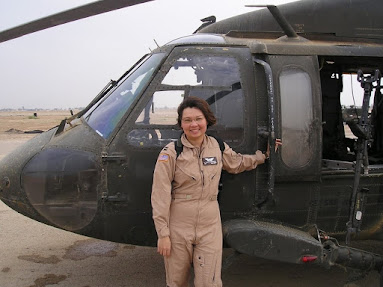
But the most harrowing experience, of course, was what happened on Nov. 12, 2004, when Duckworth’s Black Hawk was shot down in the Iraqi desert.


Both of her legs gone. Her arm badly mangled. Shrapnel in her face and body. Her fellow soldiers thought she was dead, but they refused to leave her body behind.


U.S. Army Warrior Ethos comes alive in the aftermath of the shootdown as Duckworth’s teammates extract her nearly lifeless torso and arrange for a medieval to Baghdad, where troops lined up to give blood. She needed 40 units of blood, plasma, and platelets.


Duckworth’s recovery at Walter Reed Army Medical Center is told in painful detail –– how she bore a “wall of pain,” learned to walk with two prosthetic legs, and came to terms with her new circumstances after the tragedy in Iraq, where she says, “There’s a piece of me there, both literally and figuratively.”

At Walter Reed she had to have parts of her body surgically removed and used to repair her mangled arm. She showed unimaginable grit and toughness, mixed with typical wounded warrior morbid humor and resolve.


Duckworth’s story is one of superior resilience. “I had no choice but to power through,” she writes. “It made no sense to lie around and feel sorry for myself. I had to accept my situation, then start working to change it.”


Found Haiku in “Every Day Is a Gift”:


When the obstacle

is effort, then there is no

obstacle (at all)


Something bad happens

you can either let it own

you, or you own it


(And) no matter how

grievous the wound, healing is

always possible


I found this book at Barnes & Noble bookstore on Memorial Day. It is a perfect companion book to one recently featured in Navy Reads: James Patterson’s “Walk in my Combat Boots.”


In fact, Duckworth’s missing combat boot is symbolically returned to her by fellow soldiers in a pivotal part of her story.

During her recovery and after meeting Illinois Senators Dick Durbin and Barack Obama, Duckworth resolved to enter politics. 

She was influenced personally by wounded warrior public servants Senators Bob Dole and Max Cleland, who helped her confront post-traumatic stress disorder.

“Senator Max Cleland, who lost his legs and an arm in Vietnam, sought treatment for PTSD three decades after his injury, when he lost an election in 2002. I met Max while at Walter Reed, and talking to him helped me to truly understand that the best we can do is take life one day at a time.

In the summer of 2005, when I realized I would never fly for the Army again, that advice from Max helped save me. I was no longer sure what my purpose in life would be, but I had to just take it one day at a time, and be open to whatever came my way.”

Obama, Akaka, and Duckworth
She fought for reforms at Walter Reed and the Veterans Administration, first in Illinois and then in President Barack Obama’s administration. She fought to make a national difference, first as a representative in the U.S. Congress and then as a senator. And she fought to become a parent.

Lt. Col. Duckworth’s struggle to become a mother and her realization that there is no such thing as “work-life balance” can be an inspiration to women and a revelation to men.


In Congress Duckworth was helped by Senators Kristen Gillibrand and Amy Klobuchar, among others. The late Senator Daniel K. Akaka honored her by bestowing Hawaiian names for her two daughters.


Her choice to enter politics so she could help people is not surprising.


Early in her life she saw first-hand the need for a social safety net and equal opportunity for people of color. Fifty-four years ago, in June 1967, the Supreme Court ruled in Loving v. Virginia that interracial couples, like Duckworth’s parents, could marry.


Her father’s hero was President Ronald Reagan. In the aftermath of the Vietnam War, Reagan signed the AmerAsian Immigration Act that allowed many Southeast Asian “half-children” into the United States. Of course, they were not “halfs.”

In “Every Day Is a Gift” Senator Tammy Duckworth, who lost nearly half her body in combat, shows that every person can be part of a greater whole. She lives the teamwork ethos –– no one left behind.


This is a marvelous and powerful book filled with tears, smiles, revelations, and inspiration. Like “Walk in My Combat Boots,” this book comes with an endorsement from Adm. William H. McRaven (U.S. Navy, Ret.): 


“Raw, unfiltered, powerful –– a compelling story of courage and determination against overwhelming odds. Tammy Duckworth is a true warrior who overcame a difficult upbringing, a glass ceiling, and a horrific helicopter shootdown to become one of the most respected senators on Capitol Hill. Nothing can stop her.”

Wednesday, February 12, 2020

A Groundbreaking 'Double Victory' – NMAAHC

Review by Bill Doughty

U.S. Navy Capt. Brian O. Walden, right, directs the U.S. Navy Ceremonial Band as they play "Hail to the Chief" during the groundbreaking ceremony for the Smithsonian NMAAHC in Washington, D.C., Feb. 22, 2012. (Photo by Chief Musician's Mate Stephen Hassay)
The U.S. Navy Ceremonial Band played "Hail to the Chief" as President Barack Obama and first lady Michelle Obama arrive on stage for the historic groundbreaking ceremony for the Smithsonian National Museum of African American History and Culture during Black History Month, Feb. 22, 2012.

Among the museum's exhibitions, collections, photos and other treasures are tributes to – among others – Medal of Honor recipients, the Tuskegee Airmen, Mess Attendant Doris "Dorie" Miller, and the overall "African American Military Experience."

Visitors view an exhibit about the legacy of Mess Attendant Doris “Dorie” Miller at the Smithsonian NMAAHC, Nov. 1, 2016. Adm. Nimitz presented Miller with the Navy Cross for his extraordinary courage during the Dec. 7, 1941 Japanese attack on Pearl Harbor. (U.S. Navy photo by Arif Patani)
The museum's "Official Guide" (Smithsonian Institution, 2017) shows various galleries and collections – floor-by-floor – and provides context within a history of overcoming slavery and the struggle to achieve civil rights and equality. "The United States was created in this context, forged by slavery as well as a radical new concept, freedom."

The museum represents the triumph of that concept promised in the Declaration of Independence and guaranteed in the Constitution – a democratic republic under the rule of law, not under a dictator or monarch. E pluribus unum: out of many, one.

First envisioned in 1915 after World War I, the creation of the museum was a nearly century-long struggle with lots of fits and starts. Congress finally authorized legislation in 2001, signed by President George W. Bush, to create a presidential commission that came back with a strong recommendation backed by Representatives John Lewis and J.C.Watts as well as Senators Sam Brownback and Max Cleland leading to enactment of a public law to bring the museum to life.

The guidebook takes visitors floor by floor to expansive open areas of discovery, art and education.

On the third floor of the museum, "Double Victory: The African American Military Experience" starts with the American Revolution and the War of 1812, into the Civil War and other conflicts, and through both world wars and the Cold War. Wartime military service has proven to be a catalyst for progressive social change throughout U.S. history.
"During the Revolutionary War, thousands of African Americans served as soldiers in the American colonial armies, including Jack Little, whose 1782 pay certificate for his service in the 4th Connecticut is on display here ... The War of 1812, sometimes referred to as the Second War of Independence, opened the ranks of the U.S. Navy to skilled African American seamen ... The Civil War was one of the most pivotal events in American history, and the Union victory that established the possibility of freedom for all depended on the service and sacrifice of tens of thousands of black soldiers, many formerly enslaved."
Museum artifacts include those of the "Buffalo Soldiers," Harlem Hellfighters of WWI, Tuskegee Airmen of WWII, U.S. Marine drill instructor Sgt. Maj. Edgar P. Huff of the Korean War, Air Force General Lloyd "Fig" Newton of the Vietnam War, as well as Vietnam Veteran Maj. Gen. Charles F. Bolden, a Marine Corps aviator who became an astronaut and the first black administrator of NASA.

Portrait photo of retired U.S. Marine Corps Maj Gen Charles Frank Bolden Jr. hours before his induction into the National Aviation Hall of Fame in Ft. Worth, Texas, Oct. 27, 2017. Bolden was nominated by President Barack Obama and confirmed by the U.S. Senate as the 12th Administrator of the National Aeronautics and Space Administration in 2009 to advance the missions and goals of the U.S. space program. (U.S. Marine Corps photo by Sgt. Cristian Bestul)

Other modern leaders of note featured in the "Double Victory" displays include Gen. Colin Powell, Gen. Hazel Johnson-Brown, and Adm. Michelle Howard.

The official guide is a good read prior to a visit to the museum, and is an invaluable companion for a self-guided tour. With cutaway floor maps and clear color-coded guides, this book offers behind-the-scenes stories about the exhibitions and collections. Of course there's also a downloadable mobile app for Apple IOS and Android to navigate the museum. Visitors can go to the Rosa Parks display, Martin Luther King Jr. tribute, Michael Jordan section, or George Clinton's actual P-Funk Mothership.

A highlight is the exhibition of artifacts recovered by maritime and archeology teams from the Slave Wrecks Project, including from the wreck of Portugese slave ship São José-Paquete de Africa, which sank in a storm off the coast of Cape Town, South Africa Dec. 27, 1794.

The recovery of artifacts from the wreck and collaboration with international teams features prominently in the biography of the NMAAHC founding director Lonnie Bunch III, "A Fool's Errand: Creating the National Museum of African American History and Culture in the Age of Bush, Obama, and Trump" (Smithsonian Books, 2019).

Bunch describes the trials and tribulations of creating the museum and speaks most poignantly of retrieving artifacts related to the São José project in a visit to Africa:
"Finding relics from the São José was the goal of my journey, but I discovered so much more about Mozambique, about slavery in South Africa, about maritime archeology, and about myself. I knew that relics from the ship such as wood from the hold that we would eventually display was not an inanimate object, but a touchstone to give meaning and humanity to the subject of slavery. It would serve as a totem that would prod Americans to replace the silences that we find so comforting with conversations, though difficult, that could lead to reconciliation and healing."
In his description of the groundbreaking ceremony in 2012, Bunch notes, "The United States Navy Band ... delighted the audience and provided a wonderful musical counterbalance to the array of speakers that included senior Smithsonian colleagues, [former first lady] Laura Bush, then Governor of Kansas Sam Brownback, Reverend Calvin O. Butts III, and Congressman John Lewis."

He has an interesting encounter with President Trump during a tour of the museum which is insightful and worth reading.

Bunch concludes with pride about the museum's relevance globally. Yet, he conveys humility about what the museum can mean for all Americans.

"Museums alone cannot ease the tensions that come from the debates surrounding the fluidity of national identity in the twenty-first century," he writes. 
"... But museums can contribute to understanding by creating spaces where debates are spirited but reasoned. Where contemporary challenges are addressed through contextualization and education. Since its opening, NMAAHC has become a site where rational healing and reconciliation are possible."

Author, historian and educator Bunch became Secretary of the Smithsonian Institution, June 16, 2019. According to his published biography he oversees 19 museums, 21 libraries, the National Zoo, numerous research centers, and several education units and centers.

Visitors tour exhibits at the Smithsonian NMAACH focusing on the African American military experience. (U.S. Navy Photo by Arif Patani)

Sunday, February 14, 2021

McCarthyism/Trumpism III: Endless ‘Anxiety’

Review by Bill Doughty

In this third book review (in a Navy Reads trilogy) about Senator Joe McCarthy and his legacy, author Haynes Johnson provides more unintended parallels and links to Trumpism in “The Age of Anxiety: McCarthyism to Terrorism” (Harcourt, 2005).

Anxiety at the time this book was written came from the smoldering memories of 9/11 and fear of ongoing terrorism as the American military waged war in Afghanistan and in Iraq. Haynes makes a connection from 9/11 to the anxiety of communism in the 50s –– which would lead to the Vietnam War debacle.


Today, there are still fears of socialism and communism, as well as anxiety about fascism in the aftermath of a failed insurrection Jan. 6 at the Capitol by Trump supporters.


Presciently, Haynes writes this more than fifteen years ago: “The age of anxiety has not ended, nor is it likely to end soon.”


Here are some more parallels and links, including page numbers in the first edition version of this insightful book:


Like Trump, McCarthy tried to paint his opponents, including democrats, as unpatriotic, irreligious and unAmerican. Both Trump and McCarthy warned of “godless communism” in their speeches calling for their version of patriotism. (p.314)


After an earlier hearing in the Senate in the wake of the Tydings report (somewhat comparable to Trump’s first impeachment hearing) “McCarthy was rebuked, but not rejected. From then until the November elections, he became the Republican Party’s most tireless, sought-after, and effective campaigner.” (p. 188)


“The Democrats remained clueless. They believed that McCarthy’s falsehoods were so transparent and outrageous that they would emerge victorious from any encounter with him.” “McCarthy had poked the tigers of the Senate and showed them to be toothless.” (p.159)


McCarthy sued opponents, including a $2M libel suit against Sen. William Benton, admittedly for intimidation purposes and to “force him to spend money to defend himself.” (p.221)

Eisenhower makes a point with McCarthy
President Eisenhower, who is considered a moderate –– or even liberal –– Republican, worked behind the scenes to fight McCarthy. He “was becoming so frustrated with the obstructionism of McCarthy and other ultraconservatives, [he] … was considering the formation of a new party bringing together all the sensible people in the great middle of American life.” (p.260)

Haynes writes, “Over the decades, a more rigidly ideological Republican Party has emerged, forged by many of the forces McCarthy unleashed or harnessed.” (p.461) 


Navy readers will find a fascinating parallel between the swift-boating of John Kerry  and the smear of another Vietnam veteran Max Cleland, both former Senators who had been awarded multiple Purple Heart medals. (p.498)


In Kerry’s case, in which wealthy Texas Republicans funded TV ads with false claims that Kerry falsely received his combat medals, including the Silver Star. “Constant repetition over cable outlets had an echo chamber effect the greatly magnified the ads’ false charges.” (p.499)


Here’s some irony: McCarthy lied about his service in the Marine Corps, and he falsified records after the war to get Distinguished Flying Cross and Air Medal commendations. “The deceit was breathtaking,” Haynes writes. A later investigation revealed McCarthy had apparently drafted his own letter praising his war record and forged the signature of his CO, Maj. Glenn A. Todd. McCarthy then forwarded the letter to be countersigned by Admiral Chester Nimitz, commander of the U.S. Pacific Fleet, as a matter of routine. (p. 53)


The McCarthy “hearings were a landmark in American History. They were consequential, and they stamped indelible images in the public mind.” (p.388) So was the second impeachment of Donald J. Trump, which included indelible images of bloodthirsty Trump supporters attempting to overturn an election and transfer of power. Rioters were summoned to D.C., incited to fight, directed toward the Capitol, and allowed to attack police and the Capitol itself for hours.


Are McCarthyism and Trumpism names for the same phenomenon, describing ultranationalism, patriarchy, racism, and misguided patriotism? Examples in American history abound: slavery, actual witch hunts, Alien and Sedition Acts, loyalty tests, disallowing women the right to vote, civil rights violations, and family child separations, and others.

Haynes reports about the first Great Red Scare just over 100 years ago as World War 1 was about to end and Lenin and Trotsky came to power in the Russian Revolution. Bombings and riots shook the United States. In 1919, in the middle of the Great Influenza Pandemic, soldiers and sailors stormed the office of a Cleveland socialist newspaper. In Chicago, a sailor shot a man for not standing and removing his hat for the Star Spangled Banner. (p.102)


SECDEF Lloyd J. Austin III
A century later: A remarkable number (reports say 12 percent or more) of insurrectionists and rioters who stormed the Capitol last month had served in the military. New Secretary of Defense Lloyd J. Austin III ordered a 60-day stand-down to confront extremism.

Endless vigilance against violence is required of those who take an oath to protect and defend the Constitution against all enemies, foreign and domestic. As Edward R. Murrow said, “We cannot defend freedom abroad by deserting it at home.”


Haynes gives an excellent presentation of the Army hearings in which the Army's lead defense attorney Joseph Welch confronted and ended McCarthy’s reign of terror with the immortal rebuke: “… You have done enough. Have you no sense of decency at long last ? Have you left no sense of decency?”


Haynes concludes, “McCarthyism remains a story without an ending.” “Extremism –– and the suspicion and hatred it engenders –– may be Joe McCarthy’s most lasting legacy.”


A Presidents Day Postscript:


Haynes writes, “As a way of indicating his own model for statesmanship, McCarthy posted on the wall of his Senate office a copy of Lincoln’s famous remark: ‘If the end brings me out all right, what is said against me won’t amount to anything. If the end brings me out wrong, ten angels swearing I was right would make no difference.’” (p.79)


Conservative anti-communists prevented the performance of “Lincoln Portrait” at Eisenhower’s inauguration, because the composer, Aaron Copland, was loosely associated with “radical causes,” although he did not belong to the Communist Party. “Portrait” includes Lincoln’s memorable and still relevant words, “Fellow citizens, we cannot escape history. We of this Congress and this Administration will be remembered in spite of ourselves.” (p.300)


Democratic presidential candidate in 1952, Adlai Stevenson, echoed Lincoln in a speech about the Republican Party divide over McCarthyism: “A political party divided against itself, half McCarthy and half Eisenhower, cannot produce national unity.” (p.375)


Just a reminder: Navy Reads is an unofficial blog of book reviews and personal views on critical thinking, core values, Constitutional issues, and political-military-diplomatic philosophy.


WASHINGTON (April 15, 2015) -- Aviation Maintenance Administrationman Airman Apprentice Zaine Ahringhoff, assigned to the Nimitz-class aircraft carrier USS Abraham Lincoln (CVN 72), admires the Lincoln Monument during a trip to Washington, D.C. to commemorate the 150th anniversary of President Abraham Lincoln's assassination, April 15.  (MC3 Brenton Poyser)