Showing posts with label Honor. Show all posts

Thursday, November 17, 2022

‘Zookeeper’s Wife’ and Shipwrecked Souls

Review by Bill Doughty––

In a village a circus lion suddenly died…

“The circus director asked a poor old Jewish man if he would pretend to be the lion, and the man agreed since he needed the money. The director said: ‘All you have to do is wear the lion’s fur and sit in the cage, and people will believe you’re a lion.’ And so the man did, muttering to himself, ‘What strange jobs I’ve had in my life,’ when his thoughts were interrupted by a noise. He turned just in time to see another lion creeping into his cage and fixing him with a hungry stare. Trembling, cowering, not knowing how to behave himself, the man did the only thing he could think of –– vociferously chant a Hebrew prayer. No sooner had he uttered the first desperate words, Shema Yisroel (Hear O Israel) … than the other lion lined in with adonai elohenu (The Lord our God), and the two would-be lions finished the prayer together.”

Zookeeper Jan Żabiński and real lion.
It’s an old folk story that Diane Ackerman heard as a young girl and shares in an introductory Author’s Note. And it’s a tale that became “oddly relevant” to the true story she tells in her amazing book, where art and storytelling come alive to become history.

“The Zookeeper’s Wife: A War Story” (W. W. Norton,  2007) is based on a true story in which brave people in Poland risked everything to help protect Polish Jews in World War II from the Nazis and the Holocaust. Like the lion-man in the folk story, “shipwrecked souls” eventually make their way to a zoo outside Warsaw for sanctuary.


And regarding relevance: Though the book was written in 2007 –– one year before Russia's Vladimir Putin invaded Georgia, seven years before he invaded Crimea, and 15 years before he began waging war in Ukraine –– readers in 2022 will likely think of Poland's role in Putin's current war in Ukraine as they read about what happened in Warsaw eight decades ago.


At first Ackerman lulls readers with her depiction of an idyllic human-animal bond, one of understanding, love, and respect for life. Innocence. Nature. Nurture. Peace. The pursuit of happiness in pre-war Warsaw. Ackerman beautifully depicts that world before the storm clouds of war start to destroy the way of life of the Żabiński family.


Antonina and family pet badger
Antonina Żabiński is the Zookeeper’s wife and a hero of this tale along with her husband, Jan, who served secretly with the Polish Underground to fight the Nazis. Ackerman dedicated the book “For Antonina and her family, human and animal.” The Żabiński matriarch helps manage the improbable zoo as well as schemes to hide and feed Jews they call “Guests.”

With the arrival of the Nazis, the sometimes-normal-occasional-calm of the zoo is shattered. Fascism brings iron-fisted and racist “law and order.” The Nazis build walls and deny freedom based on differences of religion and ethnicity. Casual cruelty leads inexorably to calculated genocide.


Ackerman depicts the banal evil of Adolf Hitler, Heinrich Himmler, Hermann Goring, Eugene Fischer, and others who valued the lives of other animals over the humans they condemned to camps, ovens, and mass graves.


Ackerman writes in a “narrative history” style. Her embellishments are sometimes well beyond David McCullough’s interpretive style. Yet, like McCullough, she imparts cold hard history. In "The Zookeeper's Wife" she builds her storytelling around actual facts published or contained in interviews, news stories, and diaries, including the diary of Antonina.


“‘How can this barbarity be happening in the twentieth century?!!!!!!’ Antonina asked herself, an outcry of disbelief with no fewer than six exclamation points.” Antonina saw the war as a return to the Dark Ages. She and her family counter their horrors with efforts to help those who were targeted by the Nazis for destruction. Along with housing and feeding castaways, the Żabińskis participated in a plot to feed Jewish residents in the Ghetto.


The Warsaw zoo helped make animal-human connections in 1938, before the arrival of the Nazis.

After most of the animals in their zoo were removed, released, or killed by the Nazis, the Żabińskis turned their enterprise into a pig farm. They secretly transported meat into the Ghetto. “If it felt a little off-color giving Jews pork, a taboo food, dietary laws had long since been waived, and everyone was grateful for protein, a scarce gift on either side of the wall,” Ackerman observes.


Such humanism and such audacity –– helping targeted victims of the Nazis –– was extremely risky.

“Unlike other occupied countries, where hiding Jews could land you in prison, in Poland harboring a Jew was punishable by immediate death to the rescuer and also to the rescuer’s family and neighbors, in a death-frenzy deemed ‘collective responsibility.’ Nonetheless, many hospital workers disguised adult Jews as nurses, drugged small children to quiet them before smuggling them out in knapsacks, and planted people in funeral carts under a heap of corpses. Many Christian Poles hid Jewish friends for the whole length of the war, even though it meant reduced rations and relentless vigilance and ingenuity. Any extra food entering the house, unfamiliar silhouettes, or whispers seeping from a cellar or closet might inspire a visiting neighbor to notify the police or tip off the city’s underbelly of blackmailers. The wayfarers often spent years in the dark, barely able to move, and when they finally emerged, unfolding their limbs, their weak muscles failed and they needed to be carried like a ventriloquist’s dummies.”
Diane Ackerman
Ackerman, author of “The Whale by Moonlight,” “Natural History of the Senses,” and “Dawn Light,” writes with heartbreaking brilliance of “The unbearable weight of Ghetto life.” Not surprisingly, her words include these metaphors of nature and the sea.

“During this time of seismic upheaval, more and more Ghetto dwellers washed up on the deck of the villa, arriving weatherbeaten, ‘like shipwrecked souls,’ Antonina wrote in her diary. ‘We felt that our house wasn’t a light, flimsy boat dancing on high waves, but a Captain Nemo’s submarine gliding through deep ocean on its journey to a safe port.’ Meanwhile, the war storm blew violently, scaring all, and ‘casting a shadow on the lives of our Guests, who fled from the entrance of crematoriums and the thresholds of gas chambers,’ needing more than refuge. ‘They desperately needed hope that a safe haven even existed, that the war’s horrors would one day end,’ while they drifted along in the strange villa even its owners referred to as an ark.”

Navy readers and their families who choose to read this book will identify with the core values of the Żabiński family: honor, courage, and commitment.


There is a familiar ethos in the character of the men, women, and children who participated in rescuing victims of the Nazis. Ackerman writes:

“Rescuers tended to be decisive, fast-thinking, risk-taking, independent, adventurous, openhearted, rebellious, and usually flexible –– able to switch plans, abandon habits, or change ingrained routines at a moment’s notice. They tended to be nonconformists, and though many rescuers held solemn principles worth dying for, they didn’t regard themselves as heroic. Typically, one would say, as Jan did: ‘I only did my duty –– if you can save somebody’s life, it’s your duty to try.’ Or: ‘We did it because it was the right thing to do.'"

Antonina had to deal with Nazis who invaded her home and threatened her; then she had to confront Russians who came to liberate Poland but tried to take what wasn’t theirs. Her inner strength, voice, and instincts proved to be all too powerful.


This is another treasured find I discovered in a used book store. It is also a book that gives a hopeful view of the human spirit, strength in resilience, and the power of righteousness in time of war.

Ackerman and W. W. Norton include comprehensive “details,” a bibliography, and index. The paperback version I scored comes with a “reading group guide” and list of other books with similar group guides. Blurbs are from an impressive list of reviewers, with standouts for me by Dava Sobel (“Longitude”), Jared Diamond (“Guns, Germs, and Steel”), and Donna Seaman of Los Angeles Times.


The Żabińskis in Warsaw, Poland, saved 300 Jews.


As of the autumn of 2022, Poland has accepted at least 1.4 million refugees who fled Ukraine due to Putin’s war and campaign of terrorism against civilians. This week, during a Russian missile onslaught against Ukraine, a Ukrainian defensive missile exploded on a grain farm in the rural village of Przewodow, five miles within Poland's border, killing two people. NATO nations, including the United States, met to consider additional options to deal with Russia’s continued aggression.

Thursday, May 26, 2022

Enough: Justice takes on Gun Safety


By Bill Doughty––

What did a former Supreme Court justice –– a Navy veteran of World War II –– have to say about gun safety regulations and mass shootings? In “The Making of a Justice,” published in 2019, just before he died at age 99, Justice John Paul Stevens noted that “Throughout most of our history there was no federal objection to laws regulating the civilian use of firearms.”


Ens. Stevens, circa 1942-1945.
Stevens was not a stranger to guns. He served in the Navy and as an ensign was stationed in Washington D.C. (on Constitution Avenue), where he carried a .45 caliber handgun and guarded intelligence traffic in the aftermath of Imperial Japan's attack on Pearl Harbor, Oahu, Dec. 7. He was later stationed in Pearl Harbor, near Adm. Nimitz's Makalapa headquarters, and he was serving as an intelligence officer during the Battle of Midway and when Adm. Yamamoto was killed. Navy Reads reviewed Stevens's memoir three years ago: “Justice: Battle of Midway and the Constitution.”

After the Navy, Justice Stevens served in various positions in the private sector and in government service. President Gerald Ford, another World War II Navy veteran, nominated Stevens to the Supreme Court when Justice William O. Douglas stepped down in November, 1975.


Stevens said that when he joined the Court, “both state and federal judges accepted the Court’s unanimous decision in United States v. Miller as having established that the Second Amendment’s protection of the right to bear arms was possessed only by members of the militia and applied only to weapons used by the militia.” In the Miller case, the Court upheld an indictment restricting a man from owning a short-barreled shotgun.


The common sense of Miller, was replaced with a Supreme Court decision in District of Columbia v. Heller in 2007.


Heller opened the floodgates for the proliferation of firearms, including weapons of war with large-capacity magazines. These weapons can be sold to people in many states with few or no background checks or other regulations.


“Heller is unquestionably the most clearly incorrect decision that the Court announced during my tenure on the bench,” Stevens wrote. “The text of the Second Amendment unambiguously explains its purpose: ‘A well regulated Militia being necessary to the security of a free State, the right of the people to keep and bear Arms, shall not be infringed.’”

Stevens examined original context and founders’ intent, including Madison’s draft, as well as an established history of some gun control in the United States.


After presenting colleague Justice Breyer’s dissent in Heller –– in which Breyer discusses early colonial history of firearms regulations in the three largest cities at the time: Boston, Philadelphia, and New York –– Stevens expounded on the history of gun safety laws in the past hundred years.

“For most of our history, the invalidity of Second Amendment-based objections to firearms regulations had been well settled and uncontroversial. The first two federal laws directly restricting the civilian use and possession of firearms –– the 1927 act prohibiting mail delivery of handguns and the 1934 act prohibiting the possession of sawed-iff shotguns and machine guns –– were enacted over minor Second Amendment objections that were dismissed by the vast majority of legislators participating in the debates. After reviewing many of the same sources that are discussed at greater length by [Justice] Nino Scalia in his majority opinion in Heller, the Miller Court unanimously concluded that the Second Amendment did not apply to the possession of a firearm that did not have ‘some relationship to the preservation or efficiency a well regulated militia.’ ‘ So well settled was the issue that, speaking on the PBS NewsHour in 1991, the retired Chief Justice Warren Burger described the National Rifle Association’s lobbying in support of an interpretation of the Second Amendment as a limitation regulation of the civilian uses of firearms in these terms: ‘One of the greatest pieces of fraud, I repeat the word ‘fraud,’ on the American public by special interest groups that I have ever seen in my lifetime.’”

Stevens SCOTUS portrait, 2006
Stevens called for an amendment to the Constitution to overrule Heller “to prevent tragedies such as the massacre of twenty grammar schoolchildren at Sandy Hook Elementary School on December 14, 2012, from ever happening again." Stevens added, "Yet, in the course of writing this chapter, on October 1, 2017, a gunman fired from the thirty-second floor of a hotel in Las Vegas, killing at least fifty-eight people and injuring over five hundred more who were attending an outdoor concert.”

In “Making” Stevens recounted the NRA’s seeming concession in the wake of the Las Vegas massacre, agreeing to a prohibition of bump stocks, which allowed shooters to convert semi-automatic rifles into machine guns.


However, the NRA’s Institute for Legislative Action denied their support for a prohibition of bump stocks: “Some have used our October 2017 statement to claim that NRA supports ATF’s final rule, but as NRA-ILA’s Executive Director Chris Cox noted only days after our statement was issued, “‘We don’t believe that bans have ever worked on anything.’” Against any “bans … on anything,” the NRA, like many gun manufacturers and some politicians, wants more guns in people’s hands, including in schools.


But In the United States there are already 120 guns for every 100 citizens, more guns than automobiles. And, New England Journal of Medicine notes that the leading cause of death of American children is no longer car accidents –– it is death by firearms.

While seatbelts, airbags, carseats, and many other features and regulations save countless children’s lives, some politicians won’t pass laws to restrict weapons of war, huge magazines, or the proliferation of handguns. Some don’t want background checks,“red flag” laws, age restrictions until 21, storage requirement laws, or similar common sense safety protections.


Stevens lamented the lack of progress in making schools, concerts, churches, and even guns themselves safer, especially semiautomatic military-style weapons, such as those used in Las Vegas (and last week in Buffalo, NY, and this week in Uvalde, TX). In “Making” he wrote:

“Devices that make such deadly weapons even deadlier should be banned. But prohibiting bump stocks alone will do little to curtail the scourge of gun violence plaguing this country. (Indeed, I could not even finish writing this chapter before another mass shooting occurred, this one involving the the death of twenty-six people –– including three generations of a single family –– at a church on November 5, 2017.)”

Stevens saw the Heller case’s negative consequences arising from what he considered “a radical change in the law that would greatly tie the hands of state and national lawmakers endeavoring to find solutions to the gun problem in America."


He said it was a twin failure: first, the misreading of the Second Amendment and, second, the failure to respect settled precedent (stare decisis) in Miller, relaxing in “the worst self-inflicted wound in the Court’s history.”

The Supreme Court’s handling of the right to an abortion is another contentious issue that might be a significant self-inflicted wound.


But both explosive issues of gun safety and abortion can be framed in the right to “life, liberty, and the pursuit of happiness.”


Whose liberty and freedom takes precedent: The angry young man with an AR-15 or dozens of school children? The self-righteous individual or the family of a raped pregnant teenager? The self-serving politician or voters in a rules-based society?


With some similarity to the gun safety controversy, Stevens saw the issue of abortion as one framed in “liberty” rather than “privacy.” He looked at Roe v. Wade and related cases, including Griswold v. Connecticut (which protects the right of married couples to use contraceptives) beginning on page 149 of “The Making of a Justice.” Highly recommended reading.


By the way, here’s a relevant Found Haiku, from a twitter post this week by actor George Takei, Star Trek’s Mr. Sulu:


“Ban assault rifles,

not books. Regulate firearms,

not women’s bodies.”


“The Making of a Justice” continues to be a source of wisdom and historical context for some of the most controversial issues of our time.


Stevens closes his memoir by sharing a personal letter from 2014 on White House stationery from President Barack Obama, sending warm wishes for Stevens’s 94th birthday. Obama wrote: “With unwavering integrity, you have stood as an impartial guardian of the law and protected the principles enshrined in our founding documents. Your steadfast commitment to justice and your understanding of how the law affects the lives of ordinary Americans have set a proud example and built a legacy worthy of celebration.”

Pres.-elect Barack Obama and VP-elect Joe Biden with Justices during a visit to the U.S. Supreme Court, Jan. 14, 2009: Obama, Chief Justice John Roberts, John Paul Stevens, Ruth Bader Ginsburg, Clarence Thomas, David Souter, and Biden. (Pete Souza) 

Tuesday, May 17, 2022

‘American Buffalo’ by Steven Rinella

Review by Bill Doughty––

America’s most famous living hunter-conservationist is Steven Rinella. He is the brain and heart of the MeatEater Netflix show, podcast, and franchise. Rinella believes in respect for nature, conservation, and the environment. And he sees a deep connection between us and our food.


On one of his shows Rinella takes former Navy SEAL and Navy Reservist Cmdr. Rorke Denver, for a hunt in Alaska for black bear.* Denver is a fellow author who starred in “Act of Valor.” They eventually find a bear, and when he looks through the rifle’s scope at the bear now coming closer, Denver pauses to appreciate the beauty and power of the life he is about to take.


Rinella has a similar moment when he sights a buffalo, as described in gripping detail in “American Buffalo: In Search of a Lost Icon” (Spiegel & Grau, Doubleday, Random House; 2008).


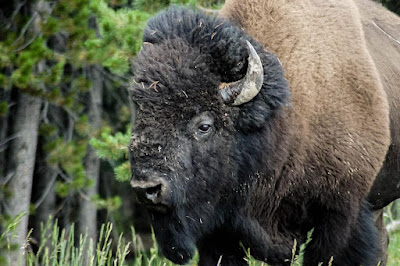
A North American buffalo.
Lucky to have won a lottery for a hunting permit for wild buffalo, Rinella is luckier still to be one of a few who actually finds and shoots one. His journey in Alaska, eluding bears and other predators, battling the elements, and navigating dangerous waterways, is compelling. So is his moment of truth as he prepares to shoot. His careful butchering of the animal is presented in precise detail. Though written fourteen years ago –– before Rinella became a world-renowned figure –– this book reveals the talents of a gifted writer and outdoorsman.

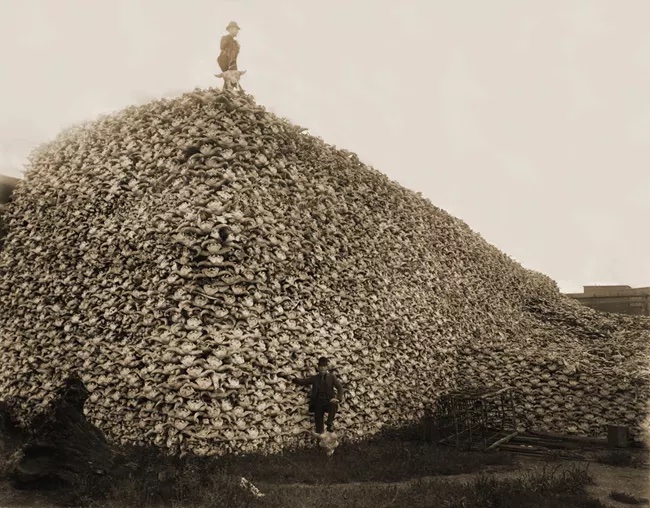
But what makes “American Buffalo” truly great and lasting is the author’s panoramic view of time and a philosophical connection to nature and life. He looks unblinkingly at the devastating destruction and near extinction of bison and other species in North America, lamenting the wanton greed and shortsightedness of people who killed only for profit and trophy. Rinella eats what he kills.


In this photo from 1892, men stand next to and atop a pile of American bison skulls waiting to be ground up for fertilizer.

Like other hunters, he sees the animal’s skull as a kind of connection to life’s mysteries.

“Buffalo skulls were put to various uses by Indians, most of a spiritual or metaphysical nature. The buffalo skull was an especially potent symbol to many Plains Indians tribes, but not because it equaled death. Rather, a skull represented a form of rebirth to many tribes. To reduce a buffalo to its skeleton was like ushering the animal back to a sort of primordial starting line, or beginning. The clean skull allowed for continuity, like a blank canvas upon which future buffalo could be created…

“I’m not a particularly religious person, though I do sense an inkling of the spiritual when I look at this buffalo skull. Many people have tried to explain to me what they feel when they look at a crucifix of Torah scroll; it’s an emotion often described as a mixture of gratitude, devotion, continuity, and awe. Looking at a buffalo skull is probably the closest I’ll ever come to experiencing those feelings, however faintly, and I’m glad to have a taste of that…”

Rinella describes how he embraces the privilege of being alive for the relatively short time we have.


Alaska's Copper River Valley
He searches for meaning and symbols. He calls the landscape he hunts in a "trophy."

And he questions the connection between his reverence for the animal he hunts and his commitment to killing and eating it.

“In a historical sense, I suppose that my confused and convoluted relationship to the buffalo is nothing new. For the entirety of man’s existence in North America, we’ve struggled with the meaning of this animal, with the ways in which its life is intertwined with our own. I think of the first hunters who walked through some long-ago gap between glaciers and stumbled onto a landscape populated with strange and massive creatures. The buffalo was just one of many then, a giant among a host of other giants, but over time these many animals were whittled away by the forces of man and nature. Eventually the buffalo stood alone, like the winning contestant in a game show.

“The prize was humanity’s never-ending attention, which was ultimately a bittersweet award. For thousands of years, the first people of North America fed on the buffalo’s meat and wore the buffalo’s skin, and then made a deity of the animal as a way of reconciling their need to slaughter the thing that granted them life. My own European ancestors came to the New World and scoffed at the heathen nature of the Indians’ ideas, then stood by as the buffalo nearly vanished from the earth beneath their notion that the animal was an expendable gift of their own God, a commodity meant to get them started before stepping aside and letting ‘civilization’ bloom in the wilderness.”

Throughout this book, Rinella blends spirituality with superstition, history with mystery, and his own life’s experiences within the context of our shared science and reality.


“American Buffalo” opens with an extended soliloquy about Neil Young and his early band Buffalo Springfield.

In a fun and mind-bending “association game,” he links “For What It’s Worth," a song against the Vietnam War ; Dances with Wolves, filmed in Canada; Hernando Cortéz of Spain; Crazy Horse of the Oglala Sioux; Springfield rifles; the Civil War; Black Diamond, the buffalo on the American nickel coin; President Theodore Roosevelt, hunter and conservationist; and the city of Buffalo, New York.

"Buffalo," is the name of cities in eighteen states. But, Rinella notes, no wild buffalo lived near Buffalo, New York.


On Saturday, Buffalo was the site of another race-based mass shooting by a white supremacist with an AR-15 "assault-style" rifle. Today, President Biden and First Lady Jill Biden visited Buffalo. Biden, a lifelong supporter of the Second Amendment, has asked Congress to pass legislation to require new background checks for gun buyers, and ban military-style "weapons of war" and large-capacity ammunition magazines.


Steven Rinella
Rinella does not hunt with AR-15s. He uses bolt-action rifles, pump shotguns, and bows and arrows for hunting. Rinella is an ethical hunter who calls himself “an evironmentalist with a gun.”

He became interested in environmental issues, according to a profile earlier this year in The New York Times by Malia Wollan, when one of his big brothers gave him a paperback of Aldo Leopold’s “A Sand County Almanac.”According to Wollan, “Most people read Leopold as belonging to the pantheon of American environmental writers, with the likes of Henry David Thoreau, Rachel Carson and John Muir. Rinella reads Leopold as a fellow hunter.” (Marjory Stoneman Douglas is another great environmentalist in that pantheon.)


On his latest podcast, Rinella discusses hunting, fishing, and books. He talks to Cameron Hanes about Hanes’s new book, “Endure: How to Work Hard, Outlast, and Keep Hammering,” with a foreword by Joe Rogan and afterword by David Goggins. Hanes says, “If you wish you could run farther and shoot straighter, this book is for you.”


Rinella, himself, is the author of a half-dozen books, with more planned for release in coming months and years, including books for children, outdoor cooking, and an “atlas for the outdoors.”


Steven Rinella, the “environmentalist with a gun,” is also a philosopher with a pen and a voice.

Some people, especially vegans and those who prefer not to think about where their super market food comes from, will be turned off by the whole MeatEater oeuvre. But that’s the beauty of American freedom, diversity, and the right to choose.


In the MeatEater episode with former Navy SEAL Rorke Denver, after Denver bags his bear, and just before he and Rinella skin and butcher it, Rinella expresses his appreciation for the service and sacrifice of Denver and other veterans who serve in the nation’s defense.


In “American Buffalo: In Search of a Lost Icon” readers can discover an ethos of honor, courage, and commitment.


*(Top photo: Denver and Rinella trek their bear meat and fur out of the Alaskan wilderness in a scene from MeatEater, YouTube.)

Friday, November 19, 2021

Eddie Gallagher & Alpha ‘Loyalty’

Review by Bill Doughty––

David Philipps gives a passionate and compassionate profile of a case that hit the U.S. Navy like a “missile” –– that of former U.S. Navy SEAL Chief Petty Officer Eddie Gallagher, accused of war crimes after his deployment with the Alpha platoon of SEAL Team 7 in “ALPHA: Eddie Gallagher and the War for the Soul of the Navy SEALS” (Penguin Random House, 2021).


This is a book about accountability and justice. And karma.


SEALs in Alpha Platoon, wearing their tridents and under the logo of the “Bad Karma Chick,” saw their role as the embodiment of bad karma: “Alpha was there to make sure that bad things happened to bad people.”

“ALPHA” reads less like a book about war and more like a Shakespearean tragedy of an elite American warfighter who chose a noble journey but somehow took a wrong path. Eddie Gallagher began his career as a Hospital Corpsman and tried in vain to become a SEAL until the Afghanistan and Iraq wars opened a sudden need for more of the Navy’s special operations warfare specialists and Gallagher was accepted. He deployed seven times overseas in the so-called war on terror.


Philipps describes the warfighter after seventeen years of service this way:

“Eddie looked like a Navy SEAL poster boy. He had close-cropped blond hair, glacier-like blue eyes, a strong, square jaw, the shoulders of a lion, and a lion’s killer instinct. He was fast, agile, strong, and a dead shot. But a closer look revealed a face deeply lined from years in the desert sun. After so many deployments, the mileage was starting to show. He was thirty-nine years old. In the military, where the average age is twenty-seven, he was closing in on obsolescence. His back hurt. His neck hurt. His shoulders hurt. He had ringing in his ears from too many gunfights. Sometimes he had trouble remembering  things. Not that he regretted any of it. For all the talk about post-traumatic stress disorder and the unfair burden the nation had put on its warfighters, Eddie never once saw combat as a hardship. He had chosen it. He was good at it. He thrived on it. Truth be told, it was cool as hell. He loved the heart-pounding exhilaration of gunfights. He loved the simple intensity of war. Sometimes he felt it was the only thing that made sense. If there were bad guys out there looking to take on the United States and become martyrs, he was happy to punch their ticket.”

But –– “Beneath that SEAL veneer was a history of disappointments and screw-ups that had dogged him for much of his life,” Philipps writes later in “ALPHA.”


This book reveals a tectonic struggle: rule-of-law ethos exemplified by Adm.(Ret.) William McRaven versus a no-rules “pirate” death-cult personified by former Vietnam-era SEAL Cmdr.(Ret.) Richard “Demo Dick” Marcinko –– and Gallagher.

One side prefers to be quiet, humble, and righteous in their work. The other side is all bravado, might-makes-right, and anything goes, including killing unarmed civilians and prisoners when necessary.


One side meant it when they took their oath to support and defend the Constitution; they are loyal to each other and to the mission. The other side abuses power and demands loyalty in a cult of personality, often putting the mission and team in unnecessary danger.


One side has to work silently within the constraints of the Uniformed Code of Military Justice, committed to truth and justice. The other side uses TV, radio, and social media to bend information, threaten opponents, and smear the Navy chain of command.


One side lives by the SEAL Ethos. The other does not.

“…My loyalty to Country and Team is beyond reproach. I humbly serve as a guardian to my fellow Americans always ready to defend those who are unable to defend themselves. I do not advertise the nature of my work, nor seek recognition for my actions. I voluntarily accept the inherent hazards of my profession, placing the welfare and security of others before my own. 

“I serve with honor on and off the battlefield. The ability to control my emotions and my actions, regardless of circumstance, sets me apart from others. Uncompromising integrity is my standard. My character and honor are steadfast. My word is my bond…”

Gallagher stood trial for allegedly murdering a defenseless Iraqi teenager aligned with ISIS by stabbing him with a knife. Gallagher was turned in by a number of his SEAL teammates, who also claimed to have witnessed him shooting indiscriminately into civilian areas as well as deliberately shooting an unarmed girl and an old man.


Philipps provides damning information about Gallagher’s character, including allegations of stealing from the Navy as well as fellow SEALs, illegal habitual drug use, false claims for a Purple Heart and other medals, lying and putting SEALs in harms way for personal gain, and threatening murder in an attempt to cover up his crimes.


The truth emerges thanks to information from key members of the Alpha Team as well as evidence gathered by NCIS and New York Times, where Philipps is a Pulitzer Prize winning national correspondent.


“ALPHA”
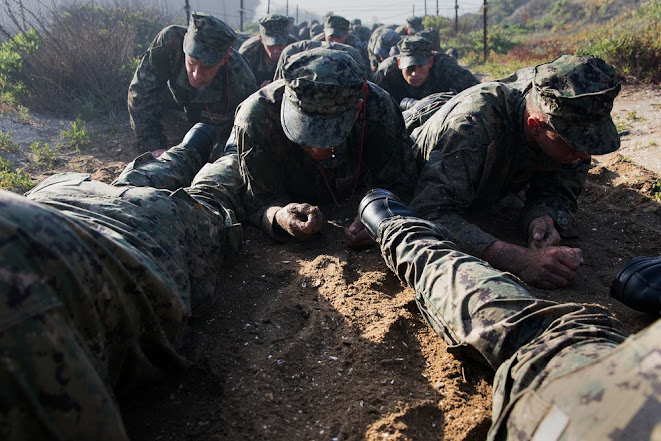
presents a brief history of the Navy SEALs, from their founding by Navy WWII veteran President John F. Kennedy, through Vietnam and into the 21st century. Philipps describes the rigorous body-breaking BUD/S training SEALS undergo in Coronado, San Diego –– a crucible where instructors are “striking down hubris like ancient gods.”

He introduces readers to a fascinating cast of characters, each on a spectrum of loyalty to each other, to Navy core values, and to the Constitution. There’s LPO (now Chief) Craig Miller, in many ways the hero of this tragedy; CAPT Matt Rosenbloom, a leader of leaders who put his SEALs ahead of outside threats, including to his career; and Secretary of the Navy Richard Spencer, who, like other characters in this story, tries to build a bridge to what was right, only to see his infrastructure crumble under politics and undue influence by the commander in chief.


When SECNAV Spencer was fired for appearing to disobey the president’s bidding immediately, Spencer said it was “just politics,” but was it “just” –– in both meanings of the word? Spencer, a former Marine whose mentor was SECDEF James Mattis, believed in strong standards and values. He tried to allow the SEALs to conduct an ethical review. Philipps writes, “Civilian rule of the military was a delicate thing. It required respect, deference, and a mutual understanding.” It did not do well with heavy-handed tipping of the scale of justice.


Trump and Gallagher
Philipps shows former President Trump’s role in the Gallagher case; disgraced Trump acolytes Bernard Kerik and Duncan Hunter as well as Trump lawyer Marc Mukasey helped Gallagher. Later, Gallagher hobnobbed with Michael Flynn, Erik and Donald Trump Jr., and Rudy Giuliani. Gallagher endorsed and campaigned for Donald Trump, and was feted at Mar a Lago. Trump granted clemency to Gallagher and pardoned two other service members who had been found guilty of war crimes.

The dark side of “loyalty” can be seen in the insurrection of Jan. 6, 2021. It can be seen in the code of silence over police brutality and killings that prompted the BLM protests and riots in the summer of 2020. The dark side of “loyalty” can be found in grievance and resentment and fear of the Other. It can be seen in anyone forgetting their oath to the Constitution and pledging their loyalty to a Big Lie and cult of personality that rejects democracy and embraces fascism and autocracy.


Facebook provides a platform for SEALs to express their support of Gallagher and the “pirate” ethos. “None of the SEALs on Facebook seemed to care that a chief had targeted civilians,” Philipps says. “They were just mad that guys in Alpha had said anything about it.”


"ALPHA" tells the story of true loyalty. Some characters, notably another former corpsman and SEAL, Corey Scott, fail in their commitment to the truth. Others, like Chief Craig Miller, rise to the challenge and stand tall.


Karma is on their side.


Miller, the leading petty officer of Alpha platoon during the Iraq deployment of 2017, uses his experience to teach young SEAL leaders about ethical choices, norms and virtues. Philipps describes Miller’s view: “In real ways, the future of humanity was built by the small actions of millions of everyday folks, and it could be torn down the same way.”


U.S. Navy SEAL candidates participate in Basic Underwater Demolition/SEAL (BUD/S) training. SEALs are the maritime component of U.S. Special Forces and are trained to conduct a variety of operations from the sea, air and land. (U.S. Navy photo by Petty Officer 1st Class Abe McNatt)

(This year a podcast called “The Line” explored various sides of the Eddie Gallagher saga and his war crimes trial in 2019 based on witness reports that he stabbed the ISIS teenager to death. In the podcast Gallagher says, “We killed that guy. Our intention was to kill him.” Gallagher admits. “It was to do medical scenarios on him until he died,” adding “He was going to die regardless. ... We weren't taking any prisoners.”

Speaking of karma: 

A new four-part documentary video series on Apple+, also called "The Line,” airs starting today.

"The Line" is by a team led by filmmaker Alex Gibney, Oscar winner for 2007’s Afghanistan War documentary "Taxi to the Dark Side." Directors Doug Shultz and Jeff Zimbalist obtained the participation of Gallagher; his wife, Andrea; and the members of SEAL Team 7 who stepped forward to accuse Gallagher of war crimes, and all appear on camera.)


Saturday, November 13, 2021

A True Patriot and Statesman: Max Cleland

By Bill Doughty––

When Joseph Maxwell "Max" Cleland spoke at the 72nd Pearl Harbor Day commemoration ceremony, Dec. 7, 2013, with Pearl Harbor itself as a backdrop, he was nearly overcome with emotion. He saw the dozens of World War II veterans seated in the front rows of the audience, and he thought of his father. Cleland spoke without notes, from the heart, about the sacrifice of military service and the joy of homecomings.


Army CPT Max Cleland in Vietnam
Hugh Cleland, Max’s dad, joined the Navy after the attack on Oahu in 1941. In 1965, Max volunteered for the Army to serve in combat in Vietnam, where he earned the Silver Star and Bronze Star.

Cleland was severely wounded and nearly killed. Yet, he personified resilience to become head of the Veterans Administration and a U.S. Senator.

Cleland died earlier this week. He was a great statesman, military veteran, and advocate for veterans, especially those with lasting physical and mental wounds.


President Joe Biden issued a statement November 9 on Cleland’s passing:

“Max Cleland was an American hero whose fearless service to our nation, and to the people of his beloved home state of Georgia, never wavered.

As a 25-year-old serving in the 1st Cavalry Division of the U.S. Army during the Vietnam War, Max lost both of his legs and his right arm in a grenade explosion at Khe Sanh. After grueling months in the hospital, enduring multiple surgeries and a long road back to recovery, Max turned his pain into purpose. He continued his distinguished public service, becoming a lifelong champion of the dignity and rights of working people and America’s wounded veterans. His leadership was the essential driving force behind the creation of the modern VA health system, where so many of his fellow heroes have found lifesaving support and renewed purpose of their own thanks in no small part to Max’s lasting impact... He was a man of unflinching patriotism, boundless courage, and rare character... He will be remembered as one of Georgia’s and America’s great leaders.”

I was fortunate to help plan the Navy’s Pearl Harbor Day commemoration ceremony in 2013 and to hear Max Cleland speak about honor, courage, and commitment –– as well as true family values and patriotism.


In 2013 I posted a Navy Reads review featuring Cleland’s autobiography, “Heart of a Patriot.”

Cleland, who chaired the armed services subcommittee on personnel in the Senate, was known for working closely with both Democratic and Republican colleagues.


Cleland reads about JFK.
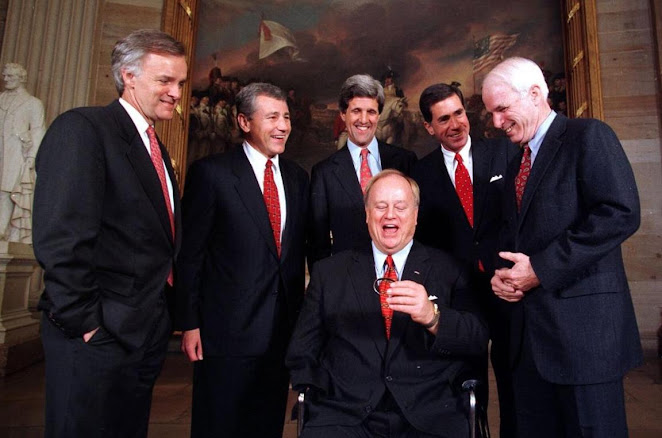
From Navy Reads: “His colleagues, mentors and friends in the Senate included fellow combat veterans Chuck Hagel, Dan Inouye, John Kerry and ‘my Vietnam veteran brother’ John McCain. Cleland describes the pride of wearing his dad's WWII Navy peacoat as a U.S. Senator during a presidential inauguration.”


Prior to serving in the Navy for three years during WWII, Max Cleland’s father, Hugh, had served in the Civilian Conservation Corps, an environmental infrastructure program created by President Franklin D. Roosevelt during the Great Depression. FDR was an inspiration to a young Max Cleland. Cleland loved books and reading. He authored several books.


Like Biden, Secretary of Defense Lloyd Austin issued a statement about Senator Cleland’s passing; fittingly, Austin includes references to literature.


In part, SECDEF Austin says:

“The Department of Defense stands united in mourning the loss of Senator Max Cleland, an extraordinary public servant and a great patriot…He served his country and his community from a wheelchair, following in the gallant tradition of his hero President Franklin Roosevelt.”


SECDEF Austin notes that as head of the Veterans Administration, Cleland “fought fiercely for his fellow veterans, made PTSD an official VA diagnosis, and helped create the groundbreaking Vet Centers program. Later, after being elected a U.S. senator from Georgia, he continued his passionate focus on defense and veterans' issues, serving with distinction on the Senate Armed Services Committee and leading on such issues as health care, bioterrorism preparedness, and homeland security. He also served on the 9/11 Commission before being nominated for the board of the Export-Import Bank. His final act of public service was leading the American Battlefield Monuments Commission. When battle maps of Vietnam were added to the National Memorial Cemetery of the Pacific in Hawaii, he asked to add an inscription from the poet Archibald MacLeish: ‘We leave you our deaths: give them their meaning.’

With courage and grit, Senator Cleland struggled with PTSD and depression—seeking help through counseling, medication, and attendance at a recovery group. He said that he drew strength from being around his fellow veterans and wounded warriors, including those from Iraq and Afghanistan. As the head of the VA, he made psychological counseling available to his fellow veterans. And I hope that his example will encourage others carrying unseen wounds to seek out the help they need and deserve. 

Senator Cleland liked to quote Hemingway, who wrote, ‘The world breaks everyone and afterward many are strong at the broken places.’ He surely was. Max Cleland's civic-minded spirit, optimism, and resilience will stand as an inspiration to every American.”

Funeral services are planned for early next week.


Senator Max Cleland, RIP.


Vietnam War veteran Max Cleland, a triple amputee, holds a photograph of himself as a child with his father, Hugh, and mother, Juanita, at the National Memorial Cemetery of the Pacific at Punchbowl in 2013. (Jamm Aquino, Honolulu Star-Advertiser)


The Senate had six Vietnam combat veterans in January 1997. Sen. Max Cleland, D-Ga., is in the front. Behind him, from left: Bob Kerrey, D-Neb., Chuck Hagel, R-Neb., John Kerry, D-Mass., Chuck Robb, D-Va., and John McCain, R-Ariz. This photo was taken by The World-Herald during Senate orientation the previous month. (Kiley Cruse, The World-Herald)

Top photo: Secretary Max Cleland, American Battle Monuments Commission, delivers keynote remarks during the 72nd anniversary commemoration of the Dec. 7, 1941, attack on Oahu. This year’s commemoration theme, “Sound the Alarm,” examines how thousands of Americans answered the call to duty in the wake of the attack. More than 2,500 people attended the Pearl Harbor commemoration. (MC2 Nardel Gervacio)