Showing posts with label McRaven. Show all posts

Thursday, August 13, 2026

Hertling’s Found Haiku, ‘Polished Diamonds’

Review by Bill Doughty––


Retired U.S. Army Lt. Gen. Mark Hertling concludes his vital book “If I Don’t Return” with deep reflection and a hope that the advice he offer is received as intended: as a gift to help others.


Much of his advice is reflected in a prayer by General Douglas MacArthur, “Build Me a Son, O Lord.” 


Citing elements of the prayer, Hertling writes,

“Be strong enough to admit weakness. Be brave enough to face yourself. Hold you head up in honest defeat and lower it in victory. Be selfless, kind, and fair. Seek the truth and laugh often. Choose service over self. Draw out the myriad motivations that live in others. Polish diamonds –– gently, patiently, precisely –– until their brilliance helps others see. Our world needs all of that, from each of us.”

The following “found haiku” (unintended poetic prose revealed in 5-7-5 syllables) are polished diamonds quoted from Hertling’s book:


In his introduction:


In these pages, strength

In values. In character.

In purpose. In love


From a key section, “Make it Matter”:


Don’t delay. Don’t wait.

Don’t count the days. Instead, make

every day count


Regarding the value of the military family’s support back home (from a saying by Martha Summerhayes written in 1866):


I had cast my lot

with a soldier, and where he 

was, was home to me


On the importance of civilian communities’ expressions of appreciation and kindness to deployed service members:


We should all take that

lesson to heart. Make someone

feel better today


After appreciating the “permanence” of death and environmental destruction in the aftermath of combat:


The awareness that

long after war’s end, it is

the loss that endures


On the biggest “diamond” in his book –– finding and embracing humility:


Victory is a

terrible teacher if you

let it flatter you

Humility is a core value for Hertling, especially important for good leaders. “Take your job, but never yourself, seriously,” he advises.


In a very personal insight, Hertling discusses his Christian faith and how prayer helped him early in his life, especially when deployed to Desert Shield and in Desert Storm.


“Over time, my faith has become less about answers and more about the courage to ask better questions,” he writes. “To walk into uncertainty with conviction, not arrogance.”


Curiosity led him to explore other religious scriptures and beliefs.


“My faith now includes mystery –– and mystery requires humility.” [And THAT is a near found haiku.]


Hertling says, “It’s good to be humble enough to learn. To be bold enough to explore. And to be wise enough to know that culture isn’t about comparison. It’s about connections,” he writes. Hertling made lifelong connections wherever he was stationed, including in Germany (right).

Humility. Connections. Honor, Courage and Commitment…


It is impossible to read “If I Don’t Return” without thinking about current chaos in 2026: the War with Iran and suffering of Sailors aboard USS Abraham Lincoln (CVN-72).; the cruelty by ICE “shock troops” on American streets; ongoing efforts at election interference and other attacks on constitutional democracy; and corruption of the Justice Department, Department of Defense, and the greedy president and his family.


“Humility prevents power from becoming arrogance, wisdom from becoming pride, and strength from becoming cruelty,” Hertling writes. “Humility is not the absence of strength –– it is strength under control.”


Throughout this great book, Hertling not surprisingly quotes a lot of Lao Tzu and Clausewitz, philosophers who have long inspired military leaders. But he also works in some Mark Twain, Epictetus, and even Michael Jordan, Mike Tyson, and Yogi Berra.

And, a quote from an episode of the popular show Ted Lasso stands out.


Hertling writes,

“Lasso explains that people often judge too quickly because they think they know enough about someone or something. He mentions a quote he once saw on a wall: ‘Be curious, not judgmental.’ The rest of the episode doesn't matter, because that's the best advice for leaders. Curiosity keeps you learning. Curiosity keeps you humble. And curiosity keeps you open to the possibility that the next great lesson may come from the most unexpected source.”

This book is a must-read for any military leader, and in Hertling’s mind that means anyone in uniform. But it also written as a guide for anyone in business, medicine, sports, or other fields.


American hero and Hertling’s friend, retired Admiral William H. McRaven, agrees. His extended blurb reads:

“‘If I Don't Return’ is the story every soldier wants to tell but struggles to put into words. Deeply personal, incredibly moving, and storytelling at its finest! Mark Hertling has written a timeless tale of life as a soldier, a father, and a wartime leader, but this book is about more than combat— it is about how we face life's greatest challenges with faith, wisdom, and gratitude. Everyone who is searching will find something of value in this beautifully written narrative.”

McRaven is, of course, former commander of U.S. Special Operations Command, who under orders from Commander in Chief President Barack Obama found and killed Osama bin Laden.


Filled with polished diamonds of wisdom, “If I Don’t Return: A Father’s Wartime Journal” by Mark Hertling, Lieutenant General, U.S. Army (Retired) is published by Ballast Books, 2026.

Thursday, October 10, 2024

Who Could Be Against Trump?

By Bill Doughty

Hundreds of former national security leaders –– from both Republican and  Democratic administrations –– signed a stark warning letter to the nation last month, citing about ex-President Trump, “He has shown no remorse for trying to overturn the 2020 election on January 6th, promises to pardon the convicted perpetrators, and has made clear he will not respect the results of the 2024 election should he lose again. That alone proves Mr. Trump is unfit to be Commander-in-Chief.”


Project 2025 was the must-read of the summer, and now this letter is a must-read for autumn, just a few weeks before the election. The lead signature is from Rear Admiral Michael E. Smith, USN (Ret), President of National Security Leaders for America.


Signatories include former SECDEFs Chuck Hagel, William Cohen, Leon Panetta, and William Perry as well as seven Senate-confirmed military service secretaries. The officials and senior officers called former President Donald J. Trump "impulsive," "ill-informed" and “unfit” to serve again as commander in chief.


They condemn his promise to “terminate” parts of the Constitution, his constant lying, and his role in the January 6, 2021 attempt to overturn the previous election and his “promises to pardon the convicted perpetrators.”


The letter includes signatures from three former acting service secretaries, former Secretary of Homeland Security Jeh Johnson, former Secretary of State Hillary Clinton, and former Secretary of Homeland Security Janet Napolitano. Among the more than 740 Americans who signed the letter are service members, civilians, and military spouse representatives. There are at least 63 Navy and 18 Marine Corps retirees who endorse Harris over Trump


Many Republicans have denounced Trump, with most pledging support to Kamala Harris for President. Notably, former Vice President Dick Cheney and former Representative Liz Cheney announced their endorsement of Harris. Liz Cheney is former House GOP conference chair and was the #3 Republican in the House of Representatives until she turned against Trump and helped lead a congressional investigation into the January 6, 2001 (J6) insurrection, consequently becoming a victim of MAGA retaliation.


Now Liz Cheney joins former Trump White House aides Alyssa Farah Griffin, Cassidy Hutchinson and Sarah Matthews today in Pennsylvania to campaign against Trump, noting, according to reports, his threat to democracy, the rule of law, and the Constitution. Former Trump White House communications director Anthony Scaramucci has issued similar warnings about another Trump presidency, and is actively supporting Kamala Harris and Tim Walz.

Recently, retired U.S. Army General Stanley McChrystal endorsed Vice President Kamala Harris for president, writing in a New York Times OpEd, “Ms. Harris has the strength, the temperament and, importantly, the values to serve as commander in chief.” He added, “I have cast my vote for character, and that vote is for Vice President Kamala Harris.”


In 2020, Admiral William McRaven, former commander of the U.S. Special Operations Command, warned the nation about a second Trump administration and what it would mean for the future of the country: “When good men and women can't speak the truth, when facts are inconvenient, when integrity and character no longer matter, when presidential ego and self-preservation are more important than national security — then there is nothing left to stop the triumph of evil.”

In another editorial about Trump, McRaven addressed him directly and wrote, "Through your actions, you have embarrassed us in the eyes of our children, humiliated us on the world stage and, worst of all, divided us as a nation.” Both McRaven and Admiral James Stavridis, former NATO Supreme Allied Commander, condemn Trump for his lack of character, his failure to uphold his oath to the Constitution, his affection for dictators and autocrats, and his antagonism of Allies and alliances.


Late Senator John McCain’s family have joined former members of Trump’s own administration –– including VP Pence, SECDEF Gen. Mattis, SECDEF Esper, CoS Gen. Kelly, NSA John Bolton, and CJCS Gen. Milley –– in condemning Trump for his role in the J6 insurrection coup attempt, threat to national security, and lack of stability. For his part, Trump threatens to retaliate against his critics both in government and in the media.

Next week, Bob Woodward’s new book, “War,” will hit book shelves, reporting on Trump’s “romance” with Russia’s Putin expanding on allegations of Russia’s help in Trump’s 2016 election when Trump, “Russia if you’re listening…” and publicly siding with Putin over his own Intelligence officers. Woodward reports that Trump secretly sent Covid-19 testing equipment directly to Putin in the early weeks of the 2020 pandemic, even though there was a shortage and need for testing in the United States. Trump denied the report, but Kremlin spokesman Dmitry Peskov said yesterday that the tests had been sent to Putin. It seems Woodward has written another must-read for this year.

Tuesday, July 16, 2024

Interesting Situation…

Review by Bill Doughty––

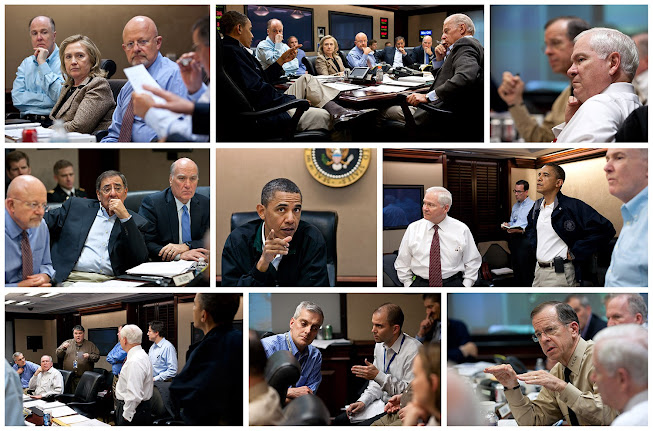
George Stephanopoulos pulls back the curtains of secrecy surrounding one of the most important rooms in the world: The White House Situation Room is his momentous and relevant book for the “interesting times” in which we live.


Through vignettes, descriptions, and photos, we get to look into the room where key decisions are made and history is forged.


In “The Situation Room” (Hachette Books, 2024), author and pundit Stephanopoulos shows its creation by JFK during the Cold War, its role in the infamous Iran-Contra affair under Reagan and Bush Sr., and its iconic place in history during killing of Osama bin Laden under leadership of Obama, Biden, Gates and McRaven.


The book weaves together the importance of an integrated military-civilian team as part of the federal government, especially in intelligence. Stephanopoulos describes the importance of open and honest discussion in which every voice is heard, and no one is afraid to speak truth to power.

“This is the Situation Room at its best: a place of sober discussion, informed thinking, apolitical attitudes and an absence of grandstanding,” he writes. There is no place for loyalty tests or fear of retribution. The room was critical in the wake of 9/11 and dozens of other crises. In recent years the Situation Room was used by Vice President Pence and Drs. Fauci and Birx during the Covid pandemic under President Trump.


Repeatedly, we see the important tenet of good leadership: surround yourself with good people who can help shape good decision-making, especially in a crisis situation. We also see the opposite.


“This book examines crisis management in the modern presidency. During the Trump administration, the president was the crisis to be managed.

It took a toll on those who had to do it. Trump tore through and wore out his national security team: Four secretaries of defense. Four directors of national intelligence. Four White House chiefs of staff and five secretaries of homeland security. The most damning judgments of his competence and character come from those he appointed to these most sensitive positions. His first secretary of state, Rex Tillerson, famously told colleagues that Trump was a ‘moron.’ James Mattis, the former Marine Corps general who served as Trump’s first secretary of defense, described him as a threat to the Constitution ‘who does not try to unite the American people –– does not even pretend to try.’ Fellow Marine general and White House chief of staff John Kelly called Trump ‘the most flawed person I have ever met in my life.’”


Tillerson, Mattis and Kelly

Now, in the wake of the tragic attempted assassination of the former president, the situation may have changed, according to some pundits who hope for more understanding, unity, and comity. Yet, this week’s Republican National Convention showcases the rise of Christian Nationalism as many of Trump’s loyal associates and January 6 insurrectionists are in prison or under a cloud of indictments and accountability. That includes Trump himself. It’s a strong contrast to Biden, most of his associates, and particularly his national security team.


Stephanopoulos and Lester Holt recently interviewed President Biden in the wake of Biden’s abysmal debate performance. The interviews have apparently not allayed concerns about Biden’s ability to communicate effectively, fight threats to the Constitution, or defend his record of achievements on behalf of the middle class, women’s rights, bipartisan infrastructure, environmental issues, CHIPS and Science Act, reduced unemployment, and gun safety. This reality magnifies the importance of Biden's ability to surround himself with good people of honor, compassion, integrity, and dedication.

That is the current situation and the curse we are under: living in “interesting times.”

Wednesday, September 13, 2023

McRaven’s ‘Simple’ Bullfrog Advice

Review by Bill Doughty––

Seventy-three years ago, September 15, 1950, Gen. Douglas MacArthur landed at Inchon, Korea. In the following weeks, U.S. forces began to rout the communist North Korean army and push them almost to the Yalu River near China. Then, in November the Americans encountered well-armed Chinese interventionists supporting the North Koreans.


“Hill 205 seemed an unlikely place for an Army legend to be born,” writes Admiral William H. McRaven (U.S. Navy, Ret.) at the beginning of chapter 7 of “The Wisdom of the Bullfrog: Leadership Made Simple (But Not Easy). McRaven recounts the actions of Army Ranger First Lieutenant Ralph Puckett, who in 2021 received the Medal of Honor, presented by President Joe Biden for actions in Korea. At great personal risk, Puckett helped his Rangers locate and attack camouflaged Chinese machine gun nests and mortar teams that pinned them down.

“Puckett, who had positioned himself at the front of the advancing Rangers, knew there was only one thing he could do. With complete disregard for his own life, Ralph Puckett rose from his foxhole and dashed out into the open field, forcing the Chinese to take aim at the young lieutenant. As the machine gunners began to fire a the sprinting Puckett, the Rangers spotted their positions and engaged them. Puckett returned to his foxhole only to catch his breath, and then leaped out and ran into the open again. With each dash by Puckett into the exposed terrain, the Rangers were able to isolate and destroy more enemy machine gunners.

“Having suppressed the small arms fire, the Rangers proceeded to take Hill 205. History would show that over the next two days, the Rangers under the command of Ralph Puckett would fight off wave after wave of Chinese assaults that took the lives of ten Rangers and left thirty-one wounded, including Puckett.”

Puckett would again serve with honor in Vietnam, where he earned the Distinguished Service Cross and two Silver Stars and was personally recognized by President Lyndon B. Johnson.


McRaven uses the story of Puckett’s heroism at Hill 205 to illustrate the Ranger motto “Sua Sponte” (“Of Your Own Accord”).  “In other words, doing what needs to be done without being told to do so,” McRaven explains.

“There is often the misguided belief that soldiers only follow orders, but the strength of the American military is that the great soldiers, the truly great leaders, do what is right without being told. They do what is right to protect their men and women.”


Senior military leaders expect even young and relatively junior service members to take the initiative when necessary. Such integrated empowerment is a cornerstone of leadership, and can be effective not only in the military but also in business, sports, medicine, citizenship, and developing a healthy family.


A simple, powerful concept. Which is also a good descriptor for this small but excellent book.


Memorial statue of Basilone in New Jersey
“Sua Ponte” is just one of the ideas presented here by the author of “Make Your Bed,” “The Hero Code,” and “Sea Stories.”

McRaven opens his latest book with a discussion with the most important aspects of being a good leader: Honor and integrity, captured in legendary United States Marine hero Sgt. John Basilone’s motto: “Death before Dishonor.” Honor and integrity are the foundation of a trustworthy leader.


Another motto explored in “Bullfrog” is the British Special Air Service’s Qui Audet adipiscitur: "Who dares, wins."


An honorable leader who demonstrates commitment, hard work, and initiative, will earn the trust of their followers, according to McRaven. Stamina, a willingness to sacrifice, and confidence, along with humility and the ability to make hard choices, are also important leadership qualities. Commanders “must have perseverance and, above all, confidence in ourselves.”


All the above qualities and more were personified by Adm. Chester W. Nimitz in World War II, particularly in the Battle of Midway: The great admiral faced a difficult choice about whether to ambush the Imperial Japanese Navy at Midway. “The fate of the entire Navy, and perhaps our nation, rested on this decision,” McRaven writes. “But history would show that the Battle of Midway was the single most decisive naval battle of the war and turned the tide in the Pacific.


Other legendary leaders highlighted in this outstanding book include father of the Navy SEALs, Adm. Chuck LeMoyne; WWII British officer and father of the SAS, Col. David Stirling; U.S. Special Operations leader Gen. Stanley McChrystal; Air Force visionary Billy Michell; Vietnam War hero Col. Elliot “Bud” Sydney; and former president Barack Obama, who, like Nimitz and Midway, faced a difficult decision, with uncertain information, about launching the mission to capture Osama bin Laden.


“It was an enormous risk, but one the president knew he had to take. I admired his guts –– Who Dares Wins –– but more importantly,” McRaven reflects about Obama, “I admired his intellect for understanding the nature of the risks he was assuming.”

Good leaders attack problems aggressively. “Mistakes of action are far less consequential than mistakes of inaction,” he notes. Hope, luck, and desire are important, but they are not a strategy. “Be a risk-taker, but manage the risk through extensive planning, preparation, and proper execution.”

All Hands: McRaven speaks to service members at Bagram Air Field, Afghanistan, Thanksgiving Day, 2013. (Army Staff Sgt. Osvaldo Equite)
Each chapter features an insightful epigram quotation by well-known and sometimes surprising people: Abraham Lincoln, Marie Curie, Alvin Toffler, Oprah Winfrey, Michael Jordan, William Shakespeare, Tacitus, Booker T. Washington, Coach Mike Krzyzewski, and Taylor Swift.

Yes, Taylor Swift.


In fact, her epigram quote for chapter ten, titled “No Plan Survives First Contact with the Enemy,” is a found haiku:


Just because you made

a good plan doesn’t mean that’s

what’s gonna happen


McRaven discusses the importance of planning, inspecting, and always having a plan B.

When one of their helicopters became damaged in the bin Laden raid, the well-trained and ready SEALs adjusted, overcame, and accomplished their mission. Training mitigates risk and saves lives.

Importantly, McRaven notes that even the best leaders will have setbacks and seemingly insurmountable challenges. But how they deal with failures and obstacles makes all the difference.

This is a great book for any new leader, would-be commander, and anyone interested in the importance of character, competence, and ethical behavior –– integrity –– in military and national leadership.


There are many references in “Bullfrog” to Basic Underwater Demolition/SEAL training, Coronado, and San Clemente. But there is an unexpected thread throughout the book leading through Hawaii, which help illustrate key leadership principles.


“The Wisdom of the Bullfrog” concludes with a spotlight on Navy SEAL Lt. Michael Murphy’s favorite book, “Gates of Fire” by Steven Pressfield"Gates of Fire" is also a favorite of Gen. James Mattis (USMC, Ret.) and is a recommendation by Adm. James Stavridis (USN, Ret.). The novel is or has been on the reading lists of many military leaders, including the Commandant of the Marine Corps (currently a vacant position).


Pressfield speaks to Marines and fellow veterans at Camp Pendleton in 2011. (Sgt. Skyler Tooker)
“Gates of Fire” imagines the 300 Spartans who fought valiantly in the Battle of Thermopylae in 480 BCE. In the fictionalized account, Pressfield, a former Marine, channels what the last Spartan may have said about his king, King Leonidas, and what made his king such a great leader: “A king does not abide within his tent while his men bleed and die upon the field. A king does not dine while his men go hungry, nor sleep when they stand at watch upon the wall, A king does not command his men’s loyalty through fear nor purchase it with gold; he earns their love by the sweat of his own back and the pains he endures for their sake. That which comprises the harshest burden, a king lifts first and sets down last. A king does not require service of those he leads but provides it to them…”

While not always easy –– and often extremely hard to live by –– McRaven’s leadership principles are actually “simple” he says. He offers a list of sayings taken from his chapter headings and a QR code at the end of the book for readers to obtain a printable version of the “Wisdom of the Bullfrog.” (The term Bullfrog refers to the the longest serving Navy SEAL on active duty, which McRaven once was for nearly 40 years.)


Sometimes advanced age has its leadership advantages.