Showing posts sorted by relevance for query mabus. Sort by date Show all posts

Sunday, June 13, 2010

Hot, Flat, and Crowded, by Thomas L. Friedman

Review by Bill Doughty

Why do we race to use up the earth’s non-renewable resources? How can we prevent the destruction of our ecosystem? Those are key questions posed in Tom Friedman’s follow-up to The World is Flat, entitled Hot, Flat, and Crowded (Why We Need a Green Revolution -- and How It Can Renew America).”

Friedman says the crisis we face is an “opportunity”:

“Why an opportunity? Quite simply because the human race can no longer continue to power its growth with the fossil-fuel-based system that has evolved since the Industrial Revolution and thrust us into the Energy-Climate Era,” Friedman writes.

“If we do, the earth’s climate, forests, rivers, oceans, and ecosystems are going to be increasingly disrupted. We need a new Clean Energy System to drive our economies forward and bring more people out of poverty -- without despoiling our planet -- and therefore the countries, communities, and companies that invent and deploy clean power technologies most effectively will have a dominant place in tomorrow’s global economy.”

But the questions remain. How can people be convinced to take action toward a greener economy? How can the gulf of suspicion, disbelief and linear thinking be bridged? What can be done to deal with a hot, flat and crowded world?

The Navy has some answers and is taking big steps toward adopting alternative energy, reducing pollution and controlling climate change, all in order to save and protect the environment and make the world more secure -- from the Gulf of Mexico to the Arabian Gulf.

On June 9, 2010 Secretary of the Navy Ray Mabus, who understands the issues, both as former governor of Mississippi and then ambassador to Saudi Arabia in the mid-90s, spoke to the Naval War College about Navy and Marine Corps efforts to reduce dependence on fossil fuels.

Mabus spoke about the Navy's first hybrid ship, the amphibious assault ship USS Makin Island (LHD 8), which saves millions of dollars in fuel costs by using an electric drive for speeds of 10 knots or less.

"Over the lifetime of that ship, if fuel prices remain absolutely the same, we will save about a quarter of a billion dollars in fuel. We're prototyping that engine to be retrofitted onto our guided-missile destroyers so that we can begin to move that further out into the fleet," said Mabus.

"In April (2010), we flew the Green Hornet, an F-18 Hornet,” Mabus said. “The Green Hornet, a regular off-the-shelf F-18, supersonic, flew on a mixture of regular gasoline and biofuel...”

USS Independence (LCS 2) joins USS Freedom (LCS 1) as a new generation, sleek and fast, energy-efficient Navy ship, operating with a small crew.

"We're the first all-aluminum warship," said Lt. Cmdr. Philip Garrow last April. The 419-foot ship is started with the help of a computer mouse, and steered with joysticks and powered not with propellers, but rather with four jets. The Independence's hull is also a trimaran. "We're really like a giant outrigger canoe," Garrow said.

The biofuel-powered boat John W. Finn, named after the Medal of Honor recipient who passed away last month, already takes hundreds of visitors to the USS Arizona Memorial every day in Pearl Harbor.

The Navy is building new infrastructure with carbon reduction, marine mammal protection and energy conservation in the forefront. Coordinating with the U.S. Coast Guard, the Navy conducts international fisheries enforcement in the Pacific. Environmental stewardship is tied with maritime security and Navy’s efforts are reported in the quarterly magazine Currents.

Chief of Naval Operations Adm. Gary Roughead said in an address to the Surface Navy Association, “The world is running out of oil. If we don't get serious about energy, we're delivering a terrible future to our children."

In April 2010, Adm. Jon Greenert, Vice Chief of Naval Operations, released the Navy Climate Change Roadmap. The first sentence of the executive summary states: “Climate change is a national security challenge with strategic implications for the Navy.”

Last month, Commander, Naval Installations Command Vice Adm. Mike Vitale hosted a conference with CEOs of Navy and Marine Corps Public Private Venture housing. His discussion on process improvements to provide efficient and effective service focused on the impact of rising energy costs affecting all Navy installations.

Military leaders at the highest echelons recognize the value of controlling energy costs, controlling our reliance on oil and reducing our carbon footprint.

Friedman devotes a good part of Chapter 14 to recognizing the “green hawks” of the Pentagon who support more solar energy, improved insulation and greater reduction of fossil fuel use. Energy reduction is tied to greater security, a policy especially embraced by Army and Marine Corps leaders in Iraq and Afghanistan.

Friedman uses real-world examples and scientific evidence to outline his argument, showing how unrestrained population growth causes destruction of the environment, depletes resources and puts people everywhere at risk.

The countries that invest in a new Green way of thinking will survive and be strong. He devotes a clear-eyed assessment of the challenges facing China, and asks whether Red China can turn green.

For the United States, “Green is the new Red, White and Blue,” Friedman says, and should appeal to both progressives and conservatives (in the truest sense of progressing and conserving).

In other words, the issues transcend politics.

Navy Capt. Rymn Parsons reminds us in Proceedings Magazine this week about a 2007 study that predicts increased tensions in stable regions and more volatility in unstable regions. “Infertile, inhospitable conditions may prove fertile and hospitable to extremist ideology and inviting to transnational crime.”

Parsons says, “President Obama noted in his 2009 Nobel Peace Prize acceptance speech: ‘It is not merely scientists and activists who call for swift and forceful action—it is military leaders in my country and others who understand that our common security hangs in the balance.””

According to Friedman, “the green revolution is similar to the civil rights movement in that it is about personal virtue... but the civil rights movement started with citizen activism...”

Unless there is an groundswell of such activism, “Green is still more option than necessity.”

Friedman answers the big question of how to achieve a citizen activism and a tipping-point breakthrough in American understanding of the threats, challenges and opportunities: “Leadership.”

“Whenever you face a big challenge, like ending segregation or fighting a world war, the quality of leadership is often the deciding factor,” Friedman writes. “In the case of the Energy-Climate Era, we need leaders who can shape the issues so that people understand why ignoring them is such a threat and why rising to them is such an opportunity. We also need leaders who not only understand the importance of dealing with this problem in a systemic way, but who can actually generate the vision and authority to pull that system together.”

As a follow-up to The World Is Flat, lays out a harvest of choices. He concludes with some gentle suggestions: “First, pay attention and personally lead as environmentally sustainable a life as you can.” Then, translate personal commitments into national and international commitments by choosing and supporting good leaders.

(Friedman’s book was published before the terrible oil spill in the Gulf of Mexico, where the Navy is working with the U.S. Coast Guard in support of the Department of Homeland Security to help clean up and control oil pollution. Nearly 100,000 feet of oil boom has been provided by the Navy; Navy skimmer systems are working with full crews at various locations along the coast. Naval Air Station Pensacola is serving as a staging facility and is on a front line of the crisis.)

Sunday, August 11, 2013

Picturing the War of 1812, ‘Rise of U.S. Navy’

Review by Bill Doughty

National Geographic’s gorgeous “The War of 1812 and the Rise of the U.S. Navy” is a coffee-table book that is literally a work of art.

The pages pop with high-resolution photographs of paintings, drawings and artifacts reminiscent of the great Dorling Kindersley DK Eyewitness Books (works of nonfiction from England for all ages, with sharp visual-bites of illustrations, information and insights) on topics of science, history and exploration.

Like some of the DK books, “The War of 1812 and the Rise of the U.S. Navy,” produced under the auspices of the Naval History and Heritage Command, is both nonlinear and linear; readers can open for a rewarding browse or follow events from 200 years ago in chronological order.  

For example, if you want to see what was happening 200 years ago this month, turn to page 140.  In August 1813, as Lt. Thomas MacDonough rebuilt a small force led by the sloops President, Commodore Preble and Montgomery, on Lake Champlain a British squadron attacked American facilities.

Meanwhile, British Commodore Sir James Lucas Yeo, aboard his flagship HMS Wolfe, played a cat-and-mouse game with Captain Isaac Chauncey while confronting storms on Lake Ontario, in which two armed schooners, Hamilton and Scourge were lost, along with more than 70 sailors.

“Neither commander, it seemed, had anything to spare for Lake Erie,” the authors write.

The book focuses on the events, equipment and personalities -- and drama -- of the war.  Commodore Oliver Hazard Perry is shown as an honorable leader facing the British at Lake Erie in August 2013 leading up to the inevitable confrontation.

“By August, a bad situation was made much worse when Perry's little flotilla effectively blockaded Barclay (in charge of the gunboat division on the St. Lawrence River before assuming command of the Provincial Marine squadron with HMS Detroit on Lake Erie under appointment by Commodore Yeo) in Amhertsburg.  The specter of starvation then reared its ugly head; it was critical that the water highway to the east be reopened.  The young Royal Navy lieutenant could no longer resist the pressure to give battle.  Off Malden, the Americans staked out his operation, finding him and his men hard at the task of making preparations for engagement.  Detroit was almost, but not quite, ready.  Some of Perry’s officers recommended striking them unawares, but Perry wouldn’t have it. ‘No,’ he said.  ‘I will take no dishonorable advantage of them, but wait until they get in readiness, and meet them fairly and openly on the lake.”

Perry moved on to Put-in-Bay the following month, leading to the Battle of Lake Erie in which Perry wrote, “We have met the enemy and they are ours...”
William Powell's painting of Oliver Hazard Perry and sailors: "Battle of Lake Erie"

Authors Mark Collins Jenkins and David A. Taylor present the history of the war from Boston Harbor to the Great Lakes, from Baltimore and D.C. to New Orleans, with a brief visit to the other side of the Atlantic.

The book features a personal and heartfelt foreward by Douglas Brinkley.  The preface by Hon. Ray Mabus, Secretary of the Navy, discusses the tradition of the Navy related to the War of 1812 and  puts in context not only in the lessons in leadership, commitment and sea-power but also lessons for the future:

“Much has changed in the past two hundred years,” writes Mabus.  “Britain, once our staunch foe, has become our strong friend.  Where we once depended upon the wooden walls of our sailing ships, we now sail ships of steel.  The smoothbore cannons of 1812 have become the modern naval guns, missiles, and torpedoes of today.  Wind power has given way consecutively to coal-fired steam power, then oil and nuclear power and now the fleet is on the cusp of another change to biofuel and renewable energy.  Situational awareness was once limited to the horizon, based on the eyesight of a keen lookout from a ship’s tops.  This has given way to instantaneous communications to any point on the globe, to submarines sailing the depths, to aircraft soaring the skies and rocketing into outer space, and to sailors on the cyber sea."

The book brings to mind CNO Adm. Greenert's tenets "warfighting first, operate forward and be ready." 

CNO Adm. Jon Greenert and SECNAV Mabus (second from right) kick off the War of 1812 Bicentennial.
Interestingly, the first introductory quote in this book is from Alfred Thayer Mahan from his “Sea Power in Its Relations to the War of 1812”: 

“Both parties to the War of 1812 being conspicuously maritime in disposition and occupation, while separated by three thousand miles of ocean, the sea and its navigable approaches became necessarily the most extensive scene of operations.”

Sunday, April 19, 2020

'All Hell Breaking Loose'

Review by Bill Doughty–

The United States Navy may face ongoing existential threats because of pandemics, mega-droughts, fires, massive storms, and rising sea levels – caused by or made worse by climate change.

That's according to scientists, analysts and educators, including Michael T. Klare in "All Hell Breaking Loose: The Pentagon's Perspective on Climate Change" (Metropolitan Books, Henry Holt Company, 2019). 

Already impacted by COVID-19, the military is also straining to retain readiness as it confronts potential threats in the Arctic as ice melts and nations, especially Russia, compete for resources and sea lanes. And with increasing calls for Humanitarian Assistance and Disaster Relief missions in response to devastating storms, diseases and environmental destruction, military leaders are concerned about "the specter of disaster clusters."

This relevant book is a well-written and sobering look at the threats, impact and mitigation response by the military, especially led by the Navy.

Chapter One opens with a Senate Armed Service Committee hearing of April 9, 2013, in which then Commander, U.S. Pacific Command Adm. Samuel J. Locklear testified about the threat of not only China and North Korea, but also climate change: "Increasingly severe weather patterns and rising sea levels threaten lives and property," Locklear said, "and could even threaten the loss of low-lying nations."
"A similar assessment was provided in 2019 by one of Locklear's successors at what had been rechristened the Indo-Pacific Command. Asked by Senator Elizabeth Warren of the Senate Armed Services Committee to discuss the impact of climate change on operational readiness in his area of responsibility, Admiral Philip S. Davidson replied: 'The immediate manifestation, ma'am, is the number of ecological disaster events that are happening.' In just the past few months, he indicated, the Indo-Pacific Command had been called on to assist with emergency relief operations in the U.S.-administered Northern Mariana Islands after they were struck by Super Typhoon Yutu. 'Our assistance in terms of humanitarian assistance and disaster relief, our ability to command and control, to marshal troops, to deliver logistics, is important training for the region.'"
Klare shows how training and warfighting are negatively impacted by more frequent heatwaves, when it becomes too deadly to operate. Conversely, the military is also challenged in super-cold environments such as Red Dawn-like exercises in Norway in sub-Arctic terrain, in which hundreds of U.S. Marines must train in amphibious assaults. There are "distinctive challenges in fighting in snow-covered sub-zero conditions," according to Klare.

"Climate change," he says, "will make itself felt in multiple situations, increasing the risk that long-standing hostilities will erupt into full-scale war." Another likely scenario: millions of displaced people as mega-fires, freshwater shortages, monster storms and rising sea levels cause mass migration.

U.S. Navy Lt. Jose Garcia inactivates Ebola virus at Bushrod Island, Liberia, Oct. 2014.
Klare writes, "For many observers, the Ebola epidemic of 2014-2016 represents a preview of what can be expected in the future as global warming advances, certain infectious diseases extend their range and vulnerable states prove unable to cope with the multiple challenges of extreme weather, resource scarcity, and inadequate public institutions." He cites Zika, dengue and malaria as other diseases of concern.

The Navy has a history of responding to crises, including within our own country, but also throughout the world. "Our country is a compassionate, generous and caring nation with a long history of aiding those around the world who are impacted by disasters," said Adm. Kurt Tidd as a relief effort commenced to the Caribbean in response to Hurricane Maria in 2017. 

That year, Hurricanes Harvey, Irma and Maria "pummeled Texas, Florida and Puerto Rico, prompting an unprecedented U.S. military response." 

Perhaps the biggest existential threat of global climate change to the Navy, though, is the impact to its bases themselves, especially those located at or near sea level.


Klare gives an extensive report on the dangers of rising sea levels to Navy bases, especially in Virginia and Florida, particularly Norfolk (featured in a special hosted by Arnold Schwarzegger), Hampton Roads Mayport, Jacksonville and Key West. Scientists predict a possible nearly two-meter sea level rise by the end of the century; a one meter rise would "inundate Norfolk," headquarters of the U.S. Atlantic Fleet and many other commands.

Rear Adm. Bolivar gives thumbs up prior to surveying damage from Hurricane Michael, Oct. 2018.
He quotes Commander Navy Region Southeast Rear Admiral Babette Bolivar, who issued an evacuation order in September 2017 for nonessential personnel from Naval Air Station Key West as Hurricane Irma "carved its destructive path" toward Florida. A year later Hurricanes Florence and Michael caused destruction at Marine Corps Air Station Beaufort and Marine Corps Training Depot Parris Island, South Carolina.
"When Hurricane Florence shifted course and headed to the Carolinas instead of the Norfolk area in September 2018, those bases were severely impacted; normal operations were suspended and nonessential personnel ordered to evacuate. Camp Lejuene, a major Marine training center, was especially hard hit by Florence, with some nine hundred buildings damaged or destroyed. As sea levels rise, flooding of Lejeune's low-lying areas is likely to occur on a daily basis and large parts of it can expect to be fully inundated during future hurricanes. Parris Island, the Marines' main East Coast recruit training facility, and MCAS Beaufort, home to six Marine F/A-18 fighter squadrons, are equally at risk of inundation. At present, a storm surge of five to ten feet induced by a Category 1 hurricane would cover some 90 percent of Parris Island; by 2100, almost the entire base would be covered by ten to fifteen feet of water. MCAS Beaufort faces similar risks." (Klare cites Union of Concerned Scientists studies and reports.)
We read how Naval Base Coronado in San Diego is at risk, as is fire-prone Marine Corps Base Camp Pendleton, also in California. Wildfires threaten bases throughout the Southwest, and Alaska military facilities are in danger from shoreline erosion and/or thawing permafrost. Offutt Air Force Base near Omaha, Nebraska, home of the U.S. Strategic Command, is seriously affected by flooding due to storms.

Aircrewmen load an Air-Deployable Expendable Ice Buoy onto a Royal Danish Air Force C-130 aircraft at Thule Air Force Base in Greenland Sept. 7, 2017, in preparation for deployment in the high Arctic as part of the International Arctic Buoy Program (IABP). (U.S. Navy photo by John F. Williams)

Overseas bases and sites, including in the Middle East, Africa and Central and South America are also under threat from the effects of global warming. 

"For forces operating in the Asia-Pacific area, sea-level rise and extreme storm events are likely to pose the greatest dangers," Klare says, focusing on Diego Garcia in the Indian Ocean and Kwajalein in the Marshall Islands, which is the location of the Ronald Reagan Ballistic Missile Defense Site, at risk from saltwater intrusion into its freshwater aquifer.
"Elsewhere in the region, the DoD faces a substantial climate threat to its cluster of air and naval bases in Japan. These installations, including the naval base at Yokosuka on Japan's main island of Honshu, and Kadena Air Force Base, on Okinawa, are among the most important U.S. military facilities in Asia. Yokosuka, located on the mouth of Tokyo Harbor, hosts the USS Ronald Reagan (America's only forward-deployed carrier) and its supporting vessels; Kadena is the largest Air Force facility in East Asia, housing the 18th Air Wing and a host of other units. Both of these bases, and many others nearby, are located on or close to the Pacific Ocean and are regularly menaced by typhoons. As global warming proceeds, these facilities – like their counterparts in the estern United States – will be exposed to rising seas and an ever-increasing risk of extremely powerful storms."
Using science-based research and common sense, the Navy has shown significant leadership in the approach to climate change for more than ten years, with admirals and civilian leaders unafraid to speak truth to power.

In fact, 2016 marked a watershed year as then Secretary of the Navy Ray Mabus launched the Great Green Fleet, named in stark contrast to President Teddy Roosevelt's Great White Fleet that sailed more than a century earlier, which was powered strictly by carbon-based fuel. The GGF was essentially the John C. Stennis (CVN 74) Strike Group, led by the nuclear-powered aircraft carrier and including the guided-missile cruiser USS Mobile Bay (CG 53) and guided-missile destroyers USS Chung-Hoon (DDG 93) and USS William P. Lawrence (DDG 110), each running on alternatives to conventional petroleum. The surface ships steamed underway using a hybrid fuel mixture.

Then SECNAV Ray Mabus talks Navy sustainability at the greengov symposium, June 2015.
Klare acknowledges Mabus's initiative may have had only a minimal contribution to slowing the advance of global warning, "Still, the Great Green Fleet does represent a significant effort by a large and powerful organization to at least start transitioning from carbon-based fuels to climate-friendlier alternatives."

Klare concludes with a hopeful look at how the insight and initiatives by the military, including net-zero goals, could be emulated by the civilian community.
"Equally insightful is the U.S. military's emphasis on cooperation with the militaries of friendly nations in addressing the perils of climate change. From the very beginning, senior officials have stressed the need to work with other countries in reducing their own climate change vulnerabilities, thereby enhancing regional and international stability. In accordance with this precept, U.S. services have collaborated with foreign militaries in preparing for extreme event, for example, by stockpiling emergency relief supplies, conducting joint disaster relief drills, and helping to harden critical facilities. Although modest in comparison to what is actually needed to protect the world from warming's severe effects, these endeavors demonstrate a basic understanding that human survival at this perilous moment will require international collaboration of just this sort."
The Pentagon has confronted the issue of climate change in various publications and plans: DoD's "Climate Change Adaptation Roadmap;" Quadrennial Defense Reviews over the past ten years; DoD Directive 4715.21, "Climate Change Adaptation and Resilience;" 2019's "Report on Effects of A Changing Climate to the Department of Defense;" and Naval Facilities and Engineering Command's "Climate Change Installation Adaptation and Resilience Planning Handbook."

Saturday, May 30, 2015

Catching Up on Names, Namesakes

by Bill Doughty
New Jersey, John Finn, Midway and Craig Symonds, Mary Roach, Jimmy Carter and John S. McCain – all in the news recently and each with featured spots in Navy Reads. Make the connections...

A state of the Navy is New Jersey. Secretary of the Navy Ray Mabus announced this week that the newest Virginia-class attack submarine to be named after the Garden State would be SSN 796, USS New Jersey. A DOD story this week reminds us that the Navy’s first submarine, USS Holland, was designed and built in New Jersey in 1900.

Medal of Honor recipient John Finn, Dec. 7, 2006.
In Mabus's home state of Mississippi, at the beginning of this month, USS John Finn was christened at Ingalls Shipbuilding in Pascagaoula. According to an informative post about John Finn on Navy Live Blog, "The future USS John Finn is the 63rd Arleigh Burke class destroyer, and the first of the DDG 51 Flight IIA restart ships."

John Finn passed away five years ago this week, May 27, 2010. We interviewed him for Navy Reads in late 2009, when he told us his favorite author prior to World War II was Ernest Thompson Seton – author, artist and naturalist. “I always loved books about wildlife,” he said. 

Finn was a hero who fought back against Imperial Japanese Navy planes attacking Oahu, Hawaii on December 7, 1941.

Craig Symonds
On Oahu next week Craig L. Symonds will be featured speaker at the Pacific Aviation Museum on Ford Island, Pearl Harbor to commemorate the 73rd anniversary of the Battle of Midway, which became the namesake for a great aircraft carrier, USS Midway (CV 41), now a museum in San Diego. The battle is considered the turning point of the war in the Pacific, just six months after the attack on Pearl Harbor and Oahu.
Dr. Symonds, a scholar of naval history and the Civil War, will conduct several book-signing events and interviews during the week leading up to the event at PAM, Saturday, June 6, 2015.

Mary Roach
Meanwhile, another gifted author who has contributed to Navy Reads, Mary Roach, is up in Skagway, Alaska this week as keynote speaker for "Exploring the Frontiers of Language / Let Skagway Inspire You," sponsored by North Word Writers Symposium. Roach – a champion of science, humor and critical thinking – is author of the New York Times bestsellers "Gulp: Adventures on the Alimentary Canal," "Packing for Mars: The Curious Science of Life in the Void," "Stiff: The Curious Lives of Human Cadavers," "Bonk: The Curious Coupling of Science and Sex," and "Spook: Science Tackles the Afterlife." 

Yesterday, 90-year-old Navy veteran and former U.S. President Jimmy Carter – author of numerous books on human rights, history, international relations and peace – attended a change of command ceremony for his namesake submarine, Seawolf-class attack submarine USS Jimmy Carter (SSN 23) during a ceremony at Naval Base Kitsap, Bangor, Wash.

Cmdr. Melvin Smith (right) assumes command of USS Jimmy Carter.
Cmdr. Melvin Smith relieved Cmdr. Brian Elkowitz as commanding officer.


A Navy.mil story noted that "the 39th president and 2002 Nobel Peace Prize winner is the only U.S. president to graduate from the Naval Academy and the only one to qualify on submarines."

Carter, who graduated from the Naval Academy in 1946 and served in the Navy until 1953, said: "Of all the honors I have ever received, I've never had anything of greater honor than the chance to be the namesake of USS Jimmy Carter."

Vice Adm. John S. McCain Sr. and Cmdr. John S. McCain Jr. in 1945.
In a ceremony May 28 in Yokosuka Japan, the forward-deployed Arleigh Burke-class USS John S. McCain conducted a change of command ceremony. Cmdr. Chad Graham relieved Cmdr. Chase Sergeant as CO. McCain is named for Admirals John S. McCain Sr. and John S. McCain Jr., both WWII veterans and leaders, grandfather and father to Senator John McCain, Vietnam veteran, Navy pilot and former POW.

Sen. McCain's book "Character is Destiny" was featured on Navy Reads last year. The book, written with Mark Salter, is filled with short biographies and inspirational stories about core values, leadership, and the importance of good character.


Saturday, January 28, 2012

A Case for Optimism: Navy Energizes

by Bill Doughty
In some distant future, will people read Thomas Friedman’s books and think, “So that’s why we’re in this mess”?
That Used to Be Us: How America Fell Behind in the World It Invented and How We Can Come Back, published in 2011, begins and ends with self-described “frustrated optimism” that we will see, read, understand and heed the warnings all around us -- ecological, political and economic.
The book combines the progression and global perspective of Friedman’s previous works -- Hot, Flat and Crowded and The World is Flat, an original title on the Navy Professional Reading Program.
Friedman and co-author Michael Mandelbaum show that the nation’s energy policy is a strategic issue.  Embracing clean renewable energy and reducing the use of fossil fuels would:
  • Make troops and supply lines in Afghanistan less vulnerable,
  • Free us from economic dependency from despots and radical Islamists,
  • Trigger innovation and make us more competitive in the global market,
  • Strengthen the dollar and improve our trade deficit, and
  • Provide cleaner air and reduce related health-care costs.
Secretary of the Navy (SECNAV) Ray Mabus talks with Sailors and Marines 
in Afghanistan about Ground Renewable Expeditionary Energy System (GREENS).
(Photo by MCC Sam Shavers)
The authors single out the Department of the Navy, recognizing the Navy’s success in promoting new energy.
Led by Ray Mabus, President Obama’s Secretary of the Navy and the former U.S. ambassador to Saudi Arabia, the Navy and Marines are not waiting.  Using their own resources, they have been building a strategy for “out-greening” al-Qaeda, the Taliban and the world’s petro-dictators.
The authors amp up their optimism in discussing the historic first flight of a Navy F/A-18 Super Hornet fighter in 2010 powered by a fifty-fifty blend of conventional jet fuel and biofuel.  But they express their frustration about how the nation is currently dealing with education and politics.
Last September the U.S. Navy flight demonstration team, the Blue Angels, flew using the fifty-fifty blend for the first time.
An "Energy Security" logo on an F/A-18 Hornet.
 (Photo by MC1 Rachel McMarr)
Friedman and Mandelbaum show how trust, creativity and innovation are top traits in what they call today’s hyper-connected world and dealing with such issues as global climate change, fossil fuel depletion and a root cause: overpopulation.  They report that the world’s population is projected to grow to 9.2 billion by 2050 from 6.8 billion at the time their book was published.
We learn that in the "flattened" world, in which workers from China and India are competing for jobs down the street, we need new ways of learning new skills.  Here are the traits employers now want in their work force:
They are looking for workers who can think critically, who can tackle non-routine complex tasks, and who can work collaboratively with teams located in their office or globally.
Creative, innovative thinking is valued not only in the marketplace but also in the classroom.
EOD Sailors demonstrate IED
detection.  (Photo by J. Johnston)
The authors cite Chairman of the Joint Chiefs of Staff Gen. Martin E. Dempsey’s vision and support of outcome-based training as a model for education.  Dempsey says that peer-to-peer hands-on training is the most effective way to learn.
Dempsey champions wiki doctrinal manuals, for example, on how to deal with IEDs and bridge-crossings in Afghanistan.  The manuals are continually updated with new information from the troops on the ground -- literally of the people, by the people, for the people.
The bottom line: “Collaboration is important on the battlefield, and trust is the cement of collaboration,” said Dempsey.  “And trust is the prerequisite for creativity.  You will never be creative if you think that what you have to say will be discounted.  So creativity cannot happen without trust and collaboration cannot happen without trust.  It is the essential driver.  And that is why you build authority now from the bottom up and not the top down.”
Writing in one voice, Friedman and Mandelbaum do their own teaching, using references to Orson Welles, Galileo, Pasteur, Darwin, Einstein, Lewis Carroll and Atlanta Mayor Kasim Reed.
They praise two key points in Amy Chua’s Battle Hymn of the Tiger Mother: “The need to hold children to the highest standards that push them out of their comfort zones, and the need to be involved in their schooling.” Like Chua, they encourage strategies that challenge young people to think critically and understand science.
Global warming is a call to action, according to the authors, who explain why the United States has failed so far to meet the challenges of climate change and moving to alternative energy use.
In a subchapter called Of Science and Political Science, they write, “For starters, climate change occurs gradually and may not produce an equivalent of Pearl Harbor -- until it is too late.”
The authors salute President Richard Nixon for creating the Department of Natural Resources and the Environmental Protection Agency and pushing Congress to pass the landmark Clean Air Act of 1970.
Presidents Gerald Ford and Jimmy Carter addressed the Arab oil embargo of 1973-4 and faced down OPEC.  [Memories of 1974, Tower of Power’s Only So Much Oil in the Ground.  Lyrics: “There is only so much oil in the ground / Sooner or later, there won’t be much around... / Alternate sources of power must be found / Cause there's only so much oil in the ground / There's no excuse for our abuse...”]
Under President Reagan, then-Secretary of State George Schultz oversaw negotiation of the landmark Montreal Protocol on Substances That Deplete the Ozone Layer.  Later, President George H. W. Bush introduced the idea of “cap-and-trade” to address environmental problems.
Navy’s commitment to renewable energy was a key point in President Obama’s State of the Union speech last week.  Discoveries of natural gas and safer means of extracting traditional energy sources may be reasons for optimism in 2012.  Last year the automobile industry agreed to raise fuel efficiency to 54.5 miles per gallon by 2025.
And there appears to be a growing commitment to wind, solar, and energy efficiency and conservation.  Can we take advantage of the positive trends and deal with the negative: deficits, educational challenges and marketplace competitiveness?
That Used to Be Us concludes that the American Dream can still be achieved and sustained by reading and re-discovering our history, which brings us back to how Friedman’s books will be read and reflected upon in the future: “So that’s why we're in this mess?” or “Thank goodness we listened to the warnings!”

Saturday, May 25, 2013

The Eclectic, Electric and Heroic


by Bill Doughty

It’s been a few weeks since I’ve posted to Navy Reads. Been too busy reading an eclectic list of books: Mary Roach’s “Gulp: Adventures on the Alimentary Canal” (sickeningly good), Scott McGaugh’s “Midway Magic” (long live CV-41), and several books that may help explain the violent extremist insanity that led to the Boston Marathon bombings (to try to understand the “why”).  

These books include “Chechen Jihad” by Yossef Bodansky, “8 Pieces of Empire” by Lawrence Scott Sheets, “The Lone Wolf and the Bear” by Moshe Gammer, and “The Black Banners” by Ali Soufan.  All provide insights into Chechnya, “Chechenization” and the twisted currents of Islamist-Jihadists.

Reviews of any of the above titles are on hold, though.  I also picked up a copy of “The Orphan Master’s Son” by Adam Johnson, a work of colorful imagination set in and around North Korea.  So far, this stark thriller is a work of art and beauty with ties to both the sea and Japan.

Speaking of novels... Coming soon, a very special post courtesy of retiring Adm. James Stavridis who stepped down this month as NATO Supreme Allied Commander.
ADM Stavridis is honored after stepping down at NATO May 13, 2013.

Stavridis has an electrifying intellect.  Watch his TED Talk on global security  -- building bridges, not walls, and protecting sea lanes -- to understand the U.S. Navy’s raison d’etre.


“As secretary of the Navy it is my privilege to name these ships to honor a respected naval leader and a true American hero." Mabus said. "For decades to come, the future USS Paul Ignatius and USS Daniel Inouye will represent the United States and enable the building of partnerships and projection of power around the world." 
Sen. Inouye speaks with a Navy Captain aboard USS Midway, year unknown.

Former Navy leader Paul Ignatius served as secretary of the Navy in the late 1960s under President Lyndon Johnson.  Inouye earned the Medal of Honor for his heroism in battle with the 442nd Regimental Combat Team in Italy. First elected to the U.S. House of Representatives when Hawaii became a state in 1959, he was elected to the U.S. Senate in 1963 and served there until his death at age 88.

This will be the first Memorial Day since Sen. Inouye’s passing last December.  He was a great American hero, consensus builder and forward-thinking visionary who, decades ago, understood the importance of rebalancing to the Pacific.


070505-N-3642E-385 GROTON, Conn. (May 5, 2007) – Sen. Daniel Inouye prepares to speak at the commissioning of USS Hawaii (SSN 776). Hawaii is the third Virginia-class submarine to be commissioned and the first major Navy combatant vessel class designed with the post-Cold War security environment in mind. U.S. Navy photo by Chief Mass Communication Specialist Shawn P. Eklund (RELEASED)

Monday, March 29, 2021

‘Gutsy’ Women Knocking on the Door

Review by Bill Doughty

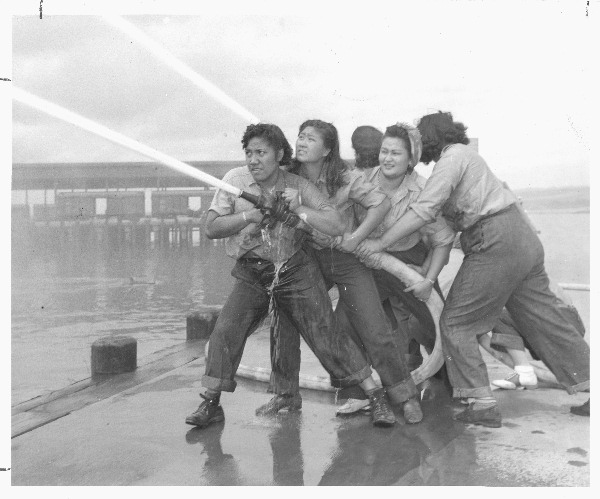
In an iconic photo, four Asian American Pacific Islander women at the Pearl Harbor Naval Shipyard train in firefighting. Long mislabeled as taken during the attack of Dec. 7, 1941, the photo in fact portrays some of  the strong women who applied to support the Navy’s war efforts in the wake of that attack. From left to right: Elizabeth Moku, Alice Cho, Katherine Lowe, and Hilda Van Gieson.


Over time, history usually has a way of sorting out fact from fiction.


Rear Adm.Grace Hopper, "Mother of Computing"
The facts and highlights of strong women of grit and grace are spotlighted in a book recommended for Women’s History Month. Profiles of more than 100 women come to life in “The Book of Gutsy Women” by Hillary Rodham Clinton and Chelsea Clinton (Simon & Schuster, 2019).

Among the women profiled are some we featured in Navy Reads posts: Rear Adm. Grace Hopper, Ada Lovelace, Rachel Carson, Marjory Stoneman Douglas, Margaret Chase Smith, Malala Yousafzai, and Maya Angelou. This book includes mini-biographies of both famous (Clara Barton, Helen Keller, Ida B. Wells, Maya Lin, Gabby Giffords, Greta Thunberg, and Venus and Serena Williams) as well as less-well-known women (Rigoberta Menchu Tum, Dr. Gao Yaojie, Nelba Marquez-Greene, Wangari Maathai, and Jineth Bedoya Lima).


Chelsea and Hillary Clinton, 2011
Hillary and Chelsea each provide essays about their subjects. They also offer personal perspectives about the women who have inspired and enlightened them – women who have made a difference in the world. The book is organized in sections: early inspirations, education pioneers, earth defenders, explorers and inventors, healers, athletes, advocates and activists, storytellers, elected leaders, groundbreakers, and women’s rights champions.

Chelsea writes, “I learned of Grace (Hopper) in 1996, when the navy named a new ship the USS Hopper (DDG 70) in her honor … I learned even more about her when I spoke many years later at the Grace Hopper celebration, the largest gathering of women technologists in the world.”


Former First Lady, senator, and Secretary of State Hillary Clinton reflects about the suffragists who knocked on the door, marched in the street, and fought for women to be able to vote in the United States one hundred years ago. That right was guaranteed with the passing of the Nineteenth Amendment to the U.S. Constitution, but it was a right that took decades to apply to women of color:

“Reading the words of the Nineteenth Amendment today, it’s hard not to wonder why it took so long” ‘The right of citizens of the United States to vote shall not be denied or abridged by the United States or by any State on account of sex. Congress shall have the power to enforce this article by appropriate legislation.’ But, of course, it was a long struggle because it was about so much more than the right of women to vote. It was about race, class, and deeply held cultural and religious views about women’s subordinate roles to men in society. It was about men’s –– and some women’s –– insecurities and fears of the unknown. These challenges are still present today.

The franchise –– the basic right of citizenship –– is still being fought over between those of us who believe every citizen should be able to vote and have that vote counted, and those who want to restrict the vote by erecting barriers against people, largely still based on race.”

Celia Ou, a graduate student at Scripps Institution of Oceanography, monitors computer screens displaying detailed sonar imaging of the ocean floor aboard the Auxiliary General Oceanographic Research (AGOR) vessel R/V Sally Ride, Dec. 15, 2016. (John F. Williams)


Nearly all the Gutsy women featured in this book faced and overcame some kind of obstacles of discrimination. Chelsea Clinton says this about space pioneer astronaut Sally Ride, the first American woman in space (in 1983) and a champion of STEM education for young people worldwide:

“Even after her death in 2012, Sally Ride kept breaking barriers. She came out as a lesbian quietly, without fanfare … Not long after her death, Tam [O’Shaughnessy, her partner of 27 years] received a call that surprised her, from Ray Mabus, then secretary of the navy. The navy hoped to honor Sally by naming a research vessel after her. Secretary Mabus was calling to ask whether Tam would be the ship’s sponsor – a role that had, up until that point, been filled by the wife of the man for whom the ship was named. ‘I think it is fitting the the celebration of Sally’s legacy as a pioneering space explorer and a role model includes an acknowledgment of who she really was and what she cared about,’ said Tam. The R/V Sally Ride, commissioned in 2016, is the first navy research ship named for a woman. Her legacy lives on in the scientific curiosity sparked in the girls and boys she continues to inspire, the ship that bears her name, and a spot on the moon named after her by NASA.”

Military readers may find fascinating nuggets of history in the essays about Sylvia Earle, Mary McLeod Bethune, Florence Nightingale, Eleanor Roosevelt, and Mary Edwards Walker. Chelsea writes this about Walker:

“…Dr. Mary Edwards Walker, the only woman in her medical school class at Syracuse Medical College in 1855. She was a practicing physician when the Civil War broke out. She desperately wanted to enlist in the Union Army as a surgeon but wasn’t allowed to because she was a woman. Initially she was called a nurse, since women generally weren’t considered doctors. Because women were not allowed to enlist, Mary had to volunteer, working for free at a temporary hospital, first in Washington and then in Virginia, where she traveled to Union field hospitals across the commonwealth … When her medical credentials were finally accepted she moved to Tennessee and became a War Department surgeon – a paid position that was the equivalent of a lieutenant in status.”


Dr. Sylvia Earle became chief scientist at the National Oceanic and Atmospheric Administration in 1990. She pioneered research in preserving 
and protecting the ocean, including the study of damage to coral reefs. Her inspiring TED talk, above, is a call to action. Hillary writes:

“When I think of Sylvia’s work, I am reminded how important it is for all of us to peruse and consider what we want to leave to the generations who come after us –– how they’ll honor the past, imagine the future, and give gifts to those who will live out their lives long after we’re gone. That’s exactly what Sylvia’s life as a scientist, an engineer, a teacher, and an explorer should inspire all of us to do: we must preserve our oceans for the future.”

Last year, this book generated controversy because of the women who were not included. For example, there is an unfortunate dearth of women who have served in or with the military. Surely, the authors could have included a “protectors” section filled with inspiring women who served in uniform.


Despite the intriguing photo on the cover, there is little focus on the women who served on the Homefront during the Second World War. In fact, there’s no explanation of the colorized photo of the women firefighters at the Pearl Harbor Naval Shipyard.

Yet, considering the general lack of attention toward the achievements of women in American and world history for many generations, it is refreshing to see a book of this scope. Women continue to knock on the door, push through the glass ceiling, and demand equality.


“The Book of Gutsy Women” illustrates the strengths of women throughout history, often in the face of sexism, misogyny, harassment, and patriarchy. It highlights the facts of women’s history and showcases women’s contributions to creating a better world now and in the future.