Showing posts with label 442nd. Show all posts

Tuesday, October 19, 2021

The Will of an ‘Unruly Torrent’

Review by Bill Doughty––

Venerable thinker George Will unleashes a storm of opinions in “American Happiness and Discontents: The Unruly Torrent, 2008-2020" (Hachette Books, 2021), proving he is still sharp in his observations while cemented in his positions of right and wrong.


This is a book of nearly two hundred essays about everything from military history and life-and-death issues to Will’s thoughts about the Beach Boys, Baptists, baseball, and blue jeans. (Regarding the latter, he claims to have only one pair, worn only once. He believes men should dress like Fred Astaire, women like Grace Kelly.)

While Will shares some acerbic humor, mostly he offers a ribbon of melancholy that ties these essays together. So many in this collection are devoted to past wars and their aftermath. Others lament culture wars still happening. And a final section, “Farewells, Mostly Fond,” features obituaries, including to fellow conservatives William F. Buckley, Charles Krauthammer, Gerald Ford, and George H.W. Bush, as well as, surprisingly, liberal-of-liberals George McGovern.


The most poignant remembrance is the final essay in the book, written July 6, 2008. Will honors the memory of Army Lieutenant Colonel Jim Walton, killed in Afghanistan. The essay is also a tribute to casualty assistance calls officers, CACOs, including LtCol Walton’s spouse, Sarah, herself a CACO who had to receive the terrible news of her husband’s death.


An epigraph by CACO Maj. Steve Beck, United States Marine Corps, at the beginning of the Walton essay contains a “found haiku”:


...curtains pull away.

They come to the door. And they

know. They always know


George Will concludes his Walton essay –– and his book –– with this:

“When the Army CACOs came to the Arlington door or Sara Walton, my assistant, she was not there. She rarely forgot the rule that a spouse of a soldier in a combat zone is supposed to inform the Army when he or she will be away from home. This time Sarah forgot, so it took the Army awhile to locate her at her parents’ home in Richmond.

“Her husband, Lieutenant Colonel Jim Walton, West Point Class of 1989, was killed in Afghanistan on June 21. This week he will be back in Arlington, among the remains of the more than 300,000 men and women who rest in the more than 600 acres where it is always Memorial Day. This is written in homage to him, and to Sarah, full sharer of his sacrifices.”*

George Will
Sacrifice on behalf of the nation is tied to the ribbon of sadness in the nearly 500 pages of this collection.

Will writes in “A Nation Not Made by Flimsy People” of the grit required to win the Revolutionary War. Readers will be reminded of the great historian David McCullough’s “1776,” one of the first books we featured on Navy Reads.


In “The Somme: The Hinge of World War I, and Hence of Modern History” he contextualizes the “reverberations” of that war. The First World War influences Will’s thinking and inspiration for topics, including in the penultimate essay, “The Last Doughboy.”


In “Haunted by Hue” and “Vietnam: Squandered Valor” he properly acknowledges the sacrifices of brave young Americans, while castigating the mendacity of the power structure that sent them to a war that was ultimately a “tragedy,” including for the people of Vietnam.


Color guard of 442nd in 1944

In “The 442nd,” written in 2010, he pays tribute to the most decorated unit for its size in American history, the Japanese-American soldiers who fought against Fascism and Nazism in Europe in WWII while many of their families were imprisoned in internment camps back in the States. George Will met some of these patriotic veterans.

“Such cheerful men, who helped to lop 988 years off the Thousand Year Reich, are serene reproaches to a nation now simmering with grievance groups that nurse their cherished resentments. The culture of complaint gets no nourishment from men like these who served their country so well while it was treating their families so ignobly. Yet it is a high tribute to this country that it is so loved by men such as these.”

Will has no time for political correctness and what’s now called “cancel culture.” He takes on some of the debates about political and social topics dominating college campuses. On the other hand, he also has no tolerance for racism, terrorism in the name of religion, and attacks on democracy.


He shows how the values of Frederick Douglass won out over Woodrow Wilson's bigotry. But he has little compassion or understanding for renaming professional sports teams such as the former Washington Redskins or for “coercing” bakers who refuse, for religious reasons, to provide a cake for a same-sex wedding. 


He celebrates books and “binge reading” while condemning new technologies and platforms that rewire the brains of young people, shorten attention spans and erode the ability to think critically and independently.

To say George Will is sometimes like the grouchy old man yelling at youngsters to get off his lawn is to state the obvious. But he cares about what he believes in, and he communicates with passion and conviction. His ribbon leads through a pursuit of happiness that ends ultimately to a reward for readers.


*(Lost at first reading is George Will’s epigraph to the entire book: “For Sarah Walton –– To whom I am indebted for her many years of indispensable assistance. And to whom the nation is indebted.”)


Grieving and Honoring
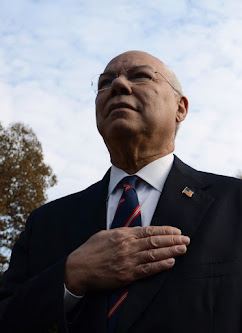

Colin Powell
I finished this book as I heard the news of an icon of conservative leadership passed away: former Secretary of State and Chairman of the Joint Chiefs of Staff Gen. Colin Powell. Flags fly at half staff for the great principled patriot and warrior-diplomat. But General Powell would want us to pay tribute to the person he most looked up to and respected in his life, his wife Alma. Powell told author Bob Woodward that Alma was his moral compass and inspiration.

Alma Powell is sponsor of USS Kearsarge (LHD-3). She is also the namesake of Kearsarge's airfield. 


According to the Navy, "Throughout her life of civic leadership [Alma] Powell has helped young people in need of educational resources for more than four decades. While serving as Chair of the Board of Directors for America’s Promise Alliance, a non-profit organization dedicated to improving the education opportunities of disadvantaged children, Ms. Powell helped to lead more than 450 partner network’s efforts to help tens of thousands of young people by connecting them with resources essential for academic success."


Capt. Neil Koprowski, commanding officer of the Wasp-class amphibious assault ship USS Kearsarge (LHD 3), delivers remarks during an airfield dedication ceremony in honor of Alma J. Powell, May 28, 2021. Alma Powell, Kearsarge’s ship sponsor, is a military spouse, a civic leader and civil rights activist who has advocated for women, children, and minorities for more than four decades, and has helped tens of thousands of disadvantaged people around the world. (MCSN Gwyneth Vandevender)

TOP PHOTO:
Gen. Colin L. Powell speaks at the 26th National Memorial Day Concert on the West Lawn of the U.S. Capitol in Washington, D.C., May 24, 2015.to help unite the country in remembrance and appreciation of the fallen and to serve those who are grieving. (MC1 Daniel Hinton)

Saturday, May 25, 2013

The Eclectic, Electric and Heroic


by Bill Doughty

It’s been a few weeks since I’ve posted to Navy Reads. Been too busy reading an eclectic list of books: Mary Roach’s “Gulp: Adventures on the Alimentary Canal” (sickeningly good), Scott McGaugh’s “Midway Magic” (long live CV-41), and several books that may help explain the violent extremist insanity that led to the Boston Marathon bombings (to try to understand the “why”).  

These books include “Chechen Jihad” by Yossef Bodansky, “8 Pieces of Empire” by Lawrence Scott Sheets, “The Lone Wolf and the Bear” by Moshe Gammer, and “The Black Banners” by Ali Soufan.  All provide insights into Chechnya, “Chechenization” and the twisted currents of Islamist-Jihadists.

Reviews of any of the above titles are on hold, though.  I also picked up a copy of “The Orphan Master’s Son” by Adam Johnson, a work of colorful imagination set in and around North Korea.  So far, this stark thriller is a work of art and beauty with ties to both the sea and Japan.

Speaking of novels... Coming soon, a very special post courtesy of retiring Adm. James Stavridis who stepped down this month as NATO Supreme Allied Commander.
ADM Stavridis is honored after stepping down at NATO May 13, 2013.

Stavridis has an electrifying intellect.  Watch his TED Talk on global security  -- building bridges, not walls, and protecting sea lanes -- to understand the U.S. Navy’s raison d’etre.


As secretary of the Navy it is my privilege to name these ships to honor a respected naval leader and a true American hero." Mabus said. "For decades to come, the future USS Paul Ignatius and USS Daniel Inouye will represent the United States and enable the building of partnerships and projection of power around the world." 
Sen. Inouye speaks with a Navy Captain aboard USS Midway, year unknown.

Former Navy leader Paul Ignatius served as secretary of the Navy in the late 1960s under President Lyndon Johnson.  Inouye earned the Medal of Honor for his heroism in battle with the 442nd Regimental Combat Team in Italy. First elected to the U.S. House of Representatives when Hawaii became a state in 1959, he was elected to the U.S. Senate in 1963 and served there until his death at age 88.

This will be the first Memorial Day since Sen. Inouye’s passing last December.  He was a great American hero, consensus builder and forward-thinking visionary who, decades ago, understood the importance of rebalancing to the Pacific.


070505-N-3642E-385 GROTON, Conn. (May 5, 2007) – Sen. Daniel Inouye prepares to speak at the commissioning of USS Hawaii (SSN 776). Hawaii is the third Virginia-class submarine to be commissioned and the first major Navy combatant vessel class designed with the post-Cold War security environment in mind. U.S. Navy photo by Chief Mass Communication Specialist Shawn P. Eklund (RELEASED)

Tuesday, December 18, 2012

Senator Inouye - Passing of an American Hero

by Bill Doughty

When Senator Daniel K. Inouye was a young man going to war in 1943 to fight in Europe his father told him, “...if you must die, die with honor.”  After a lifetime of honorable service, Medal of Honor recipient Inouye passed away Dec. 17, 2012.

A statement from his office conveyed the loss.  President Obama issued a statement, calling Inouye “a true American hero” who  “worked to strengthen our military, forge bipartisan consensus, and hold those of us in government accountable to the people we were elected to serve.”

A Navy Reads post, “Honor by Fire,” describes the commitment and sacrifice of Inouye and his compatriots and the saga of Americans of Japanese Ancestry in World War II in a review of "Honor by Fire" by Lyn Crost.

Ten days prior to his death Sen. Inouye, an eyewitness of the attack on Pearl Harbor, reflected on the “magnitude and cost of the war.”

Statement by Senator Daniel K. Inouye, Dec. 7, 2012:
“In 1941, the date December 7th was a day that evoked anger, fierce patriotism and dangerous racism. Soon after that day, I suddenly found myself, pursuant to a decision by the government and along with thousands of Japanese Americans declared 4C, enemy aliens. It was a difficult time. I was 17.”
“I joined many of my classmates and sent petitions to the government, pleading for the opportunity to fight. We wanted to affirm our loyalty and pride of citizenship. The request was granted in the final days of 1942.”
“The government decided to form a combat team made up of young Americans of Japanese Ancestry (AJA), the 442nd Regimental Combat Team. In Hawaii, they asked for 1,500 volunteers. About 10,000 signed up, more than 85 percent of the eligible Japanese American males in Hawaii.”
“The day I rushed down to the draft board to volunteer, I was a freshmen in college. I was a pre-medicine major. There were 36 AJA’s in my class, 34 volunteered, and all were wounded or killed. As a result, after the war, there were very few AJA doctors in Hawaii.”
Inouye, front left, and AJA buddies.
“During one of our first fights, my best friend, Jin Hatsu Chinen, was killed in an artillery barrage. We were to open a clinic in Honolulu together after the war. He was teaching me to play the guitar. His death, reminded me, reminded all of us, of the magnitude and cost of the war we were fighting.”
“The 442nd went on to become the most decorated unit of its size in the history of the United States Army, but we suffered horrific losses and those of us lucky to survive the fight swore we would live life for our brothers who did not come home. I shall always be grateful to President Roosevelt for giving us the opportunity to demonstrate our love of country.”
“On this day, let us remember all those who have had the courage to put on the uniform and sacrifice for our great nation. Our way of life has always, and will always be, protected and preserved by volunteers willing to give their lives for what we believe in. I thank each of you for your service to the nation, I thank you for your many sacrifices, and I thank you for being an American patriot.”

Sunday, May 15, 2011

Ganbare!

Review by Bill Doughty
Juxtaposed: the glory earned by Hawaii’s famed 442nd Regimental Combat Team in WWII and the humiliation endured by some of Hawaii’s Japanese immigrants and Americans of Japanese Ancestry incarcerated during the war.  
Along with other people of Japanese ancestry in the mainland and in Central and South America, immigrants and their families in Hawaii were literally caught up in the aftermath of the attack on Pearl Harbor of Dec. 7, 1941 and placed in internment camps in Hawaii and on the U.S. mainland.
The story of these prisoners is told by Patsy Sumie Saiki in Ganbare! An Example of Japanese Spirit, copyright 1982.  “Ganbare,” a word used frequently in everyday conversation in Japanese, means “don’t give up,” “keep going,” “persevere,” “keep trying.”
Saiki interviewed dozens of Japanese American internees and several former military internment camp leaders, giving her book the feel of an oral history. 
She shows examples of the unintended consequences of war and how quickly some people are ready to shed moral or ethical values in the name of assumed greater security.  Saiki reveals how immigrants’ fishing boats were strafed and how even U.S. planes were shot down in friendly fire incidents in the foggy aftermath of the attack.  She introduces us to the families torn apart when an Imperial Japanese military pilot was shot down and stranded on the island of Ni‘ihau.  
Internee tents at Sand Island in December, 1941.
We learn about the stockades and camps at Kalaheo, Kauai and Haiku, Maui.  We see how the prisoners lived and adapted on Sand Island, Oahu and at camps in Wisconsin, Tennessee, Oklahoma, Louisiana, Arkansas, Texas, New Mexico and other states.
Prisoners had creative ways of dealing with the humiliation of incarceration.  When they had to use the latrine they would have to report to the guard and say “Prisoner.”  Instead, the internees would purposely mispronounce the word and report as “Pissoner.”  Such pranks have a familiar ring.  It’s how POWs, like Gerald Coffee in Vietnam, dealt with similar situations.
The concept of “Ganbare!” -- endure and overcome -- is raised time and again as detainees faced family separation, loss of dignity and other hardships.
What also helped them the most?  The Hawaiian concepts of “ohana” (family) and “aloha” (love and caring).
In her “oral histories,” Saiki reveals that what the prisoners most remembered the kindness, caring and sharing not only of their fellow inmates but also of the camp guards such as Sgt. Launcelot Moran, Lt. Col. Horace Ivan Rogers and Capt. Siegfried Spillner.
These characters show the strength of humanity and the importance of “home” despite national origin or religious affiliation.
One online dictionary shows the meaning of “ganbare” as “bear up!, hold out!, keep going!, Never say die!, Come on!, Hang in there!, Go for it!”... similar to the 442nd’s “Go for Broke!”
Ganbare! -- enduring, persevering, overcoming -- is reflected in the way Japan is dealing with the aftermath of the earthquake and tsunami of 2011.  It’s also a lesson learned from 1941 to help people prevent conflict and not repeat the mistakes of war.
This week Chief of Naval Operations Adm. Gary Roughead served as keynote speaker at the 26th Annual Federal Asian Pacific American Council (FAPAC) National Leadership Training Conference, during Asian American Pacific Islander Month. 
"We as public servants, all of us, with the trust of the American people must leverage our uniquely American advantages in diversity if we are to lead institutions poised to deliver greater peace and prosperities to the generations to come," Roughead said.

Saturday, January 2, 2010

Honor by Fire

Review by Bill Doughty

Honor, courage and commitment in the face of prejudice, fear and disenfranchisement: This book shows the story of triumph of American democracy over small-mindedness and bigotry as its author introduces us to a special group of service members from World War II.

Lyn Crost, correspondent for AP, Star-Bulletin and Honolulu Advertiser, documented this important slice of history just three years prior to her death in 1997 at the age of 80.

One hundred years ago Imperial Japan considered Okinawa a stepchild. Okinawans were treated as second-class citizens. Many emigrated to a land of opportunity Hawaii.

Japanese from Okinawa and mainland Japan who came to the Hawaiian islands and the West Coast of the United States embraced their new country, a land of freedom and opportunity.

Their children (nisei, or second generation), became loyal Americans, willing to serve in the U.S. military and risk their lives for the country of their birth.

After the attack on Pearl Harbor on Dec. 7, 1941, however, many non-Japanese Americans questioned the patriotism of Americans of Japanese Ancestry (AJAs).

Racism brought about internment imprisonment of Japanese families, mostly those living in California, including some of the families of the AJAs serving in the military.

Ironically, AJA service members exemplified by the 442nd Regiment, 552nd Field Artillery Battalion (pictured at right with Crost), Military Intelligence Service, and others fought against racist German Nazis, Italian Fascists, and Japanese imperialists, while their families experienced discrimination back home.

Nisei demonstrated superior intelligence collection, communication skills and bravery under fire. Crost’s history of AJAs in WWII in Honor by Fire is a chronological work of love, a tribute to the achievements and legacy of these proud Americans, both in the Pacific and in Europe.

There are universal timeless lessons in this book.

Crost shows the success of the nisei approach to treating and interrogating prisoners by building trust and showing empathy.

Each of the Marine divisions at Iwo Jima had a team of nisei linguists who worked with Marines and Seabees in clearing caves (pictured below), trying to persuade Imperial Japanese soldiers to surrender instead of committing suicide, then interviewing them to gather intelligence.

Linguists also translated diaries and documents that revealed vital information about the enemy, information provided immediately to Fleet Admiral Chester Nimitz and Army and Marine Corps leaders.

The AJAs used their trust-building techniques to communicate with Japanese civilians and soldiers on Okinawa near the end of the war, persuading hundreds hiding in tunnels or caves to surrender. Unfortunately, many women and children chose to believe Imperial Japanese Army propaganda and jumped from cliffs into the rocks and sea below.

Crost tells compelling stories of AJA heroism, taking readers to New Guinea, Italy, Burma, Anzo, Philippines and German death camps. She introduces us to dozens of individual soldiers along the way.

Tech. Sgt. Herbert Miyasaki, Gen. Frank D. Merrill (of Merrill’s Marauders) and Tech. Sgt. Akiji Yoshimura. Merrill's evaluation of the nisei: "As for the value of the nisei group, I couldn't have gotten along without them. Probably few realized that these boys did everything that an infantryman normally does plus the extra work of translating, interrogating, etc. Also they were in a most unenviable position as to identity, as almost everyone from the Japanese to the Chinese shot first and identified later."

Among the best known of the AJAs of WWII: then-2nd Lt. Daniel K. Inouye, whose platoon engaged in combat against fascists in Italy at Mount Nebbione on Apr. 20, 1945. Crost reports what happened:

Inouye’s platoon encircled and destroyed an enemy patrol and mortar observation post, then advanced to within forty yards of the main enemy force, which was shielded in a hilltop rock formation with three machine guns hidden in a bunker. There was no cover on the hillside leading to it. Inouye crawled up the hill alone to locate the weapon emplacements; as he was taking out a grenade, he was hit in the stomach by machine-gun fire. The blow knocked him down, but he managed to get up, pull the pin from the grenade, run to within five yards of the nearest machine gun, and throw the grenade inside the position. As the gunners struggled to their feet, he raked them with his tommy gun.

His men ran to help him but were pinned down by enemy fire. Inouye, bleeding from the stomach, staggered farther up the hill and threw two more grenades into the second position before he fell again He dragged himself toward the last machine-gun nest, stood up, and pulled the pin from another grenade. He had just drawn back his right arm to throw it when his right elbow as smashed by a rifle grenade, which almost tore off the arm. By reflex action, his right hand was still clenching the grenade and its safety handle. His men ran to help him but Inouye yelled at them: “Go back!” Reaching down with his good left hand, he took the grenade out of the clenched fist of his shattered right arm and threw it at the remaining machine-gun next, destroying it. Then, with his left hand controlling his tommy gun and his right arm flapping against his side, he started finishing off the surviving gunners. Before he was through he was hit again by gunfire, this time in his right leg and he fell down the hill... Inouye refused to be evacuated until his men were deployed in defensive positions against a possible counterattack.

In this attack, twenty-five enemy troops were killed and eight others captured. Inouye’s right arm had to be amputated. His dream of becoming a doctor was ended...

At the war’s end, Inouye, like a lot of AJAs, had to deal with racism back in the United States.

Passing through California on his way back to Hawaii, Capt. Inouye tried to get a haircut at a barbershop near San Francisco. An attendant met him at the door and said, “You’re a Jap and we don’t cut Jap hair.”

Today, Senator Daniel K. Inouye, a recipient of the Medal of Honor, is the second-most senior member of the U.S. Senate, chairman of the U.S. Senate Committee on Appropriations and senior member of the Commerce, Rules and Indian Affairs Committees.

The outright racism Inouye experienced 65 years ago is thankfully less overt today, though one could argue that fear-borne incivility is making a resurgence.

Educated voices, on the other hand, call for collaboration, embracing differences to achieve harmony. Crost's conclusion:

“I have learned that we are dependent on each other, and that the future will be based on the ability of our diverse races, religions and cultures to weave an understanding that will rise above inevitable conflicts. My Japanese-American friends have taught me this lesson.”

While this book is not on the Navy’s Professional Reading Program list, it is recommended by the U.S. Army Center of Military History on its history site about the 442nd Regimental Combat Team. Other titles referenced include Masayo Duus’s Unlikely Liberators: The Men of the 100th and 442nd, Thomas Murphy’s Ambassadors in Arms: The Story of Hawaii’s 100th Battalion, Orville C. Shirey’s Americans: The Story of the 442nd Combat Team, Ronald Takaki’s Strangers from a Different Shore: A History of Asian Americans, Chester Tanaka’s Go for Broke, and Daniel K. Inouye’s Journey to Washington.