Showing posts with label LBJ. Show all posts

Wednesday, September 13, 2023

McRaven’s ‘Simple’ Bullfrog Advice

Review by Bill Doughty––

Seventy-three years ago, September 15, 1950, Gen. Douglas MacArthur landed at Inchon, Korea. In the following weeks, U.S. forces began to rout the communist North Korean army and push them almost to the Yalu River near China. Then, in November the Americans encountered well-armed Chinese interventionists supporting the North Koreans.


“Hill 205 seemed an unlikely place for an Army legend to be born,” writes Admiral William H. McRaven (U.S. Navy, Ret.) at the beginning of chapter 7 of “The Wisdom of the Bullfrog: Leadership Made Simple (But Not Easy). McRaven recounts the actions of Army Ranger First Lieutenant Ralph Puckett, who in 2021 received the Medal of Honor, presented by President Joe Biden for actions in Korea. At great personal risk, Puckett helped his Rangers locate and attack camouflaged Chinese machine gun nests and mortar teams that pinned them down.

“Puckett, who had positioned himself at the front of the advancing Rangers, knew there was only one thing he could do. With complete disregard for his own life, Ralph Puckett rose from his foxhole and dashed out into the open field, forcing the Chinese to take aim at the young lieutenant. As the machine gunners began to fire a the sprinting Puckett, the Rangers spotted their positions and engaged them. Puckett returned to his foxhole only to catch his breath, and then leaped out and ran into the open again. With each dash by Puckett into the exposed terrain, the Rangers were able to isolate and destroy more enemy machine gunners.

“Having suppressed the small arms fire, the Rangers proceeded to take Hill 205. History would show that over the next two days, the Rangers under the command of Ralph Puckett would fight off wave after wave of Chinese assaults that took the lives of ten Rangers and left thirty-one wounded, including Puckett.”

Puckett would again serve with honor in Vietnam, where he earned the Distinguished Service Cross and two Silver Stars and was personally recognized by President Lyndon B. Johnson.


McRaven uses the story of Puckett’s heroism at Hill 205 to illustrate the Ranger motto “Sua Sponte” (“Of Your Own Accord”).  “In other words, doing what needs to be done without being told to do so,” McRaven explains.

“There is often the misguided belief that soldiers only follow orders, but the strength of the American military is that the great soldiers, the truly great leaders, do what is right without being told. They do what is right to protect their men and women.”


Senior military leaders expect even young and relatively junior service members to take the initiative when necessary. Such integrated empowerment is a cornerstone of leadership, and can be effective not only in the military but also in business, sports, medicine, citizenship, and developing a healthy family.


A simple, powerful concept. Which is also a good descriptor for this small but excellent book.


Memorial statue of Basilone in New Jersey
“Sua Ponte” is just one of the ideas presented here by the author of “Make Your Bed,” “The Hero Code,” and “Sea Stories.”

McRaven opens his latest book with a discussion with the most important aspects of being a good leader: Honor and integrity, captured in legendary United States Marine hero Sgt. John Basilone’s motto: “Death before Dishonor.” Honor and integrity are the foundation of a trustworthy leader.


Another motto explored in “Bullfrog” is the British Special Air Service’s Qui Audet adipiscitur: "Who dares, wins."


An honorable leader who demonstrates commitment, hard work, and initiative, will earn the trust of their followers, according to McRaven. Stamina, a willingness to sacrifice, and confidence, along with humility and the ability to make hard choices, are also important leadership qualities. Commanders “must have perseverance and, above all, confidence in ourselves.”


All the above qualities and more were personified by Adm. Chester W. Nimitz in World War II, particularly in the Battle of Midway: The great admiral faced a difficult choice about whether to ambush the Imperial Japanese Navy at Midway. “The fate of the entire Navy, and perhaps our nation, rested on this decision,” McRaven writes. “But history would show that the Battle of Midway was the single most decisive naval battle of the war and turned the tide in the Pacific.


Other legendary leaders highlighted in this outstanding book include father of the Navy SEALs, Adm. Chuck LeMoyne; WWII British officer and father of the SAS, Col. David Stirling; U.S. Special Operations leader Gen. Stanley McChrystal; Air Force visionary Billy Michell; Vietnam War hero Col. Elliot “Bud” Sydney; and former president Barack Obama, who, like Nimitz and Midway, faced a difficult decision, with uncertain information, about launching the mission to capture Osama bin Laden.


“It was an enormous risk, but one the president knew he had to take. I admired his guts –– Who Dares Wins –– but more importantly,” McRaven reflects about Obama, “I admired his intellect for understanding the nature of the risks he was assuming.”

Good leaders attack problems aggressively. “Mistakes of action are far less consequential than mistakes of inaction,” he notes. Hope, luck, and desire are important, but they are not a strategy. “Be a risk-taker, but manage the risk through extensive planning, preparation, and proper execution.”

All Hands: McRaven speaks to service members at Bagram Air Field, Afghanistan, Thanksgiving Day, 2013. (Army Staff Sgt. Osvaldo Equite)
Each chapter features an insightful epigram quotation by well-known and sometimes surprising people: Abraham Lincoln, Marie Curie, Alvin Toffler, Oprah Winfrey, Michael Jordan, William Shakespeare, Tacitus, Booker T. Washington, Coach Mike Krzyzewski, and Taylor Swift.

Yes, Taylor Swift.


In fact, her epigram quote for chapter ten, titled “No Plan Survives First Contact with the Enemy,” is a found haiku:


Just because you made

a good plan doesn’t mean that’s

what’s gonna happen


McRaven discusses the importance of planning, inspecting, and always having a plan B.

When one of their helicopters became damaged in the bin Laden raid, the well-trained and ready SEALs adjusted, overcame, and accomplished their mission. Training mitigates risk and saves lives.

Importantly, McRaven notes that even the best leaders will have setbacks and seemingly insurmountable challenges. But how they deal with failures and obstacles makes all the difference.

This is a great book for any new leader, would-be commander, and anyone interested in the importance of character, competence, and ethical behavior –– integrity –– in military and national leadership.


There are many references in “Bullfrog” to Basic Underwater Demolition/SEAL training, Coronado, and San Clemente. But there is an unexpected thread throughout the book leading through Hawaii, which help illustrate key leadership principles.


“The Wisdom of the Bullfrog” concludes with a spotlight on Navy SEAL Lt. Michael Murphy’s favorite book, “Gates of Fire” by Steven Pressfield"Gates of Fire" is also a favorite of Gen. James Mattis (USMC, Ret.) and is a recommendation by Adm. James Stavridis (USN, Ret.). The novel is or has been on the reading lists of many military leaders, including the Commandant of the Marine Corps (currently a vacant position).


Pressfield speaks to Marines and fellow veterans at Camp Pendleton in 2011. (Sgt. Skyler Tooker)
“Gates of Fire” imagines the 300 Spartans who fought valiantly in the Battle of Thermopylae in 480 BCE. In the fictionalized account, Pressfield, a former Marine, channels what the last Spartan may have said about his king, King Leonidas, and what made his king such a great leader: “A king does not abide within his tent while his men bleed and die upon the field. A king does not dine while his men go hungry, nor sleep when they stand at watch upon the wall, A king does not command his men’s loyalty through fear nor purchase it with gold; he earns their love by the sweat of his own back and the pains he endures for their sake. That which comprises the harshest burden, a king lifts first and sets down last. A king does not require service of those he leads but provides it to them…”

While not always easy –– and often extremely hard to live by –– McRaven’s leadership principles are actually “simple” he says. He offers a list of sayings taken from his chapter headings and a QR code at the end of the book for readers to obtain a printable version of the “Wisdom of the Bullfrog.” (The term Bullfrog refers to the the longest serving Navy SEAL on active duty, which McRaven once was for nearly 40 years.)


Sometimes advanced age has its leadership advantages.

Saturday, April 29, 2023

Three Navy-blue Green Presidents

Review by Bill Doughty––

Six United States presidents in my lifetime were Navy veterans: John Kennedy, Lyndon Johnson, Richard Nixon, Gerald Ford, Jimmy Carter, and George H.W. Bush. Each in his own way and to varying degrees was an optimistic champion of the environment.


Efforts of the first three –– JFK, LBJ and RMN –– led to the first Earth Day in 1970, now Earth Month in April.


The environmental movement is sometimes overshadowed by the other tectonic shifts during that era: The Cold War, Civil Rights, and the Vietnam War. But Douglas Brinkley takes the history of the green movement out of the shadows by centering on the three presidents of the era, as well as highlighting the life and work of ecologist-writer Rachel Carson, in “Silent Spring Revolution: John F. Kennedy, Rachel Carson, Lyndon Johnson, Richard Nixon, and the Great Environmental Awakening” (HarperCollins, 2022).


Sailor JFK
The Navy had a large part in shaping the vision of the presidents who defended pristine wilderness, clean air and water, and preservation of the environment.

For Kennedy of Massachusetts, it began with a deep love of the sea and shoreline, according to Brinkley, who opens the book with this:

“Beguiled by the way sea and sky played together, almost always unpredictably, John F. Kennedy was enthralled by the complexity of the Atlantic Ocean: the moody sky, the invisible might of the tides, shifting clouds, and the yaw and pitch of movement. To be on the water in a sailboat, even in a cruel wind, provided him with a profound connection with nature.”

Kennedy saw, in his own words, the human “biological fact that all of us have, in our veins, the same percentage of salt in our blood that exists in the ocean, and, therefore, we have salt in our blood, in our sweat, in our tears. We are tied to the ocean,” he said.


Johnson of Texas, was saddled with fighting the Vietnam War, poverty, segregation, and voter suppression. Environmentalism took somewhat of a back seat to other priorities. Brinkley writes:

“On the conservation front, Johnson probably should have been aware of of the importance of intelligent land stewardship. His favorite novel –– John Steinbeck’s ‘The Grapes of Wrath’ (1939) –– was based on a man-made ecological catastrophe during the Great Depression that destroyed ranches and farms in Texas, New Mexico, and Oklahoma. It was soil depletion that led to the Dust Bowl. Johnson, however, was left wanting to help the rural poor, without setting an equal priority on nurturing the natural world around them. Johnson liked Bureau of Reclamation dams, because he knew first-hand how electricity lit up forgotten regions, literally and figuratively.”

LBJ’s penchant for dam-building, both at home and abroad, as well as his escalation of the Vietnam war, caused consternation for environmentalists.

LBJ
Yet, in 1968, Johnson signed the Wild and Scenic Rivers Act. “Rivers, Johnson believed, from the far-flung waterways of Alaska, Idaho, and Wyoming to those coursing through the rural countryside of Vermont and Maine were the lifeblood of America,” Brinkley observes.

Johnson “forged ahead on conservation legislation to protect wild places because it was part of America’s frontier heritage.” LBJ is responsible for bringing about the Wilderness Act, Highway Beautification Act, and a commitment to “a green legacy for tomorrow.” According to Brinkley, Johnson should be given more credit for his advocacy to conservation, particularly of America’s rivers (just as President Eisenhower is recognized for the national highway system). As regards LBJ, “His Wild and Scenic Rivers Act was a visionary law passed purely on behalf of the aesthetics of rivers.”


Nixon of California, was captivated by the Pacific Ocean, as a child in Orange County. In 1969 he would make his home, as Kennedy did, next to the ocean. In Nixon’s case, it was in San Clemente, where he enjoyed whale watching. Though facing his own corruption issues that would eventually lead to his expulsion from office, Nixon still managed to achieve positive global initiatives such as rapprochement with China and arms control talks with Russia. And he not only supported the Clean Air Act, Clean Water Act, and National Environmental Policy Act, but he also created the Environmental Protection Agency.

“If Nixon’s signing of NEPA and his Everglades protection were the first big time indications of the administration’s serious commitment to environmental protection, the State of the Union address on January 22, with its plea that ‘Restoring nature to its natural state is a cause beyond party and beyond factions,’ was seen by surprised Democrats as the Great Reconfirmation that Nixon indeed harbored a genuine TR streak … When Nixon delivered a Special Message to the Congress on Environmental Quality on February 10 (1970), he listed fourteen executive orders and twenty-three legislative proposals to combat pollution and provide parkland. ‘The time has come when we can wait no longer to repair the damage already done,’ he told Congress.”

Brinkley notes several times that Nixon was “suspicious” of liberal traps, so he did not appear on TV for the first Earth Day. He even asked FBI director J. Edgar Hoover, to spy on high-profile Earth Day events on college campuses, fearful of their ties with the anti-Vietnam War movement.


Yet, Nixon’s support of conservation, preservation, and a clean environment persisted.


Nixon
In 1970 he created the EPA (Environmental Protection Agency) and NOAA (National Oceanic and Atmospheric Association, and he signed the Clean Air Act.

On October 21, 1972, Nixon signed the Federal Environmental Pesticide Control Act of 1972, an achievement to the legacy of Rachel Carson. He signed the Marine Mammal Protection Act in 1972 and the Endangered Species Act of 1973.


And he signed the Emergency Highway Energy Conservation Act (limiting nationwide speed limits to 55) and the Federal Energy Administration Act in 1974 (the same year he was forced to resign because of Watergate).


Brinkley briefly shows how the Navy stopped pumping sewage into San Francisco Bay while in port. He also discusses how, during the Nixon administration, Marines at Camp Pendleton helped protect endangered wildlife. In coordination with the Department of Interior and NASA, the Navy sponsored the first all-women team of aquanauts in Tektite II to study the ecosystem at the bottom of the sea.


All three Navy-veteran presidents –– two Democrats and one Republican –– were following the lead of conservationist Republican President Theodore Roosevelt of another generation, and who had his own strong ties to the Navy and who championed nature and national parks. 


In two appendices Brinkley lists scores of national wildlife refuges and national parks created or authorized by Kennedy, Johnson, and Nixon.


One of President Nixon’s many environmental preservation initiatives included establishing a federally designated Wilderness area, the Cumberland Island National Seashore. “Because Cumberland National Seashore encompassed twenty-three different ecological communities, Nixon agreed that only three hundred tourists at a time be allowed on Cumberland Island. Georgia Governor Jimmy Carter, a moderate Democrat, played a major conservation role regarding the saving of Cumberland…"


Rachel Carson talks about "Silent Spring" in April 1963
This massive book (857 pages!) includes dozens of evocative photos, memorable stories, and captivating personalities of the people who created the environmental enlightenment and “awakening” in the 1950s, 60s, and early 70s.

Rachel Carson provided much of the inspiration for the environmental movement leading up to the first Earth Day and the public’s demand for clean water, air, and land. She wisely connected the long-lasting danger of atmospheric tests of nuclear weapons with the hazards related to DDT, a pernicious pesticide that altered ecosystems. We have referenced or featured Carson’s works several times here on Navy Reads.


Carson’s “Silent Spring” and her Sea Trilogy inspired John F. Kennedy. Family matriarch Rose Kennedy gave a copy of “Under the Sea-Wind,” published in 1941, to JFK in the mid-1950s.


“Although ‘Under the Sea-Wind’ sold in low numbers, perhaps because Pearl Harbor occurred right after it debuted, it became celebrated by marine biologists and other lovers of the animal kingdom,” Brinkley writes.


Carson was, in turn, inspired by Albert Schweitzer. And it seems everyone was inspired by Henry David Thoreau. 


Brinkley also follows the influence and positive impact of artists, writers, scientists, and politicians: Ansel Adams, John Muir, Carl Sandburg, Marjorie Stoneman Douglas, William O. Douglas, Linus Pauling, Harold Ickes, Wallace Stegner, Robert Frost, Ted Sorensen, Robert F. Kennedy, Cesar Chavez, Jacques Cousteau, Sylvia Earle, Barry Commoner, David Brower, Lady Bird Johnson, Howard Zahniser, Ralph Nader, Robert Boyle, John Saylor, Katherine Ordway, Chief Luther Standing Bear, Laurance Rockefeller, Russell Train, Stewart Udall, Ronald Dellums, Daniel Patrick Moynihan, Henry “Scoop” Jackson, Frank Church, Philip Hart, Gaylord Nelson, Edmund Muskie, William Ruckelshaus, Walter Hickel, Al Gore, and John Ehrlichman.


In the book’s preface, Brinkley praises those “serving a cause bigger than oneself” and warns against the ostrich syndrome of ignoring ongoing threats to the environment, including climate chaos. 

He writes: “The poisonous climate cocktail of ravaging wildfires, mega floods, and monstrous blizzards costs American taxpayers billions of dollars every year (soon to climb to trillions), disrupts lives, causes vast displacement, ruins communities, and kills countless citizens.”

Brinkley says, “In some small way, I hope this book illuminates how an engaged citizenry can bring America’s natural beauty back from the brink.” He writes, “Optimism must remain in our oxygen.”


I remember the feeling of optimism, hope, and activism of the first Earth Day in 1970, the first recognition that something needed to be done to confront pollution, overpopulation, and other ecological threats.


Among more than a dozen books, Brinkley is the author of “The Wilderness Warrior: Theodore Roosevelt and the Crusade for America” (2009) and “The Unfinished Presidency: Jimmy Carter’s Journey Beyond the White House” (1998).

Thursday, March 31, 2022

‘Insurrection’ (& Creation of Military)

Review by Bill Doughty––

When Chairman of the Joint Chiefs of Staff Gen. Mark Milley testified to Congress and defended the study of racism, hatred, and rage, he could have been speaking about the people involved in key incidents depicted in “Insurrection: Rebellion, Civil Rights, and the Paradoxical State of Black Citizenship” by Hawa Allan (W.W. Norton & Company, 2022).


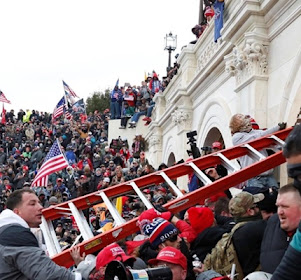
This timely book examines the history of insurrections in the America. Insurrections and riots began in the 1600s, continued through the Civil War, and kept occurring in a plague of lynchings and riots, often after KKK political rallies. “Insurrection” also briefly contextualizes the J6 insurrection of the Capitol. And some of its insights even apply, unintentionally, to the current catastrophe of Putin’s invasion and war in Ukraine.

The U.S. Insurrection Act got is start even before there was a United States. Variations of early insurrection acts were instituted to repress rebellions against slavery. But there have been other reasons to call up responses to restore “order.”


The Founders created the military, in part, to respond to insurrections, without relying solely on state militias and federalism (power dispersed primarily within the states), yet state militias were still needed as part of a balance-of-power equation. Allan explains:

“As elaborated in The Federalist Papers, Alexander Hamilton advocated for ‘a force constituted differently from the militia to preserve the peace of the community and to maintain the just authority of the laws against those violent invasions of them which amount to insurrections and rebellions.’ In other words, framers advocated for the establishment of a federal military force, which was eventually enumerated in Article 1, referring to the power of Congress to 'raise and support Armies’ and ‘provide and maintain a Navy.’ The concerns raised at the time about establishing federal military forces –– the modern-day equivalent to the federal military corps that includes the Army, Navy, and Coast Guard –– had less to do with the enslaved and seemed to generally arise from that threat that such an armed body could pose to white citizens themselves.

“To dispel concerns about any abuse of federal military power, James Madison surmised in The Federalist Papers that the state militia together with armed civilians would be sufficiently numerous to repel a federal army. In other words, federal military forces could be easily repelled by the ‘people.’ Hamilton, however, also sought to quell fears about the federal military by assuring doubters that the federal military would, in fact, be constituted by the ‘people.’ ‘Where in the name of common sense are our fears to end if we may not trust our sons, our brothers, our neighbors, our fellow-citizens?’ Hamilton rhetorically asked in The Federalist Papers. ‘What shadow of danger can there be from men who are daily mingling with the rest of their countrymen and who participate with them in the same feelings, sentiments, habits, and interests?’”

The military and/or militias have been on both ends of insurrection acts, both as responders and as perpetrators. In 1786-7, veterans of the Revolutionary War, stormed court houses and attempted to take over a federal arsenal in what’s known as Shay’s Rebellion.


A sea change occurred during the Civil War and especially after the Emancipation Proclamation and during the years of Reconstruction. No longer was there a federal effort to repress slave rebellions; instead, riots arose from racism, hatred, and rage of white supremacists against fellow free black citizens.


A "KKK Services" 1929 rally. National Photo Company Collection (Library of Congress)

President Ulysses S. Grant, top former Union General during the Civil War, initiated actions to quell uprisings by groups, including especially the Ku Klux Klan. Insurrection acts and riot acts have been called up most often in former Confederate states, including Mississippi, Alabama, and Virginia.


The U.S. military has always had a role in suppressing insurrection, but Congress put guard rails on that role under the Posse Comitatus Act of 1878, which “heralded the end of the Reconstruction era by formally prohibiting the deployment of federal troops to enforce the law –– that is unless otherwise authorized by the Constitution or Congress.”


[Of note, this week President Biden signed the Emmitt Till anti-lynching bill in belated response to the killing of an African American teenager by a white mob in 1955.]


Gov. Orval Faubus calls for rejecting integration at Little Rock State Capitol, Arkansas, in 1959. (John T. Bledsoe; LOC)
President Eisenhower deployed the 101st Airborne Division and federalized the entire Arkansas National Guard in the face of Gov. Faubus's blockade of schools. Faubus fomented a white supremacist crowd against school integration.

Many white citizens in the South were rallied to oppose integration and "race mixing" in the name of Christianity and anti-Communism. Faubus contended that Arkansas had sovereignty, and that the federal government was "occupying Arkansas." Parents should have rights over schools and the government, including the right to segregation.


White segregationists demonstrate, calling race mixing "Communism" and "march of the Anti-Christ." (John T. Bledsoe; LOC)
The Insurrection Act was invoked many times in U.S. history, including during the Civil Rights era. Navy veteran Presidents John F. Kennedy and Lyndon B. Johnson used it to help continue desegregating schools after the Supreme Court’s “Brown v. Board of Education” ruling.

Throughout her presentation of the history of U.S. insurrections, Allan scatters anecdotes of personal experience dealing with issues of race. She contemplates the meaning of dreams, silence, rage, and peace as she explores concepts from psychology, sociology, and philosophy..


Frederick Douglass
Among the philosophers, writers, and historians quoted are Georg Hegel, Gustave Le Bon, Toni Morrison, Abraham Lincoln, Hanna Arendt, and Frederick Douglass. We’ve spotlighted Douglass in several posts here on Navy Reads. He was “a vocal proponent of the enlistment of Negroes into the Union Army, and agitated for an end to the formal exclusion of Negro soldiers from service.”

Douglass, “a fugitive slave turned grand orator and editor,” said, “No man can put a chain around the ankle of his fellow man without at last finding the other end fastened around his own neck.”


That particular Douglass quote brings to mind the tragedy of Putin’s terror campaign in Ukraine and how it’s also affecting the people of Russia. Putin’s expanded kinetic war in Ukraine began three weeks ago. Brave Russians are risking their lives stand up and speak out against the war.


Citing the findings of Le Bon, Allan talks about the psychology of crowds –– and dangers of being a bystander who acquiesces or, worse, supports a deranged leader of their country or party.


These insights apply to the Lost Cause of the Civil War, lies by Hitler and Nazi Germany, and falsehoods and pretexts by Putin to justify invading Ukraine. Unfortunately, albeit on a smaller scale, the insights also apply to the Big Lie of a “stolen” 2020 U.S. election and resultant coup attempt at the U.S. Capitol, January 6, 2021.

“If the crowd is vulnerable to suggestion –– to having its collective unconscious tapped into and its drives channeled into unified action –– then who, exactly, is doing the hypnotizing? Le Bon puts forth a charismatic leader who, through his projection of strength and confidence, can transform a mere group of individuals into a crowd at his command. Such a charismatic leader can, perhaps, also transfer a government of laws into a government of men. Yet, as Le Bon suggests, this charismatic leader alone may not have the influence to muster a crowd. Though largely parroting the repetitive slogans of a strongman, the crowd also tends to be formed by members primed to defend their long-standing beliefs …

“The crowd, as Le Bon says, is inherently conservative, and seeks to either preserve the present or reinstate the conditions of the past. Only the crowd’s erratic violence might cause its members to be mischaracterized as revolutionary instead of what they actually are, which is reactionary. ‘It is precisely crowds that cling most tenaciously to traditional ideas and oppose their being changed with the most obstinacy,’ Le Bon writes. ‘The crowd does not usher in the new, but, instead, clears the way for the reinstatement of the old, and such beliefs, once finally implanted in the crowd, are difficult to uproot, and can only ‘be changed at the cost of violent revolutions.’ As Le Bon also writes, ‘The beginning of a revolution is in reality the end of a belief.’”

Allan assesses how populations are impacted by disasters, including in the aftermaths of hurricanes Hugo, Andrew, and Katrina. But the storm of war also applies, and our thoughts turn to Ukraine, especially as the toll of war dehumanizes people.


Hawa Allan
Allan admits to feeling uncomfortable and embarrassed in high school learning about the ultimate dehumanization of slavery –– people owning other people. But, even though it made her and other students feel uncomfortable, she notes the importance of learning history that is not selectively imparted and fearfully sanitized, the need to learn the “why,” not just the who, what, when, where, and what.

How the Insurrection Act and related acts were used in history is told in black and white by Hawa Allan, who takes into account the motives of those who called for the Act and those who were impacted by it –– as well as the anger and rage they lived through.


Allan’s writing is well-paced and balanced, although some readers may find her style to be a bit scattered and off-point. I would have liked to see discussion of Milley’s rejection (along with other military leaders) of former President Trump’s threats and attempts to deploy the military against civilian protests, especially in the summer of 2020.

In the name of "law and order," Trump often threatened to enact the Insurrection Act during riots and protests after the murder of George Floyd and various police shootings of African Americans.


Yet, on January 6, 2021, “As commander in chief of the D.C. National Guard, it is clear that Trump and his administration could have authorized its deployment –– that is, if they actually interpreted the riot to be a threat to law and order.”


[Public hearings of the U.S. Congress’s J6 Select Committee could begin in April or May 2022, and the committee announced it intends to release an interim report in June.]

This is another worthwhile book by a gifted woman writer and yet another recommended read for Women’s History Month. General Milley would no doubt appreciate the wisdom Allan shares.


Top Photo: Army Gen. Mark A. Milley (chairman of the Joint Chiefs of Staff), then-Army Chief of Staff in 2016. (Sgt. 1st Class Jim Greenhill)