Showing posts with label Symonds. Show all posts

Friday, July 13, 2018

Conversation III: CNO, Drones & Beer w/ Mahan

Interview by Bill Doughty

Professor John Jackson, creator of the Navy Professional Reading Program
He's the originator of the Navy's Professional Reading Program (NPRP, or CNO PRP), and this is our third interview. In this "conversation with the creator III" Naval War College Professor John Jackson, an expert in robotics and unmanned systems, provides insights into how the CNO's reading program, now 12 years old, has evolved over the years. Our interview begins with how the NPRP was personally reinvigorated by Chief of Naval Operations Adm. John Richardson. Like Navy Reads, Jackson aims to support reading and critical thinking.

Q. What was CNO ADM Richardson's contribution to the latest incarnation of the NPRP?

Adm. Richardson has been very “hands-on” in shaping his Professional Reading Program. In fact, we met with him prior to his assumption of the CNO job so we could get a head-start in ensuring that his program met his expectations. He has personally selected the books on the various lists and sub-lists, and has updated them about every six-months. He is a “true-believer” in the value of reading as a primary tool to improve the professionalism of our force. 

Adm. John Richardson, Chief of Naval Operations
Q. The Canon seems to be a foundation – and a good starting point – for Navy readers.

The Canon represents books with which every Sailor should be familiar. It was very difficult to limit the number of books in this category since Navy professionals work in such a wide variety of jobs and specialties. Choices were made that cut across all communities and provided a baseline valuable to everyone in Navy blue and gold.  

Q. The NPRP has evolved since it started under CNO Adm. Mike Mullen. What are some of the biggest changes you've seen in how it's organized and presented?

Our original list in 2006 was categorized by “skills” such as leadership and critical thinking, and was further divided into collections based on experience/rank. The “junior enlisted” collection focused on issues young Sailors would contend with, and the “senior leaders” collection focused more command and large organization issues. We have now evolved into a reading program that is “rank agnostic” and allows everyone to read any book they desire.   

MASN Trevor Miller browses the LiveSafe app on a smartphone. (MC2 Ricks)
Q. Speaking of changes, how has the audience changed? What are some of the ongoing challenges of reaching the digital generations who seem to be tied to their smart phones?

Because of the issues you raise, the CNO-PRP is now based on e-books and digital content. We no longer distribute hard-copy books. As an old guy who likes paper, I tend to read more in hard-copy, but the younger crowd of “digital natives” prefers to read on Kindles, Nooks, or other readers… or to squint and read them on their phones. We don’t care, as long as they are READING!

Fleet Adm. Nimitz and Gen. Eisenhower loved reading about history.
Q. Does reading develop better leadership skills?

I can think of no better way to improve a person’s leadership skills than to read about successful leaders from today and yesterday. It is often said that no one can live long enough to make all the mistakes, but rather should learn from others' experiences whenever possible. It has been said that “not all readers are leaders, but all leaders are readers”!

Q. How can reading and writing help develop better trained and ready Sailors?

Reading and writing demand concentration, much more so than watching a movie or a television program. Your brain must be fully engaged in translating the letters into words and the words into ideas. You can’t be a passive reader.  There are thousands of books on nearly every subject, so Sailors who want to be better at the profession should seek out the biographies and autobiographies of people who have succeeded on the paths they are beginning to walk.

Q. What are the best books right now in your specialty, the study of Unmanned Vehicle Systems?

P.W. Singer’s “Wired For War” is a bit dated, but is still a great source for understanding how we arrived at the place we are in the development and use of Unmanned Systems. “Killing Without Heart” by M. Shane Riza raises many thoughtful questions about what it means to fight a “robot war.” 

And there is a new book being published by the U.S. Naval Institute called “One Nation, Under Drones.” I am the editor, and 10 highly qualified chapter authors write at length about the world of “drones” as it exists today and how it will probably develop in the future. OK, so I plugged my own book! It will be out in December, and I know what everyone on MY Christmas list is getting!

Professor Sally Paine, USNWC
Q. Who are some good women writers you'd recommend?

Naval War College professor Sally Paine has written a number of top-quality books about Asian affairs and other subjects. "The Wars for Asia 1911–1949" (by S. C. M. Paine) is an award winner book that is highly regarded for its use of original source material in the native languages of the originators. 

Q. In May 2017 Navy Reads published a list of 50 books (for 50 years) about the Vietnam War. What are a few of your favorite titles about Vietnam?

Jim Webb’s novel “Fields of Fire” which describes in painful and searing details how U.S. marines faced the challenges of ground combat in the jungles of South East Asia, and “Two Souls Indivisible” by James S. Hirsch that tells the story of the friendship that saved two POWs in Vietnam. My close personal friend CDR Porter Halyburton, USN (ret), lectures annually at the Naval War College and shares the lessons he learned from his seven-and-a-half year ordeal in the prisons of North Vietnam. His inspiring recollections are full of faith, friendship and forgiveness.   

Q. If you could have lunch or a beer with any four or five historians (living or dead) who would be at the table? Why?

I have been blessed to be able to interact with a number of incredible historians, and have shared a meal or a drink with: 

1. David McCullough for his ability to capture the essences of historical events by mining the intimate details of the simple men and women involved. 

2. Craig Symonds, the author of 12 books and the editor of another 9, taught history at the U.S. Naval Academy for three decades and has been on the faculty of the Naval War College. His books (mostly on maritime subjects) are all considered classics. His book “The U.S. Navy: A Concise History” is THE source for understanding how our Navy grew into the incredible fighting force it is today. 

3. George Baer, whose book “100 Years of Seapower” is a classic in every sense. He helped shape thousands of young military officers during his long tenure at the Naval War College. 

…. And in addition to the remarkable men above, I would make special room for Winston Churchill and Alfred Thayer Mahan.   

Q. Adm. Richardson encourages writing as well as reading. For my money, Zinsser's "On Writing Well," is indispensable (a recommendation from Adm. Richardson and Rear Adm. (ret) John Kirby). What's your advice for writers? What should be in their toolbox?

The best way to become a good writer is to write as frequently as possible. You must exercise your “writer’s brain” and seek out other authors/writers and ask them to critique your work. You must have tough skin, since the comments could be harsh. But accept the criticism with the good intention with which it is provided…. write another draft….. rinse and repeat. 

Q. What do you see on the horizon? What's ahead for the Navy's Professional Reading Program?

The CNO-PRP will continue to provide digital access to books that matter. We will do all that we can to promote a reading culture within our Navy and help every Sailor become more effective as they labor in support of our great Navy and our treasured nation. I salute “Navy Reads” for doing a superb job of fanning the flames of learning through reading!

Professor John Jackson (right), program manager for the CNO-PRP, discusses reading with U.S. Navy Cmdr. Daniel Dolan and Rear Adm. Walter E. Carter Jr. (center), president of the Naval War College, in Newport, R.I., in Dec. 10, 2013. (Photo by MCC James E. Foehl)

Saturday, May 30, 2015

Catching Up on Names, Namesakes

by Bill Doughty
New Jersey, John Finn, Midway and Craig Symonds, Mary Roach, Jimmy Carter and John S. McCain – all in the news recently and each with featured spots in Navy Reads. Make the connections...

A state of the Navy is New Jersey. Secretary of the Navy Ray Mabus announced this week that the newest Virginia-class attack submarine to be named after the Garden State would be SSN 796, USS New Jersey. A DOD story this week reminds us that the Navy’s first submarine, USS Holland, was designed and built in New Jersey in 1900.

Medal of Honor recipient John Finn, Dec. 7, 2006.
In Mabus's home state of Mississippi, at the beginning of this month, USS John Finn was christened at Ingalls Shipbuilding in Pascagaoula. According to an informative post about John Finn on Navy Live Blog, "The future USS John Finn is the 63rd Arleigh Burke class destroyer, and the first of the DDG 51 Flight IIA restart ships."

John Finn passed away five years ago this week, May 27, 2010. We interviewed him for Navy Reads in late 2009, when he told us his favorite author prior to World War II was Ernest Thompson Seton – author, artist and naturalist. “I always loved books about wildlife,” he said. 

Finn was a hero who fought back against Imperial Japanese Navy planes attacking Oahu, Hawaii on December 7, 1941.

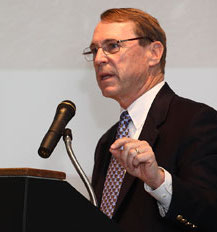
Craig Symonds
On Oahu next week Craig L. Symonds will be featured speaker at the Pacific Aviation Museum on Ford Island, Pearl Harbor to commemorate the 73rd anniversary of the Battle of Midway, which became the namesake for a great aircraft carrier, USS Midway (CV 41), now a museum in San Diego. The battle is considered the turning point of the war in the Pacific, just six months after the attack on Pearl Harbor and Oahu.
Dr. Symonds, a scholar of naval history and the Civil War, will conduct several book-signing events and interviews during the week leading up to the event at PAM, Saturday, June 6, 2015.

Mary Roach
Meanwhile, another gifted author who has contributed to Navy Reads, Mary Roach, is up in Skagway, Alaska this week as keynote speaker for "Exploring the Frontiers of Language / Let Skagway Inspire You," sponsored by North Word Writers Symposium. Roach – a champion of science, humor and critical thinking – is author of the New York Times bestsellers "Gulp: Adventures on the Alimentary Canal," "Packing for Mars: The Curious Science of Life in the Void," "Stiff: The Curious Lives of Human Cadavers," "Bonk: The Curious Coupling of Science and Sex," and "Spook: Science Tackles the Afterlife." 

Yesterday, 90-year-old Navy veteran and former U.S. President Jimmy Carter – author of numerous books on human rights, history, international relations and peace – attended a change of command ceremony for his namesake submarine, Seawolf-class attack submarine USS Jimmy Carter (SSN 23) during a ceremony at Naval Base Kitsap, Bangor, Wash.

Cmdr. Melvin Smith (right) assumes command of USS Jimmy Carter.
Cmdr. Melvin Smith relieved Cmdr. Brian Elkowitz as commanding officer.


A Navy.mil story noted that "the 39th president and 2002 Nobel Peace Prize winner is the only U.S. president to graduate from the Naval Academy and the only one to qualify on submarines."

Carter, who graduated from the Naval Academy in 1946 and served in the Navy until 1953, said: "Of all the honors I have ever received, I've never had anything of greater honor than the chance to be the namesake of USS Jimmy Carter."

Vice Adm. John S. McCain Sr. and Cmdr. John S. McCain Jr. in 1945.
In a ceremony May 28 in Yokosuka Japan, the forward-deployed Arleigh Burke-class USS John S. McCain conducted a change of command ceremony. Cmdr. Chad Graham relieved Cmdr. Chase Sergeant as CO. McCain is named for Admirals John S. McCain Sr. and John S. McCain Jr., both WWII veterans and leaders, grandfather and father to Senator John McCain, Vietnam veteran, Navy pilot and former POW.

Sen. McCain's book "Character is Destiny" was featured on Navy Reads last year. The book, written with Mark Salter, is filled with short biographies and inspirational stories about core values, leadership, and the importance of good character.


Sunday, October 5, 2014

Farragut 'Touched by Fire'

by Bill Doughty
Admiral David G. Farragut (art by Antonio Verceluz)

Strong Confederate forts. Batteries of guns. Torpedo mines. The iron-clad "ram" CSS Tennessee. All these and more faced the Union Navy led by Adm. David Glasgow Farragut in Mobile Bay in August 1864, 150 years ago this past summer.

The intrepid hero of New Orleans/Mississippi sailed his wooden ships within range of the forts, as described by Farragut contemporary First Lieutenant John Coddington Kinney:
"The central figure was the grand old admiral, his plans all completed, affable with all, evidently not thinking of failure s among the possibilities of the morrow, and filling every one with his enthusiasm. He was sixty-three years old, of medium height, stoutly built, with a finely proportioned head and smoothly shaven face, with an expression combining overflowing kindliness with iron will and invincible determination, and with eyes that in repose were full of sweetness and light, but, in emergency, could flash fire and fury."
Kinney's is one of dozens of first person accounts and memoirs originally published in 1881 by "The Century" magazine and now part of a terrific compilation from 2011, "Hearts Touched By Fire: The Best of Battles and Leaders of the Civil War," edited by Harold Holzer. The book is divided into five parts, each for a year from 1881 through 1885.

In the introduction to "1864," historian Joan Waugh sets the stage:
"Two Federal naval victories in 1864 mitigated the disappointment of the seemingly endless ground campaigns. On June 19 the war sloop USS Kearsarge defeated the famed Rebel raider CSS Alabama off the coast of France in the Battle of Cherbourg. Writing for Battles and Leaders, the Union ship's surgeon, John M. Browne, recounted the war of wits ..."The second Union naval success carried an even greater lift for Northers at a critical time. On August 5, Admiral David G. Farragut seized control of Mobile Bay in Alabama, bringing an end to Confederate shipbuilding in that city and disabling the port's ability to offer a friendly harbor for Southern ships avoiding the Union blockade ... Farragut's triumph closed the last remaining major Confederate port on the Gulf of Mexico and boosted Lincoln's prospects for a fall victory."
Navy Reads contributor Craig Symonds does a masterful introduction for "1861" helping foreshadow the "horrible slaughter and wholesale destruction that would follow" the early months of the war.


The story of how the first compilation came to be published by "The Century" in 1881 involves some intriguing negotiation with President U.S. Grant after the Civil War. The editors ensured we get an accurate portrayal told in real and vibrant prose, not just dry war plans and reports. Illustrations from the time – paintings and etchings from both the Union and Confederacy perspective – are included.

In "Farragut at Mobile Bay" Kinney describes the fire and smoke of battle where "every minute seemed a second." Admiral Farragut climbed the rigging to get better command and control. He damned the torpedoes, faced and ordered broadsides and took his wooden ships into close battle with the enemy. We can almost hear and feel the wooden Hulls scraping and crashing against the iron-clad Tennessee that had been "strengthened by an artificial prow."

Kinney writes of a brief lull in the action:
"The thunder of heavy artillery now ceased. The crews of the various vessels had begun to efface the marks of the terrible contest by washing the decks and clearing up the splinters. The cooks were preparing breakfast, the surgeons were busily engaged in making amputations and binding arteries, and under canvas, on the port side of each vessel, lay the ghastly line of dead waiting the sailor's burial. As if by mutual understanding, officers who were relieved from immediate duty gathered in the ward-rooms to ascertain who of their mates were missing, and the reaction from such a season of tense nerves and excitement was just setting in when the hurried call to quarters came and the word passed around, 'the ram is coming.'"
Kinney takes us back into the intense fighting as Farragut and his fleet focused on what was thought to be the strongest vessel afloat, "virtually invulnerable." 

"The Tennessee now became the target for the whole fleet, all the vessels of which were making toward her, pounding her with shot, and trying to run her down," he writes. Lashed to the rigging, Farragut directed the battle as his sailors and marines continued the attack, with side-by-side bombardments and fearless full-speed attacks and cannon barrages leading to the enemy's surrender and a Union victory.

"Hearts Touched by Fire" is a fascinating you-are-there set of memories from the soldiers, sailors, leaders and citizens affected by that pivotal war that ended slavery and kept the states united.

(See the Navy Reads post about the Adm. Farragut, the U.S. Navy's first Hispanic admiral, from 2011, "Damn the Torpedoes." Hispanic heritage is celebrated in the United States from Sept. 15 to Oct. 15. The Navy Birthday is Oct. 13, 1775.)

Saturday, May 17, 2014

'God-Awful Luckiest' Battle of Midway

by Bill Doughty
Fleet Adm. Chester W. Nimitz
How did the United States Navy achieve victory at Midway and turn the tide in the Pacific so early in World War II?  An anthology from the Naval Institute Press shows the answer: Sailor ingenuity, science and skill blended with Admiral Nimitz's wisdom and determination -- along with some luck.

Other factors contributed, including miscalculations and overconfidence of Imperial Japan, whose military leaders were set on taking out "Hawaii's sentry," Midway Atoll. But fortune favored many of the U.S. carrier aviators who fatally damaged three enemy carriers, writes John B. Lundstrom in historian Thomas C. Hone's "The Battle of Midway: The Naval Institute Guide to the U.S. Navy's Greatest Victory."  Imperial Japan would lose four carriers that attacked Pearl Harbor and more than 100 of its aviators.

Lundstrom notes, "The actual sequence of events was stranger than anyone could have imagined; as [Rear Adm. Murr] Arnold wrote in 1965, it was 'the most god-awful luckiest coordinated attack.'"
In "The Battle of Midway" editor Hone brings together a gifted roster of writers and leaders including Craig L. Symonds, E.B. Potter, James Schlesinger, Adm. Raymond A. Spruance, Rear Adm. Edwin T. Layton, Elliot Carlson, Mitsuo Fuchida, Masatake Okumiya, Lundstrom and Mark R. Peattie, among others.

Throughout this book of mostly essays written over a span of seven decades, Hone adds context and analysis. In his introduction to Chapter 9, "Prelude to Midway," he explains Imperial Japan's motive for the attack.
"The Midway operation had two central objectives. The first and more limited one was the seizure of Midway as an advance air base to facilitate early detection of enemy carrier forces operating toward the homeland from Hawaii, with the attack on the Aleutians as a diversion ... The second, much broader objective was to draw out what was left of the United States Pacific Fleet so that it could be engaged and destroyed in decisive battle. Were these objectives achieved, the invasion of Hawaii itself would become possible, if not easy."
America's fury against Imperial Japan and commitment to avenge at Midway immediately after the attack on Oahu of December 7, 1941 was fueled by lies: pretended diplomacy in Washington D.C. even after the "Rising Sun's" torpedo bombs exploded in Pearl Harbor. Americans, led by President Roosevelt, called the act illegal, ignoble and infamous.
Eri Hotta's "Japan 1941: Countdown to Infamy," published by Alfred A. Knopf Publisher, describes how the two emissaries, Nomura and Kurusu, were set up by the military government "warmongers" in Japan. The two were returned to Japan in a citizen exchange via Rio de Janeiro in the Atlantic, Mozambique in the Indian Ocean and finally Yokohama in Pacific, arriving August 20, 1942. Hotta writes:
"By then, Japan's preponderance at sea was declining precipitously. The balance of power had been tipped. From June 4 to 7, the Imperial Japanese Navy fought one of the most devastating naval battles in modern history, the Battle of Midway. The same men who planned the Pearl Harbor attack conceived of the Midway strategy, hoping to eliminate the United States from the Pacific once and for all. The operation ended in disaster for Japan. By this time the Japanese military code had been broken by the United States ... The Japanese navy was dragged down from its glorious pinnacle only six months after it had reached it."
Hotta's "Japan 1941" shows how misunderstanding, miscalculations and misinformation not only led Japan into war but also perpetuated the fighting even after defeat was inevitable.

Hone's "The Battle of Midway" opens with Part I, which explores Nagumo's kido butai (air fleet), presents Admiral Yamamoto from a Japanese perspective, and shows why Imperial Japan's carrier pilots were so skilled in the first year of the war with the U.S. Navy; it was because they had already gained experience in the previous decade in China. Part II is titled "Approach to Midway" and includes a brief but powerful piece from Proceedings, "Lest We Forget: Civilian Yard Workers," by Lt. Cmdr. Thomas J. Cutler, USN (ret.). Cutler is author of "Bluejacket's Manual," "A Sailor's History of the U.S. Navy" and numerous other books.

USS Yorktown struggles in vain to survive during the Battle of Midway.
Part III, "The Battle," recounts the battle Kurosawa-like, from different angles and viewpoints including several from an Imperial Japanese perspective. "I Sank the Yorktown at Midway," by Yahachi Tanabe and Joseph D. Harrington, is one provocative title. Parts IV and V deal with the aftermath of the battle, its finale and the official report by Commander-in-Chief, U.S. Pacific Fleet. 

Part VI of "The Battle of Midway" explores the personalities, strategies and relationships of the commanders: Nimitz, Spruance, Nagumo, Yamato, Fletcher and Mitscher. Part VII shows how code-breaking helped provide some of the "god-awful luck" that gave U.S. Navy the edge against the enemy fleet. Editor Hone leads with an analysis of the complicated state of affairs with regard to code-breaking, and he includes an excerpt from Elliot Carlson's excellent "Joe Rochefort's War: The Odyssey of the Codebraker Who Outwitted Yamamoto at Midway."

Hone's book concludes with Part VIII "Assessments of the Battle" and appendixes, including the USS Enterprise Action Report and Spruance's Letter to Fletcher of June 8, 1942. 

There are several implied and outright pleas by historians to ensure Midway is understood and commemorated. Since Adm. Jonathan Greenert became CNO, The Battle of Midway has been part of a curriculum for Sailors and has been honored at every command.

The source materials, oral histories, chronologies and analysis in "The Battle of Midway" make this book a compelling overview of the heroic battle while leaving some mysteries, fog-of-war questions, and the impact of luck as still part of the story and lessons of Midway.

Chief of Naval Operations (CNO) Adm. Jonathan Greenert, members of the official party and ceremony attendees salute a wreath at the U.S. Navy Memorial placed there in honor of the Battle of Midway Commemoration Day ceremony in Washington, D.C. June 4, 2012, the 70th Anniversary of the decisive Battle of Midway. (U.S. Navy photo by Mass Communication Specialist 1st Class Peter D. Lawlor/Released)

Sunday, June 23, 2013

Taunt of 'Congo' -- Navy Lt. in Africa

by Bill Doughty

“Congo: The Miserable Expeditions and Dreadful Death of Lt. Emory Taunt, USN” by Andrew C. A. Jampoler, soon-to-be released by the Naval Institute Press, is a fascinating safari into the history of Africa and the adventures and “misadventures,” as Craig L. Symonds calls them, of a naval officer more than a century ago, a mere two decades after the Civil War.

Symonds, author of "Battle of Midway" and "Lincoln and His Admirals" writes in his review note, “In 1885 an otherwise undistinguished U.S. Navy lieutenant named Emory Taunt embarked alone on a journey up the Congo River into what was then still called darkest Africa. Soon Taunt was seeking to parlay his presumed expertise into a lucrative contract with businessman Henry Sanford, and when that didn't pan out, to convince President Cleveland that he should be named U.S. consul to the Congo State. This history of Taunt's misadventures is a window into the curious and conflicted U.S. relationship with Africa in the late Victorian era, and especially with the Congo basin."

SECNAV cover letter, 1887.
Jampoler retraces Taunt’s journey down the Congo River to “Banana Point” and the Atlantic Ocean in the book’s epilogue.  In the preceding chapters he ponders the hard life of native porters, the effects of slavery, the influence of business and religion in the 1800s, the dangers of malaria and yellow fever, and Taunt’s and others’ political schemes and dreams. 

The narrative pivots on taunt’s spotty record in the Navy, culminating in a court-martial for unauthorized absence due to intoxication, a case that led to a clemency appeal and involvement by Commander-in-Chief President Grover Ceveland, and one of the most interesting excuses for incapacity due to alcohol.

Taunt contended his UA was due to a previous trip to Africa.  Jampoler recounts what Taunt told The New York Herald

“I returned from the Congo broken down with fevers, liver troubles and malaria, and I have not felt myself at all ... I did not mean to disobey orders, and I was not drinking anything stronger than some wine which my doctor ordered for me.  My mind is a blank as to what transpired...”

Map of Taunt's expedition down the Congo, Navy History and Heritage Cmd.
Divorced and resigned from the Navy, Taunt lobbied successfully for an appointment as commercial agent in Boma, Congo with a paltry annual salary of $4,000.  His success brings to mind the so-called Chinese curse, “be careful what you ask for, you may get it.”

Rather than achieve wealth and immortality, Taunt, continued to contract diseases in the Congo, died at the young age of 39.  His adventure did manage to bring attention to Belgian atrocities in Africa.

Jampoler introduces us to some colorful characters in the late 1800s.

Sen. George Edmunds helped establish and fund the position Taunt would fill in Boma.  The senator was best known for his sponsorship of the Edmunds-Tucker Act of 1887, a law prohibiting polygamy and de-incorporating the Church of Jesus Christ of the Latter Day Saints, pushing Mormon practitioners, including Mitt Romney’s grandfather, to seek foreign sanctuary in Mexico.

Sen. John Tyler Morgan, “former Confederate general, and emeritus Grand Dragon of the Alabama Realm of the Ku Klux Klan, (who) stood on the front rank of those few American politicians engaged in Congo policy making near the end of the century.” Morgan supported a drive to repatriate American blacks to Africa.

Jampoler writes about legislator and gifted Renaissance man George Washington Williams of Pennsylvania, who “just missed being appointed the American minister to Haiti; the post went to Frederick Douglass instead.” Williams indicted King Leopold directly in strong language for “deceit, fraud, robberies, arson, murder, slave-raiding,” etc. in Congo.

Finally, Emory Taunt is tied with British author and former merchant seaman Joseph Conrad, whom he met in Congo.  Conrad is best known as the author of “Heart of Darkness,” which was first published in 1899.  Jampoler opens “Congo” with an excerpt from “Heart of Darkness”:

“Going up the river was like traveling back to the earliest beginnings of the world, when vegetation rioted on the earth and the big trees were kings.  An empty stream, a great silence, an impenetrable forest.  The air was warm, thick, heavy, sluggish.  There was no joy in the brilliance of sunshine.  The long stretches of the waterway ran on deserted, into the gloom of overshadowed distances.  On silvery sandbanks hippos and alligators sunned themselves side by side.  The broadening waters flowed through a mob of wooded islands; you lost your way on that river as you would in a desert, and butted all day long against shoals, trying to find the channel, till you thought yourself bewitched and cut off forever from everything you had known once -- somewhere -- far away -- in another existence perhaps.”

The Congo River is described as having 15 times the runoff of the Nile, providing perspective and scope for the exploration and exploitation that occurred centuries ago.

Andrew C. A. Jampoler
“Congo” flows between bits of history and personality insights and includes links to the War of 1812 and Napoleon and the aftermath of the Civil War and naval history from Peru to Samoa and from the East Coast of the United States to western Africa and King Leopold ll’s documented abuses of native people in Congo.

Jampoler documents how other authors weighed in on Leopold’s crimes.  Sir Arthur Conan Doyle and Mark Twain, perhaps America’s greatest writer, reported on the atrocities and lobbied for progressive change and reforms to President Theodore Roosevelt.

Naval Institute Press of Annapolis has published another winner in “Congo,” a good summer -- or fall -- read.  NIP offers a list of other reading recommendations this week in its 2013 fall catalog.