Showing posts with label Clinton. Show all posts

Thursday, June 29, 2023

McVeigh/Constitution/Jan. 6 –– Part 1

Review by Bill Doughty––

“Homegrown: Timothy McVeigh and the Rise of Right-Wing Extremism” by Jeffrey Toobin (Simon & Schuster, 2023) is a relevant and necessary account of the bombing of the Murrah federal building in Oklahoma City in 1995 during President Bill Clinton's administration. 


The bombing was sparked by anger and hatred in the wake of “woke,” even before that term became popular. Timothy McVeigh, the Army-veteran-turned-right-wing-extremist was an avid supporter of states’ rights, white separatism, and unobstructed Second Amendment access to military-style assault weapons.


He wanted to spawn a militia army to start a civil war against the federal government. He hoped his bomb –– which killed or maimed hundreds of men, women, and children –– would inspire others.

And McVeigh may have been right about his expectation about gaining support for the causes he espoused.


White supremacist Dylann Roof left a McVeigh-like manifesto trying to justify his murder of nine parishioners in Charleston, South Carolina. Brandon Russell, the leader of a neo-Nazi group was arrested in Tampa, Florida, in possession of explosives; “there was a framed photo of McVeigh on his nightstand.” Richard Tobin, of Brooklawn, New Jersey, wanted to see bombings of synagogues around the country quoting the method used by McVeigh. Timothy Wilson planned to blow up non-Christian worship centers and an elementary school in the Kansas City area; he quoted Timothy McVeigh in a text to an associate.


Toobin presents dozens of other examples of homegrown terrorism by white supremacists, vigilante militia members, Christian nationalists and anti-abortionists. He says the “Unite the Right” rally in Charleston, Virginia, in August 2017 showed that “the ‘army’ that McVeigh told his lawyers he was seeking had finally assembled.” Neo-Nazis, militia members, and other extremists gathered there and violently clashed with left-wing protesters who were demanding the removal of a statue of Confederate General Robert E. Lee.


Toobin also notes how “terrorism associated with radical Islam and left-wing extremists never disappeared from the United States.” He cites the 2009 shooting of 13 unarmed soldiers by a psychiatrist at Fort Hood, Texas; the 2015 mass shooting by an Islamist couple in San Bernardino, California; the 2017 shooting by a leftist political activist at a congressional baseball game; and the stalking and threatening by a mentally ill protester of Supreme Court Justice Brett Kavanaugh.


“Still, the record is clear that there were far fewer of these attacks than those by right-wing extremists,” Toobin writes. Indeed, according to one study, right-wing extremism was responsible for 76 percent of all extremist murders in the United States from 2009 to 2019.”


Toobin shows how white nationalism increased after the election of President Barack Obama. “Days after the 2008 election, a Marine corporal at Camp Lejeune in North Carolina was arrested and charged with planning to kill Obama as a ‘domestic enemy’ in ‘Operation Patriot.’”
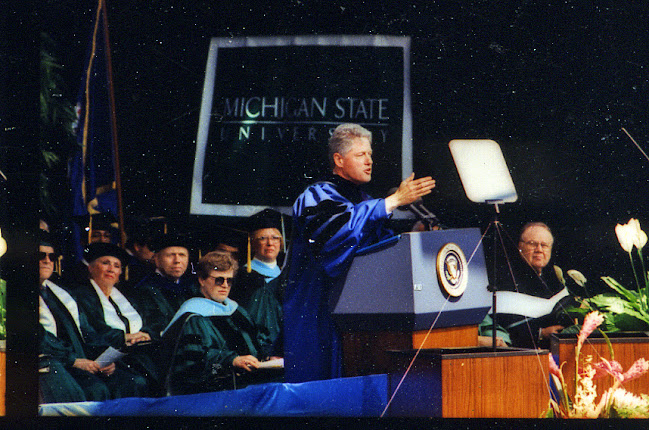

The question of patriotism and issues such as the First and Second Amendment were addressed head-on in the aftermath of the Oklahoma City bombing when then-President Bill Clinton gave a memorable commencement address at Michigan State University, May 5, 1995, in East Lansing. (McVeigh’s accomplice, Terry Nichols, was associated with the Michigan Militia.) Toobin excerpts a big chunk of Clinton's speech, and it’s worth reading in its entirety for its thoughtful and nuanced message.

Here is the part of that speech that Toobin included in “Homegrown.” Clinton offers comments not only to the graduates, but also to right-wing militia members:

“I want to say this to the militias … I am well aware that most of you have never violated the law of the land. I welcome the comments that some of you have made recently condemning the bombing in Oklahoma City. I believe you have every right, indeed you have the responsibility, to question our government when you disagree with its policies. And I will do everything in my power to protect your right to do so. But I also know there have been lawbreakers among those who espouse your philosophy. I know from painful personal experience as a governor of a state who lived through the coldblooded killing of a young sheriff and a young African American state trooper who were friends of mine by people who espoused the view that the government was the biggest problem in America and that people had a right to take violence into their own hands.

“So I say this to the militias and all others who believe that the greatest threat to freedom comes from the government instead of from those who would take away our freedom: If you say violence is an acceptable way to make change, you are wrong. If you say that government is in a conspiracy to take your freedom away, you are just plain wrong. If you treat law enforcement officers who put their lives on the line for your safety every day like some kind of enemy army to be suspected, derided, and if they should enforce the law against you, to be shot, you are wrong. If you appropriate our sacred symbols for paranoid purposes and compare yourselves to colonial militias who fought for the democracy you now rail against, you are wrong. How dare you suggest that we in the freest nation on Earth live in tyranny! How dare you call yourselves patriots and heroes! I say to you, all of you, the members of the Class of 1995, there is nothing patriotic about hating your country or pretending that you can love your country but despise your government.”

Victims' families attend a memorial service as President Clinton gives remarks, April 23, 1995. 
Clinton, who also spoke at the memorial service in Oklahoma City in April 1995, took the opportunity in at Michigan State University to condemn violence by both the Left and Right. He noted, “Freedom of political speech will never justify violence--never. Our Founding Fathers created a system of laws in which reason could prevail over fear. Without respect for this law, there is no freedom.”

Prosecutors in the McVeigh trial used the bomber’s own words against him: how he wanted to start a new revolution in order to protect the Second Amendment, states’ rights, and a white male hierarchy. He hoped to provoke another civil war.


“The McVeigh prosecutors put the ‘civil war’ issue in front of the jury to show how extreme and exotic the defendant’s views were," Toobin writes. "But a quarter century later, McVeigh’s view was close to the conservative movement norm. This view –– about the possibility of civil war –– became mainstream as the passions underlying the January 6 insurrection roiled conservatives during the Biden presidency.”


According to Toobin, “The events of January 6, 2021, saw the full flowering of McVeigh’s legacy in contemporary politics. McVeigh was obsessed with gun rights; he saw the bombing as akin to the revolutionary struggle of the Founding Fathers; and he believed that violence was justified to achieve his goals. So did the rioters on January 6.”


(In Part 2, we examine the Oklahoma City bombing and rise of right-wing extremism through the lens of the U.S. military.)

Monday, January 2, 2023

Power of a Woman in Power

Review by Bill Doughty––

She was born March 26, 1940, nine months before Imperial Japan attacked Oahu and Pearl Harbor. The Second World War had already been waging for years in Europe and Asia. Like millions of Americans, she came from a family with deep roots in Europe.


Nancy D’Alesandro’s father was U.S. Representative Thomas D’Alesandro Jr., of Baltimore, Maryland., a second-generation American whose own father had immigrated to the United States from Italy. He was a vocal activist on behalf of Jews in Europe who were targeted by the Nazis, and his advocacy had a profound influence on his daughter, the future Nancy Pelosi.

Susan Page writes in “Madam Speaker: Nancy Pelosi and the Lessons of Power –– a Biography” (Hachette Book Group, 2021) about Pelosi’s father’s strong defense of European jews, including in a speech on the House floor in 1943:

“‘Daily, hourly, the greatest crime of all time is being committed.’ D’Alesandro had declared. ‘A defenseless and innocent people is being slaughtered in a wholesale massacre of millions.’

Years later, Nancy Pelosi would cite the influence that her father’s support of the Bergson Group had on her. It was a factor when she decided to break with another Democratic president, Bill Clinton, on the issue of China and human rights. She was Clinton’s ally on most issues but a thorn in his side on this one. She had been a little girl when World War II ended, but she remembered with pride the example her father had set. ‘His enthusiasm came from doing what he believed was right,’ she said.”

Page’s biography of Pelosi is a fully satisfying examination of her beliefs, ethics, strategies, and embrace of power. “Madam Speaker” covers Pelosi’s early years growing up in Baltimore’s Little Italy, her ties to politics from an early age, her devout Catholic faith, and her legacy as the first woman Speaker of the House.


One of the many great and unexpected photos in this book is one from 1957 of 16-year-old Nancy with then-Senator from Massachusetts John F. Kennedy, Navy hero of WWII, whose “Profiles in Courage” had recently been published.


Pelosi came of age during the Cold War and in the Civil Rights era. She would meet JFK again in 1961 when then-President Kennedy appointed her father as a member of the Renegotiation Board.

Though she was always close to politics, her first priority was to her own immediate family in San Francisco. She and Paul Pelosi have five children. In her autobiography (which could serve as an inspiration for military servicewomen and spouses), “Know Your Power: A Message to America’s Daughters” (Doubleday 2008), Pelosi writes, “Raising a family is challenging. I want women to know that the skills I acquired as a mother and homemaker have been invaluable to me. These same skills –– so often undervalued –– are transferable to many other arenas in life, including the United States Congress.”

Pelosi says her leadership skills were forged by her children, even more than by her parents. She had five kids in six years, which forced her to develop her modus operandi: “efficiency, teamwork, and organization.”


Among her favorite axioms are:

  • “Let’s have some cooperation.”
  • “Proper preparation prevents poor performance.”
  • “Seize the moment when you can; play the long game when you can’t.”
  • “Our diversity is our strength; our unity is our power.”
  • “Be ready to seize power.”
  • And, of course, “Know your power.”

With five young children, she says she had good practice dealing with temper tantrums, a skill that helped her deal with some members of Congress and with other senior elected leaders.


Pelosi, who arrived in the U.S. House of Representatives at the age of 47, credits mentors –– women and men –– for contributing to her success and ability to gain power and influence. Susan Page writes about one of those mentors:

“Representative John Murtha, Democrat of Pennsylvania, was a general in the Old Guard. The blunt-spoken former Marine, the recipient of two Purple Hearts and the first Vietnam veteran elected to Congress, had been serving in the House for a quarter of a century. He was a powerhouse on the Appropriations Committee, especially on military issues. In more ways than one, his district in south-central Pennsylvania, dependent on steel and coal, was as distant from San Francisco as it could be.

Yet Murtha and Pelosi somehow hit it off.”

Pelosi had opposed the Vietnam War. And, while she supported the war in Afghanistan, she became a powerful voice against Bush’s war in Iraq, calling it “one of the biggest mistakes in American history.” Page writes, “They were at war over the war in Iraq.”


Reps. Jack Murtha and Nancy Pelosi
At first, Pelosi’s position was also at odds with that of Rep. Murtha, “a leading voice on defense policy” who had voted to go to war after being contacted by then-Vice President Dick Cheney. But eventually Murtha came around to Pelosi’s position and regretted his vote. “He called the war ‘a flawed policy wrapped in illusion,’” Page writes. (Murtha was a recipient of the John F. Kennedy Profile in Courage Award in 2006.)

Pelosi stepped up her campaign against the war after Bush’s “Mission Accomplished” landing on USS Abraham Lincoln, May 1, 2003, suggesting to Bush that he change course, reach out to the Islamic world, and work with Allies instead of deploying a preemptive “go-it-alone foreign policy.” Page writes, “Pelosi said he impatiently dismissed the idea.”


Throughout her two terms as Speaker, Pelosi championed Veterans issues, especially those related to health care. Six months ago (a year after publication of Page’s book), Pelosi oversaw House passage of the PACT act, to help Veterans exposed to toxic substances during military service. She made many visits to military bases over the years, both in Asia and Europe. She visited Camp Leatherneck on Mother's Day in 2012 (top photo by Spc. Chelsea Russell).

(PO1 Jonathan Carmichael)

Murtha retired in 2008, two years before he passed away at 77. He wrote in notes for an intended memoir that Pelosi had as “good a political mind as anyone I have ever seen,” and once remarked that she was “one of the premier leaders in America today.” Other leaders, including U.S. presidents, world leaders, and colleagues have had similar praise for her skills and achievements. According to Page:

“Through the first two decades of the twenty-first century, Nancy Pelosi would stand at center stage during an era of domestic and global disruption.

She was the senior Democrat on the House Intelligence Committee in the aftermath of the 9/11 terror attacks that started the century, in 2001. She was the senior member of Congress to oppose the Iraq War from its beginning. She was the most persistent congressional critic of China on human rights, challenging both Democratic and Republican presidents on the issue. She was the irresistible force pushing through controversial pieces of major legislation, most notably the Wall Street bailout and the Affordable Care Act. She was the top fund-raiser and strategist who twice led Democrats to wrest back control of the House, in 2006 and 2018. She took the lead in negotiating massive relief packages in response to the coronavirus pandemic in 2020.”

Pelosi initiated several congressional efforts to hold ex-President Trump accountable for his actions while in office –– including two impeachments and creation of the bipartisan House select committee inquiry into the January 6, 2021 insurrection. Since publication of Page’s “Madam Secretary,” Pelosi led House efforts to pass landmark bills such as the American Rescue Plan Act of 2021, the Infrastructure Investment and Jobs Act, the CHIPS and Science Act, the Inflation Reduction Act of 2022, and the Respect for Marriage Act. She moved gun safety legislation successfully through the House, but was blocked by the Senate. She made a trip to Taiwan and Ukraine to demonstrate support for those democracies. Pelosi has been a steadfast champion of military defense aid and humanitarian assistance to Ukraine in the wake of Putin’s invasion and Russia’s war.


Congresswoman Nancy Pelosi, Speaker of the United States House of Representatives, addresses the audience during the Congressional Gold Medal Ceremony held to honor Merchant Mariners of WWII at the U.S. Capital, May 18, 2022. During WWII Merchant Mariners put their lives on the line for their country, braving German and Japanese submarines, in their Liberty Ships, as they delivered critical supplies for service members serving in the European and Pacific theaters. (U.S. Navy photo by Bill Mesta)


“Not everyone sees her legacy in a positive light, of course,” Page observes. “Republicans have demonized her as a rigid ideologue and deployed her as a weapon to raise funds.”


Speaker Pelosi steps down officially from House leadership when the 118th Congress begins its term this week. She has already handed the reins of her caucus’s power to a new generation, led by her successor, incoming Minority leader Hakeem Jeffries, whom Pelosi mentored. She stands out in history for her courage, conviction, and conscientious use of her power.


Both “Madam Secretary” and “Know Your Power” are inspirational reads for women and men in the 21st century.


Speaker of the House Nancy Pelosi meets with military service members during her visit to Yokota Air Base, Japan, Aug. 5, 2022. During her visit to Japan, Speaker Pelosi met with Japanese Prime Minister Fumio Kishida to discuss strengthening the U.S.-Japan alliance and a free and open Indo-Pacific. (U.S. Air Force photo by Senior Airman Hannah Bean)

Friday, May 21, 2021

Why ‘Walk In My Combat Boots’?


Review by Bill Doughty

“These are the stories America needs to hear about the remarkable young men and women who serve.” –– Adm. William H. McRaven, US Navy (Ret.)


“Walk in My Combat Boots” by James Patterson, Matt Eversmann, and with Chris Mooney (Little, Brown and Company, 2021) focuses on military service members from each key service. Each warfighter tells their individual stories –– often about how and why they joined, what combat is like, and how war impacts the people who deploy. Most of the combat scenes are in Iraq or Afghanistan. Many of the stories ask, sometimes in screaming prose: Why? Collectively, these recollections give the reader a better appreciation of the service and sacrifice of these young men and women.

The authors present the stories in crisp first-person voice and in honest brutal detail –– what Gen. Stanley A. McChrystal, US Army (Ret.), calls “painfully raw, improbably funny, and completely human.” The individual stories are short, the language is conversational, and the font-type is large, but the content is sometimes hard to read; the authors pull no punches. This book is not for kids.


President George W. Bush presents the Purple Heart medal to US Army PFC Jeddah DeLoria of Chosen, Colo., Thursday, Dec. 20, 2007 at the Walter Reed Army Medical Center in Washington, D.C. DeLoria was recovering from injuries sustained in Operation Enduring Freedom in Afghanistan. (Joyce N. Boghosian)


Some of the most interesting stories include those by Miguel Ferrer, a Navy corpsman who had challenges working with the Afghan military; Jeddah Deloria (pictured above), born in the Philippines, who received a Purple Heart from President George W. Bush; Navy Chief Petty Officer Ryan Leahy, whose great grandfather was one of naval history’s most influential leaders, Adm. William Leahy; Staff Sgt. Lisa Marie Bodenburg (pictured below), a Marine door gunner, who says, “I would do it all over again in a heartbeat, because I love the Marine Corps. I love leading Marines. There is nothing greater, no greater feeling, no greater responsibility or achievement.”

Then-Cpl. Lisa M. Bodenburg, a UH-1N crew chief with Marine Light Attack Helicopter Squadron 367, 3rd Marine Aircraft Wing (LCpl. Frederick J. Coleman)

The service members, like Army intelligence collector “Red,” whose father served in the Navy, describes what it was like every day in Iraq. For example:

“When you’re in Iraq, you don’t have any days off. If you’re here for a year, it’s 365 days, every day. You never get a break, and it takes years off your life. Big years. There’s the physical demand –– always being on patrol or being stuck doing time-sensitive target (TST) missions and not sleeping for forty-eight hours –– and then there’s the mental aspect of seeing all the shit you see, doing the shit you do. Sometimes you do things that don’t feel right. You question your own morality. It’s mentally and emotionally and spiritually draining.

Every. Single. Day.”

Election Day in Baghdad, Iraq, 2010. (Spc. Edward Siguenza)
Dozens of stories ask "why?" –– why did I join, why did I step on an IED, why did I have to face life-or-death decisions, why can’t I go back to be with my troops, and why can’t the locals reject the violence in their culture?

Patrick Kern attended West Point and joined the Army. His brother chose the Marines. Patrick expresses the frustration of serving in Iraq, where the local population was not just generally thankless for attempts to ensure fair elections but also often dangerous to the service members trying to help them.

“When the Iraqis are not attacking us, they’re attacking the elections that are going on. A chief of police from one tribe gets elected, and the other tribe assassinates him. We have another election. Another guy wins, and then he gets assassinated. The Sunnis go after any Shiites who go out and vote. Suicide car bombs go off and kill anywhere from seventy to eighty people.

It’s a daily occurrence.

When they’re not killing each other, they’re mortaring our forward operating base and using IEDs to try to take us out on the roads…

… What people have a hard time understanding is the Iraqi culture isn’t wired for democracy … Their culture values death.”

Jason Burke
Jason Burke, who retired as a Navy captain, laments the corruption he confronted in counterinsurgency missions in Afghanistan against the Taliban. “Trying to reduce corruption –– it’s a difficult and, at times, impossible task.” He describes Afghanistan in 2008 as "like the Wild West."
"The level of poverty here –– people can't imagine it. In some of these area, you see groups of kids running around without shoes in forty-degree weather, dirty from head to toe, hair in dreadlocks, snot in their noses. But as a whole, they smiled and played like children anywhere else on the planet. They had hope."
Burke tells with teeth-clenching tension about his role in the capture of Aafia Siddiqui, “Lady al Qaeda,” a Pakistani terrorist who studied in the United States at the University of Houston, MIT, and Brandeis, before returning to the region to try to kill Americans in Afghanistan.

Ron Silverman, an Army MEDCOM major general, performed dental work on Saddam Hussein. He shares some of Hussein’s last thoughts before the former Iraqi leader was put to death by hanging. And, he speaks about being back home in the United States and taking long walks on the beach, even in the middle of the night.

“Tonight, as I’m walking along the beach, the sky is beautiful and clear, the moon glistening over the calm, still waters. It’s serene. I think about how, for over a year, I couldn’t go anywhere alone –– I certainly couldn’t walk anywhere by myself at night.

And here I am outside, walking along this beach in freedom, and it brings tears to my eyes. Most people don’t recognize or understand what we have here, in the United States.”

Providing security during an assault on an air assault near Tikrit, Iraq, 2008. (Rick Rzepka)
That’s the reason why this book is a must-read. It’s why we cherish freedom and those who fight to preserve freedom and defend elections.

Consider the idiomatic adage, “unable to see the forest for the trees.” This book is an up-close examination of the individual “trees,” with less consideration of the forest –– and the concept of how it grew there. But war is more than a concept, and these necessary stories show the realities and effects of combat up close and personal.


President Bill Clinton writes, “This book will take your breath away, break your heart, and leave you in awe of the hard work, raw courage, ingenuity, and resilience of the men and women who wear the boots. You’ll hear them say why they do it and how they deal with triumph, tragedy, and living with the legacy of their service. Every American should read it.”


(This is part one of a two-part review of this remarkable book for Navy Reads, with the second to be published in time for Memorial Day.)

Monday, March 29, 2021

‘Gutsy’ Women Knocking on the Door

Review by Bill Doughty

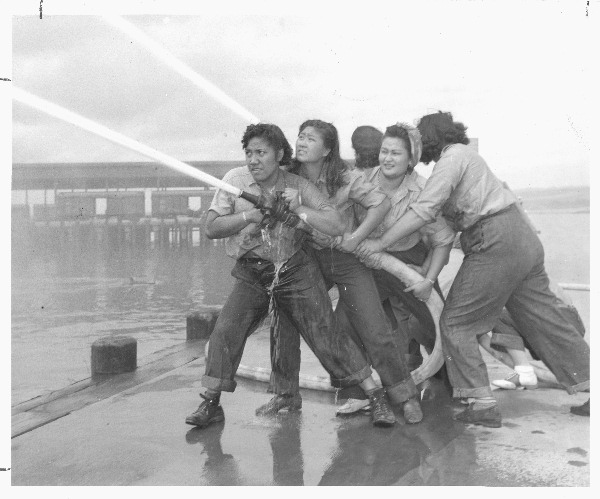
In an iconic photo, four Asian American Pacific Islander women at the Pearl Harbor Naval Shipyard train in firefighting. Long mislabeled as taken during the attack of Dec. 7, 1941, the photo in fact portrays some of  the strong women who applied to support the Navy’s war efforts in the wake of that attack. From left to right: Elizabeth Moku, Alice Cho, Katherine Lowe, and Hilda Van Gieson.


Over time, history usually has a way of sorting out fact from fiction.


Rear Adm.Grace Hopper, "Mother of Computing"
The facts and highlights of strong women of grit and grace are spotlighted in a book recommended for Women’s History Month. Profiles of more than 100 women come to life in “The Book of Gutsy Women” by Hillary Rodham Clinton and Chelsea Clinton (Simon & Schuster, 2019).

Among the women profiled are some we featured in Navy Reads posts: Rear Adm. Grace Hopper, Ada Lovelace, Rachel Carson, Marjory Stoneman Douglas, Margaret Chase Smith, Malala Yousafzai, and Maya Angelou. This book includes mini-biographies of both famous (Clara Barton, Helen Keller, Ida B. Wells, Maya Lin, Gabby Giffords, Greta Thunberg, and Venus and Serena Williams) as well as less-well-known women (Rigoberta Menchu Tum, Dr. Gao Yaojie, Nelba Marquez-Greene, Wangari Maathai, and Jineth Bedoya Lima).


Chelsea and Hillary Clinton, 2011
Hillary and Chelsea each provide essays about their subjects. They also offer personal perspectives about the women who have inspired and enlightened them – women who have made a difference in the world. The book is organized in sections: early inspirations, education pioneers, earth defenders, explorers and inventors, healers, athletes, advocates and activists, storytellers, elected leaders, groundbreakers, and women’s rights champions.

Chelsea writes, “I learned of Grace (Hopper) in 1996, when the navy named a new ship the USS Hopper (DDG 70) in her honor … I learned even more about her when I spoke many years later at the Grace Hopper celebration, the largest gathering of women technologists in the world.”


Former First Lady, senator, and Secretary of State Hillary Clinton reflects about the suffragists who knocked on the door, marched in the street, and fought for women to be able to vote in the United States one hundred years ago. That right was guaranteed with the passing of the Nineteenth Amendment to the U.S. Constitution, but it was a right that took decades to apply to women of color:

“Reading the words of the Nineteenth Amendment today, it’s hard not to wonder why it took so long” ‘The right of citizens of the United States to vote shall not be denied or abridged by the United States or by any State on account of sex. Congress shall have the power to enforce this article by appropriate legislation.’ But, of course, it was a long struggle because it was about so much more than the right of women to vote. It was about race, class, and deeply held cultural and religious views about women’s subordinate roles to men in society. It was about men’s –– and some women’s –– insecurities and fears of the unknown. These challenges are still present today.

The franchise –– the basic right of citizenship –– is still being fought over between those of us who believe every citizen should be able to vote and have that vote counted, and those who want to restrict the vote by erecting barriers against people, largely still based on race.”

Celia Ou, a graduate student at Scripps Institution of Oceanography, monitors computer screens displaying detailed sonar imaging of the ocean floor aboard the Auxiliary General Oceanographic Research (AGOR) vessel R/V Sally Ride, Dec. 15, 2016. (John F. Williams)


Nearly all the Gutsy women featured in this book faced and overcame some kind of obstacles of discrimination. Chelsea Clinton says this about space pioneer astronaut Sally Ride, the first American woman in space (in 1983) and a champion of STEM education for young people worldwide:

“Even after her death in 2012, Sally Ride kept breaking barriers. She came out as a lesbian quietly, without fanfare … Not long after her death, Tam [O’Shaughnessy, her partner of 27 years] received a call that surprised her, from Ray Mabus, then secretary of the navy. The navy hoped to honor Sally by naming a research vessel after her. Secretary Mabus was calling to ask whether Tam would be the ship’s sponsor – a role that had, up until that point, been filled by the wife of the man for whom the ship was named. ‘I think it is fitting the the celebration of Sally’s legacy as a pioneering space explorer and a role model includes an acknowledgment of who she really was and what she cared about,’ said Tam. The R/V Sally Ride, commissioned in 2016, is the first navy research ship named for a woman. Her legacy lives on in the scientific curiosity sparked in the girls and boys she continues to inspire, the ship that bears her name, and a spot on the moon named after her by NASA.”

Military readers may find fascinating nuggets of history in the essays about Sylvia Earle, Mary McLeod Bethune, Florence Nightingale, Eleanor Roosevelt, and Mary Edwards Walker. Chelsea writes this about Walker:

“…Dr. Mary Edwards Walker, the only woman in her medical school class at Syracuse Medical College in 1855. She was a practicing physician when the Civil War broke out. She desperately wanted to enlist in the Union Army as a surgeon but wasn’t allowed to because she was a woman. Initially she was called a nurse, since women generally weren’t considered doctors. Because women were not allowed to enlist, Mary had to volunteer, working for free at a temporary hospital, first in Washington and then in Virginia, where she traveled to Union field hospitals across the commonwealth … When her medical credentials were finally accepted she moved to Tennessee and became a War Department surgeon – a paid position that was the equivalent of a lieutenant in status.”


Dr. Sylvia Earle became chief scientist at the National Oceanic and Atmospheric Administration in 1990. She pioneered research in preserving 
and protecting the ocean, including the study of damage to coral reefs. Her inspiring TED talk, above, is a call to action. Hillary writes:

“When I think of Sylvia’s work, I am reminded how important it is for all of us to peruse and consider what we want to leave to the generations who come after us –– how they’ll honor the past, imagine the future, and give gifts to those who will live out their lives long after we’re gone. That’s exactly what Sylvia’s life as a scientist, an engineer, a teacher, and an explorer should inspire all of us to do: we must preserve our oceans for the future.”

Last year, this book generated controversy because of the women who were not included. For example, there is an unfortunate dearth of women who have served in or with the military. Surely, the authors could have included a “protectors” section filled with inspiring women who served in uniform.


Despite the intriguing photo on the cover, there is little focus on the women who served on the Homefront during the Second World War. In fact, there’s no explanation of the colorized photo of the women firefighters at the Pearl Harbor Naval Shipyard.

Yet, considering the general lack of attention toward the achievements of women in American and world history for many generations, it is refreshing to see a book of this scope. Women continue to knock on the door, push through the glass ceiling, and demand equality.


“The Book of Gutsy Women” illustrates the strengths of women throughout history, often in the face of sexism, misogyny, harassment, and patriarchy. It highlights the facts of women’s history and showcases women’s contributions to creating a better world now and in the future.

Tuesday, July 30, 2019

Now More Than Ever: 'Back Channel' Diplomacy!

Review by Bill Doughty

It turns out bagging groceries in a military commissary is a good step in preparing for a career in diplomacy.

Career Ambassador William J. Burns
Such was the beginning of a life of service for military brat William J. Burns, who became a diplomat serving before, during and after 9/11. He held senior U.S. State Department leadership positions during the killing of Osama bin Laden, the rise of Putin, the Arab Spring, growth of China, and the challenges of Iran's nuclear threats.

Burns shows how life as a military dependent can widen the aperture – providing an individual with an understanding of the world and an appreciation of human rights. He recounts people, events and consequences in "The Back Channel: A Memoir of American Diplomacy and the Call for Its Renewal" by William J. Burns (Penguin Random House, 2019).

"Public service was already in my blood. I grew up as an Army brat, the product of an itinerant military childhood that took my family from one end of the United States to the other, with a dozen moves and three high schools by the time I was seventeen," Burns writes.

His father, who served in Vietnam and became a two-star general in the Army, told him, "Nothing can make you prouder than serving your country with honor." Frequent moves at an early age and traveling overseas also helped a young Burns gain insights about his country.

Burns became a diplomat in President Ronald Reagan's and George Shultz's State Department. He served under both Presidents Bush and with Presidents Bill Clinton and Barack Obama. He held key positions in the Middle East, as Ambassador to Russia and as a State Department leader in Washington D.C., retiring in 2014 as Deputy Secretary of State and Career Ambassador. (Today he is president of the Carnegie Endowment for International Peace.)

This book is a must-read for diplomats – including diplomat-sailors/soldiers – who seek to understand "great power rivalry," the Iran nuclear deal, challenges in Asia and eastern Europe, the "frustration seething beneath so many authoritarian Arab societies" and why the U.S.-led war in Iraq was such a mistake.

Burns, who worked directly for Gen. Colin Powell, is clear in his accounting:
"The Iraq invasion was the original sin. It was born of hubris, as well as failures of imagination and process. For neoconservative proponents, it was the key tool in the disruption of the Middle East – the heady, irresponsible, and historically unmoored notion that shaking things up violently would produce better outcomes. In a region where unintended consequences were rarely uplifting, the toppling of Saddam set off a chain reaction of troubles. It laid bare the fragilities and dysfunctions of Iraq as well as the wider Arab state system – proving that Americans could be just as arrogant and haphazard in their impact on Middle East maps as the original British and French mapmakers."
He asks, "What if we had tried to harness the massive outpouring of international goodwill and shared concern for the terrible attacks of September 11 in a different – more constructive – direction?"
"The eighteen months between 9/11 and the invasion of Iraq were one of those hinge points in history, whose contours are easier to see today than they were at that uncertain and emotional time. If we had avoided the debacle in Iraq, and instead projected American power and purpose more wisely, it seems obvious today that American interests and values would have been better served. That would have required a real attempt at coercive diplomacy in Iraq – not the one we employed, which was long on coercion and short on diplomacy. That would also have required patience in our diplomacy and a readiness to share in its design and execution. Instead, we opted for the more immediate satisfactions of unilateral impulses and blunt force, and kept the sharing part to a minimum. It was beyond our power and imagination to remake the Middle East, with our without the overthrow of Saddam, but we could certainly make an already disordered region worse and further erode our leadership and influence. And we did."
Will we do the same in Iran?

Yeoman 2nd Class DeMario Smith places flowers at the Stark Memorial plaque during the guided-missile frigate USS Stark (FFG 31) remembrance ceremony at the Naval Station Mayport. On May 17, 1987, while on a routine patrol in the Persian Gulf, USS Stark was struck by two Iraqi missiles killing 37 Sailors. Despite the damage inflicted, the efforts of the Stark's crew saved the ship. Stark was later decommissioned in 1999. (Photo by MC2 Damian Berg)
Burns recounts the following tragedies while he was in the State Department: the bombing of U.S. Marine Barracks in Lebanon that killed 241 Marines; the Arms for Hostages debacle with Iran; Iraq's attack on USS Stark (FFG-31) that killed 37 Sailors; the USS Samuel B. Roberts (FFG-58) mine incident that wounded ten Sailors, the attack on the American embassy Benghazi, Libya that killed four Americans including Ambassador Chris Stevens; and Russian ongoing meddling in other countries' affairs.

"Putin had a remarkable capacity for storing up grievances and slights ... Putin was an apostle of payback," Burns writes. Putin is described as "cocky, cranky, aggrieved and insecure." He is the "anti-Yeltsin, half a generation younger, sober, ruthlessly competent, hardworking and hard-faced."

Adm. John Poindexter (Photo from NHHC)
Burns offers terse yet deep descriptions of individuals, especially colleagues:

  • Donald Rumsfeld – "Supremely confident but unfettered by much knowledge of the region (Middle East)."
  • George Shultz – "Impressive integrity and intellect ... Shultz was a firm believer in the importance of 'tending the garden' in diplomacy."
  • John Whitehead – (who served in the U.S. Navy during WWII and participated in the D-Day Invasion) "Self-assured and thoroughly decent."
  • Adm. John Poindexter – "Became Reagan's fourth NSC chief in four years at the end of 1985. A decent man with a nuclear engineer's exacting intellect, Poindexter was badly miscast in the role."
  • Lawrence Eagleburger – "A rumpled, blunt-spoken, chain-smoking foreign service veteran, sometimes bursting at the seams of his disproportionally sized pinstriped suits."
  • Richard Holbrooke – "Was a brilliant diplomat, whose talents and drive were matched only by his showmanship and sense of self."
  • Adm. Bill McRaven – "It was impossible not to feel his confidence."

Burns was in the Situation Room Sunday, May 1, 2011, along with his boss, Secretary of State Hillary Clinton, after President Obama approved the raid by McRaven's SEALs on bin Laden's compound in Pakistan.
"At 2:30 p.m., we watched on a small video map as two Black Hawk helicopters took off for Abbottabad from Jalalabad in eastern Afghanistan. The next couple hours seemed like an eternity, and the raid itself began with gut-wrenching drama, when one of the two helicopters made a hard landing in the courtyard of the compound. The SEALs were unhurt, but they had to destroy the helicopter and adapt quickly. McRaven narrated the whole operation with incredible calm from a command post in Afghanistan. As the president and his senior aides sat in rapt attention, there wasn't a hint of second-guessing or backseat commentary. Then McRaven's voice came on the line to confirm 'E-KIA' – the enemy had been killed in action. Bin Laden was dead. Never have I been prouder of the U.S. military, or of a president who had so coolly taken such a big risk. For a diplomat accustomed to long slogs and victories at the margins, this was an incredible moment."
In the Situation Room May 1, 2011 as President Obama and his National Security team observe the SEAL raid on bin Laden's compound. (Pete Souza, WH)
Burns thinks military strikes against Syria should have been ordered after President Bashar Assad deployed chemical weapons in his country's civil war. But President Obama insisted on getting congressional authorization. "Few Republicans wanted to be helpful to Obama, and many Democrats were uneasy, afflicted by 2003 Iraq War déjà vu."

"Hindsight neither diminishes the continuing pain and cost of Syria's civil war," Burns writes, "nor illuminates any easy choices for policymakers."

Burns presents the incredibly nuanced strategies and tactics involved in nuclear arms talks, including especially with Iran. He also describes the Gordian knot of Syria, Israel, Egypt and, to a lesser degree in this book, Saudi Arabia and other Arab states.

In 2013 General Jim Mattis famously advised Congress, "If you don’t fund the State Department fully, then I need to buy more ammunition." Burns notes, "The savaging of American diplomacy as the Trump administration consolidated its grip was not the first such assault in our history, but it was in many ways the worst."

Seated: Former Secretaries of State Henry Kissinger, James Baker, Madeleine Albright, Colin Powell, Hillary Clinton and John Kerry and others participate in the dedication of the George Marshall Conference Center at the Harry S. Truman Building, Sept. 3, 2014. (Photo by Ken Richards, DOS, DVIDS)
Still, Burns is optimistic about America's advantages going forward, with an assessment that might make Mahan, Kaplan and Friedman smile:
"Our assets are substantial. We still spend more every year on defense than the next seven countries combined. Our economy, despite risks of overheating and persistent inequalities, remains the biggest, most adaptable, and most innovative in the world. Energy, once a vulnerability, now offers considerable advantages, with technology unlocking vast natural gas resources, and advances in clean and renewable energy accelerating. Demography is another strength. Compared to our peer competitors, our population is younger and more mobile, and if we could stop doing so much practical and moral damage to ourselves on immigration issues we could lock in that strategic edge for generations. Geography sets us apart, with our two liquid assets – the Pacific and Atlantic oceans – insulating us to some extent from the kinds of security threats that expose other major powers. Diplomacy ought to be another advantage. We have more allies and potential partners than any of our peers or rivals, with greater capacity for coalition-building and problem-solving."
While Burns acknowledges the current problems and challenges of American diplomacy, and recommends a return to core values of judgment, balance and discipline. He recommends adopting U.S. military employment of "systematic case studies and after-action reports." And he calls for making a connection with the American public about the importance and relevance of global diplomacy to citizens' daily lives.

At a fundamental – and relatable – level, diplomacy can prevent war. Burns shows in this book how a study of history and diplomacy can promote cooperation between increasingly connected nations, ensuring a safer and more prosperous world – for everyone, from commissary baggers to presidents.