Showing posts sorted by relevance for query angelou. Sort by date Show all posts

Sunday, December 9, 2018

New York Says What to Read. Wait, What?


Review by Bill Doughty

The trouble with a book that recommends 1,000 books for your bucket-list is this: What prism is the editor/compiler looking through.

"A Thousand Books to Read Before You Die" (Workman Publishing, 2018, New York, NY) is a beautiful book offering an impressive spectrum of colorful titles and great authors.

You'll find great writers and thinkers like Isaac Asimov, Ulysses S. Grant, Maya Angelou, Stephen J. Gould, George Orwell, Mark Twain, Leo Tolstoy, Oliver Sacks, Homer, Dorothy Parker, D.H. Lawrence, J.K. Rowling, Jon Krakauer and Agatha Christie.

There are a relative handful of selected books that would appeal to Navy readers, including Tim O'Brien's "The Things They Carried," Tom Clancy's "The Hunt for Red October," Erich Maria Remarque's "All Quiet on the Western Front," "The Personal Memoirs of Ulysses S. Grant," Shelby Foote's "The Civil War," Robert Hughes's "The Fatal Shore," William Manchester's "Goodbye Darkness," John Keegan's "The Face of Battle," David McCullough's "Truman," David Halberstam's "The Best and the Brightest," Herman Melville's "Moby Dick," Ernest Hemingway's "The Old Man and the Sea," Kurt Vonnegut's "Slaughterhouse Five," Joseph's Heller's "Catch-22" and Orson Scott Card's "Ender's Game":
"...Just try to put it down. Tracing Ender's path to Battle School – a space center in which the best and the brightest children are trained for high-tech war – and, ultimately, to Command School, on the edge of the interstellar front lines. Orson Scott Card's novel is riveting... Ender's fierce initiation reveals his unparalleled gifts for warfare. As the stakes mount, the simulated battles he dominates are transformed from complex and dangerous games into sinister – and spectacular – realities."
Author James Mustich features his one thousand books, mentions many others and merely names a slew of extras. In other words, there are thousands of books discussed in this readable, interesting and hefty offering: a beautiful book about books.

So, what's the problem?

BM3 Ivan Naranjo reads aboard USS Anchorage (LPD 23), 2018. Photo by MC3 Ryan M. Breeden
As great as this book is, the personal lens of the editor understandably distorts reason, trumps objectivity, and begs questions as to how some of the authors and their works were selected. 

I mean, Anne Rice? Moss Hart's show business autobiography? Richard Ford's adventures in making artisan bread and pizza? "Adventures on the Wine Route: A Wine Buyer's Tour of France"? "When French Women Cook"? "Between Meals: An Appetite for Paris"? "The Auberge of the Flowering Hearth"? 

Mustich, a New York bookseller with an apparent deep love of fashion, fine dining, Broadway, the Big Apple, Provence and France, all but admits his bias and certainly is upfront about his selections not being perfect. "Hot dogs to haute cuisine," as he says. But if comfort foods of literature are allowed, where are Edgar Rice Burroughs, Mario Puzo, Louis L'Amour and Zane Grey?

Stephen King gets "Carrie" and "11/22/1963," but where are "The Stand," "The Shining" and "Cujo"?


William Shakespeare
As one would expect from a polished bookseller, this is like a bookstore readers can hold, complete with a detailed general index and 1,000 book checklist.

Overall, Mustich does a pretty good job of ensuring diversity, including different age groups and interests – both fiction and non-fiction; poetry and philosophy; youth and adult; U.S. and international; escapist and pay-attention-this-is-important.

The Bhagavad Gita, Bible and The Book of Job find themselves co-located, thanks to alphabetical listings, as are Plato, Pliny the Younger and Plutarch. Shakespeare is the overall winner in number of works listed, with 13 titles.

Nice surprises include personal favorites such as Gould's "The Panda's Thumb," Loren Eiseley's "The Immense Journey," Larry McMurtry's "Lonesome Dove," Richard Dawkins's "The Selfish Gene," "Portable Dorothy Parker," Taylor Branch's "Parting the Waters," "Narrative of the Life of Frederick Douglass, an American Slave," Carl Sagan's "Dragons of Eden," Edward O. Wilson's "The Naturalist," and Charles Darwin's "The Voyage of the Beagle."

Thankfully there's a heavy helping of science, including Thomas's wonderful collection of essays, "The Lives of a Cell":
"Every genre has its native charms, and the allure of the essay is its easy way with rumination. In the best examples of the form, the essayist communicates not just learning, but thinking, inviting the reader to share the satisfactions of a mind at play on a field of observation or experience. When an essay's author is as masterful as Lewis Thomas, it can shine like a jewel, glittering with truths small and large."
But where are shining lights by Christopher Hitchens, Steven Covey, Desmond Morris ("The Naked Ape"), John Hersey ("Hiroshima"), Thomas Paine ("The Age of Reason"), Steven Pinker, William Zinsser, Mary Roach, Craig Symonds, Jared Diamond, Nathaniel Philbrick, Erik Larson, James D. Hornfischer, Hector Hugh Munro a.k.a. Saki, Doris Kearns Goodwin, Thomas Friedman, Noah Yuval Harari and Stephen Hawking?

It's a tragedy that Mary Roach and Hope Jahren ("Lab Girl") are missing.

So many great authors are left on forgotten shelves, so many books. It can be difficult to choose any individual one. That's where a book like this can help. Perhaps there will be more versions of "1,000 Books to Read" – even someday "1,000 Navy Books to Read."

Bazelon, Richardson and Plotz of Slate's Political Gabfest.
This book first came to my attention after hearing it recommended by David Plotz, anchor of Slate Magazine's Political Gabfest podcast with Emily Bazelon and John Richardson.

Plotz said this about editor Mustich: "He's a reader of such joy and bouyancy. ... He has a real knack for recognizing what in a book is wonderful ... He's a spirit you'll want to spend time with."

And Plotz said this about the book itself: "Over 948 magnificent pages, well-illustrated. The familiar and the highly unfamiliar ... It's so much fun."

Gabfest's John Dickerson said, "So, does that make it a thousand and one?"

The best endorsement may be through the prism of writer, historian, producer Ken Burns: "If you've ever doubted that books were the greatest invention of all time, and that they carry within them our collective memories and dreams as well as any semblance of intelligence we have as a species, pick up this book and start reading."

Monday, March 29, 2021

‘Gutsy’ Women Knocking on the Door

Review by Bill Doughty

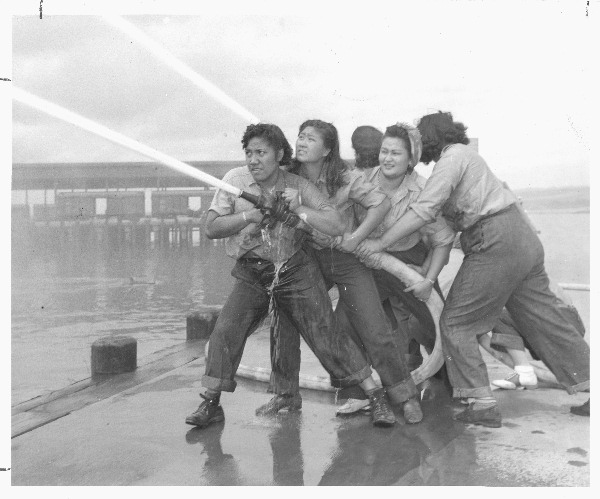
In an iconic photo, four Asian American Pacific Islander women at the Pearl Harbor Naval Shipyard train in firefighting. Long mislabeled as taken during the attack of Dec. 7, 1941, the photo in fact portrays some of  the strong women who applied to support the Navy’s war efforts in the wake of that attack. From left to right: Elizabeth Moku, Alice Cho, Katherine Lowe, and Hilda Van Gieson.


Over time, history usually has a way of sorting out fact from fiction.


Rear Adm.Grace Hopper, "Mother of Computing"
The facts and highlights of strong women of grit and grace are spotlighted in a book recommended for Women’s History Month. Profiles of more than 100 women come to life in “The Book of Gutsy Women” by Hillary Rodham Clinton and Chelsea Clinton (Simon & Schuster, 2019).

Among the women profiled are some we featured in Navy Reads posts: Rear Adm. Grace Hopper, Ada Lovelace, Rachel Carson, Marjory Stoneman Douglas, Margaret Chase Smith, Malala Yousafzai, and Maya Angelou. This book includes mini-biographies of both famous (Clara Barton, Helen Keller, Ida B. Wells, Maya Lin, Gabby Giffords, Greta Thunberg, and Venus and Serena Williams) as well as less-well-known women (Rigoberta Menchu Tum, Dr. Gao Yaojie, Nelba Marquez-Greene, Wangari Maathai, and Jineth Bedoya Lima).


Chelsea and Hillary Clinton, 2011
Hillary and Chelsea each provide essays about their subjects. They also offer personal perspectives about the women who have inspired and enlightened them – women who have made a difference in the world. The book is organized in sections: early inspirations, education pioneers, earth defenders, explorers and inventors, healers, athletes, advocates and activists, storytellers, elected leaders, groundbreakers, and women’s rights champions.

Chelsea writes, “I learned of Grace (Hopper) in 1996, when the navy named a new ship the USS Hopper (DDG 70) in her honor … I learned even more about her when I spoke many years later at the Grace Hopper celebration, the largest gathering of women technologists in the world.”


Former First Lady, senator, and Secretary of State Hillary Clinton reflects about the suffragists who knocked on the door, marched in the street, and fought for women to be able to vote in the United States one hundred years ago. That right was guaranteed with the passing of the Nineteenth Amendment to the U.S. Constitution, but it was a right that took decades to apply to women of color:

“Reading the words of the Nineteenth Amendment today, it’s hard not to wonder why it took so long” ‘The right of citizens of the United States to vote shall not be denied or abridged by the United States or by any State on account of sex. Congress shall have the power to enforce this article by appropriate legislation.’ But, of course, it was a long struggle because it was about so much more than the right of women to vote. It was about race, class, and deeply held cultural and religious views about women’s subordinate roles to men in society. It was about men’s –– and some women’s –– insecurities and fears of the unknown. These challenges are still present today.

The franchise –– the basic right of citizenship –– is still being fought over between those of us who believe every citizen should be able to vote and have that vote counted, and those who want to restrict the vote by erecting barriers against people, largely still based on race.”

Celia Ou, a graduate student at Scripps Institution of Oceanography, monitors computer screens displaying detailed sonar imaging of the ocean floor aboard the Auxiliary General Oceanographic Research (AGOR) vessel R/V Sally Ride, Dec. 15, 2016. (John F. Williams)


Nearly all the Gutsy women featured in this book faced and overcame some kind of obstacles of discrimination. Chelsea Clinton says this about space pioneer astronaut Sally Ride, the first American woman in space (in 1983) and a champion of STEM education for young people worldwide:

“Even after her death in 2012, Sally Ride kept breaking barriers. She came out as a lesbian quietly, without fanfare … Not long after her death, Tam [O’Shaughnessy, her partner of 27 years] received a call that surprised her, from Ray Mabus, then secretary of the navy. The navy hoped to honor Sally by naming a research vessel after her. Secretary Mabus was calling to ask whether Tam would be the ship’s sponsor – a role that had, up until that point, been filled by the wife of the man for whom the ship was named. ‘I think it is fitting the the celebration of Sally’s legacy as a pioneering space explorer and a role model includes an acknowledgment of who she really was and what she cared about,’ said Tam. The R/V Sally Ride, commissioned in 2016, is the first navy research ship named for a woman. Her legacy lives on in the scientific curiosity sparked in the girls and boys she continues to inspire, the ship that bears her name, and a spot on the moon named after her by NASA.”

Military readers may find fascinating nuggets of history in the essays about Sylvia Earle, Mary McLeod Bethune, Florence Nightingale, Eleanor Roosevelt, and Mary Edwards Walker. Chelsea writes this about Walker:

“…Dr. Mary Edwards Walker, the only woman in her medical school class at Syracuse Medical College in 1855. She was a practicing physician when the Civil War broke out. She desperately wanted to enlist in the Union Army as a surgeon but wasn’t allowed to because she was a woman. Initially she was called a nurse, since women generally weren’t considered doctors. Because women were not allowed to enlist, Mary had to volunteer, working for free at a temporary hospital, first in Washington and then in Virginia, where she traveled to Union field hospitals across the commonwealth … When her medical credentials were finally accepted she moved to Tennessee and became a War Department surgeon – a paid position that was the equivalent of a lieutenant in status.”


Dr. Sylvia Earle became chief scientist at the National Oceanic and Atmospheric Administration in 1990. She pioneered research in preserving 
and protecting the ocean, including the study of damage to coral reefs. Her inspiring TED talk, above, is a call to action. Hillary writes:

“When I think of Sylvia’s work, I am reminded how important it is for all of us to peruse and consider what we want to leave to the generations who come after us –– how they’ll honor the past, imagine the future, and give gifts to those who will live out their lives long after we’re gone. That’s exactly what Sylvia’s life as a scientist, an engineer, a teacher, and an explorer should inspire all of us to do: we must preserve our oceans for the future.”

Last year, this book generated controversy because of the women who were not included. For example, there is an unfortunate dearth of women who have served in or with the military. Surely, the authors could have included a “protectors” section filled with inspiring women who served in uniform.


Despite the intriguing photo on the cover, there is little focus on the women who served on the Homefront during the Second World War. In fact, there’s no explanation of the colorized photo of the women firefighters at the Pearl Harbor Naval Shipyard.

Yet, considering the general lack of attention toward the achievements of women in American and world history for many generations, it is refreshing to see a book of this scope. Women continue to knock on the door, push through the glass ceiling, and demand equality.


“The Book of Gutsy Women” illustrates the strengths of women throughout history, often in the face of sexism, misogyny, harassment, and patriarchy. It highlights the facts of women’s history and showcases women’s contributions to creating a better world now and in the future.

Saturday, June 2, 2018

To Tell the Truth, Mr. President

Review by Bill Doughty

Autocratic dictators lie.

So said President Harry S. Truman, American everyman leader-philosopher.

"The dictators of the world say that if you tell a lie often enough, why people, will believe it," Truman wrote, as quoted in Jon Meacham's insightful "The Soul of America" (Random House, 2018). "Well, if you tell the truth often enough, they'll believe it and go along with you," Truman wrote.

Our previous Navy Reads post shows some of the ways the Navy was influential in history – an unintended subtext in Meacham's book. This blogpost focuses on Truman's and other leaders' roles, especially during the Cold War, when democracy was threatened by a politician who sought to divide people with fear, hate and intolerance: Wisconsin's Senator Joseph R. McCarthy.

Using fear, religion and his version of patriotism, McCarthy spewed the conspiracy theory of a deep state with communists behind every tree. Meacham reports McCarthy's words: "'Today we are engaged in a final, all-out battle between communistic atheism and Christianity,' McCarthy told the Ohio County Republican Women's Club in Wheeling, West Virginia, on Thursday, February 9, 1950."

McCarthy reveling in headlines about himself.
McCarthy "exploited the privileges of power and prominence without regard to its responsibilities; to him politics was not about the substantive but the sensational," Meacham writes. "A master of false charges, or conspiracy-tinged rhetoric, and of calculated disregard for conventional figures (from Truman and Eisenhower to [Gen. George C.] Marshall), McCarthy could distract the public, play the press, and change the subject – all while keeping himself at center stage."

"McCarthy was an opportunist, uncommitted to much beyond his own fame and influence."
"How he loved the story of himself as a brave warrior, a story that dominated the newspapers of the day. McCarthy needed the press, and the press came to need McCarthy. He was fantastic copy, a real life serial. The twists and turns of the McCarthy saga meant more bylines for the reporters, more exciting headlines for the editors, and, given the subject matter – alleged infiltration of the government of the United States by a fatal foe – more copies sold for the owners. Radio and television amplified McCarthy's impact."
He manipulated the media and news cycles and kept the spotlight on himself. He advocated for banning books by authors such as Dashiell Hammett's "The Maltese Falcon" and "The Thin Man" because of the author's leftist leanings.

McCarthy and Cohn
According to McCarthy's own New York attorney, Roy M. Cohn, who ultimately turned on his boss by reflecting about McCarthy: "He was impatient, overly aggressive, overly dramatic. He acted on impulse. He tended to sensationalize the evidence he had ... He would neglect to do important homework and consequently would, on occasion, make challengeable statements," Cohn said.

"He saw the dramatic political opportunities connected with a fight on Communism. McCarthy was gifted with a sense of political timing," Cohn added. "Sometimes he misjudged, but on balance his sense of what made drama and headlines was uncommonly good."

Sen. Margaret Chase Smith
Allied against McCarthy were Eleanor Roosevelt, who compared McCarthy's tactics to "hitlerism"; Winston Churchill, who called for defending "the Anglo-American tradition of fair play"; Maine's Republican Senator Margaret Chase Smith, who said McCarthy created "a national feeling of fear and frustration that could result in national suicide and everything that we Americans hold dear"; editor Palmer Hoyt, who told his reporters to call out lies when statements were "demonstrably false"; reporter Edward R. Murrow, who said, "We will not be driven by fear into an age of unreason if we dig deep in our history and our doctrine and remember that we are not descended from fearful men"; and (former Army captain) Truman, who believed in telling the truth in plain English.
"On Thursday, March 30, 1950, at a press conference at his Florida retreat in Key West – where Truman could indulge his fondness for Hawaiian shirts, bourbon and poker – the president told the assembled journalists exactly what he believed, 'I think the greatest asset that the Kremlin has is Senator McCarthy,' Truman said ... The net effect of the McCarthyite campaign,Truman said, was to undermine confidence in the country in a time of cold war. 'To try to sabotage the foreign policy of the United States,' he said,'is just as bad in this cold war as it would be to shoot our soldiers in the back in a hot war."
Young Navy war hero Sen. John F. Kennedy and his brother Robert F. Kennedy aligned themselves with McCarthy in the early 1950s and later regretted it. RFK even served as a young lawyer on McCarthy's staff.

McCarthy tried to associate himself with a hero of naval history when his adversaries spoke out against him:
"In the early 1950s legions of people were entranced by McCarthy's Manichaean vision of life. He spoke in the starkest of terms, savoring superlatives. Everything was dramatic, contentious, perilous: So few things, McCarthy implied, stood between American freedom and Communist slavery. But one of those things – perhaps the most important of them – was McCarthy himself, who quoted John Paul Jones: 'I have just begun to fight.'"
Eisenhower failed to take on McCarthy when he became president, but he did address the nation about resisting fear. "His April 1954 speech about fear, which falls about midway between these landmarks (of his speeches about D-Day landings and warning about the 'military-industrial complex') ... described the disposition necessary to survive life in an age of strain and uncertainly.'"

Department of Army attorney Welch and Sen. McCarthy in Senate hearing."Have you no sense of decency?"
McCarthy's downfall came after Eisenhower's speech on fear, Murrow's public denunciation and an event that occurred in Congress involving the U.S. Army and Roy M. Cohn, when McCarthy seemed to slander and call into question the integrity of an army lawyer.
"In an iconic moment, the counsel for the army, Joseph N. Welch, attacked the senator, who had clumsily attempted to impugn the loyalty of a young lawyer on Welch's team. 'Until this moment, Senator, I think I never really gauged your cruelty or your selfishness,' Welch told McCarthy. 'Little did I dream you would be so reckless and cruel to do injury to that lad ... I fear he shall always bear a scar needlessly inflicted by you. If it were in my power to forgive you for your reckless cruelty I would do so. I like to think that I am a gentle man, but your forgiveness will have to come from someone other than me.' McCarthy blundered forward and took up the theme again. Welch was ready and struck with force. 'You have done enough. Have you no sense of decency, sir, at long last? You have done enough. Have you left no sense of decency?'"
President Dwight D. Eisenhower and Sen. Prescott Bush
Meacham points out that even after the wind left McCarthy's sails, he still had a base support within the country, with 34 percent still backing him. It took a Senate censure to finally evaporate his power. Among those senators who spoke in favor of censure was a senior senator from Connecticut, Prescott Bush, father of President George H. W. Bush and grandfather of President George W. Bush.
"When Joe McCarthy died at Bethesda Naval Hospital on Thursday, May 2, 1957, he was once more the center of attention," Meacham writes. "'Years will pass before the results of his work can be objectively evaluated,' Vice President Nixon said, 'but his friends and many of his questions will not question his devotion to what he considered to be the best interests of his country.'"
Meacham's book serves a tray of rich appetizers from history. He reveals how Americans have survived division and dissension, how we've been able to vanquish real threats to our democracy and live up to our ideals set forth by the nation's founders. We're left hungry to learn more, and fortunately we have a list of books and authors from Meacham, both in the chapters and in the extensive bibliography, all of which contributed in some way to the soul.

For example:

Garry Wills's "Inventing America"

The works of Thomas Jefferson, Aristotle, Cicero, Locke, St. Augustine, Shakespeare, Ulysses S. Grant, Frederick Douglass, Emerson and Thoreau

Corey Robin's "Fear: the History of a Political Idea"

Jacob A. Riis's "How the Other Half Live"

Sinclair Lewis's "It Can't Happen Here"

Nathaniel West's "A Cool Million"

Maya Angelou's "I Know Why the Caged Bird Sings"

Robert Penn Warren's "Segregation" and "The Legacy of the Civil War"

John Lewis's "Walking with the Wind"

Authors: Arthur M. Schlesinger, Alexis de Tocqueville, Stephen Ambrose, Taylor Branch, W.E.B. Dubois, Doris Kearns Goodwin, Eric Foner, Chris Matthews, Theodore C. Sorensen, Thomas Aquinas, Barbara Tuchman, David McCullough and Fareed Zakaria, among scores of others.

Meacham dedicates the book to fellow historians Evan Thomas and Michael Beschloss. "They are reassuring, selfless, and kind."

"The Soul of America" is a recent #1 New York Times bestseller, supplanted this week by Navy veteran Senator John McCain's "The Restless Wave" (Simon and Schuster, 2018).

In closing, we share these words from Thomas Paine, quoted early in Meacham's book: "As in absolute governments the king is law, so in free countries the law ought to be king."

Remembering the thoughts of Truman and Paine: Dictators and kings who think they have absolute power lie. The law – based on the Constitution, the support of the American people and the better angels of our nature – stands for truth.