Showing posts with label Marine Corps. Show all posts

Saturday, December 2, 2023

Best Friend, Worst Enemy: WWJD?

Review by Bill Doughty––

A Marine with a warrior heart must also have a trained mind, according to General James Mattis –– one of the key U.S. military leaders of this century. Among his many assignments, Mattis commanded the U.S. Joint Forces Command and U.S. Central Command. He led Marines in combat in Operations Iraqi Freedom and Enduring Freedom in the Middle East. And he served as the first Secretary of Defense in the Trump administration.


In his combat operations, Mattis faced jihadist enemies who ignored the rules and laws of war and put innocent civilians at risk, hiding behind women and children.

So, WWJD? What would Jim Mattis do –– if able –– about the situation now in Israel and Gaza? In “No Better Friend, No Worse Enemy: The Life of General James Mattis” (HarperCollins, 2018) author Jim Proser gives us a clue.


Mattis learned valuable lifelong lessons in Vietnam and its aftermath, as Marines and Sailors rescued refugees fleeing on small boats from Laos, Cambodia, and South Vietnam.

“The human aftermath of US political defeat in Vietnam and the ensuing political instability crowds every available inch of deck space around Mattis. They fill the seats hold of the ship, clutching their children and meager possessions, often shaking with fear and trauma. This is Mattis’s first real-world experience of war as a Marine. As soldiers of the navy, the first in and often the last out of smaller, third-world conflicts, Marines frequently end up with the responsibility for evacuation of war victims.”

Proser traces the arc of Mattis’s life, one dedicated to service, philosophy, and his fellow Marines and other service members. “No Better Friend” was published just months before Mattis resigned as SECDEF over differences with Trump (who later falsely claimed he fired Mattis).


The book concentrates on Mattis’s role in military operations, where we see his ethical leadership and humanism. The “Warrior Monk” –– callsign Chaos –– is against wholesale and indiscriminate warfare that ignores the effect on noncombatants. For example, after the Islamist attack of Sept. 11, 2001, Mattis recognized the danger of the Bush Administration’s race to invade Iraq under the pretense that Saddam Hussein was producing weapons of mass destruction.

“This rushed strategy by the Pentagon planners lacked deep thinking about the needs of the Iraqi people beyond their basic survival and provided few details on what Iraq’s tribes, communities, and cities would need after their country was invaded and their government overtaken. Mattis’s lifelong devotion to the study of philosophy and experience in occupied territories gave him a much keener sense of human needs, particularly in times of war. He could no more overlook the humanity of the Iraqis he would become responsible for under the rules of war than he could that of his own troops. In Mattis’s educated view, Iraqis and his occupying troops would have to form a community with specific physical, emotional, and spiritual needs.”

For Mattis, innocent families caught in the middle of war must have access to water, food, medicine, trash removal, and –– importantly –– education.


To some, "Peace through strength" means more violence and lethality; to Mattis and other thinking leaders, true strength rests in restraint, diplomacy, and ethical behavior and a clear warning to enemies against escalation.


Outside a medical clinic at Joint Security Station Douro, Iraq, Aug. 28, 2008. (PO2 Joan Kretschmer)

In the face of distrust and mistrust by local citizens in Iraq, Mattis instructed his Marines to show compassion and a helping hand, “first do no harm.” Proser says the general gave his Marines an extensive reading assignment leading up to engagement with the enemy. Mattis insisted “his Marines engage their minds before they engage their weapons.”


In a PBS interview in 2003, then-Major General Mattis said, “In other words, if the enemy tried to provoke us into a fight and that fight would cause innocent people to die, then we would forgo the fight. We would try to find a way to get them another day.”


In his “commander’s intent” instruction to troops on the eve of battle in Afghanistan, Mattis echoed lessons learned in Beirut and Baghdad: “We will be compassionate to all the innocent and deadly only to those who insist on violence, taking no ‘sides’ other than to destroy the enemy.”


“Show the people respect,” Mattis told his Marines.


At a school in Kandahar, Afghanistan, April 16, 2014 (Spc. Sara Wakai)
The least desirable outcome of war against an enemy is causing more animosity, hatred, and radicalization of the populace –– what Proser calls “a full-blown blood vendetta.”

The common enemy in the war on terrorism is Islamist extremism, which goes by many names: ISIS, ISIL, al-Qaeda, Hamas, and Hezbollah (literally, “the party of God”). A common denominator in the support of violent extremism is Iran. In an interview with MIHS Islander in 2017, Mattis said:

“Until the Iranian people can get rid of this theocracy, these guys who think they can tell the people even which candidates they get a choice of, it’s going to be very, very difficult. This is a regime that employs surrogates, like Lebanese Hezbollah to threaten Israel…

“The Iranian people are not the problem. The Iranian people are definitely not the problem; it’s the regime that sends agents around to murder ambassadors in Pakistan or in Washington DC. It’s the regime that provides missiles to Lebanese Hezbollah or the Houthi in Yemen…

“So, somehow, you don’t want to unite the Iranian people with that unpopular regime because if you pressure them both then they will grow together. We’ve got to make certain that the Iranian people know that we don’t have any conflict with them.”

Mattis says that if the people have economic and political alternatives and “a stake in the future” they will be less likely to pick up a gun and lash out.
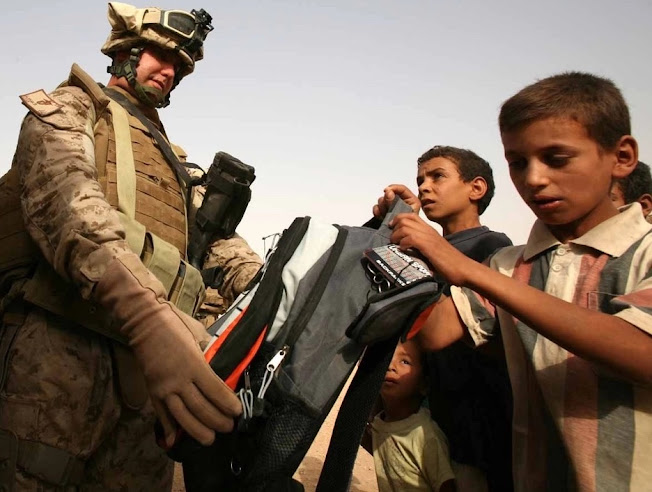

Staff Sgt. James Altman hands out book bags filled with school supplies to Iraqi children in Sahl, Al Assad, Iraq (Cpl. George Papastrat)
I finished this book in the midst of a pause in Israel’s war in Gaza against Hamas and heightened calls by President Biden for more restraint by Israel in its bombing campaign, which has been killing hundreds of civilians in Gaza. Unfortunately, as I write this, Israel has apparently ended the truce and ceasefire, and is bombing military and civilian targets again. Hostage negotiators in Qatar are suspending talks for now. Hamas seems to be succeeding in its efforts to create more violence and division in the region and beyond.

This week, the New York Times published a devastating report that Prime Minister Netanyahu’s government knew details about Hamas’s plan for an attack more than a year ago. Israel named the 40-page plan “Jericho Wall.” [It's a fraught name. Leading up to the attempted coup of at the U.S. Capitol of January 6, 2001, white Christian nationalists participated in Jericho Marches.]


Pre-MAGA conspiracist Proser is a gifted writer. His descriptions of the heat, stink, and noise of combat in Iraq and Afghanistan are gripping and powerful. Intentionally or not, readers get a nuanced view of what General Jim Mattis would do to achieve actual "peace through strength."


Proser, by the way, avidly promotes the Big Lie about elections, vaccination misinformation, and gender indoctrination conspiracies. His writings and repostings downplay the January 6, 2001, insurrection of the Capitol by white Christian nationalists and Trump supporters.


Trump, Mattis, and then-CJCS Joseph Dunford host a ceremony at Arlington National Cemetery, Virginia, for Memorial Day, May 28, 2018. (Sgt. Amber I. Smith)

In contrast, Mattis and retired General Joseph Dunford, former CJCS, each spoke out against the Big Lie and the J6 coup attempt on the same day of the insurrection.


Here's how CNN reported Mattis's and Dunford's position on J6:


"Trump's first secretary of defense, James Mattis, charged that Wednesday's 'violent assault on our Capitol, an effort to subjugate American democracy by mob rule, was fomented by Mr. Trump,' while Retired Gen. Joseph Dunford, the former chairman of the Joint Chiefs of Staff, told CNN that he believes 'our leaders who have continued to undermine a peaceful transition in accordance with our Constitution have set the conditions for today's violence.'"


Overall, Proser’s biography of Mattis is a rewarding read, although it unsurprisingly lacks the political analysis of the Mattis versus Trump relationship and Mattis’s unambiguous warning that Trump and Trumpism are a real and growing threat to the U.S. Constitution and the nation.


Top photo: Afghan civilians and Cpl. William C. Kaylor, 3rd Battalion, 3rd Marine Regiment, watch an MV-22 Osprey land at Forward Operating Base Geronimo, Helmand province, Afghanistan, July 14, 2010. (Sgt. Mark Fayloga)

Thursday, November 9, 2023

‘The Root’: In Tribute to Veterans

Review by Bill Doughty––

The bombing was accurately described by Marine historian, journalist, and author Eric Hammel and his publisher as a “disaster”:

“At 6:22 a.m. on October 23, 1983, a yellow Mercedes truck raced across the parking lot of the Beirut International Airport in Lebanon. Crashing through a chain-link gate into the 24th Marine Amphibious Unit’s headquarters compound, it raced on, careening through a shack and into the open atrium lobby of a terminal building where the men were housed, many still asleep.

“The truck lurched to a stop. Seconds later, 12,000 pounds of high explosives piled in the bed of the truck exploded. The four-story steel and concrete building shuddered, then collapsed. Two hundred forty-one Americans were killed and many more injured in the disaster.”

The book’s cover sets the stage for “The Root: The Marines in Beirut, August 1982 - February 1984” by Eric Hammel (Harcourt Brace Jovanovich, 1985). Hammel arrived in Beirut Lebanon 40 years ago this month. He interviewed nearly 200 enlisted personnel and officers and reported on the who, what, when, where, and why of the devastating terrorist bombing of the barracks in a city the Marines nicknamed The Root. United States Marines and Navy and Army support personnel had been sent to Lebanon by then-President Ronald Reagan as part of a peacekeeping mission.

I was drawn to this book after reading and reviewing another contemporaneous account of the bombing, “Peacekeepers at War” by Col. Timothy J. Geraghty, USMC (ret.). Like Geraghty, Hammel brings forth fresh-at-the time details and rich context while focusing on the courage and sacrifice of service members involved. Hammel says upfront he is focused primarily on the Marines themselves:

“This is not a book about Beirut or Lebanon in the wake of the June 1982 Israeli invasion, nor is it about the Lebanese people, the Lebanese religious and political factions, Lebanon’s problems with its Syrian and Israeli neighbors, nor even the goals and aspirations articulated by the Reagan administration with respect to its hastily conceived and cosmetic solutions for the ongoing Lebanese tragedy. All those factors are part of this book only insofar as they impact upon Marines who were in Beirut.”

Beirut Memorial Run Oct. 20, Lejeune Memorial Gardens (LCpl. Ramsammy)
The relevance and parallels of what happened in Beirut 40 years ago to what is now happening in the Middle East are striking. 

Then, in 1983, the Israeli Defense Force invaded Lebanon after Islamist extremists in the Palestine Liberation Organization attacked villagers in northern Israel and established a “state within a state” within Lebanon, supported by the Palestine Liberation Army and Syria. Today, Israel is invading the southern sector of Gaza, after extremist Islamists in Hamas barbarically attacked innocent civilians in southern Israel with support from Iran and its agents.

In both cases, innocent civilians were and are caught in the crossfire of massive air and artillery bombardments. 


In both cases Islamist terrorists use civilians as human shields out of religious extremist beliefs justifying sacrifice for a greater good. 


And in both cases, the U.S. military assets respond in support of Israel in an attempt to deter an expansion of the war.


[Yesterday a U.S. MQ-9drone was reported to have been downed by attackers off the coast Yemen. Commenting in response, Neil Cavuto of FOX News said, “The war nobody wants to widen keeps stubbornly trying to widen.” Last night, most Republican candidates for president said in a televised NBC debate that the United States should attack Iran directly. Whether there will be further escalation, especially with Iran, is yet to be determined in that volatile region.]


Hammel describes a yawning “chasm that separates perception from reality in the Middle East.”


While the title of the book “The Root” refers to the city occupied by the Marines and other military personnel, there is also a possible double entendre. The root of the problem of the yawning “chasm that separates perception from reality” is religion –– A conflict between Moslems, Jews and Christians; a deadly feud between Shiite and Sunni sects; and a theocratic forever war by Islamist Jihadists against freedom, democracy, and diversity.


Clear-eyed reasoning can confront other root causes of world conflict and potential war: past imperialism, current overpopulation, and future climate change resulting in more mass migrations.


Hammel’s carefully researched and reported accounting of the Beirut tragedy is presented in who (including the names of U.S. service members killed in Lebanon September 1982 through February 1984), what (excellent descriptive writing), when (a chronological narrative), where (helpful maps and diagrams), and why (a scathing conclusion in the book’s epilogue).


He recounts the heroism of the Marines and Navy personnel who doggedly tried to make their mission a success despite growing attacks and other incidents of violence, including sniper fire in the months leading up to the bombing. “As nearly as any of the American servicemen who were directly involved could tell, the August 28 fighting in and around Beirut was precipitated by the desecration of a Maronite Christian church with posters depicting the Ayatollah Khomeini.”

Hammel describes the suicide bombing of the barracks with attention to detail and through the eyes and voices of the service members who experienced the horror. His matter-of-fact style brings forth the true heroism of the service members who responded, rescued and recovered their shipmates as well as the aftermath of dealing with the tragedy on the home front.


The epigraph of the book reads: “For the Marines, Sailors, and Soldiers Who Died in Beirut –– and for their families.”


This book is a good read as we approach Veterans Day and the Marine Corps Birthday, both occurring this weekend. Forty years ago the Marine Corps Birthday Ball, which is held anywhere in the world in which there are Marines, was a solemn event worldwide. There are moments of solemnity and remembrance at all Marine Corps birthday commemorations, where a table is set aside with empty chairs to remember the Marines who had made the ultimate sacrifice.


Leaders who send service members in harms way must always consider the why.


“The Root” hits home the truism that those who do not learn the lessons, mistakes, and disasters of history are condemned to repeat them.


Hammel died three years ago. He is remembered and honored by the Beirut Veterans Association as a “final muster,” publishing a note from Hammel’s son Daniel at the time of Eric’s death: “My dad wrote a lot of books about a lot of people, but there was no group that he was more in touch with than yours. I know that he touched many of your lives and many of you touched his. He saw you all as brothers, even though he didn't serve, he loved you all."

Top photo: U.S. Marines with the 2d Marine Aircraft Wing Band and U.S. Marine Corps Forces Europe and Africa prepare to enter a memorial service during a Beirut bombing commemoration in Lyon, France, Oct. 21, 2023. The Beirut bombing memorial commemorates the 40th anniversary of the attacks conducted against the French and Americans. (LCpl. Mary Linniman)


Monday, October 23, 2023

40 Years Ago: Peacekeepers’ Sacrifice in Beirut

By Bill Doughty––

Religious war in the Middle East seems never-ending, with non-democratic Islamist extremists targeting Jews and other non-Muslims as infidels deserving of death. Hamas terrorists from Gaza inflicted a brutal attack on innocent Israelis and other civilians on October 7. Israel is retaliating and pledges to destroy Hamas. As a result of Hamas’s attack, innocent people living in Gaza, who terrorists use as human shields, are being killed in the crossfire.


Meanwhile, Iran fuels the flames of terrorism and destruction –– supporting not only Russia in its war in Ukraine but also Hamas in Gaza on Israel’s southern border and Hizbollah in Lebanon on Israel’s northern border. Iran also supports Islamic Jihad terrorists such as those whose misfired rocket killed hundreds at a Baptist hospital in Gaza.


Forty years ago today, Islamic Jihad bombers supported by Hizbollah and elements in Iran and Syria, attacked a multinational peacekeeping force in Beirut, Lebanon, killing 241 U.S. military personnel, 58 French military personnel, and six civilians at the Marine barracks. Of the U.S casualties, 220 were Marines; 18 were Sailors, including 15 Navy corpsmen and one medical officer; and three were Army Soldiers.

Then-President Ronald Reagan sent the U.S. military to Lebanon to provide security, stability, and deterrence in the wake of Israel’s 1981 invasion of Lebanon, where Muslims and Christians were at war.


Instead, the presence of Western peacekeepers provoked the jihadists. According to Col. Timothy J. Geraghty, USMC (ret.), who commanded the U.S. Multinational Peacekeeping force, “The Beirut experience has an overarching lesson: force-building and peacekeeping do not mix, particularly in the Middle East.”


Geraghty is author of the definitive accounting of the Beirut MNF Bombing, “Peacekeepers at War: Beirut 1983 –– The Marine Commander Tells His Story” (Potomac Books, 2009). He contends, “The seeds of modern-day terrorism and suicide bombings were sown in Lebanon in 1983. The evolution of this insidious movement began with the suicide bombings of the U.S. embassy and the Marines’ Battalion Landing Team Headquarters and continued with the kidnappings, murder, torture, and intimidation of Americans and fellow Westerners.”

Geraghty says frankly, “The peacekeeping experience in Lebanon demands that we carefully review these events and learn how we can better prepare ourselves to preclude any recurrence of this tragedy.”


One lesson he calls for is appropriate retaliation, which did not happen after the Marine barracks bombing.


Pulitzer Prize-winning author Patrick J. Sloyan praises Geraghty in “When Reagan Sent in the Marines: The Invasion of Lebanon” (Thomas Dunne Books, St. Martin’s, 2019) and agrees with him that not retaliating at the time was a big mistake.


Sloyan writes:

“Reagan refused to strike Iran despite solid evidence of its role in the embassy and Marine barracks bombing sin 1983. Rather than prolong the conflict and threaten his reelection in 1984, Reagan resorted to his political skills to manipulate perceptions and divert attention from the Beirut debacle. In the process, he gave a cold shoulder to the battered Marines there. Instead of accepting his share of responsibility for the tragedy, he blamed it all on the Marine commander in Beirut. It was his worst moment as commander in chief. In leaving Iran unpunished, he encouraged the Tehran regime and other enemies to continue their back-alley war against the United States without fear of reprisal.”

In his book, Sloyan presents a devastating account of the Iran-Contra scandal, in which Reagan and members of his team –– principally Robert McFarlane and Col. Oliver North –– orchestrated an arms for hostage deal with Iran, involving shipping hundreds of missiles and other arms to the Shia-led government.

“It was North who provided the highlights of the trip,” writes Sloyan. “He delivered an Israeli-baked chocolate cake in the shape of a key, to symbolize the unlocking of US-Iranian relations, and a bible Reagan signed and inscribed from Galatians 3:8. ‘All the nations shall be blessed in you.’” The goal was to free hostages held by Iran-backed Hizbollah militants.


As part of the arms-for-hostages deal, North received $15 million that was later funneled to the right-wing Contras who were in armed conflict with the communist Sandinista government in Nicaragua. At first, Reagan lied to the American people about his involvement in the Iran-Contra scandal, but a week later admitted and expressed regret for the affair.


Retired Col. Timothy J. Geraghty signs copies of his book "Peacekeepers at War" after his professional miliitary education class at the Command Museum aboard Marine Corps Recruit Depot San Diego, April 29, 2011. Geraghty commanded the 24th Marine Amphibious Unit during the Beirut bombing in 1983. (LCpl Eric Quintanilla)

Both Sloyan’s and Geraghty’s books are informative, revelatory, and prescient.

Geraghty sees a direct line between the horrors of 1983 and the attacks of 9/11 in 2001. Despite the virtual elimination of ISIS, we see the religious ideology of hatred continue in what happened to jews and secularists in Israel on October 7.


Garaghty has been a guest of the Marines for a number of memorial commemorations of the Beirut bombings. He concludes his landmark “Peacekeepers at War” with this observation:

“The Islamist jihadists attacked us in Beirut, but they have also struck in New York, Washington, London, Madrid, Tel Aviv, Bali, Kabul, and numerous other locations around the world. Their indiscriminate targeting of civilians and brutality reflect their fear and hatred of liberty and freedom. We must pursue victory over this scourge of mankind, not only for our own security, but also to honor the valor and sacrifice of our finest and most dedicated warriors, those who go into harm’s way to protect the freedoms we all cherish.”

Still, the never-ending war in the Middle East continues. And there is now an intense risk of escalation as U.S. military forces are targeted. Some see the potential for an actual world war as Russia, Iran, and North Korea (and China) align closer.


In a world requiring nuanced understanding and commitment to human rights and lasting peace, some would unfortunately prefer to see only bipolar options fueled by their faith, hate, and grievance –– authoritarianism and theocracy over liberty and democracy.


Top photo: Distinguished guest paticipants stand at the position of attention as the wreaths are laid during the 34th Beirut Memorial Observance Ceremony at Lejeune Memorial Gardens in Jacksonville, N.C., Oct. 23, 2017. A memorial observance is held Oct. 23 of each year to remember those lives lost during the terrorist attacks at U.S. Marine Barracks, Beirut, Lebanon, in 1983. (U.S. Marine Corps photo by Cpl. Judith L. Harter)


Wednesday, September 13, 2023

McRaven’s ‘Simple’ Bullfrog Advice

Review by Bill Doughty––

Seventy-three years ago, September 15, 1950, Gen. Douglas MacArthur landed at Inchon, Korea. In the following weeks, U.S. forces began to rout the communist North Korean army and push them almost to the Yalu River near China. Then, in November the Americans encountered well-armed Chinese interventionists supporting the North Koreans.


“Hill 205 seemed an unlikely place for an Army legend to be born,” writes Admiral William H. McRaven (U.S. Navy, Ret.) at the beginning of chapter 7 of “The Wisdom of the Bullfrog: Leadership Made Simple (But Not Easy). McRaven recounts the actions of Army Ranger First Lieutenant Ralph Puckett, who in 2021 received the Medal of Honor, presented by President Joe Biden for actions in Korea. At great personal risk, Puckett helped his Rangers locate and attack camouflaged Chinese machine gun nests and mortar teams that pinned them down.

“Puckett, who had positioned himself at the front of the advancing Rangers, knew there was only one thing he could do. With complete disregard for his own life, Ralph Puckett rose from his foxhole and dashed out into the open field, forcing the Chinese to take aim at the young lieutenant. As the machine gunners began to fire a the sprinting Puckett, the Rangers spotted their positions and engaged them. Puckett returned to his foxhole only to catch his breath, and then leaped out and ran into the open again. With each dash by Puckett into the exposed terrain, the Rangers were able to isolate and destroy more enemy machine gunners.

“Having suppressed the small arms fire, the Rangers proceeded to take Hill 205. History would show that over the next two days, the Rangers under the command of Ralph Puckett would fight off wave after wave of Chinese assaults that took the lives of ten Rangers and left thirty-one wounded, including Puckett.”

Puckett would again serve with honor in Vietnam, where he earned the Distinguished Service Cross and two Silver Stars and was personally recognized by President Lyndon B. Johnson.


McRaven uses the story of Puckett’s heroism at Hill 205 to illustrate the Ranger motto “Sua Sponte” (“Of Your Own Accord”).  “In other words, doing what needs to be done without being told to do so,” McRaven explains.

“There is often the misguided belief that soldiers only follow orders, but the strength of the American military is that the great soldiers, the truly great leaders, do what is right without being told. They do what is right to protect their men and women.”


Senior military leaders expect even young and relatively junior service members to take the initiative when necessary. Such integrated empowerment is a cornerstone of leadership, and can be effective not only in the military but also in business, sports, medicine, citizenship, and developing a healthy family.


A simple, powerful concept. Which is also a good descriptor for this small but excellent book.


Memorial statue of Basilone in New Jersey
“Sua Ponte” is just one of the ideas presented here by the author of “Make Your Bed,” “The Hero Code,” and “Sea Stories.”

McRaven opens his latest book with a discussion with the most important aspects of being a good leader: Honor and integrity, captured in legendary United States Marine hero Sgt. John Basilone’s motto: “Death before Dishonor.” Honor and integrity are the foundation of a trustworthy leader.


Another motto explored in “Bullfrog” is the British Special Air Service’s Qui Audet adipiscitur: "Who dares, wins."


An honorable leader who demonstrates commitment, hard work, and initiative, will earn the trust of their followers, according to McRaven. Stamina, a willingness to sacrifice, and confidence, along with humility and the ability to make hard choices, are also important leadership qualities. Commanders “must have perseverance and, above all, confidence in ourselves.”


All the above qualities and more were personified by Adm. Chester W. Nimitz in World War II, particularly in the Battle of Midway: The great admiral faced a difficult choice about whether to ambush the Imperial Japanese Navy at Midway. “The fate of the entire Navy, and perhaps our nation, rested on this decision,” McRaven writes. “But history would show that the Battle of Midway was the single most decisive naval battle of the war and turned the tide in the Pacific.


Other legendary leaders highlighted in this outstanding book include father of the Navy SEALs, Adm. Chuck LeMoyne; WWII British officer and father of the SAS, Col. David Stirling; U.S. Special Operations leader Gen. Stanley McChrystal; Air Force visionary Billy Michell; Vietnam War hero Col. Elliot “Bud” Sydney; and former president Barack Obama, who, like Nimitz and Midway, faced a difficult decision, with uncertain information, about launching the mission to capture Osama bin Laden.


“It was an enormous risk, but one the president knew he had to take. I admired his guts –– Who Dares Wins –– but more importantly,” McRaven reflects about Obama, “I admired his intellect for understanding the nature of the risks he was assuming.”

Good leaders attack problems aggressively. “Mistakes of action are far less consequential than mistakes of inaction,” he notes. Hope, luck, and desire are important, but they are not a strategy. “Be a risk-taker, but manage the risk through extensive planning, preparation, and proper execution.”

All Hands: McRaven speaks to service members at Bagram Air Field, Afghanistan, Thanksgiving Day, 2013. (Army Staff Sgt. Osvaldo Equite)
Each chapter features an insightful epigram quotation by well-known and sometimes surprising people: Abraham Lincoln, Marie Curie, Alvin Toffler, Oprah Winfrey, Michael Jordan, William Shakespeare, Tacitus, Booker T. Washington, Coach Mike Krzyzewski, and Taylor Swift.

Yes, Taylor Swift.


In fact, her epigram quote for chapter ten, titled “No Plan Survives First Contact with the Enemy,” is a found haiku:


Just because you made

a good plan doesn’t mean that’s

what’s gonna happen


McRaven discusses the importance of planning, inspecting, and always having a plan B.

When one of their helicopters became damaged in the bin Laden raid, the well-trained and ready SEALs adjusted, overcame, and accomplished their mission. Training mitigates risk and saves lives.

Importantly, McRaven notes that even the best leaders will have setbacks and seemingly insurmountable challenges. But how they deal with failures and obstacles makes all the difference.

This is a great book for any new leader, would-be commander, and anyone interested in the importance of character, competence, and ethical behavior –– integrity –– in military and national leadership.


There are many references in “Bullfrog” to Basic Underwater Demolition/SEAL training, Coronado, and San Clemente. But there is an unexpected thread throughout the book leading through Hawaii, which help illustrate key leadership principles.


“The Wisdom of the Bullfrog” concludes with a spotlight on Navy SEAL Lt. Michael Murphy’s favorite book, “Gates of Fire” by Steven Pressfield"Gates of Fire" is also a favorite of Gen. James Mattis (USMC, Ret.) and is a recommendation by Adm. James Stavridis (USN, Ret.). The novel is or has been on the reading lists of many military leaders, including the Commandant of the Marine Corps (currently a vacant position).


Pressfield speaks to Marines and fellow veterans at Camp Pendleton in 2011. (Sgt. Skyler Tooker)
“Gates of Fire” imagines the 300 Spartans who fought valiantly in the Battle of Thermopylae in 480 BCE. In the fictionalized account, Pressfield, a former Marine, channels what the last Spartan may have said about his king, King Leonidas, and what made his king such a great leader: “A king does not abide within his tent while his men bleed and die upon the field. A king does not dine while his men go hungry, nor sleep when they stand at watch upon the wall, A king does not command his men’s loyalty through fear nor purchase it with gold; he earns their love by the sweat of his own back and the pains he endures for their sake. That which comprises the harshest burden, a king lifts first and sets down last. A king does not require service of those he leads but provides it to them…”

While not always easy –– and often extremely hard to live by –– McRaven’s leadership principles are actually “simple” he says. He offers a list of sayings taken from his chapter headings and a QR code at the end of the book for readers to obtain a printable version of the “Wisdom of the Bullfrog.” (The term Bullfrog refers to the the longest serving Navy SEAL on active duty, which McRaven once was for nearly 40 years.)


Sometimes advanced age has its leadership advantages.