Showing posts sorted by relevance for query uss midway museum. Sort by date Show all posts

Sunday, September 11, 2022

September Remember: USS Midway in Japan

by Bill Doughty––

I was attending school in Tokyo and living in Yokosuka in 1973 when USS Midway (CV-41) arrived in Yokosuka –– the first U.S. aircraft carrier to be stationed in Japan as part of the Forward-Deployed Naval Forces. It was a big deal, less than thirty years after World War II, and just months after the U.S. military departed Vietnam.


Midway was commissioned 77 years ago, Sept. 10, 1945, just eight days after Imperial Japan surrendered. Stationing the ship in Japan was hugely symbolic; Midway is named for the historic and pivotal battle in 1943 that turned the tide in WWII.


USS Midway (CV-41) arrives in Yokosuka, Oct. 7, 1973. Photo from Midway cruise book. (Ryo Isobe, DVIDS)
But that’s only one reason the carrier’s arrival in Yokosuka was opposed by many Nihonjin, sometimes violently.

Hundreds of Japanese citizens, loudly opposed to America’s war in Vietnam, came to Yokosuka in 1973 to protest the arrival of Midway.

I remember scores of demonstrators in headbands and helmets, faces covered, white-knuckled fists gripping bamboo poles. The demonstrators assembled by the Yokosuka JNR station and marched to the closed gates of the base. Japanese police in riot gear formed a human shield. Marine guards stood ready behind them. Some radical demonstrators attacked the police and were repelled with fire hoses.


Midway had been a recent (and repeated) participant in what was then called the Vietnam Conflict, a war for which the ship received the Presidential Unit Citation from President Nixon in early 1973.


Two years later, Midway would join with other ships of the U.S. 7th Fleet in Operation Frequent Wind, the evacuation of Saigon.


Three years after Midway’s arrival in Yokosuka, the United States celebrated its bicentennial, 1776-1976. By then, I was just out of college and contributing stories to the Seahawk base newspaper on my way to becoming editor and eventually a public affairs officer.

Early in its career, Midway participated in historic operations in the Caribbean, near the Arctic, throughout the Mediterranean, and in both the Atlantic and Pacific, including near North Korea.

Midway would go on to participate in various peacekeeping operations, including Operation Desert Shield and Desert Storm, after Iraq failed to obey a United Nations ultimatum to withdraw from its invasion of Kuwait.


Just as it did in the evacuation of refugees after the fall of Saigon, Midway played a key role with other ships in rescuing evacuees from the Philippines in Operation Fiery Vigil after the eruption of Mt. Pinatubo. That was in June of 1991.


I was still living in Yokosuka and working for the Navy when USS Midway departed Yokosuka for the final time in August 1991. The workhorse aircraft carrier was headed to retirement 31 years ago this month –– via Pearl Harbor, Seattle, and Bremerton –– eventually to San Diego.


USS Midway arrives in Pearl Harbor, August 23, 1991.
By 1991, more Japanese people came to realize the value of having a strong U.S. Navy presence, working cooperatively with the Japan Maritime Self-Defense Force to maintain freedom of the seas. 

Just as the United States Constitution was a model for Japan’s form of government, the United States Navy served as a model for the JMSDF –– with direct help and guidance from Adm. Arleigh A. Burke.


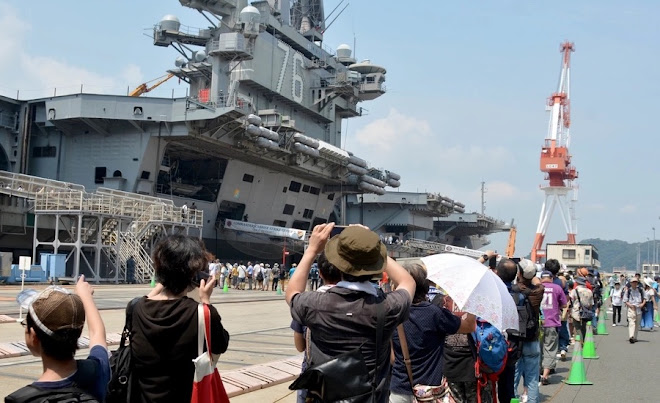
Over many years, Yokosuka has held hugely popular base open-house events, inviting tens of thousands of Japanese citizens onto the base to participate in games, enjoy food booths, attend concerts, and go aboard U.S. Navy ships.


The most popular draw at base open-house events? Tours of an aircraft carrier.


After Midway’s departure, other carriers followed its lead to become forward-deployed in Japan: USS Independence (CV-62), USS Kitty Hawk (CV-63), USS George Washington (CVN-73), and USS Ronald Reagan (CVN-76).


Japanese guests line up to board USS Ronald Reagan (CVN-76), October 10, 2015, during Yokosuka's Friendship Day open-base event. (MC1 Peter Burghart)

Open-base events were suspended for a time in the aftermath of attacks on the United States by religious zealots –– Islamist terrorists –– on September 11, 2001. (I remember the gates being locked down for weeks. Everyone who lived off base were required to park a few miles away and were offered rides to work or schools on base in carefully screened shuttle buses.)


In September 2003, USS Midway departed its temporary home of Bremerton, WA, to become a museum and memorial in San Diego. It welcomes an average of more than one million visitors per year. As with the USS Arizona Memorial in Pearl Harbor, many of the visitors to the USS Midway Museum include people from Japan who come to pay respect and learn about history.


Operation Sandy (Midway Museum Archives)
The museum offers a robust website highlighting the ship’s proud legacy, including operations in the Arctic, Taiwan Strait, and Vietnam, among others. I found some fascinating Midway photos available for download from Flikr, courtesy of the Museum. Some of the photos on the museum’s site include ringside views of Operation Sandy, the world’s first test-firing of a ballistic missile from a ship at sea.

There are numerous resources on the museum’s website, including videos and first-person accounts. This line stands out: “When history speaks, turn up the volume.”


In reading the history of the USS Midway, we can see the evolution of the modern Navy, from the immediate postwar, through the entire Cold War, and operations in Vietnam. But the ship is remembered most fondly, perhaps, for its role in helping people and promoting peaceful protection, especially for eighteen years in Yokosuka, Japan.


USS Midway’s strategic role in the Cold War, is a key part of James D. Hornfischer’s fascinating “Who Can Hold the Sea: The U.S. Navy in the Cold War, 1945-1960” (Bantam Books, 2022).


I have a two-part review of Hornfischer's final work posted in recent weeks. Hornfischer has been a favorite over the years. In May 2012, he offered a guest mini-review of five books he recommended to Navy Reads.


Sunday, June 2, 2013

‘Midway Magic,’ Legacy of Battle of Midway

by Bill Doughty

Forty years ago, October 5, 1973, USS Midway (CV 41) -- named for the Battle of Midway -- pulled into its new forward-deployed port: Yokosuka, Japan.
Built in Newport News, Virginia and commissioned just after Imperial Japan’s surrender in 1945 in Tokyo Bay, near Yokosuka, USS Midway would become America’s longest serving aircraft carrier in the 20th Century, deployed near the Arctic and in the Atlantic, Pacific and Indian Oceans.  Midway projected power and presence in a variety of conflicts throughout the Cold War, Korean War, Vietnam War and beyond, including in Operation Desert Storm.

Scott McGaugh’s “Midway Magic: An Oral History of America’s Legendary Aircraft Carrier” is a tribute to the continually deploying, hard-working carrier.  “Midway became known as one of the best operating carriers in the Navy in the 1970s and 80s,” he writes.
The author recognizes by name many of the COs and deckplate Sailors who served aboard Midway over the decades.  He lauds Sailors and civilians -- including Japanese civilian workers who worked on the ship, including in drydock in Yokosuka.

“Each time Midway put in at the Yokosuka ship repair facility, Japanese shipyard workers overhauled a designated portion of the carrier.  Every few months, part of Midway was enhanced, repaired, or replaced.  Other carriers went into the yard periodically for two-year overhauls.  Midway was usually in port for no more than a month.  Hundreds of Japanese ship workers descended on Midway upon arrival in Yokosuka.  The honesty and dedication of Japanese welders, electricians, pipe fitters, and plumbers working on Midway became legendary.”
In 1942 it was American civilian shipyard workers in Pearl Harbor who repaired, refitted and rearmed the aircraft carrier USS Yorktown (CV-5) to play a key role in helping the Navy win the Battle of Midway.
If the Battle of Midway represented a turnaround in the War in the Pacific, 30 years later the arrival of the USS Midway in Japan marked a solidarity of partnership as allies, with the U.S. Navy and Japan Self-Defense Force as the best of friends.
It was the first time for a U.S. Navy aircraft carrier to be assigned to the forward-deployed naval forces stationed in Japan.  While there were decidedly mixed feelings by the people of Japan, demonstrations against the carrier were mostly because of opposition to the war in Vietnam.

Midway’s arrival in October 1973 occurred just 36 weeks after the Paris Peace Accords were signed to end the war.  Coincidentally, that month saw the beginning of the world embargo of oil by Arab members of the Organization of Petroleum Exporting Countries (OPEC) during the Arab-Israeli War.  World War II in the Pacific began in 1941, in large part, because of an embargo against Japan because of that country’s expansion into other Asian countries for oil and other resources.
Lt. George Gay with his squadron just prior to the Battle of Midway.
The Battle of Midway, 71 years ago this week, was a historic milestone against fascism and for freedom.  It was a watershed moment for aviation, too, proving the era of battleships was ending and the time of naval aviation and aircraft carriers had begun.  The Battle of Midway showed the spirit of a bonded and enervated force, dedicated to working together using new technology and exploring innovative new tactics to achieve victory for the common good.
McGaugh’s “Midway Magic” begins with an introduction by a naval (and Air Force exchange program) aviator who served aboard USS Midway after his commissioning from the U.S Naval Academy -- astronaut Wally Shirra.  “I was one of the fresh-faced kids aboard Midway in 1950, a hot-shot aviator at the dawn of the jet age.”  Shirra writes:
Midway Pilot and Astronaut Wally Shirra

“For men and nations alike, Midway did more than influence our world.  Midway dictated the course of world events, sometimes by her mere presence as a beat cop stepping into the middle of a heated dispute, at other times as the fireman rushing into harm’s way to save lives.  For me and thousands of other young men over the expanse of nearly 50 years, Midway Magic showed each of us our backbone, inspired us to never cut our dreams to fit, and taught us values and ideals that served as guideposts for rest of our lives.  And in the hearts and souls of the men who served aboard her, the magic continues to this day.”
McGaugh describes with emotion the decommissioning ceremony of USS Midway 21 years ago, attended by, among others, aviators Adm. Riley Mixson, Mugs McKeown, Dick Parker and George Gay.  It was one of the last public appearances by Gay, the famed survivor of the Battle of Midway who was also present at the ship’s launching.
USS Midway was remembered for its role in war and peace, including in humanitarian missions such as its final mission in 1991, after the Mt. Pinatubo volcanic eruption in the Philippines.  Along with USS Abraham Lincoln (CVN 72), Midway provided emergency evacuation of 15,000 military and civilian personnel from Clark Air Base and Subic Naval Base.
The decommissioning wasn’t the end of the Magic.
Ten years ago, Aug. 29, 2003, the ship was awarded to the San Diego Aircraft Carrier Museum nonprofit.  It was towed from Bremerton to Oakland to San Diego and opened as a museum in 2004.
Today, USS Midway Museum sits proudly at Navy Pier, off Harbor Drive, part of downtown San Diego.
“Midway Magic’s” appendix includes a work of poetry from the ship’s 1989-1990 cruise book.  Here’s an excerpt:
For more than forty-five years 
Midway has steamed,
Returning to safe harbor --
Mission following mission.

Amid the pulsation of four shafts
And the throb of jets at military power,
The true beat of her heart
Depends on the courageous --

Those who tread the decks,
Populate the compartments,
Operate the machinery,
Serve in Harmony.

Remember the faithful
Whose final service
Was given in full measure
On this Gray Lady...


(I was a student in Japan and worked for the Navy Exchange in 1973.  I watched the USS Midway arrive at its new forward-deployed port of Yokosuka in October of that year.  Several years later I served as editor of the base newspaper Seahawk.  -- Bill Doughty)

Saturday, May 12, 2012

Happy Birthday Joe Rochefort - Midway Legacy


by Bill Doughty
Today is the 112th anniversary of the birth of Joseph John Rochefort.  Tomorrow, May 13, 2012, is the 70th anniversary of Rochefort’s discovery of the Imperial Japanese Navy’s plan to attack Midway Atoll.
The Battle of Midway altered the course of World War II and saved Hawaii, Australia and perhaps the West Coast of the United States from further attacks by Japan.
With a reporter’s skills, Elliott Carlson shows the influence of one man on the outcome of Midway in “Joe Rochefort’s War: The Odyssey of the Codebreaker Who Outwitted Yamamoto at Midway.”
Carlson employs dogged research, personal interviews, presentation of facts and a resistance to speculate.  Thanks to his access to Rochefort’s family members and Navy archives he is able to paint a picture of the complicated man and the political intrigue that marked his naval career.
Rochefort is revealed as a “restless maverick” -- caustic, acerbic, sarcastic.  But he was also gifted with extraordinary memory, able to solve puzzles and synthesize complex shifting information.
These abilities proved indispensable in the Pacific War.  Rochefort implemented actionable intelligence in an independent, decentralized setting at Pearl Harbor’s Station Hypo -- predicting the future for Adm. Nimitz and Adm. King and allowing them to develop strategies to defeat the enemy.
Rochefort, the youngest of seven children, was born May 12, 1900 to Irish immigrant parents.  To put things into historical context: his father, Frank, was born in Dublin 160 years ago (1852), only forty years after the War of 1812 and nine years before the American Civil War.  One hundred years ago (1912), the Rochefort family moved from Dayton, Ohio to Los Angeles, where Joe would be recruited into the Navy.
With no college or even a high school diploma, Joe Rochefort joined the Navy in 1918.  His science and math abilities propelled him to the rank of ensign, and he served on training ships, tankers, a mine sweeper, and a destroyer.  He served aboard the cruisers USS New Orleans and USS Indianapolis, as he was recruited into the intelligence field, and on several battleships, including USS Maryland, USS California, USS Pennsylvania and USS Arizona.
Author Carlson shows how Rochefort was haunted by the attack on Pearl Harbor, Dec. 7, 1941.  Rochefort felt a sense of guilt for not being able to predict the attack.  But Pearl Harbor motivated him, as it did for the rest of the nation.
Rochefort redoubled his efforts to crack the JN-25(b) code, analyze radio transmissions and track the Imperial Japanese Navy.  Carlson provides just enough information about the art of codebreaking -- in an era of nascent computing and related technology -- to show how daunting the task was for Rochefort’s team: 50,000 possible meanings of 33,333 5-digit codes with an indeterminate, shifting beginning.
Despite the challenges, Rochefort correctly predicted the location of the Imperial Fleet in the western Pacific as early as January 1942.  He gave Nimitz information that proved correct in the Battle of the Coral Sea, setting the stage for Midway.
“Gains registered in cryptanalysis and codebreaking permitted Rochefort to practically look over Yamamoto’s shoulder as he moved his forces around the Pacific,” Carlson writes.
On May 13, 1942, Rochefort decrypted information that the IJN was focusing on areas near Midway and the Aleutians.  Rochefort analyzed the information and made a case for an impending attack on Midway, suspected as being “AF” in the Japanese code.  He presented his analysis on sheets of paper on plywood and wooden sawhorses; PowerPoint would not be available for decades.
With help from former submariner, engineer and University of Hawaii faculty member Jasper Holmes, who knew Midway’s infrastructure, Rochefort devised a ruse so the Japanese would reveal their plans.  Nimitz approved the plan, and a fake message was issued that Midway was running short of fresh water.  The IJN then sent out their own message about the water shortage in code, thus confirming that “AF,” “Affirm Fox,” was indeed Midway.
Scene on board USS Yorktown (CV-5) during Battle of Midway. (Navy photo) 
Nimitz carried out his own subterfuge, directing fake carrier transmissions in the Coral Sea and a bombing of Tulagi by PBYs that fooled the Japanese into thinking that U.S. aircraft carriers were still on location.
With intelligence, guts and luck the United States Navy defeated the Imperial Japanese Navy at Midway.
Carlson writes: “Eventually the Battle of Midway would be compared with Trafalgar, Jutland, and other major campaigns at sea that turned the tide of history.  The battle transformed the conflict between the United States and Japan.  Many agonizing years of combat loomed ahead, but after Midway the United States would remain on the offensive.  ‘Midway was the crucial battle of the Pacific War, the engagement that made everything else possible,’ Nimitz said after the war.”
Rochefort’s contributions continued despite political intrigue and infighting within the intelligence community and a resistance to innovation and free-thinking by some leaders and colleagues.
Rochefort tracked Japanese action in Guadalcanal, acoustic mines, oil supplies and access to sea lanes and even the Japanese view of the situation in Germany late in the war.  He had other challenging assignments, as well, including working on floating drydocks, but he soon retired on Jan. 1, 1947 at the rank of captain and at 46 years old, returning to the Navy briefly during the Korean War.
The attack of Dec. 7, 1941 brings inevitable comparisons to Sept. 11, 2001, and, though he does not make the comparisons himself, several jump out in Carlson’s book.  Among the biggest: a lack of imagination in predicting the attack and a failure for agencies to share information, what Carlson quotes as “fatal defects in the Army-Navy relationship.”
Interservice rivalry continued to challenge Rochefort when the Army’s 7th Air Force doubted Hypo’s information analysis and resisted the evidence that Midway would be a target in June 1942.
Another 9/11 comparison comes after the war when consipiracy theories abounded.  Groups targeted FDR, accusing former President Roosevelt of knowing about the attack on Oahu and allowing it to happen in order to push the country into WWII.
Carlson shows the lack of evidence for the conspiracy theories and gives credit to Rochefort for resisting political and peer pressure to fix blame.
Author Elliot Carlson speaks at the National WWII Museum.
Time and perspective, combined with evidence and good sources, are a strong combination, and Carlson wields a deft pen in describing the life and impact of Joe Rochefort and his role in winning the Battle of Midway.
The book is made even better with the inclusion of photos, including rare family pictures.  Among the more fascinating are photos of a young Rochefort in Tokyo, 1929-32, where he studied Japanese and gained an understanding of the culture.
“Joe Rochefort’s War” is a tour de force and a top ten read for the history of the Battle of Midway.

Saturday, May 30, 2015

Catching Up on Names, Namesakes

by Bill Doughty
New Jersey, John Finn, Midway and Craig Symonds, Mary Roach, Jimmy Carter and John S. McCain – all in the news recently and each with featured spots in Navy Reads. Make the connections...

A state of the Navy is New Jersey. Secretary of the Navy Ray Mabus announced this week that the newest Virginia-class attack submarine to be named after the Garden State would be SSN 796, USS New Jersey. A DOD story this week reminds us that the Navy’s first submarine, USS Holland, was designed and built in New Jersey in 1900.

Medal of Honor recipient John Finn, Dec. 7, 2006.
In Mabus's home state of Mississippi, at the beginning of this month, USS John Finn was christened at Ingalls Shipbuilding in Pascagaoula. According to an informative post about John Finn on Navy Live Blog, "The future USS John Finn is the 63rd Arleigh Burke class destroyer, and the first of the DDG 51 Flight IIA restart ships."

John Finn passed away five years ago this week, May 27, 2010. We interviewed him for Navy Reads in late 2009, when he told us his favorite author prior to World War II was Ernest Thompson Seton – author, artist and naturalist. “I always loved books about wildlife,” he said. 

Finn was a hero who fought back against Imperial Japanese Navy planes attacking Oahu, Hawaii on December 7, 1941.

Craig Symonds
On Oahu next week Craig L. Symonds will be featured speaker at the Pacific Aviation Museum on Ford Island, Pearl Harbor to commemorate the 73rd anniversary of the Battle of Midway, which became the namesake for a great aircraft carrier, USS Midway (CV 41), now a museum in San Diego. The battle is considered the turning point of the war in the Pacific, just six months after the attack on Pearl Harbor and Oahu.
Dr. Symonds, a scholar of naval history and the Civil War, will conduct several book-signing events and interviews during the week leading up to the event at PAM, Saturday, June 6, 2015.

Mary Roach
Meanwhile, another gifted author who has contributed to Navy Reads, Mary Roach, is up in Skagway, Alaska this week as keynote speaker for "Exploring the Frontiers of Language / Let Skagway Inspire You," sponsored by North Word Writers Symposium. Roach – a champion of science, humor and critical thinking – is author of the New York Times bestsellers "Gulp: Adventures on the Alimentary Canal," "Packing for Mars: The Curious Science of Life in the Void," "Stiff: The Curious Lives of Human Cadavers," "Bonk: The Curious Coupling of Science and Sex," and "Spook: Science Tackles the Afterlife." 

Yesterday, 90-year-old Navy veteran and former U.S. President Jimmy Carter – author of numerous books on human rights, history, international relations and peace – attended a change of command ceremony for his namesake submarine, Seawolf-class attack submarine USS Jimmy Carter (SSN 23) during a ceremony at Naval Base Kitsap, Bangor, Wash.

Cmdr. Melvin Smith (right) assumes command of USS Jimmy Carter.
Cmdr. Melvin Smith relieved Cmdr. Brian Elkowitz as commanding officer.


A Navy.mil story noted that "the 39th president and 2002 Nobel Peace Prize winner is the only U.S. president to graduate from the Naval Academy and the only one to qualify on submarines."

Carter, who graduated from the Naval Academy in 1946 and served in the Navy until 1953, said: "Of all the honors I have ever received, I've never had anything of greater honor than the chance to be the namesake of USS Jimmy Carter."

Vice Adm. John S. McCain Sr. and Cmdr. John S. McCain Jr. in 1945.
In a ceremony May 28 in Yokosuka Japan, the forward-deployed Arleigh Burke-class USS John S. McCain conducted a change of command ceremony. Cmdr. Chad Graham relieved Cmdr. Chase Sergeant as CO. McCain is named for Admirals John S. McCain Sr. and John S. McCain Jr., both WWII veterans and leaders, grandfather and father to Senator John McCain, Vietnam veteran, Navy pilot and former POW.

Sen. McCain's book "Character is Destiny" was featured on Navy Reads last year. The book, written with Mark Salter, is filled with short biographies and inspirational stories about core values, leadership, and the importance of good character.


Monday, October 10, 2011

‘The U.S. Navy’s Finest Hour’

Review by Bill Doughty
The Last Stand of the Tin Can Sailors: The Extraordinary World War II Story of the U.S. Navy’s Finest Hour is James D. Hornfischer’s powerful tribute to surface warriors and naval aviators and one of the very best books in the Navy’s Professional Reading Program.
Through exceptional prose the book explores the WWII Battle off Samara -- part of the Invasion of Leyte, Philippine Islands, Oct. 17-25, 1944.  It’s a good read for the Navy’s Birthday this week (Oct. 13).  
In The Last Stand Hornfischer explores:
  • The bravery and sacrifice of American Sailors
  • The hubris of Adm. Halsey
  • The strategic mistakes of Imperial Japan
  • The power of creative, instinctive free-thinking, even in the heat of battle
The author shows a McCullough-like historian’s skill in revealing characters, introducing us to heroes like leaders Lt. Cmdr. Robert W. Copeland, CO of USS Samuel B. Roberts (DE-413); Cmdr. Ernest E. Evans, the Cherokee American CO of USS Johnston (DD-557); pioneer of aviation Rear Adm. Clifton A.F. “Ziggy” Sprague, commander of Escort Carrier Group Task Unit 77.4.3 “Taffy 3”; and dozens of others.
Hornfischer introduces us to real sailors like Chief Radioman Tullio Serafini and Gunner’s Mate Paul Carr and describes the horrors of the sea battles.  And, in a compelling tribute, he publicizes the names of the Sailors of Task Unit 77.4.3 killed in the battles, with hundreds of names listed from USS Heermann (DD-532),  USS Hoel (DD-533), USS Johnston, USS Samuel B. Roberts, USS St. Lo (CVE-63), USS Gambier Bay (CVE-63), other ships and various composite squadrons.
In The Last Stand the surface Navy Sailors seem to breathe again.  The ships -- from the Tin Can “Kaiser coffins” to the giant Japanese battleships bristling with “armor and steel” -- sail again.  The reckless, fearless American pilots who changed the balance of the battle through innovation and bold action fly again.
Some excerpts:
(A description of the Imperial Japanese high command’s plan) “The Sho-1 plan was massive in scale, Byzantine in complexity, and exacting in its requirement that four fleets separated by thousands of miles of ocean time their movements with near-impossible precision.  From the far-flung imperial anchorages in Japan’s Inland Sea, from Borneo in Malaysia, and from Singapore’s Lingga Roads, the fleets would sortie to the attack.”
(At the moment of discovery of the enemy fleet by naval aviator Ens. William C. Brooks and turret gunner Joe Downs) “Looking down as the armada filed by below him, Brooks made out the tall pagoda towers of Japanese battleships and cruisers.  The doubt evaporated into a stunning realization: they are Japanese.”
(On the realities of warfare at sea) “The shells’ screeching impacts scrapped the innards of the Kalinin Bay right before the crew’s horrified eyes.  Armor-piercing shells penetrated the thin hull and flight deck without exploding, turning the ship into an oversized colander.  Shells hitting below the waterline let torrents of ocean water rush in.”
(After the battle) “At one point Copeland counted as many as fifty shark fins cutting the surface near him.  Thanks to the oil that bathed the survivors in his group, these predators were all swim and no bite.  But because no one could be too confident of that, the men feared the worst whenever a fin moved closer and then disappeared under water.”
(The context) “The three-day series of melees around the Philippines in October 1944 was by multiple measures the most sprawling, spectacular, and horrible naval battle in history.  If it was not as decisive, in the word’s purest sense, as the victory at Midway, it was the greatest naval battle ever fought for the distances it spanned, for the tonnage of ships sunk, for the duration of the duels between surface ships,and for the terrible losses of human life...”
Adm. William "Bull" Halsey
Hornfischer focuses on the desperate requests for back-up support from U.S. Seventh Fleet Commander Vice Adm. Thomas C. Kinkaid and how Adm. Halsey’s and Gen. MacArthur’s personalities influenced the placement of forces.  
Halsey, ever on offense, was chasing a Japanese fleet decoy with his Task Force 34, leaving San Bernardino Strait unguarded.
MacArthur had insisted all Third Fleet and Seventh Fleet messages be routed through his headquarters, which ultimately delayed the Seventh Fleet requests to Halsey for help.
Adm. Nimitz, Commander in Chief of the Pacific Fleet, saw the delay and intervened with a message that included a possible historical literary reference from Lord Tennyson’s poem, “The Charge of the Light Brigade.”  The explanation, context and Halsey’s strong negative reaction to receiving Nimitz’s message is just another reason to pick up this great book.

Two more reads to add to the (growing) to-read list: Hornfischer’s Ship of Ghosts and Neptunes Inferno: The U.S. Navy at Guadalcanal.
The Clifton A. F. Sprague memorial, near USS Midway Museum, San Diego.

Saturday, August 22, 2026

Dorie Miller –– Looking Back

by Bill Doughty––

In the wake of news that the U.S. Navy is considering renaming the upcoming aircraft carrier CVN-81 from "USS Doris 'Dorie' Miller" to "USS Donald J. Trump," we looked back at our previous Navy Reads posts mentioning Miller, his heroism at Pearl Harbor, and his ongoing legacy.


Here are excerpts from those posts:


Courage of a King and a Miller –– JANUARY 20, 2020


In a review of Barbara Darling-Smith's "Courage" (University of Notre Dame Press, 2002), we focused on one of the Navy’s core values and necessary virtues. For example:


Dorie Miller showed “The virtues of an enlisted Sailor who assessed danger in the attack on Pearl Harbor and took matters into his own hands aboard USS West Virginia (BB 48). His heroism is remembered today as the Navy names a future aircraft carrier USS Doris Miller (CVN 81). Doris ‘Dorie’ Miller was killed at sea during World War II.”


His courageous virtues lived on to inspire others.


“After the war, Dorie Miller was a key influence to Americans who showed courage during the fight for Civil Rights Movement, a movement led by Dr. Martin Luther King, Jr. Examples of courage are not restricted to the battlefield.”


PEARL HARBOR (Jan. 20, 2020) The Honorable Eddie Bernice-Johnson, United States representative from the 30th district of Texas, left, speaks at the unveiling of the new Ford-class aircraft carrier USS Doris Miller (CVN 81) at a Dr. Martin Luther King Jr. Day celebration event on Joint Base Pearl Harbor-Hickam as Acting Secretary of the Navy Thomas B. Modly look on. This will be the second ship named in honor of Miller, and the first aircraft carrier ever named for an African American and an enlisted Sailor. (U.S. Navy photo by Mass Communication 2nd Class Justin R. Pacheco)


A Groundbreaking 'Double Victory' – NMAAHC –– FEBRUARY 12, 2020


Six years ago we reviewed NMAAHC founding director Lonnie Bunch III’s, "A Fool's Errand: Creating the National Museum of African American History and Culture in the Age of Bush, Obama, and Trump" (Smithsonian Books, 2019).


(U.S. Navy photo by Arif Patani)

The museum opened during President Trump’s first term with an exhibit featuring Dorie Miller’s heroism in WWII.


In his book Bunch “conveys humility about what the museum can mean for all Americans.”


"Museums alone cannot ease the tensions that come from the debates surrounding the fluidity of national identity in the twenty-first century," he writes. 

"... But museums can contribute to understanding by creating spaces where debates are spirited but reasoned. Where contemporary challenges are addressed through contextualization and education. Since its opening, NMAAHC has become a site where rational healing and reconciliation are possible.”


During a tour of the museum in 2017 with Director Bunch, President Trump paused at an exhibit showing the Dutch role in the transatlantic slave trade; Trump said to Bunch, “You know, they love me in the Netherlands.”

Visitors view an exhibit about the legacy of Mess Attendant Doris “Dorie” Miller at the Smithsonian NMAAHC, Nov. 1, 2016. Adm. Nimitz presented Miller with the Navy Cross for his extraordinary courage during the Dec. 7, 1941 Japanese attack on Pearl Harbor. (U.S. Navy photo by Arif Patani)


Andrew Young ‘An Easy Burden’ –– OCTOBER 17, 2025


We started our post about Andrew Young with this: “He was a lieutenant to Dr. Martin Luther King Jr. In fact, he was by his side not only in life but also at King’s death at the hands of an assassin.”


Young lived a life of service, and he was deeply devoted to human rights.


He credited the military for its role historically to promote civil rights.


“Andrew Young shows how the American civil rights movement arose largely as a result of World War II and the resultant Marshall Plan. The military provided proof and a blueprint for the success of diversity, inclusion, meritocracy, and equality."


Young writes about former slave and abolitionist Frederick Douglass and the struggle to “redeem the soul of America.” He shows how Dorie Miller and other black heroes inspired change. Young writes:


“That soul we saw less in America's actions than in its ideals: freedom, equality, justice. While we endured segregation, we knew that America had shed the blood of hundreds of thousands of its sons and daughters in a war that ended slavery. We knew that America had risen up out of the depths of a Great Depression to defeat fascism. We had cheered the exploits of Dorie Miller and the Tuskegee Airmen and other colored soldiers who refused to let racial segregation prevent them from offering their lives for freedom and for America, and we were inspired by their example. Dorie Miller was told he could only be a cook's helper, but he dared to believe he could shoot down enemy aircraft [at Pearl Harbor]. The Tuskegee Airmen dared to believe black men could fly. 

We were thought to be naive, but in truth we were visionary. We dared to believe that America could be healed of the gangrene of racism. We saw America as we could become, not just as we were.”


Andrew Young celebrates black history with First Army, Fort Gillem, Georgia, in 2009 (Gayle Johnson, Public Affairs Office)


Stavridis on Crucial Crucible of Decision –– NOVEMBER 1, 2022


Four years ago, we reviewed one of our favorite authors, and one of his books of inspiration for warfighters.


“Admiral James Stavridis (USN, Ret.) offers key lessons for Sailors and Marines in ‘To Risk It All: Nine Conflicts and the Crucible of Decision’ (Penguin Press, 2022). Most of the stories will be familiar to readers of Stavridis or his recommended reading list


Our main focus the time was on Captain Brett Crozier, the heroic Navy Captain who was scapegoated for failures to address the dangers of COVID, early in the pandemic.


Stavridis’s book also explores weighty decisions made by Capt. John Paul Jones, Lt. Stephen Decatur, Rear Adm. David Farragut, Commodore George Dewey, Cook Third Class Doris “Dorie” Miller, Adm. William “Bull” Halsey, Lt. Cdr. Lloyd M. Bucher, Rear Adm. Michelle Howard, and Cdr. Ernest Evans.


“Each story methodically evaluates the circumstances, personnel, and ramifications of decisions made in moments of often extreme stress, with lives on the line, and when there appears to be no perfect response.”


Stavridis writes with his usual panache and passion. His book is accessible to any deckplate Sailor or rifleman Marine, who will be inspired by the courage and grit of Dorie Miller at Pearl Harbor. 


Frederick Douglass Speaks to Us in 2023: Part 4, Unity –– FEBRUARY 24, 2023


A “statesman” is defined as “a wise, skilled, and respected political leader who guides a government and works for the public good instead of seeking personal power.”


Frederick Douglass, an unofficial advisor to President Abraham Lincoln, was himself one of our nation's greatest statesmen.


In “Douglass: Speeches & Writings” by Frederick Douglass (edited by David W. Blight, Library of America, 2022), the statesman examines American ideals, leaders, and the reality of caste over the concept of “race.”


In our Navy Reads post we mention the future USS Doris Miller (CVN 81) –– the first aircraft carrier named for an enlisted Sailor and the first named for an African American –– is expected to be launched “90 years after Miller’s heroic action at Pearl Harbor.”


We write, “Two hundred years prior to CVN 81’s expected launch, Frederick Douglass was still enslaved in Maryland but would soon escape in 1838 to the North in a sailor’s uniform.”


The Nimitz We Need Now –– MAY 14, 2023


We always admire the works of Clyde Symonds, author of “Nimitz at War: Command Leadership from Pearl Harbor to Tokyo Bay” (Oxford University Press, 2022).


In this great biography, “We get a gripping recounting of the intelligence preparations, training challenges, command tensions, and communications frustrations in the early 1940s. We read about Nimitz’s quiet 'anxiety' in the lead-up to the Battle of Midway, for example, where Nimitz decided to trust Rochefort’s intelligence and ambush the then-powerful Imperial Japanese Navy. ‘It is difficult in hindsight to appreciation the boldness of that decision,’ Symonds writes."


Nimitz was the right leader at the right time. He was able to do good planning, build trust with people, and care for and about the Sailors and Marines he sent into harm’s way.


“Of course, like all humans, Nimitz was not a perfect person. Symonds calls the Texas hill country admiral ‘a product of his time and his culture’ in that he avoided African American service members (with the notable exception of Messman Doris ‘Dorie’ Miller, to whom Nimitz presented the Navy Cross for December 7 heroism). In 1943 there were no black officers in the Navy. And Nimitz also wanted no part in having women service members on his staff, disallowing WAVES from serving in the Pacific.”


Nimitz hailed from Fredericksburg, Texas. Miller was born in Waco, Texas, and enlisted in the Navy in Dallas in 1939. Nimitz presented his fellow Texan with the Navy Cross in 1942.


Miller receives the Navy Cross from Admiral Chester W. Nimitz, at an awards ceremony held on the flight deck of USS Enterprise (CV-6) at Pearl Harbor, 27 May 1942. The medal was awarded for heroism on board USS West Virginia (BB-48) during the Pearl Harbor Attack, 7 December 1941. (U.S. Navy)


Yesterday, the Waco FOX News affiliate FOX-44 reported on the public backlash against stripping Miller’s name from CVN-81 and replacing it with Trump’s name. “U.S. Sen. Mark Kelly of Arizona, a retired Navy captain [and Navy fighter pilot and astronaut], said Miller’s name should remain on the aircraft carrier and argued that his actions at Pearl Harbor warrant the honor,” FOX-44 reported.


In a social media post, Kelly wrote that Miller's Pearl Harbor bravery is legendary and argued the ship "shouldn't be renamed at all, let alone for Donald Trump, who has denigrated servicemembers like Dorie Miller who have paid the ultimate price.” During the Vietnam War, Trump famously avoided the draft and military service with five deferments, including one for bone spurs.


The Navy has not yet made a final decision about renaming the Gerald Ford Class aircraft carrier (CVN-81).