Showing posts with label Mary Roach. Show all posts

Sunday, April 1, 2018

Science Evangelist: Climate Blasphemy?

Hope Jahren presents to a joint audience at NOAA, Pearl Harbor, April 10, 2017 (MC1 Troutman),
Review by Bill Doughty

Friend of Navy Reads, Hope Jahren, author of "Lab Girl," edits "The Best American Science and Nature Writing 2017" (Houghton Miflin Harcourt Publishing Company, 2017).

Jahren reminds us that "science is essential and frivolous, jubilant and despairing, lovely and brutal, perfect and broken – all at the same time – just like the scientists who fashion it." 

She brings us essays on emerging fields of study, changing areas of our world, and the "real life" of scientists, warts and all, who wonder, discover, contemplate and explain.

In her introduction Jahren focuses on a theme that runs throughout this book and appeared in "Lab Girl": the effects of increasing carbon in our atmosphere and the resulting climate change and inevitable impacts: hotter summers, more severe storms and rising seas.

Hayhoe quotes from authors of the Bible such as Peter and John.
Sounds Old Testament, right? Which is fitting because one of the best works in this collection is by Sonia Smith, "Unfriendly Climate," from Texas Monthly, about a compelling scientist named Katharine Hayhoe who uses the Bible to explain why people should care about climate change, not just as a scientific issue, but also "a moral issue." Hayhoe consults for DOD and other agencies.

Called by others a "climate-change evangelist," Hayhoe says, "I feel more like a Cassandra, or an Old Testament prophet spreading bad news." 

But Hayhoe, we learn, is also optimistic about the opportunity to preach about renewable energy and the potential for solar and wind energy to eclipse our reliance on fossil fuels – especially in her home state of Texas.

The CoServ Solar Station in Krugerville, Texas. (Photo by Ken Oltmann)
Author Sonia Smith writes: "Over the past 15 years, climate change has emerged as one of the most polarizing issues in the country, ahead of guns, the death penalty and abortion." Yet, the basic science was worked out more than a century ago when scientists Joseph Fourier, Jon Tyndall and Svante Arrhenius came up with and proved the greenhouse effect of carbon dioxide in the atmosphere.
"Today there is robust scientific consensus that global warming is 'real, caused by humans and dangerous'; a study found that 97 percent of climate scientists agree with those conclusions. The Department of Defense calls climate change a 'threat multiplier,' because it exacerbates existing problems. And the year 2015 was the warmest on record, breaking the previous mark, which was set in 2014."
Katharine Hayhoe hopes. (Photo by M. Voelker)
Hayhoe, we read, uses passages from the Bible in her slide presentations to make her point, including this New Testament quote from John 13:34-35" "Let me give you a new command: Love one another. In the same way I loved you, you love one another. This is how everyone will recognize that you are my disciples – when they see the love you have for each other."

Agnodike (or Agnodice), Greek scientist.
In another essay we learn about ancient women scientists who contributed to their societies in Greece, Egypt and Babylon: Agnodike, Aglaonike, Hypatia, Aspasia, Merit Ptah, Tapputi, Artemisia and En Hedu-Anna.

The writers who contributed to this volume take us from the mountains and jungle of Virunga to the icy edge of the Arctic, from Assateague Island on the East Coast to Houston and Los Angeles, from the Marshall Islands south to the Chukchi Sea north, from our own DNA to the Milky Way and beyond.

We explore a wide spectrum of topics: effects of overuse of antibiotics, study of rats in Vancouver, hot Santa Ana winds, evolution of altruism, wave piloting, use of public wilderness lands, darkness studies, gravity and quantum theory, space exploration, and down-to-earth investigations of sexual harassment in the workplace.

Elizabeth Kolbert and Eric Rignot in Greenland, where Kolbert reports on the shrinking ice sheet.
But the stifling threats to the world's climate resurface time and again throughout this book. Elizabeth Kolbert's remarkable "A Song of Ice," published in the New Yorker, explains calving and melting ice in Greenland, at the U.S. Army outpost Camp Century and beyond. "I keep finding myself drawn back to the ice – to its beauty, to its otherworldliness, to its sheer, ungodly significance," Kolbert writes.
"I first visited the Greenland ice sheet in the summer of 2001. At that time vivid illustrations of climate change were hard to come by. Now they’re everywhere—in the flooded streets of Florida and South Carolina, in the beetle-infested forests of Colorado and Montana, in the too warm waters of the Mid-Atlantic and the Great Lakes and the Gulf of Mexico, in the mounds of dead mussels that washed up this summer on the coast of Long Island and the piles of dead fish that coated the banks of the Yellowstone River."
In a New York Times Magazine piece by Nathaniel Rich, "The Invisible Catastrophe," we read that "the World Health Organization has called climate change the greatest health threat of the 21st century." Rich writes about the godawful health effects to people and pets from methane gas pollution in Aliso Canyon, Orange County, California.
"The most dangerous threats to our species are precisely those that are most difficult to visualize: long-term, slow-to-emerge, amorphous. These threats include not only warming temperatures but also mutating viruses and political corruption and tend to be invisible, dimensionless and pervasive, like death. Like natural gas."
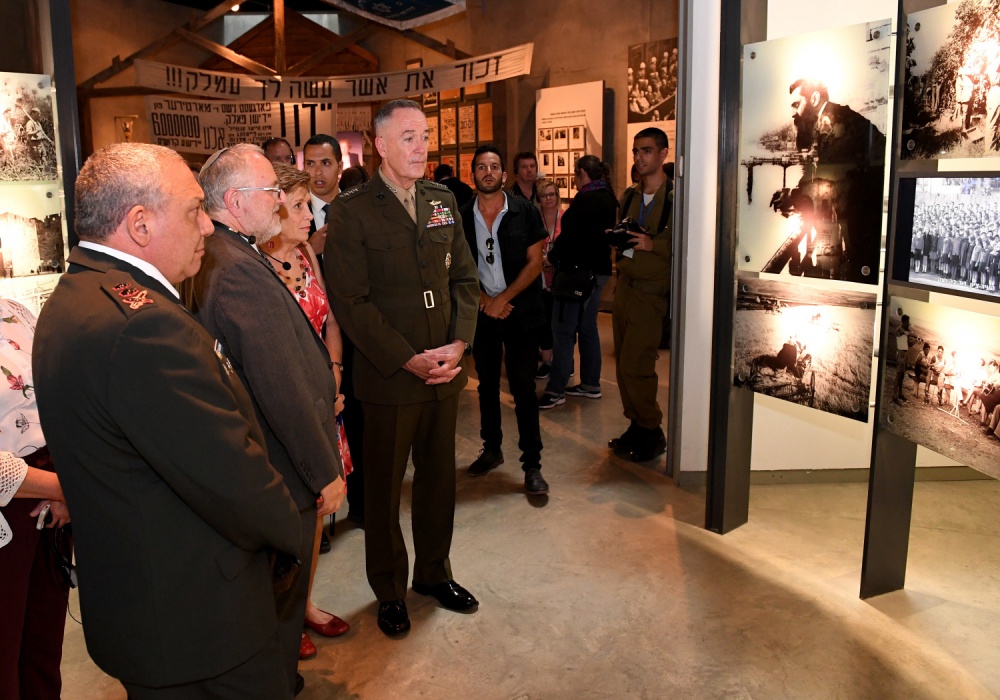
CJCS General J. Dunford tours Yad Vashem Holocaust Memorial Museum May 9, 2017.
Tim Folger is the series editor for "The Best American Science and Nature Writing," and he writes a passionate plea for freedom of research, respect for the truth, and the need to heed reality. He compares attacks on science to events in Germany in the 1930s, when mobs of young men burned the works of scientists and Jewish writers considered blasphemous to the Nazis. Authoritarianism thrives when the free press, justice system and electoral process are threatened.
"One measure of the health of any modern society must be the degree to which it supports its scientists. A few days before I started to write this foreword, hundreds of thousands of people in dozens of cities across the country participated in the March for Science. It was an event at once inspiring and worrisome: inspiring because so many took a stand for rationalism ... worrisome because who would have thought that in the 21st century scientists and citizens would feel the need to gather in support of something so self-evidently valuable as unfettered scientific research?"
Hope Jahren joins a roster of other great science writers who have helmed the series since it began in 2000, among them: Oliver Sacks, Steven Pinker, Edward O. Wilson, Richard Dawkins, and another friend of Navy Reads, Mary Roach.

In Jahren's introduction to this volume, she jumps into a charge of "allegorizing human endeavors by way of plant biology," something that makes "Lab Girl" so personal and relatable. Jahren studies how extra carbon dioxide in the atmosphere helps some plants thrive, and she tests how much may be too much.

"Right here, right now, I'll suggest that the Internet is like carbon dioxide for science writers, who are themselves like plants, and that we are living in an unprecedented era of diverse and thriving journalism in the service of science – albeit one that could be cut off and mowed down if we don't actively value and defend it."

Saturday, March 3, 2018

Women Who Changed the World

Review by Bill Doughty

"Throughout history many women have risked everything in the name of science. This book tells the stories of some of these scientists, from ancient Greece to the modern day, who in the face of 'No' said, 'Try and stop me.'"

With cool-weird drawings and sparkling insights, writer-illustrator Rachel Ignotofsky profiles some of the women who stand out in fields of Science, Technology, Engineering and Mathematics in "Women in Science: 50 Fearless Pioneers Who Changed the World" (Ten Speed Press, 2016).

Among the 50 women featured are Wang Zhenyi, Ada Lovelace, Karen Horney, Marie Curie, Marjory Stoneman Douglas, Rachel Carson, Katherine Johnson, Valentina Tereshkova, Jane Goodall, Maryam Mirzakhani, and Grace Hopper, "Navy admiral and computer scientist."
"Grace Hopper was ... a relentless trailblazer, recognized as the mother of computer programming," Ignotofsky writes. The author spices her profiles with one-liners like: "Invented the first compiler, forever changing how we use computers," "Her great-grandfather was also in the Navy," and "Pioneered the standards for testing computer systems."
Grace Hopper, born in 1906, was fourteen years old when women in the United States achieved the right to vote, a step toward greater equality for women. She earned a PhD in mathematics at Yale fourteen years after passage of the 19th Amendment. Hopper joined the Women Accepted for Volunteer Emergency Service (WAVES) in 1943, bringing her mathematics skills to the war effort.
"After the war, Grace joined the private sector. At the time, programmers needed the skills that came with an advanced degree in mathematics and used binary code to program. Grace Hopper thought it would be easier to just 'talk' to a computer in English. Everyone thought Grace was nuts, but she proved them wrong when she invented the first compiler. This led to create COBOL, the first universal computer language. Thanks to Grace just about anyone can learn to code! Grace returned to the Navy in 1967. Even after she retired as the oldest person on active duty (just a few months short of turning 80), she continued to lecture, consult, and teach – always reminding the world that 'the most damaging phrase in the language is 'we've always done it this way.'"
Along with the short biographies of the fifty featured women are a timeline, statistics in STEM, an illustrated list of lab tools and a glossary. While this book appeals to young readers it, like the works of Mary Roach and Hope Jahren, can inspire any readers to see how women have contributed to progress in the world.

The author's other books (this one was her first) include "I Love Science" and "Women in Sports."

Ignotofsky, who supports critical thinking and evidence-based decision-making exemplified in the "March for Science," writes in her conclusion:
"Women make up half of our population, and we simply cannot afford to ignore that brain power – the progress of humankind depends on our continual search for knowledge. The women in this book prove to the world that no matter your gender, your race, or your background, anyone can achieve great things. Their legacy lives on. Today, women all over the world are still risking everything to discover and explore."
Don't try to stop them.

Friday, March 10, 2017

One Hope for Science

Review by Bill Doughty

Dr. Hope Jahren asks us to plant a tree while she plants a forest of ideas in this remarkable book. Part autobiography in the very cool shade of science essays, "Lab Girl" (Alfred A. Knopf, 2016 by A. Hope Jahren), is a perfect book for Women's History Month.

Michiko Kakutani compares Jahren's style of poetry and scientific imagination to Oliver Sacks and Stephen Jay Gould. I smiled – and laughed – at passages that sounded like Mary Roach. And I read and reread beautiful passages that brought E.O. Wilson and Rachel Carson to mind.

But, to be clear, Hope Jahren is a unique voice, humble but fearless in what she reveals. This book that is ultimately an extended love letter to the world, to life, to "the transcendent value of loyalty," and to her imagined granddaughter.

I enjoy reading short chapters of "Lab Girl" to my young grandkids. Here's an excerpt from her chapter on seeds (and more):
"A seed knows how to wait. Most seeds wait for at least a year before starting to grow; a cherry seed can wait for a hundred years with no problem. What exactly each seed is waiting for is known only to that seed. Some unique trigger-combination of temperature-moisture-light and many other things is required to convince a seed to jump off the deep end and take its chance to take its one and only chance to grow ... Each beginning is the end of a waiting. We are each given exactly one chance to be. Each of us is both impossible and inevitable. Every replete tree was first a seed that waited."
Anomalocaris pictured in a Cambrian sea.
Here's a passage the kids and I enjoyed that sets the stage for life on earth – before plants. This one sent us to Google for a look-see at Anomalocaris and a sidebar to YouTube to see how the history of the earth can be understood using a football field, thanks to NPR's Skunk Bear. Just sharing.
"For several billion years, the whole of the Earth's land surface was completely barren. Even after life had richly populated the oceans, there is no clear evidence for any life on land. While herds of trilobites wallowed on the ocean floor, preyed upon by Anomalocaris – a segmented marine insect the size of a Labrador retriever – there was nothing on land. Sponges, mollusks, snails, corals, and exotic crinoids maneuvered through nearshore and deepwater environments – still nothing. The first jawed and jawless fishes appeared and radiated into the bony forms we know today – still nothing ... Sixty million more years passed before there was life on land that constituted any more than a few single cells stuck together within the cracks of a rock. Once the first plant did somehow make its way onto land, however, it took only a few million years for all of the continents to turn green, first with wetlands and then with forests."
Gorilla at Monkey Jungle
Dr. Jahren is heart-achingly honest and belly-achingly funny in describing roadtrips, the Monkey Jungle, dancing at a glacier, finding something special in hackberry seeds, finding love, being pregnant, and confronting mortality.

Along most of the way she introduces us to  her fraternal soulmate, fellow scientist and lab partner, Bill. We get a bit of history about Armenia and Norway, as relates to Bill's and Hope's families respectively.
Another theme of this book is self-awareness and self-acceptance, as expressed in this found haiku about her life's confusing and sometimes unstable path toward enlightenment:

being what you are
while knowing that it's more than
people want to see
In advice for any parent, leader, scientist or sailor, Jahren writes, "People are like plants. They grow toward the light."
Her writing is often pure poetry in prose:
"In Minnesota, the spring thaw happens all at once when the frozen ground yields to the sun in one day, wetting the spongy soil from within. On the first day of spring, you can can reach into the ground and easily pull up great, loose clumps of dirt as if they were handfuls of too-fresh devil's food cake and watch the fat pink earthworms come writhing out and fling themselves joyfully back into the hole. There is not even a hint of clay within the soils of southern Minnesota; they have lain like a rich black blanket over the limestone of the region for a hundred thousand years ... but the growing season is short, so there's no time to be wasted."
In "Lab Girl" we travel with indefatigable Jahren to her birthplace in Minnesota to places like California, Alaska, the American South, Maryland, Norway and Ireland, then finally to her new home and lab – often the same thing – at the University of Hawaii at Manoa in Honolulu, where she was a tenured professor when "Lab Girl" ends.

Among her studies and achievements: In 2009 she and her team were in the third year of conducting forensic analysis of chemical aftermath of a terrorist attack. "Our idea was to compare, and perhaps link, the chemical fingerprint of post-blast residue with that of the chemical traces gathered from surfaces where the explosives might have been constructed – a kitchen countertop, for example." She achieved success with "a definite dataset, made with integrity and interpreted honestly."
What makes this book so perfect for Women's History Month is the inspiring story behind Jahren's success as a woman in the traditionally man's world of science. She overcame significant roadblocks and obstacles – with toughness, grit and her namesake optimism.

Jahren writes about being stereotyped and second-guessed – knee-deep in chauvinism in a male-dominated world.
"Public and private organizations all over the world have studied the mechanics of sexism within science and have concluded that they are complex and multifactorial. In my own small experience, sexism has been something very simple: the cumulative weight of constantly being told that you can't possibly be what you are."
Global climate change and the urbanization of the planet is a big concern for Jahren. "Viewed from space, our planet appears less green with each passing year," she warns. And, "Humans are actively creating a world where only weeds can live and then feigning shock and outrage upon finding so many."

Baobob tree at University of Hawaii, Manoa.
In a recent study, Jahren and her team are showing that sweet potatoes can grow larger as carbon dioxide increases as predicted for the next several hundred years. 
"This is not a surprise. We also saw that these big potatoes were less nutritious, much lower in protein content, no matter how much fertilizer we gave them. This was a bit of a surprise. It is also bad news, because the poorest and hungriest nations of the world rely on sweet potatoes for a significant amount of dietary protein. It looks as if the bigger potatoes of the future might feed more people while nourishing them less. I don't have an answer for that one."
Hope Jahren takes a clear-eyed look at the real longterm threats to our world and breathes beauty into the nature of reality (and reality of nature) with practical advice: "plant a tree."


This is another book I heard about on the great podcast, Tom Ashbrook's "On Point."

Saturday, September 24, 2016

Atlas Obscura Shrugged

Review by Bill Doughty

When it comes to strange and wonderful places or things in our Universe, it's not about the who or what or where or when or even why; according to authors of "Atlas Obscura," it's the "how"––specifically, how we choose to see our world and everything around us.

The opportunities to discover, see and catalogue new wonders are "infinite," according to Dylan Thuras, "if you're willing to sort of slow down, look around, listen and start asking questions."

Thuras, Joshua Foer and Ella Morton bring us this book packed with question-asking strangeness, subtitled a Freakonomics-esque "An Explorer's Guide to the World's Hidden Wonders" (2016, Workman Publishing).

Mary Roach enjoys a different perspective including "Atlas"
It goes on sale today.

Once a person chooses to see the world differently, they can discover places in their own neighborhood––or aboard their ship––or in places admittedly farther afield that are strangely fascinating.

That's the approach the authors take as they journey into the world in what Mary Roach, author of "Gulp" and "Grunt," describes as “a joyful antidote to the creeping suspicion that travel these days is little more than a homogenized corporate shopping opportunity. Here are hundreds of surprising, perplexing, mind-blowing, inspiring reasons to travel a day longer and farther off the path."

Some places and things in this book to see in a new light: "Cargo Cults of Tanna" in Vanuatu archipelago, "Slab City" and the "East Jesus" community on a former U.S. Marine Corps training base near Niland, California, "Yamamoto's Bomber" wreckage still in the jungle north of Buin, Papua New Guinea,  "Ghost Fleet of Truck Lagoon" in Chuuk, and the not-to-be-missed (?) "Victorious Fatherland Liberation War Museum" in Pyongyang (mural at right).

Website Wonders

The wonders of the "Atlas Obscura" spring from the popular website of the same name.

Foer and Thuras are cofounders of the Atlas Obscura phenomenon, who see there work as "never complete" and who are always ready to credit legions of fans who provide tips, photos and edits as "co-authors."

In the introduction to the new book they proclaim, "Though Atlas Obscura may have the trappings of a travel guide, it is in truth something else. The site, and this book, are a kind of wunderkammer of places, a cabinet of curiosities that is meant to inspire wanderlust as much as wanderlust."

Here are just a few of the wonders to be found on their website, on the internationally themed #navalhistory section:


John Paul Jones tomb: 

"Today, Jones rests in a extravagant sarcophagus below the chapel of the United States Naval Academy in Annapolis, Maryland. The incredible coffin is covered in sculpted barnacles and is held up by legs in the shape of stylized dolphins. The whole thing is sculpted out of a black and white marble that makes it look as though it has been weathered by untold ages beneath the waves."


NOAA's Discovery of USS Conestoga:

"In September 2014, a team from the National Oceanic and Atmospheric Administration was on an expedition in the Greater Farallones National Marine Sanctuary, looking for shipwrecks, when they found the wreck ... a seagoing tugboat. It had a metal hull, and though the upper deck had collapsed, the boilers, the anchor and the engine were all still there. They determined that it had been powered by coal, which dated it to the late 19th century or early 20th ... When the Conestoga disappeared, it was the last U.S. Navy ship to be lost, without explanation, during peacetime. Planes and ships were sent out to find it, in the largest air and sea search in Navy history until the hunt for Amelia Earhardt. But for almost 100 years, it remained lost."


USS Constitution

"Commissioned by the first US president, George Washington, the USS Constitution is probably most famous for defeating numerous British warships in the War of 1812. It was during this war, in the battle against the HMS Guerriere, the ship earned the nickname “Old Ironsides,” when her crew noticed shots from the British ship simply bounced off. The USS Constitution is America's Ship of State ... Today the ship is berthed neatly at Pier 1 of the former Charlestown Navy Yard, at the end of the Freedom Trail in Boston, where she stands the oldest commissioned and fully functioning warship in the United States. The wooden-hulled, 3-mast heavy frigate of the US Navy was launched in 1797 ... Today, the ship keeps a crew of 60 officers and sailors to aid in its mission to promote the understanding of the US Navy's role in war and peace, as part of the Naval History & Heritage Command. The crew are all active-duty Navy sailors––an honorable special duty assignment ... Until current restoration work is complete, the ship is in Dry Dock. The USS Constitution is still open to the public on a first-come, first-serve basis during their operating hours."


Mare Island Cemetery

"Hidden away on Mare Island in Vallejo is the Bay Area's oldest Naval cemetery, the final resting place of sailors and soldiers and loved ones--and one convicted killer ... Burials began at this hillside cemetery in 1856 and continued until 1921. Although it's not noted for big-name interments, there are some memorable stories among the headstones. Among the approximately 900 buried here are the daughter of Francis Scott Key, murderess Lucy Lawson, and six Russian sailors who were laid to rest near the middle during the Civil War era."


Treasure Island Naval History Mural

"Within the lobby of Treasure Island’s former administration building of the 1939 World’s Fair is a mural that stretches 251 feet long and 26 feet high. Designed by New York artist Lowell Nesbitt and executed by a team of a dozen Bay Area painters, the enormous artwork depicts naval history in the Pacific since 1813, featuring a total of eleven Navy and Marine Corps events. The mural was completed in 1976 to align with the opening of the Navy-Marine Corps Museum, which included artifacts from Treasure Island’s World's Fair, Pan Am Clipper flights and American military operations in the Pacific ... Today, the building is occupied by the Treasure Island Development Authority. The museum artifacts have come and gone, but the impressive mural continues to glow on the lobby’s East wall."

Granted, there is not much from the Navy-Marine Corps team in Atlas Obscura, especially in the new book. But, before you shrug: For anyone interested in "how" to look at world differently, this book––and of course the Atlas Obscura website––is a treasure trove of weirdness and enlightenment.

Mary Roach calls this "...Bestest travel guide ever.”

Saturday, June 11, 2016

Navy Reads 'Grunt'

Aboard USS Tennessee (SSBN  734) Photo by MC1 Rex Nelson
Review by Bill Doughty

Mary Roach's interest in writing "Grunt: The Curious Science of Humans at War" (W.W. Norton & Company, 2016) is not in the killing "but in the keeping alive."

Mary said "Grunt" is "probably the most interesting book I've written." (My interview with Mary was posted earlier this week.)

One of the most popular and best science writers in our time, Mary Roach is attracted to the offbeat and weird. She brought us the science of sex in "Bonk," of death in "Stiff," of the possible afterlife in "Spook," of digestion in "Gulp," of space in "Packing for Mars," and of all kinds of curious, cool stuff as editor of "Best American Science and Nature Writing (2011)."

In "Grunt" she explores foxholes and body armor, flies and medicinal maggots, heat and sweat, beaded curtains and unrefrigerated goat meat, camouflage and MRAPS, IEDs and earplugs, and diarrhea and sharks.
  • In Groton, Connecticut she takes us into a wet trainer, aka, "one of the reasons Sailors swear." Here's Mary: "A blast of pressurized air empties the submarine's ballast tanks like a Heimlich maneuver on a purpling guest."
  • At the Monell Chemical Senses Center she donates her own underarm gases to stink researchers who evaluate and provide a grade.
  • At Camp Lemmonier in Djibouti, Africa she examines the insufficient size of toilet paper provided in MREs and hears that "Navy guys pack baby wipes" while "Marines just cut off a piece of their t-shirt. Which possibly sums up the whole Marine Corps-Navy relationship."
    Getting a tour of a Stryker. (Photo courtesy of Mary Roach)
  • At Marine Corps Base Camp Pendleton's paintball range she asked to be shot to see what it feels like. Forty Marines volunteered, for which Mary seemed to have mixed feelings.
But there's a serious side to Roach's investigations and reports.

At Walter Reed National Military Medical Center she makes a poignant connection with wounded warriors who share their mental toughness and grit. They joke even when severely wounded. Their first thoughts are about their fellow troops rather than about themselves.
"This is some kind of blinding selflessness, the sort of instinct that sends parents running into burning buildings. The bonding of combat, the uncalculating instinct of duty to one's charges and fellow fighters, these are things that I, as an outsider, can never really understand ... My world is full of people, and that includes me, who never have to put their lives and bodies on the line for other human beings or for things they believe in. 'Hero' has always been a movie word, a swelling orchestral soundtrack word. A Walter Reed hallway word. Now it has something under it."
Mary Roach focuses on the sacrifice and resilience of wounded troops who return from war: young people changed but committed with their families to getting back on track.

But there's always insatiable curiosity and Mary's willingness to, in the words of David Bowie, turn and face the strange.

"Grunt" brings us research about maggots in wound care and explores whether sharks are really as dangerous to live humans as their reputation is made out to be. By the way, according to the scientists, "human urine does not attract sharks." A typical Mary Roachism: How do sharks acknowledge pee in the pool when they have "no eyebrows to raise or shoulders to shrug."


Photo from Navy Medicine, DoD NavyLive Blog.
Regarding sharks, she references a former Chief of Navy's Bureau of Medicine and Surgery, reveals studies from the Office of Naval Research, and quotes from a paper by Navy Captain H. David Baldridge Jr.: "Analytic Indications of the Impracticality of Incapacitating an Attacking Shark by Exposure to Waterborne Drugs."

Sharks eschew what's alive and chew what's dead, preferring, in Mary's words, to "take no risks and go after a meal that's not going to put up a fight. Injured is good. Dead is better."
"As with fish, so with humans. Over and over, in the shark attack reports of World War II, corpses took the hit. A floating sailor could dispatch a curious shark by hitting it or churning the water with his legs. (Baldridge observed that even a kick to a shark's nose from the rear leg of a swimming rat was enough to cause a 'startled response and rapid departure from the vicinity.') 'The sharks were going after dead men,' said a survivor quoted in a popular book about the 1945 sinking of the USS Indianapolis, an event that often comes up in discussions of military shark attacks. 'Honestly, in the entire 110 hours I was in the water,' recalls Navy Captain Lewis L. Haynes, in an oral history conducted by the US Navy Bureau of Medicine and Surgery, 'I did not see a man attacked by a shark ...' They seemed to have been, he said, 'satisfied with the dead.' Haynes says fifty-six mutilated bodies were recovered, but there's nothing to suggest that any more than a few of them were bitten into while alive."
Mary asked a Naval Special Warfare Command representative about sharks attacking Navy SEALs. His reply: "The question is not, Do Navy SEALs need shark repellent? The question is, Do sharks need Navy SEAL repellent?"


Mary Roach and notebook aboard USS Tennessee (SSBN 734). Photo by MC1 Rex Nelson
Mary explores curious military science aboard a boomer, Ohio-class ballistic missile submarine USS Tennessee (SSBN 734), where "extreme caution is ever the mindset," and where she learns more about "crush depth," "the galley," "Momsen's lungs," and "Trident II launch tubes," among other things – including the importance of sleep in a world with no circadian rhythm. Despite the "long hours and grueling tedium" the crew remains focused and friendly:
"Almost everyone I've met down here has been easygoing and upbeat, especially given how tired they must be. I am, to quote the Dole banana carton in the galley pantry, 'hanging with a cool bunch.' If everyone in the world did a stint in the Navy, we wouldn't need a Navy."
As usual, some of the biggest smiles come from reading the footnotes. For example: Did Julia Childs really cooked up a shark repellent – or just a good story?; Did Brian Williams really like a caffeinated meat stick he sampled at Army's Soldier Systems Center, Natick?; Did you know that when diarrhea researchers are named Riddle and Tribble there's a 94 percent chance of mistakenly calling them "Dribble"?

Mary says that reading science books makes you smarter and more likely to attain attractive dinner partners. But some of her chosen subject matter may make you lose your appetite. In a good way.

"Grunt" ends with a perspective on getting perspective about death in war – important thoughts after her story about "quiet, esoteric battles with less considered adversaries: exhaustion, shock, bacteria, panic, ducks."

Ultimately, Roach writes, "This book is a salute to the scientists and the surgeons, running along in the wake of combat, lab coats flapping," studying "the curious science of humans at war."

Tuesday, June 7, 2016

Mary Roach Interview 2016 'Curious Science'

By Bill Doughty

Mary Roach's latest work, "Grunt: The Curious Science of Humans at War" hits bookstores today.

I interviewed Mary recently. As usual she was open, insightful and funny, never taking herself completely seriously.

Mary Roach deals with serious subjects – even war and death – in the same way many women and men in uniform do: with a fearless swagger but reflecting a sometimes sick, macabre humor. Shamelessly human and real.

In this interview: Who's a hero? Which branch of the service would Mary choose? What does she think of the World War II generation? Why read books?

What was physically toughest thing you did during research and writing of this book? What was mentally toughest?
​"I carried a 30-pound ruck inside the USUHS (Uniformed Services University of the Health Sciences) "cook box," as part of a heat injury study. Thirty pounds is about a third of what soldiers regularly carry in heat like that.  And I lasted seven minutes, I think.  Put me on a boat, man."Mentally toughest: trying to strike the right tone in my writing.  Needing to be the irreverent, flip goofball my readers have come to expect, but at the same time wanting to be respectful of  men and women in the armed forces and cognizant of the hard work and risks that they undertake on behalf of all Americans."  
From your "Grunt" interviews and interaction, is there someone who is impossible to get out of your mind?
​"The young combat engineer I interviewed after his surgery at Walter Reed.  He had stepped on an IED​, lost all of one leg and part of another and his pelvis was broken, and his first concern, when he comes to, was his men.  He was their commander and he kept trying to get up to see who was hit, who needed help.   As I said in the book, the word "hero" never used to mean much to me.  Sort of a movie word, a swelling-orchestral-soundtrack word.  Now there's something behind it."
Aboard USS Tennessee (SSBN  734) Photo by MC1 Rex Nelson
Now that you've experienced life with different branches of the service, if you had to sign up tomorrow, which would you choose?
​"Why, Navy, of course, Bill!  What a silly question." ​
In "Grunt," you said, "If everyone in the world did a stint in the Navy, we wouldn't need a Navy." Would you mind elaborating a bit?
"I wrote that in my notebook when I was out at sea on an SSBN, the USS Tennessee.  Those guys were working and concentrating for hours on end on very little sleep, and I didn't hear anyone complain.  I never even saw a yawn.   Everyone was upbeat, flexible, and professional, with sense of  humor intact.  For weeks after I got home, I tried to conduct myself more like them.  Then I gave up and went back to being my usual whiney, bratty self." 
What was the biggest insight about the military? Any surprises to original surmises?
"I originally thought that access would be a problem.  I expected double-talk, obfuscation, delays. Got none of that.  PAOs, Navy especially, were more helpful and more forthcoming than most civilian PAOs.  Unless something was classified, the PAO would do what he or she could to address my request.  (Though, granted, I was not writing 'Zero Dark Thirty'!)"
You conclude "Grunt" with a perspective on thinking about war. Is war ever justified?
Mary climbs out of a Stryker. (photo courtesy Mary Roach)
​"The book ends at AFMES (Armed Forces Medical Examiner System), at a Combat Mortality Conference.  In that particular setting, it was hard to have the kind of perspective one needs to see the justification for the lives lost:  so many, so young.  But unfortunately there are situations in which it is justified."
In "Grunt" you mention previous wars, especially the Second World War. This December we'll commemorate the 75th anniversary of the Pearl Harbor attack. Any words about "the Greatest Generation" and the legacy of that war?
​"They put us Baby Boomers and Millennials to shame. We're spoiled and self-centered. We  have no idea how easy we have it."
In general, what can young people get from reading books (especially science books)?
​"A deeper knowledge and understanding of history and the world around them.  The ability to sound smarter than they actually are, and thereby attain fame, riches, and attractive dinner companions."
What are you reading now?
​"I just finished 'Dead Wake,' Erik Larson's terrific book about the last crossing of the Lusitania.  I had not read much set in WWI, so it was doubly interesting for me.  My father came over to the US on the Lusitania in 1913, a couple years before she went down, so I was curious to learn about more about it.  My dad (he was 65 when I was born) traveled in steerage class, though, and there wasn't anything about that part of the ship in Larson's book. Probably because most survivors who went on to write memoirs were first-class."


Mary Roach's "Grunt" tour began this week at Barnes & Noble, Union Square, New York. My review of "Grunt" will be posted later in the week. See some other Navy Reads posts related to Mary Roach, including her previous recommended reading list here.

Saturday, May 30, 2015

Catching Up on Names, Namesakes

by Bill Doughty
New Jersey, John Finn, Midway and Craig Symonds, Mary Roach, Jimmy Carter and John S. McCain – all in the news recently and each with featured spots in Navy Reads. Make the connections...

A state of the Navy is New Jersey. Secretary of the Navy Ray Mabus announced this week that the newest Virginia-class attack submarine to be named after the Garden State would be SSN 796, USS New Jersey. A DOD story this week reminds us that the Navy’s first submarine, USS Holland, was designed and built in New Jersey in 1900.

Medal of Honor recipient John Finn, Dec. 7, 2006.
In Mabus's home state of Mississippi, at the beginning of this month, USS John Finn was christened at Ingalls Shipbuilding in Pascagaoula. According to an informative post about John Finn on Navy Live Blog, "The future USS John Finn is the 63rd Arleigh Burke class destroyer, and the first of the DDG 51 Flight IIA restart ships."

John Finn passed away five years ago this week, May 27, 2010. We interviewed him for Navy Reads in late 2009, when he told us his favorite author prior to World War II was Ernest Thompson Seton – author, artist and naturalist. “I always loved books about wildlife,” he said. 

Finn was a hero who fought back against Imperial Japanese Navy planes attacking Oahu, Hawaii on December 7, 1941.

Craig Symonds
On Oahu next week Craig L. Symonds will be featured speaker at the Pacific Aviation Museum on Ford Island, Pearl Harbor to commemorate the 73rd anniversary of the Battle of Midway, which became the namesake for a great aircraft carrier, USS Midway (CV 41), now a museum in San Diego. The battle is considered the turning point of the war in the Pacific, just six months after the attack on Pearl Harbor and Oahu.
Dr. Symonds, a scholar of naval history and the Civil War, will conduct several book-signing events and interviews during the week leading up to the event at PAM, Saturday, June 6, 2015.

Mary Roach
Meanwhile, another gifted author who has contributed to Navy Reads, Mary Roach, is up in Skagway, Alaska this week as keynote speaker for "Exploring the Frontiers of Language / Let Skagway Inspire You," sponsored by North Word Writers Symposium. Roach – a champion of science, humor and critical thinking – is author of the New York Times bestsellers "Gulp: Adventures on the Alimentary Canal," "Packing for Mars: The Curious Science of Life in the Void," "Stiff: The Curious Lives of Human Cadavers," "Bonk: The Curious Coupling of Science and Sex," and "Spook: Science Tackles the Afterlife." 

Yesterday, 90-year-old Navy veteran and former U.S. President Jimmy Carter – author of numerous books on human rights, history, international relations and peace – attended a change of command ceremony for his namesake submarine, Seawolf-class attack submarine USS Jimmy Carter (SSN 23) during a ceremony at Naval Base Kitsap, Bangor, Wash.

Cmdr. Melvin Smith (right) assumes command of USS Jimmy Carter.
Cmdr. Melvin Smith relieved Cmdr. Brian Elkowitz as commanding officer.


A Navy.mil story noted that "the 39th president and 2002 Nobel Peace Prize winner is the only U.S. president to graduate from the Naval Academy and the only one to qualify on submarines."

Carter, who graduated from the Naval Academy in 1946 and served in the Navy until 1953, said: "Of all the honors I have ever received, I've never had anything of greater honor than the chance to be the namesake of USS Jimmy Carter."

Vice Adm. John S. McCain Sr. and Cmdr. John S. McCain Jr. in 1945.
In a ceremony May 28 in Yokosuka Japan, the forward-deployed Arleigh Burke-class USS John S. McCain conducted a change of command ceremony. Cmdr. Chad Graham relieved Cmdr. Chase Sergeant as CO. McCain is named for Admirals John S. McCain Sr. and John S. McCain Jr., both WWII veterans and leaders, grandfather and father to Senator John McCain, Vietnam veteran, Navy pilot and former POW.

Sen. McCain's book "Character is Destiny" was featured on Navy Reads last year. The book, written with Mark Salter, is filled with short biographies and inspirational stories about core values, leadership, and the importance of good character.