Showing posts with label Hopper. Show all posts

Monday, March 29, 2021

‘Gutsy’ Women Knocking on the Door

Review by Bill Doughty

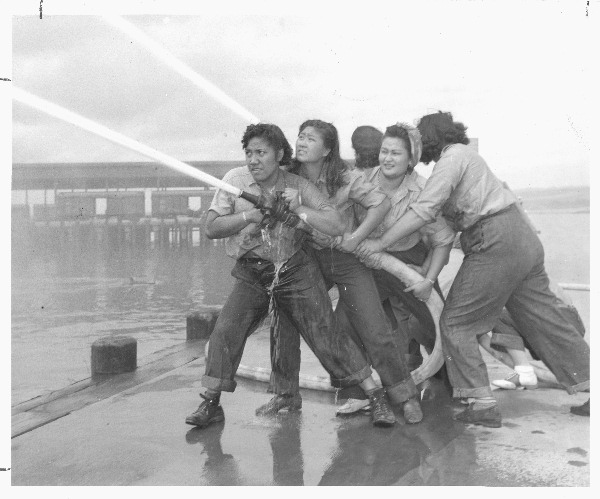
In an iconic photo, four Asian American Pacific Islander women at the Pearl Harbor Naval Shipyard train in firefighting. Long mislabeled as taken during the attack of Dec. 7, 1941, the photo in fact portrays some of  the strong women who applied to support the Navy’s war efforts in the wake of that attack. From left to right: Elizabeth Moku, Alice Cho, Katherine Lowe, and Hilda Van Gieson.


Over time, history usually has a way of sorting out fact from fiction.


Rear Adm.Grace Hopper, "Mother of Computing"
The facts and highlights of strong women of grit and grace are spotlighted in a book recommended for Women’s History Month. Profiles of more than 100 women come to life in “The Book of Gutsy Women” by Hillary Rodham Clinton and Chelsea Clinton (Simon & Schuster, 2019).

Among the women profiled are some we featured in Navy Reads posts: Rear Adm. Grace Hopper, Ada Lovelace, Rachel Carson, Marjory Stoneman Douglas, Margaret Chase Smith, Malala Yousafzai, and Maya Angelou. This book includes mini-biographies of both famous (Clara Barton, Helen Keller, Ida B. Wells, Maya Lin, Gabby Giffords, Greta Thunberg, and Venus and Serena Williams) as well as less-well-known women (Rigoberta Menchu Tum, Dr. Gao Yaojie, Nelba Marquez-Greene, Wangari Maathai, and Jineth Bedoya Lima).


Chelsea and Hillary Clinton, 2011
Hillary and Chelsea each provide essays about their subjects. They also offer personal perspectives about the women who have inspired and enlightened them – women who have made a difference in the world. The book is organized in sections: early inspirations, education pioneers, earth defenders, explorers and inventors, healers, athletes, advocates and activists, storytellers, elected leaders, groundbreakers, and women’s rights champions.

Chelsea writes, “I learned of Grace (Hopper) in 1996, when the navy named a new ship the USS Hopper (DDG 70) in her honor … I learned even more about her when I spoke many years later at the Grace Hopper celebration, the largest gathering of women technologists in the world.”


Former First Lady, senator, and Secretary of State Hillary Clinton reflects about the suffragists who knocked on the door, marched in the street, and fought for women to be able to vote in the United States one hundred years ago. That right was guaranteed with the passing of the Nineteenth Amendment to the U.S. Constitution, but it was a right that took decades to apply to women of color:

“Reading the words of the Nineteenth Amendment today, it’s hard not to wonder why it took so long” ‘The right of citizens of the United States to vote shall not be denied or abridged by the United States or by any State on account of sex. Congress shall have the power to enforce this article by appropriate legislation.’ But, of course, it was a long struggle because it was about so much more than the right of women to vote. It was about race, class, and deeply held cultural and religious views about women’s subordinate roles to men in society. It was about men’s –– and some women’s –– insecurities and fears of the unknown. These challenges are still present today.

The franchise –– the basic right of citizenship –– is still being fought over between those of us who believe every citizen should be able to vote and have that vote counted, and those who want to restrict the vote by erecting barriers against people, largely still based on race.”

Celia Ou, a graduate student at Scripps Institution of Oceanography, monitors computer screens displaying detailed sonar imaging of the ocean floor aboard the Auxiliary General Oceanographic Research (AGOR) vessel R/V Sally Ride, Dec. 15, 2016. (John F. Williams)


Nearly all the Gutsy women featured in this book faced and overcame some kind of obstacles of discrimination. Chelsea Clinton says this about space pioneer astronaut Sally Ride, the first American woman in space (in 1983) and a champion of STEM education for young people worldwide:

“Even after her death in 2012, Sally Ride kept breaking barriers. She came out as a lesbian quietly, without fanfare … Not long after her death, Tam [O’Shaughnessy, her partner of 27 years] received a call that surprised her, from Ray Mabus, then secretary of the navy. The navy hoped to honor Sally by naming a research vessel after her. Secretary Mabus was calling to ask whether Tam would be the ship’s sponsor – a role that had, up until that point, been filled by the wife of the man for whom the ship was named. ‘I think it is fitting the the celebration of Sally’s legacy as a pioneering space explorer and a role model includes an acknowledgment of who she really was and what she cared about,’ said Tam. The R/V Sally Ride, commissioned in 2016, is the first navy research ship named for a woman. Her legacy lives on in the scientific curiosity sparked in the girls and boys she continues to inspire, the ship that bears her name, and a spot on the moon named after her by NASA.”

Military readers may find fascinating nuggets of history in the essays about Sylvia Earle, Mary McLeod Bethune, Florence Nightingale, Eleanor Roosevelt, and Mary Edwards Walker. Chelsea writes this about Walker:

“…Dr. Mary Edwards Walker, the only woman in her medical school class at Syracuse Medical College in 1855. She was a practicing physician when the Civil War broke out. She desperately wanted to enlist in the Union Army as a surgeon but wasn’t allowed to because she was a woman. Initially she was called a nurse, since women generally weren’t considered doctors. Because women were not allowed to enlist, Mary had to volunteer, working for free at a temporary hospital, first in Washington and then in Virginia, where she traveled to Union field hospitals across the commonwealth … When her medical credentials were finally accepted she moved to Tennessee and became a War Department surgeon – a paid position that was the equivalent of a lieutenant in status.”


Dr. Sylvia Earle became chief scientist at the National Oceanic and Atmospheric Administration in 1990. She pioneered research in preserving 
and protecting the ocean, including the study of damage to coral reefs. Her inspiring TED talk, above, is a call to action. Hillary writes:

“When I think of Sylvia’s work, I am reminded how important it is for all of us to peruse and consider what we want to leave to the generations who come after us –– how they’ll honor the past, imagine the future, and give gifts to those who will live out their lives long after we’re gone. That’s exactly what Sylvia’s life as a scientist, an engineer, a teacher, and an explorer should inspire all of us to do: we must preserve our oceans for the future.”

Last year, this book generated controversy because of the women who were not included. For example, there is an unfortunate dearth of women who have served in or with the military. Surely, the authors could have included a “protectors” section filled with inspiring women who served in uniform.


Despite the intriguing photo on the cover, there is little focus on the women who served on the Homefront during the Second World War. In fact, there’s no explanation of the colorized photo of the women firefighters at the Pearl Harbor Naval Shipyard.

Yet, considering the general lack of attention toward the achievements of women in American and world history for many generations, it is refreshing to see a book of this scope. Women continue to knock on the door, push through the glass ceiling, and demand equality.


“The Book of Gutsy Women” illustrates the strengths of women throughout history, often in the face of sexism, misogyny, harassment, and patriarchy. It highlights the facts of women’s history and showcases women’s contributions to creating a better world now and in the future.

Wednesday, November 27, 2019

Naval Gazing: 'Sailing True North'

DC2 Reginald Selgren looks out at the horizon on the flight deck of USS Stockdale (DDG 106) while underway in the Pacific Ocean. (MC3 Abigayle Lutz)
Review by Bill Doughty

The deck of a ship provides a platform to simultaneously contemplate eternity and look within to understand our place in the universe.
"... any sailor can walk out on a rolling deck at night and stare at the distant point where the sky meets and sea and recognize that we are merely the smallest part of a huge and diverse universe that stretches forever unto the mind of God, and which will last far beyond the age of human beings. This combination of attributes – the endless vision of eternity dangling before our eyes – creates a deepening of character in the best of sailors ... and deepen our own characters."
Adm. James Stavridis, USN (ret.), brings us aboard with short biographical stories in "Sailing True North: Ten Admirals and the Voyage of Character" (Penguin Press, 2019). The bios and stories illustrate key character traits: creativity/innovation, resilience, humility, balance, honesty, empathy, justice, decisiveness, determination, and perspective.


Stavridis poses with instructors at the Naval Surface and Mine Warfighting Development Center in 2018. (Lt. M. Stroup)
Contemplating "great deep waves" and endless stars above and over the horizon provides perspective through deep reflection. 

Stavridis laments shortened attention spans and constant distractions in recent years that prevent us from reflection and true awareness. The antidote: reading, thinking and learning – reflection.

We can see the future and understand the present by looking into the past as well as the horizon. 

Through personal anecdotes and stories from history, Stavridis teaches about how to achieve a good character and practice good leadership.

Reagan, Lehman and Rickover in 1982.
He compares humble Rear Adm. Grace Hopper with irascible Adm. Hyman Rickover and offers a powerful story of Rickover's confrontation of Secretary of the Navy John Lehman and President Reagan in the Oval Office. Sometimes exemplary (and often flawed) character traits are illustrated in sea stories about such diverse figures as Themistocles, Zheng He, Sir Francis Drake, Mahan, Zumwalt and Nimitz ("In so many ways he was the greatest of the Navy's admirals").

Among the character traits that seem to really set the good apart from the bad are humility, justice, empathy and honesty. "Truth matters for us all," Stavridis writes, "but especially for leaders whose decisions shape the world. Character that is built around a respect, really a veneration, for the truth is the sort of character to have."

As for empathy, this trait when conducted – like gazing at the horizon from a ship's deck – helps us get out of our own skulls, escape the notion that we are the center of world. In that context, Stavridis introduces us to the "brilliant and memorable" speech by David Foster Wallace, delivered at Kenyon College in 2005, "This is Water."


Wallace calls for valuing lifelong education, caring for others, and awareness in living "life BEFORE death." Wallace demands we question what we worship and be open to new ideas. "Blind certainty," had says, is "a close-mindedness that amounts to an imprisonment so total that the prisoner doesn't even know he's locked up."
"If you worship money and things, if they are where you tap real meaning in life, then you will never have enough, never feel you have enough. It's the truth. Worship your body and beauty and sexual allure and you will always feel ugly. And when time and age start showing, you will die a million deaths before they finally grieve you. On one level, we all know this stuff already. It's been codified as myths, proverbs, clichés, epigrams, parables; the skeleton of every great story. The whole trick is keeping the truth up front in daily consciousness. Worship power, you will end up feeling weak and afraid, and you will need ever more power over others to numb you to your own fear. Worship your intellect, being seen as smart, you will end up feeling stupid, a fraud, always on the verge of being found out. But the insidious thing about these forms of worship is not that they're evil or sinful, it's that they're unconscious. They are default settings."
Obviously, Stavridis is open to inspiration from diverse sources in order to overcome our personal default settings. 

Two of Stavridis's mentors, Secretary of Defense Leon E. Panetta and Chairman of the Joint Chiefs of Staff Adm. Mike Mullen, testify at a hearing of the Senate Armed Services Committee on the U.S. strategy in Afghanistan and Iraq, Sept. 22, 2011. (PO1 Chad McNeeley)
"True North" reveals the author's mentors Adm. Mike Mullen, Gen. Colin Powell, and secretaries of defense Bob Gates and Leon Panetta. We read profiles on Adm. Bill McRaven and Adm. Michelle Howard, and we get quotes from Coach John Wooden, Shakespeare and Oscar Wilde.

Wilde's quote, by the way, is a found haiku:


"We are all in the
gutter but some of us are
looking at the stars"

Stavridis offers a wealth of books in his "selected bibliography and further reading." 

"True North" is worth a place on any sailor's bookshelf and is recommended for anyone interested in what it takes to lead an examined life as a good leader.

Happy Thanksgiving indeed.

Sunday, March 18, 2018

Navy's Crowded Future

Review by Bill Doughty

Rosenblatt with the Perceptron in the late 1950s.
While we rightfully focus on the achievements of computer pioneer Rear Adm. Grace Hopper, we can also make room for another scientist who worked on a project funded by the Navy – an early attempt to develop artificial intelligence. This relatively obscure thinker, Frank Rosenblatt, came up with a theory how to teach machines, in the same way people learn language: through repetition, context and feedback.
"One of the first digital machines that learned in this way was the Perceptron, a U.S.-Navy funded attempt at building a thinking, learning machine led by Frank Rosenblatt, a scientist at the Cornell Aeronautical Laboratory. The goal with the Perceptron, which debuted in 1957, was to be able to classify things that it saw – dogs versus cats, for example. To this end, it was configured a bit like a tiny version of the brain."
So write Andrew McAfee and Erik Brynjolfsson in "Machine Platform Crowd: Harnessing Our Digital Future" (W.W. Norton, 2017), a book recommended by Chief of Naval Operations, Adm. John Richardson.

The Perceptron is a tiny example of one of three "rebalancings" happening now, in this case "machines," where we see daily examples of how technology, often held in our hand, takes care of basic math, data transmission and record-keeping.

To show how far we've come from a time of paper-only business, the authors give an example of an area today where machines are not yet fully implemented. It hits close to home, reminding us of what it was like in a time of carbon paper, file carts and file cabinets:
"A disturbing window back to this time exists today at the 'Paperwork Mine,' an underground nightmare of inefficiency operated by the U.S. government's Office of Personnel Management. The site exists to handle the necessary administrative steps when a federal employee retires. Because these steps have not been computerized, however, the routine tasks require 600 people, who work in a supermarket-sized room full fo tall file cabinets; for baroque reasons, this room is located more than 200 feet underground in a former limestone mine. Back in 1977, completing the (quite literal) paperwork for a federal retirement took, on average sixty-one days. Today, using essentially the same processes, it still takes sixty-one days. The state of Texas, which has digitized its process, currently does it in two."
CNO Adm. John Richardson sees innovations at the Naval Surface Warfare
Center, Dahlgren, Va. Jan. 18, 2017. (Photo by MC1 Nathan Laird)
Properly resourced and run, OPM, like other areas of the government could benefit from 21st century innovations. At the beginning of the 1900s electrification changed the face of manufacturing, opening new fields but ending businesses that couldn't or wouldn't adapt.

The authors think about thinking. They outline two systems humans use to think. The two ways mirror nature and nurture – our animal instincts versus "evolutionarily recent" human ability to contemplate and reason.

They cite Nobel prize winner Daniel Kahneman for his work in behavioral economics and for how he documented two thinking systems. Thinking system 1 is reflexive and relies on biases, intuition, emotions resulting in a reactive response. Thinking system 2 is more reflective, reasoned, based on data and other evidence.

Guess which type of thinking is more machine-like and more likely to have positive results. 

The future is now. Artificial intelligence in machines is making quantum leaps in development, thanks to research and development, and with help from other machines.

Is this something to fear? Is there a dystopian post-Singularity world on the horizon under the banner of Skynet, as depicted in "Terminator"?

The authors are optimistic about the future, even as they run through all the areas that have been transformed in our society, where the Internet is a "shatterer of worlds" and platform for new platforms. 

Here are the worlds shattered, as we once new them: newspapers, music industry, photography, magazines, phone companies, radio, malls and shopping. It was poignant to be reading this book when Toys"R"Us made their announcement this week about going out of business.

In the chaos, however, is opportunity.

We read how Facebook, Apple and Google platforms are transforming our world, both in accessibility and ease-of-use. The authors describe the success of apps like Dropbox, Fitbit, ClassPass, Uber, Waze, 99Degrees Custom, Airbnb, and others.

Einstein said, "Make things as simple as possible, but not simpler," and so we see limitations and balance in changes here and yet to come. In the spirit of Einstein: Make things as free and open as possible but not without security.
"It seems unlikely that the U.S. Department of Defense will ever turn to a digital platform to source the military's next fighter plane or submarine. This is because the market contains very few possible participants (only one buyer and very few sellers). In addition, the transaction is incredibly complex and requires enormous amounts of communication. Markets in which players are few and offerings are complicated will probably be some of the least amenable to platforms."
In the disruptive, often chaotic revolution we are all navigating, McAfee and Brynjolfsson provide this guidebook to explain changes in egalitarianism, connectivity and empowerment.

By the way, the authors believe in capitalism, while lauding President Teddy Roosevelt's trust busting more than a century ago. "Capitalism can be an enormous force for good, but 'crony capitalism' – the act of distorting markets so that friends of the powerful an enrich themselves –should always be rooted out," they write. 

The final area of change in this digital revolution involves the Crowd, another reason for optimism for a world in which freedom of ideas and expression is widespread and spreading.

"For the first time in human history a near majority of humans are now connected," they write. What does this mean in the long run for oppressive regimes in countries that restrict freedom of speech, expression and assembly as the people learn more about free and democratic societies.


Can incidents such as the recent eye-rolling Chinese journalist be quashed once they become viral, or are they out there forever for freethinkers to access and contemplate.

If libraries and hardbound encyclopedias represent the "core" of what's come before, as examples of centers of knowledge, the Internet and Wikipedia show the new "crowd," where collective intelligence and sharing information, centered on Thinking system 2 and properly verified, can educate and enlighten.

In its early years, Wikipedia, which was created by Jimmy Wales and Larry Sanger and relied on public participation, was questioned for its veracity, but as the "Machine Platform Crowd" authors note, there are more good and honest people in the world than there are trolls and other bad actors. Today Wikipedia is nearly always accurate and carefully sourced.

After reading about the Perceptron, I went to Wikipedia to learn more about Rosenblatt and his work.

From Wikipedia: "In a 1958 press conference organized by the US Navy, Rosenblatt made statements about the perceptron that caused a heated controversy among the fledgling AI community; based on Rosenblatt's statements, The New York Times reported the perceptron to be "the embryo of an electronic computer that [the Navy] expects will be able to walk, talk, see, write, reproduce itself and be conscious of its existence."


The new in-crowd allows everyone's voice to be heard. People on the front lines often have the best ideas for improving processes. Smart bosses ask for their workers' suggestions and empower them to be innovative in their approach to their jobs while, wherever possible, including stakeholders.

Aviation Boatswain's Mate 3rd Class Donovan Hampton launches an F-35B assigned to the "Green Knights" of Marine Fighter Attack Squadron 121 (VMFA-121) off the flight deck of the amphibious assault ship USS Wasp (LHD 1) March 2, 2018 as part of a routine patrol in the Indo-Pacific region. The Wasp Expeditionary Strike Group (ESG) was conducting a regional patrol in the East China Sea meant to strengthen regional alliances, provide rapid-response capability, and advance the Up-Gunned ESG concept. (U.S. Navy photo by Mass Communication Specialist 3rd Class Levingston Lewis)
"Smart organizations are figuring out how to take advantage of the crowd to get their problems solved, and for many other purposes," the authors write. Their advice: "decentralize," which is at the heart of the Internet: "The web has already greatly democratized access to information and educational resources."

Thanks to forward thinkers, the Navy is also part of the digital future.

Saturday, March 3, 2018

Women Who Changed the World

Review by Bill Doughty

"Throughout history many women have risked everything in the name of science. This book tells the stories of some of these scientists, from ancient Greece to the modern day, who in the face of 'No' said, 'Try and stop me.'"

With cool-weird drawings and sparkling insights, writer-illustrator Rachel Ignotofsky profiles some of the women who stand out in fields of Science, Technology, Engineering and Mathematics in "Women in Science: 50 Fearless Pioneers Who Changed the World" (Ten Speed Press, 2016).

Among the 50 women featured are Wang Zhenyi, Ada Lovelace, Karen Horney, Marie Curie, Marjory Stoneman Douglas, Rachel Carson, Katherine Johnson, Valentina Tereshkova, Jane Goodall, Maryam Mirzakhani, and Grace Hopper, "Navy admiral and computer scientist."
"Grace Hopper was ... a relentless trailblazer, recognized as the mother of computer programming," Ignotofsky writes. The author spices her profiles with one-liners like: "Invented the first compiler, forever changing how we use computers," "Her great-grandfather was also in the Navy," and "Pioneered the standards for testing computer systems."
Grace Hopper, born in 1906, was fourteen years old when women in the United States achieved the right to vote, a step toward greater equality for women. She earned a PhD in mathematics at Yale fourteen years after passage of the 19th Amendment. Hopper joined the Women Accepted for Volunteer Emergency Service (WAVES) in 1943, bringing her mathematics skills to the war effort.
"After the war, Grace joined the private sector. At the time, programmers needed the skills that came with an advanced degree in mathematics and used binary code to program. Grace Hopper thought it would be easier to just 'talk' to a computer in English. Everyone thought Grace was nuts, but she proved them wrong when she invented the first compiler. This led to create COBOL, the first universal computer language. Thanks to Grace just about anyone can learn to code! Grace returned to the Navy in 1967. Even after she retired as the oldest person on active duty (just a few months short of turning 80), she continued to lecture, consult, and teach – always reminding the world that 'the most damaging phrase in the language is 'we've always done it this way.'"
Along with the short biographies of the fifty featured women are a timeline, statistics in STEM, an illustrated list of lab tools and a glossary. While this book appeals to young readers it, like the works of Mary Roach and Hope Jahren, can inspire any readers to see how women have contributed to progress in the world.

The author's other books (this one was her first) include "I Love Science" and "Women in Sports."

Ignotofsky, who supports critical thinking and evidence-based decision-making exemplified in the "March for Science," writes in her conclusion:
"Women make up half of our population, and we simply cannot afford to ignore that brain power – the progress of humankind depends on our continual search for knowledge. The women in this book prove to the world that no matter your gender, your race, or your background, anyone can achieve great things. Their legacy lives on. Today, women all over the world are still risking everything to discover and explore."
Don't try to stop them.

Saturday, June 24, 2017

A Woman's Place...

Review by Bill Doughty

... is "Serving Proudly."

This "History of Women in the U.S. Navy" by Susan H. Godson (Naval Institute Press, 2001) shows how women's roles evolved in the sea service, especially at first in Navy medicine.

Women served in defense of the nation even before there was a United States Navy, but women like Clara Barton (for the United States in the War of 1812) and Florence Nightingale (for Britain in the Crimean War) proved the value of women near the battlefield in the early and mid 1800s. By the end of the century, during the Spanish-American War, the U.S. Navy Hospital Corps was created (1898). 

The book opens with an epigraph by Rear Adm. Grace M. Hopper: "The highest award I have received is serving proudly in the U.S. Navy."
"By the end of the nineteenth century, the U.S. Navy had developed into a world-class naval power with fleets to sail and colonies to administer. The Navy's evolution had been uneven and sporadic, and growth had depended on external threats or, by the 1890s, on markets to open, colonies to supervise, and primitive people to uplift. Concurrently, training and requirements for officers and men had become professionalized... But the Medical Department still lacked a vital element: professionally trained nurses – those women who had taken two- or three-year courses in hospital training schools. Nursing, along with teaching and social work, was one of the few professions open to women. During the nineteenth century, many women emerged from their prescribed sphere and went into reform movements, clubs and associations, and higher education. And they were no strangers to the seafaring life; they had been in virtually all types of vessels, both private and naval. The Navy needed professional nurses, and such women had proven their worth during the Spanish-American War. Could the two, in fact, be mutually beneficial?"
In 1908 the Navy Nurse Corps was born. Esther Voorhees Hasson, Lenah S. Higbee and J. Beatrice Bowman were the first superintendents.

Godson examines the Navy's influence in breaking down walls, promoting education and progressing toward greater equality for women throughout the 20th century. 
"During World War I, the U.S. Navy grew in men and ships to address the demands of the European conflagration. How it met wartime requirements depended largely on Secretary of the Navy Josephus Daniels. Because of his vision and boldness, the Navy embarked on the temporary and unprecedented wartime expedient of bringing women into its enlisted ranks as yeomen (F) and Marine Reservists (F). Those women who entered the naval service had no idea that they were pioneers. They joined the Navy because the country needed their talents."
The author relates the early influence of civilians Margaret Sanger, who "launched the birth control movement, which gave women the knowledge and ability to control family size;" Alice Paul whose party proposed an equal rights amendment; and Eleanor Roosevelt, who championed social-welfare causes.

"A dramatic breakthrough for women" came during the Second World War, when some 350,000 women served in the military ashore. Women throughout the nation saw greater opportunity serving in the industrial sector. Of course, it was in WWII that  WAVES – Women Accepted for Volunteer Emergency Service – was created, in the face of quite a bit of resistance to change.

The Marine Corps, part of the Department of the Navy, was most recalcitrant about integrating women into its ranks. Although only a small number of women Marines were allowed to serve temporarily during the First World War in the Reserves, they were welcomed back in 1943, again in support roles, separate but unequal.

WAVES march in a parade for Fleet Admiral Chester W. Nimitz and Medal of Honor veterans in New York City, Oct. 9, 1945. (NHHC)

After the war, pioneers like Cmdr. Joy Bright Hancock "firmly believed that women should be allowed to serve in the regular Navy as a regular career." She traveled around the country, coordinated with the newly formed Department of Defense, and lobbied Congress, causing the "House Armed Services Committee to run up the white flag."

Women were in a "holding pattern" mid-century, but the 60s brought about great change in civil rights, including for women, and the Navy was in the forefront of the changes. A small number of WAVES served in support roles in Vietnam, but "the Navy never hesitated to dispatch nurses to the war zone," according to Godson. The 70s brought more demonstrations, class-action lawsuits and a "new brand of feminism," resulting in the Equal Opportunity Act and the Supreme Court's decision in Roe v. Wade (1973), which "represented another victory for equality."

"Guiding the Navy from 1970 to 1974 was CNO Adm. Elmo R. Zumwalt Jr., who undertook to modernize both the fleet and personnel policies... Zumwalt issued the famous (or infamous) Z-116 on 7 August (1972), giving equal rights and opportunities to Navy Women," Godson writes.

Zumwalt opened the U.S. Naval Academy to women and opened avenues for women to be able to achieve flag rank. Once again, Navy Medicine was in the lead with the first women allowed to serve aboard ships going aboard the hospital ship USS Sanctuary (AH-17). The Navy's newest warship in early 2017 is named for the visionary Navy leader. According to the Navy, "USS Zumwalt (DDG 1000) is the largest and most technologically advanced surface combatant in the world."


The 80s were a period of entrenchment, with greater participation and new roles for women in the Navy, leading to the early 90s and the repeal of combat exclusion for women, thanks to Rep. Patricia Schroeder, DACOWITS (The Defense Advisory Committee on Women in the Services) and Secretary of Defense Les Aspin.

Vice Admiral Nora Tyson, Commander U.S. Third Fleet.
Godson's book ends on a hopeful note as she wonders about the "long-term impact of these sweeping changes" (initiated more than twenty years ago). She reflects on women's achievements in the first Gulf War, at sea, in aviation, at the Naval Academy, and of course in the Navy Nurse Corps.
"The story of all Navy women is one of dedication and valor. They proudly chose to serve their country as part of the U.S. Navy and pursued their goal with dogged determination. They would not be denied such an honorable calling. As in the eighteenth and nineteenth centuries, women's familiarity with maritime matters and their nursing skills have made them essential to the naval service. Tributes to their service have been many. One of the most touching came in 1996, when the Navy named the guided-missile destroyer USS Hopper (DDG 70) in honor of Rear Adm. Grace Hopper, who had led the Navy into the computer age. And in the fall of 1997, a lasting monument to Navy woman, as well as to all 1.8 million women who have served in the military was dedicated: the women in Military Service for America Memorial at the entrance to Arlington National Cemetery, which stands as a fitting reminder of all women who have volunteered to defend American freedom."
Working with renowned Navy historians such as Jan K. Herman, Robert J. Schneller, Dean C. Allard and Edward J. Marolda, Godson provides a wealth of information and some great photos in "Serving Proudly."

She presents controversial issues such as sexual harassment, sexism, discrimination against lesbians and uniform issues. And she gives a wide-ranging history of the progress women have made in and out of the Navy, acknowledging that the history of women in the military is still being written.


Commodore Grace Hopper, special assistant to the commander, Naval Data Automation Command, gives an autograph and a length of wire representing distance an electron moves in an nanosecond during groundbreaking ceremonies for the Grace M. Hopper Navy Regional Data Automation Center at Naval Air Station, North Island, California, Sept. 27, 1985. Photo by PH2 Michael Flynn, Naval History and Heritage Command.

Saturday, February 1, 2014

Iran: Twilight War, Nightmare or Daylight

Review by Bill Doughty
"Twilight War: The Secret History of America's Thirty-year Conflict with Iran" by David Crist ends on a pessimistic note, with both Iran and the United States in seemingly intractable hardened positions after three decades of quasi-war.

Crist predicted, "the light is dimming."  

Were we heading for a night and nightmare of war with Iran? Crist's book ends in 2012 so is understandably incomplete as history continues to unfold.

Crist walks us through the tense minefields and occasional explosions of the modern U.S.-Iran relationship.
"President Carter inherited a Persian Gulf policy forged entirely on the anvil of the Cold War," Crist writes, beginning with a face-off with Russia over Tehran in 1946. "The United States started from a distinct disadvantage in the nuclear balance in the Middle East. The Soviets arrayed a massive arsenal of strategic weapons toward the Persian Gulf, capable of devastating the area's military bases, ports and refineries and oil fields."
The roots of hostility with Iran itself can be traced to 1953 when the CIA ousted democratically elected Prime Minister Mohammed Mossadegh and restored the monarchy under Shah Mohammed Reza Pahlavi.  The Iranian people's resentment would eventually lead to a revolution.
Hostages at the U.S. Embassy in Iran in 1979.


As tempers flared in the late 1960s, the U.S. couldn't show presence in the Persian Gulf because it was "bogged down" in Vietnam.

Ten years later, during the Iranian Revolution, in which the U.S. embassy was captured and 52 hostages were held for 444 days, defense options continued to be limited.  
"In the aftermath of Vietnam, the U.S. Army had committed itself intellectually and fiscally to building conventional forces poised for a massive clash of tanks and artillery in Germany ... While the admirals shared some of their army brethren's concerns about diverting ships away from the main effort against the Soviets -- in their case, in the Atlantic and Pacific Oceans -- the Persian Gulf presented considerable challenges for the U.S. Navy.  Although since 1949 the United States had maintained a small show-the-flag flotilla based in Bahrain called Middle East Force, the navy had little experience operating in this remote, torrid region.  The Persian Gulf lay three thousand miles from the nearest naval base."
Carter, Brzezinski and Vance at the White House.
Crist contrasts the "perennially upbeat" and "energetic" President Reagan with the more detail-oriented President Carter but gives Carter, the former naval officer, credit  for developing "a new plan to defend Middle East oil, "staking out the American policy of freedom of navigation in the Persian Gulf.  Specifically, Carter authorized the Pentagon to use force to prevent Iran from closing the Strait of Hormuz to oil exports."

By the end of 1980 the U.S. was on a course to develop closer ties with pro-Western Arab nations in the region.  Military ties would fortify defenses for all concerned.

"The first military plans had been refined to combat the Soviets.  While Reagan's supporters touted the dawn of a new, firmer stance against the Soviet Union in the Cold War, in fact it had been Jimmy Carter who laid the foundation for American grand strategy for the next decade," Crist writes.

The creation of CENTCOM and role of U.S. Pacific Fleet in the 80s are underscored.  Crist gives us detailed behind-the-scenes profiles of individuals, incidents and initiatives to deal with conflict.
"On April 29, 1988, President Reagan ordered U.S. forces to broaden the protection of vessels in the Gulf.  This marked a major change in the rules of engagement in the Gulf and muddled the clear distinction about belligerency.  U.S. warships were now free to take any action necessary to end an Iranian attack in progress, including using deadly force, but they could not retaliate for an attack that had previously occurred."
The Iranian frigate Sahand burns after being attacked by aircraft from USS Enterprise in 1988.
Several situations came close to sparking all-out war with Iran during the late 80s and in the years since:
  • Iran's Sabalan and Sahand provocations and Navy's response in "Praying Mantis"
  • USS Samuel B. Roberts mine strike
  • USS Vincennes shoot-down of Iran Air flight 655
  • Arms for hostages in the ill-fated Iran Contra Affair
  • Bombing of Marine Barracks in Lebanon
  • Direct harassment, threats and plots against U.S. forces in Iraq and Afghanistan
  • Quds Force actions, including bombing of Khobar Towers in Saudi Arabia
  • Support to Hamas and other extremist groups
  • Threats with Sudan to "the other great maritime choke point": the Suez Canal
  • Hostility and threats to USS Paul F. Foster, USS Hopper, USS Port Royal, USS Ingraham and other U.S. warships
Vice President Bush (right) briefs President Reagan.
Crist describes President George H. W. Bush's overtures for a better relationship with Iran as the 80s ended.  Bush, also a former naval officer, extended "a major olive branch to the Iranians" in the middle of another crisis, in which Iran-influenced Hezbollah held American hostages in Lebanon.

Bush Senior said in his first inaugural address, "Assistance can be shown here, and will be long remembered.  Goodwill begets goodwill.  Good faith can be a spiral that endlessly moves on ... Great nations like great men must keep their word.  When America says something, America means it, whether a treaty or an agreement or a vow made on marble steps."

In the wake of the Iran-Iraq war, death of Ayatollah Khomeini and ascension of Ayatollah Khamenei and President Rafsanjani, rapprochement looked possible.  However, good relations did not materialize in a climate of mistrust and "a list of four issues that divided the two nations," according to Crist: "terrorism, the Middle East peace process, weapons of mass destruction, and human rights."

The night of war seemed closer, Crist says, in 1995 as Iranians perceived provocations by President Clinton's defense department and actions by Congress.
"The new speaker of the House, Newt Gingrich, a plump Georgian intellect and not one to shy away from the press, openly advocated overthrowing the Iranian regime.  He argued that Clinton's dual containment lacked any stick with which to beat the intransigent mullahs.  While the Clinton administration immediately rejected the feasibility of overthrowing the Iranian government, Gingrich pushed through a very public $18 million plus-up for the CIA's covert action budget for Iran."
Ironically, instead of buying regime change the money was used for "small programs such as the 'Great Books' program, which sought to smuggle classics of Western literature into the country," such as Kafka and Alex deTocqueville's "Democracy in America."  However, "Gingrich's CIA funding enraged the Iranians," and they saw it as a declaration of covert war, something Iran excelled in, Crist says.

In the wake of he Khobar Towers and on the brink of war, the winds shifted again with the election of President Khatami.

Khatami "pushed for economic reform and political liberalization" that extended to foreign policy and even religion.  Crist writes, "He advocated that there could be more than a single interpretation of Islam, with a more contemporary reading of the Koran."  In an interview with CNN's American reporter Christiane Amanpour, Khatami strongly condemned terrorism "in all its forms and manifestations."
"The election of Mohammad Khatami changed the dynamics in the waters of the Persian Gulf too.  The harassment of U.S. warships transiting the Persian Gulf ceased.  Late on the morning of September 19, 1999, the American cruiser USS Lake Erie intercepted a Belize-flagged merchant ship suspected of smuggling Iraqi crude.  the U.S. warship stopped the ship just three miles from Iranian waters, but in an area claimed by Tehran.  It was just the sort of incident that would have threatened to escalate in the past.  But this time Tehran simply lodged a complaint with the United Nations.  The Revolutionary Guard never displayed the professional attitude of the Iranian navy, but it was clear that Khatami had reined in the bellicose excesses of the guard commanders.  The tension in the Gulf decreased precipitously."
Crist writes, "The next spring Clinton took a gamble by offering another olive branch to Iran." But, "Thus far, American overtures toward Iran had yielded nothing."

Hardliners in Iran, the author shows, conspired to undermine any hopes at rapprochement.  Harassment of the U.S. Navy in the Persian Gulf continued.
In 2000 USS Cole was bombed in the port of Aden, Yemen, killing 17 Sailors and wounding 39 in the worst attack against a Navy warship since Iraq attacked USS Stark in 1987.  Evidence would show the Cole attack was perpetrated by al-Qaeda and Osama bin Laden, but strong suspicions turned to Iran.

President George W. Bush, Vice President Cheney and Secretary of Defense Rumsfeld came into power and expedited military plans for dealing with Iran.

But Crist shows how the Bush administration, which included national security advisor Condi Rice, assistant defense secretary Paul Wolfowitz, John Bolton, William Luti, Peter Rodman, Doug Feith and other "neocons," also shifted focus to Iraq especially following the attack of Sept. 11, 2001.

Suddenly, Iran became the "enemy of my enemy" in the complicated morass of Sunni/Shi'ite Muslim ideology.
"The perpetrators of 9/11 were harbored by a fiercely anti-Shia, anti-Iranian Afghan tribal alliance, the Taliban. Iran supported the main opposition group, the Northern Alliance, with close ties to the legendary Afghan resistance fighter who opposed both the Soviets and the Taliban, Ahmad Massoud. In 1998, Iran threatened to invade Afghanistan following the killing of eight Iranian diplomats by Taliban forces when they stormed the city of Mazar-e Sharif in northern Afghanistan.  As a result, Iran increased its support for the Northern Alliance and the anti-Taliban forces."
Nevertheless, President George W. Bush linked Iran not only with Iraq but also with North Korea when in 2000 he called all three nations "an axis of evil."  The comments in his 2002 State of the Union speech were greeted with indignation in Iran.

Unfortunately, after the "axis of evil" characterization, Iran pulled out of "promising talks" with Secretary of State Colin Powell's emissary, Ryan Crocker.

On one point, everyone in the Bush administration and subsequent Obama administration agreed:  the need to get Iran to stop its developing nuclear weapons and ballistic missiles.
Marine Gen. Mattis meets with then Secretary of Defense Gates in 2011.
That point of contention with Iran led to international sanctions. Tough-minded leaders in the military like General Abizaid, Admiral Gortney and General Mattis built coalitions and strategies and stood strong against Iran without igniting war.

Of the current Commander in Chief, Crist writes, "During the course of Barack Obama's first three years in office, his policy had morphed from one of hopeful optimism and an extended hand of friendship to harsh sanctions and preparations for war ... While critics accused him of being naive in his initial approach, Obama's policy was more sophisticated than many realized.  He knew the sticks of sanctions or military strikes were always there; what he did not know was whether Iran was seriously willing to sit down and discuss the differences that had divided the two nations for more than thirty years."

This book is a comprehensive, extremely well-researched accounting of Iran-U.S. animosity, with many fits and starts toward normal relations, but it does not end on a hopeful note:
"Distrust permeates the relationship.  Three decades of twilight war have hardened both sides. When someone within the fractured governing class in Tehran reached out to the American president, the United States was unwilling to accept anything but capitulation.  When President Obama made a heartfelt opening, a smug Iranian leadership viewed it as a ruse or a gesture of a weak leader.  Iran spurned him ..."
Iranian President Rouhani at the United Nations in September 2013.
Crist's pessimism may be simply because the author's narrative doesn't go beyond 2012.  With the democratic election of President Hassan Rouhani last summer, Iran's signing of a short-term nuclear deal in November, and partial lifting of sanctions in January 2014, there is genuine hope among analysts for a new dawn rather than a nightmare of another war in the region.  

Threatening reconciliation: hardliners in Iran and the U.S. resurfacing once again to move toward conflict and confrontation.  And so it goes.

"Twilight War's" epilogue offers a fascinating account of a thwarted Iranian assassination plot in Washington D.C. against the Saudi ambassador to the United States.  The anecdote reads like an episode of TV's "Homeland" or, with it's Mexican drug smuggler side story, an episode of "Breaking Bad."  

Crist's thorough and engrossing history of America's relationship with Iran is a key read on the CNO's reading list.  This review may be long but it only scratches the surface of what this book has to offer.

Also recommended: Time magazine's recent piece by Robin Wright with a fresh perspective of the issues -- also tied to history and the roots of the Iranian Revolution.