Showing posts with label USS Ronald Reagan. Show all posts

Monday, June 14, 2021

Tammy Duckworth: Life’s Whole “Gift”


Review by Bill Doughty

I have a good American friend in Japan who bristles when people call his sons “hah-fu” –– half Japanese, half “gaijin” (foreigner).


“They’re not half,” he explains. “They’re doubles!”


The first chapter of “Every Day Is a Gift: A Memoir” by Tammy Duckworth (Hachette Book Group, 2021) is titled “Half Child.”


As a mixed race child, Tammy Duckworth was bullied by Thai kids (and even her cousins) for being larger and whiter and freckled –– a “half,” a “less-than.” She was called “farang” (“whitey”). But that would be one of the least of the problems she would face –– as presented in her deeply personal story of overcoming discrimination, disability, and disappointment.


Duckworth’s mom is Chinese by birth; mom’s family escaped Mao’s persecutions in Communist China by immigrating to Thailand. Duckworth’s dad is a former United States Marine who became an officer in the Army and eventually a federal civilian worker. The family lived in Bangkok and Jakarta as well as Phnom Penh, Cambodia, during the Vietnam War.


Tammy and her family escaped Cambodia in 1975. She remembers vividly watching Operation Frequent Wind on TV from the safety of Bangkok –– the evacuation of Saigon by American helicopters to U.S. Navy aircraft carriers in the South China Sea.

Tammy, age 3, in Bangkok
Later, nearly penniless, she and her brother and father came to Honolulu. Like many DoD brats, Duckworth had to move a lot. Eventually she would live in Winchester, Virginia; Washington, D.C.; and DeKalb, Illinois.

In “Every Day Is a Gift” Duckworth shares both her adventures and her many difficulties growing up with a patriarchal and domineering father and devoted but sometimes distant mother.


After her father lost his job and the family’s savings, Tammy lived a harrowing life as a teenager in Hawaii. Her first Thanksgiving in the States was at the Waialana Coffee House (which closed down during the COVID-19 pandemic).


As for prejudice and discrimination in her new home, fortunately in Hawaii people embrace the concept of “hapa” for mixed race people, but of course in Hawaii most folks aren’t “halfs” or “doubles”; they’re “multiples.”


Duckworth attended McKinley High School, whose alumni include multi-talented Dwayne “The Rock” Johnson and legendary Senator Daniel K. Inouye. In high school she met Inouye, whose arm was blown off by a Nazi soldier in World War II. Tammy had no idea that one day she, too, would be a wounded warrior and, in her case, a double amputee.


Her association with the military started tangentially when she got a temporary position with the U.S. Naval Institute, famous for publishing Tom Clancy’s first blockbuster, “The Hunt for Red October.”


She attended ROTC for a summer at George Washington University and was propelled to enroll full time in ROTC at Georgetown University. That’s where she fell in love with military life in general and the Army specifically. She met her future husband in uniform in a humorous encounter highlighted in the book.


At 23 she pursued international diplomacy studies at Northern Illinois University and found her home.
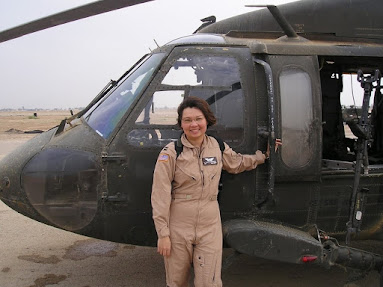
In the National Guard as an Army Reservist, Duckworth was able to follow her passion, pursue post-graduate studies, and work while serving her country. She says this about the sacrifices and service of Guardsmen and Reservists:

“There are several reasons people prefer the Reserve forces. Some don’t want to give up civilian jobs that pay better than military service. Some don’t want to commit to moving around every two or three years, which active duty servicemembers have to do. Some of them have already served on active duty and enter the Reserves after finishing their commitment.

One thing we all have in common, though, is our desire to serve. Being a member of the United States military is a privilege and an honor. When our country calls us to undertake a mission, we stop up, even if there’s a personal and professional cost to us. Citizen Soldiers do this over and over and over again –– and nonmilitary people don’t even know about it.”

Lt. Col. Duckworth joined the military before women were authorized to serve in combat, but she got as close as she could by becoming a helicopter pilot. She describes flying over the Egyptian desert and passing the Great Pyramid of Giza in Operation Bright Star. She flew low over the Amazon rainforest in Guyana  in Operation New Horizon. And she piloted missions in Iceland to clear glaciers of rusting equipment from World War II in Operation Northern Viking.


But the most harrowing experience, of course, was what happened on Nov. 12, 2004, when Duckworth’s Black Hawk was shot down in the Iraqi desert.


Both of her legs gone. Her arm badly mangled. Shrapnel in her face and body. Her fellow soldiers thought she was dead, but they refused to leave her body behind.


U.S. Army Warrior Ethos comes alive in the aftermath of the shootdown as Duckworth’s teammates extract her nearly lifeless torso and arrange for a medieval to Baghdad, where troops lined up to give blood. She needed 40 units of blood, plasma, and platelets.


Duckworth’s recovery at Walter Reed Army Medical Center is told in painful detail –– how she bore a “wall of pain,” learned to walk with two prosthetic legs, and came to terms with her new circumstances after the tragedy in Iraq, where she says, “There’s a piece of me there, both literally and figuratively.”

At Walter Reed she had to have parts of her body surgically removed and used to repair her mangled arm. She showed unimaginable grit and toughness, mixed with typical wounded warrior morbid humor and resolve.


Duckworth’s story is one of superior resilience. “I had no choice but to power through,” she writes. “It made no sense to lie around and feel sorry for myself. I had to accept my situation, then start working to change it.”


Found Haiku in “Every Day Is a Gift”:


When the obstacle

is effort, then there is no

obstacle (at all)


Something bad happens

you can either let it own

you, or you own it


(And) no matter how

grievous the wound, healing is

always possible


I found this book at Barnes & Noble bookstore on Memorial Day. It is a perfect companion book to one recently featured in Navy Reads: James Patterson’s “Walk in my Combat Boots.”


In fact, Duckworth’s missing combat boot is symbolically returned to her by fellow soldiers in a pivotal part of her story.

During her recovery and after meeting Illinois Senators Dick Durbin and Barack Obama, Duckworth resolved to enter politics. 

She was influenced personally by wounded warrior public servants Senators Bob Dole and Max Cleland, who helped her confront post-traumatic stress disorder.

“Senator Max Cleland, who lost his legs and an arm in Vietnam, sought treatment for PTSD three decades after his injury, when he lost an election in 2002. I met Max while at Walter Reed, and talking to him helped me to truly understand that the best we can do is take life one day at a time.

In the summer of 2005, when I realized I would never fly for the Army again, that advice from Max helped save me. I was no longer sure what my purpose in life would be, but I had to just take it one day at a time, and be open to whatever came my way.”

Obama, Akaka, and Duckworth
She fought for reforms at Walter Reed and the Veterans Administration, first in Illinois and then in President Barack Obama’s administration. She fought to make a national difference, first as a representative in the U.S. Congress and then as a senator. And she fought to become a parent.

Lt. Col. Duckworth’s struggle to become a mother and her realization that there is no such thing as “work-life balance” can be an inspiration to women and a revelation to men.


In Congress Duckworth was helped by Senators Kristen Gillibrand and Amy Klobuchar, among others. The late Senator Daniel K. Akaka honored her by bestowing Hawaiian names for her two daughters.


Her choice to enter politics so she could help people is not surprising.


Early in her life she saw first-hand the need for a social safety net and equal opportunity for people of color. Fifty-four years ago, in June 1967, the Supreme Court ruled in Loving v. Virginia that interracial couples, like Duckworth’s parents, could marry.


Her father’s hero was President Ronald Reagan. In the aftermath of the Vietnam War, Reagan signed the AmerAsian Immigration Act that allowed many Southeast Asian “half-children” into the United States. Of course, they were not “halfs.”

In “Every Day Is a Gift” Senator Tammy Duckworth, who lost nearly half her body in combat, shows that every person can be part of a greater whole. She lives the teamwork ethos –– no one left behind.


This is a marvelous and powerful book filled with tears, smiles, revelations, and inspiration. Like “Walk in My Combat Boots,” this book comes with an endorsement from Adm. William H. McRaven (U.S. Navy, Ret.)


“Raw, unfiltered, powerful –– a compelling story of courage and determination against overwhelming odds. Tammy Duckworth is a true warrior who overcame a difficult upbringing, a glass ceiling, and a horrific helicopter shootdown to become one of the most respected senators on Capitol Hill. Nothing can stop her.”

Friday, November 6, 2020

Waking up to ‘The Fate of the Earth’

Review by Bill Doughty––

“The Fate of the Earth” by Jonathan Schell (Alfred A. Knopf, 1982) is landmark book calling for nuclear weapons control. It was written 38 years ago –– and nearly 38 years after nuclear bombs were dropped on Hiroshima and Nagasaki (pictured above) in order to end the war with Japan in WWII.

Schell asks Americans to open their eyes to a continuing danger of Mutually Assured Destruction that would be brought about by nuclear war, even if the war is started by accident.


“A society that systemically shuts its eyes to an urgent peril to its physical survival and fails to take any steps to save itself cannot be called psychologically well,” Schell asserts. Looking at the problem of mass extinction by nuclear weapons makes us sick, he says, but the true sickness is in not confronting what is real.


Schell contends there’s a new reality: nuclear weapons have made war obsolete. “By effectively removing the limits on human access to the forces of nature, the invention of nuclear weapons ruined war, which depended for its results, and therefore for its usefulness, on the exhaustion of the forces of one of the adversaries.”


Rickover
An icon of the nuclear Navy saw the new reality even during the Cold War.

“On the occasion of his retirement, Admiral Hyman Rickover, who devoted a good part of his life to overseeing the development and construction of nuclear-powered, nuclear-missile-bearing submarines for the United States Navy, told a congressional committee that in his belief mankind was going to destroy itself with nuclear arms. He also said of his part in the nuclear buildup that he was ‘not proud’ of it, and added that he would like to ‘sink’ the ships that he had poured so much of his life into. And, indeed, what everyone is now called on to do is to sink all the ships, and also ground all the planes, and fill in all the missile silos, and dismantle all warheads.”

This book is rich with history, context, and philosophy and includes numerous references to early thinkers (Socrates, Lucretius, Plutarch, and Pericles); historians and philosophers (Arendt, Burke, Camus, de Tocqueville, Bertrand Russell, Einstein, and Clausewitz); and the Bible (Genesis, Ten Commandments, Armageddon, and Jesus Christ –– “prince of peace” and “a servant to all”).

An early image of Jesus Christ: "not to judge the world but to save it."

In a presentation reminiscent of John Hersey’s spellbinding “Hiroshima,” Schell makes a disturbing analysis of the various ways humans would die during and especially after an all-out nuclear conflagration: radiation, fires, starvation, exposure, long-term illnesses, and short-term diseases –– all leading to possible extinction of our species.


“The weight of extinction, like the weight of mortality, bears down on life through the mind and spirit but otherwise, until the event occurs, leaves us physically undisturbed,” Schell writes.

“At present, most of us do nothing. We look away. We remain calm. We are silent. We take refuge in the hope that the holocaust won’t happen, and turn back to our individual concerns. We deny the truth that is all around us. Indifferent to the future of our kind we grow indifferent to one another. We drift apart. We grow cold. We browse our way toward the end of the world. But if once we shook off our lethargy and fatigue and began to act, the climate would change. Just as inertia produces despair –– a despair often so deep that it does not even know itself as despair –– arousal and action would give us access to hope, and life would start to mend: not just life in its entirety but daily life, every individual life. At that point, we would begin to withdraw from our role as both the victims and the perpetrators of mass murder. We would no longer be the destroyers of mankind but, rather, the gateway through which the future generations would enter the world. Then the passion and will that we need to save ourselves would flood into our lives. Then the walls of indifference, inertia, and coldness that now isolate each of us from others, and all of us from the past and future generations, would melt, like snow in the spring. E.M. Forster told us, ‘Only connect!’ Let us connect. Auden told us, ‘We must love one another or die.’ Let us love one another –– in the present and across the divides of death and birth. Christ say, ‘I come not to judge the world but to save the world.’ Let us, also, not judge the world but save the world. By restoring our severed links with life, we will restore our own lives.”

Schell presents a stark choice.

“Two paths lie before us. One leads to death, the other to life. If we choose the first path –– if we numbly refuse to acknowledge the nearness of extinction, all the while increasing our preparations to bring it about –– then we in effect become the allies of death, and in everything we do our attachment to life will weaken: our vision, blinded to the abyss that has opened at our fee, will dim and grow confused; our will, discouraged by the thought of trying to build on such a precarious foundation anything that is meant to last, will slacken; and we will sink into stupefaction, as though we were gradually weaning ourselves from life in preparation for the end. On the other hand, if we reject our doom, and bend our efforts toward survival –– if we arouse ourselves to the peril an act to forestall it, making ourselves the allies of life –– then the anesthetic fog will life; our vision, no longer straining not to see the obvious, will sharpen; our will, finding secure ground to build on, will be restored; and we will take full and clear possession of life again.”

He imagines mechanisms that would prevent the threat of nuclear war: destruction of weapons, destruction of the factories that manufacture them, and clear-eyed verification as part of international cooperation as we realize our ignorance in order to achieve greater reverence for the “swollen power” to destroy ourselves as a species. 


At first, Schell's thesis may come off as overly hopeful or even naive, but he realizes the importance of first strengthening international cooperation in order to achieve mutually assured survival. "The present-day United Nations," he says, "is the empty husk of those irresolute good intentions." 


As usual, education and critical thinking are key to understanding and wisdom.

“We are in deep ignorance. Our ignorance should dispose us to wonder, our wonder should make us humble, our humility should inspire us to reverence and caution, and our reverence and caution should lead us to act without delay to withdraw the threat we now pose to the earth and to ourselves.”

In his more recent “The Seventh Decade: The New Shape of Nuclear Danger” (Metropolitan Books, Henry Holt and Company; 2007), Schell ties the nuclear threat to another existential danger: climate change.

“The two perils have a great deal in common. Both are the fruit of swollen human power –– in the one case, the destructive power of war; in the other, the productive power of fossil-fuel energy. Both put stakes on the table of a magnitude never present before in human decision making. Both threaten life on a planetary scale. Both require a fully global response. Anyone concerned by the one should be concerned with the other. It would be a shame to save the earth from slowly warming only to burn it up in an instant in a nuclear war.”

Will 2020 be a turning point for world cooperation in starting to deal with global climate change, a worldwide pandemic, and eventual elimination of nuclear weapons?


Schell’s “Fate of the World” was written on the eve of President Reagan’s historic meeting with leader of the Soviet Union Mikhail Gorbachev, so in “The Seventh Decade” he focuses on the potential as well as the missed opportunities during and after the Cold War.


Reagan and Gorbachev
Reagan and Gorbachev tried to have nuclear weapons “dispatched to history’s graveyard. Superior power was no longer the route to dominance. Certainly, global empire was out of the question,” just as all-out war itself had been made obsolete.

The Republican Party of 2020 has no platform, stating, “Resolved, That the 2020 Republican National Convention will adjourn without adopting a new platform until the 2024 Republican National Convention,” and “the Republican Party has and will continue to enthusiastically support the President’s America-first agenda.” Despite no mention in a formal platform, President Trump has boasted about upgrading and building more nuclear weapons.


On the other hand, the Democratic Party’s extensive platform says, in part, “Democrats believe the United States has a moral responsibility and national security imperative to prevent the spread of nuclear, chemical, and biological weapons, and eventually secure their elimination.”


President-elect Biden's platform also resolves:

“Democrats believe that the sole purpose of our nuclear arsenal should be to deter—and, if necessary, retaliate against—a nuclear attack, and we will work to put that belief into practice, in consultation with our allies and military. We will work to maintain a strong, credible deterrent while reducing our overreliance and excessive expenditure on nuclear weapons. The Trump Administration’s proposal to build new nuclear weapons is unnecessary, wasteful, and indefensible.”

Notably, the platform echoes President Reagan’s commitment to reducing nuclear dangers by returning to talks and treaties. 

“Democrats commit to strengthening the Treaty on the Non-Proliferation of Nuclear Weapons, maintaining the moratorium on explosive nuclear weapons testing, pushing for the ratification of the UN Arms Trade Treaty and Comprehensive Test Ban Treaty, and extending New START. Just as was the case during the height of the Cold War, it’s in our interest to work with Russia to verifiably limit and reduce our nuclear stockpiles. We will build on this foundation to negotiate arms control agreements that reflect the emergence of new players like China, capture new technologies, and move the world back from the nuclear precipice.”


The position to eventually eliminate nuclear, chemical, and biological weapons comes in a section of the platform called “Renewing American Leadership,” which says, "We can only be strong in the world when we are strong and united at home. We believe that a healthy democracy, just society, and inclusive economy are essential prerequisites for effective American leadership abroad. And we believe that the ultimate measure —and purpose—of our foreign policy is whether it protects and advances America’s security, prosperity and values—and delivers results for all Americans.”

Schell demands an eyes-wide-open examination of the global threats we face. He challenges us to think differently about the future in order to preserve the future –– and our species.


Then-Vice President Joe Biden meets a Sailor aboard Nimitz-Class aircraft carrier USS Ronald Reagan (CVN 76). Biden and Dr. Jill Biden visited San Diego in 2009.

Sunday, October 25, 2020

‘Strike from the Sea’

The first REGULUS II is launched from US Navy submarine USS GRAYBACK (SSG 574) in the Pacific, 17 September 1958.

Review by Bill Doughty––

U.S. Naval Institute Press has another winner in “Strike from the Sea: The Development and Deployment of Strategic Cruise Missiles Since 1934” by Norman Polmar and John O’Connell (2020). This carefully researched and documented book –– filled with photos, diagrams, statistics, and appendices –– presents a history of some of the world’s most dangerous tools of war.

Told from an American and largely U.S. Navy perspective, "Strike from the Sea" shows the development of Regulus and Regulus II, Rigel, Triton, Polaris, Vertical Launch Tubes, Tomahawk, and the Virginia Payload Module, among others. (Below, painting of an undersea ballistic missile by Walter H. Bollendonk from 1961 “Polaris Underwater Firing,” USNI.)


We see the evolution of submarines and the roles of USS Barbero (SSA317) and USS Medregal (SS 480) USS Grayback (SSG 574) and USS Growler (SSG 577), USS Halibut (SSGN 587) and USS Permit (SSGN 594, and USS Providence (SSN 719) and USS Pittsburgh (SSN 730). The authors also discuss missile development on surface ships, especially cruisers and carriers, as well as related training, refinement and deployment.

Since submarines are center point, Adm. Rickover is mentioned of course. But once again, Chief of Naval Operations Adm. Elmo Zumwalt comes across as a true hero of forward-thinking leadership, including regarding the development of sea-based cruise missiles.

“In 1972, at Admiral Zumwalt’s direction, the Navy dropped [Rickover’s] concept but continued its separate strategic (Tomahawk) and tactical (Harpoon) cruise missile programs … Thanks to a strategic arms initiative of Dr. Henry Kissinger and the desire of Admiral Elmo Zumwalt to enhance the Navy’s war fighting effectiveness beyond the relatively few large-deck aircraft carriers, the U.S. Navy has generated a massive sea-based cruise missile strike capability.”


The authors show a strong influence of former Secretary of State Kissinger. They also touch on the comparative ambivalence or outright resistance of CNO Adm. James Holloway. “Admiral Holloway, a naval aviator and a former carrier commander, may have been reflecting that community’s disdain for land-attack cruise missiles that could threaten the carrier’s nuclear strike mission.”


Personalities of the people in power can affect policies and strategies. So it’s worthwhile that the authors include the influence of key players to explain how the hardware developed during the Cold War. Any hope of reducing the risk of nuclear weapons, for example, will require international collaboration.


“The Russian navy, despite severe financial, personnel, and other problems, continued a robust program of cruise missile development for surface ships, submarines, and coastal defense –– both anti-ship and land-attack weapons,” the authors note. The Russian initiatives, including development of other vehicles, “were articulated by President Vladimir Putin in March 2018.”


Collective leadership and cooperation have prevented a global nuclear confrontation despite several accidents, malfunctions, close-calls, and misunderstandings. The conclusion of “Strike from the Sea” is compelling and thought-provoking.


In a final section called “Dishonoring a Treaty,” Polmar and O’Connell write:

“The Reagan-Gorbachev Intermediate-range Nuclear Forces (INF) treaty of 1987 was the only agreement of the Cold War era that eliminated an entire class of nuclear weapons –– land-based ballistic and cruise missiles, with nuclear or conventional warheads, with ranges between 310 to 3,400 miles … In early 2008, the Russians began testing a nuclear-capable cruise missile, designated SSC-8 by Western intelligence (Russian designation 9M729). In 2014, after observing continued testing of the missile, the Obama Administration announced that Russia had violated the INF treaty. However, U.S. administration officials later said that although the missile had a range prohibited by the treaty, as of 2015 test flights apparently had not exceeded the 310-mile mark. Subsequently, Russia began a limited deployment of the missile, which has an estimated range of more than 3,400 miles, with various warhead options, some of which reduce its maximum range. In October 2018, President Donald Trump announced that the United States would withdraw from the landmark treaty because of the alleged Russian violations; the withdrawal became formal on 2 August 2019. The Secretary of Defense at the time, James Mattis, a retired Marine general, had consulted with officials from the 28 other members of NATO, seeing their ideas on how to react to the Russian violations of the INF treaty … The Russian government denied violating the INF treaty and said that U.S. withdrawal would be dangerous and could spark a new nuclear arms race.”

This insight into the Trump-Putin implosion of the bilateral INF treaty leaves a huge question: what comes next –– not only in the evolution of earth-threatening missiles, but also in the re-creation of a world without nuclear weapons?

That question led me to a remarkably interesting and well-written book by French author Guillaume Serina, translated by David A. Andelman: “An Impossible Dream: Reagan, Gorbachev, and a World Without the Bomb” (Pegasus, 2019).


Former Soviet Union leader Mikhail Gorbachev said, “We must demilitarize.” Reagan, with some advice from his Secretary of State George Shultz, told the world, “We proposed the most sweeping and generous arms control proposal in history. We offered the complete elimination of all ballistic missiles –– Soviet and American –– from the face of the Earth by 1996.”


Reagan quoted another great leader in his remarks: “Another president, Harry Truman, noted that our century has seen two of the most frightful wars in history and that ‘the supreme need of our time is for man to learn to live together in peace and harmony.’”

Serina’s book offers an introduction by Gorbachev, who says, “What we need today is precisely this: political will. We need another level of leadership, collective leadership, of course.”


Along with “Strike from the Sea’s” terrific history of cruise missile hardware development it is important to read more about the work of President Reagan, Gorbachev, and other leaders who confronted nuclear arms proliferation. What can be done to achieve nuclear disarmament and prevent global destruction?


PACIFIC OCEAN (Sept. 17, 2020) – Sailors inspect Harpoon anti-ship cruise missiles aboard the Los Angeles-class fast-attack submarine USS Chicago (SSN 721) in support of Valiant Shield 2020. Valiant Shield is a U.S. only, biennial field training exercise (FTX) with a focus on integration of joint training in a blue-water environment among U.S. forces. This training enables real-world proficiency in sustaining joint forces through detecting, locating, tracking, and engaging units at sea, in the air, on land, and in cyberspace in response to a range of mission areas. (U.S. Navy photo by Mass Communication Specialist 1st Class Derek Harkins/Released)


Saturday, October 10, 2020

‘Stand Back and Stand By’ for Autocracy

Review by Bill Doughty

Praising lawlessness of supporters, demonizing the media, lying to the public, threatening free elections, changing the meaning of words, and destroying institutions are clear signs of autocracy.


That’s according to two authors who discuss the threat to democracy in the fall of 2020: Masha Gessen in “Surviving Autocracy” (Riverhead Books, Penguin; 2020) and Anne Applebaum in “Twilight of Democracy: The Seductive Lure of Authoritarianism” (Doubleday; 2020). These books are literary grandchildren of Hannah Arendt’s “The Origin of Totalitarianism” and close cousins of Timothy D. Snyder’s “On Tyranny. Snyder, in fact, endorsed the books and authors as “extraordinary,” “penetrating, and “indispensable.”


Gessen takes a scholarly approach in laying out the case for an imminent threat to American democracy. He quotes from the works and words of Arendt, George Orwell, Michiko Kakutani, Ronald Reagan, and Confucius.

He pinpoints President Trump’s “contempt for excellence” and corruption. “Trump’s incompetence is militant. It is not a factor that might mitigate the threat he poses: it is the threat itself.” He adds, “Trump not only doesn’t know what he’s doing –– he did not even know what he was not doing.”


If impeachment had succeeded in removing Trump from office, Gessen writes, “it would have constituted a triumph of institutions over the autocratic attempt. It did not.”


Trump’s embrace of white nationalism and his failure to acknowledge the threat of white power terrorists –– including his call to arms to “stand by,” to “LIBERATE MICHIGAN,” and to come to polling places on election day –– are all part of a pattern.


Trump’s contemptuous disregard for military justice is also part of the picture. Gessen writes:

“The hero Trump chose during the fall of his impeachment was Navy SEAL Chief Petty Officer Edward Gallagher. In the summer of 2019, Gallagher faced trial for allegedly killing an unconscious, unarmed captive in Iraq. The Navy fumbled the investigation, and in the last minute a witness who had been granted immunity testified that he, not Gallagher, had killed the young man; Gallagher was acquitted on most charges … After Gallagher was acquitted, Trump congratulated him by tweet. He then intervened to reverse the Navy’s decision to discharge Gallagher without honors –– once again demonstrating that the commander in chief can issue orders by tweet. Trump reinstated Gallagher’s rank and pay, and stripped the prosecutors in the case of their Navy medals. Ultimately, the struggle over Gallagher’s fate cost the secretary of the Navy, Richard Spencer, his job.”

Gallagher and Trump; SECNAV Spencer boxed in.
Gessen notes that Gallagher was turned in by members of his platoon, who were interviewed saying he was “freaking evil” and “perfectly okay with killing anybody that was moving,” intentionally targeting women and children, saying he “just wants to kill anybody he can.” Trump invited Gallagher to his residence at Mar-a-Lago and praised him as an American hero.


According to Gessen, Gallagher embodied the essence of the presidency: raw, unchecked power, contempt for rules, laws and norms, and an unbridled desire to act out of hatred.


Gessen writes, “Raw power can overtake moral authority, and perhaps today it is easier than ever before, but a determined effort to preserve ideals when they are under attack can serve as a bridge to the future.”


In “Twilight of Democracy,” Applebaum –– who describes herself as “educated conservative elite” –– takes a denser and more global view, building her own bridge from the past to the present and future to explain how autocracy continues to thrive.


She takes the reader on a tour of Poland, Hungary, England, EU, Spain, and France before landing in the United States. Like Gessen, she relies on Arendt and Orwell as bedrock literature, but she also cites Graham Greene’s “The Quiet American,” Marcel Proust’s “Remembrance of Things Past,” and Svetlana Boym’s “The Future of Nostalgia.”


Applebaum laments that the “party of Reagan became the party of Trump,” noting, “Reaganite optimism disappeared and slowly hardened into apocalyptic pessimism shared by so many others.” Echoing Gessen, Applebaum quotes Reagan’s UN ambassador, Jeanne Kirkpatrick, who said, “To destroy a society, it is first necessary to delegitimize its basic institutions.”


In a timely insight, Applebaum warns of the threat of autocracy and tyranny in the time of a pandemic. “Throughout history, pandemics have led to an expansion of the power of the state: at times when people fear death, they go along with measure that they believe, rightly or wrongly, will save them –– even if that means a loss of freedom,” she writes.


She explains, “People are often attracted to authoritarian ideas because they are bothered by complexity.” “Restorative nostalgics” see the world in black and white, without nuance; they want a return to what they perceive as a simpler past:

“Restorative nostalgics don’t just look at old photographs and piece together family stories. They are mythmakers and architects, builders of monuments and founders of nationalist political projects. They do not merely want to contemplate or learn from the past. They want, as Boym puts it, to ‘rebuild the lost home and pitch up the memory gaps.’ Many of them don’t recognize their own fictions about the past for what they are: ‘They believe their project is about truth.; They are not interested in a nuanced past, in a world in which great leaders were flawed men, in which famous military victories had lethal side effects. They don’t acknowledge that the past might have had its drawbacks. They want the cartoon version of history, and more importantly, they want to live in it, right now.”

Applebaum shows that tyranny can rise from the radical left as well as the radical right. But extreme right-wing domestic terrorism is the greatest threat in the United States now, according to the FBI. There is a connection between racism and defending the Confederacy, Confederate monuments, and gun-carrying vigilantes.


Later in her book she shows how that world view, exemplified in “America First,” is a siren call to white nationalism and radical right-wing terrorists. 

“Like those who live on the extreme edges of the American far left, some of those who live on the extreme edges of the far right have long been attracted to violence. There is no need to rehearse here the history of the Ku Klux Klan, to tell the stories of Oklahoma bomber Timothy McVeigh and Charleston shooter Dylan Roof, or to describe the myriad individuals and militia movements who have plotted mass murder, and continue to plot mass murder, in the name of rescuing a fallen nation. In 2017, an Illinois militia set off a bomb at a Minnesota mosque. In 2018, a man who believed Jews were plotting to destroy white America murdered eleven people at a Pittsburgh synagogue. In January 2019, a group of men calling themselves ‘the Crusaders’ plotted to put a bomb in an apartment complex in Garden City, Kansas, because they hoped to murder a large number of Somali refugees. These groups and movements were also inspired by a confection that democracy is worthless, that elections cannot bring real change, and that only the most extreme and desperate actions can stop the decline of a certain vision of America.”

Governor Whitmer at her Oct. 8 press conference.
Just this past week, the FBI and Michigan State Police busted a plot by right-wing terrorists to kidnap and possibly kill the governor of Michigan, Gretchen Whitmer. Whitmer thanked law enforcement and called out President Trump for his dog whistle calls to those among his supporters who are white nationalists.

In a press conference Oct. 8, Whitmer said, “Just last week, the president of the United States stood before the American people and refused to condemn white supremacists and hate groups like these two Michigan militia groups. ‘Stand back and stand by,’ he told them. ‘Stand back and stand by.’ Hate groups heard the president’s words, not as a rebuke, but as a rallying cry, as a call to action. When our leaders speak, their words matter. They carry weight. When our leaders meet with, encourage, or fraternize with domestic terrorists, they legitimize their actions and they are complicit. When they stoke and contribute to hate speech, they are complicit.”


Both Gessen and Applebaum cite Reagan’s openness to immigration and focus on optimism for the future.


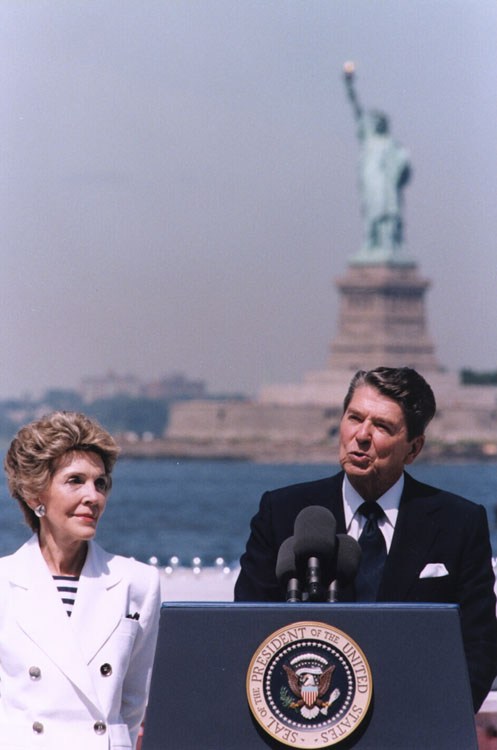
President Reagan and First Lady Nancy Reagan.

Whitmer herself brought up the 40th president of the United States: “In 1981, President Ronald Reagan spoke to the NAACP’s annual convention, and his comments stand in sharp contrast to what we have seen on the national and state level from his own beloved party in 2020. He said, ‘A few isolated groups in the backwater of American life still hold perverted notions of what America is all about.’ Recently, in some places in the nation, there’s been a disturbing recurrence of bigotry and violence.  Then Reagan sent a direct message to those who still adhere to senseless racism and religious prejudice: ‘You are the ones who are out of step with our society,' he said. 'You are the ones who willfully violate the meaning of the dream that is America. And this country, because of what it stands for, will not stand for your conduct.’”


Applebaum offers this chilling conclusion that provides the title for her book: “It is possible we are already living through the twilight of democracy; that our civilization may already be heading for anarchy or tyranny, as the ancient philosophers and America’s founders once feared…”


But, like Gessen, she offers explicit and implicit antidotes to a muddy downward slide toward autocracy. Explicitly: Build cooperation and coalitions; embrace allies; promote “rational thought, rule of law and integration;” and be “rooted to a place and yet open to the world.” Implicitly: become educated, practice critical thinking, and take the high road –– in the face of hate and anger, show love and kindness.