Showing posts with label USS Midway Museum. Show all posts

Sunday, September 11, 2022

September Remember: USS Midway in Japan

by Bill Doughty––

I was attending school in Tokyo and living in Yokosuka in 1973 when USS Midway (CV-41) arrived in Yokosuka –– the first U.S. aircraft carrier to be stationed in Japan as part of the Forward-Deployed Naval Forces. It was a big deal, less than thirty years after World War II, and just months after the U.S. military departed Vietnam.


Midway was commissioned 77 years ago, Sept. 10, 1945, just eight days after Imperial Japan surrendered. Stationing the ship in Japan was hugely symbolic; Midway is named for the historic and pivotal battle in 1943 that turned the tide in WWII.


USS Midway (CV-41) arrives in Yokosuka, Oct. 7, 1973. Photo from Midway cruise book. (Ryo Isobe, DVIDS)
But that’s only one reason the carrier’s arrival in Yokosuka was opposed by many Nihonjin, sometimes violently.

Hundreds of Japanese citizens, loudly opposed to America’s war in Vietnam, came to Yokosuka in 1973 to protest the arrival of Midway.

I remember scores of demonstrators in headbands and helmets, faces covered, white-knuckled fists gripping bamboo poles. The demonstrators assembled by the Yokosuka JNR station and marched to the closed gates of the base. Japanese police in riot gear formed a human shield. Marine guards stood ready behind them. Some radical demonstrators attacked the police and were repelled with fire hoses.


Midway had been a recent (and repeated) participant in what was then called the Vietnam Conflict, a war for which the ship received the Presidential Unit Citation from President Nixon in early 1973.


Two years later, Midway would join with other ships of the U.S. 7th Fleet in Operation Frequent Wind, the evacuation of Saigon.


Three years after Midway’s arrival in Yokosuka, the United States celebrated its bicentennial, 1776-1976. By then, I was just out of college and contributing stories to the Seahawk base newspaper on my way to becoming editor and eventually a public affairs officer.

Early in its career, Midway participated in historic operations in the Caribbean, near the Arctic, throughout the Mediterranean, and in both the Atlantic and Pacific, including near North Korea.

Midway would go on to participate in various peacekeeping operations, including Operation Desert Shield and Desert Storm, after Iraq failed to obey a United Nations ultimatum to withdraw from its invasion of Kuwait.


Just as it did in the evacuation of refugees after the fall of Saigon, Midway played a key role with other ships in rescuing evacuees from the Philippines in Operation Fiery Vigil after the eruption of Mt. Pinatubo. That was in June of 1991.


I was still living in Yokosuka and working for the Navy when USS Midway departed Yokosuka for the final time in August 1991. The workhorse aircraft carrier was headed to retirement 31 years ago this month –– via Pearl Harbor, Seattle, and Bremerton –– eventually to San Diego.


USS Midway arrives in Pearl Harbor, August 23, 1991.
By 1991, more Japanese people came to realize the value of having a strong U.S. Navy presence, working cooperatively with the Japan Maritime Self-Defense Force to maintain freedom of the seas. 

Just as the United States Constitution was a model for Japan’s form of government, the United States Navy served as a model for the JMSDF –– with direct help and guidance from Adm. Arleigh A. Burke.


Over many years, Yokosuka has held hugely popular base open-house events, inviting tens of thousands of Japanese citizens onto the base to participate in games, enjoy food booths, attend concerts, and go aboard U.S. Navy ships.


The most popular draw at base open-house events? Tours of an aircraft carrier.


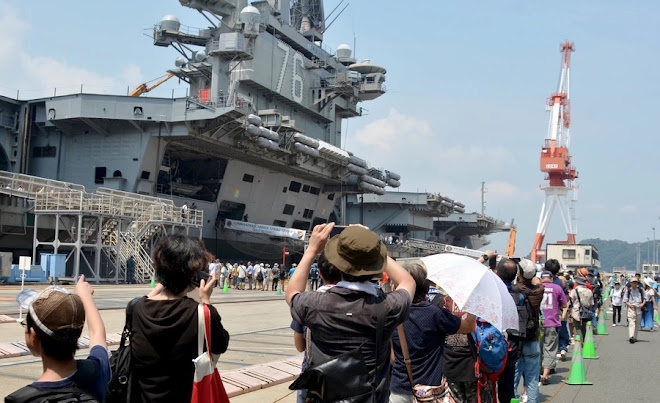
After Midway’s departure, other carriers followed its lead to become forward-deployed in Japan: USS Independence (CV-62), USS Kitty Hawk (CV-63), USS George Washington (CVN-73), and USS Ronald Reagan (CVN-76).


Japanese guests line up to board USS Ronald Reagan (CVN-76), October 10, 2015, during Yokosuka's Friendship Day open-base event. (MC1 Peter Burghart)

Open-base events were suspended for a time in the aftermath of attacks on the United States by religious zealots –– Islamist terrorists –– on September 11, 2001. (I remember the gates being locked down for weeks. Everyone who lived off base were required to park a few miles away and were offered rides to work or schools on base in carefully screened shuttle buses.)


In September 2003, USS Midway departed its temporary home of Bremerton, WA, to become a museum and memorial in San Diego. It welcomes an average of more than one million visitors per year. As with the USS Arizona Memorial in Pearl Harbor, many of the visitors to the USS Midway Museum include people from Japan who come to pay respect and learn about history.


Operation Sandy (Midway Museum Archives)
The museum offers a robust website highlighting the ship’s proud legacy, including operations in the Arctic, Taiwan Strait, and Vietnam, among others. I found some fascinating Midway photos available for download from Flikr, courtesy of the Museum. Some of the photos on the museum’s site include ringside views of Operation Sandy, the world’s first test-firing of a ballistic missile from a ship at sea.

There are numerous resources on the museum’s website, including videos and first-person accounts. This line stands out: “When history speaks, turn up the volume.”


In reading the history of the USS Midway, we can see the evolution of the modern Navy, from the immediate postwar, through the entire Cold War, and operations in Vietnam. But the ship is remembered most fondly, perhaps, for its role in helping people and promoting peaceful protection, especially for eighteen years in Yokosuka, Japan.


USS Midway’s strategic role in the Cold War, is a key part of James D. Hornfischer’s fascinating “Who Can Hold the Sea: The U.S. Navy in the Cold War, 1945-1960” (Bantam Books, 2022).


I have a two-part review of Hornfischer's final work posted in recent weeks. Hornfischer has been a favorite over the years. In May 2012, he offered a guest mini-review of five books he recommended to Navy Reads.


Tuesday, September 6, 2022

Part II: Hornfischer’s One Ocean…

Review by Bill Doughty––

James D. Hornfischer’s final book, “Who Can Hold the Sea,” opens with a poignant message from Jim’s widow, Sharon Hornfischer.


Sharon includes this advice:

“Jim believed, as I also do, that others of this generation and future generations will carry on telling the stories of our great nation’s history. Share your stories with your children and grandchildren, nieces and nephews, so that they are engaged in our nation’s history and our country’s continued fight for freedom and democracy. Encourage our next generation, take them to air shows, museums, and libraries; ignite the spark of curiosity in our future historians and writers so that they can continue to tell stories for us all to read.”

Hornfischer
It’s both sad and inspiring to read Jim Hornfischer’s final work. As both a gifted writer and historian, he created vivid true stories of Sailors and Marines and their leaders. This book’s preface, introduction, and acknowledgements bookend the story of the Cold War with tender personal messages.

Hornfischer’s “Who Can Hold the Sea” (Bantam Books, 2022) opens in the gray aftermath of World War II.


After confronting and defeating fascism, the United States and most of the Allies moved toward greater democracy, peacekeeping, rule of law, and liberty for all. The Soviet Union, on the other hand, held on to autocracy, aggression, violations of laws, and control of its citizens’ freedoms.


“For Truman,” Hornfischer observes, “the Soviet Union was a treacherous and malignant betrayer.”


Americans adjusted to postwar realities –– not only fear of spreading communism and Soviet expansion, but also budgetary turmoil that reached into the military. Some politicians proposed doing away with the Marine Corps and Navy and merging the service branches.


None other than Adm. William “Bull” Halsey spoke out against the merger in a speech thankfully excerpted by Hornfischer.


Halsey said, in part:

“Merger is not necessary. It is not desirable. It is plainly dangerous. It would destroy the initiative of individual services. It would hamstring their right to advance. It would deprive them of representation before Congress and the people. It would substitute military for civilian control. It might lead to military dictatorship.”

Admirals Chester Nimitz, Ernest J. King, Marc Mitscher, and Edward L. Cochrane –– along with Secretary of the Navy (and first Secretary of Defense) James V. Forrestal –– persuaded President Truman and others that the Navy had a strategic role in the Atomic Age; merger of the services, along with loss of the Marine Corps, would be a bad idea.


President Truman is welcomed aboard USS Franklin D. Roosevelt (CV-42) by SECNAV Forrestal and Adm. Nimitz. Adm. Leahy pictured in background. (NHHC)
Truman visited Norfolk, Virginia, in April 1946 at the invitation of Commander in Chief, U.S. Atlantic Fleet Adm. Mitscher. Truman witnessed the power of naval aviation and capabilities of aircraft carriers USS Franklin D. Roosevelt (CV-42) and the seemingly ubiquitous USS Midway (CV-41). Mitscher’s chief of staff was Capt. Arleigh Burke.

Then-SECNAV Forrestal was one of the principal architects of the post-war modern Navy. His global vision was based on peace through freedom and democracy, not communism or autocracy. Hornfischer writes, “If that world was to become a community, it would be possible, Forrestal thought, only with U.S. leadership, the victorious democracy investing its credibility and standing in the world to promote self-determination and freedom wherever it showed aspiration.” Hornfischer explores the role Forrestal played and delves into Forrestal’s controversial death at Bethesda Naval Hospital.


“Who Can Hold the Sea” vividly covers how Burke, Nimitz and Forrestal shaped the Navy during the Cold War. And strategic thinker and diplomat George Frost Kennan influenced the influencers, as Mahan had done for the first half of the century. Kennan recognized early the “perverse brutality and terror” of Joseph Stalin and Communism’s threat to Capitalism and democracy.


Watercolor of scorched USS Nevada (BB-36) as Nagato and Sakawa sink.. (Arthur Beaumont, 1946)
As a result of those fears, including the real fear that the Soviets were developing nuclear weapons, the United States rushed to conduct atomic bomb tests in the Pacific just a year after the war. In Operation Crossroads, the Navy positioned hundreds of pigs and goats, as well as 4,000 rats, aboard a target ship to test the results of radiation from a nuclear “cauliflower head.” The results were staggering and crippling.

The flagship of Adm. William H. “Spike” Blandy, who headed up Operation Crossroads, was contaminated with radiation, so “hot” it needed to “cool down” before it could be boarded.


After "Able" and "Baker," Blandy had to cancel a third "Charley" stage of the test, Hornfischer notes. “The radioactive mess had become impossible to manage.”


Later, he would celebrate the operation with a bizarre cake-cutting ceremony.


Vice Adm. Blandy and his wife cut into an Operation Crossroads cake shaped to look like a radioactive geyser, as Rear Adm. Frank J. Lowry looks on, Nov. 7, 1946.

The Navy forged forward in developing deployable nuclear weapons, supported by John L. Sullivan, Secretary of the Navy.

“The atomic bomb would shape the entire forty-four-year span of the Cold War. Made even smaller and more easily deployable, with larger and larger payloads, it would place every crook and crevice of the world under threat of ruin. War planners schemed to win atomic exchanges, even as they and every policy maker had no sense of consequences, and prudence demanded keeping the weapon in Pandora’s box. Humility, terror, curiosity, eager innovation, and abject paranoia would be the diverse by-products of the bomb.”

Louis A. Johnson
Sullivan would fight for the Navy but would resign in the face of cutbacks, cancellation of construction of the CVA-58 class aircraft carrier USS United States, and favoritism for the Air Force by SECDEF Louis A. Johnson. “The new defense secretary was an equal opportunity irritant, abrasive and arrogant and making no effort to filter it,” Hornfischer writes. “Johnson’s animus toward the Navy was an open secret.”

Despite obstacles, the Navy forged ahead in developing deployable nuclear weapons and nuclear-powered ships, including submarines. 


Hornfischer reveals how close the world came to nuclear war in the decade-and-a-half after bombs were dropped on Hiroshima and Nagasaki.


Leaders contemplated using nuclear weapons after Communist China threatened Formosa (Taiwan), after Communist North Korea invaded the South, and after Communists took power in French Indochina (Vietnam). Eisenhower was a voice of reason in nixing the idea of using the Bomb. Though not covered in this book, the Bay of Pigs incident comes to mind, when President John F. Kennedy, Navy veteran and WWII hero, proved to be the voice of reason in preventing nuclear war after the Soviet Union threatened to position nuclear weapons in Cuba.


Admittedly incomplete and somewhat unfinished, Hornfischer’s history of the Cold War is a compelling book thanks to the author’s distinctive style and grace. His writing shines in descriptions of not only events but also people, such as the great Arleigh Burke, “the son of a humble Colorado farmer,” a leader who embraced an ethos of good leadership.

“[Burke] had taken integrity, self-discipline, and strong principles from his father and mother, a teacher. In 1923, the year he graduated from the U.S. Naval Academy, the faculty had just compiled the first textbook on naval leadership. It listed the ‘essential qualities’ of a naval officer as personal dignity, honor, courage, truthfulness, faith, justice, earnestness, assiduity, judgment, perseverance, tact, self-control, simplicity, and loyalty –– to country and to service, to both one’s seniors and juniors. ‘Loyalty up and down was important because of the natural independence and self-reliance of the American sailor,’ and naval officers had to earn the respect of their men [and women] through their personal merit and example. Burke had been trained as a specialist in ordnance, earning a master’s degree in chemical engineering and becoming a design and production specialist in explosives. This background exposed Burke to the most advanced naval technologies of his time and would prepare him as CNO to promote the development of nuclear weapons, nuclear power, and guided and ballistic missiles.”

Burke helped guide the Navy through rough seas during the Cold War.


CNO Arleigh Burke on the bridge of USS Forrestal (CVA-59) March 12, 1956 as ship's CO Capt. Roy L. Johnson points out distant aircraft. (NHHC)

It’s bittersweet to read this excellent book about the Cold War knowing that Hornfischer is gone. He died last summer after a valiant fight with cancer. As mentioned, his wife Sharon offers a beautiful tribute to him and his legacy in the book’s preface.

Both Jim and Sharon offer acknowledgements at the end of this book. They thank retired Navy Admiral “Fox” Fallon, former commander of both U.S. Pacific Command and Fleet Forces Command and current board chairman of the Naval Historical Foundation. They also acknowledge and thank other graybeards, including retired Rear Admiral Samuel Cox, director of Naval History and Heritage Command and Curator of the Navy. The Hornfischers pay special tribute to the Nimitz Museum in Fredericksburg, Texas, hometown of the great admiral who led the winning strategy in the Pacific War.


This terrific book brought other books to mind that would make good companion reading: “Atlantic” and “Pacific” by Simon Winchester; "The Second Most Powerful Man in the World: The Life of Admiral William D. Leahy, Roosevelt's Chief of Staff" by Phillips Payson O'Brien; “Revolt of the Admirals: The Fight for Naval Aviation, 1945-1950” by Jeffrey G. Barlow; "The Silent War: The Cold War Battle Beneath the Sea” by John Piña Craven; “This Kind of War: The Classic Korean War History” by T. R. Fehrenbach; “Gangsters of Capitalism: Smedley Butler, the Marines, and the Making and Breaking of America’s Empire” by Jonathan M. Katz; “Opening the Great Depths: The Bathyscaph Trieste and Pioneers of Undersea Exploration” by Norman Polmar and Lee J. Mathers; and “The Blue Age: How the US Navy created Global Prosperity –– and Why We’re in Danger of Losing It” by Gregg Easterbrook. It goes without saying that every book by Hornfischer should be on the reading list for anyone interested in American maritime history.


The Hornfischers valued libraries, museums, research institutes, and, of course, books. As Jim writes, “Those interested in national and maritime affairs ought to be mindful of the major events of the past.”


Top Photo: Operation Crossroads "Baker Day" A-bomb underwater explosion, seen from shore of Bikini Atoll, 25 July 1946. NHHC


(In Part I of this review, we presented Hornfischer's view of "one global ocean." We also compared Gorbachev and Putin, discussed the rise of NATO, and presented some coincidental milestones that happened in August and September decades ago.)

Wednesday, July 3, 2019

McRaven on Navy, Character, War, Peace


Review by Bill Doughty

Admiral William H. McRaven showcases adventures as a Navy SEAL, discusses warrior ethos as a leader of warfighters, writes of "second chances," and even describes life as a military brat in France and Lackland Air Force Base in "Sea Stories: My Life in Special Operations" (Hachette Book Group, 2019).

In fact, his memories as a military dependent, listening to his dad's WWII buddies' aviator stories, become a springboard for his own storytelling in this inspirational and patriotic read for Independence Day.

Here's how McRaven describes the character of the Greatest Generation:
"Like all the men and women of their generation, they were children of World War I, lived through the Depression, and the men all fought in World War II and Korea. They were survivors. They didn't complain. They didn't blame others for their misfortune. They worked hard and expected the same for their children. They treasured their friendships. They fought for their marriages. They wore their patriotism on their sleeve, and while they weren't naive about America's faults, they knew that no other country in the world valued their service as much as the United States did. They flew their flags proudly and without apology."
McRaven moves quickly from stories of his adventurous youth to life as a young officer and Navy SEAL leader.

He recounts boarding one of Saddam Hussein's oil tankers in 1990 as part of a Marine Expeditionary Unit/Special Operations Capable, which along with USS Okinawa (LPH-3), USS Fort McHenry (LSD-43), USS Ogden (LPD-5), USS Cayuga (LST-1186) and USS Durham (LKA-114) made up the Amphibious Ready Group/MEU Team.

Here's his description of life aboard a Navy ship, in this case USS Okinawa:
"Life aboard a Navy ship hadn't changed much in fifty years. The technology has changed, but as with the ships of World War II, you still lived in very close quarters, ate together, worked together, and fought together. There were all the human dynamics of people crammed into a steel hull, but that's where Navy discipline and a minimalistic lifestyle were crucial to having a well-oiled crew. The sailors slept in racks stacked three or four high. The only space for personal items was underneath your mattress or in a small locker. The officers' 'staterooms' were generally four men to a room, and the more senior officers were two to a room. Racks were made every morning. The sinks were always wiped down after use. Showers were three minutes – no more. You showed up for watch fifteen minutes prior to turnover. If you showed up fourteen minutes prior, you were late. The brass throughout the ship was polished to prevent corrosion. The passageways were swabbed. Old paint was chipped away and new coats of paint applied every week. Nothing was left unattended. Everything about your day was planned down to the minute. Even your free time was on the calendar. The rigor was tiring at times, but also reassuring and predictable and, in a strange way, comforting."
As for the Amuriyah, which initially resisted being boarded by McRaven and his team, it was eventually sunk by an A-6 from the aircraft carrier USS Midway (CV-41).

We read about McRavens role in fighting pirates (including leading the SEALs who rescued Captain Phillips), capturing Saddam Hussein, and killing Osama bin Laden.

SEALs in training, May 29. 2019. (USN photo, MCCS Jayme Pastoric)
McRaven says this about his warrior ethos:
"As terrible as it sounds, every SEAL longs for a worthy fight, a battle of convictions, and an honorable war. War challenges you manhood. It reaffirms your courage. It sets you apart from the timid souls and the bench sitters. It builds unbreakable bonds among your fellow warriors. It gives your life meaning. Over time, I would get more than my fair share of war. Men would be lost. Innocents would be killed. Families would be forever changed. But somehow, inexplicably, war would never lose its allure. To the warrior, peace has no memories, no milestones, no adventures, no heroic deaths, no gut-wrenching sorrow, no jubilation, no remorse, no repentance, and no salvation. Peace was meant for some people, but probably not for me."
He sees the role of the warfighter as the deliverer of justice. And, despite what he says, McRaven was meant for peace. Read how he believes in the human spirit, that despite our faults, humans are "worthy of this world":
"For every reckless belligerent who seeks war, there are thoughtful wise men and women who strive for peace. For all the unbridled hatred that abounds, there is an even greater amount of unconditional love. For every Al Qaeda torture house in Iraq, every Taliban death squad in Afghanistan, every suicide bomber in Somalia, every righteous zealot who kills indiscriminately, there are countless mothers who care for their children and fathers who raise their young sons and daughters to be honest and hardworking. Man's compassion far exceeds his greed. His caring is greater than his brutality. His courage outshines his cowardice and his sense of hope always prevails."
Simply and powerfully told, this collection of true stories is a great read for July 4th and a fitting addition to McRaven's #1 New York Times bestseller, "Make Your Bed."

During a Profiles in Leadership seminar, Retired U.S. Navy Adm. William H. McRaven speaks to service members inside the Pfingston Reception Center at Joint Base San Antonio – Lackland, Texas, Jan. 10, 2018. McRaven focused on character and how it applies to leadership. McRaven is University of Texas System Chancellor. (U.S. Air Force photo by Tech. Sgt. Ave I. Young)

Sunday, April 8, 2018

Midway to Midway: Navy Saves Nature

By Bill Doughty

At the turn of the last century the U.S Navy responded to end cruel and greedy destruction at a remote island in the Northwestern Hawaiian Islands. 

Layson albatross eggs are harvested at Layson Island in early 1900s.
William T. Hornaday, an American zoologist, recounts the incident in his 1913 book "Our Vanishing Wild Life" about the devastation of hundreds of thousands of Laysan albatross birds.

An excerpt is published in "American Earth: Environmental Writing Since Thoreau" (Library of America, Penguin Putnam Inc., 2008), edited by Bill McKibben.

The incident at Laysan Island occurred just six years after President Theodore Roosevelt sent United States Marines to Midway Atoll to stop the slaughter of seabirds for their feathers and eggs.

Hornaday writes:
"Ever since 1891 the bird life on Laysan has been regarded as one of the wonders of the bird world. One of the photographs taken prior to 1909 shows a vast plain, apparently a square mile in area, covered and crowded with Laysan albatrosses. They stand there on the level sand, serene, bulky and immaculate. Thousands of birds appear in one view – a very remarkable sight."
Laysan Island was known to the whalers who hunted and butchered the huge mammals of the sea for their oil. In the spring of 1909 businessman Max Schlemmer of Honolulu targeted the island for its birds and their byproducts: guano for fertilizer, eggs for food, and the birds themselves for their feathers. He surreptitiously sailed there with 23 Japanese laborers to kill thousands of birds, according to Hornaday.


"For several months they slaughtered diligently and without mercy," Hornaday writes. They clubbed and cut the wings off the large birds, with an apparent goal to ship the wings to Japan and France where the feathers could be used in the fashion industry.

But a college professor of zoology in Honolulu heard about Schlemmer's venture and "promptly wired the United States Government."
"Without the loss of a moment the Secretary of the Navy despatched the revenue cutter Thetis to the shambles of Laysan. When Captain Jacobs arrived he found that in round numbers about three hundred thousand birds had been destroyed, and all that remained of them were several acres of bones and dead bodies, and about three (railroad) carloads of wings, feathers and skins. It was evident that Schlemmer's intention was to kill all the birds on the island, and only the timely arrival of the Thetis frustrated that bloody plan."
It wasn't the only time the Navy came to help the island, repairing the damage to nature caused by the greedy Schlemmer.

Schlemmer not only slaughtered birds, but also destroyed the ecology by purposely introduced rabbits and guinea-pigs as a way to start a meat canning business. But the rodents reproduced rapidly and consumed most of the plant life on the island, changing the habitat for generations. Aboard minesweeper USS Tanager (AM-5) the Navy made five surveys of Laysan Island in 1923 and 1924 with the Bureau of Biological Survey and the Bishop Museum in eradicating the rodents and studying plant and animal life. 

The scientists who were part of the Tanager Expedition documented the extinction of the Laysan honeycreeper and witnessed, firsthand, the devastation of the island by nature itself, in the form of severe tropical storms.

Laysan Island is about two thirds of the way up the archipelago from Kauai to Midway.

When I visited Midway Atoll in 2007 for the 65th anniversary of the Battle of Midway, Laysan albatrosses sat everywhere. At several points, while on a tour of the island by U.S. Fish and Wildlife Service rangers, we had to stop to gently move the huge birds out of the way of our electric carts. I had the great good luck of being allowed to carry one of the birds out of harm's way.

Laysan albatrosses are graceful flyers but clumsy landers. Their chicks are fuzzy and gray, while the adults are slick white and black with shades of gray and Amy Winehouse eyes.

In recent years the regal birds, some with a wingspan of six to seven feet, returned to the Pacific Missile Range Facility on Kauai, where they became a hazard to themselves and pilots at the Navy's sprawling testing and training range.

Working with the Pacific Rim Conservation group, the Navy translocated eggs to the James Campbell National Wildlife Refuge on Oahu, where chicks were hatched and raised. Laysan albatross adults are programmed by nature to return to their place of birth after spending the first few years of their adult life at sea. The return last month of the first PMRF-translocated bird, called V106, is a sign of success for the project.


Laysan albatross egg at Pacific Missile Range Facility, Kauai (Photo by MC2 Omar-Kareem Powell.
Last week the Chief of Naval Operations announced that PMRF is one of  the 2017 CNO Environmental Award winners for "Natural Resources Conservation, Small Installation."

A new children's book captures the beauty and majesty of the Albatross, "A Perfect Day for an Albatross" by Caren Lowebel-Fried (Cornell Lab Publishing Group, 2017).

Artist and author Lowebel-Fried illustrates her book with woodblock prints. She tells a story from the perspective of a bird born at Midway.

Her description of life at sea takes the young reader along for the flight:
"Not far from here, when I grew old enough to fly for the first time, I looked at the ocean and spread my wings. I ran and felt the wind beneath my wings lifting me up and up. Suddenly I was no longer over the land! The rolling, splashing wet sea was beneath me! I learned to land on the ocean, catch squid and find flying fish eggs to eat, then run across the surface of the sea and take to the sky again. I explored for years, traveling across the ocean, the smells and signals from the sea telling me where to find food."

Lowebel-Fried's albatross returns to Midway, finds a mate, and does the artful dancing, preening and beak sparring that is a joy to see. Cornell Lab offers a behind-the-scenes video of Lowebel-Fried's visit to Midway Atoll.

The book ends with a glossary, geography lesson and tips on where to see a Laysan albatross, such as at the Kilauea Point National Wildlife Refuge on Kauai and at the James Campbell National Wildlife Refuge on Oahu. Also included: tips on how to protect the birds, such as "Reuse or recycle plastics to keep them out of the ocean," something the Navy does at sea every day.

One of the artist's amazing woodblock prints not included in this book features a cool mix of natural and Navy images from Midway Atoll, along with a voyaging canoe.

In "Our Vanishing Wild Life," Hornaday notes, "In February, 1909, President (Theodore) Roosevelt issued an executive order creating the Hawaiian Islands Reservation for Birds."

Today, according to Papahanaumokuakea.gov, "Papahānaumokuākea Marine National Monument is the largest contiguous fully protected conservation area under the U.S. flag, and one of the largest marine conservation areas in the world. It encompasses 582,578 square miles of the Pacific Ocean (1,508,870 square kilometers) – an area larger than all the country's national parks combined."

The eclectic "American Earth" compilation includes works by Lewis Thomas, Alice Walker, E. O. Wilson, John Muir, Joni Mitchell, Rachel Carson, R. Crumb, Walt Whitman, Al Gore, Marvin Gaye, Philip K. Dick, E. B. White, and Henry David Thoreau.

Sunday, March 25, 2018

Enough Marches

Washington and Lafayette with the militia at Valley Forge. (Lib. of Congress)
Review by Bill Doughty

Fear of a standing army and navy prompted the Framers to draft the stilted wording and punctuation of the Second Amendment to the Constitution that called for citizens to arm themselves as part of civilian "well regulated militia." But after the Revolutionary War, when members of the militia were not compensated for their service, officers threatened to mutiny and march on Washington D.C. The mutiny was put down by George Washington himself. That was in March 1783 – 285 years ago this month.

Michael Waldman recounts the story in "The Second Amendment: A Biography" (Simon & Schuster, 2014), a good primer for anyone interested in how fear and paranoia of tyranny brought on a passion for firearms in the United States.

Waldman explores the meanings of "the right of the people," "the security of a free state," and "militia" in what it means to keep and bear arms and not infringing on that right.

Fear and paranoia have been potent weapons for decades in preventing legislation for sensible gun laws, according to Gabrielle Giffords and Mark Kelly, authors of "Enough: Our Fight to Keep America Safe from Gun Violence" (Scribner, 2014), a personal but clear-eyed look at the issue.

Senator John McCain and General Stanley McChrystal both endorsed their book, with McChrystal calling the authors, "inspiring voices for responsibility. We need to listen."

Giffords and Kelly show how  "wannabe military" militia  try to look the part, speak in acronyms to sound cool, and align themselves with fundamentalist, white supremacist survivalists who, like the National Rifle Association, pose a real threat to society. The NRA is dangerous to citizens when they attack background checks, prohibit research into gun violence, and prevent voting on restrictions on armor-piercing bullets, ultra-capacity magazines, and assault-style military grade weapons, according to the authors.

Astronaut Capt. Kelly recounts his time in the Navy and having to lock his handgun in the Yokosuka base armory while he was stationed aboard USS Midway in 1990. "We tried to handle the deadly weapons of war with the utmost respect," he writes. Kelly lived off base, where firearms (and gun incidents) are unheard of. He fought – and dodged incoming fire as an F-14 fighter pilot in the Gulf War, Operation Desert Storm.

Both authors are gun owners who, even after Giffords was nearly assassinated by a gunman in 2011, shoot at ranges. Kelly is an avid hunter. Neither wants to do away with the Second Amendment. But they don't understand why the United States, which has only around one percent of the world's population of children, has 85 percent of the world's children deaths by guns.

"Enough" was one of the first words Giffords said after the senseless massacre of twenty young children and six adults at Sandy Hook Elementary School in Newtown, Connecticut just before Christmas, 2012. This powerful book walks us through the preventable tragedies of Tucson, Virginia Tech, Columbine, Aurora and Newtown. The book was written before mass shootings and killings in Orlando, Las Vegas and, of course, at Marjory Stoneman Douglas High School in Lakeland, Florida last month.

Gun control was part of society in the 1800s, including in Tombstone and Dodge City. Laws have come and gone, depending on the fear-inducing power and intimidation of the NRA: The National Fire Arms Act of 1934 after an assassination attempt on FDR; The Gun Control Act of 1968 in the wake of assassinations of JFK, RFK and MLK; the Brady Bill of 1993 after an attempted assassination of President Reagan; and the Assault Weapons Ban of 1994 after a spike of violence.

In the mid-90s white identity fundamentalists at Waco, Ruby Ridge and Oklahoma City (Timothy McVeigh) fomented hate, fear and violence. McVeigh had been a member of the NRA and shared NRA leader Wayne LaPierre's "demonization of the ATF" (Bureau of Alcohol, Tobacco, Firearms and Explosives). In the wake of McVeigh's bombing of the Murrah federal building that killed 168 people, including children in the day-care center, and wounded more than 680 others, George H. W. Bush resigned his life membership in the NRA.

Domestic terrorism can still explode in our society. Witness the bombings this month in Austin, Texas. But the number of bombing incidents pales in comparison to mass shootings. Those who fear tyranny are causing a tyranny of violence. Navy Veteran Kelly rejects their paranoia, promoted by the NRA:
"The NRA has, in essence, turned the tables on the Declaration of Independence. Forget about a government designed to protect 'life, liberty and the pursuit of happiness.' Most of us trust our government: even if, sure, the average ninth grader can build a better website, we believe the men and women we elect to represent us have our best interest at heart. But to hear the NRA tell it, once federal or state governments start to pass laws to reduce gun violence in any way, shape, or form, it's a 'slippery slope' or 'jackbooted' federal agents banging on a gun owner's door to demand he turn over his firearm. As a Navy pilot who risked his life during bombing missions over Iraq and Kuwait, I find that preposterous and offensive. I was fighting to protect the ideals of a country and a government that I believed in. I blasted into space for my country, in a government-financed spaceship. The NRA'S slippery slope is a fantasy, and a dangerous one. If the NRA gets its way, we'll be left with a country where everyone is armed but no one is safe."
When Gabby Giffords was shot, the shooter was tackled while trying to reload. When a bystander grabbed the shooter's gun, the bystander was nearly shot by someone responding with a concealed weapon. In the chaos of a shooting, more guns may not be the answer. And in a peaceful society, more guns indiscriminately in hands of more people is not the answer, according to the authors.

As long as there are lax laws for background checks, mentally ill people, including paranoid conspiracy theorists, Islamist terrorists and other end-times believers, have relatively easy access to firearms in the United States.

The irony is that crazed assassins who want to become famous for killing a public figure can instead become famous for spurring responsible gun control regulations and legislation.


"March for Our Lives": Yesterday, an estimated 800,000 students, survivors and supporters marched in Washington D.C. and thousands more marched in more hundreds of cities across the United States in a call for positive change for safer schools and streets and sensible gun laws, including restrictions on offensive military style weapons designed to kill people rather than for hunting or defense.

Yolanda Renee King stands with Jackie Corin.
Marjory Stoneman Douglas student Jackie Corin said last week, "The people of America care," adding, "The love outweighs the hate, no matter what." Corin said she and other students are following the inspiration of "students during the Vietnam War era" as well as the nonviolent philosophy of Dr. Martin Luther King, Jr.

Corin stood with MLK's nine-year-old granddaughter Yolanda Renee King yesterday. King said, "My grandfather had a dream that his four little children will not be judged by the color of their skin, but by the content of their character," adding, "I have a dream that enough is enough."

David Hogg at March for Our Lives March 24, 2018.
Fellow student David Hogg, hoping for common ground in the debate, said, "People get afraid and then misunderstand people. We're not trying to take your guns; we're trying to save the future of America."

In Michael Waldman's Second Amendment "biography," which calls for focusing on the phrase "the right of the people," the author concludes this about gun violence:
"This is a remarkably dense and thorny issue. The controversy is thick with symbolic politics. It pits rural culture against urban norms. It asks us to avoid emotionalism, to rely more on research, to find policies that actually work. Efforts to enact sensible regulations of guns face many obstacles: powerful organizations, inflamed opponents, cowardly politicians, a media culture that (when not suffused with violence itself) quickly loses interest. To surmount these will require grit and wisdom. It should not have to require overcoming a hostile judiciary, misreading history, over-interpreting text, and imposing political views in the guise of judicial philosophy."
The burning of Washington D.C. in 1814 proved the weakness of relying on the states' militia.
After Waldman recounts venerated George Washington's role in preventing a march by a mutinous militia on Philadelphia, the nation's capital at the time, he tells how the militia service itself "withered."

In the War of 1812, the British overran state militias and they marched on Philadelphia, burning the White House. It was clear that a well-regulated and equipped military was needed more than a "well-regulated militia." Fear of a standing army and navy gradually gave way to a sense of confidence in the strength of a free democracy, relying on the people and their right to vote, being able to withstand a rise of tyranny, even from within.

Waldman reminds us of this quote from Abraham Lincoln while debating slavery and an earlier Supreme Court decision: "Public sentiment is everything. With public sentiment, nothing can fail; without it, nothing can succeed. Consequently he who molds public sentiment goes deeper than he who enacts statutes or pronounces decisions."