Showing posts with label globalization. Show all posts

Saturday, June 17, 2023

Navy Good, Future Unraveling

Review by Bill Doughty––

Geopolitical strategist Peter Zeihan expresses high regard for the United States Navy as a global force for good. He says the U.S. is “primarily a naval power,” and it is America’s Navy that has protected sea lanes and global commons, allowing what could be the greatest period of peace and prosperity in the history of the world.


That peace was guaranteed after the Second World War and the defeat of Japanese and German imperialism and fascism, when the Americans “offered their wartime allies a deal.”

“The Americans would use their navy –– the only navy of size to survive the war –– to patrol the global ocean and protect the commerce of all. The Americans would open their market –– the only market of size to survive the war –– to allied experts so that all could export their way back to wealth. The Americans would extend a strategic blanket over all, so that no friend of America need ever fear invasion again.”

But in Zeihan’s now-dystopian view of the future, that era of peace and prosperity is over.

In “The End of the World Is Just the Beginning: Mapping the Collapse of Globalization” (HarperCollins, 2022) Zeihan presents extensive data, charts, and demographic analysis showing evidence of de-globalization, less world trade, and aging populations in many countries:

  • This is the “best it will ever be in our lifetime.”
  • “The world –– our world –– is breaking apart.”
  • China is aging “into demographic obsolescence.”
  • “We are entering a period of extreme transformation, with our strategic, political, economic, technological, demographic, and critical norms all in flux at the same time.”
  • “Everything is going to change” and “the process will be the definition of traumatic.”
  • “Living through history is messy.”

“De-globalization,” Zeihan writes, “doesn’t simply mean a darker, poorer world; it means something far worse. An unraveling.”


If he’s right, the United States will be able to weather the storm that will overcome other nations and territories, especially in Asia and Europe. Unlike those countries, America has the resources, relatively younger population, protective geography (including rivers and protected deep-water ports), and friendly next-door neighbors.


Justin Taschek, the Senior Maritime Projects Administrator for the Port of Oakland, California, gives a tour of the port to Chief of Navy Air Training Rear Adm. Daniel Dwyer, Feb. 12, 2020. Dwyer visited Oakland as part of a Navy Executive Engagement Visit designed to help educate the American public about the capability, importance and value of today's Navy to national security, global communication and trade. Oakland is a deep-water port. (MC1 Aaron Chase)

In “The End of the World…” Zeihan predicts countries are “likely to brawl over the shattered remnants of a collapsed economic system.” Just months after he wrote those lines and after the final manuscript of his book went to the publisher, Putin’s Russia launched a full invasion of  Ukraine. Zeihan and HarperCollins added a one-page note at the end of a chapter about the invasion. Perhaps his predictions –– although imperfect –– are already coming true.


He examines transportation, finance and currencies, energy, industrial materials, manufacturing, and agriculture, showing how each pillar of civilization has evolved over time and predicting the future based on current trends.


For example, he shows how Admiral (Commodore) Matthew C. Perry ignited the start of a global capital financial system when he opened Japan to trade, redefining the role of debt and unleashing “the Asian Financial Model.” In a section called “A Credit Compendium,” Zeihan gives diverse examples of “extravagances and exaggerations” and “excesses and eruptions” comparing Greece, Germany, UK, Hungary, Australia, Colombia, Indonesia, Brazil, Saudi Arabia, India, Turkey, Russia, and China.


In the final, and one of the longest sections in the book, he examines agriculture and “the geopolitics of vulnerability,” including the challenges of feeding the world amid climate change, water shortages, and his prediction of reduced global trade. The thing that keeps him up at night the most, he says, is the threat of coming famine in the world.


Service members hold the national flags of participating nations during the opening ceremony for Exercise Saber Strike at the Pabrade Training Area, Lithuania, June 8, 2015. The exercise provides an opportunity for a multilateral force to conduct operations side by side. (USMC Sgt. Paul Peterson)

As the world changes and globalization ends, what is the role of the military, especially the Navy, with its power projection capabilities?

“Expect the Navy and Marines both to be assigned a set of secondary tasks that include aggressive sanctions enforcement. Perhaps the most jarring issue all countries and companies must adapt to is the Americans not simply giving up their role as the global guarantor of order, but transforming into active agents of disorder.”

Zeihen predicts more future disorder on the seas, including the return of piracy and militarized merchant marines.


Will the nations of the world be forced to become inward looking turtles? Head-in-the-sand ostriches? Will self-interest, self-aggrandizement, greed and authoritarianism win the day? Whether he is completely correct or not, Zeihan deserves to be read and heard in what could be an unraveling world. Perhaps the U.S. Navy, “forged by the sea,” will be even more relevant and necessary as a global force for good.
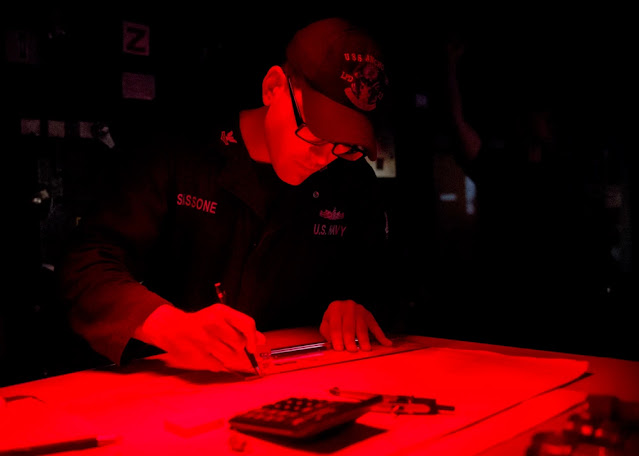


Above: Quartermaster 2nd Class Brandon Sassone, from Plainview, N.Y., plots ship position in the pilot house aboard the San Antonio-class amphibious transport dock ship USS Anchorage (LPD 23) during a scheduled deployment of the Essex Amphibious Ready Group (ARG) and the 13th Marine Expeditionary Unit (MEU), Sept. 2, 2018. They were deployed to the 5th Fleet area of operations in support of naval operations to ensure maritime stability and security in the Central Region, connecting the Mediterranean and the Pacific through the western Indian Ocean and three strategic choke points. (MC3 Ryan M. Breeden)


Top photo: The Arleigh-Burke class guided-missile destroyer USS Michael Murphy (DDG 112) participated in Australia’s Kakadu exercise in August 2018 in Darwin to enhance maritime security skills with participating nations, which highlighted information sharing and multilateral coordination. (MC3 Morgan K. Nall)

Monday, April 19, 2021

Earth Day & ‘Ten Lessons for a Post-Pandemic World’

Review by Bill Doughty

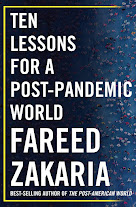
Fareed Zakaria takes a global look at the past to predict the future in “Ten Lessons for a Post-Pandemic World" (W.W. Norton & Company, 2020). In fact, Zakaria takes an out-of-this-world look at the impact of disease, pollution, and climate change on human survival:

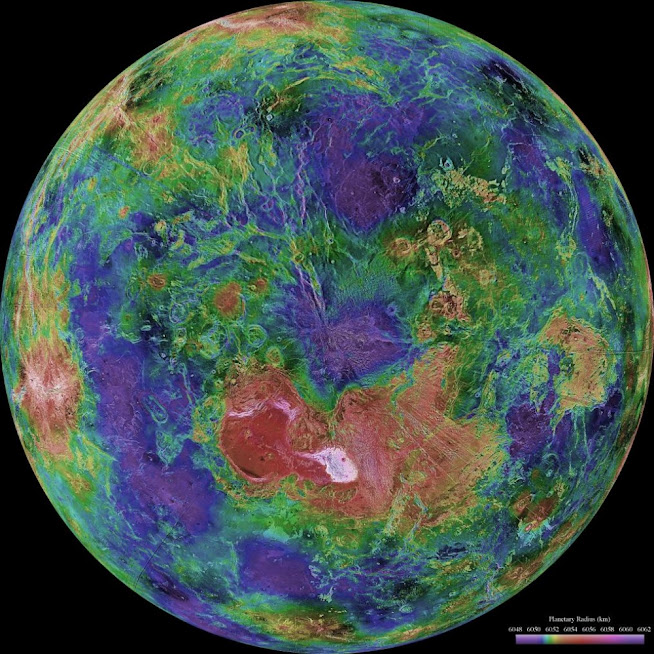
“Climate scientists who warn of the dangers of our current path are unconsciously mirroring Nobel laureate Joshua Lederberg’s warnings to us about viruses, back in 1989. Like him, they are urging us to assume that nature is a benign force that has any particular interest in the survival of life on this earth. The climate doesn’t care about us; it is simply an accumulation of chemical reactions that could easily get out of control and destroy the planet and all who live on it. Millions of other planets in other celestial systems may have suffered the same fate. In our own solar neighborhood, NASA’s recent computer modeling suggests that Venus (above) might have been habitable for around 2 billion years, after which a ‘runaway greenhouse gas effect’ led to the scorched and sterile conditions on the Venus of today. We can mitigate the forces that are pushing the earth in a similar direction. If that is not a sound reason for cooperation, then we will not find another.”

Non-cooperation within and between nations can be life-threatening.


Cooperation, on the other hand, can be lifesaving. That’s a chief lesson of the COVID-19 pandemic: telling the truth, marshaling resources, and cooperating together can reduce the number of cases and prevent deaths.


“If people cooperate, they will achieve better outcomes and more durable solutions than they could acting alone,” Zakaria writes, in what sounds a lot like Adm. Mike Mullen’s ‘A Cooperative Strategy for 21st Century Seapower’ from 2007. Zakaria continues, “If nations can avoid war, their people will lead longer, richer, and more secure lives. If they become intertwined economically, everyone ends up better off.” Updated versions of the U.S. Maritime Strategy continue to note the interconnectedness of nations sharing the same oceans.

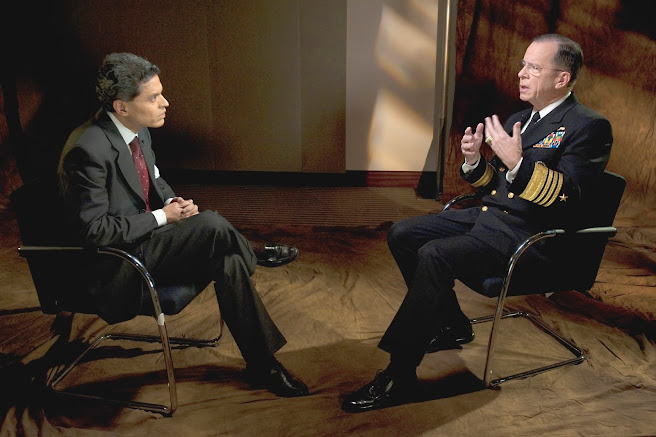
Zakaria interviews then-Chairman of the Joint Chiefs of Staff Adm. Mike Mullen in 2010. They discussed, among other topics, a drawdown of troops in Afghanistan.

Such idealism is not blindfolded. With China’s saber-rattling toward Hong Kong and Taiwan, as well as it’s maritime claims in the South China Sea, the world may be on the verge of another Cold War. Yet Zakaria writes, “Tensions between the United States and China are inevitable. Conflict is not.”

Zakariah shows how a “deeply interconnected” world can prevent wars despite “a real-life butterfly effect,” in which a fluttering butterfly’s –– or bat’s –– wing can supposedly influence the wind and eventually weather patterns on the other side of the world.

“There is a paradoxical feature of pandemics: even though they have come to be named for specific locations, they are decidedly not contained by borders. This has been true for centuries, since the Silk Road caravans and merchant galleys of the medieval world, and especially over the past 150 years since the age of steamships and trains. There was the ‘Russian flu’ of 1889-90, the ‘Spanish flu’ of 1918-19, the ‘Asian flu’ of 1957-58, the ‘Hong Kong flu’ of 1968-69, the ‘Middle East Respiratory Syndrome’ (MERS) of 2012, and now the ‘Wuhan virus’ of 2019-21. By revealing obsession with foreign labels, these names –– even when incorrect as to the origin of the virus –– betray the diseases’ much wider reach. The urge to view a pathogen as coming from abroad is strong, but of course, those diseases have rarely been known by those monikers in the places they’re named for. In Spain, the ‘Spanish flu’ was just the flu.”

Naturally, Zakaria –– a voracious reader –– cites numerous authors and books: William Maxwell’s “They Came Like Swallows,” Katherine Anne Porter’s “Pale Horse, Pale Rider,” Thomas Friedman’s “The Lexus and the Olive Tree,” Francis Fukuyama’s “Political Order and Political Decay,” and Michael Lewis’s “The Fifth Risk,” for example.

Other writers and thinkers he cites include Shakespeare, Clausewitz, Ian McEwan, Yuval Noah Harari, and Doris Kearns Goodwin.


Zakaria quotes Apple CEO Tim Cook, who, like Henry J. Kaiser in the past century, believes that his company’s “greatest contribution to mankind … will be about health.” (Kaiser, who helped shape history in the American West and in World War II, is featured in the most recent Navy Reads post earlier this month.)


It’s in his evaluation of history that Zakaria makes his most insightful conclusions about the importance of international cooperation in the wake of the pandemic –– and toward continued world peace.

“Franklin Roosevelt was assistant secretary of the navy in Woodrow Wilson’s administration and a great admirer of Wilson’s vision of a world ‘made safe for democracy’ He watched that idealism collapse in the years after World War I, leading to an even wider war during his own presidency. But the lesson FDR drew from Wilson’s experiences was to try international cooperation again, this time with America at the center of the new system –– and this time giving the great powers stronger practical incentives to fully commit themselves to the peace. A few months after America entered World War II, when victory was still uncertain and distant, FDR began formulating plans to create international institutions and systems of collective security that made future world wars unlikely. His longtime secretary of state, Cordell Hull, having seen how the trade wars of the 1930s spiraled into hot war, singlemindedly championed a new, international free trade regime. His successors realized this vision in the years after 1945 –– first through the General Agreement on Tariffs and Trade, which evolved into the World Trade Organization.

Roosevelt was known to be an idealist at heart, but his successor, Harry S Truman, had no such reputation. Truman is credited as the hard-nosed realist who dropped the atomic bombs on Hiroshima and Nagasaki, created NATO, worked to contain the Soviet Union, and waged war in Korea. But Truman was also a deeply idealistic man, and he too had drunk from the well of Wilsonian internationalism.”

Truman, when asked why he strongly supported the United Nations, would quote from Alfred Lord Tennyson’s poem “Locksley Hall,” a poem which foresaw a world where cooperation reigned and nations formed a federation based on peace, commerce, and “universal law.”


Twice in this book, Zakariah recalls Dwight D. Eisenhower’s visit to the U.S. military cemetery at Colleville-sur-Mer in Normandy (above) on the twentieth anniversary of D-Day. In an interview with Walter Cronkite, Eisenhower, who as president had called for abolishing nuclear weapons worldwide and strengthening the UN, spoke to Cronkite about the 9,000 American bodies buried there: “These people gave us a chance, and they bought time for us, so that we can do better than we have before … So every time I come back to these beaches, or any day when I think about that day 20 years ago now, I say once more we must find some way to work to peace, and really to gain an eternal peace for this world.”


“Ten Lessons” advocates for people listening to experts –– and experts listening to people. One lesson is that “what matters is not the quantity of government but the quality.” Another is about the reality of virtuality: “Life is digital.” Still another is recognizing the rise of ultranationalism and that “the world is becoming bipolar” as well as more unequal.

U.S. Marine Corps Cpl. Larry Hunter, an energy NCO with Headquarters Battalion, Marine Corps Base Hawaii, monitors as a child spins a questionnaire spin wheel during an Earth Day event, Apr. 23, 2019 about the importance of energy conservation, recycling, and protecting the environment. (Sgt. Zachary Orr)


But the most important lesson, one that permeates the whole book, is the importance of the world’s interconnectedness and need for cooperation.


George W. Bush initiated a war on AIDS in Africa. Obama/Biden led the global battle to contain the Ebola virus in Africa. Unfortunately, in early 2020, despite declaring war on COVID-19, the Trump administration failed to acknowledge and confront the threat and provide a centralized plan for testing, tracing, and telling the truth.

“By the middle of 2020, tragically, with the pandemic raging across most of its fifty states –– long after Europe and East Asia contained their outbreaks –– America had no attention for anything or anyone else, except to bash Beijing. The Trump administration is not wrong to critique China’s handing of COVID-19. But coming from such a messenger, the message lands with a thud. A lifelong friend of America, the former Australian prime minister Kevin Rudd wrong in Foreign Affairs of his horror and disappointment over how far America has fallen: ‘Once there was the United States of the Berlin airlift. Now there is the image of the USS Theodore Roosevelt (CVN-71) crippled by the virus, reports of the administration trying to take exclusive control fo the vaccine being developed in Germany, and federal intervention to stop the commercial sale of personal protective equipment to Canada. The world has been turned on its head.’”

At the beginning of March, 2020, only a few people in the United States had died from COVID-19, but the number of cases was beginning to grow exponentially. By the end of April, just after the United States commemorated the 50th anniversary of Earth Day, there were more than 1 million cases in the U.S. and more than 60,000 deaths –– despite messages from President Trump that everything was under control, the virus would go away, people should take Hydroxychloroquine, and we should try injecting bodies with disinfectants (one year ago this week).

A runner pushes through the last 100 meters of a 5K Earth Day Fun Run at Marine Corps Air Ground Combat Center, Twentynine Palms, April 2014. (Cpl. Ali Azimi)

One year later, on Earth Day 2021, there have been nearly 570,000 American deaths. But a coordinated vaccination campaign is working now to reduce cases and fatalities. Unfortunately, the world has suffered 3.1 million deaths due to the novel coronavirus pandemic, and new variants threaten everyone.

“Ten Lessons” presents the stark realities and possibilities ahead; Zakaria warns about the near certainty of another pandemic this century in a connected world. But he also presents an optimistic message about the possibilities ahead if the nations of the world become more educated, more equal, and more committed to cooperation to confront existential threats, including global climate change.


Idealism is not dead. Hope is alive. And the opportunity for lifesaving cooperation is here now despite –– and because of –– the pandemic.

Saturday, December 27, 2014

Climate Change as Serial Killer

by Bill Doughty

Climate change has been a killer for millennia, according to Eugene Linden, author of "The Winds of Change" (Simon & Shuster, 2006).

"Earthrise" in 1968. Photo courtesy of NASA.
His examination of the history of climate-as-assassin – and key questions in the debate – shows what may be in store with a warming earth, melting ice and the effect on in the invisible "ocean conveyor" on what Bill McKibben described in "Eaarth": "a blue-and-white marble floating."

Seen clearly from space for the first time in the early days of space exploration, earth is revealed as an ecosystem of sea, land and sky – "vast ocean, air currents and weather systems" – a home world alone in the vastness of space. Balanced. Interconnected.

Over time earth has experienced the extremes of heat, cold, floods and droughts. But thanks to a rare synergy of offsets – the position of large land masses, contours of the ocean floor, the reflective power of ice and snow, and tilting of earth's spin axis, among others – the period over the past 10,000 years has been relatively calm for our planet.

In other words, "This is about as good as it gets," according to Linden.

But the serial killer waits to strike again. Climate change has killed entire species, disrupted humanity and changed cultures.

Akkadian victory stele of Ram-Sin
"It's not climate, but climate change that throws civilizations into a tailspin," Linden writes.

Africa and Mesoamerica experienced drought that collapsed cultures including the Mayans. Ancient civilizations thought they had displeased the gods. The Anasazi disappeared. The Akkadian civilization disintegrated as warming climate dried the lands and hot winds blew away topsoil.

Linden cites the works of Barbara Tuchman ("A Distant Mirror"), Jared Diamond ("Guns, Germs and Steel") and, interestingly, Adam Smith ("The Wealth of Nations") as well as David Keys, author of "Catastrophe: An Investigation Into the Origins of the Modern World."
"Keys does not shy away from big ideas. In 'Catastrophe' he argues that by unleashing the plague from the south and causing barbarians to move westward from Asia, the climate upheavals of 536 played a key role in the end of the Roman Empire, the rise of Islam, and other events that marked the end of ancient times and set the stage for the emergence of the modern world. It's a sweeping claim, so bold that it almost begs contradiction, even from those willing to posit the consequential role of climate in human affairs. When a civilization is in decline, after all, the agent of its end might be entirely different from the cause of its decline. When pneumonia kills an aged patient in failing health, is pneumonia the killer, or merely the final nudge? As Keys exhaustively documents, by the sixth century, the Roman Empire was senescent, with little sense of purpose, kept together principally by the fear of the gathering barbarians at the gates who were constantly probing for opportunities and signs of weakness."
Bruegel's Triumph of Death
Climate warming unleashes invasive species and diseases – bark beetles, rats, hantavirus, mosquitoes, fleas and ticks. The result is millions of deaths, including from plagues. The Black Death started in China, came down the Silk Road to Crimea, and then in 1346 moved westward to Europe.

Climate change may be a killer, but it also opens the way for ecological opportunity. Just as Kaplan does in "Monsoon," Linden sees synergy in climate, weather and geography: "Climate does not control geography, of course, but climate can override the advantage that geography might otherwise confer."

Preparing a gravity core for deployment.
(Photo by Mary Carman, Woods Hole)
Researchers, including Navy veteran Lloyd Keigwin of Woods Hole's McLean Laboratory, are studying the effects of and on the ocean as a result of abrupt climate change. Are oceans stable? How will currents and civilization change in a warmer climate? What can we learn by studying paleoclimate in the Holocene, including the "Little Ice Age"?

Ice, caves, lake sediment, tree rings and dirt blown over ice are witnesses to the serial killing, the silent witnesses or proxies that help scientists examine the past.

A clear and present danger comes periodically in the form of El Niño, "the killer next door."

"In the rogue's gallery of climate killers, El Niño may be a mere foot soldier, but because we are repeatedly reminded of its depredations, it looms large in the minds of those who study the impact of climate on history," Linden writes.


El Niños in India and China over the past century and a half killed substantially more than the 60 million people who perished during World War II, according to Linden and his source, Cesar Caviedes ("El Niño in History: Storming Through the Ages"). Is it possible that a warmer world will invite more severe storms?

Earth's system for achieving balance on the blue-and-white marble (with an El Niño pictured in red) is interconnected and not completely understood, but Linden shows in research, timeline and graphs how science is searching for answers to questions in his final chapter, "Going Forward":
"Where are we headed? Is climate changing? If so, are we causing these changes? What changes lie in the future? Are we better prepared to deal with climate change? Can we do anything to halt climate change or ameliorate its effects?"
Navy leaders recognize that climate change can accelerate instability and conflict, degrade the environment and cause food and water scarcity, disruption and migration – requiring significant humanitarian assistance.

In 2009 the Secretary of the Navy outlined goals for reducing use of fossil fuels and embracing new sustainable, renewable and nonpolluting forms of energy. Also in 2009 the Chief of Naval Operations created Task Force Climate Change (TFCC) to address the naval implications of a changing Arctic and global environment. 


The Navy participates with the U.S. Coast Guard and National Oceanic and Atmospheric Administration in the National Ice Center, whose mission is to "provide the highest quality, timely, accurate, and relevant snow and ice products and services to meet the strategic, operations, and tactical requirements of the United States interests across the global area of responsibility."

Last month the U.S. and China, the world's biggest polluters, signed a climate agreement to significantly reduce emissions over the next decade and beyond. A United Nations climate summit in Lima, Peru shows hope for the world in reducing greenhouse gas emissions and making significant progress in next December's global climate treaty meeting in Paris, France. 

Is cooperation in fighting a serial killer among the New Year's resolutions through 2015 and 2016?

140318-N-RB579-607 ICE CAMP NAUTILUS (March 18, 2014) Chief Machinist's Mate (Nuclear) Aaron Cook braves the cold while supervising a work party at Ice Camp Nautilus, located on a sheet of ice adrift on the Arctic Ocean, during Ice Exercise (ICEX) 2014. ICEX 2014 is a U.S. Navy exercise highlighting submarine capabilities in an arctic environment. (U.S. Navy photo courtesy of Lockheed Martin by Dr. Amy Sun/Released)

Monday, October 13, 2014

Reason for Hope in 'Abundance'

Review by Bill Doughty

In the face of Islamic State (ISIL/ISIS), ebola, overpopulation, poverty and global climate change is there reason for optimism? Yes, according to the authors of "Abundance: The Future Is Better Than You Think."
The first thing to do is determine how far we've come – from the stone age to what Peter H. Diamandis and Steven Kotler call the new "Cooperation Age": from millions of years as hunter-gatherers and nomads – to thousands of years as farmers – to hundreds of years in the industrial age – to decades in the information age – to now, a new age of cooperation.

The book opens with "The Lesson of Aluminum" and the recounting of a story by Pliny the Elder (b. AD 23 – d. AD 79). Pliny was a naval and army commander in the Roman Empire who became a philosopher and author of "Naturalis Historia." He tells about a goldsmith who presented Emperor Tiberius with an unnaturally light and shiny plate that had been extracted from plain clay (bauxite) through a secret technique known only to himself and the gods:
"Tiberius, though, was a little concerned. The emperor was one of the great generals, a warmonger who conquered most of what is now Europe and amassed a fortune of gold and silver along the way. He was also a financial expert who knew the value of his treasure would seriously decline if people suddenly knew the value of his treasure would seriously decline if people suddenly had access to a shiny new metal rarer than gold. 'Therefore,' recounts Pliny, 'instead of giving the goldsmith the regard expected, he ordered him to be beheaded.'"
Of course, aluminum would be rediscovered and, through technology, would become plentiful and cheap, certainly nothing to lose one's head over. 

Times have changed, at least in most parts of the world.  Over time people have become, in general, less superstitious, more accepting of new technology and more willing to cooperate. Can we continue to evolve beyond our reptilian amygdala part of the brain and move away from cognitive biases of the mind?

The authors of "Abundance" think so, despite obvious challenges.

Diamandis and Kotler show in dozens of charts and through examples from Ray Kurzweil, Google and the U.S. Air Force that the rate of change in the world is moving exponentially.

Some examples of future technology or innovation changing the world: artificial intelligence, nanotechnology, 3D printers, genetic engineering, the Cloud and smartphones.
Venter is awarded the National Medal of Science by President Barack Obama
Energy: Craig Venter, the scientist who sequenced the human genome, created synthetic DNA and hopes to create a new kind of algae that can make fuel from carbon dioxide and water.  Venter served a tour of duty as a Navy Corpsman in Vietnam from 1967 to 1968 before beginning his formal education at the University of California at San Diego.

Water: Self-taught physicist and entrepreneur Dean Kamen developed a distiller capable of recycling its own energy. "The current version [of Slingshot] can purify 1,000 liters (250 gallons) of water a day using the same amount of energy it takes to run a hair dryer."

Communication and connectivity: Vint Cerf, a father of the internet, foresees a future of networks and sensors that will be a "central nervous system for the planet."

Food: Former futurist Sir Winston Churchill foresaw synthetically grown food:
"In 1931 Winston Churchill said, 'Fifty years hence, we shall escape the absurdity of growing a whole chicken in order to eat the breast or wing by growing these parts separately under a suitable medium.' As it turns out, it took a few extra decades for biotechnologists to deliver on Churchill's promise, but more and more, it looks like it was worth the wait. Cultured meat (or in-vitro meat, as some prefer) is meat grown from stem cells."
The U.S. military pioneered modern development of hydroponics at the end of World War II on Ascension Island in the South Atlantic, later on Iwo Jima and in Chofu, Japan in the western Pacific, and even in Iraq and Bahrain in the Middle East, where troops guarded the oil supply. The idea was to grow food locally regardless of the availability or viability of soil and not to have to rely on transportation logistics.

The future of agriculture lies in rediscovering hydroponics, refining aquaculture, using aeroponics and developing vertical farming, including extensively in cities.

Hackers, do-it-yourselfers, garage biologists and techno-philanthropists – people inspired by the counter-culture movement of the 60s – are sharing ideas for how to tackle problems. They are committed to a world of sustainment, cooperation and hope and away from consumption, destruction and greed.

As always the key to the future lies in education and freedom, which is "both an idea and access to ideas." The authors postulate that freedom and the need to make a difference is at the hierarchy of needs for people. Freedom to educate and be educated is tied to good health:
"Recent research into the relationship between health and education found that better-educated people live longer and healthier lives. they have fewer heart attacks and are less likely to become obese and develop diabetes. We also know that there's a direct correlation between a well-educated population and a stable, free society. The more well educated the population, the more durable its democracy. But these advances pale before what's possible if we start educating the women of tomorrow alongside the men."
Two-thirds of the 130 million children who are not in school are girls. The United Nations Educational, Scientific and Cultural Organization (UNESCO) concludes that educating these girls is "the key to health and nutrition; to overall improvements in the standard of living; to better agricultural and environmental practices; to higher gross national product; and to greater involvement and gender balance in decision making at all levels of society." 

A quality education empowers women and reduces fear, poverty and birth rates.

Last Friday, Malala Yousafzai, 17, became the youngest winner of the Nobel Peace Prize. Malala, a muslim from Pakistan, along with children's rights activist Kailash Satyarthi, a hindi from India, were awarded the prize.  According to Nobel.org: "The Nobel Peace Prize 2014 was awarded jointly to Kailash Satyarthi and Malala Yousafzai "for their struggle against the suppression of children and young people and for the right of all children to education."

"Abundance" presents the ideas of dozens of thinkers, inventors and philanthropists, including Arthur C. Clarke, Stewart Brand, Margaret Mead, Catherine Mohr, Martin Luther King Jr., Steve Jobs, Bill Gates, Salman Khan (Khan Academy), Matt Ridley, Bill McKibben and Ray Kurzweil: "Kurzweil learned that human ideas were all powerful. DaVinci's ideas symbolized the power of invention to transcend human limitations. Hitler's ideas showed the power to destroy."

In WWII, the free world cooperated to defeat Imperial Japan and fascist Germany. Both nations are now globally connected democracies, educated and free. Of note, the nation's Maritime Strategy for the Navy, Marine Corps and Coast Guard is called "A Cooperative Strategy for 21st Century Seapower."

The idea of cooperation growing in an interconnected world comes together in a chain equation: new technology creates specialization that increases cooperation that leads to more capability that generates more technology, and the cycle continues – an engine of change and a reason for hope and optimism in "Abundance."

Saturday, September 20, 2014

Thomas Jefferson Calls for Submarines

by Bill Doughty
The third president of the United States was the first to expand into the American West, combat religious fundamentalism and terrorists abroad, and think about the future of naval warfare: using submarines and surface ships to provide defense of the States and forward-deploying forces for maritime security. He foresaw peace through global commerce between nations – globalization.

In "Thomas Jefferson: The Art of Power" Jon Meacham explores the complicated way Jefferson combined pure reason with muddy politics as Governor of Virginia, congressman, Secretary of State, President, diplomat in France, and as statesman and philosopher, always trying to achieve "the Founders' dream of a nation beyond partisanship."
Battle of Tripoli Harbor, Aug. 3, 1804
Facing bitter opposition, Jefferson called for naval power against a Muslim caliphate in the Barbary states (Morocco, Algiers, Tunis and Tripoli). Barbary pirates had harassed and kidnapped merchants and captured an American ship. Rather than paying ransom, Jefferson, in a letter to James Monroe, suggested a reasoned approach with hard consequences.

Jefferson wrote, "Would it not be better to offer them an equal treaty? If they refuse, why not go to war with them? ... We ought to begin a naval power, if we mean to carry on our own commerce. Can we begin it on a more honorable occasion or with a weaker foe?"
According to Meacham:
"On Saturday, August 1, 1801, Andrew Sterett of the Enterprize (Enterprise), who was serving under [Commodore Richard] Dale, defeated the Tripolitan vessel Tripoli near Malta. 'Too long ... have those barbarians been suffered to trample on the sacred faith of treaties, on the rights and laws of human nature,' Jefferson told Sterett. 'You have shown your countrymen that that enemy cannot meet bravery and skill united.'"
Meacham judges Jefferson as "more of a chess player than a traditional warrior."

"The Art of Power" is carefully researched and backed up with good source material on both sides of the Atlantic, including unpublished papers. Unfortunately there's not much more discussion about Jefferson's complicated views about developing a Navy. Meacham piques our interest in other writings by Jefferson. 
In a letter published in a collection by the Library of America, "Writings: Autobiography, Notes on the State of Virginia, Public and Private Papers, Addresses, Letters," and written in 1807, President Jefferson communicates his views about naval strategy with Robert Fulton, inventor of the steam engine. Jefferson discusses use and limitations of torpedoes (mines), which would be used extensively a few years later in the War of 1812, and half a century later in the Civil War by Cmdre. David Farragut in the Battle of New Orleans.

In his letter to Fulton, Jefferson calls for more commitment to developing and employing submarines. And he floats the idea of creating a corps of submariners.
"I consider your torpedoes as very valuable means of defence of harbors, & have no doubt that we should adopt them to a considerable degree. Not that I go the whole length (as I believe you do) of considering them as solely to be relied on ... But I have ever looked to the submarine boat as most to be depended on for attaching them [torpedoes], & tho' I see no mention of it in your letter, or your publications, I am in hopes it is not abandoned as impracticable. I should wish to see a corps of young men trained to this service. It would belong to the engineers if at land, but being nautical, I suppose we must have a corps of naval engineers, to practise & use them. I do not know whether we have authority to put any part of our existing naval establishment in a course of training, but it shall be the subject of a consultation with the Secretary of the Navy. Genl Dearborne has informed you of the urgency of our want of you at N Orleans for the locks there. I salute you with great respect & esteem."
Jefferson's views of the Navy seem to have evolved over time. Earlier writings in the 1780s questioned the need for a naval force to compete with European powers. (Eventually, though, especially in response to the Barbary threats, Jefferson understood the need for a strong means to back up peaceful intentions.)

In Query XXII of his "Notes on the State of Virginia" written in 1781-1782, Jefferson offers predictions that have been realized centuries later after wars against Britain, Japan and Germany – cooperative interaction with other nations:
"It should be our endeavour to cultivate the peace and friendship of every nation, even of that which has injured us most, when we shall have carried our point against her. Our interest will be to throw open the doors of commerce, and to knock off all its shackles, giving perfect freedom to all persons for the vent of whatever they may chuse to bring into our ports, and asking the same in theirs."
Jefferson's own words, found in separate collections, help expand revelations in Meacham's biography, which in words and impressive artwork shows many of the key people in Jefferson's life.
Jon Meacham
Meacham's work is personalizing. It focuses on many of Jefferson's relationships, including  with John Adams, Aaron Burr, George Washington, Alexander Hamilton, Sarah "Sally" Hemings, Thomas Paine and Patsy Jefferson Randolph. Meacham writes about Jefferson's friendships, loves and rivalries. Unlike other Founders, Thomas Jefferson did not succumb to bitterness. He took on a recalcitrant Congress and achieved his strategic goals.

The dustcover of Meacham's book proclaims:
"The father of the ideal of individual liberty, of the Louisiana Purchase, of the Lewis and Clark expedition, and the settling of the West, Jefferson recognized that the genius of humanity – and the genius of the new nation – lay in the possibility of progress, of discovering the undiscovered and seeking the unknown. From the Declaration of Independence to elegant dinners in Paris; from politics in Philadelphia and New York to the capital on the Potomac; from his complicated life at Monticello, his breathtaking house and plantation in Virginia, to the creation of the University of Virginia, Jefferson was central to the age."
Jefferson's passion and courage gave us the Declaration of Independence, Constitution and Bill of Rights. Some could say Jefferson's foresight and commitment to progressive development gave us the birth of maritime strategy. And one could even say his expansion of the American West – eventually through Colorado to Washington State – led directly to this weekend's NFL rematch between Peyton Manning of Denver and Russell Wilson of Seattle.

Sunday, May 30, 2010

The World is Flat, by Thomas Friedman

Review by Bill Doughty

“The Curse of Oil” is one of the final subchapters of the CNO-recommended The World is Flat - A Brief History of the Twenty-First Century.

Oil-rich regions of the world have the most fundamentalist, least democratic and most warlike countries. Friedman shows how political and religious leaders in these countries often substitute critical thinking and creativity with supersition and intolerance.

In a world of growing population and diminishing resources, Friedman plants the seeds for new ways of thinking about energy, education, economic competition and, ultimately, the environment...

The World Is Flat, first published in 2005, follows in the footsteps of Friedman's earlier works, especially The Lexus and the Olive Tree, and recalls the works of Alvin Toffler (Future Shock) and John Naisbitt (Global Paradox - the Bigger the World Economy, the More Powerful Its Smallest Players).

A flat world means a level playing field, with opportunities opening to every person on earth who is willing to meet the challenges of competition and innovation.

Friedman’s book is very typically first-person, has lots of examples from his family and, in his trademark style, includes travel vignettes and recent economics history lessons. His book is on the Navy Professional Reading Program's "Division Leaders Collection" of recommended titles.

He walks the reader through three phases of American history. The first he calls "Globalization 1.0," lasted from 1492 to 1800. Globalization 1.0 was characterized by power and muscle of individual countries, according to Friedman.

Globalization 2.0, he says, was an expansion of global integration through increased trade and opening of markets, thanks to steamship, trains, and the wiring of the world through phone lines and computers.

Now, he says, we're living in 3.0, where people - individuals - are empowered and pushed by "not horsepower, and not hardware, but software (and a) global fiber-optic network that has made us all next-door neighbors."

In The World is Flat, Friedman gives examples of the new wired globalization at work. At a McDonald's near Cape Girardeu, Mo., the person taking your order at the drive-through is actually at a call-center 900 miles away in Colorado Springs. If you call JetBlue to make a reservation, you might be speaking with a homemaker in Utah, working part time. Many of us have talked to a customer service representative who identifies himself as "Bob" or "Mike" but whose real name might be Rajendrakumar-prakash.

Friedman puts numbers to what we all suspect: 5,000 of Wal-Mart's 6,000 suppliers are from China. But the wires go both ways. On Oct. 17, it was announced that Wal-Mart had the winning bid ($1 billion) to purchase Trust-Mart, one of the biggest retail chains in China. This makes Wal-Mart one of the biggest retailers in the fastest growing market in the flattened world.

Friedman sees the globalization and leveling of the playing field less as a threat and more as an opportunity. More consumers may mean more investment by developing countries, not just in the world's economy, but also in world peace and dealing with the world's problems. We're all invested in the future, after all.

Friedman is not a blind optimist. He questions how globalization trends will impact cultures, fundamentalist religions, and nationalism.

He challenges Americans to address the erosion of mathematics, science and technology. Nearly one in five scientists and engineers in the United States is an immigrant, and foreign students now earn slightly more than half of U.S. doctorates in engineering.

Friedman tells his daughters - and all Americans - to do their homework, study and read!

He describes an eye-opening moment at one of India's huge outsourcing companies, Infosys, watching hundreds of employees. He stood `'at the gate observing this river of educated young people flowing in and out . . . They all looked as if they had scored 1600 on their SATs. . . . My eye kept . . . telling me . . . `Oh, my God, there are just so many of them, and they all look so serious, so eager for work. And they just keep coming, wave after wave.

How in the world can it possibly be good for my daughters and millions of other young Americans that these Indians can do the same jobs as they can for a fraction of the wages?'"

Everyone will not agree with Friedman's views, style, or premise, but he is right that we cannot ignore or stop the waves of change, the waves of history, or the realities of a world under “the curse of oil.”

The Navy's new professional reading program's list is packed with titles about history and, in the case of The World is Flat, books that put history - and current events - in context.