Showing posts with label Hokulea. Show all posts

Sunday, April 22, 2018

Nainoa Thompson & Planet Earth, 'Hawaiki Rising'

Review by Bill Doughty

When Pwo (Master) Navigator Nainoa Thompson brought the voyaging canoe Hōkūle`a into Pearl Harbor in February of this year, he spoke in part about harnessing fear, overcoming the dangers of complacency, embracing diversity as a strength, and passing knowledge and wisdom to the next generation.

Thompson addressed the Navy and local civilian audience during his visit – part of a statewide "Mahalo Hawaii" tour of thanks to everyone for their support of Hōkūle`a's Malama Honua (caring together for Island Earth) circumnavigation of the planet completed in 2017.

Sam Low's "Hawaiki Rising: Hōkūle`a, Nainoa Thompson, and the Hawaiian Renaissance" (Island Heritage Publishing, 2013) provides a fascinating history of the beloved canoe, the revival of Hawaiian culture beginning in the 1970s, and how dedicated individuals inspired others to become aware of the need to respect and care for our environment, including our oceans.

Renaissance man Herb Kane at work in his Chicago studio.
Low served in the United States Navy in the Pacific in the mid-1960s. He introduces us to iconic individuals who brought Hōkūle`a ("Star of Joy") to life, including Herb Kane, and artist, sailor and thinker who was inspired by a book, "Canoes of Oceania" and by Polynesian culture, in general. Kane worked in Chicago but dreamed of the Pacific, learning all he could of voyaging canoes.

Kane created14 paintings of Polynesian canoes in the 1960s. The Hawaii State Foundation of Culture and the Arts purchased the paintings in 1969, making it possible for Kane to move to Hawaii to continue his studies and setting the stage for the revival of Hawaiian culture in the 1970s. 

At the time the foundation that purchased Kane's art was headed by its first director, Alfred Preis, architect of the USS Arizona Memorial in Pearl Harbor.

The late Daniel Inouye, United States Senator from Hawaii, once said, “When you saw a Herb Kane painting, you were energized and motivated to learn about the past. …His artwork captured both ancient and modern-day Hawaii and help preserve Hawaii's unique culture for future generations.”

Nainoa Thompson called Kane, who was a Navy veteran, "father of the Hawaiian Renaissance.”


In 1973 Kane envisioned construction of a voyaging canoe that would inspire that renaissance. He met with University of Hawaiʻi anthropologist Ben Finney and Tommy Holmes, author of The Hawaiian Canoe. Together they founded the Polynesian Voyaging Society and began work on the Hōkūle‘a, capable of sailing between Hawaii and Tahiti. One day, their canoe would sail around the world on a mission to bring awareness about earth's ecology.

Kane lived in East Oahu, which is where he met a young man who was serious, quiet and young enough to be imprinted with a love of the stars, the sea and sailing.

Nainoa Thompson
That young man was Nainoa Thompson, whose father, Myron "Pinky" Thompson was a World War II Army veteran, a strong supporter of Hawaiian culture, and a foundation for Nainoa's philosophy of life. Pinky told his son "Ninety percent of success is preparing for it." He helped Nainoa overcome his fears and learn values shared by the U.S. Navy: the importance of discipline, training and having a vision.

Nainoa writes this in the book's foreword:
"Our canoe, Hōkūle`a, and our dreams have now carried us ... (following) in the wake of our ancestors who discovered and settled Polynesia. It has been a process of finding ourselves not only as Hawaiians, as native to these islands, but also as native to planet Earth. On all of our voyages, we have been guided by the wisdom of our elders, our kupuna. Among them is my father, Myron "Pinky" Thompson, who understood that voyaging is a process in which we are guided by values that are universal. 'Before our ancestors set out to find a new island,' my father told me, 'they had to have a vision of that island over the horizon. They made a plan for achieving that vision. They prepared themselves physically and mentally and were willing to experiment, to try new things. They took risks. And on the voyage they bound each other with aloha so they could together overcome those risks and 'seeking, planning, experimenting, taking risks, and caring for each other. The same principles that we used in the past, are the ones that we use today and that we will use into the future. No matter what race we are or what culture we carry, these are values that work for us all."
Nainoa learned some values the hard way aboard Hōkūle`a: the importance of good seamanship, communication and the courage to assume command at sea.

Nainoa went to Bishop Museum's planetarium, studied at Willamette College in Oregon after attending Punahou School, and was inspired by a book called "The Stars: A New Way to See Them" by H. A. Rey, author of "Curious George." 

Low introduces us to another earlier influencer in Nainoa's life: Yoshio Kawano, who lived in traditional Japanese style and taught the young Nainoa how to fish and make connections with nature. Nainoa says, "Yoshi may have been my most important teacher of all. I didn't know it then, and certainly he didn't either, but he was preparing me for my life."

Pwo Navigator Mau Piailug
Through Low's insightful narrative we get to know others who worked with or inspired Nainoa and who have strong ties to Hōkūle`a: Mau Piailug, Eddie Aikau, Lacy Veach, Snake Ah Hee, Sam Ka'i, Chad Bayaban, Will Kyselka, Gordon Pi'ianapa'a, Shorty Bertelmann, Kimo Lyman, Dave Lyman, Wally Froiseth, Bruce Blankenfeld, Tava Taupa and Kawika Kapahulehua, among others.

We get an intimate view of life aboard Hōkūle`a, including on two roundtrip journeys to Tahiti in this book, published just before Malama Honua. We relive the heartbreaking loss of Eddie Aikau in 1978 and the rescue of the capsized Hōkūle`a, thanks to an observant Hawaiian Airlines pilot and a ready response from the U.S. Coast Guard.

Eddie ("Eddie Would Go") Aikau
Eddie's loss strengthened Nainoa's resolve. He pledged to fulfill Aikau's dream on his behalf, to see "Tahiti rising," coming up on the horizon as the voyaging canoe approached.

Using charts and simple explanations, Low shows some of the how-to of wayfinding. "The concept was straightforward – stars rise in the east, arc overhead, and set in the west, defining points on the horizon to steer by, or 'houses,' as Nainoa called them." Data becomes knowledge and, over time, knowledge becomes intuitive wisdom.

Author Sam Low blends science with art in his presentation, explaining some of the fundamentals of Nainoa's wayfinding using stars, constellations, ocean swells, birds, the moon and other means – using science and all the senses plus a spiritual dimension that defies explanation.

On one key night in the doldrums, confused about their direction, Nainoa "sensed" the moon before he saw it. He turned the canoe and when the clouds parted he saw the light shine through and knew he made the right decision.
"'I can't explain it,' Nainoa continues, 'there was a connection between something in my abilities and my senses that went beyond the analytical, beyond seeing with my eyes. It was something very deep inside. Before that happened, I relied on math and science because it was so much easier to understand things that way. I didn't know how to trust my instincts. My instincts were not trained enough to be trusted. That night, I learned there are levels of navigation that are realms of the spirit. Hawaiians call it na'au – knowing through your instincts, your feelings, rather than your mind or your intellect. It's like new doors of knowledge open and you learn something new But before the doors open you don't even know that such knowledge exists.'"
"Hawaiki Rising" is about discovering new knowledge, moving from anger and fear to love and courage, and rediscovering a culture of sustainable living on "Island Earth," showing how one person can make a profound difference. It's a good read for Earth Day 2018.

Sunday, February 11, 2018

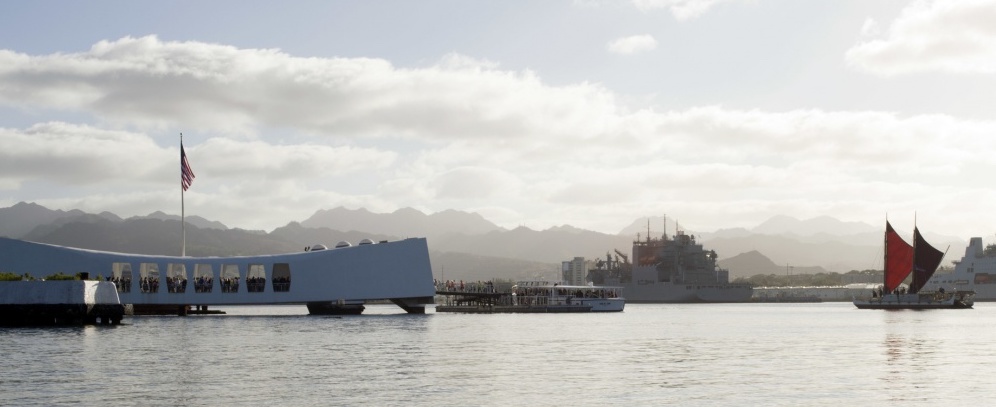
Hōkūle‘a Visits Pearl Harbor

People aboard Battleship Missouri Memorial help welcome voyaging canoe Hōkūle‘a in Pearl Harbor Feb. 10. (Photo by Kaimana Pine, courtesy PVS)
Voyaging Canoe Makes Historic First Visit

Story by Petty Officer 1st Class Jeffrey Troutman, Navy Public Affairs Support Element Detachment Hawaii

The traditional Polynesian double-hulled voyaging canoe, Hōkūle‘a, sailed into the waters of Pearl Harbor and visited the Puʻuloa region for the first time in the canoe’s 42-year history, Feb. 10.

The Hōkūle‘a crew was welcomed at Rainbow Bay Marina by the Puʻuloa community and US Navy who will host the canoe during a week-long visit to the region.

Rear Adm. Brian Fort, commander, Navy Region Hawaii and Naval Surface Group Middle Pacific, spoke at the welcoming ceremony of the Hōkūle‘a’ crew’s values, and how they reflect those of the U.S. Navy and the Hawaiian community at Pearl Harbor.

“Today is truly a historic day here at Pu’uloa,” said Fort. “I am a firm believer that the values that unite us are much greater than the distractions that divide us, and here today, we are truly inspired by the brave and humble navigators and voyagers of Hōkūle‘a, and by the values they cherish and represent.”

Rear Adm. Brian Fort, commander, Navy Region Hawaii and Naval Surface Group Middle Pacific, speaks with Nainoa Thompson, president of the Polynesian Voyaging Society and Master Navigator of the traditional Polynesian double-hulled voyaging canoe, Hōkūle‘a. The week-long engagement to follow will include school visits, public dockside tours and a crew talk story event. (U.S. Navy Photo by Mass Communication Specialist 1st Class Jeff Troutman)
The Hōkūle‘a crew’s week-long engagement with the local community will include school visits, public dockside tours and a crew speaking event. As part of the Mahalo, Hawaiʻi Sail, the purpose of Hōkūleʻa’s visit is to bring the canoe to more of Hawaiʻi’s children, honor Pearl Harbor’s ancient culture and history, and to learn about the efforts to restore the area’s cultural sites, including the nearby Loko Paʻaiau Fishpond.

“This is an emotional day for me, because this is the very first time this historic vessel has ever sailed upon the waters of Pearl Harbor,” said Nainoa Thompson, president of the Polynesian Voyaging Society and Master Navigator of Hōkūle‘a. “To feel this sense of community and to know that the efforts of this crew are being celebrated in this moment, it is my hope that today is a chance for us to all take one more step towards coming together as one.”

Hōkūle‘a renders honors at USS Nevada Memorial at Hospital Point. (Photo by MC1 Troutman)
Upon entering the waters of Pearl Harbor, the Hōkūle‘a crew paid their respect as the vessel sailed past significant cultural and historical sites including Halealoha Halemau (Fort Kamehameha Reburial Platform), USS Nevada, Arizona Memorial, Battleship Missouri, Ford Island, USS Utah, and Loko Paʻaiau Fishpond, before piering at Rainbow Bay Marina. The crew will conclude their week-long visit by working with the restoration team at Loko Paʻaiau Fishpond on February 17.

The Loko Paʻaiau fishpond is located at McGrew Point Navy housing and is one of only three fishponds out of an original 22 in the Pu’uloa area which are still relatively intact. In September 2014, the Navy invited members of the local Hawaiian civic clubs and ʻAiea community members to begin work on restoring the historic fishpond.

“We want to celebrate this place and the movement taking place by the Puʻuloa community and the Navy to restore the Native Hawaiian history, sites and cultural identity of Pearl Harbor,” said Nainoa Thompson, president of the Polynesian Voyaging Society. “We hope Hōkūleʻa’s visit will open the doors for our young people to learn about the extraordinary history and culture of this very special, sacred place.”

More than 1,000 school children are scheduled to visit Hōkūleʻa and participate in educational activities during the canoe's stop at Puʻuloa.

For more information about the Hōkūleʻa and her crew, please visit: http://www.hokulea.com/.

For a series of Navy Reads reviews and other posts over the years about Hōkūleʻa click here.

Schedule of events at Rainbow Bay Marina this week, provided by Polynesian Voyaging Society:

Public Open House Tours of Hōkūleʻa to Feb. 17

Rainbow Bay Marina (next to Restaurant 604, adjacent to National Park Service's Pearl Harbor Visitor Center.
  • Sunday Feb. 11, 10 a.m. to 5 p.m. and

  • Monday thru Friday, Feb. 12 to 16, 3 p.m. to 5 p.m.
  • Hōkūleʻa Crew Talk Story (Sponsored by Kamehameha Schools ʻEwa Region) at Rainbow Bay Marina Pavilion Thursday, Feb. 15, 5 to 7 p.m.
  • Meet crew and community members who will discuss the significance of Hōkūleʻa’s visit to the Puʻuloa region.

  • Saturday Feb 17, 7:00 a.m., Hōkūleʻa departs Rainbow Bay Marina

  • Hōkūle‘a renders honors as it passes by the USS Arizona Memorial (Photo by MC1 Jeff Troutman)

    Friday, June 3, 2016

    World Oceans Day and Rachel Carson

    Review by Bill Doughty

    Prose is poetry for Rachel Carson, whose "Silent Spring," published in 1962, awakened the ecology/environment movement in the United States. In "The Sea Around Us" (1951, Oxford University Press), she explains the oceans' relationship with the earth and our ties to the sea.

    Perfect for World Oceans Day, June 8.

    "The Sea Around Us" is a work of art. Carson's imagery is as fresh as when it was created mid-20th century. She shows how the earth and oceans formed and how life crawled from the sea, always dependent on "mother sea," but she presciently warns of a warming planet and rising seas.

    Want to understand the science of the creation, tides, seasons and inhabitants of the oceans or how we are all connected by the oceans? Read Rachel Carson. 

    Eventually after millions of years of evolution, "man, too, found his way back ..."
    "And yet he has returned to his mother sea only on her own terms. He cannot control or change the ocean as, in his brief tenancy of earth, he has subdued and plundered the continents. in the artificial world of his cities and towns, he often forgets the true nature of his planet and the long vistas of its history, in which the existence of the race of men has occupied a mere moment of time. The sense of all these things comes to him most clearly in the course of a long ocean voyage, when he watches day after day the receding rim of the horizon, ridged and furrowed by waves; when at night he becomes aware of the earth's rotation as the stars pass overhead; or when, alone in this world of water and sky, he feels the loneliness of his earth in space. And then, as never on land, he knows the truth that his world is a water world, a planet dominated by its covering mantle of ocean, in which the continents are but transient intrusions of land above the surface of the all-encircling sea."
    Carson predicts global warming based on natural phenomenon and cycles she observed and studied in the last century. In the 1950s and 60s she wrote about erosion, pesticides and pollution, invasive species, endangered species, and ocean dumping. What would she say about our impact on the climate and our effect on the planet today?

    "Unquestionably, there are other agents at work in bringing about the climatic changes in the Arctic and sub-Arctic regions," she writes in the mid-1950s. "We have therefore begun to move strongly into a period of warmer, milder weather. There will be fluctuations, as earth and sun and moon move through space and the tidal power waxes and wanes. But the long trend is toward a warmer earth; the pendulum is swinging."

    She acknowledges the challenges of exploring the seas for fossil fuels and other resources.
    "So our search for mineral wealth often leads us back to the seas of ancient times – to the oil pressed from the bodies of fishes, seaweeds, and other forms of plant and animal life and then stored away in ancient rocks; to the rich brines hidden in subterranean pools where the fossil water of old seas still remains; to the layers of salts that are the mineral substances of those old seas laid down as a covering mantle over the continents."
    According to biographer William Souder, author of "On a Farther Shore: The Life and Legacy of Rachel Carson," among Carson's admirers was Fleet Admiral Chester Nimitz. (Both Nimitz and Carson were featured in the Great Americans series of stamps provided by the U.S. Postal Service in the 80s and 90s.)

    Carson reminds us of the U.S. Navy's role in mapping and studying the oceans, especially by seafaring scientist Lt. Matthew Fontaine Maury in the 19th century, prior to the Civil War. She writes of USS Ramapo's encounter with a 112-foot wave in 1933 while sailing from Manila, Philippines to San Diego. Carson shares discoveries in the Pacific by the U.S. Navy aboard USS Jasper, USS Henderson and USS Nereus in the Pacific during and just after World War II.

    The ancients, she says, revered and respected the deep mysteries of the oceans.
    "For the sea lies all about us. The commerce of all lands must cross it. The very winds that move over the lands have been cradled on its broad expanse and seek ever to return to it. The continents themselves dissolve and pass to the sea, in grain after grain of eroded land. So the rains that rose from it return again in rivers. In its mysterious past it encompasses all the dim origins of life and receives in the end, after, it may be, many transmutation, the dead husks of that same life. For all at last return to the sea – to Oceanus, the ocean river, like the ever-flowing stream of time, the beginning and the end."
    Curiosity about navigating the oceans began thousands of years ago. "Of the methods of those secretive master mariners, the Phoenicians, we cannot even guess. We have more basis for conjecture about the Polynesians, for we can study their descendants today, and those who have done so find hits of the methods that led ancient colonizers of the Pacific on their course from island to island."

    Ancient voyagers sailed by the stars, understood "the varying color of the water," read the clouds, felt the winds, interpreted the currents and followed the migration of birds to lead them to different lands.

    Aboard the Hōkūle'a canoe, the Polynesian Voyaging Society's Malama Honua  voyagers are in New York this week during World Oceans Day, sharing their vision for a sustainable earth. No doubt the spirit of Rachel Carson sails aboard Hōkūle'a.

    Rachel Carson with a feline friend and her 1951 book, “The Sea Around Us.” (A. Aubrey Bodine, Baltimore Sun file photo, 1954)

    Friday, April 8, 2016

    Exploration, Navigation, Commitment to Care


    Master builder Wright Bowman Sr., born in 1907, created this scaled reproduction sculpture of Hōkūleʻa in 1978, on display at the Honolulu Museum of Art.

    by Bill Doughty

    U.S. astronaut Air Force Lt. Col. Charles Lacy Veach looked out the window of the space shuttle as it passed over Hawaii and had an epiphany about "island Earth."

    "Lacy could see all the islands, and he could see his whole spirit and soul here. He could see the entire planet as one vision," said master navigator Dr. Nainoa Thompson, president of the Polynesian Voyaging Society.

    Hōkūleʻa
    Thompson credits Veach for inspiring Mālama Honua ("Care for the Earth"), the worldwide journey of a double-hull voyaging canoe, Hōkūleʻa, using traditional navigation techniques. The voyage is underway to raise awareness of our collective responsibility to protect and cherish our home planet.

    "Hawaii is a laboratory for living well on islands, including Island Earth," according to Thompson, in an interview with PBS.

    Kathy Muneno of Hawaii's KHON reports, "Thompson says it’s when Veach saw Hawaii from space that he knew it held the answer to a beautiful, sustainable and caring Earth. He says Veach actually planted the seed for Hōkūleʻa to sail around the world."

    Muneno writes, "Veach and Nainoa Thompson became fast friends and hatched a plan for a three-way call: Veach in the space shuttle, Thompson on the ‘spaceship’ of ancestors, Hōkūleʻa in the South Pacific, both fielding questions from children in Hawaii and broadcasting to hundreds of classrooms."

    Friends Nainoa Thompson and Lacy Veach.
    They answered students' questions and put navigation by the stars – and with the stars – in context: "exploration."

    Hōkūleʻa ("star of gladness," named for the star Arcturus, which passes over Hawaii) departs from Titusville, Florida today after a poignant visit to NASA's Kennedy Space Center, where Thompson and other voyagers paid tribute to Veach's legacy before continuing their voyage up the East Coast.

    “The country needs to know that Lacy was the one that planted the idea as a seed into us in 1992 to take Hōkūleʻa around the world.” said Thompson, “Florida becomes foundational for us to articulate and communicate to this country that that’s why we’re coming – out of respect, and out of honoring and making sure that they know that Lacy’s legacy counts. I don’t think we can go up the coast until we establish that.”

    Arriving in Titusville, Florida. Photo courtesy Hokulea.com and Oiwa TV, by Niehu Anthony.
    Thompson held a ceremony aboard the canoe to honor the memory of Hawaii astronauts Ellison Onizuka and Lacy Veach and their contributions to exploration in space. He spoke with NASA employees and shared stories of how Veach inspired a generation of students and voyagers at sea and in space.

    “Coming to NASA for me has been an amazing celebration,” Thompson told Hōkūleʻa and NASA crew, as reported on Hokulea.com. “Lacy is our navigator on this voyage, and for that, this is the most important two days for me.”

    Thompson's tribute to Lacy and his vision of "the beauty of island Earth" is published by the Polynesian Voyaging Society. It's a beautiful tribute and shows Veach's commitment to teaching the next generation.

    Like President Obama, Veach is a graduate of Punahou School in Honolulu. He was commissioned in the United States Air Force upon graduation from the Air Force Academy in 1966 and served as a USAF fighter pilot. According to his NASA bio, he flew "the F-100 Super Sabre, the F-111, and the F-105 Thunderchief, on assignments in the United States, Europe, and the Far East, including a 275-mission combat tour in the Republic of Vietnam."

    Lacy Veach in space.
    He was a member of the USAF Air Demonstration Squadron, the Thunderbirds, in 1976 and 1977. Veach left active duty in 1981, but served as a F-16 pilot with the Texas Air National Guard before becoming an astronaut in June 1985. 

    From his bio: "He held a variety of technical assignments, and had flown as a mission specialist on two Space Shuttle missions, STS-39 in 1991 and STS-52 in 1992. He had logged 436.3 hours in space. Most recently, Lacy had worked as the lead astronaut for the development and operation of robotics for the International Space Station."

    Veach is mentioned in the same breath as Pinky Thompson (Nainoa's father), Mao Piailug and Eddie Aikau, inspirational leaders who are part of a seafaring tradition. 

    Eddie was an experienced waterman and crew member of Hōkūleʻa who was lost at sea in 1978 when he set out on his surfboard to get help after the canoe capsized. "Eddie would go" symbolizes determination, commitment and selflessness.

    U.S. Navy Sailors in Hawaii have a history of working with the Polynesian Voyaging Society – volunteering to assist with fixing and painting facilities, sanding and refurbishing canoes, and advising voyagers.

    Just prior to Hōkūleʻa's voyage, Rear Adm. Frank Ponds (then-Commander, Navy Region Hawaii and Naval Surface Group Middle Pacific) spoke with Kathy Muneno and spoke about mitigating the dangers they could face transiting the Pacific, including pirates, storms and rogue waves.

    Lt. D. Stayton holds a sextant in a class at USNA. (Photo by MU2 T. Caswell.)
    Recently the Navy announced a renewed interest in teaching traditional navigation techniques at the Naval Academy (USNA), using constellations, the sun and moon as Hōkūleʻa does, without relying on global positioning satellites.

    National Public Radio published a story about the initiative, noting "Navigation by the stars dates back millennia. The ancient Polynesians used stars and constellations to help guide their outrigger canoes across thousands of miles of the Pacific Ocean. And right up until the mid-20th century, navigation on the sea was usually done by looking at the heavens."

    As for Hōkūleʻa, the voyaging canoe heads north up the East Coast now toward Washington D.C. and New York via South Carolina, North Carolina and Virginia. At the Mariner's Museum in Newport News, the voyagers plan to participate in the Earth Day celebration there April 23. 

    In a post on Hokulea.com:

    "After spending about a week in Washington DC, Hōkūleʻa will sail to New York City, where she will be a focal point at World Oceans Day events hosted by the United Nations on June 8, 2016. The theme of this year’s World Oceans Day is 'Healthy Oceans, Healthy Planet.' While in New York City, Hōkūleʻa will also participate in the Hawaiian Airlines Liberty Challenge, which is the East Coast’s largest Pacific Islands festival and one of the world’s most competitive outrigger races. Hōkūleʻa is expected to depart New York City on June 18 for several engagements in the New England area."

    To follow the Mālama Honua Worldwide Voyage, visit http://hokulea.com/track-the-voyage


    Sunday, April 26, 2009

    Hōkūle‘a

    This week I had the privilege of participating in a Native Hawaiian Cultural Communications Course at Mokapu -- Marine Corps Base Hawaii (Kaneohe), sponsored by DoD. Key points: Our similarities outweigh our differences; understanding each other helps build trust and partnership.
    We all respect and protect our environment: Malama kekahi i kekahi; Malama Aina. We respect and protect the earth: Malama Honua.
    I've had the link to the Hokule‘a blog on Navy Reads (under Maritime/Voyages) since shortly after starting these reviews and discussion.

    The most recent posting on the Hokule‘a blog is a Q&A about their recent voyage to Palmyra. Fascinating insights and brilliant imagery.


    "For more than 30 years, voyagers aboard Hokule‘a – the iconic traditional Hawaiian open-ocean canoe – have combined the wisdom of their ancestors with modern insights to navigate a course for our future. Embracing the concept of Malama Hawai‘i (caring for and protecting Hawai‘i), these explorers have reconnected to their heritage while helping to foster a community committed to peace, caring and a healthier world.

    "Now, Hokule‘a and her sister vessels will begin an eight year voyage to circumnavigate the globe to find answers, through exploration, on our journey toward a shared destination – a healthy and sustainable Earth for future generations. With Hokule‘a as a catalyst for global attention and local action, the worldwide voyage is a journey that will chart a new course for sustainability."

    (Photo: Mike Taylor)

    By the way, two books from the Navy Reading Program came up in discussions or as an actual part of Native Hawaiian Cultural Communications presentation: Covey's 7 Habits of Highly Effective People and Malcolm Gladwell's Tipping Point. Both were brought up in the context of relationships/connections and developing and building trust. Maritime Strategy!