Showing posts sorted by relevance for query inouye. Sort by date Show all posts

Saturday, January 2, 2010

Honor by Fire

Review by Bill Doughty

Honor, courage and commitment in the face of prejudice, fear and disenfranchisement: This book shows the story of triumph of American democracy over small-mindedness and bigotry as its author introduces us to a special group of service members from World War II.

Lyn Crost, correspondent for AP, Star-Bulletin and Honolulu Advertiser, documented this important slice of history just three years prior to her death in 1997 at the age of 80.

One hundred years ago Imperial Japan considered Okinawa a stepchild. Okinawans were treated as second-class citizens. Many emigrated to a land of opportunity Hawaii.

Japanese from Okinawa and mainland Japan who came to the Hawaiian islands and the West Coast of the United States embraced their new country, a land of freedom and opportunity.

Their children (nisei, or second generation), became loyal Americans, willing to serve in the U.S. military and risk their lives for the country of their birth.

After the attack on Pearl Harbor on Dec. 7, 1941, however, many non-Japanese Americans questioned the patriotism of Americans of Japanese Ancestry (AJAs).

Racism brought about internment imprisonment of Japanese families, mostly those living in California, including some of the families of the AJAs serving in the military.

Ironically, AJA service members exemplified by the 442nd Regiment, 552nd Field Artillery Battalion (pictured at right with Crost), Military Intelligence Service, and others fought against racist German Nazis, Italian Fascists, and Japanese imperialists, while their families experienced discrimination back home.

Nisei demonstrated superior intelligence collection, communication skills and bravery under fire. Crost’s history of AJAs in WWII in Honor by Fire is a chronological work of love, a tribute to the achievements and legacy of these proud Americans, both in the Pacific and in Europe.

There are universal timeless lessons in this book.

Crost shows the success of the nisei approach to treating and interrogating prisoners by building trust and showing empathy.

Each of the Marine divisions at Iwo Jima had a team of nisei linguists who worked with Marines and Seabees in clearing caves (pictured below), trying to persuade Imperial Japanese soldiers to surrender instead of committing suicide, then interviewing them to gather intelligence.

Linguists also translated diaries and documents that revealed vital information about the enemy, information provided immediately to Fleet Admiral Chester Nimitz and Army and Marine Corps leaders.

The AJAs used their trust-building techniques to communicate with Japanese civilians and soldiers on Okinawa near the end of the war, persuading hundreds hiding in tunnels or caves to surrender. Unfortunately, many women and children chose to believe Imperial Japanese Army propaganda and jumped from cliffs into the rocks and sea below.

Crost tells compelling stories of AJA heroism, taking readers to New Guinea, Italy, Burma, Anzo, Philippines and German death camps. She introduces us to dozens of individual soldiers along the way.

Tech. Sgt. Herbert Miyasaki, Gen. Frank D. Merrill (of Merrill’s Marauders) and Tech. Sgt. Akiji Yoshimura. Merrill's evaluation of the nisei: "As for the value of the nisei group, I couldn't have gotten along without them. Probably few realized that these boys did everything that an infantryman normally does plus the extra work of translating, interrogating, etc. Also they were in a most unenviable position as to identity, as almost everyone from the Japanese to the Chinese shot first and identified later."

Among the best known of the AJAs of WWII: then-2nd Lt. Daniel K. Inouye, whose platoon engaged in combat against fascists in Italy at Mount Nebbione on Apr. 20, 1945. Crost reports what happened:

Inouye’s platoon encircled and destroyed an enemy patrol and mortar observation post, then advanced to within forty yards of the main enemy force, which was shielded in a hilltop rock formation with three machine guns hidden in a bunker. There was no cover on the hillside leading to it. Inouye crawled up the hill alone to locate the weapon emplacements; as he was taking out a grenade, he was hit in the stomach by machine-gun fire. The blow knocked him down, but he managed to get up, pull the pin from the grenade, run to within five yards of the nearest machine gun, and throw the grenade inside the position. As the gunners struggled to their feet, he raked them with his tommy gun.

His men ran to help him but were pinned down by enemy fire. Inouye, bleeding from the stomach, staggered farther up the hill and threw two more grenades into the second position before he fell again He dragged himself toward the last machine-gun nest, stood up, and pulled the pin from another grenade. He had just drawn back his right arm to throw it when his right elbow as smashed by a rifle grenade, which almost tore off the arm. By reflex action, his right hand was still clenching the grenade and its safety handle. His men ran to help him but Inouye yelled at them: “Go back!” Reaching down with his good left hand, he took the grenade out of the clenched fist of his shattered right arm and threw it at the remaining machine-gun next, destroying it. Then, with his left hand controlling his tommy gun and his right arm flapping against his side, he started finishing off the surviving gunners. Before he was through he was hit again by gunfire, this time in his right leg and he fell down the hill... Inouye refused to be evacuated until his men were deployed in defensive positions against a possible counterattack.

In this attack, twenty-five enemy troops were killed and eight others captured. Inouye’s right arm had to be amputated. His dream of becoming a doctor was ended...

At the war’s end, Inouye, like a lot of AJAs, had to deal with racism back in the United States.

Passing through California on his way back to Hawaii, Capt. Inouye tried to get a haircut at a barbershop near San Francisco. An attendant met him at the door and said, “You’re a Jap and we don’t cut Jap hair.”

Today, Senator Daniel K. Inouye, a recipient of the Medal of Honor, is the second-most senior member of the U.S. Senate, chairman of the U.S. Senate Committee on Appropriations and senior member of the Commerce, Rules and Indian Affairs Committees.

The outright racism Inouye experienced 65 years ago is thankfully less overt today, though one could argue that fear-borne incivility is making a resurgence.

Educated voices, on the other hand, call for collaboration, embracing differences to achieve harmony. Crost's conclusion:

“I have learned that we are dependent on each other, and that the future will be based on the ability of our diverse races, religions and cultures to weave an understanding that will rise above inevitable conflicts. My Japanese-American friends have taught me this lesson.”

While this book is not on the Navy’s Professional Reading Program list, it is recommended by the U.S. Army Center of Military History on its history site about the 442nd Regimental Combat Team. Other titles referenced include Masayo Duus’s Unlikely Liberators: The Men of the 100th and 442nd, Thomas Murphy’s Ambassadors in Arms: The Story of Hawaii’s 100th Battalion, Orville C. Shirey’s Americans: The Story of the 442nd Combat Team, Ronald Takaki’s Strangers from a Different Shore: A History of Asian Americans, Chester Tanaka’s Go for Broke, and Daniel K. Inouye’s Journey to Washington.

Tuesday, December 18, 2012

Senator Inouye - Passing of an American Hero

by Bill Doughty

When Senator Daniel K. Inouye was a young man going to war in 1943 to fight in Europe his father told him, “...if you must die, die with honor.”  After a lifetime of honorable service, Medal of Honor recipient Inouye passed away Dec. 17, 2012.

A statement from his office conveyed the loss.  President Obama issued a statement, calling Inouye “a true American hero” who  “worked to strengthen our military, forge bipartisan consensus, and hold those of us in government accountable to the people we were elected to serve.”

A Navy Reads post, “Honor by Fire,” describes the commitment and sacrifice of Inouye and his compatriots and the saga of Americans of Japanese Ancestry in World War II in a review of "Honor by Fire" by Lyn Crost.

Ten days prior to his death Sen. Inouye, an eyewitness of the attack on Pearl Harbor, reflected on the “magnitude and cost of the war.”

Statement by Senator Daniel K. Inouye, Dec. 7, 2012:
“In 1941, the date December 7th was a day that evoked anger, fierce patriotism and dangerous racism. Soon after that day, I suddenly found myself, pursuant to a decision by the government and along with thousands of Japanese Americans declared 4C, enemy aliens. It was a difficult time. I was 17.”
“I joined many of my classmates and sent petitions to the government, pleading for the opportunity to fight. We wanted to affirm our loyalty and pride of citizenship. The request was granted in the final days of 1942.”
“The government decided to form a combat team made up of young Americans of Japanese Ancestry (AJA), the 442nd Regimental Combat Team. In Hawaii, they asked for 1,500 volunteers. About 10,000 signed up, more than 85 percent of the eligible Japanese American males in Hawaii.”
“The day I rushed down to the draft board to volunteer, I was a freshmen in college. I was a pre-medicine major. There were 36 AJA’s in my class, 34 volunteered, and all were wounded or killed. As a result, after the war, there were very few AJA doctors in Hawaii.”
Inouye, front left, and AJA buddies.
“During one of our first fights, my best friend, Jin Hatsu Chinen, was killed in an artillery barrage. We were to open a clinic in Honolulu together after the war. He was teaching me to play the guitar. His death, reminded me, reminded all of us, of the magnitude and cost of the war we were fighting.”
“The 442nd went on to become the most decorated unit of its size in the history of the United States Army, but we suffered horrific losses and those of us lucky to survive the fight swore we would live life for our brothers who did not come home. I shall always be grateful to President Roosevelt for giving us the opportunity to demonstrate our love of country.”
“On this day, let us remember all those who have had the courage to put on the uniform and sacrifice for our great nation. Our way of life has always, and will always be, protected and preserved by volunteers willing to give their lives for what we believe in. I thank each of you for your service to the nation, I thank you for your many sacrifices, and I thank you for being an American patriot.”

Saturday, May 25, 2013

The Eclectic, Electric and Heroic


by Bill Doughty

It’s been a few weeks since I’ve posted to Navy Reads. Been too busy reading an eclectic list of books: Mary Roach’s “Gulp: Adventures on the Alimentary Canal” (sickeningly good), Scott McGaugh’s “Midway Magic” (long live CV-41), and several books that may help explain the violent extremist insanity that led to the Boston Marathon bombings (to try to understand the “why”).  

These books include “Chechen Jihad” by Yossef Bodansky, “8 Pieces of Empire” by Lawrence Scott Sheets, “The Lone Wolf and the Bear” by Moshe Gammer, and “The Black Banners” by Ali Soufan.  All provide insights into Chechnya, “Chechenization” and the twisted currents of Islamist-Jihadists.

Reviews of any of the above titles are on hold, though.  I also picked up a copy of “The Orphan Master’s Son” by Adam Johnson, a work of colorful imagination set in and around North Korea.  So far, this stark thriller is a work of art and beauty with ties to both the sea and Japan.

Speaking of novels... Coming soon, a very special post courtesy of retiring Adm. James Stavridis who stepped down this month as NATO Supreme Allied Commander.
ADM Stavridis is honored after stepping down at NATO May 13, 2013.

Stavridis has an electrifying intellect.  Watch his TED Talk on global security  -- building bridges, not walls, and protecting sea lanes -- to understand the U.S. Navy’s raison d’etre.


As secretary of the Navy it is my privilege to name these ships to honor a respected naval leader and a true American hero." Mabus said. "For decades to come, the future USS Paul Ignatius and USS Daniel Inouye will represent the United States and enable the building of partnerships and projection of power around the world." 
Sen. Inouye speaks with a Navy Captain aboard USS Midway, year unknown.

Former Navy leader Paul Ignatius served as secretary of the Navy in the late 1960s under President Lyndon Johnson.  Inouye earned the Medal of Honor for his heroism in battle with the 442nd Regimental Combat Team in Italy. First elected to the U.S. House of Representatives when Hawaii became a state in 1959, he was elected to the U.S. Senate in 1963 and served there until his death at age 88.

This will be the first Memorial Day since Sen. Inouye’s passing last December.  He was a great American hero, consensus builder and forward-thinking visionary who, decades ago, understood the importance of rebalancing to the Pacific.


070505-N-3642E-385 GROTON, Conn. (May 5, 2007) – Sen. Daniel Inouye prepares to speak at the commissioning of USS Hawaii (SSN 776). Hawaii is the third Virginia-class submarine to be commissioned and the first major Navy combatant vessel class designed with the post-Cold War security environment in mind. U.S. Navy photo by Chief Mass Communication Specialist Shawn P. Eklund (RELEASED)

Monday, June 14, 2021

Tammy Duckworth: Life’s Whole “Gift”


Review by Bill Doughty

I have a good American friend in Japan who bristles when people call his sons “hah-fu” –– half Japanese, half “gaijin” (foreigner).


“They’re not half,” he explains. “They’re doubles!”


The first chapter of “Every Day Is a Gift: A Memoir” by Tammy Duckworth (Hachette Book Group, 2021) is titled “Half Child.”


As a mixed race child, Tammy Duckworth was bullied by Thai kids (and even her cousins) for being larger and whiter and freckled –– a “half,” a “less-than.” She was called “farang” (“whitey”). But that would be one of the least of the problems she would face –– as presented in her deeply personal story of overcoming discrimination, disability, and disappointment.


Duckworth’s mom is Chinese by birth; mom’s family escaped Mao’s persecutions in Communist China by immigrating to Thailand. Duckworth’s dad is a former United States Marine who became an officer in the Army and eventually a federal civilian worker. The family lived in Bangkok and Jakarta as well as Phnom Penh, Cambodia, during the Vietnam War.


Tammy and her family escaped Cambodia in 1975. She remembers vividly watching Operation Frequent Wind on TV from the safety of Bangkok –– the evacuation of Saigon by American helicopters to U.S. Navy aircraft carriers in the South China Sea.

Tammy, age 3, in Bangkok
Later, nearly penniless, she and her brother and father came to Honolulu. Like many DoD brats, Duckworth had to move a lot. Eventually she would live in Winchester, Virginia; Washington, D.C.; and DeKalb, Illinois.

In “Every Day Is a Gift” Duckworth shares both her adventures and her many difficulties growing up with a patriarchal and domineering father and devoted but sometimes distant mother.


After her father lost his job and the family’s savings, Tammy lived a harrowing life as a teenager in Hawaii. Her first Thanksgiving in the States was at the Waialana Coffee House (which closed down during the COVID-19 pandemic).


As for prejudice and discrimination in her new home, fortunately in Hawaii people embrace the concept of “hapa” for mixed race people, but of course in Hawaii most folks aren’t “halfs” or “doubles”; they’re “multiples.”


Duckworth attended McKinley High School, whose alumni include multi-talented Dwayne “The Rock” Johnson and legendary Senator Daniel K. Inouye. In high school she met Inouye, whose arm was blown off by a Nazi soldier in World War II. Tammy had no idea that one day she, too, would be a wounded warrior and, in her case, a double amputee.


Her association with the military started tangentially when she got a temporary position with the U.S. Naval Institute, famous for publishing Tom Clancy’s first blockbuster, “The Hunt for Red October.”


She attended ROTC for a summer at George Washington University and was propelled to enroll full time in ROTC at Georgetown University. That’s where she fell in love with military life in general and the Army specifically. She met her future husband in uniform in a humorous encounter highlighted in the book.


At 23 she pursued international diplomacy studies at Northern Illinois University and found her home.

In the National Guard as an Army Reservist, Duckworth was able to follow her passion, pursue post-graduate studies, and work while serving her country. She says this about the sacrifices and service of Guardsmen and Reservists:

“There are several reasons people prefer the Reserve forces. Some don’t want to give up civilian jobs that pay better than military service. Some don’t want to commit to moving around every two or three years, which active duty servicemembers have to do. Some of them have already served on active duty and enter the Reserves after finishing their commitment.

One thing we all have in common, though, is our desire to serve. Being a member of the United States military is a privilege and an honor. When our country calls us to undertake a mission, we stop up, even if there’s a personal and professional cost to us. Citizen Soldiers do this over and over and over again –– and nonmilitary people don’t even know about it.”

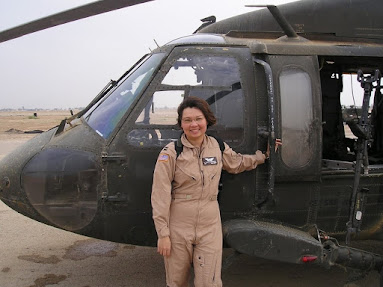
Lt. Col. Duckworth joined the military before women were authorized to serve in combat, but she got as close as she could by becoming a helicopter pilot. She describes flying over the Egyptian desert and passing the Great Pyramid of Giza in Operation Bright Star. She flew low over the Amazon rainforest in Guyana  in Operation New Horizon. And she piloted missions in Iceland to clear glaciers of rusting equipment from World War II in Operation Northern Viking.


But the most harrowing experience, of course, was what happened on Nov. 12, 2004, when Duckworth’s Black Hawk was shot down in the Iraqi desert.


Both of her legs gone. Her arm badly mangled. Shrapnel in her face and body. Her fellow soldiers thought she was dead, but they refused to leave her body behind.


U.S. Army Warrior Ethos comes alive in the aftermath of the shootdown as Duckworth’s teammates extract her nearly lifeless torso and arrange for a medieval to Baghdad, where troops lined up to give blood. She needed 40 units of blood, plasma, and platelets.


Duckworth’s recovery at Walter Reed Army Medical Center is told in painful detail –– how she bore a “wall of pain,” learned to walk with two prosthetic legs, and came to terms with her new circumstances after the tragedy in Iraq, where she says, “There’s a piece of me there, both literally and figuratively.”

At Walter Reed she had to have parts of her body surgically removed and used to repair her mangled arm. She showed unimaginable grit and toughness, mixed with typical wounded warrior morbid humor and resolve.


Duckworth’s story is one of superior resilience. “I had no choice but to power through,” she writes. “It made no sense to lie around and feel sorry for myself. I had to accept my situation, then start working to change it.”


Found Haiku in “Every Day Is a Gift”:


When the obstacle

is effort, then there is no

obstacle (at all)


Something bad happens

you can either let it own

you, or you own it


(And) no matter how

grievous the wound, healing is

always possible


I found this book at Barnes & Noble bookstore on Memorial Day. It is a perfect companion book to one recently featured in Navy Reads: James Patterson’s “Walk in my Combat Boots.”


In fact, Duckworth’s missing combat boot is symbolically returned to her by fellow soldiers in a pivotal part of her story.

During her recovery and after meeting Illinois Senators Dick Durbin and Barack Obama, Duckworth resolved to enter politics. 

She was influenced personally by wounded warrior public servants Senators Bob Dole and Max Cleland, who helped her confront post-traumatic stress disorder.

“Senator Max Cleland, who lost his legs and an arm in Vietnam, sought treatment for PTSD three decades after his injury, when he lost an election in 2002. I met Max while at Walter Reed, and talking to him helped me to truly understand that the best we can do is take life one day at a time.

In the summer of 2005, when I realized I would never fly for the Army again, that advice from Max helped save me. I was no longer sure what my purpose in life would be, but I had to just take it one day at a time, and be open to whatever came my way.”

Obama, Akaka, and Duckworth
She fought for reforms at Walter Reed and the Veterans Administration, first in Illinois and then in President Barack Obama’s administration. She fought to make a national difference, first as a representative in the U.S. Congress and then as a senator. And she fought to become a parent.

Lt. Col. Duckworth’s struggle to become a mother and her realization that there is no such thing as “work-life balance” can be an inspiration to women and a revelation to men.


In Congress Duckworth was helped by Senators Kristen Gillibrand and Amy Klobuchar, among others. The late Senator Daniel K. Akaka honored her by bestowing Hawaiian names for her two daughters.


Her choice to enter politics so she could help people is not surprising.


Early in her life she saw first-hand the need for a social safety net and equal opportunity for people of color. Fifty-four years ago, in June 1967, the Supreme Court ruled in Loving v. Virginia that interracial couples, like Duckworth’s parents, could marry.


Her father’s hero was President Ronald Reagan. In the aftermath of the Vietnam War, Reagan signed the AmerAsian Immigration Act that allowed many Southeast Asian “half-children” into the United States. Of course, they were not “halfs.”

In “Every Day Is a Gift” Senator Tammy Duckworth, who lost nearly half her body in combat, shows that every person can be part of a greater whole. She lives the teamwork ethos –– no one left behind.


This is a marvelous and powerful book filled with tears, smiles, revelations, and inspiration. Like “Walk in My Combat Boots,” this book comes with an endorsement from Adm. William H. McRaven (U.S. Navy, Ret.)


“Raw, unfiltered, powerful –– a compelling story of courage and determination against overwhelming odds. Tammy Duckworth is a true warrior who overcame a difficult upbringing, a glass ceiling, and a horrific helicopter shootdown to become one of the most respected senators on Capitol Hill. Nothing can stop her.”

Monday, December 6, 2021

Stavridis’s 50: ‘The Sailor’s Bookshelf’

Review by Bill Doughty––

The FedEx van pulled up in front of my home as I backed into my driveway. It’s a special feeling when a wished-for book arrives. I carefully sliced through the padded mailer and there it was: “The Sailor’s Bookshelf: Fifty Books to Know the Sea” by Admiral James Stavridis, arriving just days before Pearl Harbor Remembrance Day. This year’s commemoration comes on the 80th anniversary of the attack on Oahu of Dec. 7, 1941.


Stavridis gives a very personal reflection of some of the favorite books on his bookshelf, and some relate to Pearl Harbor, Hawaii, and the Pacific, which he calls “the mother of all oceans.” Others center on Europe and his favorite ocean, the Atlantic. Still others offer a diverse window into the art of reading, the lure of history –– and the terrible yet tempting beauty of the sea.


Some of the books in his collection go back to Stavridis's childhood. Many were influential in his choosing to apply to the U.S. Naval Academy or were part of his life throughout his distinguished careers both in and after the Navy.


Retired Adm. James Stavridis, former supreme allied commander, Europe, gives the keynote speech during the Armed Forces Communication and Electronics Association-U.S. Naval Institute (AFCEA/USNI) West 2016 conference. (MC2 Liam Kennedy)

His midshipman cruise in 1972 was to Pearl Harbor.

So was his first cruise as an ensign and anti-submarine warfare officer aboard USS Hewitt (DD-996), in which Stavridis sailed first to Hawaii and then westward across the Pacific in some of the same waters once explored by Capt. James Cook. 


Cook’s voyages come to life in one of Stavridis’s recommendations, “Blue Latitudes: Boldly Going Where Captain Cook Has Gone Before.” The book follows Cook’s “three epic cruises in the mid-1700s” when only about a third of the world globe was known and mapped for navigation.


The flag flies at half mast while Marines of 3rd Marine Regiment "man the rails" of the USS Arizona Memorial in 2011. (Maj. Alan Crouch)

In the Explorers section of his book, Stavridis also features James P. Delgado’s “Across the Top of the World: The Quest for the Northwest Passage.” Delgado is a maritime archeologist and veteran diver who has explored hundreds of shipwrecks, including USS Arizona (BB-39) and USS Nevada (BB-36), both hit in the attack on Pearl Harbor. Delgado goes far, far north to present a history and heritage of exploration of the Arctic region. Sir John Franklin’s perilous journey in 1845 is at the heart of the story.

Rear Adm. Fiske (NHHC)
Another intrepid explorer of a sort is a “consummate seaman” and commander who invented technology in the late 1800s and turn of the century to help sailors on steam vessels and promote sea control and sea power. Admiral Bradley A. Fiske is author of “The Navy as a Fighting Machine.” Like Alfred Thayer Mahan, who is also featured in this collection, Fiske lobbied for and helped establish the position of Chief of Naval Operations. 

He was a champion for readiness as “a persuasive and thoughtful operational maritime thinker and writer.”


Exactly one hundred years ago, Fiske was president of USNI.


Stavridis writes:

“He was also a prescient strategic analyst. He served as president of the U.S. Naval Institute, the intellectual heart of the naval profession, for eleven years, 1912-1923, thinking, writing, and publishing constantly. As late as 1924 he was commenting on international affairs, correctly predicting the inevitability of a U.S.-Japanese war. He lived to see that dire proclamation come to pass with the 1941 attack on Pearl Harbor in his eighty-seventh year but sadly not quite long enough to see the pivotal battle of Midway in the early summer of 1942 turn the tide in the Pacific.”

Speaking of heroes and Pearl Harbor, Stavridis features a book in the “Oceans” section co-authored by Adm. Chester W. Nimitz, along with Professor E.B. Potter, titled “Sea Power: A Naval History.” Nimitz, of course, commanded the Pacific Fleet from Pearl Harbor and led the effort to defeat Imperial Japan in less than four years. In this classic 932-page book, first published in 1960, Potter and Nimitz provide a history of the American and world navies and how naval warfare has evolved to become a fundamental part of national power.


Stavridis, who was a student of Potter’s at the Naval Academy, wrote his own book with the same name but “different in tone and style” and in homage to his former professor. Adm. Stavridis’s “Sea Power: The History and Geopolitics of the World’s Oceans” is one of many of his works I’ve featured on Navy Reads over the past decade. 


Stavridis acknowledges he could have chosen to showcase many other books about the War in the Pacific in addition to the Potter-Nimitz “Sea Power.” He considered Samuel Eliot Morison’s multi-volume “History of Naval Operations in World War II” and Craig L. Symonds’s single-volume “World War II at Sea: A Global History."


Lt. Cmdr. Ernest E. Evans, at commissioning ceremonies of USS Johnston (DD-557), Seattle, WA, 27 October 1943. He was Johnston's commanding officer from then until she was sunk in the Battle off Samar, 25 October 1944, and was lost with the ship. (U.S. Naval History and Heritage Command)


The “cornerstone book about the naval war in the Pacific during World War II” he chooses, however, is the captivating “Sea of Thunder: Four Commanders and the Last Great Naval Campaign, 1941-1945.” The book centers on the Battle of Leyte Gulf in October 1944 and, as the subtitle says, four commanders:

“Admiral William ‘Bull’ Halsey, a swaggering (and deeply racist) commander of the American fleet for much of the combat; the elegant Japanese admiral Takeo Kurita, a battleship force commander who launched a near-suicidal attack on the American forces poised to retake the Philippine Islands; another Japanese admiral, Matome Ugaki, who saw himself as the purest of samurai and led the kamikaze forces at the end of the war; and –– the most appealing of the four –– the relatively junior Navy commander Ernest Evans, captain of USS Johnston (DD-557), a small destroyer that undertook a deeply heroic attack on a far larger Japanese force … In the course of telling the story of the battle, Thomas takes the reader through the vast U.S. maritime strategy to reconquer to Pacific Ocean and its hundreds of atolls, islands, barrier reefs, and littoral nations after the Japanese offensive wave of conquest had swept over much of it in the early days of the war” [in the aftermath of Pearl Harbor]

Pearl Harbor is just one of the many themes touched on in this wonderful collection that also includes diverse works by Rachel L. Carson, Simon Winchester, Thomas J. Cutler, Caroline Alexander, Nathan Philbrick, Herman Wouk, Patrick O’Brian, Sebastian Junger, and Joan Druett.


Throughout the collection, Stavridis shares personal joys and discoveries through reading. He expresses his deep love for the sea, starting in childhood. “What fascinated me then, and still does so many decades later, was the unpredictability of the ocean. It could change color, smell, wave pattern, surface condition, and a dozen other variables in an hour. It was a chameleon…”


The admiral’s curiosity also drives unpredictability in his selection of books in this collection, which features a book of poetry (“Moods of the Sea: Masterworks of Sea Poetry” by George C. Solley and Eric Steinbaugh), a book about art (“Turner & the Sea” by Christine Riding and Richard Johns, about artist J. M. W. Turner, who painted "The Battle of Trafalgar" and "The Fighting termeraire tugged to her last Berth to be broken up," pictured above), and a book of magical fiction (“Life of Pi” by Yann Martel), requiring the reader to suspend the constraints of science.

“I have always loved magical realism in the world of literature. This is a strain of fiction writing in which things exist in a novel or short story (or even a poem) that cannot quite be squared with the real world. The most famous writer of magical realism, who is especially prominent in the literature of Latin America, is the Nobel Prize-winner Gabriel García Márquez. His extraordinary novel “One Hundred Years of Solitude” is widely regarded as the classic example of magical realism. Some other authors who deal in this style of writing include Toni Morrison (“Beloved”), Salman Rushdie (“Midnight’s Children”), Haruki Murakami (“IQ84”), Günter Grass (“The Tin Drum”), and Neil Gaiman (“The Ocean at the End of the Lane”). In such novels there are often ghostly visitations, dreamlike sequences, mythological gods, talking animals, imagined events, and unreliable narrators.”

Stavridis is a most-reliable narrator and navigator as he takes us on his voyage to “The Sailor’s Bookshelf” and a journey of self discovery. “I’ve always believed that reading allows an individual to essentially expand their life every time they open a book,” he writes in the book’s preface.


U.S. Navy Airman Benjamin Adams, from Panama City, Fla., reads a book on the fantail of the aircraft carrier USS Nimitz (CVN 68), July 5, 2017, in the South China Sea. Nimitz was on deployment in the U.S. 7th Fleet area of operations. The U.S. Navy has patrolled the Indo-Asia Pacific routinely for more than 70 years promoting regional peace and security. (MC3 Ian Kinkead)

While he provides ample inclusion of fiction titles, most of the selections in “The Sailor’s Bookshelf” are nonfiction and history. Based on his recommendation, I added this title to my to-read list: “Empires of the Sea: The Siege of Malta, the Battle of Lepanto, and the Contest for the Center of the World,” a book about the Battle of Lepanto, and a book that had special meaning to Stavridis when he was the Supreme Allied Commander of NATO.

“For a sailor to read ‘Empires of the Sea’ is to almost feel the ships under way and hear the sails snapping in the breeze. You can smell the gunpowder and hear the crack of cannons over the waves and wind. Crowley focuses on the geopolitics as backdrop, but the great strength of this book is a realistic focus on war at sea. It includes descriptions of the sea battles and sieges against the islands of Cyprus and Malta as well as the more or less constant activities of pirates. The centerpiece, of course, is Lepanto, and there is not a better description written. The entire book is truly an engrossing read, and one that keeps the reader’s sensibility under way with every page.”

The subtitle of “The Sailor’s Bookshelf” says “50 books,” but the author can’t help himself. Readers will find hundreds of titles of great books tucked inside “bonus” suggestions, lists, and notes as well as the fifty essays themselves.


                                                                                                                                         (PO2 Patrick Kelly)
Among the recommended reads are titles of books that were read by Pearl Harbor Survivors and other World War II veterans. I’ve had the honor to meet and interview many Pearl Harbor Survivors, most of whom are gone. Before and after and sometimes even during the war they read Jules Verne, Herman Melville, and Ernest Hemingway, all featured in this collection. Stavridis’s “The Sailor’s Bookshelf” is a labor of love.

It is dedicated “To my parents who taught me to love reading, To my teachers who taught me to love writing, To my shipmates who taught me to love the sea, and To my wife and daughters who taught me to love life.”


I will revisit this collection for a future Navy Reads “Bookshelf Part II.”


-----------------------------------------------------------------------


RIP Senator Robert J. Dole


American statesman Sen. Bob Dole of Kansas died yesterday, Dec. 5, 2021, after a long bout with lung cancer. Like another of his colleagues, late Sen. Daniel K. Inouye of Hawaii, Dole wanted to become a doctor prior to the attack on Oahu and the start of American involvement in World War II. And like Inouye, Dole joined the Army shortly after Pearl Harbor and was severely, nearly mortally, wounded but recovered and dedicated his life to continued public service.


Senator Bob Dole and President Gerald Ford, Oval Office, 1976. (Bob and Elizabeth Dole Archives, KU)

While in Congress, Dole helped bring about the Civil Rights Act, the Voting Rights Act, and the Americans with Disabilities Act. He helped save Social Security when it came under threat in 1983, and he was a lifelong strong supporter of national defense.


Dole, known for his dry-wit sense of humor, support for the Constitution, and general grace in defeat, was vice presidential running mate to Navy/WWII Veteran President Gerald Ford in the 1976 U.S. campaign; Dole became the Republican nominee for president in 1996. President Bill Clinton presented Dole with the Presidential Medal of Freedom in 1997 (pictured below).


Flags are flying at half-staff to honor both Dole and Pearl Harbor Remembrance Day on the 80th anniversary of the attack.