Showing posts with label Cold War. Show all posts

Sunday, September 11, 2022

September Remember: USS Midway in Japan

by Bill Doughty––

I was attending school in Tokyo and living in Yokosuka in 1973 when USS Midway (CV-41) arrived in Yokosuka –– the first U.S. aircraft carrier to be stationed in Japan as part of the Forward-Deployed Naval Forces. It was a big deal, less than thirty years after World War II, and just months after the U.S. military departed Vietnam.


Midway was commissioned 77 years ago, Sept. 10, 1945, just eight days after Imperial Japan surrendered. Stationing the ship in Japan was hugely symbolic; Midway is named for the historic and pivotal battle in 1943 that turned the tide in WWII.


USS Midway (CV-41) arrives in Yokosuka, Oct. 7, 1973. Photo from Midway cruise book. (Ryo Isobe, DVIDS)
But that’s only one reason the carrier’s arrival in Yokosuka was opposed by many Nihonjin, sometimes violently.

Hundreds of Japanese citizens, loudly opposed to America’s war in Vietnam, came to Yokosuka in 1973 to protest the arrival of Midway.

I remember scores of demonstrators in headbands and helmets, faces covered, white-knuckled fists gripping bamboo poles. The demonstrators assembled by the Yokosuka JNR station and marched to the closed gates of the base. Japanese police in riot gear formed a human shield. Marine guards stood ready behind them. Some radical demonstrators attacked the police and were repelled with fire hoses.


Midway had been a recent (and repeated) participant in what was then called the Vietnam Conflict, a war for which the ship received the Presidential Unit Citation from President Nixon in early 1973.


Two years later, Midway would join with other ships of the U.S. 7th Fleet in Operation Frequent Wind, the evacuation of Saigon.


Three years after Midway’s arrival in Yokosuka, the United States celebrated its bicentennial, 1776-1976. By then, I was just out of college and contributing stories to the Seahawk base newspaper on my way to becoming editor and eventually a public affairs officer.

Early in its career, Midway participated in historic operations in the Caribbean, near the Arctic, throughout the Mediterranean, and in both the Atlantic and Pacific, including near North Korea.

Midway would go on to participate in various peacekeeping operations, including Operation Desert Shield and Desert Storm, after Iraq failed to obey a United Nations ultimatum to withdraw from its invasion of Kuwait.


Just as it did in the evacuation of refugees after the fall of Saigon, Midway played a key role with other ships in rescuing evacuees from the Philippines in Operation Fiery Vigil after the eruption of Mt. Pinatubo. That was in June of 1991.


I was still living in Yokosuka and working for the Navy when USS Midway departed Yokosuka for the final time in August 1991. The workhorse aircraft carrier was headed to retirement 31 years ago this month –– via Pearl Harbor, Seattle, and Bremerton –– eventually to San Diego.


USS Midway arrives in Pearl Harbor, August 23, 1991.
By 1991, more Japanese people came to realize the value of having a strong U.S. Navy presence, working cooperatively with the Japan Maritime Self-Defense Force to maintain freedom of the seas. 

Just as the United States Constitution was a model for Japan’s form of government, the United States Navy served as a model for the JMSDF –– with direct help and guidance from Adm. Arleigh A. Burke.


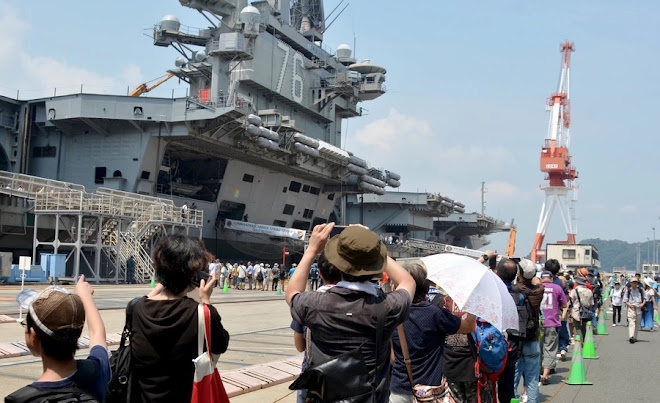
Over many years, Yokosuka has held hugely popular base open-house events, inviting tens of thousands of Japanese citizens onto the base to participate in games, enjoy food booths, attend concerts, and go aboard U.S. Navy ships.


The most popular draw at base open-house events? Tours of an aircraft carrier.


After Midway’s departure, other carriers followed its lead to become forward-deployed in Japan: USS Independence (CV-62), USS Kitty Hawk (CV-63), USS George Washington (CVN-73), and USS Ronald Reagan (CVN-76).


Japanese guests line up to board USS Ronald Reagan (CVN-76), October 10, 2015, during Yokosuka's Friendship Day open-base event. (MC1 Peter Burghart)

Open-base events were suspended for a time in the aftermath of attacks on the United States by religious zealots –– Islamist terrorists –– on September 11, 2001. (I remember the gates being locked down for weeks. Everyone who lived off base were required to park a few miles away and were offered rides to work or schools on base in carefully screened shuttle buses.)


In September 2003, USS Midway departed its temporary home of Bremerton, WA, to become a museum and memorial in San Diego. It welcomes an average of more than one million visitors per year. As with the USS Arizona Memorial in Pearl Harbor, many of the visitors to the USS Midway Museum include people from Japan who come to pay respect and learn about history.


Operation Sandy (Midway Museum Archives)
The museum offers a robust website highlighting the ship’s proud legacy, including operations in the Arctic, Taiwan Strait, and Vietnam, among others. I found some fascinating Midway photos available for download from Flikr, courtesy of the Museum. Some of the photos on the museum’s site include ringside views of Operation Sandy, the world’s first test-firing of a ballistic missile from a ship at sea.

There are numerous resources on the museum’s website, including videos and first-person accounts. This line stands out: “When history speaks, turn up the volume.”


In reading the history of the USS Midway, we can see the evolution of the modern Navy, from the immediate postwar, through the entire Cold War, and operations in Vietnam. But the ship is remembered most fondly, perhaps, for its role in helping people and promoting peaceful protection, especially for eighteen years in Yokosuka, Japan.


USS Midway’s strategic role in the Cold War, is a key part of James D. Hornfischer’s fascinating “Who Can Hold the Sea: The U.S. Navy in the Cold War, 1945-1960” (Bantam Books, 2022).


I have a two-part review of Hornfischer's final work posted in recent weeks. Hornfischer has been a favorite over the years. In May 2012, he offered a guest mini-review of five books he recommended to Navy Reads.


Tuesday, September 6, 2022

Part II: Hornfischer’s One Ocean…

Review by Bill Doughty––

James D. Hornfischer’s final book, “Who Can Hold the Sea,” opens with a poignant message from Jim’s widow, Sharon Hornfischer.


Sharon includes this advice:

“Jim believed, as I also do, that others of this generation and future generations will carry on telling the stories of our great nation’s history. Share your stories with your children and grandchildren, nieces and nephews, so that they are engaged in our nation’s history and our country’s continued fight for freedom and democracy. Encourage our next generation, take them to air shows, museums, and libraries; ignite the spark of curiosity in our future historians and writers so that they can continue to tell stories for us all to read.”

Hornfischer
It’s both sad and inspiring to read Jim Hornfischer’s final work. As both a gifted writer and historian, he created vivid true stories of Sailors and Marines and their leaders. This book’s preface, introduction, and acknowledgements bookend the story of the Cold War with tender personal messages.

Hornfischer’s “Who Can Hold the Sea” (Bantam Books, 2022) opens in the gray aftermath of World War II.


After confronting and defeating fascism, the United States and most of the Allies moved toward greater democracy, peacekeeping, rule of law, and liberty for all. The Soviet Union, on the other hand, held on to autocracy, aggression, violations of laws, and control of its citizens’ freedoms.


“For Truman,” Hornfischer observes, “the Soviet Union was a treacherous and malignant betrayer.”


Americans adjusted to postwar realities –– not only fear of spreading communism and Soviet expansion, but also budgetary turmoil that reached into the military. Some politicians proposed doing away with the Marine Corps and Navy and merging the service branches.


None other than Adm. William “Bull” Halsey spoke out against the merger in a speech thankfully excerpted by Hornfischer.


Halsey said, in part:

“Merger is not necessary. It is not desirable. It is plainly dangerous. It would destroy the initiative of individual services. It would hamstring their right to advance. It would deprive them of representation before Congress and the people. It would substitute military for civilian control. It might lead to military dictatorship.”

Admirals Chester Nimitz, Ernest J. King, Marc Mitscher, and Edward L. Cochrane –– along with Secretary of the Navy (and first Secretary of Defense) James V. Forrestal –– persuaded President Truman and others that the Navy had a strategic role in the Atomic Age; merger of the services, along with loss of the Marine Corps, would be a bad idea.


President Truman is welcomed aboard USS Franklin D. Roosevelt (CV-42) by SECNAV Forrestal and Adm. Nimitz. Adm. Leahy pictured in background. (NHHC)
Truman visited Norfolk, Virginia, in April 1946 at the invitation of Commander in Chief, U.S. Atlantic Fleet Adm. Mitscher. Truman witnessed the power of naval aviation and capabilities of aircraft carriers USS Franklin D. Roosevelt (CV-42) and the seemingly ubiquitous USS Midway (CV-41). Mitscher’s chief of staff was Capt. Arleigh Burke.

Then-SECNAV Forrestal was one of the principal architects of the post-war modern Navy. His global vision was based on peace through freedom and democracy, not communism or autocracy. Hornfischer writes, “If that world was to become a community, it would be possible, Forrestal thought, only with U.S. leadership, the victorious democracy investing its credibility and standing in the world to promote self-determination and freedom wherever it showed aspiration.” Hornfischer explores the role Forrestal played and delves into Forrestal’s controversial death at Bethesda Naval Hospital.


“Who Can Hold the Sea” vividly covers how Burke, Nimitz and Forrestal shaped the Navy during the Cold War. And strategic thinker and diplomat George Frost Kennan influenced the influencers, as Mahan had done for the first half of the century. Kennan recognized early the “perverse brutality and terror” of Joseph Stalin and Communism’s threat to Capitalism and democracy.


Watercolor of scorched USS Nevada (BB-36) as Nagato and Sakawa sink.. (Arthur Beaumont, 1946)
As a result of those fears, including the real fear that the Soviets were developing nuclear weapons, the United States rushed to conduct atomic bomb tests in the Pacific just a year after the war. In Operation Crossroads, the Navy positioned hundreds of pigs and goats, as well as 4,000 rats, aboard a target ship to test the results of radiation from a nuclear “cauliflower head.” The results were staggering and crippling.

The flagship of Adm. William H. “Spike” Blandy, who headed up Operation Crossroads, was contaminated with radiation, so “hot” it needed to “cool down” before it could be boarded.


After "Able" and "Baker," Blandy had to cancel a third "Charley" stage of the test, Hornfischer notes. “The radioactive mess had become impossible to manage.”


Later, he would celebrate the operation with a bizarre cake-cutting ceremony.


Vice Adm. Blandy and his wife cut into an Operation Crossroads cake shaped to look like a radioactive geyser, as Rear Adm. Frank J. Lowry looks on, Nov. 7, 1946.

The Navy forged forward in developing deployable nuclear weapons, supported by John L. Sullivan, Secretary of the Navy.

The atomic bomb would shape the entire forty-four-year span of the Cold War. Made even smaller and more easily deployable, with larger and larger payloads, it would place every crook and crevice of the world under threat of ruin. War planners schemed to win atomic exchanges, even as they and every policy maker had no sense of consequences, and prudence demanded keeping the weapon in Pandora’s box. Humility, terror, curiosity, eager innovation, and abject paranoia would be the diverse by-products of the bomb.”

Louis A. Johnson
Sullivan would fight for the Navy but would resign in the face of cutbacks, cancellation of construction of the CVA-58 class aircraft carrier USS United States, and favoritism for the Air Force by SECDEF Louis A. Johnson. “The new defense secretary was an equal opportunity irritant, abrasive and arrogant and making no effort to filter it,” Hornfischer writes. “Johnson’s animus toward the Navy was an open secret.”

Despite obstacles, the Navy forged ahead in developing deployable nuclear weapons and nuclear-powered ships, including submarines. 


Hornfischer reveals how close the world came to nuclear war in the decade-and-a-half after bombs were dropped on Hiroshima and Nagasaki.


Leaders contemplated using nuclear weapons after Communist China threatened Formosa (Taiwan), after Communist North Korea invaded the South, and after Communists took power in French Indochina (Vietnam). Eisenhower was a voice of reason in nixing the idea of using the Bomb. Though not covered in this book, the Bay of Pigs incident comes to mind, when President John F. Kennedy, Navy veteran and WWII hero, proved to be the voice of reason in preventing nuclear war after the Soviet Union threatened to position nuclear weapons in Cuba.


Admittedly incomplete and somewhat unfinished, Hornfischer’s history of the Cold War is a compelling book thanks to the author’s distinctive style and grace. His writing shines in descriptions of not only events but also people, such as the great Arleigh Burke, “the son of a humble Colorado farmer,” a leader who embraced an ethos of good leadership.

“[Burke] had taken integrity, self-discipline, and strong principles from his father and mother, a teacher. In 1923, the year he graduated from the U.S. Naval Academy, the faculty had just compiled the first textbook on naval leadership. It listed the ‘essential qualities’ of a naval officer as personal dignity, honor, courage, truthfulness, faith, justice, earnestness, assiduity, judgment, perseverance, tact, self-control, simplicity, and loyalty –– to country and to service, to both one’s seniors and juniors. ‘Loyalty up and down was important because of the natural independence and self-reliance of the American sailor,’ and naval officers had to earn the respect of their men [and women] through their personal merit and example. Burke had been trained as a specialist in ordnance, earning a master’s degree in chemical engineering and becoming a design and production specialist in explosives. This background exposed Burke to the most advanced naval technologies of his time and would prepare him as CNO to promote the development of nuclear weapons, nuclear power, and guided and ballistic missiles.”

Burke helped guide the Navy through rough seas during the Cold War.


CNO Arleigh Burke on the bridge of USS Forrestal (CVA-59) March 12, 1956 as ship's CO Capt. Roy L. Johnson points out distant aircraft. (NHHC)

It’s bittersweet to read this excellent book about the Cold War knowing that Hornfischer is gone. He died last summer after a valiant fight with cancer. As mentioned, his wife Sharon offers a beautiful tribute to him and his legacy in the book’s preface.

Both Jim and Sharon offer acknowledgements at the end of this book. They thank retired Navy Admiral “Fox” Fallon, former commander of both U.S. Pacific Command and Fleet Forces Command and current board chairman of the Naval Historical Foundation. They also acknowledge and thank other graybeards, including retired Rear Admiral Samuel Cox, director of Naval History and Heritage Command and Curator of the Navy. The Hornfischers pay special tribute to the Nimitz Museum in Fredericksburg, Texas, hometown of the great admiral who led the winning strategy in the Pacific War.


This terrific book brought other books to mind that would make good companion reading: “Atlantic” and “Pacific” by Simon Winchester; "The Second Most Powerful Man in the World: The Life of Admiral William D. Leahy, Roosevelt's Chief of Staff" by Phillips Payson O'Brien; “Revolt of the Admirals: The Fight for Naval Aviation, 1945-1950” by Jeffrey G. Barlow; "The Silent War: The Cold War Battle Beneath the Sea” by John Piña Craven; “This Kind of War: The Classic Korean War History” by T. R. Fehrenbach; “Gangsters of Capitalism: Smedley Butler, the Marines, and the Making and Breaking of America’s Empire” by Jonathan M. Katz; “Opening the Great Depths: The Bathyscaph Trieste and Pioneers of Undersea Exploration” by Norman Polmar and Lee J. Mathers; and “The Blue Age: How the US Navy created Global Prosperity –– and Why We’re in Danger of Losing It” by Gregg Easterbrook. It goes without saying that every book by Hornfischer should be on the reading list for anyone interested in American maritime history.


The Hornfischers valued libraries, museums, research institutes, and, of course, books. As Jim writes, “Those interested in national and maritime affairs ought to be mindful of the major events of the past.”


Top Photo: Operation Crossroads "Baker Day" A-bomb underwater explosion, seen from shore of Bikini Atoll, 25 July 1946. NHHC


(In Part I of this review, we presented Hornfischer's view of "one global ocean." We also compared Gorbachev and Putin, discussed the rise of NATO, and presented some coincidental milestones that happened in August and September decades ago.)

Wednesday, August 31, 2022

Hornfischer’s 'One Ocean' in the Cold War

Review by Bill Doughty––

In his best, pure “The Last of the Tin Can Sailors” style, James D. Hornfischer tells the harrowing story of the fate of the submarine USS Cochino (SS-345) in “Who Can Hold the Sea: The U.S. Navy in the Cold War, 1945-1960” (Bantam Books, 2022).

USS Cochino and other submarines, including USS Tusk (SS-426), were operating near the Arctic Circle in August 1949, seventy-three years ago this month, four years after World War II and at the start of the Cold War with the Soviet Union. Hornfischer writes of the heroism of U.S. Navy Sailors trying to save their submarine after a gas leak, fire, and explosions. “Heroism,” he writes, “was never a function of rank.”


Hornfischer’s account of the Sailors’ valor, both aboard Cochino and the rescue submarine Tusk, is typically gripping and dramatic –– and too long to adequately excerpt here. Readers can find it in Chapter 11, “Abandon Ship.” But readers who invest time in reading all 400-plus pages of this book will be rewarded with an understanding of how the United States Navy and Marine Corps survived, thrived, and helped maintain peace in the aftermath of WWII and in the face of communist expansion, especially by the Soviets.

As a result of America’s commitment to democracy and its alliance with Western Europe –– impelled by the Truman Doctrine –– twelve nations, including the United States, signed the North Atlantic Treaty on April 4, 1949, four months prior to the Cochino incident. Norway is one of those original NATO members.


Capt. Roy Benson, Commander of Submarine Development Group Two, met with the surviving American Sailors of Cochino and Tusk in Norway. He also met with Norwegian diplomats. Hornfischer writes:

“The relationship between Oslo and Washington, fully reciprocal and secure within NATO, was based on the security needs of democratic Norway and the strategic value of its coast … the Norwegian fjords offered plentiful tactical advantages for an enterprising fleet commander. These included ‘ready concealment; year-round ice-free deepwater paths to the sea by diverse routes, easy protection from surface or ground forces, ideal antiaircraft gun protection possibilities, [and] large seaplane sheltered landing areas. Thus, bases in the fjords could be advantageous to us as denial of them to the opponent would be disastrous to his plans.’ These insights would not be forgotten.

“The Norwegian officers who met Roy Benson and his men were ready to meet Russia in war. ‘Within thirty minutes of declaration of war,’ a host officer boasted to the Americans, ‘every Norwegian male would be in uniform and under arms and in another half hour every Communist would be dead or in custody.’ Scandinavians had known recently the sound of the treads of Russian tanks and held no illusions about Moscow’s continuing ambitions. They knew that Russia coveted naval bases in the fjords as a means of escaping the polar ice prison that constrained their potential to project naval power into the world. As Worthington put it, the Norwegians were ‘happy to see evidence that the U.S. Navy was thinking of their part of the world.’”

In his profound way, Hornfischer observes, “Nations that perceive threats globally were compelled to operate on the outer membrane of the possible.” Freedom and democracy took a stand against Communism and autocracy in the Cold War.


Now there are 30 nations as part of NATO, with Finland and Sweden on their way to becoming members in the face of Russian revanchism after Putin’s unprovoked attack on neighbor Ukraine earlier this year.


Stalin and Putin
Hornfischer examines the mindset of authoritarian Joseph Stalin under “Communism’s self-hypnosis” of blind belief but with the “political reflexes of a perpetually fear-bound despot.” He examines Russia’s national psychology and Stalin’s “mastery of the tools of the paranoid art.” Such feelings of persecution and victimization are familiar in studying other autocrats.

In sharp contrast to Putin, is the pivotal leader who brought about the dissolution of the Soviet Union, Mikhail Gorbachev, who died today at the age of 91. A generation after the era covered in this book, Gorbachev famously proposed doing away with nuclear weapons. He worked with Presidents Ronald Reagan and George H. W. Bush to reduce nuclear arms. Putin, on the other hand, threatens to use them, especially if NATO threatens to help Ukraine directly. Gorbachev’s USSR was brought down in the aftermath of the Chernobyl meltdown; Putin has his military fire upon and otherwise threaten nuclear power plants in an attempt to make Russia great again.


The fifteen-year span covered in this book covers the evolution of submarines and the nuclear navy and the game-changing development of the Polaris missile. Hornfischer briefly covers the Korean War, U.S. nuclear weapons tests in the Pacific, “Revolt of the Admirals,” and threats by Communist China to Taiwan. He reveals sometimes startling milestones that occurred in August or September:

  • The secret mission of Operation Sandy near Bermuda, in which USS Midway (CV-41) would test for the first time a Navy ship’s ability to launch strategic ballistic missiles, Sept. 2-6, 1947.
  • The creation of the CIA, led by its first director, Navy Rear Adm. Roscoe H. Hillenkoetter, Sept. 18, 1947.
  • The discovery by a military “Pole Vaulter” from Misawa Air Base of the Soviet Union’s apparent first nuclear test, Sept. 3, 1949.
  • The first time Marines moved from ship (USS Sicily CVE-118) to shore aboard helicopters (HRS-1) into the Inchon area in South Korea, Sept. 1, 1952.
  • The U.S. Navy’s confrontation with Communist China over bombardment in the staged attack on Quemoy islands in the Taiwan Strait, Aug. 23, 1958. (USS Midway was deployed from Pearl Harbor to provide deterrence and protection to Taiwan.)
  • The first (unsuccessful) attempt by USS Nautilus (SSN-571), captained by William Anderson to find an “undersea Northwest Passage in reverse” under the Arctic, Aug. 19, 1957.
  • The second (successful) attempt by USS Nautilus, captained by William Anderson, to transit the Arctic, arriving beneath the North Pole on Aug. 2, 1958.

Hornfischer’s taut style, found in “Tin Can Sailors,” "Neptune's Inferno," and "Ship of Ghosts," captures readers as his words pulsate about USS Nautilus's attempt.


USS Nautilus underway.
The submariners squeeze under and around walls of ice, not knowing what might lie ahead. “Only Neptune knew what kind of ice was in store for them in these tight underwater caves.”

From descriptions of Cochino’s failed attempt to transit the Barents Sea and Arctic Circle in August 1949 to Nautilus’s victorious achievement in August 1958, Hornfischer shows the resilience, commitment, and innovation of the U.S. Navy to “Hold the Sea.”


Echoing ret. Adm. James Stavridis, Hornfischer writes, “Though landsmen speak of the world’s seven seas, there is in fact only one global ocean.”

NATO Response Force and Allied Marines from the U.S., Sweden, Finland, and U.K. simulate amphibious assaults on a Swedish beachhead during BALTOPS June 10, 2015. The 17 Allied and partner countries integrated air, land, and sea operations and procedures to demonstrate the combined-forces capability to respond to threats in the Baltic region. (Sgt. Tatum Vayavananda.)

Sunday, January 30, 2022

Blue Age II: China, Russia, Mahan & Law

Review by Bill Doughty––

In Part I of our review of Gregg Easterbrook’s “The Blue Age: How the US Navy Created Global Prosperity –– and Why We’re in Danger of Losing It” we explored his thesis that the United States Navy is a force for good, keeping peace and stability on the seas, promoting prosperity, and reducing worldwide poverty.


Easterbrook says, “The United States would do well to recognize how many of its advantages are gifts of the sea.” Keeping sea lanes open the global commons from other nations’ ill intent and also from piracy means “open highways without trolls or tolls.”

Then-CNO Adm. Gary Roughead visits PLAN hospital ship Daishandao in Qindao, China in 2009,
Former Chief of Naval Operations Adm. Gary Roughead is quoted twice in “The Blue Age.” Roughead says, “Land and air forces can win disputes, but it is the Navy that keeps disputes far from our shores.” Easterbrook quips, “Keeping disputes far from our shores looks better all the time.

In Part I of our review of “The Blue Age,” we also presented Easterbrook’s conclusion that thinker-strategist Alfred Thayer Mahan was fundamentally wrong in some of his beliefs that, in fact, may have led to two world wars –– and may be influencing China today in the PRC’s expansionist policies, which parrot some of Mahan’s own views.

We also touched on Easterbrook’s conclusion that a continued era of peace and prosperity requires nations' commitment to following international laws, which will lead to more international cooperation. That’s especially important for the world’s two biggest powers.


“The question of whether the blue age will continue comes down to this: whether the United States and China, the two most important nations of history, can get along,” Easterbrook writes. Can maritime cooperation be achieved on the “outlaw ocean” through empathy and mutual respect?


“Walking in another’s shoes is the essence of human understanding,” Easterbrook contends. 


So, what is it like in China’s shoes?


Lights of Beijing and Tianjin, captured by the International Space Station orbiting 264 miles above, May 1, 2021. (NASA)
Evidence of China's rapid rise within one generation can be seen from space. But the affluence comes with effluence. "China must control its greenhouse emissions, the worst in the world." Easterbrook says, “Life is stressful in China, corruption permeates government, elections are rigged, and there is no freedom of speech or religion. These said, China’s living-standards, improvements and poverty reduction from 1995 to 2020 rank high in any accounting of the human family’s great accomplishments.”

In a deceptively easy style but with academic rigor, Easterbrook explains some of China’s feelings of victimization, its previous isolation, and its lack of enlightenment about human rights. He looks at the history of East/West interaction over centuries in or affecting China. And he shows some of the hypocrisy in dealing with the Middle Kingdom, including in recent history.

For example, President Trump’s second Secretary of State, Mike Pompeo, lectured Chinese leaders about their lack of democracy, then –– in an attack on our own democracy –– “told the world from the podium of the Department of State that the [U.S.] election outcome would be ignored and Trump would remain president.” Then there's the January 6, 2021 insurrection, seen by the world.

“Walking in China’s shoes does not mean excusing failings, including oppression of the Uighurs and Tibetans, betrayal of Hong Kong, stifling of free speech, ‘labor camps’ that are actually prisons, no constitutional rights, corruption top to bottom. In China there is plenty of disgrace to go around. 

“Above all these, 1.4 billion human beings are living close together in a place that’s polluted and depleting its aquifers at an alarming rate. Modern China may not remain stable. Unstable societies may lash out. If China lashes out, the sea is the most likely setting.”

Easterbrook reminds his readers, “Capital C Communism has not failed some of the time; it has failed all of the time.” In large part, because the individual has a need to live free, not as vassals of an authoritarian state.

“The Western view of the world –– unbraced by the United States, the European Union, the United Kingdom, Canada, Australia, New Zealand, Norway, and increasingly by Japan and South Korea –– is the Enlightenment conclusion that the individual is more important than the state. The view is morally correct, is self-evident under natural law, is true in a metaphysical sense that exists independent of the empirical. The individual is more important than the state. That’s five hundred years of Western thought in one sentence.”

And individuals, once recognized as such, have rights, including the right to own property.

“The right to property is deceptively important, as it has been contested by many social systems, including fascist, autocratic, and communist. If at root your property is yours, just as your thoughts are yours, you have an incentive to build, create, and trade, profiting while helping others. If at root your property belongs to the commissar, prince, or Gauleiters, why work hard? That far-left and far-right nations are economically sluggish compared with the for-profit nations is explained in this way.”

Easterbrook warns against “fear of outsiders and assumption that change is automatically bad. Whatever might be true in a perfect world, in the actual world, opposition to change is a formula for being left behind.”


Ukraine President V. Zelensky meets Cmrs. John D. John, CO of USS Ross (DDG 71) during Exercise Sea Breeze 2021, Odessa, Ukraine. (MC2 Grosvenor)
Enlightened change is needed in strengthening international codes and conventions governing the world’s oceans. For example, there is a need for enforcing laws, including “against naval assaults, such as the one Russia staged in 2014 at Crimea.”

And what about Russia?


Then-Supreme Allied Commander Europe, Adm. James Stavridis holds a press conference with Russia Chief of Defense, Nov. 1, 2010. (Sebastian Kelm)
“Blue Age” evaluates the threat posed by Putin’s Russia as it also tries to build a modernized fleet as it rattles its scimitar at its neighbors, especially now against Ukraine.

“Since Russia about a decade ago gave up its hope of European Union membership, turning cold to the West, the Kremlin has resumed longing for the kind of maritime power that great nations possess. Russia’s moves against Crimea and Ukraine were seen in the West as owing to Putin’s ego. To the Kremlin, they were an attempt to fulfill centuries of Slavic desire for year-round access to warm waters.”

But intrusions into another nation is just one issue.

“A true global governance system for the blue water would eliminate flag-of-convenience loopholes, protect workers in fishing and shipping, impose strict antipollution rules, and create clear agreements about the mining of minerals on the seafloor. Prototype vessels that vacuum up nodules from the seabed discharge effluent that can pollute the towering deepwater columns essential to marine life, including the marine plants that release oxygen. If sea mining is to become common, a much better system, with close supervision, is required.”

Hope for better oversight rests in a document that is already in front of the international community, the “Law of the Sea.”


“No matter what, we need America to ratify the Convention on the Law of the Sea,” Easterbrook pleads. “The US position on this treaty is irrational. Irrational has been doing quite well in Washington, D.C., lately. But there must be international consensus on how to govern the seas. The sooner the world acts on this, the better.” International agreement and enforcement would protect fishing grounds and habitats, energy resources, and internet communication cables.


Easterbrook notes, “Since 1994 nearly every member of the Joint Chiefs of Staff, the leadership committee for the US military, has expressed support for the Law of the Sea.”


As for nuclear arms control:

“When he was president, Jimmy Carter, a former navy officer who had been the XO of a submarine, joined the Soviet Union in signing the treaty called SALT II, which aimed to reduce strategic nuclear weapons. SALT II begat an arms control regime now called NEW START. At the end of the Carter presidency, the United States and Soviet Union possessed about 54,000 nuclear bombs, according to the Federation of American Scientists; today the total is down to about 9,900. In 2009, Barack Obama won the Nobel Peace Prize for advocating elimination of nuclear explosives.”

After Trump took the United States out of the 1987 Intermediate-Range Nuclear Forces Treaty in 2018, the Russian Federation also withdrew. China was not a signatory.


Easterbrook says, “Full elimination of nuclear arms might backfire by allowing great-power fighting to resume –– but the smaller the inventory the better.”


Regarding submarines armed with such weapons, he writes, “Having them underwater and constantly changing position tells any leader that a nuclear first strike will fail. At least, any rational leader.”


“For now, nuclear deterrence clearly discourages war.”

Mahan (September 27, 1840 – December 1, 1914) died decades before nuclear weapons were developed. He was an extremely devout orthodox Christian who believed humans were preordained toward violence and war, as shown by Susanne Geissler, author of “God and Sea Power: The Influence of Religion on Alfred Thayer Mahan” (Naval Institute Press, 2015).


Geissler writes, “It is important to grasp that because of his theological views, Mahan did not view human nature as constantly improving … Therefore, he thought war never could or would be eliminated.” Geissler’s biography is indispensable in helping understand Mahan’s linear thinking and inability to consider a world at peace.


Alfred Thayer Mahan attended the First Hague Conference in 1899.
Mahan was against international “universal arbitration,” even after attending the First Hague Conference in the summer of 1899 as a member of President McKinley’s U.S. delegation. “The idea was that if international disputes could be arbitrated, war could be avoided,” Geissler writes. “In Mahan’s view, arbitration was even worse than war in that it coerces the conscience and binds it ahead of time to unforeseen situations.”

[Of note, the League of Nations created the not-so-permanent “Permanent Court of International Law,” known as the "World Court,” in 1920; the court held its first session exactly one hundred years ago today, January 30, 1922 at the Hague, Netherlands. The United States never joined the World Court, and the court disbanded one year after WWII ended.]


Mahan’s beliefs were anchored in his interpretation of the Bible, sticking with Genesis but also solidly in the New Testament. “Based on his belief in original sin and the innate depravity of humankind, he believed that war was intrinsic to the human condition.”


Captain Mahan, front row, fifth from left, was CO of USS Chicago, circa 1893-95. (NHHC)
Among other revelations from Geissler, Mahan was against women’s rights to vote or hold political office, based on his belief in scripture. He supported annexation of Hawaii near the turn of the century but “also expressed concern about the ‘great number of Chinese’ who lived in Hawaii and whether the islands would become ‘an outpost of European civilization or of the comparative barbarism of China,’” in his words.

Geissler’s “God and Sea Power” is a compelling read, especially helpful in further explaining Easterbrook’s critique of Mahan in “The Blue Age.”


Easterbrook has his own list of related and recommended books. And there are a number we’ve featured here on the Navy Reads blog, including Robert Kaplan’s “Monsoon,” James Stavridis’s “Seapower,” Eri Hotta’s “Japan 1941,” Evan Thomas’s “Sea of Thunder,” and Hampton Sides’s “In the Kingdom of Ice.”


Like Steven Pinker, author of "The Better Angels of Our Nature," Easterbrook is an optimist. After all, he is the author of "The Progress Paradox" and "It's Better Than It Looks." He notes how the United States has a vast array of strong allies, while Russia and China have only a handful of friends; in Russia's case: Iran, Syria, and Venezuela. Easterbrook lauds the fact that at least until 2016 China had been previously invited to the Rim of the Pacific exercise at Pearl Harbor, Hawaii, and PLA(N) ships were welcomed with a spirit of aloha.


U.S. and Chinese leaders watch as Keiki Hula dancers perform during an arrival ceremony for three People's Liberation Army-Navy ships, Luhu-class destroyer Qingdao (DDG 113), Jiangkai-class frigate Linyi (FFG 547) and a Fuqing-class fleet oiler as they arrive in Hawaii for a scheduled port visit, Sept. 6, 2013. Over the weekend, Chinese and U.S. leaders conducted dialogues to build confidence and mutual understanding between the two nations. The port visit was part of the U.S. Navy's ongoing effort to maximize opportunities for developing relationships with foreign navies to build trust, encourage multilateral cooperation, enhance transparency, and avoid miscalculation in the Pacific. (MC2 Nardel Gervacio)

Easterbrook is hopeful for a true win-win in the future, where cooperation can be achieved and conflict can be prevented, thanks to a strong U.S. Navy and "gifts of the sea."

Wednesday, October 27, 2021

Challenges in an ‘Imperiled World’

Review by Bill Doughty––

Robert Kagan makes a case for a stronger military –– ready and able to engage if necessary –– in “The Jungle Grows Back: America and Our Imperiled World” (Alfred A. Knopf, 2018).


And he calls for cooperation, diplomacy, and (what seems impossible today) uniting instead of dividing ourselves and our Allies.


While the United States Navy has kept the seas open and safe for global trade since the end of World War II, other nations have grown richer and more powerful and now threaten a world order of peace and prosperity, according to Kagan.

“With its security essentially safeguarded by the United States, with Chinese trade flowing freely on waterways kept open by the U.S. Navy, in a world of great-power peace preserved by American power and the liberal order, China could spend only a small percentage of its growing GDP on defense while pursuing Deng Xiaoping’s foreign policy of ‘keeping a low profile and biding time.’ … As China has grown richer, more powerful, and more secure, Chinese leaders and the Chinese people have returned to old visions of hegemony.”
Then there’s Russia. Kagan writes, "In the American-led liberal order, Russia has fallen from superpower status, but China has risen toward it.”

He says China has an emperor again; Russia has a Stalin-lite dictator; and Hungary, Turkey, and Brazil have all grown tall autocratic weeds in their gardens.


HMCS Regina (FFH 334), JS Ashigara (DDG 178) and HMAS Arunta (FFH 151) during RIMPAC 2020.

There is “No risk of the United States or Japan attacking China, but resentment that democratic countries that believe in the liberal order –– and rule of law –– will prevent China from achieving its goals of unification (Taiwan), control of the South China Sea, and status as a global leader, as an alternative to the liberal democratic model.”


Kagan says it may be the natural ebb and flow of history that does not necessarily move away from conflict.


The ebb and flow can include good uses of power such as World War II and the liberation of Kuwait and tragedies such as the second Iraq War and, of course, Vietnam. “The Iraq War resembled the Vietnam War in many ways.”


The Second World War was a righteous cause for democracy, but that doesn’t mean it was perceived that way at first.


America did not act immediately in the face of naked revanchism in Europe and Asia. American anti-interventionists argued against going to war with Germany or Japan…

“What if the United States did go to war, they asked, sent its armies across the ocean, landed its forces on a fortified continent against Hitler’s battle-tested armies, and at some unimaginable cost managed to win? What then? Wouldn’t the U.S. Navy have to ‘establish ‘freedom of the seas’…on all the oceans?’ Would not policing the world after the war entail the endless expense of American ‘blood and treasure,’ not to mention a kind of ‘unadulterated imperialism’ and ‘world domination’? Faced with these objections –– which, it turned out, were not far off the mark in predicting America’s postwar role –– Roosevelt never fully succeeded in convincing Americans.”

…until the attack on Pearl Harbor and Oahu. “After Pearl Harbor, Americans looked at the world differently,” Kagan writes.


But, he contends, “The past seven-plus decades of relatively free trade, growing respect for individual rights, and relatively peaceful cooperation among nations –– the core elements of the liberal order –– have been a great historical aberration.”

Americans are tired of overseas interventions and may be willing to appease other nations’ aggressions. After all, Kagan notes, the only reaction by the Obama administration to Putin’s invasion of Crimea was sanctions.


Kagan makes the case that appeasement is not an effective strategy, whether with Imperial Japan in Manchuria or Hitler in Poland…

“The peace established after World War II and which endures almost seventy-five years later was not based on accommodating Japanese and German anxieties, even though those nations suffered infinitely greater horrors at the hands of the Allies than anything Russians suffered at the end of the Cold War.”

… or, in modern history, Putin and Georgia and Ukraine/Crimea.


Ships and submarines from the Republic of Singapore Navy and U.S. Navy gather in formation in the South China Sea during the underway phase of Cooperation Afloat Readiness and Training (CARAT) Singapore 2015 with the U.S. Navy, U.S. Marine Corps and the armed forces of nine partner nations. (MC2 Joe Bishop)

Kagan predicts continued “challenges on the Korean Peninsula, in the South China Sea, in the Middle East, and along the fault lines between Russia and NATO.” War is not inevitable, but fear of war is rational. Armageddon is possible, he says, in a world where nuclear weapons do not guarantee world peace, and where autocracy, tyranny, and nationalism are on the rise.”


“We wanted to believe that history was taking us away from wars, tyranny, and destruction in the first half of the twentieth century,” he writes, “but history and human nature may be taking us back toward them, absent any monumental effort on our part to prevent such regression.” Aggression could be built in to the way we evolved as a species, but so is altruism and cooperation.


Kagan’s prescription: support democracies, not dictators; return to a deep engagement with Europe/NATO; reengage in international trade agreements, and fund the military. “Americans need to remember that deterring a war is much less expensive than fighting one.” Great diplomacy must be backed up by hard power when necessary, he says.


Noxious weeds and vines always threaten to overwhelm the garden, even the garden at home, according to Kagan. Invasive kudzu is fertilized by an underground sludge of fear, hate, and ignorance –– a “subterranean stream.”

“These attacks on the Enlightenment universalism on which the country was founded should not be dismissed as cranky aberrations. The United States also has its ‘subterranean stream’ running through its history from the slaveholding South to the Know-Nothings to the white supremacists of the Jim Crow era and the revival of the Klan of the 1920s to the alt-right of today. Although we prefer to forget or downplay the whole boiling cauldron of angers and hatreds and resentments which have been such a big part of our history, the jungle grows in America, too.”

Amazingly, this was written two years before the January 6, 2021 attack on the Capitol.


Trump supporters attack police at the Capitol Jan. 6, 2021 (NPR).

A window of the Capitol after Jan. 6, 2021
A modern America First identity movement –– based on white Christian nationalism and against multiculturalism –– mirrors rising autocratic sentiments against immigrants elsewhere in the world. According to Kagan, “Such views are widespread among the nationalist populist movements in Europe, and both Trump and his one-time top advisor, Steve Bannon, have consistently supported and made common cause with those abroad who share this anxiety for the preservation of white Christian culture against dark-skinned, non-Christian immigrants.”

Kagan concludes, “To sustain a foreign policy of enlightened self-interest requires enlightenment, a degree of generosity, a belief in the universalism of rights, and, yes, a measure of cosmopolitanism.”


Sustaining constitutional democracies, rule of order, and national/global cooperation requires vigilance and commitment.

“World order is one of those things people don’t think about until it is gone. The experience of the 1930s and World War II taught Americans that. They learned, and we have now forgotten, that when things go wrong, they can go very wrong very quickly, that once a world order breaks down, the worst qualities of humanity emerge from under the rocks and run wild.”
After World War II, the world changed. With the United States leading, Japan and West Germany became democracies. Other nations gravitated away from autocracy and toward democracy. “None of his would have been possible, however, if Europeans had not fundamentally trusted the Americans,” Kagan says. “They did not fear American aggression.” 

It’s up to all Americans to unite, not divide, build trust –– and pull the damn weeds.


(I tracked down and read this book after reading Kagan’s recent OpEd in the Washington Post, "Our Constitutional Crisis Is Already Here," which starts: “The United States is heading into its greatest political and constitutional crisis since the Civil War, with a reasonable chance over the next three or four years of incidents of mass violence, a breakdown of federal authority, and the division of the country into warring red and blue enclaves.”)


Top photo: U.S. Marines with Fox Company, 2nd Battalion, 24th Marines, 23rd Marine Regiment, 4th Marine Division (MARDIV), Marine Forces Reserve and Republic of Korea (ROK) Marines with 5th Company, 2nd Battalion, 7th Marine Regiment, 1st ROK MARDIV exchange tactics and standard operating procedures for room clearing and patrolling during the Military Operations in Urban Terrain (MOUT) portion of Korean Marine Exchange Program 15-8 in Pohang, South Korea as a part of Peninsula Express 15, July 3rd, 2015. Peninsula Express is one in a series of regularly-scheduled combined, small-unit, tactical training exercises that demonstrates continued dedication to the ROK-U.S. relationship, contributing to the security and stability of the Korean Peninsula and Asia-Pacific region. (Sgt. Justin A. Bopp)