Showing posts sorted by relevance for query hokulea. Sort by date Show all posts

Friday, April 8, 2016

Exploration, Navigation, Commitment to Care


Master builder Wright Bowman Sr., born in 1907, created this scaled reproduction sculpture of Hōkūleʻa in 1978, on display at the Honolulu Museum of Art.

by Bill Doughty

U.S. astronaut Air Force Lt. Col. Charles Lacy Veach looked out the window of the space shuttle as it passed over Hawaii and had an epiphany about "island Earth."

"Lacy could see all the islands, and he could see his whole spirit and soul here. He could see the entire planet as one vision," said master navigator Dr. Nainoa Thompson, president of the Polynesian Voyaging Society.

Hōkūleʻa
Thompson credits Veach for inspiring Mālama Honua ("Care for the Earth"), the worldwide journey of a double-hull voyaging canoe, Hōkūleʻa, using traditional navigation techniques. The voyage is underway to raise awareness of our collective responsibility to protect and cherish our home planet.

"Hawaii is a laboratory for living well on islands, including Island Earth," according to Thompson, in an interview with PBS.

Kathy Muneno of Hawaii's KHON reports, "Thompson says it’s when Veach saw Hawaii from space that he knew it held the answer to a beautiful, sustainable and caring Earth. He says Veach actually planted the seed for Hōkūleʻa to sail around the world."

Muneno writes, "Veach and Nainoa Thompson became fast friends and hatched a plan for a three-way call: Veach in the space shuttle, Thompson on the ‘spaceship’ of ancestors, Hōkūleʻa in the South Pacific, both fielding questions from children in Hawaii and broadcasting to hundreds of classrooms."

Friends Nainoa Thompson and Lacy Veach.
They answered students' questions and put navigation by the stars – and with the stars – in context: "exploration."

Hōkūleʻa ("star of gladness," named for the star Arcturus, which passes over Hawaii) departs from Titusville, Florida today after a poignant visit to NASA's Kennedy Space Center, where Thompson and other voyagers paid tribute to Veach's legacy before continuing their voyage up the East Coast.

“The country needs to know that Lacy was the one that planted the idea as a seed into us in 1992 to take Hōkūleʻa around the world.” said Thompson, “Florida becomes foundational for us to articulate and communicate to this country that that’s why we’re coming – out of respect, and out of honoring and making sure that they know that Lacy’s legacy counts. I don’t think we can go up the coast until we establish that.”

Arriving in Titusville, Florida. Photo courtesy Hokulea.com and Oiwa TV, by Niehu Anthony.
Thompson held a ceremony aboard the canoe to honor the memory of Hawaii astronauts Ellison Onizuka and Lacy Veach and their contributions to exploration in space. He spoke with NASA employees and shared stories of how Veach inspired a generation of students and voyagers at sea and in space.

“Coming to NASA for me has been an amazing celebration,” Thompson told Hōkūleʻa and NASA crew, as reported on Hokulea.com. “Lacy is our navigator on this voyage, and for that, this is the most important two days for me.”

Thompson's tribute to Lacy and his vision of "the beauty of island Earth" is published by the Polynesian Voyaging Society. It's a beautiful tribute and shows Veach's commitment to teaching the next generation.

Like President Obama, Veach is a graduate of Punahou School in Honolulu. He was commissioned in the United States Air Force upon graduation from the Air Force Academy in 1966 and served as a USAF fighter pilot. According to his NASA bio, he flew "the F-100 Super Sabre, the F-111, and the F-105 Thunderchief, on assignments in the United States, Europe, and the Far East, including a 275-mission combat tour in the Republic of Vietnam."

Lacy Veach in space.
He was a member of the USAF Air Demonstration Squadron, the Thunderbirds, in 1976 and 1977. Veach left active duty in 1981, but served as a F-16 pilot with the Texas Air National Guard before becoming an astronaut in June 1985. 

From his bio: "He held a variety of technical assignments, and had flown as a mission specialist on two Space Shuttle missions, STS-39 in 1991 and STS-52 in 1992. He had logged 436.3 hours in space. Most recently, Lacy had worked as the lead astronaut for the development and operation of robotics for the International Space Station."

Veach is mentioned in the same breath as Pinky Thompson (Nainoa's father), Mao Piailug and Eddie Aikau, inspirational leaders who are part of a seafaring tradition. 

Eddie was an experienced waterman and crew member of Hōkūleʻa who was lost at sea in 1978 when he set out on his surfboard to get help after the canoe capsized. "Eddie would go" symbolizes determination, commitment and selflessness.

U.S. Navy Sailors in Hawaii have a history of working with the Polynesian Voyaging Society – volunteering to assist with fixing and painting facilities, sanding and refurbishing canoes, and advising voyagers.

Just prior to Hōkūleʻa's voyage, Rear Adm. Frank Ponds (then-Commander, Navy Region Hawaii and Naval Surface Group Middle Pacific) spoke with Kathy Muneno and spoke about mitigating the dangers they could face transiting the Pacific, including pirates, storms and rogue waves.

Lt. D. Stayton holds a sextant in a class at USNA. (Photo by MU2 T. Caswell.)
Recently the Navy announced a renewed interest in teaching traditional navigation techniques at the Naval Academy (USNA), using constellations, the sun and moon as Hōkūleʻa does, without relying on global positioning satellites.

National Public Radio published a story about the initiative, noting "Navigation by the stars dates back millennia. The ancient Polynesians used stars and constellations to help guide their outrigger canoes across thousands of miles of the Pacific Ocean. And right up until the mid-20th century, navigation on the sea was usually done by looking at the heavens."

As for Hōkūleʻa, the voyaging canoe heads north up the East Coast now toward Washington D.C. and New York via South Carolina, North Carolina and Virginia. At the Mariner's Museum in Newport News, the voyagers plan to participate in the Earth Day celebration there April 23. 

In a post on Hokulea.com:

"After spending about a week in Washington DC, Hōkūleʻa will sail to New York City, where she will be a focal point at World Oceans Day events hosted by the United Nations on June 8, 2016. The theme of this year’s World Oceans Day is 'Healthy Oceans, Healthy Planet.' While in New York City, Hōkūleʻa will also participate in the Hawaiian Airlines Liberty Challenge, which is the East Coast’s largest Pacific Islands festival and one of the world’s most competitive outrigger races. Hōkūleʻa is expected to depart New York City on June 18 for several engagements in the New England area."

To follow the Mālama Honua Worldwide Voyage, visit http://hokulea.com/track-the-voyage


Sunday, May 18, 2014

L'attitude on 'Longitude' & Sailing Island Earth

by Bill Doughty

"Longitude" by Dava Sobel is subtitled "The True Story of a Lone Genius Who Solved the Greatest Scientific Problem of His Time." It's a fun and easy book that opens with a quote by Mark Twain. Sobel introduces us to the book's hero, John Harrison, and his mastery of space and time. "He succeeded, against all odds, in using the fourth -- temporal -- dimension to link points on the three-dimensional globe. He wrested the world's whereabouts from the stars..."

Harrison dedicated his life to the creation of an accurate seagoing clock, a marine chronometer, that could help sailors determine longitude in order to map commercial opportunities, prevent shipwrecks and avoid contact with enemy fleets or pirates.

In 2014, there are some notable milestones in the search for calculating longitude:

1514: Five hundred years ago this year, German astronomer Johannes Werner found a way to use the motion of the moon as a location finder.

1664: Three hundred and fifty years ago, Galileo's "intellectual heir," Christiaan Huygens's pendulum clock sailed aboard ship to and from the Cape Verde islands in the North Atlantic off the west coast of Africa and kept track of the ship's longitude. However the clock's pendulum would prove to have difficulty in long voyages and in rough seas.

John Harrison's H-1
1714: Three hundred years ago, the British parliament passed the Longitude Act and offered a prize of 20,000 pounds to anyone who could solve the problem of calculating longitude. This led to intrigue and controversy between those who tried to solve the problem through astronomy and others like clockmaker Harrison who tried through technology. He developed his land and sea clocks using intricate parts, new designs and innovative materials like tropical hardwood, diamonds and gridiron brass and steel. A replica of his breakthrough design, clock H-1, was produced by Larcum Kendall. Called K-1, it sailed with Captain James Cook in 1775 on his second voyage of HMS Resolution and helped Cook chart the South Sea Islands for the first time for England.
"So enamored was Cook of K-1 that he carried it out on his third expedition, on July 12, 1776 [eight days after our Declaration of Independence]. This voyage was not so fortunate as the first two. Despite the great diplomacy of the renowned explorer, and his efforts to respect the native peoples of the lands he visited, Captain Cook ran into serious trouble in the Hawaiian archipelago."
Captain Cook commemorative stamps from 2003.
In fact, Cook, originally hailed as an incarnation of the god, Lono, was drawn into hostilities on a return trip and was killed. According to an account of events, K-1 "also stopped ticking" at the time Cook died. But chronometers had proven their worth, and Harrison lived long enough to see the "infinite practicality" of his approach accepted and his life's work vindicated. His clocks "may have facilitated England's mastery over the oceans."

Sailors worldwide adopted the new technology at the end of the eighteenth century.

"By the turn of the century, the [U.S.] navy had procured a stock of chronometers for storage in Portsmouth, at the Naval Academy, where a captain could claim one as he prepared to sail from that port. With supply small and demand high, however, officers frequently found the academy's cupboard bare and continued to buy their own."

1814: Two hundred years ago, during the War of 1812, there were thousands of chronometers in use.

According to Sobel, on Charles Darwin's voyage aboard HMS Beagle in 1831, there were 22 chronometers on board to help fix longitudes of foreign lands, including the Galapagos.

John Harrison
"Longitude" is on the "recommended reading" list of the CNO's Professional Reading Program. It's packed with personalities of scientists involved in the search for an understanding of seagoing time and space: William Whiston, Isaac Newton, Edmond Halley, Domenico Cassini, Ole Roemer, John Flamsteed, John Hadley, Thomas Godfrey, James Bradley and (the book's "antihero" to Harrison, Rev. Nevil Maskelyne).

Sobel includes snippets of poetry by Robert Burns, Diane Ackerman, W.H. Auden, Lord Byron, Samuel Coleridge, William Blake, Lewis Carroll and William Shakespeare. Her book is endorsed by the late William F. Buckley, Jr., who writes of "Longitude," "An exquisitely done narrative of the chronometer. It is a wonderful and engrossing achievement."

Throughout, the narrative is a yin-yang of nature/technology, time/distance and, in the case of the Prime Meridian, Greenwich/Paris (England/France), where there was some negative "l'attitude" about where the first line of longitude should exist. 

Sobel's is an understandably Eurocentric view of the tension, history, and art of ocean navigation, with most of the story focused on the Mediterranean Sea and Atlantic Ocean. Of course, there's another side of the globe where Chinese and Polynesian voyagers were sailing accurately with nature's "star compass."

Yesterday members of the Polynesian Voyaging Society departed Oahu aboard two Hawaiian voyaging canoes for the beginning of a three-year tour around the globe. Dignitaries and well-wishers for master navigator/mentor Nainoa Thompson and his navigators and crew were Ocean Elders Captain Don Walsh, musician Jackson Browne and oceanographers Jean-Michel Cousteau and Dr. Sylvia Earle. Hōkūle’a was envisioned by legendary artist Herb Kāne, and voyages today were inspired by wayfinder and master navigator Mau Piailug and heroic Eddie Aikau, among others.


From Hokulea.com: "Hōkūle’a and Hikianalia, our Hawaiian voyaging canoes, are sailing across earth’s oceans to join the global movement toward a more sustainable future. Traveling through 47,000 nautical miles of Earth’s oceans and visiting 26 countries, Hōkūle’a carries a message of mālama honua (caring for Island Earth and each other)."

After a stop at Hilo on the Big Island of Hawaii, the first long leg of the journey is to Tahiti, and the voyagers plan to not use modern instruments -- no maps, sextants, clocks or GPS, only the sun, moon, waves, wind, sea life, and stars and their "houses." No Harrison's chronometer.

Again from Hokulea.com: "As we voyage, we bring together tradition and technology, timeless values and new visions, and the next generation of leaders that can build hopeful solutions for Island Earth’s and Hawaiiʻs future."

Nainoa Thompson looks at weather charts with Lt. Bill Karch in 1978.
The U.S. Navy is spiritually part of the journey. Sailors homeported in Pearl Harbor have worked with the Polynesian Voyaging Society over many years. They have helped refurbish canoes, offered advice on the dangers voyagers might face, and provided search-and-rescue training to navigators and sailors. The Navy shares some of the same interests: a sustainable future, environmental stewardship, love for the ocean, cooperation and partnership-building, STEM and leadership through empowering the next generation.

On land, people around the world, expecially young people in classrooms, can witness how Hōkūle’a and Hikianalia navigate and follow the journey through the Web and via social media, including Facebook.

“That piece about the navigation to me, it teaches perseverance," says master navigator Nainoa Thompson. "It teaches young people to be willing to take risks to train and prepare, to find their destination. It helps understand the power of vision, and it makes people work together. It teaches leadership.”

In 2011, U.S. Navy Sailors home-ported in Pearl Harbor sand pieces of a Polynesian canoe for the Polynesian Voyaging Society. Sailors helped restore the canoe, support vessels and work areas while learning about ancient Hawaiian culture in the process. (Photo by MC2 Paul D. Honnick)

Sunday, February 11, 2018

Hōkūle‘a Visits Pearl Harbor

People aboard Battleship Missouri Memorial help welcome voyaging canoe Hōkūle‘a in Pearl Harbor Feb. 10. (Photo by Kaimana Pine, courtesy PVS)
Voyaging Canoe Makes Historic First Visit

Story by Petty Officer 1st Class Jeffrey Troutman, Navy Public Affairs Support Element Detachment Hawaii

The traditional Polynesian double-hulled voyaging canoe, Hōkūle‘a, sailed into the waters of Pearl Harbor and visited the Puʻuloa region for the first time in the canoe’s 42-year history, Feb. 10.

The Hōkūle‘a crew was welcomed at Rainbow Bay Marina by the Puʻuloa community and US Navy who will host the canoe during a week-long visit to the region.

Rear Adm. Brian Fort, commander, Navy Region Hawaii and Naval Surface Group Middle Pacific, spoke at the welcoming ceremony of the Hōkūle‘a’ crew’s values, and how they reflect those of the U.S. Navy and the Hawaiian community at Pearl Harbor.

“Today is truly a historic day here at Pu’uloa,” said Fort. “I am a firm believer that the values that unite us are much greater than the distractions that divide us, and here today, we are truly inspired by the brave and humble navigators and voyagers of Hōkūle‘a, and by the values they cherish and represent.”

Rear Adm. Brian Fort, commander, Navy Region Hawaii and Naval Surface Group Middle Pacific, speaks with Nainoa Thompson, president of the Polynesian Voyaging Society and Master Navigator of the traditional Polynesian double-hulled voyaging canoe, Hōkūle‘a. The week-long engagement to follow will include school visits, public dockside tours and a crew talk story event. (U.S. Navy Photo by Mass Communication Specialist 1st Class Jeff Troutman)
The Hōkūle‘a crew’s week-long engagement with the local community will include school visits, public dockside tours and a crew speaking event. As part of the Mahalo, Hawaiʻi Sail, the purpose of Hōkūleʻa’s visit is to bring the canoe to more of Hawaiʻi’s children, honor Pearl Harbor’s ancient culture and history, and to learn about the efforts to restore the area’s cultural sites, including the nearby Loko Paʻaiau Fishpond.

“This is an emotional day for me, because this is the very first time this historic vessel has ever sailed upon the waters of Pearl Harbor,” said Nainoa Thompson, president of the Polynesian Voyaging Society and Master Navigator of Hōkūle‘a. “To feel this sense of community and to know that the efforts of this crew are being celebrated in this moment, it is my hope that today is a chance for us to all take one more step towards coming together as one.”

Hōkūle‘a renders honors at USS Nevada Memorial at Hospital Point. (Photo by MC1 Troutman)
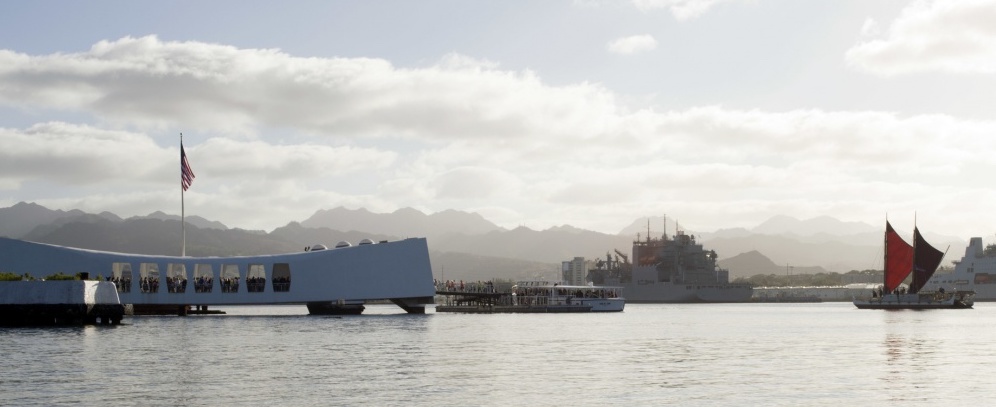
Upon entering the waters of Pearl Harbor, the Hōkūle‘a crew paid their respect as the vessel sailed past significant cultural and historical sites including Halealoha Halemau (Fort Kamehameha Reburial Platform), USS Nevada, Arizona Memorial, Battleship Missouri, Ford Island, USS Utah, and Loko Paʻaiau Fishpond, before piering at Rainbow Bay Marina. The crew will conclude their week-long visit by working with the restoration team at Loko Paʻaiau Fishpond on February 17.

The Loko Paʻaiau fishpond is located at McGrew Point Navy housing and is one of only three fishponds out of an original 22 in the Pu’uloa area which are still relatively intact. In September 2014, the Navy invited members of the local Hawaiian civic clubs and ʻAiea community members to begin work on restoring the historic fishpond.

“We want to celebrate this place and the movement taking place by the Puʻuloa community and the Navy to restore the Native Hawaiian history, sites and cultural identity of Pearl Harbor,” said Nainoa Thompson, president of the Polynesian Voyaging Society. “We hope Hōkūleʻa’s visit will open the doors for our young people to learn about the extraordinary history and culture of this very special, sacred place.”

More than 1,000 school children are scheduled to visit Hōkūleʻa and participate in educational activities during the canoe's stop at Puʻuloa.

For more information about the Hōkūleʻa and her crew, please visit: http://www.hokulea.com/.

For a series of Navy Reads reviews and other posts over the years about Hōkūleʻa click here.

Schedule of events at Rainbow Bay Marina this week, provided by Polynesian Voyaging Society:

Public Open House Tours of Hōkūleʻa to Feb. 17

Rainbow Bay Marina (next to Restaurant 604, adjacent to National Park Service's Pearl Harbor Visitor Center.
  • Sunday Feb. 11, 10 a.m. to 5 p.m. and

  • Monday thru Friday, Feb. 12 to 16, 3 p.m. to 5 p.m.
  • Hōkūleʻa Crew Talk Story (Sponsored by Kamehameha Schools ʻEwa Region) at Rainbow Bay Marina Pavilion Thursday, Feb. 15, 5 to 7 p.m.
  • Meet crew and community members who will discuss the significance of Hōkūleʻa’s visit to the Puʻuloa region.

  • Saturday Feb 17, 7:00 a.m., Hōkūleʻa departs Rainbow Bay Marina

  • Hōkūle‘a renders honors as it passes by the USS Arizona Memorial (Photo by MC1 Jeff Troutman)

    Friday, April 22, 2016

    The Worst and the Best – of the Pacific

    Review by Bill Doughty

    Tragedy and triumph. "Collision" and cooperation. War and Peace. 

    Simon Winchester, author of "Atlantic," explores the yin and yang of the world's biggest ocean in "Pacific: Silicon Chips and Surfboards, Coral Reefs and Atom Bombs, Brutal Dictators, Fading Empires, and the Coming Collision of the World's Superpowers" (2015, HarperCollins). "Pacific" is a great read for Earth Day.

    Winchester's clear-eyed assessment ranges from atmospheric testing of nuclear weapons, garbage gyres, el Niño and the "Ring of Fire" to the joys of surfing in a book he calls "a description of the modern Pacific Ocean" that begins at the end of the Second World War.

    Japan rose from the ashes of Hiroshima and Nagasaki to become an innovative and inventive world power, creating the transistor and transforming business. The Japanese people rejected an authoritarian military-controlled government to "display a mettle quite unimaginable in its scope, heft, and range" in the Pacific theater:
    "In those first months after the surrender, the country was gripped by a spasm of self-repair, of make-do and mending, of precipitous institutional about-faces and adaptations. Factories that had weeks before been making war materials switched their production lines to start making items needed not by generals and admirals, but by the bone-tired civilians and by the ragged menfolk returning from the battlefields. So bomb casings became charcoal burners, sitting neatly upright on their tail fins and helping households get through that first bitter winter. Large-caliber brass shell cases were modified as rice containers, while tea caddies were fashioned from their smaller shiny cousins. A searchlight mirror maker turned out flat glass panes to repair thousands of smashed Tokyo windows; and for country dwellers, a fighter plane engine piston maker turned his factory to building water pumps. A piston ring fabricator named Soichiro Honda took small engines used during the war as radio generators and strapped them onto the frames of Tokyo's bicycles – the resulting Bata-Bata motorcycles, the name being onomatopoeic, later evolved into a brand of bike still famed from 1950s Japan as the Dream. Its popularity and commercial success heralded the birth of today's automobile giant, the Honda Motor Company."
    Supercyclone Tracy bears down on Darwin, Australia in 1974.
    The end of empires casts a long shadow in this book: Imperial Japan and especially the British Empire – and how the monarchy's influence faded in Hong Kong and Australia.

    Darwin, Australia becomes a focal point in a discussion about Pacific storms and the effects of global climate change. "During the war, more Japanese bombs rained down on Darwin than on Pearl Harbor," Winchester writes. But when Supercyclone Tracy turned from the sea toward Darwin on Dec. 25, 1974, it destroyed 80 percent of the city. "There has never been a more dreadful and destructive event in recorded Australian history."

    Winchester mentions how the Joint Typhoon Warning Center in Hawaii tracks storms in the Pacific, including Typhoon Haiyan in 2013, which "devastated much of the Leyte Gulf region of the southwestern Philippines." 


    Northern Lights seen in ICEX 2016. Photo by Aerographer's Mate 2nd Class Zachary Yanez
    He quotes former U.S. Pacific Commander Adm. Samuel Locklear III, who, three months before Haiyan, said changes in the climate were causing increased typhoon activity. "Significant upheaval related to the warming planet is probably the thing most likely to happen ... and that will cripple the security environment," Locklear said. "Probably that will be more likely than the other scenarios we often talk about."

    Winchester discusses coral bleaching, first seen on the Great Barrier Reef in late 1981, "under threat from a rise in sea temperature and acidity." He also describes the Pacific garbage patch, effects of plastic pollution on birds, efforts to stop overfishing, and rising sea levels in Kiribati.


    Staff Sgt. Skinowski from the 3rd Tactical Fighter Wing watches Mt. Pinatubo eruption, June 1991.
    The explosion of Mt. Pinatubo, accompanied by a devastating typhoon in 1991, is described as a pivotal moment in the history of the region. Winchester reports how the USS Midway (CV 41) and USS Abraham Lincoln (CVN 72) were diverted to the Philippines to help with evacuation and recovery (Operation Fiery Vigil) and of the vacuum created by the loss of Clark Air Force Base and Subic Naval Base.

    The U.S. Navy figures prominently in "Pacific," from the USS Pueblo incident with North Korea in 1968 at the height of the war in Vietnam and during the Cold War to deployment of littoral combat ships today to Singapore. 

    Winchester shows how the border for North Korea was created by a grease pencil on a National Geographic map early in the Cold War and what that meant for those affected by the "wretched annoyance" of the "pariah state."


    Exploring with science and helping try to understand the origins of life: HOV Alvin.
    The author takes us aboard the Navy-commissioned, civilian-operated Human-Occupied Vehicle HOV Alvin, a submersible that made a startling discovery 39 years ago.
    "On a Thursday morning in mid-February 1977, this doughty miniature research submarine, so precisely engineered and so heavily armored as to allow three explorers to be brought down into the ocean deeps and then drive safely back to the surface, was lowered into the warm blue waters of the eastern Pacific for the 713th logged dive of her career. What she would find later that day, in the abyssal gloom almost two miles down, would laser-etch her name into oceanography's history books as having made perhaps the greatest maritime discovery of all scientific time. For she discovered down in the dark a whole new undersea universe, a previously unimagined dystopia of crushing pressures and scalding temperatures, of curious topography and even more curious life-forms, all gathered around a family of hitherto unknown phenomena that were immediately named for the gaseous torrents that they spewed ceaselessly out into the sea. Alvin, on that midwinter's day in 1977, first discovered the existence of what were to be called deep-ocean hydrothermal vents, gushings of gas and superheated water in places where all was believed to be cold and dark and dead."
    The Navy, with Woods Hole Oceanographic Institution aboard Alvin, had discovered new forms of life that existed through chemosynthesis, providing "information about the origins of life itself."

    While he focuses primarily on the United States, Japan and Australia, Winchester presents an enlightening discussion about China and it's "new Great Wall" at sea, saying the founding of the People's Republic "would eventually turn the Pacific into a cauldron of contention," challenging ships in international waters with claims of sovereignty.
    "And still the contagion spreads, and becomes ever broader. In recent years, China's dominance of the South China Sea has been followed by attempts to impose similar hegemonic control over the East China Sea. A long-standing claim made by the Chinese to the disputed Diaoyu Islands, an uninhabited cluster northeast of Taiwan that the Japanese have long called the Senkaku Islands, was suddenly backed up in 2013 when the Beijing government declared the airspace overhead a restricted area, and demanded that all aircraft, civilian and military, report and seek permission before entering it."
    Past and future. Destruction and renewal. Fear and hope. Symbolism and stark reality. The yin and yang of "Pacific" rides on warships and surfboards.

    Through the words of Jack London and Mark Twain and his own storytelling, Winchester introduces us to surfing icons George Freeth, Hobie Alter and Duke Kahanamoku – "a swimmer to beat all and a surfer to crown all, and if not the father of surfing ... its greatest of ambassadors, to America and beyond." His writing about the sport comes alive:
    "The Pacific is a liquid place, and on most of its inhabited coastlines this liquid is warm and ultramarine and inviting. It is also by its very nature ceaselessly in motion. For centuries native peoples who lived on many of the islands of the ocean's tropical interior have made great use of all this motion in ways that provided them with the purest joy imaginable. they rode out on long wooden boards through the beachside surf and spume and waited, floating, for a wave to lumber in from the ocean, and then stood up on the boards, toes gripping the leading edge, and from the wave's summit crest, rode the boards down its steep green face, all the way back into shore."
    The love for the sea becomes transcendent and expansive in "Pacific's" epilogue, "The Call of the Running Tide," as he describes the "duty of humanity" for Malama Honua, "to care for our island Earth." Malama Honua. That's the name of the three-year worldwide voyage of traditional waʻa, or sailing canoe, Hōkūleʻa, sailing with, as Winchester points out, "No compass. No extant. No radar. No radio. And certainly no GPS."
    "They have left the Pacific behind. The crew have now to divine their way across seas – the Indian Ocean, the Mediterranean, the Atlantic Ocean, the Caribbean Sea – that are very different from their home waters. They will pass beneath skies and patterns of stars quite strange to them. Whether or not they succeed, those aboard all keenly believe that their simple attempt will serve as a powerful reminder of the sea's singular importance. That is what all on the boat and back in Hawaii believe lies at the heart of their venture. Malama Honua: that all should be urged to care for a body of water that nourishes every living thing on earth, that gave it life in the first place, and yet that is now wearily compelled to absorb all the excesses of the humans who live beside and around it."
    Winchester concludes:
    "It seems to me there is even more potent symbolism to the Hōkūleʻa's journey, symbolism that relates quite specifically to the ocean where the boat was born, where her crew members revived and then learned their skills, and from where she came to venture out to the rest of the planet. The Pacific occupies a unique position among the world's seas; the Hōkūleʻa's journey has served as a reminder of why."
    At the end of this insightful book about the modern history of the Pacific, readers can be excused for wanting more stories from the author. But as one considers China, North Korea, global climate change – and the hopefulness of Malama Honua – history is still being written.

    From www.Hokulea.com today:  "After arriving in Newport News on Friday, April 22, Hōkūleʻa will (be) celebrating Earth Day with the Mariners’ Museum at the James River Fishing Pier on Saturday April 23rd. Canoe tours will be available to the public from 10 am to 2 pm. Enjoy fun and engaging educational activities for families, learn about traditional Polynesian voyaging and wayfinding, and meet the crew of Hōkūleʻa."