Sunday, November 24, 2013

A Kennedy Link to Lincoln

by Bill Doughty

Presidents Lincoln and Kennedy are forever linked in history -- through their stands on civil rights, by their courage in the face of existential national threats, and tragically as victims of gun violence.  
William Pitt Fessenden, date unknown. (National Archives)
Among the many Lincoln and Kennedy links is Senator William Pitt Fessenden of Maine.  A colleague of Secretary of the Navy Gideon Welles, Fessenden was Lincoln's Secretary of the Treasury during the Civil War.  

John F. Kennedy quotes Fessenden at the very end of his "Profiles in Courage," reviewed last week on Navy Reads.  Fessenden's words chosen by JFK in "Profiles" were written three years after Lincoln delivered the Emancipation Proclamation and the Gettysburg Address.  

Fessenden spoke the words as a Senator, but they can apply to anyone in public leadership positions.  The words ring strong today in the context of Navy's core values of honor, courage and commitment:

"When, Mr. President, a man becomes a member of this body, he cannot even dream of the ordeal to which he cannot fail to be exposed;

  • of how much courage he must possess to resist the temptations which daily beset him;
  • of that sensitive shrinking from undeserved censure which he must learn to control; 
  • of the ever-recurring contest between a natural desire for public approbation and a sense of public duty; 
  • of the load of injustice he must be content to bear, even from those who should be his friends; 
  • the imputations of his motives;
  • the sneers and the sarcasms of ignorance and malice;
  • all the manifold injuries which partisan or private malignity, disappointed of its objects, may shower upon his unprotected head. 
All this, Mr. President, if he would retain his integrity, he must learn to bear unmoved, and walk steadily onward in the path of duty, sustained only by the reflection that time may do him justice, or if not, that after all his individual hopes and aspirations, and even his name among men, should be of little account to him when weighed in the balance against the welfare of a people of whose destiny he is a constituted guardian and defender."
Fessenden served in both the House of Representatives and Senate before President Lincoln convinced him to fill the Treasury position vacated by the prideful Salmon P. Chase, as described in Doris Kearns Goodwin's "Team of Rivals." 
"Fessenden's appointment received immense praise. 'He is a man of undoubted financial ability, and of unsurpassed personal integrity,' the Chicago Tribune wrote."
Lincoln portrait by George P.A. Healy, 1869 in State Dining Room,
Kennedy White House, 1961.
In "Battle Cry of Freedom: The Civil War Era" author and historian James McPherson reveals Fessenden's pragmatic approach to fair taxation and the Legal Tender Act in order to provide financial support to Union troops.  U.S. notes were used as cash, unlike the Confederacy's approach to raising war funds, which also relied more on loans.  McPherson writes:
"The act created a national currency and altered the monetary structure of the United States.  It asserted national sovereignty to help win a war fought to preserve that sovereignty.  It provided the Treasury with resources to pay its bills, it restored investor confidence to make possible the sale at par of the $500 million of new 6 percent bonds authorized at the same time, and unlocked the funds that had gone into hoarding during the financial crisis of December."
McPherson reviewed Kearns Goodwin's book for the New York Times in 2005, calling it "an elegant, incisive study of Lincoln and leading members of his cabinet that will appeal to experts as well as to those whose knowledge of Lincoln is an amalgam of high school history and popular mythology."

In "Team of Rivals" Kearns Goodwin dives into White House and congressional intrigue and shows Lincoln's mastery in balancing power and personalities.  She shows that Lincoln judged Fessenden to be a statesman worthy of trust and respect.  And the feeling was mutual.
"By the spring of 1865 the treasury was stable, and when Maine reelected him to the Senate for a term to being on March 4, Fessenden felt free to resign." 
"Lincoln was sorry to lose his brilliant, hardworking secretary.  Fessenden, too, 'parted from the President with regret.' During his tenure at the Treasury, his initial critical attitude toward Lincoln had been transformed into warm admiration.  'I desire gratefully to acknowledge the kindness and consideration with which you have invariably treated me,' he wrote to the president, 'and to assure you that in retiring I carry with me great and increased respect for your personal character and for the ability which has marked your administration.'  Noting that the 'prolonged struggle for national life' was finally nearing a successful conclusion, he went on, 'no one can claim to have so largely contributed to the chosen chief magistrate of this great people.'"
President Kennedy signs joint resolution March 1, 1961 commemorating the 100th Anniversary
of the First Inauguration of President Abraham Lincoln. (JFK Presidential Library)
Kennedy's "Profiles in Courage" reveals Fessenden's brave stand during a constitutional crisis.  He stood with a handful of Republicans led by Senator Edmund G. Ross of Kansas in a vote to acquit Andrew Johnson despite calls by radical politicians who wanted revenge against the Confederacy.  Instead, Ross, Fessenden and other men of conscience embraced compromise and harmony.  They preserved efforts begun by Lincoln toward reconciliation with the South despite public scorn, ridicule and pressure to punish the secessionists.

Fessenden became the "guardian and defender" of the Constitution he wrote about in his excerpt in JFK's "Profiles."  Like other true patriots in public service his primary concern was the long-term health of the republic rather than short-term political expediency and personal profit.

Sunday, November 17, 2013

John F. Kennedy’s ‘Profiles in Courage’

Review by Bill Doughty

Seventy years ago -- August 2,1943 -- young John F. Kennedy was a PT-boat commander when his PT-109 was rammed by Imperial Japanese destroyer Amagiri.  His boat exploded, killing two crew members and burning one so badly he was unable to swim.

Oil painting by Gerard Richardson (official Navy artist 1961)
“Clutching a strap of the injured man’s life jacket in his teeth, Lieutenant Kennedy towed the wounded sailor to the nearest island, three miles away.  For the next six days, with little food or water, the men hid, fearing they would be captured by the Japanese.  Each evening Kennedy swam through the shark-infested waters to other islands seeking help, until he was spotted by two Solomon Islanders, Eroni Kumana and Biuka Gasa.  They picked a coconut, onto which Kennedy carved a message, which they took to the hideout of a nearby Australian coast watcher who arranged rescue.  In the summer of 2002 a National Geographic Society expedition found that the legend of John F. Kennedy’s courage lives on in the faraway Solomon Islands.  Using remote-controlled vehicles with underwater cameras, explorer Robert Ballard and his team discovered the sunken PT-109.  Expedition members met Eroni Kumana, the man whose simple canoe saved my father’s life and changed the course of history, and his son, John F. Kennedy Kumana.”

Caroline Kennedy writes the introduction, including the excerpt above and below, in the HarperCollins 50th anniversary edition of her father’s “Profiles in Courage.”   (The book was first published in 1956 and is one of 15 top recommended reads of Navy's Chief of Information Rear Adm. John Kirby.)

“The collision with the Japanese destroyer left him with a spinal injury, which required surgery in the winter of 1954-55.  Elected to the U.S. Senate two years before, my father was interested in understanding the qualities that make a great senator.  History was his passion, and he spent his months of recuperation reading the chronicles of his legendary predecessors.”

Caroline Kennedy writes of President Kennedy’s courage in the Cuban Missile Crisis in 1962, in which he successfully averted nuclear war, and of his support to nonviolent civil rights demonstrations in 1963 when he mobilized the Alabama National Guard, taking a stand for the ideals outlined in the Constitution.

Equal rights, equal opportunity and harmonious preservation of the Union are common themes throughout JFK’s "Profiles in Courage."  The profiles by then-Senator John F. Kennedy are of political leaders and diplomats John Quincy Adams, Daniel Webster, Thomas Hart Benton, Sam Houston, Edmund Gross, Lucius Quintus Cincinnatus Lamar, George Norris, Robert A. Taft and others.

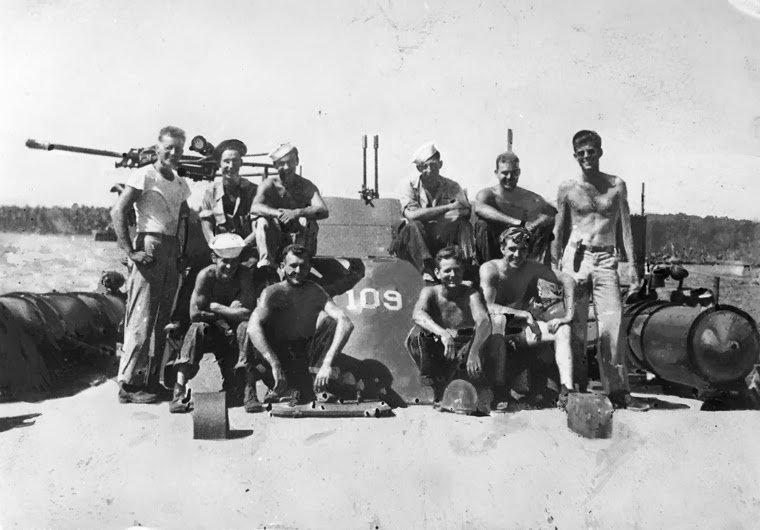
Kennedy, at right, with crew of PT-109 in Solomons.  Photos from JFK Library.
Courage -- one of the core values of the Navy and Marine Corps -- is shown in the context of these profiles, where public service is motivated by “the national interest, rather than private or political gain,” JFK wrote.

Courage can be found in balance, conciliation, mutual concession and compromise, “an art essential to keeping a nation united and enabling our government to function.”

“It is compromise that prevents each set of reformers -- the wets and the drys, the one-worlders and the isolationists, the vivisectionists and the anti-vivisectionists -- from crushing the group on the extreme opposite end of the political spectrum.  The fanatics and extremists and even those conscientiously devoted to hard-and-fast principles are always disappointed at the failure of their Government to rush to implement all of their principles and to denounce those of their opponents.  But the legislator has some responsibility to conciliate those opposing forces within his state and party and to represent them in the larger clash of interests on the national level; and he alone knows that there are few if any issues where all the truth and all the right and all the angels are on one side.”

The quote brings to mind what President Lincoln called “the better angels of our nature.”

Kennedy hoped his profiles of political heroes, some long forgotten by most Americans, would be stories “that teach, offer hope and provide inspiration” for everyone.

“To be courageous, these stories make clear, requires no exceptional qualifications, no magic formula, no special combination of time, place and circumstance.  It is an opportunity that sooner or later is presented to us all.”

It’s been seventy years since the future President Kennedy’s encounter with Imperial Japan in World War II and fifty years after his assassination.  This week, in an ultimate symbol of reconciliation, harmony and peace, JFK’s daughter Caroline has been welcomed in Tokyo as U.S. Ambassador to Japan.

Monday, November 11, 2013

Veterans Day Profiles in Courage

by Bill Doughty

JFK in WWII.
Like a lot of people in my generation I was fascinated by JFK’s heroism in World War II aboard PT-109.  (A Navy Reads review of Kennedy's "Profiles in Courage" is coming soon.) Kennedy was a naval officer who fought in the Second World War, just like former presidents and veterans George H. W. Bush and Gerald Ford.  Each of them would have an aircraft carrier namesake.  Ford’s ultra-modern, ultra-efficient CVN-78 was christened this weekend. The next Kennedy carrier, CVN-79, is being built over the next 8 years.

The Kennedy family’s Profile in Courage Award, established in 1989, is presented annually to “the nation’s public servants who have withstood strong opposition to follow what they believe to be the right course of action.”  The award has gone to people like state representative Dan Ponder Jr. (R-GA), U.S. Congressman John P. Murtha (D-PA), U.S. Senator John McCain (R-AZ), former U.S. Congressman Carl Elliot (D-AL), and most recently to former Arizona state representative and senator Gabrielle “Gabby” Giffords of Americans for Responsible Solutions, formed with her husband former Navy Captain and astronaut Mark Kelly.  

In 2001, less than four months before 9/11, the Profile in Courage Award was presented to two statesmen: former President Gerald Ford and U.S. Representative John Lewis (D-GA), who went into harm’s way (and was severely injured) in a different kind of war -- for civil rights.  In the past week, “March: Book One,” a graphic nonfiction book about Lewis’s struggle, along with Dr. Martin Luther King Jr., was published and went to number one on a New York Times bestseller list.

The Kennedy award was presented to Ford for his courage in pardoning former President Richard Nixon after Nixon’s resignation in the face of the Watergate scandal.  Ford was known for his unimpeachable integrity.

In “Halsey’s Typhoon,” authors Drury and Clavin show how President Ford considered his wartime Navy experience in making the right decision for the good of the “ship of state.”

Veterans Day began as Armistice Day to mark the end of World War I. Fighting ended in that war Nov. 11, 1918, one year after JFK was born and three years after Gerald Ford was born.  President Woodrow Wilson called for Nov. 11 to be set aside: 

"To us in America, the reflections of Armistice Day will be filled with solemn pride in the heroism of those who died in the country’s service and with gratitude for the victory, both because of the thing from which it has freed us and because of the opportunity it has given America to show her sympathy with peace and justice...”

In 1961 President Kennedy signed the Woodrow Wilson Memorial Commission bill, with former first lady Mrs. Wilson at his side.

At the signing Kennedy said, “I hope the Commission will plan a memorial that expresses the faith in democracy and President Wilson's vision of peace and a dedication to international understanding that President Wilson himself did so much to advance.  He called for a New Freedom at home, and a world of unity and peace, and we are still striving to achieve these objectives.”

The Profile in Courage Award is made of sterling silver and is designed by Edwin Schlossberg, crafted by Tiffany & Co., and inspired by the lantern on USS Constitution, the oldest commissioned ship in the U.S. Navy.  Read more about the award at the John F. Kennedy Presidential Library and Museum site.

Saturday, November 9, 2013

Red Cloud and Heart of Everything That Is

Review by Bill Doughty

“The Heart of Everything That Is: The Untold Story of Red Cloud, an American Legend,” by Bob Drury and Tom Clavin, is a terrific new book out this week that reexamines the cruelty of expansion in the American West, the warrior ethos of the Lakota Sioux, and the strategy and tactics of Red Cloud in defeating the United States Army.

“The great warrior chief Red Cloud was the only Indian ever able to claim victory over the United States,” according to Drury and Clavin, a conclusion backed up by other writers and historians.*

Red Cloud and many other colorful protagonists in “The Heart of Everything That Is” are flawed anti-heroes in a world of intertribal raids and fights, torture, mutilation, revenge, lies and numbing grief on all sides.

Photo reportedly by Ridgway Glover, 1866
“Though the Sioux were to become its most vicious practitioners, warfare among Indians was simply a way of life.  Nearly every tribe called itself “The People” and harbored deep suspicion and hatred toward outsiders with whom it competed for game and plunders.  Death arrived swiftly and often in the violent thrust and parry of aggression and defense, abetted by a culture that revolved around a quest to avenge insults and injuries real and perceived.”

In the expansion across the North American continent, individual tribes who believed in The Great Spirit faced an enemy who justified their claims in the name of Manifest Destiny.  The crusade by people of European descent can be considered a long campaign against Native Americans, often seen as less-than-human "others" undeserving of basic human rights and freedoms:

“The military historian Peter Maslowski, attending a guest-lecture series at the U.S. Army Command and General Staff College, was puzzled when a general from the Chinese People’s Army casually mentioned that the United States had fought the longest war in history.  America had never fought a Thirty Years’ War, let alone a Hundred Years’ War.  What was the visiting general talking about?  The answer came with the foreigner’s next breath.  He explained that he was referring to America’s nearly 300-year war against its Indians.  Much of the world beyond North America considered it to have begun in the early seventeenth century and to have lasted until the late nineteenth.”

The authors establish characters and reveal history, introducing us to the shadowy Crazy Horse, grizzled Jim Bridger (left), genocidal Gen. Sherman, flamboyant photographer Ridgway Glover, fearless Paul Revere-like “Portugee” Phillips, frightening George Washington Grummond and "Queeg-like" Col. Carrington, among others.  The book builds interest and tension throughout, culminating in a masterful depiction of the Fetterman Massacre, showing Red Cloud as “the equal of history’s great guerilla tacticians.”

Drury and Clavin, authors of other military books including “Last Men Out,” “The Last Stand of Fox Company” and “Halsey’s Typhoon,” make the book relevant to a Navy audience:

“The historian Stephen E. Ambrose notes that Indian fighting on the High Plains was more akin to naval warfare than to any other type of battle.  The U.S. Army ‘was lumbering around with battleships and cruisers, chasing pirates in sleek, fast vessels,’ and the forts and camps were like home ports to which large ships must return often for supplies.  Meanwhile the Indians lived off the land much as the pirates lived off the ocean, and the soldiers deployed to the frontier had no more comprehension of their surroundings than the crews of Columbus or Magellan reading blank charts marked with the warning, ‘Here be monsters.’”

With graphic depictions of monstrous mutilations and violence, the writing is closer to Larry McMurtry than Louis L’Amour, all the more powerful because it is nonfiction carefully noted and sourced.  There’s a tie to McMurtry’s “Lonesome Dove” and there are references to Abraham Lincoln, Napoleon Bonaparte and von Clausewitz.

Descriptions are colorful and memorable: “Bull Bear, by all accounts a canker of a man with a face like a clenched fist...”  “Under the broiling summer sun the stench of human and animal sweat and dung hung over the post like an illness.”

Chief Red Cloud
“At six feet, Red Cloud was tall for a Sioux, if not for most men of this era.  His slender face was dominated by a beaked nose and a broad forehead, and the leathery skin around his ravaged brown eyes was prematurely creased, as if by parentheses, with age lines.  Fond of accessories, such as eagle feathers and ribbons, he carried himself with an erect, regal mien; and at such formal ceremonies his long, course black hair was almost always bear-greased and plaited around the wing bone of an eagle to signify elegance and propriety.  A good, new rifle usually rested across his saddle pommel.  On the whole he projected an aura of quiet dignity with an undercurrent of physical menace.”

The book explores the role of technology in winning the overall campaign, discussing the role of the Navy Colt, Springfield rifle and other firearms and the development of the Union Pacific Railroad.  It explores how close to the surface is the savagery in our souls.  And it considers the importance of a strong defense in keeping peace.  Red Cloud, Crazy Horse's mentor, “was a living embodiment of the maxim that war is the best teacher of war.”

Drury and Clavin write, “The four pillars of Sioux leadership -- acknowledged by the tribe to this day -- are bravery, fortitude, generosity, and wisdom.  Time and again Red Cloud exhibited each.”  In the end, Red Cloud the statesman saw the way to peace.

The authors make a brilliant proposal in the Washington Post this week (during Native American Heritage month): Rename the NFL’s Washington Redskins the Washington Red Clouds.

“Named after such a proud and powerful winner, the Washington Red Clouds would be a lock to emulate their namesake and rout 49ers, defeat Raiders, humiliate Cowboys, pluck Eagles, turn back Texans, break Broncos and generally leave quivering the remaining would-be Giants and Titans of the National Football League,” they write.

In changing the Redskins name, Red Cloud would help win another battle...

Lakota delegation at the White House, 1877. Standing - Red Bear, Young-Man-Afraid-of-his-Horses, Good Voice, Ring Thunder, Iron Crow, White Tail, Young Spotted Tail. Seated - Yellow Bear, Red Cloud, Big Road, Little Wound, Black Crow. (Library of Congress)


* Other authors and historians reach the same conclusion about Red Cloud’s War.  James Wilson noted that the government conceded defeat in “The Earth Shall Weep: A History of Native Americans.”  McMurtry refers to Red Cloud's victories along the Bozeman Trail in his beautiful and colorful "Custer" from 2012 (published, like "The Heart of Everything That Is," by Simon & Schuster).


Sunday, October 13, 2013

Fueling 'Neptune's Inferno' at Guadalcanal

Review by Bill Doughty


The Guadalcanal Campaign, the “most sustained and vicious fight of the Pacific” was the birth of expeditionary warfare.  In what was considered a rematch of the Battle of Midway but without battleships and fought much farther from home, the U.S. Navy confronted an equally matched enemy, dealt with fuel challenges, faced fear and uncertainty, and fought like hell.

Told in chronological order from the summer of 1942 into the winter of 1943 and recounted minute by minute during combat, “Neptune’s Inferno” by James D. Hornfischer recreates the Guadalcanal Campaign at sea, where the Navy suffered more than twice the number of casualties at sea than the Army or Marine Corps endured on land.

Hornfischer creates short descriptive introductions of key players.  Some examples:

Nimitz: “The kind and trusting leader.”
King: “The bully.”
MacArthur: “Messianic commander of the Southwest Pacific.”
Fletcher: “Cautious, uninformed and uniformable.”
Mikawa: “A sea dog of the old school.”
Ghormley: “had a knack for going where the action was.”
Bode: “Insulting and intimidating when he was not entirely aloof.”
Scott: “He was a warrior; he always wanted his sword in the fight.”

Subtitled, “The U.S. Navy at Guadalcanal,” Hornfischer’s “Neptune’s Inferno,” rising from Ironbottom Sound, reminds readers of the author’s “Last Stand of the Tin Can Sailors.”  Neptune brings characters, combat and calamaties of night warfare to light, with the surface Navy in sharp relief.

“The carriers and their pilots were proven winners.  American submariners were emerging as world-beaters.  The surface Navy -- the battleships, cruisers, and destroyers of the traditional black-shoe fleet -- would have their day.  At Guadalcanal as ever, it was the most expendable members of the deep-sea combat fleet, the destroyers, that made first contact with the enemy and carried the fight to him.  While Norman Scott was getting his legs under him as commander of Task Force 64, he destroyer Navy was called to turn its guns in support of their ground-pounding brethren ashore.”

Several times throughout the book Hornfischer describes “the geometry of the fight” as ships attempted surprise, control, and maneuvers such as “crossing of the T.”  Often, confusion reigned instead.  “A clear recognition of who was friend and who was foe had been the first casualty of battle,” he writes.

Fuel was a huge challenge.  It was at the heart of Rear Adm. Fletcher’s controversial and cautious approach with his aircraft carriers, an approach that frustrated Marine commanders like Gen. Vandegrift.  Worried about refueling, Fletcher removed air support from land-based troops when he withdrew his three carriers.

Even though they were closer to their controlled territories, the Japanese faced similar constraints and concern that hamstrung their strategies.  “A shortage of fuel at Rabaul forced them to be sparing and selective in the use of their major warships.”  The fight for Henderson Field was a critical battle for what the airstrip represented for fuel and other logistics.

Hornfischer reminds us of “Teddy Roosevelt’s Great White Fleet” that visited Tokyo in 1908 and prompted a hardening of attitudes and competition between the two navies after its visit.  “The fact that the Great White Fleet had nearly stranded itself at sea for lack of fuel was long forgotten by the time its journey became the emblem of romantic naval adventure.” 

Fuel became a weapon too when cruisers went into air-sea battle, with threats coming from an unexpected source: onboard aviation.

“The Achilles’ heel of a cruiser in battle was the highly flammable realm of her shipboard aviation division.  In modern navies, cruisers carried catapult-launched floatplanes for reconnaissance and gunfire spotting.  The traditionalists bemoaned the oil stains the aircraft left on their ships’ polished teak.  Untended planes could do far worse under fire.  They made their hosts into tinderboxes ... The hangars were fuses to countless other flammables: paint, paper, furniture, and exposed crates of ready-service ammunition in nearby gun mounts.  Steel and wire and cork and glass -- all of it burned readily.  The heat of the fires was sometimes intense enough to ignite paint on bulkheads two compartments away.  The burning paint ferried flames through the compartments...”

Hornfischer’s explosive descriptions and “emotional truth” storytelling help us understand the risks, daring, chaos, heroic actions and victories of the Guadalcanal Campaign.  Key to victory, according to Nimitz, was training, training and more training.

The book has dozens of great photos and maps, including of the Battle of Savo Island, Battle of Cape Esperance, and Battle of Tassafaronga.

Hornfischer wraps his narrative in a greater tragedy of young men killed before they could reach their full potential. “Neptune’s Inferno” will help us and future generations remember their sacrifice.  Today the United States Navy celebrates 238 years of service.  The revamp of the Navy Reading Program was unveiled by CNO Adm. Jon Greenert a year ago for the Navy birthday.  "Neptune's Inferno" is on the essential "Operate Forward" list.

Sunday, October 6, 2013

Decisive Action: ‘Gravity’ & ‘Captain Phillips’

by Bill Doughty

Two movies this month offer thrill rides and edge-of-the-seat action: “Gravity” and “Captain Phillips.” Directors Alfonso Cuarón and Paul Greengrass and actors Sandra Bullock and Tom Hanks, respectively, will be up for top awards by the end of the year.  Supporting performances by George Clooney and Barkhad Abdi will likely be up for awards, too.

“Gravity” takes special effects to a new level, but the story and life-and-death performance by Bullock are grounded in humanity.  The whole world is an audience to the drama.  Some themes: cooperation in space, importance of STEM, faith in oneself, innovation, training, courage, rebirth from grief, and appreciation for the gift of life.  

The film brings out the stark challenges and deep desire to explore space and understand the universe.

Tom Hanks congratulates James Lovell on being
awarded the Lincoln Leadership Prize in 2010.
Coincidentally, this past week the U.S. Naval Institute held its 2013 annual history conference, “Past, Present, and Future of Human Space Flight,” with Capt. James A. Lovell, USN (Ret.), Capt. Robert L. Crippen, USN (Ret.), Col. Robert Cabana, USMC (Ret.) and Capt. Ken Ham, USN.  (Lovell, captain of the famed Apollo 13 mission, was portrayed by Tom Hanks in a movie about that mission.)

Ham, chair of the Aerospace Engineering Department at the Naval Academy, said he and astronauts and other aviators were influenced by the movie, “Top Gun.”  Ham commented, “When I look up into the sky at the moon, it’s epic. When I look at Mars, it’s epic. It seems to me to be completely obvious that we need to go there, and I think if we decide to do it, the American people will support it.”

There are similarities in the appeal of space and call of the sea.

“Captain Phillips,” based on the book “A Captain’s Duty” by Phillips with Stephan Talty, shows how uncompromising resolve, creative negotiation and decisive action can work against hostage-taking extortion and intimidation.  The U.S. Navy stands for freedom of commerce on the seas, and “Captain Phillips,” shows -- through blood, sweat and tears -- how that freedom is protected.  Once again, Navy SEALs are on the forefront but so are surface forces, naval aviation and hospital corpsmen.  The movie closely follows action described in the book, with an eye on accuracy.  Greengrass says he wanted the movie to seem like a documentary, and it does.

[ Coincidentally, today Secretary of Defense Chuck Hagel announced targeted operations by U.S. servicemembers against terrorists in Africa.  “These operations in Libya and Somalia send a strong message to the world that the United States will spare no effort to hold terrorists accountable, no matter where they hide or how long they evade justice. We will continue to maintain relentless pressure on terrorist groups that threaten our people or our interests, and we will conduct direct action against them, if necessary, that is consistent with our laws and our values.” ]

Barkhad Abdi as "Muse."
Building cooperative partnerships, providing humanitarian assistance and disaster relief, and enforcing international fishing laws with the U.S. Coast Guard are missions of the Navy as reflected in the Maritime Strategy and as touched on in “Captain Phillips.”  The Maersk Alabama ship was carrying relief supplies to Africa.  The pirates from Somalia claimed they were fishermen driven to piracy because of overfishing.  Their attack, however, was based on a flawed strategy from a position of weakness.

How can we preserve quality of life on the planet and protect natural resources?  How can we resolve conflict and uphold constitutional democracy?  How can we overcome fear and find the will to survive under the worst circumstances?  These are some of the questions prompted by these two movies.  On a practical level, “How did they film that?” is another question that comes to mind, especially during “Gravity.”  Amazing.

Saturday, October 5, 2013

Tom Clancy Gone?

by Bill Doughty

More than 20 years ago Martin Greenberg edited “The Tom Clancy Companion."   Like many Americans I thought about the iconic Clancy this week after his obituaries were published: Tom Clancy, author of “The Hunt for Red October,” “Red Storm Rising,” “Patriot Games,” “Clear and Present Danger” and other now-classic techno-thrillers, dead at 66.

Tom Clancy loved the Navy, and the feeling was mutual.

With an introduction by his writing partner and family friend Larry Bond, this easy read is presented in four parts: an essay by Marc A. Cerasini on “The Birth of the Techno-Thriller,” an interview with the author by Greenberg, a series of essays by Clancy, and “A Tom Clancy Concordance,” an encyclopedic compilation by Roland J. Green.  The concordance includes an entry for USS Reuben James (DDG-57), central to “Red Storm Rising.”

The interview with Clancy shows the author’s strong feeling on the mission, capabilities and power of the Navy as well as the long-lasting international impact of democracy and freedom.

 “What will happen, what must happen, very simply is that democracy is going to spread itself across the world.  And the reason democracy is going to spread itself across the world is that it works.  Over the past 200 years, representative democracy and the free-enterprise system have proven to be extraordinarily effective at giving people the things they want -- justice and prosperity.”

Read Clancy’s interview and essays and learn, among other things, his views on Reagan, Ricin, Napoleon, Apple computers, stealth technology, Bush Sr., Iran and Iraq, science and technology, Oliver Wendell Holmes, Baltimore, God and science fiction writers, including Joe Haldeman, Edgar Allen Poe and Jules Verne.

Essays

“Dinosaurs” discusses the outdated, outmoded weapons systems from previous wars and calls for extending former President Reagan’s “Zero Option” for theater nuclear forces and “an international agreement to bring intercontinental-ballistic weapons down to as close to zero as we can,” in Clancy’s words.

Clancy's essay “Before Anyone Gets Carried Away” eviscerates Oliver Stone’s movie about JFK and gives a logical and forceful view about Kennedy assassination conspiracy theories.  “But I Like to Shoot” gives the author’s views on responsible gun ownership and gun control, while “Funeral” celebrates the death of communism.  Revised in 2005, "Companion" expanded the concordance and retained the original essays.

“Getting Our Money’s Worth” showcases the British Royal Navy and prevention of war through strength, commitment and expertise.  It seems to presage CNO Adm. Greenert’s “Warfighting First” tenet:
“The military needs to restore the warrior ethic.  A warrior is someone who kills his fellow man for a living, and wants to be good at it.  Not all officers are or can be warriors, but only those who are deserve to command at any level.  The military must change its programs to identify them, to nurture them, to select only the best from their ranks, and then to give them the support and experience they need to fulfill their wartime missions at every level of command responsibility.  That will give us the force which will win in war; and recognition of it will go far toward preventing one.”

Several essays get to the heart of Clancy’s personal philosophy.  In “Investia-3. Principles,” he writes that, “A healthy society allows citizens of different beliefs to speak their mind.  In words that resonate today:

“As citizens of a free society you have a civic duty both to tolerate people whose beliefs are different from your own, and a moral duty to listen to them from time to time, because even a fool has something intelligent to say once in a while.”

“Back to the Frontier” calls for support to the nation’s space program, recalling Neil Armstrong’s and Buzz Aldrin’s walk on the moon in 1969.

Harrison, Baldwin and Affleck as Jack Ryan.
“Who can forget that night?  Who can forget the pride of nationhood?  Who can forget the excitement and the wonder? ... Exploration is part and parcel of American history ... The Space Program is the future.  It really is that simple.”

There are hundreds of other works by and especially about Tom Clancy.  Legions of critics have weighed in on the prolific writer, but he is much more complicated than his novels or protagonist Jack Ryan.  Clancy said he wrote “The Hunt for Red October” to achieve a lifelong dream to be a novelist and to achieve immortality.  

Tom Clancy, R.I.P. 

Saturday, September 21, 2013

Reflecting Heroism, September 2013

By Bill Doughty

This has been a month to reflect on the meaning of service, sacrifice and courage in the face of violence.

The week began with a terrible tragedy at the Washington Navy Yard at the Naval Sea Systems Command less than a week after 9/11.  It is ending with memorials, commemoration and more reflection.  

Throughout the week there have been expressions of grief and resolve.  Tomorrow, the nation will pause to honor those killed in the mass shooting last Monday.

Remembering POWs and MIAs  

In different ceremonies across the nation, DOD and Navy leaders paid respect to other patriots, including Prisoners of War and missing servicemembers.

Secretary of Defense Chuck Hagel speaks with Rolling Thunder Sept. 20, 2013.  
(Photo by Erin A. Kirk-Cuomo)
Yesterday, at a Pentagon ceremony, Secretary of Defense Chuck Hagel said, “Americans in uniform today are inspired by the fierce resolve of generations of American POWs.  We also draw inspiration from the bonds of camaraderie, compassion, and love that prompted our POWs to care for each other, and sustain each other, through terrible, terrible months and years of hardship.”

Addressing families and friends of missing servicemember, Hagel said, “Words and promises cannot make the lingering uncertainty and heartache go away.  But I hope it provides comfort to know that as long as members of our armed forces remain unaccounted for, the Department of Defense will do whatever we can to find them and bring them home.”

Portraits of Valor in War

In a ceremony at Naval Base San Diego yesterday, the Navy named three Arleigh-Burke class guided-missile destroyers for three heroes in three conflicts -- WWII, Vietnam and Operation Iraqi Freedom.  Named in the ceremony Sept. 20 were: USS John Finn (DDG 113), USS Ralph Johnson (DDG 114) and USS Rafael Peralta (DDG 115).  The names were selected by Secretary of the Navy Ray Mabus, who was unable to attend the ceremony because of the shooting tragedy at the Navy Yard.

The building of these ships has been overseen and coordinated by the men and women of Naval Sea Systems Command.

Beyond the Call of Duty

During this time of reflection, an inspiring book to pick up is “Medal of Honor: Portraits of Valor Beyond the Call of Duty” by photographer Nick Del Calzo and writer Peter Collier.

This large tabletop book gives a synopsis of the heroism of each Medal of Honor recipient living at the time it was published.

My copy is from 2003 and offers a forward by former President and WWII Veteran George H. W. Bush.

“The Medal of Honor pays homage to comrades who have given their lives for this great country.  These gallant souls, in their heroism and their humility, epitomize the nobility of service to country and of service above self,” Bush writes, concluding, “Americans for all times will treasure the gifts that these brave warriors have given to all of us so selflessly.”

John and wife Alice Finn in 1933.
John Finn was still living when this edition was published.  He is featured in photos in his beloved American West and as a young man with his sweetheart on a motorcycle.  The narrative in “Medal of Honor” recounts his courageous response on the morning of the attack on Oahu of Dec. 7, 1941.
“Finn found a mobile instruction stand on which guns were sometimes mounted to teach gunnery.  Although enemy planes continued to strafe the position, he moved the stand into a parking area where he would have clear visibility. Then he set a .50-caliber machine gun on it and began to shoot ... Finn had been hit by shrapnel in twenty-one places; several were serious wounds.  His left arm was numb, and a bullet had passed through one foot.  Following medical treatment, he returned to the squadron area and supervised the rearming of the remaining American planes.” 


Gen. (ret.) Richard B. Myers, then CJCS, and Lt. (ret.) John Finn look at
“Medal of Honor” book. (Photo by Mamie Mae Burke, Jan. 19, 2005.)
This book includes essays by Tom Brokaw and Senator John McCain, a POW during Vietnam who writes compellingly about owing his life to Medal of Honor recipient Air Force Maj. George “Bud” Day and Maj. Norris Overly.   Day is profiled in Del Cazo’s and Collier’s book.

McCain writes about fellow prisoners Rear Adm. Jim Stockdale and Captain Lance Sijan, both of whom showed how to live the principles of the Code of Conduct.

“As you read in these pages about Bud, Jim, and Lance, and Leo Thorsness and Jon Cavaiani, who were in prison with us, and about my friends Bob Kerrey and Dan Inouye, and all the other heroes whose extraordinary service to America is memorialized in this book you will be awed, as I am, not only by their courage and character, but by the country that produced such men and that was ennobled by the example they set for the rest of us.”

Included in the 2003 version of “Medal of Honor” are Eugene B. Fluckey, Hiroshi H. Miyamura, Donald E. Ballard, Robert E. Bush, Rodolfo P. Hernandez, George T. Sakato, William R. Charette and Ernest Childers, along with dozens of others.

A newer edition of this book includes an introduction from Brian Williams and letters from all living presidents, including President Barack Obama, who will be attending a memorial tomorrow, as announced Thursday by Press Secretary Jay Carney, “to mourn the loss of these innocent victims and share in the nation’s pain in the aftermath of another senseless mass shooting.”


Defense Secretary Chuck Hagel, right, Army Gen. Martin E. Dempsey, second from right, chairman of the Joint Chiefs of Staff, Navy Adm. Jonathan W. Greenert, chief of naval operations, and Navy Secretary Ray Mabus stand during the playing of taps at a wreath-laying at the Navy Memorial in Washington, D.C., Sept. 17, 2013. The defense leaders held the small ceremony to remember the 12 victims of the Sept. 16 shooting at the Washington Navy Yard. DOD photo by Erin A. Kirk-Cuomo