Showing posts with label oil. Show all posts

Tuesday, March 8, 2022

Russia Scars ‘The Border’

Review by Bill Doughty––

The sunflower is the national flower of Ukraine. It has become a symbol of resistance after a Ukrainian woman confronted a Russian soldier and offered him seeds. She told him to put the seeds in his pocket so sunflowers would grow when he died on Ukraine’s soil. She shouted at him, “You’re occupants, you’re fascists. Take these seeds and put them in your pockets so at least sunflowers will grow when you all lie down here … You are occupiers. You are enemies.”


The sunflower seeds incident is just one of the stories of heroic resistance and resilience in Ukraine inspiring the world for the past two weeks since Putin’s unprovoked invasion.


Erika Fatland
I was interested in learning more about the people and history of Ukraine and was rewarded with a great book by historian and travel writer Erika Fatland, author of “The Border” (translated from the Norwegian by Kari Dickson; Pegasus Books Ltd., 2017).

In Ukraine, Fatland visits Odessa, Gammalsvenskby, Crimea, Mariupol, Kramatorsk, Donetsk, Poltava, Kiev, Lviv, and other areas in her two-year exploration around Russia’s border. After completing her journey –– more than five years ago –– Fatland had a chilling premonition about Putin’s aggression:

“The borders have changed and multiplied time and again over the centuries, most recently in 2014, when Russia annexed Crimea. Borders are not set in stone; the new fibreglass boundary markers are easy to move. The world’s biggest country is low on self-esteem; the economy is failing and the population shrinking. Thus the need to assert itself is even greater.”

“Putin, a former K.G.B. officer, stops at nothing to gain power and influence,” she observes. “Rules are only followed if they are in Russia’s favor.”


Putin justifies his invasion of the sovereign democratic nation of Ukraine because it once was part of Russia. But that view is myopic, at best, considering the long sweep of history. Fatland presents history lessons throughout her narrative, and she provides a helpful annex at the end of her book listing key events in Russian History from 862 to 2015.


With regard to Ukraine, she explains the strong ties with Sweden, the role of religion in the region, and the roles of Rural the Run, Vladimir 1, Grand Prince of Kiev; Genghis Khan and the Mongols; Ivan the Terrible; Napoleon; and various Alexanders, Nicholases, and Vladimirs/Volodymirs. Readers learn about the role of the Tartars, the Turks, the Crimean War, Stalin’s war of famine, and the Putin’s aggression in recent years in Chechnya, Georgia, and Crimea.

Monument to Peter the Great, St. Petersburg, Russia

Two Russian leaders leap out of history for Navy readers: Peter the Great and Catherine the Great, each with maritime interest in Ukraine.

“In 1682, Peter I, better known as Peter the Great, was crowned tsar at the tender age of ten. He was no more than a child and liked to spend his time building and sailing boats. As he grew up, his ambitions also grew, without his losing interest in boats and sailing: Peter the Great’s dream was to make Russia a maritime superpower. He first attempted to conquer the port areas on the Black Sea, but was unsuccessful, so he turned his sights west instead. In 1700, his troops besieged the Swedish-controlled town of Narva, on the current Estonian-Russian border. The clearly inferior Swedish army, led by the then eighteen-year-old Charles XII, were blessed by a snowstorm that blew up behind them and blinded the Russians, who panicked and fled, suffering great losses.”

Catherine II, known as Catherine the Great, continued Peter’s revanchist ambitions:

In 1689, when Peter the Great came to the throne, Russia, despite its size still had only one port, in Archangel. This was frozen over for the greater part of the year and was in the far north. Peter the Great managed to secure Russia’s access to the Baltic Sea and built a new capital, St Petersburg, there. But all attempts to conquer the Black Sea coast failed. It was only at the end of the eighteenth century, under Catherine the Great, that ships flying the Russian flag finally sailed on the Black Sea. Like her predecessor, Catherine the Great was ambitious. Her big dream was to conquer Istanbul, cradle of orthodox Christianity. She was not successful in that, but in the course of two long wars with the Ottoman Empire, she did manage to acquire large parts of what is now South Ukraine, from Odessa in the south to Dnepropetrovsk (now known as Dnipro) in the north, including Crimea.

“After the war with the Turks, which ended in 1774, Crimea was given the status of independent khanate. The freedom was, however, short-lived. In 1783, Catherine the Great announced that the khan in Crimea and his people would henceforth be considered subjects of the Russian tsar.” 

Portrait of Catherine the Great by Alexey Antropov

[By the way, later in his life, with few career options after his military service, American naval hero John Paul Jones entered into the service of Catherine the Great on April 23, 1787.]


Fatland’s book and journey begins in, of all places, North Korea, which shares a tiny border but huge history with Russia. Fatland takes us on a fascinating propaganda tour filled with giant statues of the Kims, choreographed mass dances, school visits, and photo-deleting tour guides. Along the way, she contextualizes places and culture with history.


Navy readers will enjoy her brief discussion of the Russo-Japan War, where Tsar Nicholas II’s Russian fleet was destroyed by the Japanese fleet in the Tsushima Straits, May 27, 1905. President Theodore Roosevelt received the Nobel Peace Prize for helping negotiate peace.


Today, in response to Russia’s atrocities in Ukraine, the free world is imposing  more sanctions against Russia. We can imagine what the future could portend for Putin, as a result of those sanctions, when we consider the effects of Russia’s war on its home front –– in 1905:

“In addition to the many thousands of soldiers who had been killed far away in a war that very few understood, it had also resulted in food shortages in the major ciities. On January 22, several hundred peaceful demonstrators marched on the Winter Palace, demanding reform, better working conditions, and an end to the war with Japan. [Russian police were ordered to open fire on citizens]… More than 130 people were killed in what has gone down in history as ‘Bloody Sunday.’ This, in turn, led to strikes, protests, and revolt throughout the empire. In the autumn, following Russia’s humiliating defeat by the Japanese, all the major cities were brought to a standstill by a general strike … Nicholas II’s inability to accept the fact that times were changing, and that the days of the autocrat were numbered, would cost him dear.”

After Putin the autocrat aggressively annexed the Crimean Peninsula 2014 and fomented unrest in eastern Ukraine, he showed interest in fortifying his relationship with China and North Korea. Just a few months after taking over Crimea, Putin wiped out ninety percent of North Korea’s debt with Russia, according to Fatland. Russia has unrestricted access to North Korea’s mineral resources. In addition to other quid pro quo infrastructure initiatives, Putin arranged for a fifty year lease for the use of Rason, a port in the Sea of Japan.

“The Russian authorities plan to transport goods by rail from Vladivostok, which will then be transferred to ships in Rason, which, unlike Vladivostok, is ice-free all year round. Even though more than two thirds of Russia’s border is maritime, the country has very few deepwater ports. This desire for warm-water ports has been the cause of several wars in Russian history: Peter the Great, Catherine the Great, Nicholas I and Nicholas II all stopped at nothing in their attempts to make the enormous empire a maritime superpower. A leasing agreement with the world’s worst dictator is one of the less dramatic steps Russian leaders have taken to guarantee the country an ice-free port.”

The problem for the Russians in using the port, however lies in the sanctions imposed by the United States, European Union, and many other nations.


Today, President Joe Biden announced the United States was sanctioning oil and natural gas exports from Russia. The U.S. continues to send billions in military aid to Ukraine, and is fortifying NATO allies.


Pallets of ammunition, weapons and other equipment bound for Ukraine wait to be loaded during a foreign military sales mission at Dover Air Force Base, Delaware, Feb. 28, 2022. Since 2014, the United States has committed more than $5.4 billion in total assistance to Ukraine, and reaffirms its steadfast commitment to a secure and prosperous Ukraine and to its sovereignty and territorial integrity. (Tech. Sgt. J.D. Strong II)

There is so much more to discover in this book: meeting the Uyghurs in Xinjiang; taking a group tour to Chernobyl; discovering the connection between explorers Vitus Bering and Captain James Cook and the Arctic; contemplating borders as both real and abstract; and learning more about Putin’s forays into Chechnya, Syria, and Georgia.


The full name of her book is “The Border: A Journey Around Russia Through North Korea, China, Mongolia, Kazakhstan, Azerbaijan, Georgia, Ukraine, Belarus, Lithuania, Poland, Latvia, Estonia, Finland, Norway, and the Northeast Passage.”


Fatland is also author of “Sovietistan,” that, according to Kirkus Review is “A lively, if rarely cheerful, travelogue that fills a yawning knowledge gap for readers concerned with international affairs,” which aptly describes “Border” too. In "The Border," she introduces us to colorful characters, fraught or funny situations, and fascinating landscapes.


Fatland writes with precision and compassion. In Georgia’s Caucasus mountains she visited the Gergeti Monastery, pictured above. She has a poet’s soul, especially when she writes about Georgia:

“Georgia is one of my favorite countries. It is a country that has absolutely everything: some of the highest mountains in Europe in the north, you can swim in the Black Sea in the west and in the east you will find world-class vineyards. Add old, almost untouched architecture (everything from medieval villages where stone towers stand side by side, to some of the oldest churches in the world), a cuisine that can compete with Italian, and people who not only are open and hospitable, but always ready to party and have another drink, and you have Georgia. Were it not for their neighbours, the Georgians would probably be the world’s happiest people”

With her perspective as a citizen of Norway, Fatland has an objective eye, yet she sees the danger of Russian aggression throughout her journeys both on land and through time. “Being Russia’s neighbour has never been easy,” she writes. “Norway is the only one of its fourteen neighbours that has not been invaded or at war with Russia in the past five hundred years.”


“I had travelled through fourteen countries and three breakaway republics,” Fatland writes:

“And none of the countries I had travelled through were without wounds or scars left by their neighbor, Russia. For centuries, the smaller countries and peoples, in particular, had been ground between the millstones of power, torn by wars between the major players, and pulled here and there.

“Nations have not collective memory; nations have no healed wounds. It is the individuals, millions of then, who carry the scars.”

Scars –– deep scars –– are being created right now in Ukraine, where Putin’s Russia is attacking not only military targets, but also schools, hospitals, residential neighborhoods, evacuation centers, and even nuclear power plants, committing war crimes as he spreads disinformation to his own nation.

Analysts say Putin won’t stop in Ukraine unless he is stopped; some say we may already be in World War III –– or WWZ, considering the Russians use of the letter Z as a crooked half-swastika symbol. “The Border” gives us an appreciation of liberty and freedom in the face of authoritarian autocratic governments, and it helps us understand the people impacted by Russian aggression and find the right questions for what's ahead.

“After two years of traveling along Russia’s border –– in real terms, along dusty country roads and across the sea, and in figurative terms, charting its long and complex history –– I now have more questions than answers. Which is not unexpected. My main impression is of a lack of direction and opportunism. The Russian Empire grew to the size it did because tsar after tsar seized any opportunity to expand the empire’s borders, using violence, trickery and war if necessary. And one group of people after another, from the nomadic tribes of Siberia to the Muslim Khanates of Central Asia and Russia’s Slav neighbors, was encompassed by the great empire, willingly and unwillingly. In the borderlands and on the periphery, freedom came and went. History teaches us that those who were once part of the Russian empire are most at risk of falling under its yoke in the future.”

“The Border” is an amazing achievement. Fatland manages to plant dry seeds of history in a compelling, often poetic, travel adventure. At nearly 600 pages, her book is both informative and fun but also melancholy considering the humanitarian catastrophe occurring now in some of the same places she visited –– places where perhaps sunflowers will grow in the future.


Saturday, February 2, 2019

What's Up-Down in Venezuela

"Crude Nation: How Oil Riches Ruined Venezuela" by Raul Gallegos (2016, Potomac Books)

Review by Bill Doughty

What are the "odd things" that happen when toilet paper disappears? When did Venezuela become an "oil-drunk" nation and the "world's craziest economy"? How did this once-richest South American nation implode with hyperinflation and food and water (and toilet paper) shortages? Will the United States military be sent to intervene in the current crisis?

Raul Gallegos answers most of these questions and explores the history of Venezuela from the time oil – what one leader eventually called "the devil's excrement" – was discovered just over 100 years ago.

"This is a country where money simply oozes and bubbles out of the ground almost effortlessly, with very little human intervention," Gallegos writes.

A nearly worthless 100-bolivar note is now nearly worthless.
For years Venezuelans consumed gasoline like water in "4x4 sport utility vehicles, Humvees and fast cars" and "dilapidated gas-guzzlers from the 1970s" serving as taxis. Citizens spent money on plastic surgery, direct TV and brand clothing. The government did not invest in infrastructure, and few people saved for the future.

Gallegos writes, "For decades Venezuelans have been brought up to think that saving money in a bank is the fastest way to lose it, because oil riches are unpredictable and, with time, money becomes worthless."

Chavez's memory, policies and Chavismo kept alive under Maduro's clenched fist.
Under former and late dictator Hugo Chavez's Chavismo form of authoritarian socialism, "the government has lavished billions of dollars on fighter jets, helicopters and advanced military technology for armed forces that have never fought a war."

The government provided subsidies unequally to the richest families and haphazardly gave free housing to some poor people. This decreased self-reliance and created greater inequality in the face of hyperinflation. In February 2016 the government began printing higher denomination bolivar notes.
"Other countries have been down this path before, and it doesn't end well. it usually leads to episodes of hyperinflation such as those in Austria, Germany and Hungary after World War I, the Philippines under Japanese occupation during World War II, and even China when the Yuan Dynasty printed cash to finance its wars. The most notable hyperinflation episodes in history have occurred in countries trying to recover from a war or attempting to finance a military campaign. Venezuela is a country at peace, and the runaway spending that left the country with triple-digit inflation cannot be explained away by a military conflict."
Chavez and his successor Nicolas Maduro are only the latest in a chain of corrupt, greedy and/or incompetent leaders who came to power under questionable circumstances, a far cry from the freedom-loving founder of the nation, Simon Bolivar. 

Juan Vicente Gomez
Kleptocratic leaders have included Gen. Marcos Perez Jimenez, Carlos Andres Perez and the first Venezuelan leader who seized power just before oil was discovered, Juan Vicente Gomez. 

"There was no real government and no clear rule of law. Gomez was the state; he was the law; he was God. And Venezuela was his personal Eden," Gallegos writes.

The problem then was not socialism but a form of distorted capitalism.
"Oil became a godsend for Gomez. World War I was under way, and the navies of the world powers had converted from coal to oil as a source of fuel. The oil industry had begun in Pennsylvania some sixty years earlier, and oil was no longer used just to light kerosene lamps. Henry Ford had been producing his Model T for six years when the Zumaque oil well began production. Crude was a prized resource that brought Venezuela instant wealth and gave Gomez enough power to rule the country in one form or another for twenty-seven years. He allowed foreign companies to drill for oil, paying nothing in taxes and royalties, and they backed his dictatorship. He would first grant oil concessions to friends, family, and business cronies, who would later resell them to foreign companies for profit. This racket afforded him many friends and allowed him to build an immense personal fortune. By the time he died peacefully in bed in 1935, Gomez had become one of Latin America's richest men. He owned vast tracts of land and controlled paper, soap and cotton production, to name a few industries. At one point, every time a Venezuelan ate meat, drank milk or lit a match, Gomez would grow richer. He had little patience for dissent. Opponents would disappear or be tortured or poisoned in prison, because dictatorship seemed necessary at the time."


Today, the country ranks highest in the misery index. Gallegos shows how Venezuela ranks "dead last" in wastefulness, ethics and corruption rankings of the World Economic Forum's 2015-2016 Global Competitiveness Report. He compares the Andean nation with Qatar, United Arab Emirates, Finland and Norway, nations that have invested rather than squandered their resources.

In "Crude Nation," Gallegos suggests pegging Venezuela's bolivar to the dollar to bring rationality back to the economy.
"The first step in managing Venezuela's addiction to spending oil money uncontrollably is admitting the problem. Venezuela's long tradition of trying to spend more oil money than it can safely digest has deformed its economy, its institutions, and its society. Venezuela has become an upside-down world where politicians are not accountable to voters but to themselves, and voters have learned to beg their government for a living. The military is run by entitled generals who have never fought a war but who demand privilege, shiny new planes, and power over civilians. Businesses expect abnormally high profits without being competitive or efficient. Credit-card-happy consumers have no incentive to save any money but go into debt to shop compulsively instead. Poverty and inequality are legitimate concerns in Venezuela, but the country's underlying problem is wealth mismanagement. No amount of money has even been enough for Venezuela to become a stable, well-managed country. No amount of money has helped Venezuela consistently reduce poverty. In fact it often seems as if the more money Venezuela earns, the worse off it becomes. Venezuela has become a country with no future that lives only in the present."
But a therapeutic intervention does not necessarily mean a military intervention.

Stavridis
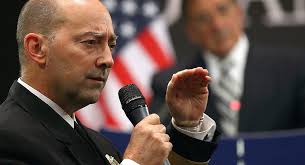
Retired Adm. James Stavridis said this on the Morning Joe show Jan. 31: 

"This is the country that Simon Bolivar centered. This is the Bolivarian Republic of Venezuela. This is where democracy began in the Americas. So, at the end of the day, the tragedy here is not Nicolas Maduro, the current leader; it's Hugo Chavez, who preceded him, invented this half-baked socialist strategy called Chavizmo named after himself, and destroyed the oil industry, cratered the economy and then died just as oil prices went down, and handed the whole mess to a bus driver named Nicolas Maduro. If there was ever an example of Karl Marx's line that history always repeats itself first as tragedy then as farce, it's Venezuela going from Chavez, the tragedy who destroyed the country, to Maduro, the farce ... There's not a good military option here. There'll be temptations to steam a carrier battlegroup down there or put the 82nd Airborne on alert. Wrong, wrong, wrong. This is political, economic, diplomatic ... I think there's a two in three chance we can sort this thing out reasonably, but us loading up the military and launching it is not the right next move," Stavridis said.

Gallegos sums up "Crude Nation" as "a tale of how hubris, oil dependency, spendthrift ways, and economic ignorance can drive a country to ruin." Unfortunately, a lack of toilet paper is the least of the problems facing the people of Venezuela today.

Sunday, December 30, 2018

Meet the Pressing Problem of our Time

Review by Bill Doughty

Science and science fiction writers Isaac Asimov and Frederick Pohl collaborated on "Our Angry Earth" (A Tor Book, McMillan, 1991) nearly 30 years ago, outlining the problems and proposing solutions to global climate change.

Reading the recently reissued (2018) "Our Angry Earth," which builds on scientific evidence from decades earlier, it's a wonder how the issue hasn't been taken more seriously until now.

Asimov called his and Pohl's book "hopeful" and a "scientific survey of the situation that threatens us all – and it says what we can do to mitigate the situation."

The first half of the book is a depressing litany of problems and challenges, including the greenhouse effect caused by burning fossil fuels and depleting forests:
"One of the most damaging effects of the greenhouse warming is likely to be a significant increase in violent weather, followed by drastic and rapid changes in the climate conditions many living things depend on for their survival. The reason for this is that the atmosphere is basically a heat engine. The more heat energy that the greenhouse gases trap in the atmosphere the more it has at its disposal to transform into kinetic energy – the energy of motion – the energy we see as winds and weather. That is a simplified statement of a complicated matter..."
Isaac Asimov and Frederick Pohl
Asimov and Pohl warn of (among other things) overfishing, rising seas, extinctions, severe storms, plastics dumping, lack of potable water and destruction of habitat. Coastal cities and nations are most at risk of the impacts.

The authors show the true cost of fossil fuels, not only in their destruction of the environment but also in the burden to the military patrolling Persian Gulf states. "The Persian Gulf War (five years before the book was published) is the war oil made," they write."

Of course the same can be said of the War in the Pacific in WWII, when Imperial Japan invaded neighbors and Southeast Asia for oil and other resources. The attack on Pearl Harbor galvanized an otherwise war-averse and skeptical United States.

Now the military, including the Navy, has been on the leading edge in confronting and battling global climate change. "Our Angry Earth" mentions the U.S. Navy and then-Soviet submarines patrolling in the Arctic. They show how the Persian Gulf War was an example of how the U.S. can lead "world opinion in the mobilization of international opposition."

The Navy has been deploying, refining and investing in solar photovoltaic arrays, wind power and ocean energy.

Chuck Todd and Meet the Press
Today, in a year-ending episode, Chuck Todd of NBC Meet the Press dedicated his program to the issue and credited the military's initiatives:

Guest Michèle Flournoy, President Obama's undersecretary of defense, said, "I think there is a very strong consensus, in the U.S. military and in the national security community, that climate change is real. This is a sort of pragmatic, clear-eyed view. And for the military, they see this as leading to a change in their mission, more humanitarian assistance, disaster-relief missions abroad and at home. They see the melting of the ice cap in the Arctic, that's going to open up an area of strategic competition with both Russia and China."

Both the Navy and Coast Guard conduct studies or facilitate research in the Arctic and Antarctic.


ARCTIC OCEAN – A team of scientists lay a cable on the Arctic ice Sunday, Sept. 30, 2018, about 350 miles northeast of Barrow, Alaska. The cable contains a series of sensors which attach to the bottom of a buoy that sits on top of the ice to measure wind speed and direction, air temperature, barometric pressure and other scientific measurements to study stratified ocean dynamics. The U.S. Coast Guard Cutter Healy (WAGB-20) is underway in the Arctic with about 100 crew members and 30 scientists to deploy sensors, buoys and semi-autonomous submarines to study how environmental factors affect the water below the ice surface for the Office of Naval Research. (NyxoLyno Cangemi/U.S. Coast Guard)

Flournoy added, "But it's also an infrastructure problem for the military. More than half of U.S. military bases and bases overseas are estimated to be severely impacted by climate change, either severe weather and/or flooding. That's our ability to project power overseas. That's our ability to operate our U.S. military. 50% of the facilities are going to be affected."

Todd framed the problem at the end of 2018: 

"This year, a series of climate reports, including one produced by 13 agencies in Mr. Trump's government, issued dire warnings of economic and human catastrophe, if there is not immediate action to reduce greenhouse gas emissions. But the federal response to the climate crisis has been political paralysis and denial," Todd said. "While the federal government lags behind, cities and states are attempting to lead their own climate efforts."

In a book that is thorough and only slightly dated, Asimov and Pohl give their own clear-eyed assessment of the changes needed, including carbon-taxes and incentives to change to green industries:
"Make no mistake about it, our environmental problems mean that large-scale changes lie ahead. Businesses will be harmed, people will have to change their jobs. The reason for this isn't that do-gooder environmentalists like ourselves insist on it because of some idealistic devotion to 'nature' or the spotted  owl. It's because our profligate ways have done so much harm that large-scale change is inevitable. The only choice we have – the only future we can invent – lies in deciding which kinds of change will be best in the long run, the ones that will come about because we try to clean the world up, or the worse ones that will come about on their own if we don't."
Both Meet the Press and "Our Angry Earth" focus on solutions that can be achieved with a consensus of support from average citizens willing to get informed, aware and engaged in supporting fair, incentivized efforts to deal with the challenges now and in the years ahead.


GREENLAND (Sep. 2, 2017) Lt. Emily Motz, right, National Ice Center (NIC) and Katrina Tiongson, Environment and Climate Change Canada, replace the parachute cone on an Air-Deployable Expendable Ice Buoy (AXIB) at Thule Air Force Base in Greenland during preparation for deployment to the high Arctic near the North Pole. The deployment team, led by the Office of Naval Research (ONR), included personnel from the NIC, Office of the Oceanographer of the Navy, Environment and Climate Change Canada, Danish Royal Navy and University of Washington. The buoys provide real-time weather and oceanographic data to enhance forecasting, and environmental models thereby reducing operational risk for assets in the Arctic. (U.S. Navy photo by John F. Williams/Released)

Sunday, November 4, 2018

Meanwhile, China

Review by Bill Doughty

"China's foreign policy addresses both bilateral relations and participation in multilateral organizations. Beijing's view that 'domestic law trumps, even creates, international law' is a problem for resolving the sovereignty issues that affect both of these facets of Chinese foreign policy." So writes Dr. Bernard "Bud" Cole in a new book that dives deep into the motives, capabilities and challenges of the Peoples Liberation Army (Navy).

Marxist communism has been replaced with nationalism, Cole contends, as the world's superheated economy burns more coal and looks to extract more nonrenewable petroleum resources on land and beneath the sea.

Cole's "China's Quest for Great Power: Ships, Oil, and Foreign Policy" (Naval Institute Press, 2018) is a measured, balanced and eye-opening study backed by 75 pages of notes and bibliography.

We see China's interests, goals and reasons for wanting "a seat at the table," as well as the PLA(N)'s maritime strategy, goals, challenges and inventory.
SOUTH CHINA SEA (Sept 25, 2018) An MH-60R Seahawk, assigned to the "Easyriders" of Helicopter Maritime Strike Squadron (HSM) 37 lands on the flight deck of the Arleigh-Burke class guided-missile destroyer Michael Murphy (DDG 112) forward-deployed to the U.S. 7th Fleet area of operations in support of security and stability in the Indo-Pacific region. (U.S. Navy photo by MC2 Justin R. Pacheco)
Ens. Adrienne Wang aboard USS Michael Murphy.
What can the United States and the rest of the international community do to counter China's quest for power and flouting of international law?

Our headlines focus on Russian meddling in elections, a Saudi hit squad dismembering a journalist, U.S. white nationalist attacking citizens, and South/Central American refugees seeking asylum; meanwhile we also need to care about China, Taiwan and the South China Sea.

The U.S. economy – as well as China's – is interdependent and tied to the global economy and sea lines of communication (SLOC). This book helps us understand the macro economic pulse of economic security, stability and prosperity that freedom of the seas provides.
"The United States is involved in all of China's maritime disputes, for several reasons. First is the vital U.S. concern with maintaining freedom of the seas, particularly freedom of access for U.S. and other seaborne trading. Second are the U.S. defense treaties with South Korea, Japan, and the Philippines, all of which border on areas in dispute with China. Third is the strategic assumption that global U.S. access, presence, and influence are being challenged by China's modernizing navy, expanding economic influence, and assertive foreign policy."
Author Capt. Bernard "Bud" D. Cole, USN (Ret.)
According to Cole, the future improvement of economic conditions in China "depends on the government's ability to maintain the security of the energy sector." How will China evolve as it confronts its own embittered nationalism, massive pollution, overfishing, unhappy neighbors and internal challenges: corruption, banking and currency issues, stove-piped opaque government, an aging population and "dramatic gender imbalance."

"Corruption, a weak intellectual property rights regime, and lack of innovation all characterize China's economy," Cole writes. "The question of how China's officials are going to seal their nation from 'western values' is both intriguing and disturbing." 

Using data and statistics, Cole shows how China's appetite has affected and continues to affect the environment, including the world's oceans. "In the words of one scientist, the combination of sovereignty and ecological 'problems mean the whole ecological system in the areas is at the brink of collapse.'"

The "areas" include not only the expansive land areas controlled by the Middle Kingdom, but also the South China Sea, the Yellow Sea and East China Sea – reaching far beyond the PRC's homeland territories.
"Why does China care so much about the sovereignty of these remote, mostly uninhabitable land features, many of which never show above the ocean's surface? The first reason is national pride, with memories of the 'century of humiliation.' Second is the issue of natural resources in the features' surrounding waters, including fisheries, petroleum, and other minerals. Third is the strategic location of the disputed land features, especially those in the South China Sea, an area of crucial SLOCs. Finally, Beijing desires to prevent events from occurring in the three seas of which it does not approve."
SECDEF James Mattis meets with China's Minister of National Defense Wei Fenghe Oct. 18, 2018.
Cole presents the current ecosystem of politics, economy and energy that gives us a clear-eyed understanding of the issues not only from China's and our perspective, but also from China's neighbors, including Japan, India, Vietnam, Philippines and others.

"China's economy is international and maritime; China believes that a strong, globally capable navy is required to secure that international economy and the foreign-origin resources required to support continued economic growth," Cole concludes. 

As Americans are distracted by daily headlines at home, we are wise also to continue tracking "China's remarkable development," quest for great power, challenges to continued growth and "a Beijing goal of diminishing Washington's dominance at sea."

Monday, January 16, 2017

Believe the Scorpion: 'Winter is Coming'

Review by Bill Doughty

What's the best thing we can do to defeat threats to our nation and world?

Brainy world chess champion Garry Kasparov offers advice, history, analysis and a prescription in his thoughtful "Winter is Coming: Why Vladimir Putin and the Enemies of the Free World Must Be Stopped" (PublicAffairs, Perseus Books Group, 2015).

Kasparov challenges us to keep human rights in the forefront – to not look away in the name of political expediency – when dealing with President Putin and his cronies. And deal we must, he says, or risk the appearance (or reality) of appeasement.
"Instead of standing on principles of good and evil, of right and wrong, and on the universal values of human rights and human life, we have engagement, resets, and moral equivalence. That is, appeasement by many other names. The world needs a new alliance based on a global Magna Carta, a declaration of fundamental rights that all members must recognize. Nations that value individual liberty now control the greater part of the world's resources as well as its military power. If they band together and refuse to coddle the rogue regimes and sponsors of terror, their integrity and their influence will be irresistible. The goal should not be to build new walls to isolate the millions of people living under authoritarian rule, but to provide them with hope and the prospect of a brighter future."
Havel (L) and Kasparov (R) meet at Democracy & Security conference, 2007.
Former Czech President Václav Havel is quoted, describing "politicians who kiss and embrace politicians, almost dizzy with the smell of oil and gas." According to Kasparov, Putin's wealth and power are provided by Western companies, especially "energy giants," investing in Russia "as Russian oligarchs spread their wealth."

This book comes with an endorsement from former Navy pilot and Vietnam War POW Senator John McCain (pictured below): "As one of the most influential critics of Vladimir Putin's reign of terror, Garry Kasparov has become a champion for the causes of freedom, democracy, and human rights in Russia."

Written after the invasion of Ukraine but before Russia's foray into Syria, this still-timely book shows how Putin – Time's Person of the Year in 2007 – came to power after Gorbachev and Yeltsin in the pivotal first year of the Millennium. 

Among the events in a tumultuous 2000, a faulty torpedo exploded aboard the Russian nuclear submarine Kursk in the frigid Barents Sea, resulting in the death of 118 Russian sailors. That same year Osama bin Laden's Al Qaeda targeted USS Cole (DDG 67), killing 17 American sailors.

Terrorism and military tension were once again on the rise in the 21st century, a combustible mix ready to explode in the fall of 2001.

President Putin.
Grandmaster Kasparov explains how history's chess pieces have moved – from Cuba's Bay of Pigs to Vietnam's Cam Ranh Bay, from Chechnya to Ukraine – and dozens of other hotspots on the planet, as ideals of freedom and democracy clashed with fascism and totalitarianism, as elections took place or power was seized and consolidated.

North Korea is mentioned several times. In 2001, "the Russian president had already established personal relations with Kim Jong-il and was ready to play a broker role on the Korean Peninsula."

Former North Korea dictator Kim Jong-il and Putin in 2002.
Kasparov describes the nature of a fascist kleptocracy such as Stalin's and Hitler's. "Dictatorships must be feared to survive and so they cannot bear to be mocked." Fear and disinformation are fomented, and freedom of speech is intolerable. 

Are dictators born or raised that way? "As with most nature-nurture questions, it's both in varying degrees of balance."

This book is filled with word gems, like:

  • "If the road to hell is paved with good intentions, compromises on principles are the streetlights."
  • "When Putin loaned the presidency to his shadow, Dmitry Medvedev it should have been clear to all that democracy was dead."
  • "Even after Western firms were repeatedly betrayed, cheated, and threatened by their Russian partners and kicked out of partnerships or the country, they came back looking for more like beaten dogs to an abusive master."
  • "The mullahs, monarchs, and dictators are pushing back against the threat to their medieval ecosystems."
  • "True nature can override logic and self-preservation."

The last bullet above refers to fabulist Orson Welles's story of the scorpion and the frog: 

"The frog carries the scorpion across the river on its back, convinced by the scorpion's logic that it will not sting him because if it does , they will both die. In the middle of the river the scorpion stings the frog, who says, dying, 'Logic? There is no logic in this!' The scorpion replies, 'I know, I can't help it. It is my character.'"

Fortunately, "Few humans are truly scorpions – complete psychopaths."

Kasparov warns, "Don't trust a scorpion because logic and being in the right doesn't help you very much when you're dead."

Dissidents are true patriots, dedicated to higher ideals as espoused in the Constitution and Declaration of Independence, according to Kasparov.

"If we rouse ourselves from our complacency and relearn how to stand up to the dictators and terrorists who threaten the modern world we have built, we can alter our course," he writes.

In other words: Read books.

Using Malala Yousafzai as an example of how education threatens fascists but empowers citizens, Kasparov, the chess champion prescribes a solution: "What these thugs cannot abide is the flowering of education, with the noteworthy exception of militant religious-teaching that often closes minds instead of opening them. They despise the possibility of an educated population, knowing it would mean the end of their kind for a generation."
"If there is anything I have learned from my extensive travels all over the world to promote chess in education it is that talent exists everywhere. The question is how to give it the opportunity to express itself and to thrive. This opportunity that education creates is what is lacking in so much of the undeveloped world and in parts of the developed world as well if we are honest – a shortfall that has wide-ranging and damaging effects. Education is the most effective way to address poverty and violence, even to tackle complex issues of terrorist groups and vicious warlords."
"Winter Is Coming" is, of course, a title taken from George R. R. Martin's "Game of Thrones," but Kasparov recommends another author "to understand the Putin regime in depth": Mario Puzo, author of "The Godfather" (a book novel published in 1969 that I read in high school English class, hiding a paperback version behind the assigned Carson McCullers book; sorry, Ms. Baker).

Kasparov advises: "The rise of Vladimir Putin and his St. Petersburg clan has been described as Machiavellian, but it is better described by the achievements of Don Vito Corleone: the web of betrayals, the secrecy, and the blurred lines between what is business, what is government, and what is criminal – it's all there in Puzo's books."

Other authors and works recommended or inspired after reading "Winter Is Coming" include David Halberstam's "War in a Time of Peace," George Orwell's "1984," Hanna Arendt's "Origins of Totalitarianism," and Masha Gessen's "The Man Without a Face."

Thursday, November 24, 2016

Orange Enemy, Operation Z, Roads to War: 'Pearl Harbor'

Review by Bill Doughty


Part I: The Roads to War...

Considering the signals, warnings and consequences 75 years ago, how in the world did the attack on Oahu of Dec. 7, 1941 happen? In light of all the evidence, Imperial Japan's attack – "Operation Z" – should have been predicted, prevented or at least defended against.

Craig Nelson presents that thesis in "Pearl Harbor: From Infamy to Greatness" (2016: Scribner) and shows the dangers of complacency (despite planning under War Plan Orange), hubris and racism, leading to "faulty stereotypes" and miscalculation.
"Five decades after December 7 and eight years before 9/11, Central Intelligence Agency analyst A. R. Northridge summarized these attitudes in a September 22, 1993, Pearl Harbor report: 'It seems clear to me that we failed to foresee the Japanese assault largely because we were influenced by a faulty stereotype of what was an adversary nation. Today, progress in the arts of weaponry and technical intelligence collection make unlikely another Pearl Harbor kind of surprise attack, but the faulty stereotypes that can lead to grave miscalculation of an adversary's capability and intent remain with us, almost as a human condition ... what sort of people did Americans, at the time of Pearl Harbor, believe the Japanese to be, and what did they believe about Japanese intentions toward themselves? ... 'The Japanese people, given the conflicts of interest between us, will quite likely – or maybe only possibly – do us a mischief if they can; but they lack the capacity to harm us seriously, and they know that this is so. On the other hand, they are so cultivated and mannerly that it really is, after all, inconceivable that they would even try to harm us.'"
Nelson adds, "The Japanese, meanwhile, shared this cultural and racial blindness." While much of racially segregated and white-dominated America saw non-whites as inferior, the Japanese believed themselves to be a morally superior race – god's people under a living god, Emperor Hirohito, pictured at right in wartime uniform.

According to Nelson, "The Japanese also believed the United States was a nation governed of the rich, by the rich, and for the rich."

Warnings of impending war were clear in the lead-up to December 7, 1941, as War Plan Orange focused on the possibility of a U.S.-Japan war.

Chief of Naval Operations Harold "Betty" Stark assigned Rear Adm. Walter Ansel to do a study nearly a year before the attack, and Ansel warned Hawaii's Adm. Husband E. Kimmel and Rear Adm. Claude Bloch of the strong possibility of a "surprise attack upon the Fleet or the Naval Base at Pearl Harbor." A bizarre ad appeared in the New Yorker on Nov. 22 seeming to warn of the attack and including dice showing the numbers 12 and 7, "numbers on no known dice." Secretary of the Navy Frank Knox saw Imperial Japan's diplomats "deliberately stalling" and reported his concerns to Roosevelt on Nov. 29.

Talk to people who remember the 1930s and early 1940s and they will tell you that everyone in the country knew war was probable. Times were tense. Under a narcissistic authoritarian ruler, war was already a reality in Europe, and under a military-controlled government, Japan was waging conquests in Asia.
Japan joins the Tripartite Axis with Germany and Italy.

On the world's stage, Hitler brought Japan into the Axis powers. Japan's military, especially its army, took control of Japan's government and media. Japan's imperialism against China and Southeast Asia continued to escalate, but U.S.-led trade embargoes against Japan by President Roosevelt were biting into the military's expansion in November 1941.

"Japan's oil reserves were vanishing. America's Pacific forces, especially in the Philippines, were rising," Nelson writes.
Adm. Kimmel and Gen. Short, tragic figures caught in infamy.

In the bitter days leading up to Dec. 7, as negotiations broke down, Stark issued a new alert system for all of Oahu.

Why didn't Adm. Kimmel or the Army's  Gen. Walter Short take more steps to minimize targets, conduct greater surveillance and protect major assets and otherwise mitigate a surprise attack? Is hindsight 20-20 vision? Could more have been done to prevent the debacle of the surprise attack? Clearly we underestimated our adversary.
"Japan, then, had the appearance of a civilian government, but it was a de facto military dictatorship. Yet, unlike the smooth governance offered by other fascists, all of this resulted in anarchy. In the fourteen years of the Great Wast Asia War – from 1931's Manchurian Incident, to 1945's unconditional surrender – Japan was led by fifteen different prime ministers. This wasn't just a fascistic and chaotic government; it was one so marred by threats of domestic violence that even the revered emperor regularly feared his assassination. One simple explanation for Pearl Harbor, then, is the great difficulty American leaders had in crafting an effective defense strategy against an enemy that had lost its mind."
Imperial Japan's "God's army" invades Manchuria in the 1930s. 
"Pearl Harbor: From Infamy to Greatness" provides a sweep of history that shows how cultural misunderstandings led to war. This book offers a lot more. We meet some of the survivors on both sides and hear their stories in Part II, "Strike." Then, Nelson takes us into the aftermath of the war and presents a surprising conclusion in Part III, "Victory."

As we approach the 75th commemoration of the attack on Oahu, Navy Reads is reviewing this timely and provocative book in parts, concluding with Nelson's view of the "greatest legacy" of Pearl Harbor.