Sunday, June 27, 2021

Universal Truths in McRaven’s ‘Code’

Review by Bill Doughty

Leadership skills and virtuous behavior are built into the human DNA.


That’s the conclusion of Adm. William H. McRaven (U.S. Navy Retired) author of “The Hero Code: Lessons Learned from a Life Well Lived” (Grand Central Publishing, Hachette Book Group, 2021).

“There is a hero in all of us. There is an innate code that has been there since the birth of mankind. It is written in our DNA. It is what drove the great expansion of humanity out of Africa. It summoned the explorers to cross the deserts and the seas. It helped create the great faiths. It emboldened the early scientists and philosophers. It nurtured the ill and infirm. It spoke truth to the masses. It brought order to chaos and hope to the desperate. This code is not a cipher, or a cryptograph, or a puzzle to be solved. It is a moral code, an internal code of conduct that drives the human race to explore, to nurture, to comfort, to inspire, and to laugh so that societies can flourish.”

McRaven helps readers and leaders tap into their innate evolved DNA. Like Richard Dawkins in “Unweaving the Rainbow,” McRaven calls for humility, respect, and courage as he gently reminds us of our mortality and relative insignificance in space and time.

McRaven writes this universal truth:

“To be humble is to recognize that one’s intellect, one’s physical strengths, one’s wealth all pale when compared to the vastness, the complexity, the richness, the power, and the grandeur of the universe. And if we are humbled by our place in the universe, then we are much more likely to see that our differences are infinitely small. We are much more likely to see that our understanding is equally fraught and that our power to overcome even he tiniest challenges is similarly difficult. Humility is born out of respect. Respect for what we do not know. Respect for what we cannot readily see. But out of this humble approach to life, we are more likely to appreciate the beauty that surrounds us, more likely to gaze into a microscope or peer at the stars and be awed, more likely to be inspired by little acts of kindness. And we are much more likely to treat others as we would have them treat us.”

Charles Duke steps on the moon during Apollo 16, April 1972. 
In a poignant post-Trump insight, McRaven writes: “The power of humility is that it brings us closer together, and the role of every hero is to unite people, not divide them.”

Throughout this compact but powerful book McRaven tells stories of true heroes such as Air Force General Charles Duke, the youngest astronaut (so far) to walk on the moon; Marine Private First Class Ralph Johnson, who in 1968 leapt on a grenade and “gave his last full measure of devotion to the men he served with;” Gary Sinise, who selflessly brought educational supplies to a war zone in Afghanistan as part of Operation International Children; and Sen. John S. McCain III, a POW survivor and true American hero, who showed McCraven humility, gratitude, honor, and a sense of humor.


Abraham Lincoln
Being able to laugh at oneself is the sign of strength, and McRaven presents a self-deprecating joke Abraham Lincoln told to people: “(Lincoln) loved to tell the story of a man who approached him on a train one day. The man said, ‘I have an article in my possession which belongs to you.’ Taking a jack-knife from his pocket, the man explained, ‘This knife was placed in my hands with the promise that I was to keep it until I found a man uglier than myself. Allow me now to say, sir, that I think you are fairly entitled to the property.’”

McRaven introduces lesser-known heroes, too, including Navy Capt. Ted Grabowsky, who taught that “honesty is the cornerstone of integrity, the foundation upon which all other aspects of your character will be built.” He tells us of cancer researcher Dr. Jim Allison, who personifies perseverance (and has an interesting connection to the great Willie Nelson). And, he shares a personal story about cancer doctor Michael Keating, who shows that hope and change can be the strongest forces in the universe.


Ten years ago this year McRaven, under Commander in Chief President Barack Obama, commanded the Navy SEALs who brought justice to Osama bin Laden. If that was a career high for him, surely one of his deepest lows came in a separate combat action when some of the military forces under McRaven’s command mistakenly killed two non-enemy sons and a daughter of a father in Afghanistan. In the tenth chapter McRaven relates in heartbreaking detail how he met with that father and how forgiveness can be transforming.

During a Profiles in Leadership seminar, Retired U.S. Navy Adm. William H. McRaven speaks to service members inside the Pfingston Reception Center located on Joint Base San Antonio – Lackland, Texas, Jan. 10, 2018, about character and how it applies to leadership. (TSgt. Ave I. Young)

The "Forgiveness" chapter’s epigram is by Mahatma Gandhi: “The weak can not forgive; forgiveness is the attribute of the strong.” We can tie McRaven’s wisdom –– giving up the burden of hatred –– to the current state of society in 2021: intolerant political correctness, QAnon conspiracies, cancel culture, voter suppression, and domestic extremism and terrorism, including the Jan. 6 insurrection attack on the Capitol –– seeking to divide rather than unite.

“Society today seems to be easily offended. We are quick to anger, and some people believe every offensive act, no matter the intent, requires a swift rebuke. The hardest thing any hero can do is to forgive. It is easier to storm the hill, fight the fire, and stop a madman with a gun. It is hard to forgive, because we are afraid. Afraid that forgiving will take away the anger that drives us, the hatred that motivates us, the righteous indignation of being wronged. We want more than anything to harness the outrage, feel the power of injustice, and the fury of discontent, so we can lash out at the offender and feel justified. We think that retribution, no matter how small or how large, will sooth our soul.

It will not.”

He advises, “Be the victor, not the victim.”


Boatswain's Mate Seaman Apprentice Esau Arellano aboard guided-missile destroyer USS Ralph Johnson (DDG 114), Aug. 4, 2020. (MC3 Anthony Collier)

His code begins with “courage.” He advises, “Take one step forward and face your inner demons. And if you take that one step forward you will find the courage you seek…”


It takes profound individual courage, for example, to confront the universal human truth of our mortality. Which reminds me again of Richard Dawkins, who writes in “Unweaving the Rainbow”: “We are going to die, and that makes us the lucky ones. Most people are never going to die because they are never going to be born. The potential people who could have been here in my place but who will in fact never see the light of day outnumber the sand grains of Arabia.”


In “Hero Code” McRaven gives respect to courageous heroes. He quotes John Adams, William Penn, Mark Twain, Winston Churchill, Anne Frank, Fyodor Dostoevsky, Nelson Mandela, Helen Keller, Sonia Sotomayor, among others.


McRaven distills his perspective on heroism down to each individual. He recommends readers find their talent “and use it to inspire others –– to give hope, to make tomorrow a better day.”


This compact book is packed with bite-sized philosophy, common-sense ethos, and universal wisdom.

Monday, June 14, 2021

Tammy Duckworth: Life’s Whole “Gift”


Review by Bill Doughty

I have a good American friend in Japan who bristles when people call his sons “hah-fu” –– half Japanese, half “gaijin” (foreigner).


“They’re not half,” he explains. “They’re doubles!”


The first chapter of “Every Day Is a Gift: A Memoir” by Tammy Duckworth (Hachette Book Group, 2021) is titled “Half Child.”


As a mixed race child, Tammy Duckworth was bullied by Thai kids (and even her cousins) for being larger and whiter and freckled –– a “half,” a “less-than.” She was called “farang” (“whitey”). But that would be one of the least of the problems she would face –– as presented in her deeply personal story of overcoming discrimination, disability, and disappointment.


Duckworth’s mom is Chinese by birth; mom’s family escaped Mao’s persecutions in Communist China by immigrating to Thailand. Duckworth’s dad is a former United States Marine who became an officer in the Army and eventually a federal civilian worker. The family lived in Bangkok and Jakarta as well as Phnom Penh, Cambodia, during the Vietnam War.


Tammy and her family escaped Cambodia in 1975. She remembers vividly watching Operation Frequent Wind on TV from the safety of Bangkok –– the evacuation of Saigon by American helicopters to U.S. Navy aircraft carriers in the South China Sea.

Tammy, age 3, in Bangkok
Later, nearly penniless, she and her brother and father came to Honolulu. Like many DoD brats, Duckworth had to move a lot. Eventually she would live in Winchester, Virginia; Washington, D.C.; and DeKalb, Illinois.

In “Every Day Is a Gift” Duckworth shares both her adventures and her many difficulties growing up with a patriarchal and domineering father and devoted but sometimes distant mother.


After her father lost his job and the family’s savings, Tammy lived a harrowing life as a teenager in Hawaii. Her first Thanksgiving in the States was at the Waialana Coffee House (which closed down during the COVID-19 pandemic).


As for prejudice and discrimination in her new home, fortunately in Hawaii people embrace the concept of “hapa” for mixed race people, but of course in Hawaii most folks aren’t “halfs” or “doubles”; they’re “multiples.”


Duckworth attended McKinley High School, whose alumni include multi-talented Dwayne “The Rock” Johnson and legendary Senator Daniel K. Inouye. In high school she met Inouye, whose arm was blown off by a Nazi soldier in World War II. Tammy had no idea that one day she, too, would be a wounded warrior and, in her case, a double amputee.


Her association with the military started tangentially when she got a temporary position with the U.S. Naval Institute, famous for publishing Tom Clancy’s first blockbuster, “The Hunt for Red October.”


She attended ROTC for a summer at George Washington University and was propelled to enroll full time in ROTC at Georgetown University. That’s where she fell in love with military life in general and the Army specifically. She met her future husband in uniform in a humorous encounter highlighted in the book.


At 23 she pursued international diplomacy studies at Northern Illinois University and found her home.

In the National Guard as an Army Reservist, Duckworth was able to follow her passion, pursue post-graduate studies, and work while serving her country. She says this about the sacrifices and service of Guardsmen and Reservists:

“There are several reasons people prefer the Reserve forces. Some don’t want to give up civilian jobs that pay better than military service. Some don’t want to commit to moving around every two or three years, which active duty servicemembers have to do. Some of them have already served on active duty and enter the Reserves after finishing their commitment.

One thing we all have in common, though, is our desire to serve. Being a member of the United States military is a privilege and an honor. When our country calls us to undertake a mission, we stop up, even if there’s a personal and professional cost to us. Citizen Soldiers do this over and over and over again –– and nonmilitary people don’t even know about it.”

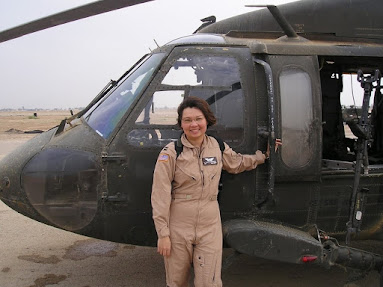
Lt. Col. Duckworth joined the military before women were authorized to serve in combat, but she got as close as she could by becoming a helicopter pilot. She describes flying over the Egyptian desert and passing the Great Pyramid of Giza in Operation Bright Star. She flew low over the Amazon rainforest in Guyana  in Operation New Horizon. And she piloted missions in Iceland to clear glaciers of rusting equipment from World War II in Operation Northern Viking.


But the most harrowing experience, of course, was what happened on Nov. 12, 2004, when Duckworth’s Black Hawk was shot down in the Iraqi desert.


Both of her legs gone. Her arm badly mangled. Shrapnel in her face and body. Her fellow soldiers thought she was dead, but they refused to leave her body behind.


U.S. Army Warrior Ethos comes alive in the aftermath of the shootdown as Duckworth’s teammates extract her nearly lifeless torso and arrange for a medieval to Baghdad, where troops lined up to give blood. She needed 40 units of blood, plasma, and platelets.


Duckworth’s recovery at Walter Reed Army Medical Center is told in painful detail –– how she bore a “wall of pain,” learned to walk with two prosthetic legs, and came to terms with her new circumstances after the tragedy in Iraq, where she says, “There’s a piece of me there, both literally and figuratively.”

At Walter Reed she had to have parts of her body surgically removed and used to repair her mangled arm. She showed unimaginable grit and toughness, mixed with typical wounded warrior morbid humor and resolve.


Duckworth’s story is one of superior resilience. “I had no choice but to power through,” she writes. “It made no sense to lie around and feel sorry for myself. I had to accept my situation, then start working to change it.”


Found Haiku in “Every Day Is a Gift”:


When the obstacle

is effort, then there is no

obstacle (at all)


Something bad happens

you can either let it own

you, or you own it


(And) no matter how

grievous the wound, healing is

always possible


I found this book at Barnes & Noble bookstore on Memorial Day. It is a perfect companion book to one recently featured in Navy Reads: James Patterson’s “Walk in my Combat Boots.”


In fact, Duckworth’s missing combat boot is symbolically returned to her by fellow soldiers in a pivotal part of her story.

During her recovery and after meeting Illinois Senators Dick Durbin and Barack Obama, Duckworth resolved to enter politics. 

She was influenced personally by wounded warrior public servants Senators Bob Dole and Max Cleland, who helped her confront post-traumatic stress disorder.

“Senator Max Cleland, who lost his legs and an arm in Vietnam, sought treatment for PTSD three decades after his injury, when he lost an election in 2002. I met Max while at Walter Reed, and talking to him helped me to truly understand that the best we can do is take life one day at a time.

In the summer of 2005, when I realized I would never fly for the Army again, that advice from Max helped save me. I was no longer sure what my purpose in life would be, but I had to just take it one day at a time, and be open to whatever came my way.”

Obama, Akaka, and Duckworth
She fought for reforms at Walter Reed and the Veterans Administration, first in Illinois and then in President Barack Obama’s administration. She fought to make a national difference, first as a representative in the U.S. Congress and then as a senator. And she fought to become a parent.

Lt. Col. Duckworth’s struggle to become a mother and her realization that there is no such thing as “work-life balance” can be an inspiration to women and a revelation to men.


In Congress Duckworth was helped by Senators Kristen Gillibrand and Amy Klobuchar, among others. The late Senator Daniel K. Akaka honored her by bestowing Hawaiian names for her two daughters.


Her choice to enter politics so she could help people is not surprising.


Early in her life she saw first-hand the need for a social safety net and equal opportunity for people of color. Fifty-four years ago, in June 1967, the Supreme Court ruled in Loving v. Virginia that interracial couples, like Duckworth’s parents, could marry.


Her father’s hero was President Ronald Reagan. In the aftermath of the Vietnam War, Reagan signed the AmerAsian Immigration Act that allowed many Southeast Asian “half-children” into the United States. Of course, they were not “halfs.”

In “Every Day Is a Gift” Senator Tammy Duckworth, who lost nearly half her body in combat, shows that every person can be part of a greater whole. She lives the teamwork ethos –– no one left behind.


This is a marvelous and powerful book filled with tears, smiles, revelations, and inspiration. Like “Walk in My Combat Boots,” this book comes with an endorsement from Adm. William H. McRaven (U.S. Navy, Ret.): 


“Raw, unfiltered, powerful –– a compelling story of courage and determination against overwhelming odds. Tammy Duckworth is a true warrior who overcame a difficult upbringing, a glass ceiling, and a horrific helicopter shootdown to become one of the most respected senators on Capitol Hill. Nothing can stop her.”

Monday, June 7, 2021

Cutler Dawson: Truth, Trust & People First


Review by Bill Doughty

Thirty years ago this month, the guided-missile cruiser USS Princeton (CG 59) was undergoing repairs after being severely battle-damaged by an Iraqi mine while on patrol in the Persian Gulf during Operation Desert Storm. Princeton’s new CO, then-Capt. Cutler Dawson, quickly realized some of his crew members were as damaged as their ship.


While Princeton was being repaired in the shipyard, Dawson set out to help his sailors and their families recover from the shock and despair they were experiencing.

"The Princeton was in very bad shape, and so were some of the sailors. In addition, we had to work with a lot of strangers –– the shipyard workers –– who were in our spaces all day and night all over the ship.”


To prevent and counter any animosity between his sailors and the civilian shipyard artisans, Dawson went to the deckplates and got to know the workers, acknowledging their hard work and showing his and his crew’s appreciation.

“Our crew hosted picnics for the shipyard workers and we singled out the ones who were doing a really good job by writing thank-you notes to them and their supervisors. With a smile, I would tell all the technical representatives who came aboard to fix our radar and combat systems that I would house and feed them as long as it took to fix the problem and that my crew was ready and willing to assist. I wanted to foster a sense of teamwork and motivate them with encouragement, not criticism. After all, we were somewhat codependent on this project to be successful and, as the saying goes, ‘You get more with honey than you do with vinegar.’”

To paraphrase Dawson in another metaphor in his book “From the Sea to the C-Suite: Lessons Learned from the Bridge to the Corner Office” (Naval Institute Press, 2020): when it comes to carrots or sticks, choose carrots!

He offers leadership advice from his perspective as a retired vice admiral and former CEO of the Navy Federal Credit Union. He shows the value of passion and compassion, energy and empathy, and incentivizing and innovating. Most of all, he demonstrates the importance of truth, trust, and putting people first.

“If you can demonstrate to your crew members that you care about them and truly understand the difficulty of their tasks, they will do remarkable things for you; by contrast, if they think you are there just to further your own career, they will do no more than the minimum.”

While USS Princeton was being repaired Dawson kept his crew busy preparing for exams and certifications, staying positive and focused on trying to achieve work-life balance. He instructed his executive officer to organize recreational outings, and he promoted training on nutrition and leading healthy lifestyles. At NFCU, he instituted some of the same strategies –– including smoking cessation, yoga, and running 5Ks –– while nurturing a family culture not only for employees but also for customers, who are called “members” of the credit union.


Dawson checks an NFCU machine at Camp Lemonnier, Djibouti.
NFCU members include sailors and marines and their families as well as DOD civilians and other military personnel and their families. Dawson quadrupled membership and grew the business exponentially –– even to Djibouti on the Horn of Africa –– while demanding the highest standards of integrity and customer service. He says he demands “honesty and transparency from my employees.” “As I always say, I want to hear the truth, even though I may not always like the truth.”

Some surprising nuggets in this book include a connection with Rear Adm. George Morrison, father of the Doors’s Jim Morrison; a visit the USS Midway in the Sea of Japan; an attempt to expand library hours for his sailors after work; an order to one of his officers to get in the bosun’s chair; and reflections about two separate collisions by Navy ships in the Pacific in 2017.


The USS Princeton shipyard vignette is just one of the many sea stories and some of the salty logic Dawson offers in this remarkable book. For example, he explains the concept of “Unodir” (unless otherwise directed), remembers what he learned from “holystoning” a teak deck, and tells why leaders must look beyond their "lifelines."


He references poignantly, more than once, what it was like to have a thoughtless, uncaring, and mean-spirited CO as a boss. You can learn how not to be when you’ve seen a bad leader in a senior leadership position.


Builder Constructionman Matthew Best, from Stockton, Calif., assigned to U.S. Naval Mobile Construction Battalion (NMCB) 3’s Detail Tinian, reaffirms the proper placement of a gable-end on a Southwest Asia hut being constructed on Camp Tinian, Northern Mariana Islands, July 28, 2020. (CBSN Marcus Henley)

Finally, Dawson puts a big spotlight on the power and ethos of the Seabees (Construction Battalion engineers/Sailors) –– “Be a Seabee and find a way to ‘get to yes.’” He shows how the Seabees’ “can do” attitude as warriors, builders, and humanitarians accomplished the seemingly impossible in World War II, the Korean War, in Vietnam, and in the Middle East. And they continue to build on their legacy.


RDML Annie Andrews and Dawson
In other salty references he cites the influences of the biography of John Paul Jones, the history of USS Constitution, and the education provided at the U.S. Naval Academy. Dawson is a distinguished graduate of the class of 1970. “The lessons I learned in the Navy were directly transferrable to the business world,” Dawson says.

A lot of Dawson’s hands-on leadership advice mirrors that of retired Navy Captain David Marquet in his landmark book, “Turn the Ship Around” –– another highly recommended Navy read.


“C-Suite” is endorsed by Adm. (ret.) Mike Mullen, Adm. (ret.) Robert J. Natter, Army Gen. (ret.) Barry R. McCaffrey, and Adm. (ret.) James Stavridis, among others. It’s not surprising that many of the insights, including “follow your North Star,” are reminiscent of Mullen (“Look. Listen. Learn.”) and Stavridis, who often speaks of sailing "True North."


“Having a strong commitment to public service was at my core,” Dawson writes. His North Star is “Always do the right thing” –– Demand truth, develop trust, and always keep people first.


At the end of each chapter of “From the Sea to the C-Suite” is a “Foot Stomper,” in maritime lingo a synopsis of his key point for added emphasis. The book’s foreword is by Vice Adm. (ret.) John A. Lockard, chairman of the board of the Navy Federal Credit Union. The book was written with Taylor Baldwin Kiland, who has authored, edited, or ghostwritten 18 books, “including two about our nation’s Vietnam POWs.”


In January 2019 Dawson handed the reins as NFCU CEO to Mary McDuffie, former Chief Operating Officer of Navy Federal Credit Union.

Friday, May 28, 2021

For Memorial Day: ‘Service Before Self’


By Bill Doughty

The first-person stories in “Walk In My Combat Boots” haunt this Memorial Day. This is the second of a two-part Navy Reads review of this important book filled with the voices of combat warriors, medics, and defenders of freedom. Part one was posted May 21.


"Walk In My Combat Boots" by James Patterson reveals “the courage, the sense of duty, [and] the patriotism of this young generation,” according to Adm. William H. McRaven (U.S. Navy, ret.).


This weekend the nation is commemorating and honoring those who have fallen in combat. We should also reflect on the service and sacrifice of young men and women who served in recent war zones and saw death first-hand, up close, heartbreakingly personal.


Lt. Col. Sherry Hemby, 455th Expeditionary Aeromedical Evacuation Flight commander, ensures the brackets are in working order on a C-130 Hercules for an aeromedical evacuation flight to Bagram Air Field, Afghanistan, June 28, 2011. (Senior Airman Krista Rose)


Many of the patriots in this book are children of military veterans. Such is the case of Sherry Hemby, an Air Force flight nurse who remembers her dad: He taught me about patriotism –– to think of others. Service before self.”


Andy Prososky, a United States Marine veteran, is the son of a Navy Corpsman who served in Vietnam.

While serving in Iraq nearly two decades ago, he mastered the ability to compartmentalize, to not think of family and home, especially when out on a mission. “I don’t care about me, only my Marines,” he says.

Prososky encapsulates the tragedy of war in one episode involving RPGs, IEDs, a JAG, and a Marine killed in action. “Back home people ask me what death is like. You can’t explain it. It’s not dramatic, there’s no music, it’s sudden, it’s violent, it’s reality.”


Marine Cpl. Rory Hamill

The final section of this book is titled “Coda: Memorial Day.” And the final featured interview and story is by former Marine Corporal Rory Patric Hamill, son of two Navy parents. An extended excerpt follows:

“The amazing thing our brains do for us is compartmentalize any kind of trauma.

And therein lies the problem: people don’t address PTSD or what psychologists call a moral injury –– the feeling of overwhelming shame and guilt, even rage, anger, or betrayal over compromising your moral conscience. If you don’t address these actions and reactions, they come back to haunt you down the road.

I learn all this stuff later. Much, much later …

…The demons from all my deployments start eating away at me day and night. I can’t sleep, and I’m drinking too much. I’m smoking like a chimney. I’m not seeing my kids, and I’m shirking my responsibilities –– and it’s all because I’ve been ripped out from the familial structure of the military. And I miss the camaraderie.

From day one in the military, your entire day is regimented. It’s scheduled and structured down to the minute. You have a mission. You go out and get it done. Now I don’t have anyone telling me to do anything. I don’t have anyone keeping me in check.

My second marriage ends.

I find myself sitting outside a marsh by my dad’s house in Atlantic City. I’m sitting in the driver’s seat, holding a pistol.

I raise it to my head, about to end my life, when for maybe a half second my kids flash through my mind.

What the fuck am I doing?

I start crying.

I disassemble my weapon, take all the bullets out of the magazine, and throw everything out of the car.

I need to address this. I need to get some help.

I get diagnosed with PTSD. I start seeing a therapist full-time and get my head out of my ass. I quit binge drinking and stop smoking, which I’ve been doing since I was thirteen. I learn the importance of exercise and nutrition and taking care of myself. I begin to claw and scrape my way out of my self-loathing. I stop hating myself for everything. I stop blaming myself for my friends dying and every other shitty thing that’s ever happened to me.

I start speaking to other people about my experiences.

Over time, I start to learn to love my fate. Instead of letting it control me, send me into a deep, spiraling depression. I discover a way to turn it around for good –– to help others. If I can help one person every day, regardless of how I do it, then that’s a win for me. If I can use my experiences, my story, to help a person every single day, then everything I’ve gone through in my life is worth it.”

Hamill writes with appreciation about the honor of receiving the Purple Heart from President Barrack Obama at Walter Reed Hospital.


Cpl. Rory Hamill, a combat-wounded Marine, pauses to look at the Navy Sailor's Creed on the wall of the base gym on Joint Base McGuire-Dix-Lakehurst, N.J., Dec. 4, 2017. (U.S. Air National Guard photo by Master Sgt. Matt Hecht)


James Patterson, Matt Eversmann, and Chris Mooney help people tell their stories in “Walk In My Combat Boots” –– tragedies and victories, comedy and pathos. Mostly pathos, considering the sacrifices required in war.


We honor the men and women lost in war on Memorial Day. And we also remember those who gave so much in service to their country. True heroes live the values of honor, courage and commitment. They confront demons and find the truth. True patriots ensure we think of others and ask why we go to war. “Service before self.”

Monday, May 24, 2021

Unspeakable Tulsa Massacre


Review by Bill Doughty––

Combustible racial tension ignited one hundred years ago when a number of whites in Tulsa, Oklahoma, took up arms and threatened to lynch a black teenager. Two thousand whites fought with a group of thirty black men, including World War I veterans, who tried to protect the teen.


The white mob then attacked and burned down the Greenwood district, a black middle class neighborhood known at the time as “Negro Wall Street.”


Dozens of people –– most of them African Americans –– were killed in what was called a riot but is now known as a massacre. Between 150 and 300 people may have died, according to historians. Police joined the white mob in attacking black people in Greenwood.


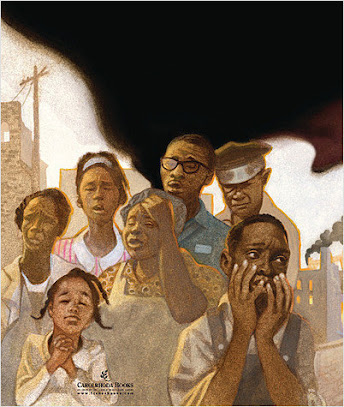
Carole Boston Weatherford (author) and Floyd Cooper (illustrator) capture the tragedy of Greenwood in a new book for young readers. The irony of the title “Unspeakable: The Tulsa Race Massacre” (Carolrhoda Books, 2021), is that the disaster of May 31/June 1, 1921, was not spoken about for decades.

Twenty years ago, Oklahoma Gov. Frank Keating signed the Tulsa Race Riot Reconciliation Act into law. But true reconciliation and accountability –– and prevention of similar violence –– cannot be achieved without an honest examination of events, especially massacres (or insurrections). That’s one reason this book by Weatherford and Cooper is so important and timely.


This book offers a short but clear and truthful history of what happened in Tulsa a century ago.

“Unchecked and, in some cases, deputized by the police, the white mob stormed into Greenwood, looting and burning homes and businesses that blacks had saved and sacrificed to build. Threatening to shoot, the mob blocked firefighters from putting out the blazes. African American World War I veterans took up arms to defend their families and property. But they were outnumbered and outgunned. Families fled with only what they could carry.” 

Some of the veterans were killed, just a day after Memorial Day. The hate-filled white mob destroyed hundreds of businesses and buildings. Thousands of black citizens were relocated to internment camps outside Tulsa.

Weatherford writes, “Black residents had to carry passes to enter the city.” Some stayed to rebuild the community while others left and never returned. It took 75 years before lawmakers launched an investigation into what had happened in 1921.


In an author’s note at the end of the book, Weatherford speaks to the history of the era and what moved her to write about the massacre, one of several against successful African American communities and thousands of murders of blacks after the Civil War and under Jim Crow laws.

“For me, racist backlash hits close to home. One cousin in Tennessee burned to death in his home, a rumored lynching. In the 1920s, whites allegedly burned down a store that belonged to another of my cousins in an all-black village cofounded by my great-great-grandfather during Reconstruction. In my adopted state of North Carolina, another ‘Black Wall Street’ anchored Durham, once a hub of black enterprise. And another race massacre occurred –– in Wilmington in 1898. Thus, family lore and proximity to history led me to the 1921 Tulsa Race Massacre.”

Last summer Navy Reads published a post about the Wilmington tragedy of 1898 and the Navy’s unfortunate connection to that massacre. The Wilmington massacre was instigated in part by a white supremacist newspaper publisher who would later become Secretary of the Navy, Josephus Daniels.


Again, confronting the truth of our past can help us reconcile. The vestiges of systemic hate-filled animus by some whites toward blacks was on full display one year ago when police officers in Minneapolis murdered George Floyd. Gun violence and mass shootings –– as well as other incidents of hate-based violence –– are on the rise in the summer of 2021. Seeing the truth can show us how far we have evolved, how much more we have to do, and where we need to continue to focus efforts toward greater equality, reform, and accountability.


In his illustrator's note, Floyd Cooper shares the story of his grandfather who grew up in Greenwood. Cooper says this about Grandpa Williams’s recollections:

“Everything I knew about this tragedy came from Grandpa; not a single teacher at school ever spoke of it … Now, the same way my grandpa told the story to us, I share it here with you. My grandpa passed away many years ago, but I hope that my art and Carole Boston Weatherford’s words can speak for Grandpa.”

Cooper’s gorgeous art does indeed honor the men, women, and children who were victims of the Tulsa tragedy. He creates emotional tension in the shading, perspective, and colors –– but most of all in the expressions –– of his subjects: women, men, and children. Their expressions speak volumes of truth.


"Unspeakable" concludes with an uplifting scene at the Tulsa Reconciliation Park, created twenty years ago as “a place to realize the responsibility we all have to reject hatred and violence and to instead choose hope.” Black and white people are pictured linking arms instead of taking up arms.

For adults interested in learning more about the unspeakable Greenwood tragedy, I recommend “Riot and Remembrance: The Tulsa Race War and its Legacy” by James S. Hirsh (Houghton Mifflin, 2002) and “Death in a Promised Land: The Tulsa Race Riot of 1921" (Louisiana State University Press, 1982). Both books include many black-and-white images of the awful events of May 31 and June 1, 1921. Each book dives deep into the history of the massacre and helps explain how feelings of entitlement, envy, privilege, and superiority manifested into violence.