Showing posts sorted by relevance for query mike mullen. Sort by date Show all posts

Friday, September 30, 2011

Damn the Torpedoes...

Review by Bill Doughty
The Navy’s first four-star admiral began service as a preteen in the War of 1812.  He was a son of the South who fought for the North in the Civil War and later served as a pallbearer at President Lincoln’s funeral.  He commanded blue-water naval warships in brown-water littoral operations in the Mississippi river, reclaiming New Orleans and later winning at Mobile Bay, famously having himself lashed to the upper rigging to ensure command and control.
“...full speed ahead.”
It’s not till the final pages of Robert J. Schneller, Jr.’s Farragut: America’s First Admiral that Farragut’s hispanic ethnicity is discussed.
At the tender age of 12 Glasgow “David” Farragut sailed as a midshipman with his mentor Captain David Porter aboard the 32-gun frigate USS Essex, fighting in the War of 1812 to stop the British from interfering with commerce on the seas.
After a stormy passage around Cape Horn and a stop in Valparaiso, Chile, the Essex roved through the Galapagos Islands, capturing a dozen British whalers and earned Porter the distinction of commanding the first American warship in the Pacific.  During the voyage Farragut saw albatrosses, flying fish, seals, sea lions, redheaded lizards, iguanas, Galapagos terrapins and other exotic wildlife.  He also weathered fierce storms and choked down his share of worm- and weevil-ridden food.
Farragut served aboard, sailed with or commanded USS Vandalia, USS Boxer, USS Consellation, USS Erie, USS Pennsylvania, USS Saratoga and USS Hartford.  Ashore, he served as commandant of Mare Island Navy Yard.
Commodore Farragut aboard USS Hartford, 1864.
Schneller describes the admiral’s distinguished service in the Civil War, fighting against the Confederate Navy, despite his roots in the south -- born in Tennessee, a resident of Virginia.
Farragut achieved a hero’s status after the Civil War.  He was promoted as the nation’s first four-star admiral on the same day that Ulysses S. Grant became the nation’s first four-star general.
After his final promotion to admiral,  Farragut was assigned by Secretary of State William Seward as commander of the European Squadron, where his Hispanic heritage and Spanish fluency helped him succeed in building partnerships and promoting peace.
The author provides a CliffsNotes version of Farragut’s life, purposely focusing on the historical details of key battles and military strategy.  Farragut is revealed as a courageous leader unafraid to make bold decisions in the heat of battle but unwilling to fully adapt to new technologies of ironclad ships, rifled cannons and mechanical means of propulsion.
For those who wish to delve deeper into Farragut’s life, Schneller offers these suggestions:  Loyall Farragut’s The Life of David Glasgow Farragut, First Admiral of the United States Navy, Embodying His Journal and Letters, Alfred Thayer Mahan’s Admiral Farragut, and Charles Lee Lewis’s two-volume study, David Glasgow Farragut: Admiral in the Making / Our First Admiral.
-----------------------------------------------------------------------------------------------------------------
Today Adm. Mike Mullen turned over the reins as Chairman of the Joint Chiefs of Staff.  The former Chief of Naval Operations prior to Adm. Gary Roughead and now Adm. Jonathan Greenert, Mullen initiated the Navy Professional Reading Program.  
As a student and teacher of history, Mullen often invoked memories of naval heroes.  Six years ago at a dedication ceremony of the Commodore Uriah P. Levy Center and Jewish Chapel at the United States Naval Academy in Annapolis, Md., Mullen said:
“I believe in the power of our past to inspire and instruct, and I believe in the power of our convictions, which have sustained generations of leaders...
“We think of heroes like John Paul Jones, Stephen Decatur, David Glasgow Farragut; as well as Carl Brashear, Grace Hopper, and Jim Stockdale.     

“Their legacy is our tapestry, a uniquely American tapestry, sewn of many diverse faiths and beliefs, cultures and backgrounds, colors and creeds.  
“We recall those leaders not in terms of where they came from, but for what they left us.”
President Barack Obama, left, shares a moment with Navy Adm. Mike Mullen, outgoing chairman of the Joint Chiefs of Staff, during the Chairman of the Joint Chiefs of Staff change of responsibility ceremony on Joint Base Myer-Henderson Hall, Va., Sept. 30, 2011. Mullen was succeeded by Army Gen. Martin E. Dempsey, who became the18th chairman of the Joint Chiefs of Staff, during the ceremony. DOD photo by U.S. Air Force Tech. Sgt. Jacob N. Bailey

Thursday, September 9, 2021

BJR2: ’The World As It Is’ post-9/11

Review by Bill Doughty––

A "found haiku" while reading Ben Rhodes:


the tension between

the world as it is and … the

world that ought to be


“After the Fall” (reviewed in the previous Navy Reads post) drops onto book shelves three years after writer Benjamin J. Rhodes’s other reflections, similarly profound and just as achingly personal: “The World As It Is: A Memoir of the Obama White House” (Random House, 2018), where Rhodes dissects, among other things, the “forever war.” This is a sweeping look back at the United States after September 11, 2001.

In announcing the beginning of bombing of Afghanistan twenty years ago, just weeks after 9/11, then-President George W. Bush told military service members: “Your mission is defined; your objectives are clear; your goal is just. You have my full confidence, and you will have every tool you need to carry out your duty.” Then, in 2003, Bush and neoconservatives invaded Iraq under false pretenses.


Unfortunately, the original mission to fight terrorists in Afghanistan morphed into a long-term counterinsurgency initiative and a doomed nation-building effort in the middle of a perpetual virtual civil war, with no end in sight.

While some progress was made in Afghanistan over two decades, especially for women and girls, the changes were neither deep nor long-lasting, as evidenced by the immediate fall of the government and Afghan military and ascension of the Taliban.

Just as Reagan invited the mujahideen to the White House in the early 80s (photo above), Trump invited the Taliban and Afghan government to Camp David two years ago this week, a secret meeting that was canceled at the last minute after it became public knowledge. Then, Trump and his Secretary of State Mike Pompeo made a deal with the Taliban but did not include the Afghanistan government. Trump announced there would be a U.S. withdrawal by May 2021, but Biden postponed the withdrawal till the end of August.


Future historians likely will not question whether the American war in Afghanistan should have continued after twenty years; rather, they will dissect how the end of the war evacuation was conducted. Some have already asked why the United States stayed so long, left so much infrastructure and equipment behind, and provided (albeit unintentionally) so much combat training to the Taliban and regional terrorists. Why didn’t we leave sooner?

In “The World As It Is” Rhodes takes us back to nearly the mid-point of the twenty-year war in Afghanistan, to Obama’s Afghan Review. Rhodes was in the room where it happened. In fact, he provided a critical role as an advisor to Obama. Other advisors who weighed in as part of the Afghan Review included Vice President Joe Biden, Secretary of State Hillary Clinton, Secretary of Defense Robert Gates, CIA Director John Brennan, General Stanley McChrystal, General David Petraeus, and Chairman of the Joint Chiefs of Staff Admiral Mike Mullen*.


Rhodes writes:

“Gates argued that he wasn’t for a CT (counterterrorism) strategy or a full COIN (counterinsurgency) strategy –– he was for something in between, something that promoted a strong, effective government that delivers services to the people. When the shortcomings of the Afghan government were pointed out, Gates said that we should not give ‘one dollar or soldier’ for a corrupt government –– even though that’s exactly what we were doing. Petraeus said our goal was not to defeat the Taliban but to deny them population centers. Mullen talked about the psychological piece –– the need to create the impression that the Taliban will lose. For the same reason, Clinton said that putting in troops wouldn’t work but you still need to put in troops. It seemed to sum things up perfectly: We had created political pressure on ourselves to send in troops based on a theory of COIN; the review was determining that COIN couldn’t succeed; but all of the arguments still pointed to sending in the same number of troops. We are not going to defeat the Taliban, Obama kept saying. We need to knock them back to give us space to go after al Qaeda.”

Vice President Joe Biden was against any escalation, and CIA Director John Brennan recommended a limited surge just in order to target al Qaeda. When Obama asked Rhodes for his opinion, Rhodes said he agreed with Brennan –– and Obama. “Target, train, transition” became their framework for their strategy and tactics.

“Ultimately, Obama decided to send thirty thousand American troops to Afghanistan, with NATO getting us the rest of the way to forty thousand. We would announce it as a temporary surge –– in eighteen months, the troops would start to draw down. We’d secure Afghanistan’s major population centers, then shift to training and counterterrorism –– essentially endorsing the Petraeus-McChrystal approach for two years, and then shifting to the Biden-Brennan approach sooner than the military wanted. At Biden’s suggestion, Obama had all the principals memorialize their agreement with the plan in writing. It felt like a big much, but his was the lesson from Vietnam: Limit escalation.”


Prior to Biden, three presidents were unable to end the war in Afghanistan. But Obama ended the war in Iraq, ordered the killing of Osama bin Laden, and greatly reduced the cost of lives and cost of war in Afghanistan. Rhodes notes:

“Obama wanted to extricate the United States from the permanent war that had begun on 9/11. On the day he took office, there were roughly 180,000 troops in Iraq and Afghanistan. By late 2014, the number of troops in Afghanistan was down to 15,000. All U.S. troops were out of Iraq. These were meaningful achievements; they saved American lives, as casualty numbers fell from nearly a hundred Americans killed each month to nearly zero, and the cost of war shrank by tens of billions of dollars.”

*Rhodes now cohosts the podcast Pod Save the World. On a recent episode he noted how former CNO and CJCS retired Adm. Mike Mullen (pictured below with then-SECDEF Gates) expressed regret for not ending the American war in Afghanistan sooner.


In an interview with veteran journalist Martha Raddatz on ABC’s This Week, Mullen said, regarding the Afghanistan government and security forces, ” I thought we could build the army and give them a chance to create structures which would run a country in a much more modern fashion. That just is not the case.” Mullen added, “What I thought we could do and I advised President Obama that –– accordingly is I thought we could turn it around. Obviously, I was wrong.”

Mullen said, “I don't think it was possible for us to just abruptly walk away right after we killed bin Laden. But, clearly, we could have gone earlier than we did. As I look back and -- and a lot of people are critical of the president right now, President Biden had it right back then. He was focused singly on counterterrorism. His advice was along those lines. And he certainly said that. And I give him credit for that.”


(Ben Rhodes is President Obama’s former National Security Advisor for Strategic Communication and Speech Writing.)


Top photo: President Barack Obama meets with his national security team on Afghanistan and Pakistan in the Situation Room of the White House, June 23, 2010. Seated at the table are, from left, General David Petraeus, head of US Central Command, Admiral Michael Mullen, Chairman of the Joint Chiefs of Staff, Defense Secretary Robert M. Gates, Vice President Joe Biden, the President, National Security Advisor Gen. James L. Jones, Secretary of State Hillary Rodham Clinton, Chief of Staff Rahm Emanuel, Deputy National Security Advisor Tom Donilon, and John Brennan, Assistant to the President for Homeland Security and Counterterrorism. (Official White House Photo by Pete Souza)

Friday, June 5, 2020

'To Unite Around a Common Purpose'

Trump and Mattis
By Bill Doughty––

This week, former Secretary of Defense retired Marine Corps General James Mattis spoke out against President Trump's threat to deploy militarized force against Americans peacefully protesting as part of their rights as guaranteed in the first amendment to the Constitution. 

In in op-ed for Foreign Policy and statement for other media outlets, Mattis wrote, "We do not need to militarize our response to protests. We need to unite around a common purpose. And it starts by guaranteeing that all of us are equal before the law." Protests throughout the United States and overseas are in the wake of the death of George Floyd, an African American, highlighting the need for greater equality and systemic police reforms.

Mattis joins a chorus of voices of respected leaders who are speaking out against misuse of the military and abuse of power by the commander in chief and his key staff. 

Trump –– along with his attorney general, secretary of defense and chairman of joint chiefs –– directed force be used to attack and remove peaceful protestors in and near Lafayette Park June 1 so the president could pose for pictures while holding a bible. Last week, Trump tweeted, "...Any difficulty and we will assume control but, when the looting starts, the shooting starts."

Prior to the photo-op, Trump spoke at the White House and threatened to "deploy the United States military" if mayors and governors didn't take brutal action to "dominate the streets." 

"As we speak," he said, "I am dispatching thousands and thousands of heavily armed soldiers, military personnel, and law enforcement officers to stop the rioting, looting, vandalism, assaults, and the wanton destruction of property."

Earlier in the day Trump held a phone call with governors in which he said, "General Milley is here, who's head of joint chiefs of staff, a fighter, a warrior, had a lot of victories and no losses ... And I just put him in charge." SECDEF Esper then told the governors, "We need to dominate the battle space."

In his op-ed, "In Union There Is Strength," Mattis wrote: "We must reject any thinking of our cities as a 'battlespace' that our uniformed military is called upon to 'dominate.' At home, we should use our military only when requested to do so, on very rare occasions, by state governors. Militarizing our response, as we witnessed in Washington, D.C., sets up a conflict —a false conflict — between the military and civilian society. It erodes the moral ground that ensures a trusted bond between men and women in uniform and the society they are sworn to protect, and of which they themselves are a part."

Mullen
His statement comes on the heels of a similar statement by former Chairman of the Joint Chiefs of Staff retired Navy Admiral Mike Mullen, published by The Atlantic the day after the incident in Lafayette Park. In an essay titled "I Cannot Remain Silent," Mullen wrote: "Our fellow citizens are not the enemy, and must never become so."

Mullen, a respected military leader, served as CNO and then as CJCS under both President George W. Bush and President Obama.

Mullen wrote, in part: "While no one should ever condone the violence, vandalism, and looting that has exploded across our city streets, neither should anyone lose sight of the larger and deeper concerns about institutional racism that have ignited this rage ... We must, as citizens, address head-on the issue of police brutality and sustained injustices against the African American community. We must, as citizens, support and defend the right—indeed, the solemn obligation—to peacefully assemble and to be heard. These are not mutually exclusive pursuits. And neither of these pursuits will be made easier or safer by an overly aggressive use of our military, active duty or National Guard."

Mullen’s successor as Joint Chiefs chairman, Army Gen. (ret.) Martin Dempsey, tweeted this week, “America is not a battleground. Our fellow citizens are not the enemy. #BeBetter.” Also speaking out on Twitter were retired Gen. Michael Hayden, former director of the CIA and NSA, and retired Gen. Tony Thomas, former head of Special Operations Command.

McRaven and Ash Carter
This morning, Adm. William H. McRaven, who served as the ninth commander of the United States Special Operations Command (2011-2014), spoke out on the "Morning Joe" show: “I was very pleased to see Jim Mattis, and obviously Adm. Mike Mullen, and today John Kelly come out and reinforce what we know to be the principles of the U.S. military,” McRaven said. “We all raise our right hand and swear an oath to the Constitution of the United States, it is not to the president of the United States, it is to the Constitution.”

“When you are in the military, there are three criteria for every decision we make: it has to be moral, legal and ethical,” McRaven said. “Ethical –– you have to follow the rules, legal –– you have to follow the law, and then moral –– you have to follow what you know to be right. And either way, that’s just not right.”

Allen
“You’re not going to use, whether it’s the military, or the National Guard, or law enforcement, to clear peaceful American citizens for the president of the United States to do a photo op,” McRaven said. “There is nothing morally right about that.”

Marine Corps General (ret.) John Allen, former commander of U.S. forces in Afghanistan, wrote in Foreign Policy this week, "To even the casual observer, Monday was awful for the United States and its democracy. The president's speech (calling for military deployment on American streets) was calculated to project his abject and arbitrary power, but he failed to project any of the higher emotions or leadership desperately needed in every quarter of this nation during this dire moment."

Among other leaders of character who are standing up and expressing their outrage about the events of June 1 is Steven J. Lepper, a retired Air Force major general, who served as Deputy Legal Counsel to the Chairman of the Joint Chiefs of Staff. Lepper wrote a thoughtful piece for The Hill about issuing and following unlawful orders and preventing misuse of the military.

Lepper
"Even before Monday," Lepper writes, "(Trump) has spent much of his time lavishing praise on the military, hailing himself as its savior, or pandering to it in ways that many have found embarrassing and, in some cases, abhorrent. Rather than treating the military as the professional organization it is and the element of national power it was intended to be, he seems to want it to be his friend. How else can anyone explain why he pardoned three accused American war criminals? By his own admission, he sought to shield these men — and, by extension, the rest of the military — from accountability on the battlefield. His 'I got your back' message was actually a slap in the face of every military professional who knows that right and wrong exist in combat."

Former defense secretaries Leon Panetta, Ash Carter and Chuck Hagel joined 86 other former Pentagon leaders in an open letter published in the Washington Post today. Yesterday, former SECDEF William Perry tweeted, "I am outraged at the deplorable behavior of our President and Defense Secretary Esper, threatening to use American military forces to suppress peaceful demonstrators exercising their constitutional rights. This is a deeply shameful moment for our nation."

Panetta and Stavridis
Navy Admiral (ret.) James Stavridis, former NATO Supreme Allied Commander Europe, wrote an essay for Time, saying, "The sweeping use of a combined civil-military force – D.C. police, Park Police, National Guard, and active duty military police – against the protesters to clear the way for a Presidential photo-op was beyond the pale of American norms. It was particularly ill-advised to include active duty military personnel in that event."

As usual, Stavridis puts recent events in the context of history: "Our founding fathers feared the use of a standing army that could be used to further the aims of a dictator."

"Our active duty military must remain above the fray of domestic politics, and the best way to do that is to keep that force focused on its rightful mission outside the United States," Stavridis writes. "Our senior active duty military leaders must make that case forcefully and directly to national leadership, speaking truth to power in uncomfortable ways. They must do this at the risk of their career. I hope they will do so, and not allow the military to be dragged into the maelstrom that is ahead of us, and which will likely only accelerate between now and November. If they do not stand and deliver on this vital core value, I fear for the soul of our military and all of the attendant consequences. We cannot afford to have a future Lafayette Square end up looking like Tiananmen Square."

In the book, "Civilian Control of the Military: Theory and Cases from Developing Countries," ed. by Claude E. Welch Jr. (State University of New York Press, Albany 1976), Welch warns against using the military in domestic civilian affairs. "Domestic violence tries the loyalty of the military to the government." Steps must be taken, he says, to "foster restraint on the part of civilian leaders." 

The book opens with advice from nearly two hundred years ago. General Maria von Clausewitz wrote that war is an instrument of state policy by an armed force created by the state, in our nation's case by "we, the people." Clausewitz writes what Welch calls "perhaps the strongest justification for civilian control over the military:
"The subordination of the political point of view to the military would be contrary to common sense, for policy has declared the war; it is the intelligent faculty, war only the instrument, and not the reverse. The subordination of the military point of view to the political is, therefore, the only thing which is possible."
Welch says that, in order to sustain civilian control over the armed forces, "Civilian politicians should follow policies of restraint in periods of domestic crisis." Policing should be left to police, including to quell the relatively few unfortunate violent and destructive acts in some cities. Also, Americans are smart enough to realize both: (1) the vast majority of law enforcement people are good and often heroic, and (2) due to systemic problems, there needs to be a fundamental reshaping of how "protect and serve" is carried out.

Mattis
Mattis's op-ed, like Mullen's and Stavridis's, leans heavily on history: "Instructions given by the military departments to our troops before the Normandy invasion reminded soldiers that "The Nazi slogan for destroying us...was 'Divide and Conquer.' Our American answer is 'In Union there is Strength.' We must summon that unity to surmount this crisis—confident that we are better than our politics."

Mattis concludes, "We can come through this trying time stronger, and with a renewed sense of purpose and respect for one another. The pandemic has shown us that it is not only our troops who are willing to offer the ultimate sacrifice for the safety of the community. Americans in hospitals, grocery stores, post offices, and elsewhere have put their lives on the line in order to serve their fellow citizens and their country. We know that we are better than the abuse of executive authority that we witnessed in Lafayette Square. We must reject and hold accountable those in office who would make a mockery of our Constitution. At the same time, we must remember Lincoln's 'better angels,' and listen to them, as we work to unite."

Sunday, August 2, 2015

A 'Chasm' Between Civilians and Their Military?

Review by Bill Doughty

Is the gap between the military and civilians growing? What are the lessons of wars in Korea and Vietnam, Iraq and Afghanistan? What are the changing roles for women in combat? What is the nature of future warfare?

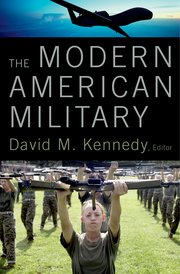
David M. Kennedy and more than a dozen contributors explore these questions and others in "The Modern American Military" (Oxford University Press, 2013), a volume of scholarly essays that looks into the All Volunteer Force and the history of evolving conflict in the world.

"The dropping of nuclear bombs on Hiroshima and Nagasaki ended World War II but ushered in an entirely new form of conflict that came to be called the Cold War." That's how the foreword to the book by former U.S. Secretary of Defense William J. Perry begins.

Perry notes:
"The security dangers we face today must be dealt with at least as much with political, social, and economic strength (soft power) as with military strength (hard power). Our need to exert military power can no longer be met by the large conventional forces used during World War II, or the large nuclear forces accumulated during the Cold War. Today, our armed forces have been reconfiguring to meet these new demands, but many more changes are required ... Our naval forces should continue to focus on their mission of establishing sea control that can be projected worldwide on relatively short notice. Also, all our military services must become more proficient in operating in an environment of cyber threats to military technologies."
William Perry (left) and Kennedy (center) at Stanford in 2010. (L.A. Cicero)
Setting the stage for the essays that follow, Perry concludes:
"The world has been changing in very important ways since the end of the Cold War, and new and dangerous threats are emerging every day. But, against all odds, the world has not had a nuclear bomb used in anger since World War II; there has not been, nor is there likely to be, a World War III; and the average standard of living worldwide has increased since the end of the Cold War. The U.S. military has played an important role in these positive results and will be called upon to continue to play that positive role in the future. In order to do this, the U.S. military will have to adapt to economic, political, technological, and social changes, as well as evolve to meet the changing global threat environment."
David M. Kennedy
This insightful book, which zeroes in on the All Volunteer Force, is edited by Pulitzer Prize-winning historian David M. Kennedy. He assembles contributions by such distinguished thinkers as Perry, Lawrence J. Korb, Karl W. Eikenberry, Mady Wechsler Segal, Renée de Nevers, and others.

Much of this book examines the AVF, established in 1973, and its effects on society and the military, with reference to such standout personalities in military history as Gen. George C. Marshall, Gen. Creighton Abrams, Gen. Charles Krulak, Gen. Stanley McChrystal and Adm. Mike Mullen.

In a chapter titled "Manning and Financing the Twenty-First-Century All-Volunteer Force," David R. Segal and Lawrence J. Korb outline the "undue strain" placed on people and systems since 9/11.
"Despite the fact that the George W. Bush administration deployed more than two hundred thousand people on a continuous basis in Iraq and Afghanistan, and although Congress approved these conflicts, our political and military leaders did not have the courage to activate the draft. Many of the volunteers in the active and reserve ground forces were abused, physically and psychologically, while Americans went shopping. The military and the nation will pay the costs of this moral failure for a long time. Let us hope that the next time we engage in large campaigns, political and military leaders will not again forget their obligations to the country and those who serve it."
Adm. Mike Mullen (right) congratulates 2nd Lt. Erin Anthony at West Point. (Tommy Gilligan)
Kennedy has been focusing on years on the dilemma of a military being at war while the nation is not. He quotes Mullen, former CNO and Chairman of the Joint Chiefs, in an address to West Point graduates in May 2011: "I fear they [civilian Americans] do not know us. I fear they do not comprehend the full weight of the burden we carry ... We're also fairly insular, speaking our own language of sorts, living within our own unique culture."

From the abstract to an essay called "American Military Culture from Colony to Empire":
"In the midst of a civilian society that is increasingly pacifistic, easygoing and well adjusted, the Army (career and non-career soldiers alike) remains flinty, harshly results oriented, and emotionally extreme. The inevitable and necessary civil-military gap has become a chasm."
While readers may wince, many of the authors' conclusions are often backed up by strong research in the costs over the past 15 years – financial, physical and psychological.

But despite the problems presented here about the AVF, there are no calls for an immediate return to the draft.

North Korean soldier conscripts.
In fact, balancing the argument for conscription is the situation in North Korea, as described by James Sheehan in "The Future of Conscription":
"In Kim Jong Un's first public appearance following his father's death, the new leader reaffirmed Kim Jong Il's emphasis on the military: it was, he declared, his government's 'first, second, and third' priority. With terms of active duty from five to twelve years and reserve obligations up to the age of sixty, North Korea has what is perhaps the world's most extensive and socially intrusive system of conscription."
Sheehan also describes historical and comparative use of conscription in Europe and other regions and countries over the past century.

This book is recommended by former Secretary of State Condoleezza Rice, who lauds the exploration of use of contractors in war zones and new technologies that are changing the nature or warfare. "We owe it to our servicemen and women and to those who command them to examine critically and debate the state of military affairs," Rice writes. "This book is a significant contribution to that cause."

The size of the gap or "chasm" between the U.S. military and the civilian society it serves is debatable. According to Kennedy, "This volume aims not only to measure the range of that distance, but to help close it."

Monday, April 19, 2021

Earth Day & ‘Ten Lessons for a Post-Pandemic World’

Review by Bill Doughty

Fareed Zakaria takes a global look at the past to predict the future in “Ten Lessons for a Post-Pandemic World" (W.W. Norton & Company, 2020). In fact, Zakaria takes an out-of-this-world look at the impact of disease, pollution, and climate change on human survival:

“Climate scientists who warn of the dangers of our current path are unconsciously mirroring Nobel laureate Joshua Lederberg’s warnings to us about viruses, back in 1989. Like him, they are urging us to assume that nature is a benign force that has any particular interest in the survival of life on this earth. The climate doesn’t care about us; it is simply an accumulation of chemical reactions that could easily get out of control and destroy the planet and all who live on it. Millions of other planets in other celestial systems may have suffered the same fate. In our own solar neighborhood, NASA’s recent computer modeling suggests that Venus (above) might have been habitable for around 2 billion years, after which a ‘runaway greenhouse gas effect’ led to the scorched and sterile conditions on the Venus of today. We can mitigate the forces that are pushing the earth in a similar direction. If that is not a sound reason for cooperation, then we will not find another.”

Non-cooperation within and between nations can be life-threatening.


Cooperation, on the other hand, can be lifesaving. That’s a chief lesson of the COVID-19 pandemic: telling the truth, marshaling resources, and cooperating together can reduce the number of cases and prevent deaths.


“If people cooperate, they will achieve better outcomes and more durable solutions than they could acting alone,” Zakaria writes, in what sounds a lot like Adm. Mike Mullen’s ‘A Cooperative Strategy for 21st Century Seapower’ from 2007. Zakaria continues, “If nations can avoid war, their people will lead longer, richer, and more secure lives. If they become intertwined economically, everyone ends up better off.” Updated versions of the U.S. Maritime Strategy continue to note the interconnectedness of nations sharing the same oceans.

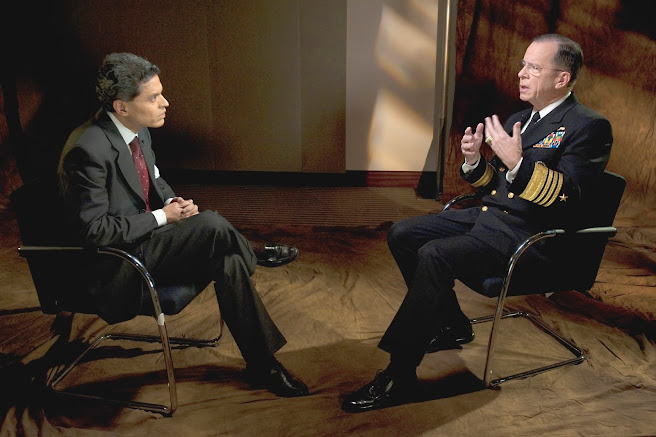
Zakaria interviews then-Chairman of the Joint Chiefs of Staff Adm. Mike Mullen in 2010. They discussed, among other topics, a drawdown of troops in Afghanistan.

Such idealism is not blindfolded. With China’s saber-rattling toward Hong Kong and Taiwan, as well as it’s maritime claims in the South China Sea, the world may be on the verge of another Cold War. Yet Zakaria writes, “Tensions between the United States and China are inevitable. Conflict is not.”

Zakariah shows how a “deeply interconnected” world can prevent wars despite “a real-life butterfly effect,” in which a fluttering butterfly’s –– or bat’s –– wing can supposedly influence the wind and eventually weather patterns on the other side of the world.

“There is a paradoxical feature of pandemics: even though they have come to be named for specific locations, they are decidedly not contained by borders. This has been true for centuries, since the Silk Road caravans and merchant galleys of the medieval world, and especially over the past 150 years since the age of steamships and trains. There was the ‘Russian flu’ of 1889-90, the ‘Spanish flu’ of 1918-19, the ‘Asian flu’ of 1957-58, the ‘Hong Kong flu’ of 1968-69, the ‘Middle East Respiratory Syndrome’ (MERS) of 2012, and now the ‘Wuhan virus’ of 2019-21. By revealing obsession with foreign labels, these names –– even when incorrect as to the origin of the virus –– betray the diseases’ much wider reach. The urge to view a pathogen as coming from abroad is strong, but of course, those diseases have rarely been known by those monikers in the places they’re named for. In Spain, the ‘Spanish flu’ was just the flu.”

Naturally, Zakaria –– a voracious reader –– cites numerous authors and books: William Maxwell’s “They Came Like Swallows,” Katherine Anne Porter’s “Pale Horse, Pale Rider,” Thomas Friedman’s “The Lexus and the Olive Tree,” Francis Fukuyama’s “Political Order and Political Decay,” and Michael Lewis’s “The Fifth Risk,” for example.

Other writers and thinkers he cites include Shakespeare, Clausewitz, Ian McEwan, Yuval Noah Harari, and Doris Kearns Goodwin.


Zakaria quotes Apple CEO Tim Cook, who, like Henry J. Kaiser in the past century, believes that his company’s “greatest contribution to mankind … will be about health.” (Kaiser, who helped shape history in the American West and in World War II, is featured in the most recent Navy Reads post earlier this month.)


It’s in his evaluation of history that Zakaria makes his most insightful conclusions about the importance of international cooperation in the wake of the pandemic –– and toward continued world peace.

“Franklin Roosevelt was assistant secretary of the navy in Woodrow Wilson’s administration and a great admirer of Wilson’s vision of a world ‘made safe for democracy’ He watched that idealism collapse in the years after World War I, leading to an even wider war during his own presidency. But the lesson FDR drew from Wilson’s experiences was to try international cooperation again, this time with America at the center of the new system –– and this time giving the great powers stronger practical incentives to fully commit themselves to the peace. A few months after America entered World War II, when victory was still uncertain and distant, FDR began formulating plans to create international institutions and systems of collective security that made future world wars unlikely. His longtime secretary of state, Cordell Hull, having seen how the trade wars of the 1930s spiraled into hot war, singlemindedly championed a new, international free trade regime. His successors realized this vision in the years after 1945 –– first through the General Agreement on Tariffs and Trade, which evolved into the World Trade Organization.

Roosevelt was known to be an idealist at heart, but his successor, Harry S Truman, had no such reputation. Truman is credited as the hard-nosed realist who dropped the atomic bombs on Hiroshima and Nagasaki, created NATO, worked to contain the Soviet Union, and waged war in Korea. But Truman was also a deeply idealistic man, and he too had drunk from the well of Wilsonian internationalism.”

Truman, when asked why he strongly supported the United Nations, would quote from Alfred Lord Tennyson’s poem Locksley Hall,” a poem which foresaw a world where cooperation reigned and nations formed a federation based on peace, commerce, and “universal law.”


Twice in this book, Zakariah recalls Dwight D. Eisenhower’s visit to the U.S. military cemetery at Colleville-sur-Mer in Normandy (above) on the twentieth anniversary of D-Day. In an interview with Walter Cronkite, Eisenhower, who as president had called for abolishing nuclear weapons worldwide and strengthening the UN, spoke to Cronkite about the 9,000 American bodies buried there: “These people gave us a chance, and they bought time for us, so that we can do better than we have before … So every time I come back to these beaches, or any day when I think about that day 20 years ago now, I say once more we must find some way to work to peace, and really to gain an eternal peace for this world.”


“Ten Lessons” advocates for people listening to experts –– and experts listening to people. One lesson is that “what matters is not the quantity of government but the quality.” Another is about the reality of virtuality: “Life is digital.” Still another is recognizing the rise of ultranationalism and that “the world is becoming bipolar” as well as more unequal.

U.S. Marine Corps Cpl. Larry Hunter, an energy NCO with Headquarters Battalion, Marine Corps Base Hawaii, monitors as a child spins a questionnaire spin wheel during an Earth Day event, Apr. 23, 2019 about the importance of energy conservation, recycling, and protecting the environment. (Sgt. Zachary Orr)


But the most important lesson, one that permeates the whole book, is the importance of the world’s interconnectedness and need for cooperation.


George W. Bush initiated a war on AIDS in Africa. Obama/Biden led the global battle to contain the Ebola virus in Africa. Unfortunately, in early 2020, despite declaring war on COVID-19, the Trump administration failed to acknowledge and confront the threat and provide a centralized plan for testing, tracing, and telling the truth.

“By the middle of 2020, tragically, with the pandemic raging across most of its fifty states –– long after Europe and East Asia contained their outbreaks –– America had no attention for anything or anyone else, except to bash Beijing. The Trump administration is not wrong to critique China’s handing of COVID-19. But coming from such a messenger, the message lands with a thud. A lifelong friend of America, the former Australian prime minister Kevin Rudd wrong in Foreign Affairs of his horror and disappointment over how far America has fallen: ‘Once there was the United States of the Berlin airlift. Now there is the image of the USS Theodore Roosevelt (CVN-71) crippled by the virus, reports of the administration trying to take exclusive control fo the vaccine being developed in Germany, and federal intervention to stop the commercial sale of personal protective equipment to Canada. The world has been turned on its head.’”

At the beginning of March, 2020, only a few people in the United States had died from COVID-19, but the number of cases was beginning to grow exponentially. By the end of April, just after the United States commemorated the 50th anniversary of Earth Day, there were more than 1 million cases in the U.S. and more than 60,000 deaths –– despite messages from President Trump that everything was under control, the virus would go away, people should take Hydroxychloroquine, and we should try injecting bodies with disinfectants (one year ago this week).

A runner pushes through the last 100 meters of a 5K Earth Day Fun Run at Marine Corps Air Ground Combat Center, Twentynine Palms, April 2014. (Cpl. Ali Azimi)

One year later, on Earth Day 2021, there have been nearly 570,000 American deaths. But a coordinated vaccination campaign is working now to reduce cases and fatalities. Unfortunately, the world has suffered 3.1 million deaths due to the novel coronavirus pandemic, and new variants threaten everyone.

“Ten Lessons” presents the stark realities and possibilities ahead; Zakaria warns about the near certainty of another pandemic this century in a connected world. But he also presents an optimistic message about the possibilities ahead if the nations of the world become more educated, more equal, and more committed to cooperation to confront existential threats, including global climate change.


Idealism is not dead. Hope is alive. And the opportunity for lifesaving cooperation is here now despite –– and because of –– the pandemic.

Friday, March 6, 2009

Welcome Aboard! / Review: Implementing Diversity

Books are still alive and well...


This blog of book reviews and discussion is for those who care about reading and who love the Navy. It is inspired by the Chief of Naval Operations’ Navy Professional Reading Program, launched by Admiral Mike Mullen and continued by Admiral Gary Roughead. It is dedicated to the sailors, civilians and families who serve in, for and with the U.S. Navy. Books selected for review/discussion are from the Reading Program.


Your comments are welcome!


Speaking of which...


In the hopes of promoting diverse views in this blog, I’ve chosen an influential book about diversity for this first posting.


Review by Bill Doughty

One of the first things Marilyn Loden does in her ground-breaking book is identify diverse types of people in an organization. Not by color or gender. Not by age, ethnicity, orientation or religion. Instead, she breaks people into distinct groups: “innovator,” “change agent,” “pragmatist,” “skeptic” and “traditionalist.

Which are you?

Key to implementing diversity, Loden shows, is to understand how you and others in your organization deal with change as one of these types.

“Innovators” and “change agents,” as you’d probably guess, are the sparkplugs and accelerants to change in an organization, but they are in the minority, she says.

“Pragmatists” and “skeptics” can be resistant to change, and “traditionalists” may try to put the brakes on innovation and change. Loden shows that pushback by some groups may be due to misunderstanding…and fear.

“Within every organization people respond to new ideas in distinct and predictable ways, based on differences in individual tolerance of perceived risk,” says Loden.

So, before implementing diversity she says that organizations need to understand the value of the concept.

Loden notes that valuing diversity means respecting and including all people in a flexible, supportive environment.

She says it’s not top-down and reactive but, rather, opportunity-driven and proactive. It’s not a quick-fix but, rather, a comprehensive systematic approach. And, it’s not “one size fits all.” Instead, it’s customized to individuals.

Which is why implementing diversity takes into account the various personality types that exist in any organization and why diversity cannot be implemented most effectively through typical “EEO” or “affirmative action” channels.

According to Loden, implementing diversity comes about through long-term cultural change that is inclusive, not exclusive, with leadership showing how diversity benefits everyone.

Chairman of the Joint Chiefs (former CNO) Admiral Mike Mullen says, “Having the cultural skills, having the diverse backgrounds in order to literally achieve our mission is really critical. That is why diversity is a strategic imperative…I believe from my heart that diversity strengthens the very fabric of who we are.”

Chief of Naval Operations (CNO) Adm. Gary Roughead recorded a podcast on diversity on Feb. 27, 2009.

"In the military and in the Navy, it's important that we are a diverse organization because we have to represent what I call the face of America. As our population changes and the percentages of majority-minority changes... we we have to reflect that same demographic in our Navy,” Roughead said. “We're stronger because of the different perspectives and ideas that people bring to bear."

Admiral Robert F. Willard, Commander of the U.S. Pacific Fleet, called diversity a key leadership issue in one of his Rat-Pac Report podcasts.

Diversity is critical to the future of our Navy. Frankly, it’s critical to our readiness now,” said Willard.

“When we talk about a diverse workforce, we’re talking about a total workforce so it includes those of us in uniform, those of us that are in reserve status, our civilians and our contractors – every race, every ethnicity, and recognition that gender in our Navy is valued and promoted. We must all be able to see ourselves reflected both up/down and across the Navy.”

Such endorsement from top leadership in an organization is critical, according to Loden, who shows that diversity is an inalienable concept with special meaning for all humans.

“Regardless of what core identities we each have, we all want to be happy, respected, and loved. In the workplace, we want to be recognized for who we are and appreciated for what we do. We want to feel comfortable with those with whom we work. We want to believe that our ideas and opinions are valued and that they influence important decisions that affect us and our work. These are basic desires that we all share, the common ground we stand on...”

Loden’s book includes tools such as assessment and implementation checklists. She gives good, pertinent case studies of implementation successes as well as failures.

Common sense alert: As diversity is implemented, don’t ridicule or purposely shut out anyone, including white male employees, who have traditionally been in the majority of the workforce, she advises.

“When people believe they are ignored or excluded from full participation they put less energy and less of themselves into making the process work.” That statement applies to all groups.

A good strategy, says Loden, is making a business case for diversity – showing the economic benefits of valuing diversity.

For the military, that case is made by senior leaders, military and civilian bosses, chiefs, LPOs and individual deckplate Sailors who tie diversity to readiness and credible leadership.

Valuing and implementing diversity, according to Loden, is good for business.

“The benefits to organizations and individuals are closely aligned,” says Loden.

“Because a welcoming and rewarding work environment produces superior human performance, it is in the employer’s best interests,” she writes.

Once organizations are on the road to implementing diversity, Loden maps out how to accelerate change in the last five chapters of the book: “Laying the Groundwork for Change,” “Reaching the Segments,” “The Diversity Curriculum,” “Best Practices Across Organizations,” and “Towards Full Adoption.”

“Implementing Diversity” is an easy read and important for anyone who is confused about what diversity is – and isn't. It’s most important as a how-to guide for implementing the concept and doing it right … for everyone.

Chances are, your command or nearby library has a copy of this book. Need some suggestions for your reading list? Visit the Navy Professional Reading Program’s web site at www.navyreading.navy.mil