Showing posts sorted by relevance for query john adams. Sort by date Show all posts

Sunday, July 3, 2016

The U.S. Constitution's Amazing 'Visionary'

Review by Bill Doughty

"John Quincy Adams: American Visionary" (2014, HarperCollins)

This book was recommended recently by John Kirby, spokesman for Secretary of State John Kerry and former Chief of Navy Information.

Like his father, John Quincy Adams was a complicated hero of a young nation. A voracious reader, world-traveler and deep-thinking moralist, JQA recognized the sin of slavery and saw the need for a strong navy and army.

In "American Visionary" we get an international perspective at a time when "The United States still had no army or navy of consequence."

John Quincy Adams – and books – in 1843.
JQA had a front-row seat to French and British confiscation of American ships, British impressment of American sailors (which brought about the War of 1812), the return of Napoleon in France, and the effects of a trade embargo. He was intimately involved in the nation's response of the British warship Leopold agains USS Chesapeake, and he was intensely interested in the inventions of Robert Fulton, including the steamboat and torpedo.

Adams was an early proponent of strength through national inclusion, innovation and infrastructure-building. He "strongly believed that the roads, canals and harbors were essential to the future prosperity of the country and the promotion of national unity."

Two hundred years ago, just after the War of 1812, John Quincy Adams served as a diplomatic envoy in London. A lover of poetry and literature, he immersed himself in the evenings in reading, reciting and studying William Shakespeare and attending theatrical performances of Shakespeare's work.

During the day he worked to represent the interests of the United States in Europe, including negotiating trade agreements, and  helped the needs of American citizens abroad. Here's a very early look at veteran homelessness from Kaplan's and Adams's description:
"And there was constant applications from American sailors, often reduced to begging, who had been impressed (forced) into the British Navy, and from American prisoners of war released from the infamous Dartmouth prison ... British poverty was palpably visible. Hungry wanderers begged for food at the door of Little Boston House, 'each with a different hideous tale of misery ... The extremes of opulence and of want are more remarkable and more constantly obvious in this country than in any other that I ever saw.' ... That there were beggars in America John Quincy knew from experience. But the numbers in Great Britain made American poverty seem minuscule and easily managed. In the United States there was more work to be had, even in hard times. It pained Adams to see starving Americans, many able-bodied, some damaged by war and imprisonment, forced to beg in the streets of a foreign country. He worked tirelessly, and stretched his own and the embassy's resources to assist them."
Adams had a long and distinguished career as a statesman even at an early age. He had lived throughout Europe. He played a role in patching up misunderstandings, reaching compromises and building peace.

In 1817 President Monroe appointed him Secretary of State.

That pivot point in JQA's life ignites Fred Kaplan's biography.

Adams's journey from England to the United States in July and August of 1817 to accept appointment as Secretary of State took 51 days, a time to consider challenges with France, Britain and Spain over the Great Lakes, Louisiana and Florida, among other areas and territories.
"On shipboard, he pondered his and his country's future. As much as he worried about foreign affairs, he had an even more pervasive anxiety: the internal health of the nation. Like both his parents, he believed as deeply in the union as he believed in his life. During his father's presidency, both Republicans and Federalists had threatened disunion. After the passage of the Alien and Sedition Acts, Jefferson and Madison had claimed the right to secession. Now the South as demanding that new states allow slavery. Whether they had moral objections or not, Northern states objected to the additional congressional and electoral votes that the South would have. The British could be handled, though there would be difficulties. So too could Spain, which Adams had reason to believe would in the end capitulate. There were trade issues with France, though at their worst they were not not likely to result in armed conflict. To Adams, domestic tensions seemed most threatening in the long run. The Declaration of Independence and slavery were, he believed, incompatible. Still, maintaining the union was paramount. 'Much as I must disapprove of the general tenor of Southern politics I would rather even yield to their unreasonable pretensions, and suffer much for their wrongs, than break the chain that binds us altogether ... if it is once broken we shall soon divide into a parcel of petty tribes at perpetual war with one another.' The War of 1812 had 'revealed our darkest side, or tendency to faction, sectionalism, and disunion.' The future contained the threat of 'the dissolution of the Union and a civil war.'"
Adams saw the Sandy Hook lighthouses as his ship came close to the American shore. He visited officials in New York, going aboard the first steam frigate that used both sail and steam, USS John Adams, before heading to see his parents in Quincy, Massachusetts aboard the steamship Fulton. In a visit to Boston he boarded both the the USS Constitution and USS Guerriere.

Kaplan reveals the internecine political thorns Adams faced close to the seat of power as Secretary of State, a position both Jefferson and Monroe had held. "More so than Monroe, Adams believed that American prosperity required greater power for the federal government to promote internal improvements and a modern banking system, encourage manufacturing, advance education and science, and strengthen the military."

"Slaves Waiting for Sale" first sketched by British artist Eyre Crowe ten years after Adams died.
Kaplan shows us his strong aversion to slavery and so-called "divine rights," a full generation before the nation plunged into the War Between the States.

His one term as president was followed by service in the House of Representatives, where he became a strong and committed voice for abolition, "proposing a constitutional amendment 'abolishing hereditary slavery in the United States, prohibiting admission of new slave states, and abolishing slavery and the slave trade in the District of Columbia.' He had moved from discreet tactfulness to outspoken radicalism," writes Kaplan. Congress voted 114 to 108 for a continuing gag rule to prevent voting on the amendment, and Adams earned countless death threats from slavery proponents.

He stepped up before the Supreme Court to successfully defend  imprisoned Africans aboard the Amistad after the slave ship was rescued and recovered by USS Washington, when "racism, proslavery sentiment and national politics were a toxic mix."

Kaplan presents Adams as a respected statesman who was selected to present the nation's eulogy for Lafayette, help establish the Smithsonian Institution and protect the rights of American Indian tribes. His position against annexation of Texas in support of  Great Britain in the opium war in China – not to mention women's rights – are perplexing until we consider his circumstances.

Human nature dictates that people are often limited in their imagination by their place in space and time. JQA was no different, believing women were denied the right to vote, for example, because of "nature's foundation in natural law and God's will" and that "the preservation of the values of the Declaration and the Constitution did not require it."

Nevertheless, Adams argued for progress in the nullification of slavery using founding documents. Kaplan writes:
"The values that should shape the present, he argued, as he had done many times before, were those inherent in the history of the nation and in its foundational documents. His major target was the doctrine of nullification, its arbitrary and willful insult to the facts and values of American history. The history he summarized was, of course, Adams' version, with its emphasis on the rationale for the revolution in specific events and natural law. Freedom was everything. Liberty and morality were the highest values. The Declaration of Independence provided the principles, the Constitution the implementation. The brilliance of the Constitution was that it was both stable and elastic – it was both stable and elastic – it was a living document. The Bill of Rights, he observed, had corrected a flaw. More corrections were necessary. The Constitution mandated that the federal government 'promote the general welfare.' That meant new initiatives, such as public improvements, that the authors could not have anticipated but had made provision for in general terms. And its most precious gift was union. It was a sacred contract."
Sailors present a wreath at the tomb of John Quincy Adams in 2009. (Photo by Lt. Chad Murphy)
Kaplan gives us details of the challenges, triumphs and failures in Adams's long life, a life filled with illness and injury, including a hand seriously hurt by a misfiring handgun leading to infections, and problems with his eyes – extreme problems for a poet, writer and reader. In addition to Shakespeare, Adams read Plutarch, Cicero, Voltaire, Hume, Samuel Johnson, Edmund Burke, Lord Byron, Alexander Pope, John Milton, the Bible and a French translation of the Koran (Quo'ran).

A theme of JQA's life was "stoic courage and acceptance of adversity and death." He experienced the death of most of his immediate and extended family, often at an early age. One son, George Washington Adams was "erratic and unstable" and committed suicide. Another son, John Adams II, died from the effects of alcoholism at 31.

The book opens with his father's death, as Quincy Adams hurries home, hoping in vain to see his beloved father before he died.

Both John Adams and Thomas Jefferson passed away hours apart on July 4th, 1826.

Saturday, December 16, 2017

Now & Then II: Statesman or Blockhead

Review by Bill Doughty

David McCullough's recent "The American Spirit: Who We Are and What We Stand For" (Simon & Schuster, 2017) can lift the spirits of anyone who reads it.

Know someone who is pessimistic or fearful about the future? Give them this book.

And encourage them to read.

In one of the collected speeches in this book, "The Animating Spirit," he advises graduates of Dickinson College in Carlisle Pennsylvania in 1998: 
"If your experience is anything like mine, the most important books in your life you have still to read. And read you will. Read for pleasure. Read to enlarge your lives. Read history, read biography, learn from the lives of others. Read Marcus Aurelius and Yeats. Read Cervantes and soon; don't wait until you're past fifty as I did. Read Emerson and Willa Cather, Flannery O'Connor and Langston Hughes. Read a wise and sparkling book called "While the Music Lasts" by an author named William Bulger. See especially page 19, where he describes his own discovery of books."
Naturally I just ordered a copy of Bulger's book from my public library.

Abigail and John Adams
In another essay/speech, "Love of Learning," presented at Boston College in 2008, McCullough profiles abolitionist Charles Sumner, whose love of reading and education and time overseas informed his life and helped a nation confront the sins of slavery.

The author also features his favorite American family in history: the Adamses.
"John Adams read everything –Shakespeare and the Bible over and over, and the Psalms especially. He read poetry, fiction, history. Always carry a book with you on your travels he advised his son John Quincy. 'You will never be alone with a poet in your pocket.' In a single year, according to the U.S. Department of Education, among all Americans with a college education, fully a third read not one novel or short story or poem. Don't be one of those... Make the love of learning central to your life. What a difference it can mean. And remember, as someone said, even the oldest book is brand-new for the reader who opens it for the first time."
One of my favorite speeches in this great little book is "Knowing Who We Are," presented at Hillsdale College in 2005. McCullough describes John Adams's love of books ("I discovered books and read forever," Adams wrote). John and Abigail Adams instilled a love of reading and lifelong learning in their son John Quincy.

America's first ambassador Benjamin Franklin in France.
I love the way McCullough paints the picture of John Adams "in the midst of winter, in the midst of war" risking his life to travel in secrecy by ship to France with eleven-year-old son John Quincy in order to give the boy an education, to associate with Ambassador Benjamin Franklin there and the great political philosophers of France. The French Revolution and freethinkers had inspired the American Revolution.

"We have little idea of what people were willing to do for education in times past," McCullough writes. "It's the one sustaining theme through our whole history – that the next generation will be better educated than we are."

It was an extremely difficult journey across the Atlantic, and when preteen John Quincy balked about making a return trip to Europe, his mother, Abigail Adams, wrote him a letter.

"And please keep in mind this is being written to an eleven-year-old boy and listen to how different it is from how we talk to our children in our time":

"These are the times in which a genius would wish to live. It is not in the still calm of life or the repose of a pacific station that great characters are formed. The habits of a vigorous mind are formed in contending with difficulties. Great necessities call out great virtues. When a mind is raised and animated by scenes that engage the heart, then those qualities which would otherwise lay dormant wake into life and form the character of the hero and the statesman."

Abigail and John Quincy depicted in Quincy, Massachusetts.
McCullough writes: "Well of course he went and the history of our country is different because of it. John Quincy Adams, in my view, was the most superbly educated and maybe the most brilliant human being who ever occupied the executive office. He was a great secretary of state – he wrote the Monroe Doctrine, among other things – and he was a wonderful human being and a great writer. Told to keep a diary by his father when he was in Europe, he kept the diary for sixty-five years."

John Quincy returned from Europe to prepare for Harvard, where his father had studied. He had learned French, politics and the arts, but the young man had apparently not learned humility. "He seemed overly enamored with himself and with his own opinions and that this was not going over very well in town."

So Abigail wrote him another letter:

"If you are conscious to yourself that you possess more knowledge upon some subjects than others of your standing, reflect that you have had greater opportunities of seeing the world and obtaining knowledge of mankind than any of your contemporaries. That you have never wanted a book, but it has not been supplied to you. That your whole time has been spent in the company of men of literature and science. How unpardonable would it have been in you to have turned out a blockhead."

Love of learning, tempered with empathy and humility, can prevent blockheads in leadership positions. 

One of our nation's great leaders, whose confidence bordered on upbeat arrogance but who united the nation, was President Theodore Roosevelt, profiled in "What's Essential is Invisible," presented at Dartmouth College in 1999.
"The twentieth-century presidency begins with Theodore Roosevelt (former Assistant Secretary of the Navy). He was like nobody who had ever been president before ... TR was the first president to go down in a submarine, the first to go up in an airplane ... Eager to display American sea power, he decided to send the fleet on a goodwill tour around the world. Told that Congress would refuse to appropriate the money, he said he had sufficient funds at hand to send the ships halfway; then it would be up to Congress to decide whether to bring them home again."
Perhaps more than any other president, Roosevelt modernized the Navy across domains during the Second Industrial Revolution. When he became the first commander-in-chief to dive in the submarine USS Plunger (SS-2), in 1905, it fired the nation's imagination and inspired Sailors. Less than four years later Ensign Chester Nimitz, future Fleet Admiral and Pacific Fleet commander in WWII, would take command of Plunger.

TR had the Panama Canal built and he revolutionized American industry. "He doubled the size of the navy, helped settle the Russo-Japanese War, established five national parks, including the Grand Canyon, and made conservation a popular cause for the first time."

According to McCullough, "He was ebullient, confident, full of ideas, interested in everything, seldom without a book. He read books, he wrote books." 

David McCullough creating ideas.
Recently someone who I care about said they've never seen our nation so divided. I reminded them that history shows things were pretty divided in the 1770s (American Revolution), 1860s (Civil War) and 1960s (Vietnam, Watergate and Civil Rights era).

Reading history leads toward optimism. 

"We've got to teach history and nurture history and encourage history because it's an antidote to the hubris of the present – the idea that everything we have and everything we do and everything we think is the ultimate, the best."

McCullough concludes, "Samuel Eliot Morison said we ought to read history because it will help us to behave better." Abigail Adams's advice to would-be blockheads remains relevant today. This book is so good I have to review it in parts, each with a theme. Part I: Ideals; Part II: Rewards of Reading.

Dawne Dewey, Head of Special Collections & Archives, second from left, shares items from the Wright Brothers Collection with historian David McCullough (left), Tom Hanks, and Amanda Wright Lane, great-grandniece of the Wright Brothers. Hanks’ film and television production company Playtone reportedly bought the rights to David McCullough’s book "The Wright Brothers," and  HBO may produce a miniseries. (Photo by Will Jones)


Saturday, March 30, 2019

McChrysal: Reality of Sailor Harriet Tubman

Review by Bill Doughty

A standout essay in General Stanley McChrystal's latest book, "Leaders: Myth and Reality" (Portfolio/Penguin, 2018) begins on a Union Navy vessel in the littorals of the Deep South during the heart of the Civil War.
"As she boarded the USS John Adams that evening, the white officers tipped their caps to the black woman they knew as 'Moses.' Apart from this polite gesture, she was paid no special attention. The 300 troops had business to take care of, and Harriet Tubman was a part of that team, with duties of her own."
Colonel James Montgomery, who commanded the 2nd South Carolina Volunteer Regiment, relied on Tubman – who had been serving as a nurse and spy for the Union Army – to guide him, his officers and 300 mostly black troops twenty-five miles up the Combahee River. They left from Beaufort, South Carolina to destroy Confederate communication and supplies and free slaves if possible.
USS John Adams depicted (in 1846)
"When the boats set off upriver, Tubman, as head scout, assumed her place next to Colonel Montgomery. It's an incongruous scene: a five-foot-tall, forty-one-year-old black woman going on a raid to free slaves in the middle of the Civil War. Heading to a battle, the officers and soldiers of the 2nd South Carolina didn't show concern with the symbolism of a middle-aged, formerly enslaved woman wearing a dress amid all the men in blue uniforms. All they cared about was her competence as a scout."
In terse prose that attempts to separate fact from myth, McChrystal and his co-authors Jeff Eggers and Jason Mangone show the difficulties Tubman faced as a slave before she escaped to become a matriarch and leader of the abolitionist movement.

She suffered separations, beatings and brain damage that left her with stupors, seizures and religious visions.
"According to a journalist who wrote about Tubman in 1863, her head injury made her 'subject to a sort of stupor or lethargy at times; coming upon her in the midst of conversation, or whatever she may be doing, and throwing her into a deep slumber, from which she will presently rouse herself, and go on with her conversation or work.' Though Tubman and her family were deeply religious well before her head injury, her skull fracture marks the time when Tubman began having religious visions, which would stay with her for the remaining eighty years of her life and contributed to what she felt was her calling."
Despite her challenges, Tubman made 13 trips into the Deep South during the 1850s as part of the Underground Railroad, a support network of black and white ministers, freethinkers and others opposed to the sin of slavery. Each trip was 450 miles both ways, and the slaves had to travel to Canada or risk being caught and returned.

Tubman is recognized for her leadership qualities of "modesty, duty, perfect truthfulness and integrity." She built relationships and valued cooperation, but she could also be fearless and demanding.

Congressman John Lewis
McChrystal's dedication of this book is: "To John Lewis and John McCain, who remind us that it's possible to keep our humanity while leading with courage and commitment."

The eclectic leaders profiled by the authors include geniuses like Albert Einstein, zealots like Maximilien Robespierre, and reformers like Dr. Martin Luther King Jr., among others.

McChrystal and his co-authors offer no clear and simple formulas on being a leader. "It is our hope that by helping to dismantle some common myths we will create space for you and other leaders to interact with reality and respond to your challenges with clear thinking and humility."

In the book's prologue, McChrystal writes, "Finally, by itself, 'Leaders' will not make you into a great leader. It won't overcome weak values, a lack of self-discipline, or personal stupidity. Instead of simplifying the challenges of leading, 'Leaders' will outline and underscore the complexities."

McChrystal and his team offer no paint-by-numbers formulas for being a good leader. They recommend dismantling common myths in order to "interact with reality and respond to your challenges with clear thinking and humility."


Frederick Douglass
To highlight the Tubman essay, McChrystal and his co-authors choose a quote from former slave and abolitionist Frederick Douglass. Part of Douglass's quote becomes a "found" haiku:


what you have done would
seem improbable to those
who do not know you

In the book's prologue, McChrystal concludes, "Finally, by itself, 'Leaders' will not make you into a great leader. It won't overcome weak values, a lack of self-discipline, or personal stupidity. Instead of simplifying the challenge of leading, 'Leaders' will outline and underscore the complexities."


Union Sailor George Commodore, 
"Leaders" recommends reading Joseph Campbell, Churchill, Plutarch and tales of Greek and Roman heroes. In fact, the book starts with McChrystal's love of reading.  For the Tubman essay, he recommends Kate Clifford Larson's "Bound for the Promised Land: Harriet Tubman, Portrait of an American Hero" (One World, 2003).

The best leaders are good readers.

Postscript: Interest in this topic and how African Americans served in the Navy in the Civil War led me to this essay by Joseph P. Reidy in Prologue Magazine, online at the National Archives: "Black Men in Navy Blue During the Civil War." 

Saturday, September 27, 2014

Captain John Paul Jones – Conflicted

by Bill Doughty

When Thomas Jefferson's letter to Captain John Paul Jones arrived asking him to lead an expedition against Islamic Barbary Pirates in North Africa it was too late. Jones had died days before the letter arrived.

No doubt John Paul Jones would have jumped at the chance to deploy and fight again. After all, he had earlier taken Jefferson's advice to become an admiral in the Russian Navy and serve under Tsarina Catherine in the Black Sea. Two decades earlier he had served under George Washington and other Founders in missions attempting to rescue prisoners of war, even deploying forward into the littorals of England, Ireland and his native Scotland.
Mutinous crews, weather, political circumstances and Jones's own ego often hampered the ship captain's success, however, according to biographer Evan Thomas in "John Paul Jones: Sailor, Hero, Father of the American Navy."

David McCullough, author of "John Adams" and "1776," endorses Thomas's book, and that's high praise. "Evan Thomas captures all the incongruities, vanities, blazing ambition, and phenomenal courage of his subject. And, importantly, he writes with vigor and a sailor's knowledge of the sea. The accounts of Jones's historic triumphs in battle and of one terrible storm are brilliant, unforgettable."

Thomas describes life in the age of sail – the stink, disease, rum allowances, cruelty of the lash and close combat. 
Two hundred and thirty-five years ago this week (Sept. 23, 1779) aboard the merchantman Bonhomme Richard, Jones achieved immortality in his seemingly hopeless battle against the larger Royal Navy HMS Serapis, cannons muzzle-to-muzzle, a "battle of the tops" – snipers on the sails, cutlasses in hand on deck, Jones standing in the face of fire, fearless, unwavering, victorious.

Born from a fleet of privateers the new American navy was a handful of sailing ships whose mission was to intercept British ships. Jones was a gifted seaman, navigator and commander. His patron in the Continental Congress, Robert Morris, saw in Jones "a quality that was utterly missing from the minds of most men of the new Navy." Jones was a "strategic seer."
Jones was effective despite veins of bad luck and occasional bad behavior running through his life. Among the author's descriptions of the great captain/commodore: "thin skinned," "far-sighted but with resentments," "lover of poetry," "whose highs and lows bordered on the manic," "futurist," "shrewd and prescient," "self-centered," "resilient," "articulate," "fastidious," "demanding and brooding," "always keen to burnish his reputation," and "tactless, vain and selfish."
"All through his life, Jones struggled to put forth his more virtuous ... self, his capacity for self-sacrifice and noble-mindedness. But his anger and insecurity eventually showed through. He would have had faster and better ships to sail in harm's way if he had followed Franklin's advice and shared credit more generously and if he had been less prickly and pushy with his superiors. Jones was sufficiently self-aware to know what to do, but tragically incapable of doing it. His ambition rendered him both gullible and self-absorbed. His sarcastic asides and demanding perfectionalism often defeated his efforts to show 'cheerful ardor' and reach out to colleagues. And, yet, his pride masked sensitivity and a longing to be loved and forgiven ... If only Jones had been able to take his own advice and hid his contempt for others, they might have forgiven him. But he could not, and they did not."
Roosevelt speaks at a Jones commemoration at the Naval Academy, 1906.
Jones had busts of himself made in the later years of his life (the ultimate 3D selfie) and sent them to Washington, Adams, Jefferson and other statesmen. He "rarely conceded error," according to Thomas, and "His sense of grandeur, his belief that he strode on a great stage, allowed him to appreciate the larger stakes."

Jones's self-awareness helped him sense change and purpose in the world in the wake of the Enlightenment. He was a true patriot fighting for freedom and against despotism. A contemporary of Thomas Paine, Jones said, "I have drawn my sword in the present generous struggle for the Rights of Men."

Reading about Jones's ego makes a quote that opens the Thomas book all the more poignant. It's from 1906 by President Theodore Roosevelt, a man who had a similar driving personality and, as revealed in the recent Ken Burns series on PBS, "The Roosevelts," plenty of personal demons to outrun. Roosevelt, a former Assistant Secretary of the Navy, said, "Every officer in our navy should know by heart the deeds of John Paul Jones."

Another book about the deeds and the man – not the myths – was written by the great naval historian Samuel Eliot Morison. He received the 1959 Pulitzer prize for biography for "John Paul Jones: A Sailor's Biography." Like Thomas, Morison looked behind the curtain of fabrication and fiction to reveal the complicated character of the naval hero.
Jefferson
In 1792 Thomas Jefferson, who dealt with his own character inconsistencies as a slaveowner, wrote to ask John Paul Jones to deal with Islamic states and Barbary pirates in North Africa who had captured American sailors and held them for ransom. Thomas writes:
"For years, Jones had been corresponding with Thomas Jefferson about the fate of 'our poor countrymen' imprisoned by the Dey of Algiers. Jones had been all for raising a fleet to put down the Barbary Coast pirates (hearing of Jones's agitation and employment with the Russian infidels, the Dey had put a price on Jones's head). Lacking the will or funds, Congress had dawdled. But now some thirteen American prisoners, sailors seized from merchantmen and thrown in grim cells of Algiers, were writing pleading letters, saying they would have to covert to Islam if help did not come soon. In the late spring of 1792 Congress was at last moved to create a delegation to negotiate with the Dey. Remembering Jones and his deep concern for the fate of prisoners, Jefferson, the first American Secretary of State, appointed Jones to lead the American delegation. But Jones was dead by the time his commission and instructions reached Paris at the end of July."
Jones died at the age of 45. Congress authorized payment of "tributes" as ransom to Barbary Coast Pirates. But, when more tributes were demanded, Jefferson called for a strong naval response, which led to the First Barbary War in 1801.

Saturday, April 15, 2017

Reading Deeper with CNO

By Bill Doughty

Chief of Naval Operations Adm. John Richardson's reading list is online, and it offers an opportunity to dive deep into a sea of history, heritage, strategic thinking and practical advice for sailors and civilians interested in seapower and national defense.

Published several weeks ago and maintained by the Naval War College, the list includes about 150 titles for the revived Navy Professional Reading Program and includes a core "Canon" of books that provide thought-provoking insights for leaders and communicators.

Titles in The Canon include: Handel's "Masters of War," Hart's "Strategy," Madison's "The Constitution," Jefferson's "The Declaration of Independence," Sun Tzu's "Art of War," and Richardson's "Navy Leader Development Framework," among others. "Framework" includes a great quote from President John F. Kennedy: "Learning and leadership are indispensable to each other." Read to lead.
Chief of Naval Operations Adm. John Richardson.

Last year in Proceedings magazine, Richardson promised this updated reading list. And he has delivered on that promise.


"Reading can teach us the fundamentals of our business. Thucydides, Clausewitz, Mahan, Corbett . . . these masters wrote works of the highest quality that have stood the test of time. As the challenges the naval service faces have multiplied, knowledge required to meet those challenges has also grown. This means that I cannot possibly dictate a comprehensive list of 'the' books to read. Still, I will soon share with you what I consider to be a canon of classic works. I am also thinking of ways I can highlight other books that I have found interesting because they helped me to think through a problem or see things differently. I will make it easy to obtain these books through an e-book program that can be easily accessed through your personal electronic devices. Finally, I will open up a way for all of us to talk about what we are reading."


The CNO outlined his plans in that article, written with Lt. Ashley O'Keefe, which resonates in his Design for Maritime Superiority. Richardson notes that warfare requires sharp thinking and the ability to adapt.
 
FN Matt Baumgardt reads aboard the aircraft carrier USS Dwight D. Eisenhower (CVN 69)
last April.  (Photo by MC3 Taylor Jackson)
"Usually, the team that can think better and adapt faster will win. Today, as we prepare for operations and war with an increasingly complex set of potential adversaries, we must do more to sharpen our thinking, learn the lessons from history, and expand our minds. The margins of victory will be razor-thin—we cannot be complacent. What we do in peace will be decisive in war."
"I want to revitalize the intellectual debate in our Navy. We all—officers, enlisted, and civilians—need to develop sound and long-term habits for reading and writing during the entire course of our careers. We must challenge our own assumptions, be informed by the facts, and be aware of the current context. We must commit to self-improvement, through formal schools and courses, and especially through self-education. I strongly encourage you to read, think, and write about our naval profession. Our Navy benefits from a vigorous intellectual debate."

Lt. j.g. Shelby Naughton of USNS Mercy (T-AH 19), reads a book to a Timorese child 
during Pacific Partnership 2016. (Photo by MC3 Trevor Kohlrus)
The 150 titles in the new Navy Professional Reading Program are categorized in The Canon, Core Attributes, Naval Power, Fast Learning, Navy Team and Partnerships and include authors such as Kaplan, Stavridis, Winchester, Toll, Daughn, Hornfischer, Morison, Carlson, Singer, Leavitt and Gladwell. One criticism of the choices offered so far: a dearth of women authors. 

But the commitment to provide e-book availability is noteworthy. And for the first time we see movies, series and documentaries recommended, including "Saving Private Ryan," "Band of Brothers," "Zulu," "Black Hawk Down," "John Adams," "Lawrence of Arabia," and "Eye in the Sky," which stars Helen Mirren: "Col. Katherine Powell, a military officer in command of an operation to capture terrorists in Kenya, sees her mission escalate when a girl enters the kill zone triggering an international dispute over the implications of modern warfare."
CNO Richardson values reading professional journals as well as books. And he encourages online discourse.
CNO Adm. Richardson speaks with Sailors in Pearl Harbor in 2015.
(Photo by MC2 Jeff Troutman)
"...more recently, online blogs, have hosted professional conversations. Thoughtful, well-researched articles can offer useful insights and, when needed, can help us change our minds," he writes – as he encourages his sailors to write.

"As reading leads to broader thinking, writing leads to clearer thinking. If you have not written much, I urge you to get started. A sharp pen reflects a sharp mind. But writing is not for the weak. The writer must form and then expose his or her ideas to public scrutiny. That takes confidence. But an argument properly conceived and defended can be of great value to our profession."

"It is not my purpose to offer writing lessons," Richardson says, "but in my experience, simple is better. Avoid acronyms or code. Be clear and concise. Keep in mind Mark Twain’s warning, 'The more you explain it, the more I don’t understand it.'”

He also recommends Zinsser's "On Writing Well," a Navy Reads favorite and a book recommended by former Chief of Navy Information Rear Adm. (ret.) John Kirby.

So, dive deep into reading and writing.

And in our humble opinion, books offer the deepest dives into insight and wisdom.
"No matter how busy you may think you are, you must find time for reading, or surrender yourself to self-chosen ignorance." – Confucius
Bill Dawson, the last surviving member of the first Naval Combat Demolition Unit (NCDU) shows CNO Adm. John Richardson a copy of "Before they were SEALs they were Frogs" during Navy appreciation night at Nationals Park last May. Photo by MC1 Nathan Laird.

Sunday, November 17, 2013

John F. Kennedy’s ‘Profiles in Courage’

Review by Bill Doughty

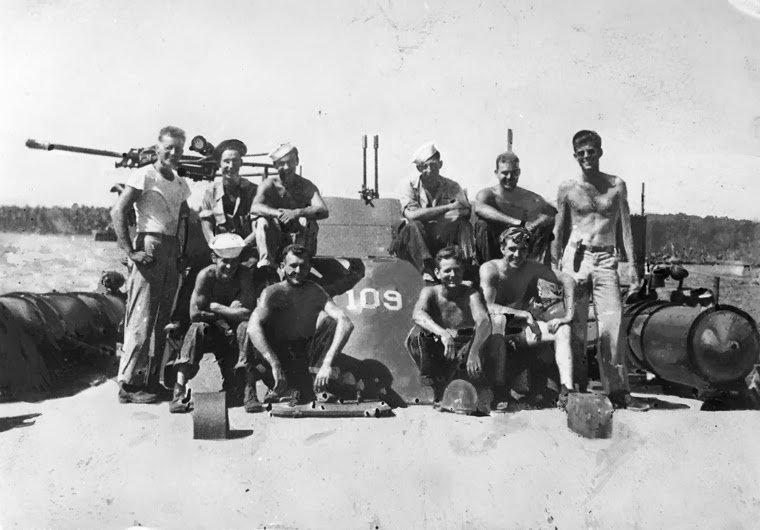
Seventy years ago -- August 2,1943 -- young John F. Kennedy was a PT-boat commander when his PT-109 was rammed by Imperial Japanese destroyer Amagiri.  His boat exploded, killing two crew members and burning one so badly he was unable to swim.

Oil painting by Gerard Richardson (official Navy artist 1961)
“Clutching a strap of the injured man’s life jacket in his teeth, Lieutenant Kennedy towed the wounded sailor to the nearest island, three miles away.  For the next six days, with little food or water, the men hid, fearing they would be captured by the Japanese.  Each evening Kennedy swam through the shark-infested waters to other islands seeking help, until he was spotted by two Solomon Islanders, Eroni Kumana and Biuka Gasa.  They picked a coconut, onto which Kennedy carved a message, which they took to the hideout of a nearby Australian coast watcher who arranged rescue.  In the summer of 2002 a National Geographic Society expedition found that the legend of John F. Kennedy’s courage lives on in the faraway Solomon Islands.  Using remote-controlled vehicles with underwater cameras, explorer Robert Ballard and his team discovered the sunken PT-109.  Expedition members met Eroni Kumana, the man whose simple canoe saved my father’s life and changed the course of history, and his son, John F. Kennedy Kumana.”

Caroline Kennedy writes the introduction, including the excerpt above and below, in the HarperCollins 50th anniversary edition of her father’s “Profiles in Courage.”   (The book was first published in 1956 and is one of 15 top recommended reads of Navy's Chief of Information Rear Adm. John Kirby.)

“The collision with the Japanese destroyer left him with a spinal injury, which required surgery in the winter of 1954-55.  Elected to the U.S. Senate two years before, my father was interested in understanding the qualities that make a great senator.  History was his passion, and he spent his months of recuperation reading the chronicles of his legendary predecessors.”

Caroline Kennedy writes of President Kennedy’s courage in the Cuban Missile Crisis in 1962, in which he successfully averted nuclear war, and of his support to nonviolent civil rights demonstrations in 1963 when he mobilized the Alabama National Guard, taking a stand for the ideals outlined in the Constitution.

Equal rights, equal opportunity and harmonious preservation of the Union are common themes throughout JFK’s "Profiles in Courage."  The profiles by then-Senator John F. Kennedy are of political leaders and diplomats John Quincy Adams, Daniel Webster, Thomas Hart Benton, Sam Houston, Edmund Gross, Lucius Quintus Cincinnatus Lamar, George Norris, Robert A. Taft and others.

Kennedy, at right, with crew of PT-109 in Solomons.  Photos from JFK Library.
Courage -- one of the core values of the Navy and Marine Corps -- is shown in the context of these profiles, where public service is motivated by “the national interest, rather than private or political gain,” JFK wrote.

Courage can be found in balance, conciliation, mutual concession and compromise, “an art essential to keeping a nation united and enabling our government to function.”

“It is compromise that prevents each set of reformers -- the wets and the drys, the one-worlders and the isolationists, the vivisectionists and the anti-vivisectionists -- from crushing the group on the extreme opposite end of the political spectrum.  The fanatics and extremists and even those conscientiously devoted to hard-and-fast principles are always disappointed at the failure of their Government to rush to implement all of their principles and to denounce those of their opponents.  But the legislator has some responsibility to conciliate those opposing forces within his state and party and to represent them in the larger clash of interests on the national level; and he alone knows that there are few if any issues where all the truth and all the right and all the angels are on one side.”

The quote brings to mind what President Lincoln called “the better angels of our nature.”

Kennedy hoped his profiles of political heroes, some long forgotten by most Americans, would be stories “that teach, offer hope and provide inspiration” for everyone.

“To be courageous, these stories make clear, requires no exceptional qualifications, no magic formula, no special combination of time, place and circumstance.  It is an opportunity that sooner or later is presented to us all.”

It’s been seventy years since the future President Kennedy’s encounter with Imperial Japan in World War II and fifty years after his assassination.  This week, in an ultimate symbol of reconciliation, harmony and peace, JFK’s daughter Caroline has been welcomed in Tokyo as U.S. Ambassador to Japan.

Friday, July 4, 2014

Our Key Founder Thomas Paine?

Review by Bill Doughty

Craig Nelson makes a convincing case that a writer (not a lawyer or an elected official) was the key "founding father" of our nation. Writer and immigrant Thomas Paine inspired Thomas Jefferson, John and Samuel Adams, Benjamin Franklin and George Washington, and he encouraged a new nation-in-the-making. Thomas Paine's "Common Sense" and "American Crisis" series led to the American Revolution and helped hold the Continental Army together in the lowest points of 1776.

Paine's genius was in seeing, thinking and writing clearly. He used words to conquer fear and build confidence. From "Thomas Paine: Enlightenment, Revolution and the Birth of Modern Nations":
"In the America of 1776, everywhere they looked, Americans saw reasons to be profoundly afraid -- afraid of what the redcoats would do to them, their families, and their property; afraid of losing their British Empire and their British citizenship; afraid of what this new homemade government would do, and what it would require. Paine answered all of these vague and paralyzing terrors in a mere eight pages."
A low point came in the dead of winter of 1776, just six months after the Declaration -- "we mutually pledge to each other our Lives, our Fortunes and our sacred Honor."

Paine gave away his copyright and all he earned from "Common Sense" in order to help fund the army. On December 23, when the future of the Revolution seemed to hang by threads, "George Washington ordered his officers to gather their men into small squads and read aloud what Paine had written":

"These are the times that try men's souls ... Tyranny, like hell, is not easily conquered; yet we have this consolation with us, that the harder the conflict, the more glorious the triumph. What we obtain too cheap, we esteem too lightly; it is dearness only that gives every thing its value ..."


Historians, and the founders themselves, credit statesman Paine with not only inspiring the army and success in the war but also instigating the Revolution itself.


His "Common Sense" took on the "divine right of kings" and sought to replace it with democratic ideals of individual rights and freedom. He embraced "the eighteenth-century stoic view of selfless devotion to the greater good as key element of virtue."

For Paine and the founders, virtue -- like Navy core values of honor, courage, commitment -- was rooted in Roman and Greek culture but also included "virtue of the heart" gained from the Enlightenment, thanks to Isaac Newton and others. Paine's freedom in thinking spanned centuries and would lead to wider and more open acceptance of science by the end of the 19th century.


Portait by Laurent Dabos.
As a person, Thomas Paine (whose family name was originally Pain) was not the most lovable person. He was generous but strongly opinionated, focused but known to imbibe heavily, fearless but petty about perceived insults. An unnamed contemporary said, "He is as great a paradox as ever appeared in human life." He famously verbally dueled with another thinker of his time, Edmund Burke, arguing with Burke that 'ordinary' people "are civilized enough to govern themselves."

At first loved and respected, Paine would eventually become vilified and hated by most Americans by the end of his life. In later decades he would inspire Americans as diverse as Abraham Lincoln, Walt Whitman, Thomas Edison, Ronald Reagan and Barack Obama.

Nelson describes him as a visionary who was always ahead of his time. He was one of the first champions of equal rights by editing and publishing in his Pennsylvania Magazine "An Occasional Letter on the Female Sex," which Nelson calls "one of the first arguments in favor of women's rights in America."
Statues of Tom Paine are in Shetford, Norfolk, England; Paris; and Morristown & Bordentown, NJ.
Paine also planted some of the first seeds of the civil rights movement, seeds that would take nearly two more centuries to fully flower.

Cowritten with Thomas Pryor in November 1775, Paine (then still "Pain") wrote "African Slavery in America," an essay "that assaulted every excuse for the trade and demanded immediate emancipation of all Africans in every colony." His was a fearless defense of reason over ignorance or any other justification for human bondage, body and mind.
After Washington's army and navy defeated the British and around the time the founders created the Constitution, Paine, ever-restless and fully committed to egalitarian republicanism, sought to export the idea of individual liberty and representational government.

After the American Revolution, Paine began his "Rights of Man" to help bring democracy and individual freedoms back across the Atlantic to Europe. His ideas and the founders' ideals would eventually reach to the Pacific and beyond. Nelson writes: "Paine's 'Rights' ... brilliantly anticipated, two hundred years ahead of its time, the style of government for close to half the world's nations today."
One of his greatest and most controversial works, condemned by many who never read it, was "Age of Reason." Nelson explores the influence of deism in a chapter called, The Religion of Science: "Besides identifying the deist principles that underlay all faiths, deists suggested that Socrates, Jesus, the Buddha, and Mohammed were each attempting to return his society's corrupt religion back to its natural state -- the state of deism."

Paine's positions in "Rights" and "Reason" led to contempt and condemnation, including by John Adams and Samuel Adams, and charges of sedition in England and France, for which he faced imprisonment and near execution by guillotine.

Prison changed Paine. His disillusionment and feeling of failure were mirrored by other "founding fathers" late in their lives.
"Almost all of Thomas Paine's Enlightenment colleagues spent their last years as he did, believing that their revolutionary programs had failed, that the philosophy of the light had been proved a pipe dream, that their life's work had been entirely for naught and the great dreams of their youth would go forever unrealized. Instead, of course, it would be the shared, hopeless despair of their last years that would in time be proven 'almost categorically' the modern paradox of the world they made."
The founders were in part disillusioned by the growing aristocracy, greed, materialism, disparity of wealth, and anti-intellectualism -- what they saw as a move away from virtue and core values.
"Yet, for anyone needing to be reminded of core Enlightenment beliefs -- that government can only be empowered by its citizens; that such citizens are born with certain natural rights; that none are born superior to any other; that all will be treated equally before the law; and that the state has a duty to help the neediest of its people -- reading Paine offers a political and spiritual inspiration, one that has driven men and women to achieve greatness across history."
Nelson concludes his biography with an excerpt from the final letter written by Thomas Jefferson, "one last bravura manifesto combining the ideas of the Enlightenment, the American and French Revolutions, and Thomas Paine."

Jefferson called for "arousing men to burst the chains under which monkish ignorance and superstition had persuaded them to bind themselves, and to assume the blessings and security of self-government..."

Imagine if those words and insights could be read and understood in countries harboring violent extremists like ISIS/ISIL, the self-proclaimed "Islamic State."

Nelson quotes a 2004 survey by the Freedom House human rights organization showing democratic elections in 89 countries with "freedom of expression, assembly, association, education, and religion." Sadly, the most recent Freedom House annual country-by-country report on global political rights and civil liberties, Freedom in the World 2014, concludes: "The state of freedom declined for the eighth consecutive year in 2013."


Professor Eric Foner, another Paine biographer.
The Navy, working with other world navies, protects the freedoms, opportunities and "army of principles" Paine, Jefferson and the other founders achieved and that we celebrate every July 4th, "Independence Day," in the United States. Paine's description of the new nation he helped found: "the noblest work of human wisdom, the grandest scene of human glory, the fair cause of freedom..."

Nelson's "Thomas Paine: Enlightenment, Revolution, and the Birth of Modern Nations" was published in 2006. It is one of dozens of biographies by great writers and thinkers like Eric Foner, Christopher Hitchens, Bertrand Russell, Owen Aldridge, David Freeman Hawke, and John Keane. The works by and about Paine are recommended reading for every world citizen interested in the concepts of virtue, freedom and individual/collective responsibility.