Showing posts with label Memorial Day. Show all posts

Friday, May 28, 2021

For Memorial Day: ‘Service Before Self’


By Bill Doughty

The first-person stories in “Walk In My Combat Boots” haunt this Memorial Day. This is the second of a two-part Navy Reads review of this important book filled with the voices of combat warriors, medics, and defenders of freedom. Part one was posted May 21.


"Walk In My Combat Boots" by James Patterson reveals “the courage, the sense of duty, [and] the patriotism of this young generation,” according to Adm. William H. McRaven (U.S. Navy, ret.).


This weekend the nation is commemorating and honoring those who have fallen in combat. We should also reflect on the service and sacrifice of young men and women who served in recent war zones and saw death first-hand, up close, heartbreakingly personal.


Lt. Col. Sherry Hemby, 455th Expeditionary Aeromedical Evacuation Flight commander, ensures the brackets are in working order on a C-130 Hercules for an aeromedical evacuation flight to Bagram Air Field, Afghanistan, June 28, 2011. (Senior Airman Krista Rose)


Many of the patriots in this book are children of military veterans. Such is the case of Sherry Hemby, an Air Force flight nurse who remembers her dad: He taught me about patriotism –– to think of others. Service before self.”


Andy Prososky, a United States Marine veteran, is the son of a Navy Corpsman who served in Vietnam.

While serving in Iraq nearly two decades ago, he mastered the ability to compartmentalize, to not think of family and home, especially when out on a mission. “I don’t care about me, only my Marines,” he says.

Prososky encapsulates the tragedy of war in one episode involving RPGs, IEDs, a JAG, and a Marine killed in action. “Back home people ask me what death is like. You can’t explain it. It’s not dramatic, there’s no music, it’s sudden, it’s violent, it’s reality.”


Marine Cpl. Rory Hamill

The final section of this book is titled “Coda: Memorial Day.” And the final featured interview and story is by former Marine Corporal Rory Patric Hamill, son of two Navy parents. An extended excerpt follows:

“The amazing thing our brains do for us is compartmentalize any kind of trauma.

And therein lies the problem: people don’t address PTSD or what psychologists call a moral injury –– the feeling of overwhelming shame and guilt, even rage, anger, or betrayal over compromising your moral conscience. If you don’t address these actions and reactions, they come back to haunt you down the road.

I learn all this stuff later. Much, much later …

…The demons from all my deployments start eating away at me day and night. I can’t sleep, and I’m drinking too much. I’m smoking like a chimney. I’m not seeing my kids, and I’m shirking my responsibilities –– and it’s all because I’ve been ripped out from the familial structure of the military. And I miss the camaraderie.

From day one in the military, your entire day is regimented. It’s scheduled and structured down to the minute. You have a mission. You go out and get it done. Now I don’t have anyone telling me to do anything. I don’t have anyone keeping me in check.

My second marriage ends.

I find myself sitting outside a marsh by my dad’s house in Atlantic City. I’m sitting in the driver’s seat, holding a pistol.

I raise it to my head, about to end my life, when for maybe a half second my kids flash through my mind.

What the fuck am I doing?

I start crying.

I disassemble my weapon, take all the bullets out of the magazine, and throw everything out of the car.

I need to address this. I need to get some help.

I get diagnosed with PTSD. I start seeing a therapist full-time and get my head out of my ass. I quit binge drinking and stop smoking, which I’ve been doing since I was thirteen. I learn the importance of exercise and nutrition and taking care of myself. I begin to claw and scrape my way out of my self-loathing. I stop hating myself for everything. I stop blaming myself for my friends dying and every other shitty thing that’s ever happened to me.

I start speaking to other people about my experiences.

Over time, I start to learn to love my fate. Instead of letting it control me, send me into a deep, spiraling depression. I discover a way to turn it around for good –– to help others. If I can help one person every day, regardless of how I do it, then that’s a win for me. If I can use my experiences, my story, to help a person every single day, then everything I’ve gone through in my life is worth it.”

Hamill writes with appreciation about the honor of receiving the Purple Heart from President Barrack Obama at Walter Reed Hospital.


Cpl. Rory Hamill, a combat-wounded Marine, pauses to look at the Navy Sailor's Creed on the wall of the base gym on Joint Base McGuire-Dix-Lakehurst, N.J., Dec. 4, 2017. (U.S. Air National Guard photo by Master Sgt. Matt Hecht)


James Patterson, Matt Eversmann, and Chris Mooney help people tell their stories in “Walk In My Combat Boots” –– tragedies and victories, comedy and pathos. Mostly pathos, considering the sacrifices required in war.


We honor the men and women lost in war on Memorial Day. And we also remember those who gave so much in service to their country. True heroes live the values of honor, courage and commitment. They confront demons and find the truth. True patriots ensure we think of others and ask why we go to war. “Service before self.”

Monday, May 24, 2021

Unspeakable Tulsa Massacre


Review by Bill Doughty––

Combustible racial tension ignited one hundred years ago when a number of whites in Tulsa, Oklahoma, took up arms and threatened to lynch a black teenager. Two thousand whites fought with a group of thirty black men, including World War I veterans, who tried to protect the teen.


The white mob then attacked and burned down the Greenwood district, a black middle class neighborhood known at the time as “Negro Wall Street.”


Dozens of people –– most of them African Americans –– were killed in what was called a riot but is now known as a massacre. Between 150 and 300 people may have died, according to historians. Police joined the white mob in attacking black people in Greenwood.


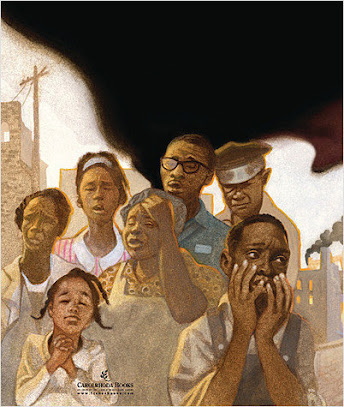
Carole Boston Weatherford (author) and Floyd Cooper (illustrator) capture the tragedy of Greenwood in a new book for young readers. The irony of the title “Unspeakable: The Tulsa Race Massacre” (Carolrhoda Books, 2021), is that the disaster of May 31/June 1, 1921, was not spoken about for decades.

Twenty years ago, Oklahoma Gov. Frank Keating signed the Tulsa Race Riot Reconciliation Act into law. But true reconciliation and accountability –– and prevention of similar violence –– cannot be achieved without an honest examination of events, especially massacres (or insurrections). That’s one reason this book by Weatherford and Cooper is so important and timely.


This book offers a short but clear and truthful history of what happened in Tulsa a century ago.

“Unchecked and, in some cases, deputized by the police, the white mob stormed into Greenwood, looting and burning homes and businesses that blacks had saved and sacrificed to build. Threatening to shoot, the mob blocked firefighters from putting out the blazes. African American World War I veterans took up arms to defend their families and property. But they were outnumbered and outgunned. Families fled with only what they could carry.” 

Some of the veterans were killed, just a day after Memorial Day. The hate-filled white mob destroyed hundreds of businesses and buildings. Thousands of black citizens were relocated to internment camps outside Tulsa.

Weatherford writes, “Black residents had to carry passes to enter the city.” Some stayed to rebuild the community while others left and never returned. It took 75 years before lawmakers launched an investigation into what had happened in 1921.


In an author’s note at the end of the book, Weatherford speaks to the history of the era and what moved her to write about the massacre, one of several against successful African American communities and thousands of murders of blacks after the Civil War and under Jim Crow laws.

“For me, racist backlash hits close to home. One cousin in Tennessee burned to death in his home, a rumored lynching. In the 1920s, whites allegedly burned down a store that belonged to another of my cousins in an all-black village cofounded by my great-great-grandfather during Reconstruction. In my adopted state of North Carolina, another ‘Black Wall Street’ anchored Durham, once a hub of black enterprise. And another race massacre occurred –– in Wilmington in 1898. Thus, family lore and proximity to history led me to the 1921 Tulsa Race Massacre.”

Last summer Navy Reads published a post about the Wilmington tragedy of 1898 and the Navy’s unfortunate connection to that massacre. The Wilmington massacre was instigated in part by a white supremacist newspaper publisher who would later become Secretary of the Navy, Josephus Daniels.


Again, confronting the truth of our past can help us reconcile. The vestiges of systemic hate-filled animus by some whites toward blacks was on full display one year ago when police officers in Minneapolis murdered George Floyd. Gun violence and mass shootings –– as well as other incidents of hate-based violence –– are on the rise in the summer of 2021. Seeing the truth can show us how far we have evolved, how much more we have to do, and where we need to continue to focus efforts toward greater equality, reform, and accountability.


In his illustrator's note, Floyd Cooper shares the story of his grandfather who grew up in Greenwood. Cooper says this about Grandpa Williams’s recollections:

“Everything I knew about this tragedy came from Grandpa; not a single teacher at school ever spoke of it … Now, the same way my grandpa told the story to us, I share it here with you. My grandpa passed away many years ago, but I hope that my art and Carole Boston Weatherford’s words can speak for Grandpa.”

Cooper’s gorgeous art does indeed honor the men, women, and children who were victims of the Tulsa tragedy. He creates emotional tension in the shading, perspective, and colors –– but most of all in the expressions –– of his subjects: women, men, and children. Their expressions speak volumes of truth.


"Unspeakable" concludes with an uplifting scene at the Tulsa Reconciliation Park, created twenty years ago as “a place to realize the responsibility we all have to reject hatred and violence and to instead choose hope.” Black and white people are pictured linking arms instead of taking up arms.

For adults interested in learning more about the unspeakable Greenwood tragedy, I recommend “Riot and Remembrance: The Tulsa Race War and its Legacy” by James S. Hirsh (Houghton Mifflin, 2002) and “Death in a Promised Land: The Tulsa Race Riot of 1921" (Louisiana State University Press, 1982). Both books include many black-and-white images of the awful events of May 31 and June 1, 1921. Each book dives deep into the history of the massacre and helps explain how feelings of entitlement, envy, privilege, and superiority manifested into violence.

Friday, May 21, 2021

Why ‘Walk In My Combat Boots’?


Review by Bill Doughty

“These are the stories America needs to hear about the remarkable young men and women who serve.” –– Adm. William H. McRaven, US Navy (Ret.)


“Walk in My Combat Boots” by James Patterson, Matt Eversmann, and with Chris Mooney (Little, Brown and Company, 2021) focuses on military service members from each key service. Each warfighter tells their individual stories –– often about how and why they joined, what combat is like, and how war impacts the people who deploy. Most of the combat scenes are in Iraq or Afghanistan. Many of the stories ask, sometimes in screaming prose: Why? Collectively, these recollections give the reader a better appreciation of the service and sacrifice of these young men and women.

The authors present the stories in crisp first-person voice and in honest brutal detail –– what Gen. Stanley A. McChrystal, US Army (Ret.), calls “painfully raw, improbably funny, and completely human.” The individual stories are short, the language is conversational, and the font-type is large, but the content is sometimes hard to read; the authors pull no punches. This book is not for kids.


President George W. Bush presents the Purple Heart medal to US Army PFC Jeddah DeLoria of Chosen, Colo., Thursday, Dec. 20, 2007 at the Walter Reed Army Medical Center in Washington, D.C. DeLoria was recovering from injuries sustained in Operation Enduring Freedom in Afghanistan. (Joyce N. Boghosian)


Some of the most interesting stories include those by Miguel Ferrer, a Navy corpsman who had challenges working with the Afghan military; Jeddah Deloria (pictured above), born in the Philippines, who received a Purple Heart from President George W. Bush; Navy Chief Petty Officer Ryan Leahy, whose great grandfather was one of naval history’s most influential leaders, Adm. William Leahy; Staff Sgt. Lisa Marie Bodenburg (pictured below), a Marine door gunner, who says, “I would do it all over again in a heartbeat, because I love the Marine Corps. I love leading Marines. There is nothing greater, no greater feeling, no greater responsibility or achievement.”

Then-Cpl. Lisa M. Bodenburg, a UH-1N crew chief with Marine Light Attack Helicopter Squadron 367, 3rd Marine Aircraft Wing (LCpl. Frederick J. Coleman)

The service members, like Army intelligence collector “Red,” whose father served in the Navy, describes what it was like every day in Iraq. For example:

“When you’re in Iraq, you don’t have any days off. If you’re here for a year, it’s 365 days, every day. You never get a break, and it takes years off your life. Big years. There’s the physical demand –– always being on patrol or being stuck doing time-sensitive target (TST) missions and not sleeping for forty-eight hours –– and then there’s the mental aspect of seeing all the shit you see, doing the shit you do. Sometimes you do things that don’t feel right. You question your own morality. It’s mentally and emotionally and spiritually draining.

Every. Single. Day.”

Election Day in Baghdad, Iraq, 2010. (Spc. Edward Siguenza)
Dozens of stories ask "why?" –– why did I join, why did I step on an IED, why did I have to face life-or-death decisions, why can’t I go back to be with my troops, and why can’t the locals reject the violence in their culture?

Patrick Kern attended West Point and joined the Army. His brother chose the Marines. Patrick expresses the frustration of serving in Iraq, where the local population was not just generally thankless for attempts to ensure fair elections but also often dangerous to the service members trying to help them.

“When the Iraqis are not attacking us, they’re attacking the elections that are going on. A chief of police from one tribe gets elected, and the other tribe assassinates him. We have another election. Another guy wins, and then he gets assassinated. The Sunnis go after any Shiites who go out and vote. Suicide car bombs go off and kill anywhere from seventy to eighty people.

It’s a daily occurrence.

When they’re not killing each other, they’re mortaring our forward operating base and using IEDs to try to take us out on the roads…

… What people have a hard time understanding is the Iraqi culture isn’t wired for democracy … Their culture values death.”

Jason Burke
Jason Burke, who retired as a Navy captain, laments the corruption he confronted in counterinsurgency missions in Afghanistan against the Taliban. “Trying to reduce corruption –– it’s a difficult and, at times, impossible task.” He describes Afghanistan in 2008 as "like the Wild West."
"The level of poverty here –– people can't imagine it. In some of these area, you see groups of kids running around without shoes in forty-degree weather, dirty from head to toe, hair in dreadlocks, snot in their noses. But as a whole, they smiled and played like children anywhere else on the planet. They had hope."
Burke tells with teeth-clenching tension about his role in the capture of Aafia Siddiqui, “Lady al Qaeda,” a Pakistani terrorist who studied in the United States at the University of Houston, MIT, and Brandeis, before returning to the region to try to kill Americans in Afghanistan.

Ron Silverman, an Army MEDCOM major general, performed dental work on Saddam Hussein. He shares some of Hussein’s last thoughts before the former Iraqi leader was put to death by hanging. And, he speaks about being back home in the United States and taking long walks on the beach, even in the middle of the night.

“Tonight, as I’m walking along the beach, the sky is beautiful and clear, the moon glistening over the calm, still waters. It’s serene. I think about how, for over a year, I couldn’t go anywhere alone –– I certainly couldn’t walk anywhere by myself at night.

And here I am outside, walking along this beach in freedom, and it brings tears to my eyes. Most people don’t recognize or understand what we have here, in the United States.”

Providing security during an assault on an air assault near Tikrit, Iraq, 2008. (Rick Rzepka)
That’s the reason why this book is a must-read. It’s why we cherish freedom and those who fight to preserve freedom and defend elections.

Consider the idiomatic adage, “unable to see the forest for the trees.” This book is an up-close examination of the individual “trees,” with less consideration of the forest –– and the concept of how it grew there. But war is more than a concept, and these necessary stories show the realities and effects of combat up close and personal.


President Bill Clinton writes, “This book will take your breath away, break your heart, and leave you in awe of the hard work, raw courage, ingenuity, and resilience of the men and women who wear the boots. You’ll hear them say why they do it and how they deal with triumph, tragedy, and living with the legacy of their service. Every American should read it.”


(This is part one of a two-part review of this remarkable book for Navy Reads, with the second to be published in time for Memorial Day.)

Sunday, May 24, 2020

A 'Dear and Sacred' Memorial Day


By Bill Doughty–

Col. Oliver Wendell Holmes Jr., in a profound speech 236 years ago in Keene, New Hampshire, said he hoped generations of Americans would continue to remember and honor Memorial Day, a day of commemoration that arose over time from the ashes of the Civil War. Would a divided nation heal completely?

It took a while for the Union and Confederacy to agree on a national day of commemoration. Veterans steeped in the stench and sounds of battlefields often did not want to remember, according to author John Keegan in "The American Civil War: A Military History" (Alfred A. Knopf, 2009). "That was a dimension of the war never to be commemorated."

Less than a century later, Adm. Nimitz would have the same feeling about commemorating the attack on Pearl Harbor. He was at first against any commemoration.

USS Bennington (CVA-20) passes the wreck of USS Arizona (BB-39) in Pearl Harbor on Memorial Day, 31 May 1958. Bennington's crew is in formation on the flight deck, spelling out a tribute to Arizona's crewmen who were lost in the 7 December 1941attack on Pearl Harbor by Imperial Japan. (NHHC)
As for the Civil War, according to Keegan, "there was no catharsis after 1865." While "Decoration Day" started with gravesites, including those at Arlington, decorated with flowers on various days, "Memorial Day" eventually became a reality for northern states on May 30, yet the south could not agree and for a time continued to commemorate three different dates.

Keegan contends, rightly, that the Civil War was the crucible that cemented a nation in a commitment to harmony. Here's what it meant for the warriors who fought on the righteous side of the Constitution –– and ultimately against slavery:
"There was no more graphic means of apprehending the power of the state than to stand in the line of battle, a voluntary act with unintended consequences. Men who performed the act and survived the consequences were transformed as citizens. They became pillars of the republic and pillars of their communities. It is often overlooked that hundreds of thousands of Americans of the Gilded Age had been touched by fire and hardened by it. Antebellum American had been a gentle society. Postbellum America was a nation as well as a society and one hardened by the Civil War to embark on a rendezvous with greatness."
Marbury, Gilbert A., drummer, Company H, 22d New York Infantry. (Natl. Archives)
In "The Civil War: A Narrative III, Volume 3: Red River to Appomatix" (Random House, 1974), historian and author Shelby Foote writes that years later, veterans of the terrible Civil War would gather to honor their fallen comrades:
"Once a year at least –– aside, that is, from regimental banquets and mass reunions, attended more and more sparsely by middle-aged, then old, then incredibly ancient men who dwindled finally to a handful of octogenarian drummer boys, still whiskered for the most part in a clean-shaven world that had long passed them by –– these survivors got together to honor their dead."
Earlier in the book Shelby Foote reminds us that Holmes, as a young Army captain, brashly yelled at President Abraham Lincoln, "Get down, you damn fool" when 6-foot-4 Lincoln stood above the parapets observing the battle near Washington (D.C.).

Twenty years after yelling at the president, Holmes gave remarks on that Memorial Day in 1884. Foote tells us:
"He began by expressing his respect, not only for the veterans gathered to hear him, but also for the men they had fought, and he told why he felt it. 'You could not stand up day after day, in those indecisive contests where overwhelming victory was impossible because neither side would run as they ought when beaten, without getting at last something of the same brotherhood for the enemy that the north pole of a magnet has for the south, each working in an opposite sense to the other, but unable to get along without the other.' Such scorn as he felt he reserved for those who had stood aside when the call came for commitment. 'I think that, as life is action and passion, it is required of a man that he should share the passion and action of his time at peril of being judged not to have lived.' Memorial Day was for him and his listeners 'the most sacred of the year,' and he believed it would continue to be observed with pride and reverence. 'But even if I am wrong, even if those who are to come after us are to forget all that we hold dear, and the future is to teach and kindle its children in ways as yet unrevealed, it is enough for us that to us this day is dear and sacred.… For one hour, twice a year at least — at the regimental dinner, where the ghosts sit at table more numerous than the living, and on this day when we decorate their graves — the dead come back and live with us. I see them now, more than I can number, as once I saw them on this earth.' He saw them, and he saw what they stood for, even now in the midst of what Mark Twain had dubbed the Gilded Age. 'The generation that carried on the war has been set aside by its experience. Through our great good fortune, in our youth our hearts were touched with fire. It was given to us to learn at the outset that life is a profound and passionate thing. While we are permitted to scorn nothing but indifference, and do not pretend to undervalue the worldly rewards of ambition, we have seen with our own eyes, beyond and above the gold fields, the snowy heights of honor, and it is for us to bear the report to those who come after us.”
Shelby Foote
Foote makes a powerful statement about the context of the Civil War, one which perhaps can be applied in this era of COVID and feelings of division:
"...But the pride remained: pride in the segment reabsorbed, as well as in the whole, which now for the first time was truly indivisible. This new unity was best defined, perhaps, by the change in number of a simple verb. In formal as in common speech, abroad as well as on this side of its oceans, once the nation emerged from the crucible of that war, 'The United States are' became 'the United States is.'"
Oliver Wendell Holmes Jr. as Supreme Court justice.
This is a "dear and sacred" concept for what the United States is and continues to be: e pluribus unum – out of many, one. Those Americans willing to sacrifice their lives in a commitment to defending the Constitution are honored on Memorial Day.

In his speech, Holmes said, in words that President John F. Kennedy would echo nearly one hundred years later: "...It is now the moment when by common consent we pause to become conscious of our national life and to rejoice in it, to recall what our country has done for each of us, and to ask ourselves what we can do for our country in return."

Holmes concluded his Memorial Day speech in 1884 this way: "I see beyond the forest the moving barriers of a hidden column. Our dead brothers still live for us, and bid us think of life, not death – of life to which in their youth they lent the passion and glory of the spring. As I listen, the great chorus of life and joy begins again, and amid the awful orchestra of seen and unseen powers and destinies of good and evil our trumpets sound once more a note of daring, hope, and will."

Naval Special Warfare Force Master Chief (SEAL) Bill King and his wife, Robin, lay a wreath on the Extortion 17 Memorial May 19, 2020, in observance of Memorial Day at the Naval Special Warfare Command Headquarters aboard Naval Amphibious Base Coronado. The Extortion 17 helicopter crash claimed the lives of 38 people, including 22 NSW personnel in Afghanistan Aug. 6, 2011. (MC1 Sean Furey)

Sunday, October 15, 2017

Shadows, Reflections of 'Intimate' Vietnam

Review by Bill Doughty

How could we  get sucked into a civil war in Asia, and how could we stay stuck in that war for so many years? What is revealed in the shadows of that war and its aftermath?

Geoffrey C. Ward and Ken Burns answer those questions and present a comprehensive and compassionate work in their massive "The Vietnam War: An Intimate History" (Knopf, 2017). It's must reading for anyone who failed to understand or learn the lessons of Vietnam.

Of course, this book is a also a detailed compendium to the documentary film series (and website) by Ken Burns and Lynn Novick. According to the authors:
"America's involvement in Vietnam began in secrecy. It ended, thirty years later, in failure, witnessed by the entire world. It was begun in good faith by decent people out of fateful misunderstandings, American overconfidence, and cold war miscalculation. And it was prolonged because it seemed easier to muddle through than to admit that it had been caused by tragic decisions, made by five American presidents, belonging to both political parties."
The Vietnam War grew out of World War II as a national liberation war to prevent totalitarianism. "Ambitious dictatorships needed to be halted in their tracks before they constituted a serious danger to the peace of the world."

President-elect Nixon visits LBJ's White House in 1968.
Ward and Burns show how American leaders willingly inherited from the French a role in Vietnam's civil war, from Truman and Eisenhower through JFK and LBJ and, finally to President Richard Nixon, who, in President Lyndon B. Johnson's words, committed "treason" by preventing an early peace with North Vietnam in order to win election in 1968.

Nixon's own words are printed as transcripts.

In one exchange, in which Ward and Burns say "Nixon was lying," Nixon told President Johnson, in the midst of the 1968 election, "We've got to get this goddamned war off the plate ... Just the quicker the better and the hell with the political credit. Believe me, that's the way I feel about it."

President Lyndon B. Johnson (Johnson Library)
(Interrogation specialist Stan Walters says often people who frequently say "believe me" or "trust me" don't believe their own claims.)

LBJ's conversations with others – and growing conflicted conscience – are also part of the record. 

Johnson was "caught between his key advisors – and between his conflicting desires simultaneously to end a war and to keep from being the first president to lose one."

Ward and Burns show how the Gulf of Tonkin incident escalated our involvement in Vietnam, from a questionable encounter at sea involving U.S. Navy destroyers USS Maddox and USS Turner Joy turned into "one of the most controversial and consequential events in American history" and leading immediately to air attacks and soon a commitment to a land war.

USS Maddox operates off Oahu, Hawaii, March 21, 1964. (Photo by PH2 Antoine, NHHC)
This book is filled with images showing the pain, exhaustion, shock, desperation and destruction of the war. The book's cover shows through a rice paddy reflection the authors' intent to show perspectives from both sides.

Highlights and insights in this 600+ page book include the role of Anna Chan Chennault before, during and after the war; the stories and lives of veterans John Musgrave, Hal Kushner, Denton "Mogie" Crocker, Joan Furey and Vincent Okamoto; the patriotism and words of John Kerry, Robert F. Kennedy, Walter Cronkite and Merrill McPeak; and the pivotal moments of Buddhist Monk Thich Quang Duc's self-immolation, the Tet Offensive, Cambodia incursion, My Lai massacre, Kent State shooting, evacuation of Saigon and release of POWs. Writers and thinkers like Tim O'Brien, Karl Marlantes and Neil Sheehan share their thoughts, and we get the perspectives of  former enemies, including Nguyen Van Thieu, Nguyen Thank Tung, Nguyen Tai, and Bao Ninh.

Former North Vietnamese soldier and acclaimed writer, Bao Ninh.
From former North Vietnamese army soldier turned writer Bao Ninh:
"The last time I caught sight of American combat troops close up, on the ground, was late one morning in April 1971, near An Khe Pass. I saw a platoon of airborne troops on patrol on Highway 19. They seemed relaxed, not particularly cautious, walking down the road in single file, skirting the edge of their base. They didn’t know there were three of us scouts silently following their every move, monitoring them from behind thick camouflage on a hill about 100 meters off the road, and they had absolutely no idea that a strongly armed North Vietnamese Army unit was waiting for them at the bend of the road half a kilometer ahead. To this day, I see them clearly in my mind, as if they were right in front of me. I especially remember a radio operator carrying a PRC-25 backpack radio. I can’t understand why as radio operator he wasn’t beside the company commander, but instead was pulling up the rear, trailing behind the group. He seemed nonchalant, with no bulletproof vest, no helmet, no M-16 or grenade launcher, just the radio on his back. He had short brown hair, no beard or mustache. Through my binoculars I saw that he was chewing something, probably gum. He was just ambling along, kicking an empty Coke can as he walked. Fifteen minutes later the sound of gunfire told me his platoon had walked into our ambush. I never found out what happened to that radio man, have no idea whether he made it. "In 1998, during my first trip to the United States, whenever I was visiting a university or high school and saw young boys and girls in auditoriums and hanging out on the lawns, I would see again the face of that young soldier, hear the clatter of that empty Coke can on the road. He was just like a kid on the way home to his mother after school, playing with whatever he happened to come across."It’s been a long time, but I still have nightmares from the war. I still hear the hiss of hundreds of bombs being dropped from B-52s, the roar of artillery barrages and the thrum of the helicopter rotors. I still see platoons of American Marines in bulletproof vests and helmets jumping out of Chinook helicopters, brandishing their M-16s.Worst of all, I can’t forget the dreadful nightmare of dioxin. In the spring of 1971, when we were stationed west of Kon Tum, we were sprayed repeatedly with Agent Orange. I didn’t know if the Americans on those C-123 Caribous knew anything about the terrible toxicity of the liquid they sprayed, or if only the chemical companies that manufactured it knew. We understood all too well its horrible destructive force. As soon as the Caribous passed over us, the sky would turn dark with a strange, thick, milky rain. The jungle canopy broke apart, ulcerated and fell to the ground. Leaves, flowers, fruits, even twigs, all silently dropped. Green leaves turned black, crumpled. Grass withered and died. I witnessed many cruel scenes in the war, but that brutal massacre of nature is what comes back to me most often and disturbs my sleep."
A shadow silhouette of President Barack Obama reflects on the Vietnam Memorial in 2012.
In the Vietnam War, blustery hubris and a "feeling of exceptionalism" on both sides led to escalation. Corruption, war-profiteering and political fears caused leaders to continue the war rather than seek peace. Blind obedience was confused as patriotism by a "silent majority" who eventually had to listen to a vocal minority.

Today, the Vietnam Veterans Memorial stands as a tribute to the more than 58,000 Americans who died in the "devastating calamity" so that, in the words of the Gold Star Mothers, "those who died should be remembered." 

Spc. 4 Donald P. Sloat is remembered. (Army photo by SSgt. Bernardo Fuller)
Vietnam veteran Jan Scruggs had the vision for a memorial to remember veterans of the war, but it was Maya Lin who envisioned what it would look like, a black V-shaped black granite wall etched with the names of those who died. The authors write:
"Throughout our long production, we were inspired by the architect Maya Lin, whose Vietnam Veterans Memorial was initially as controversial as the war itself, but which has become one of America’s sacred places. When she unveiled her design in 1981, Lin told the press that her memorial to the Americans who died in the war would be a journey 'that would make you experience death, and where you’d have to be an observer, where you could never really fully be with the dead . . . [It isn’t] some­thing that was going to say, It’s all right, it’s all over. Because it’s not.' Nothing, certainly not our film or book, can make the tragedy of the Vietnam War all right. But we can, and we must, honor the courage, heroism, and sacrifice of those who served, those who died, and those who participated in the war against the war. As filmmakers, we have tried to do that the only way we know how: by listening to their stories. 'It’s almost going to make me cry,' Army veteran Vincent Okamoto told us, remembering the infantry company he led in Vietnam in 1968. 'Nineteen-, twenty-year-old high school dropouts that come from the lowest socioeconomic rung of American society . . . they didn’t have the escape routes that the elite and the wealthy and the privileged had . . . but to see these kids, who had the least to gain . . . they weren’t going be rewarded for their service in Vietnam. And yet their infinite patience, their loyalty to each other, their courage under fire, was just phenomenal. And you would ask yourself: how does America produce young men like this?'"
Soldiers at Hue City. (Photo from National Archives)
A Sailor reads and reflects aboard USS Maddox, 1965.
In an essay titled Ghosts, the authors conclude that divisions created by the war remain, but study of the war on all sides has brought about greater understanding. "The Vietnam war was a tragedy, immeasurable and irredeemable," they write. "But meaning can be found in the individual stories of those who lived through it, stories of courage and comradeship and perseverance, of understanding and forgiveness and, ultimately, reconciliation."

According to the authors, "We can, and we must, honor the courage, heroism, and sacrifice of those who served, those who died, and those who participated in the war against the war."

Recently, the Naval History and Heritage Command completed its The U.S. Navy and Vietnam War books/pamphlets series, showcasing the Navy's role.

According to a Naval History and Heritage Command press release, "Interested readers can download a free digital copy from the Naval History and Heritage Command's (NHHC) website ... or purchase a hard copy from the Government Printing Office (GPO)."

--The Approaching Storm: Conflict in Asia, 1945-1965; 
--Nixon's Trident: Naval Power in Southeast Asia, 1968-1972;
--The Battle Behind Bars: Navy and Marine POWs in the Vietnam War; 
--Navy Medicine in Vietnam: Passage to Freedom to the Fall of Saigon;
--Combat at Close Quarters: Warfare on the Rivers and Canals of Vietnam; 
--Naval Air War: The Rolling Thunder Campaign; 
--Knowing the Enemy: Naval Intelligence in Southeast Asia;
--Fourth Arm of Defense: Sealift and Maritime Logistics in the Vietnam War; and
--End of the Saga: The Maritime Evacuation of South Vietnam and Cambodia.

I enjoyed reading Navy Medicine historian Jan Herman's "Navy Medicine in Vietnam" and saw a lot of information that added to the complete story of the Vietnam War.

A North Vietnamese motor gunboat burns in the Raonay River, 12 miles north of Dong Hoi, after being attacked by USS Midway aircraft, April 28, 1965. Note shadow of RF-8A recce plane. (National Archives and Naval History and Heritage Command)

Earlier this year I listed 50 books to represent 50 years of the Vietnam War, including multiple dimensions and perspectives. Ward and Burns's "The Vietnam War" belongs in every military library.

Sunday, May 25, 2014

Memorial Day -- Navy, National Preparedness and Unity

by Bill Doughty
Commander-in-chief President Herbert Hoover said this in a Memorial Day speech at Arlington National Cemetery in 1929 -- exactly midway between World Wars I and II: 

"Our Navy is the first and in the world sense the only important factor in our national preparedness. It is a powerful part of the arms of the world," adding, "To make ready for defense is a primary obligation upon every statesman, and adequate preparedness is an assurance against aggression."

Hoover wanted to prevent a world arms race. Nazi Germany and Imperial Japan instead chose aggression. The Axis nations ignored agreements, treaties and promises in the decade that followed, leading to wars in Europe and across the Pacific.
Ship's company poses with President Hoover during his cruise aboard USS Arizona, March 1931. The president is seated front center.
Two years after his speech, in 1931, Hoover took a brief trip to the Caribbean aboard USS Arizona (BB-39) just before the battleship underwent post-modernization sea trials.

When Hoover spoke in 1929 there were still Civil War veterans alive to hear his words.

Hoover said, "This sacred occasion has impelled our Presidents to express their aspirations in furtherance of peace. No more appropriate tribute can be paid to our heroic dead than to stand in the presence of their resting places and pledge renewed effort that these sacrifices shall not be claimed again."


Frederick Douglass
According to the U.S. Department of Veterans Affairs Decoration Day, precursor to Memorial Day, was established three years after the Civil War ended, on May 5, 1868 as "a time for the nation to decorate the graves of the war dead with flowers."  Springtime tributes to Union and Confederate soldiers and sailors had sprouted in Georgia, Pennsylvania, Illinois, Virginia and other states.

Three years later, on May 30, 1871, former slave and abolitionist Frederick Douglass gave Decoration Day remarks at Arlington. His speech is rich with themes that still resonate today: unity, dignity, universal freedom, noble sacrifice, devotion and remembrance:
Friends and Fellow Citizens, 
Tarry here for a moment. My words shall be few and simple. The solemn rites of this hour and place call for no lengthened speech. There is, in the very air of this resting-ground of the unknown dead a silent, subtle and all-pervading eloquence, far more touching, impressive, and thrilling than living lips have ever uttered. Into the measureless depths of every loyal soul it is now whispering lessons of all that is precious, priceless, holiest, and most enduring in human existence. 
Dark and sad will be the hour to this nation when it forgets to pay grateful homage to its greatest benefactors. The offering we bring today is due alike to the patriot soldiers dead and their noble comrades who still live; for, whether living or dead, whether in time or eternity, the loyal soldiers who imperiled all for country and freedom are one and inseparable.  
Those unknown heroes whose whitened bones have been piously gathered here, and whose green graves we now strew with sweet and beautiful flowers, choice emblems alike of pure hearts and brave spirits, reached, in their glorious career that last highest point of nobleness beyond which human power cannot go. They died for their country. 
No loftier tribute can be paid to the most illustrious of all the benefactors of mankind than we pay to these unrecognized soldiers when we write above their graves this shining epitaph. 
When the dark and vengeful spirit of slavery, always ambitious, preferring to rule in hell than to serve in heaven, fired the Southern heart and stirred all the malign elements of discord, when our great Republic, the hope of freedom and self-government throughout the world, had reached the point of supreme peril, when the Union of these states was torn and rent asunder at the center, and the armies of a gigantic rebellion came forth with broad blades and bloody hands to destroy the very foundations of American society, the unknown braves who flung themselves into the yawning chasm, where cannon roared and bullets whistled, fought and fell. They died for their country. 
We are sometimes asked, in the name of patriotism, to forget the merits of this fearful struggle, and to remember with equal admiration those who struck at the nation's life and those who struck to save it, those who fought for slavery and those who fought for liberty and justice.  
I am no minister of malice. I would not strike the fallen. I would not repel the repentant; but may my "right hand forget her cunning and my tongue cleave to the roof of my mouth," if I forget the difference between the parties to hat terrible, protracted, and bloody conflict.  
If we ought to forget a war which has filled our land with widows and orphans; which has made stumps of men of the very flower of our youth; which has sent them on the journey of life armless, legless, maimed and mutilated; which has piled up a debt heavier than a mountain of gold, swept uncounted thousands of men into bloody graves and planted agony at a million hearthstones -- I say, if this war is to be forgotten, I ask, in the name of all things sacred, what shall men remember? 
The essence and significance of our devotions here today are not to be found in the fact that the men whose remains fill these graves were brave in battle. If we met simply to show our sense of bravery, we should find enough on both sides to kindle admiration. In the raging storm of fire and blood, in the fierce torrent of shot and shell, of sword and bayonet, whether on foot or on horse, unflinching courage marked the rebel not less than the loyal soldier. 
But we are not here to applaud manly courage, save as it has been displayed in a noble cause. We must never forget that victory to the rebellion meant death to the republic. We must never forget that the loyal soldiers who rest beneath this sod flung themselves between the nation and the nation's destroyers. If today we have a country not boiling in an agony of blood, like France, if now we have a united country, no longer cursed by the hell-black system of human bondage, if the American name is no longer a by-word and a hissing to a mocking earth, if the star-spangled banner floats only over free American citizens in every quarter of the land, and our country has before it a long and glorious career of justice, liberty, and civilization, we are indebted to the unselfish devotion of the noble army who rest in these honored graves all around us.
Douglass wrote his autobiography, Life and Times of Frederick Douglass, and many of his speeches in his Cedar Hill library.
In 1971, on hundred years after Frederick Douglass gave his remarks, Memorial Day became a national holiday through an Act of Congress. Douglass, a scholar who loved books, is a gifted writer whose insights are worth reading today.


According to the VA, "The origins of special services to honor those who die in war can be found in antiquity. The Athenian leader Pericles offered a tribute to the fallen heroes of the Peloponnesian War over 24 centuries ago that could be applied today to the 1.1 million Americans who have died in the nation’s wars: 'Not only are they commemorated by columns and inscriptions, but there dwells also an unwritten memorial of them, graven not on stone but in the hearts of men.'"