Showing posts with label Truman. Show all posts

Tuesday, September 6, 2022

Part II: Hornfischer’s One Ocean…

Review by Bill Doughty––

James D. Hornfischer’s final book, “Who Can Hold the Sea,” opens with a poignant message from Jim’s widow, Sharon Hornfischer.


Sharon includes this advice:

“Jim believed, as I also do, that others of this generation and future generations will carry on telling the stories of our great nation’s history. Share your stories with your children and grandchildren, nieces and nephews, so that they are engaged in our nation’s history and our country’s continued fight for freedom and democracy. Encourage our next generation, take them to air shows, museums, and libraries; ignite the spark of curiosity in our future historians and writers so that they can continue to tell stories for us all to read.”

Hornfischer
It’s both sad and inspiring to read Jim Hornfischer’s final work. As both a gifted writer and historian, he created vivid true stories of Sailors and Marines and their leaders. This book’s preface, introduction, and acknowledgements bookend the story of the Cold War with tender personal messages.

Hornfischer’s “Who Can Hold the Sea” (Bantam Books, 2022) opens in the gray aftermath of World War II.


After confronting and defeating fascism, the United States and most of the Allies moved toward greater democracy, peacekeeping, rule of law, and liberty for all. The Soviet Union, on the other hand, held on to autocracy, aggression, violations of laws, and control of its citizens’ freedoms.


“For Truman,” Hornfischer observes, “the Soviet Union was a treacherous and malignant betrayer.”


Americans adjusted to postwar realities –– not only fear of spreading communism and Soviet expansion, but also budgetary turmoil that reached into the military. Some politicians proposed doing away with the Marine Corps and Navy and merging the service branches.


None other than Adm. William “Bull” Halsey spoke out against the merger in a speech thankfully excerpted by Hornfischer.


Halsey said, in part:

“Merger is not necessary. It is not desirable. It is plainly dangerous. It would destroy the initiative of individual services. It would hamstring their right to advance. It would deprive them of representation before Congress and the people. It would substitute military for civilian control. It might lead to military dictatorship.”

Admirals Chester Nimitz, Ernest J. King, Marc Mitscher, and Edward L. Cochrane –– along with Secretary of the Navy (and first Secretary of Defense) James V. Forrestal –– persuaded President Truman and others that the Navy had a strategic role in the Atomic Age; merger of the services, along with loss of the Marine Corps, would be a bad idea.


President Truman is welcomed aboard USS Franklin D. Roosevelt (CV-42) by SECNAV Forrestal and Adm. Nimitz. Adm. Leahy pictured in background. (NHHC)
Truman visited Norfolk, Virginia, in April 1946 at the invitation of Commander in Chief, U.S. Atlantic Fleet Adm. Mitscher. Truman witnessed the power of naval aviation and capabilities of aircraft carriers USS Franklin D. Roosevelt (CV-42) and the seemingly ubiquitous USS Midway (CV-41). Mitscher’s chief of staff was Capt. Arleigh Burke.

Then-SECNAV Forrestal was one of the principal architects of the post-war modern Navy. His global vision was based on peace through freedom and democracy, not communism or autocracy. Hornfischer writes, “If that world was to become a community, it would be possible, Forrestal thought, only with U.S. leadership, the victorious democracy investing its credibility and standing in the world to promote self-determination and freedom wherever it showed aspiration.” Hornfischer explores the role Forrestal played and delves into Forrestal’s controversial death at Bethesda Naval Hospital.


“Who Can Hold the Sea” vividly covers how Burke, Nimitz and Forrestal shaped the Navy during the Cold War. And strategic thinker and diplomat George Frost Kennan influenced the influencers, as Mahan had done for the first half of the century. Kennan recognized early the “perverse brutality and terror” of Joseph Stalin and Communism’s threat to Capitalism and democracy.


Watercolor of scorched USS Nevada (BB-36) as Nagato and Sakawa sink.. (Arthur Beaumont, 1946)
As a result of those fears, including the real fear that the Soviets were developing nuclear weapons, the United States rushed to conduct atomic bomb tests in the Pacific just a year after the war. In Operation Crossroads, the Navy positioned hundreds of pigs and goats, as well as 4,000 rats, aboard a target ship to test the results of radiation from a nuclear “cauliflower head.” The results were staggering and crippling.

The flagship of Adm. William H. “Spike” Blandy, who headed up Operation Crossroads, was contaminated with radiation, so “hot” it needed to “cool down” before it could be boarded.


After "Able" and "Baker," Blandy had to cancel a third "Charley" stage of the test, Hornfischer notes. “The radioactive mess had become impossible to manage.”


Later, he would celebrate the operation with a bizarre cake-cutting ceremony.


Vice Adm. Blandy and his wife cut into an Operation Crossroads cake shaped to look like a radioactive geyser, as Rear Adm. Frank J. Lowry looks on, Nov. 7, 1946.

The Navy forged forward in developing deployable nuclear weapons, supported by John L. Sullivan, Secretary of the Navy.

The atomic bomb would shape the entire forty-four-year span of the Cold War. Made even smaller and more easily deployable, with larger and larger payloads, it would place every crook and crevice of the world under threat of ruin. War planners schemed to win atomic exchanges, even as they and every policy maker had no sense of consequences, and prudence demanded keeping the weapon in Pandora’s box. Humility, terror, curiosity, eager innovation, and abject paranoia would be the diverse by-products of the bomb.”

Louis A. Johnson
Sullivan would fight for the Navy but would resign in the face of cutbacks, cancellation of construction of the CVA-58 class aircraft carrier USS United States, and favoritism for the Air Force by SECDEF Louis A. Johnson. “The new defense secretary was an equal opportunity irritant, abrasive and arrogant and making no effort to filter it,” Hornfischer writes. “Johnson’s animus toward the Navy was an open secret.”

Despite obstacles, the Navy forged ahead in developing deployable nuclear weapons and nuclear-powered ships, including submarines. 


Hornfischer reveals how close the world came to nuclear war in the decade-and-a-half after bombs were dropped on Hiroshima and Nagasaki.


Leaders contemplated using nuclear weapons after Communist China threatened Formosa (Taiwan), after Communist North Korea invaded the South, and after Communists took power in French Indochina (Vietnam). Eisenhower was a voice of reason in nixing the idea of using the Bomb. Though not covered in this book, the Bay of Pigs incident comes to mind, when President John F. Kennedy, Navy veteran and WWII hero, proved to be the voice of reason in preventing nuclear war after the Soviet Union threatened to position nuclear weapons in Cuba.


Admittedly incomplete and somewhat unfinished, Hornfischer’s history of the Cold War is a compelling book thanks to the author’s distinctive style and grace. His writing shines in descriptions of not only events but also people, such as the great Arleigh Burke, “the son of a humble Colorado farmer,” a leader who embraced an ethos of good leadership.

“[Burke] had taken integrity, self-discipline, and strong principles from his father and mother, a teacher. In 1923, the year he graduated from the U.S. Naval Academy, the faculty had just compiled the first textbook on naval leadership. It listed the ‘essential qualities’ of a naval officer as personal dignity, honor, courage, truthfulness, faith, justice, earnestness, assiduity, judgment, perseverance, tact, self-control, simplicity, and loyalty –– to country and to service, to both one’s seniors and juniors. ‘Loyalty up and down was important because of the natural independence and self-reliance of the American sailor,’ and naval officers had to earn the respect of their men [and women] through their personal merit and example. Burke had been trained as a specialist in ordnance, earning a master’s degree in chemical engineering and becoming a design and production specialist in explosives. This background exposed Burke to the most advanced naval technologies of his time and would prepare him as CNO to promote the development of nuclear weapons, nuclear power, and guided and ballistic missiles.”

Burke helped guide the Navy through rough seas during the Cold War.


CNO Arleigh Burke on the bridge of USS Forrestal (CVA-59) March 12, 1956 as ship's CO Capt. Roy L. Johnson points out distant aircraft. (NHHC)

It’s bittersweet to read this excellent book about the Cold War knowing that Hornfischer is gone. He died last summer after a valiant fight with cancer. As mentioned, his wife Sharon offers a beautiful tribute to him and his legacy in the book’s preface.

Both Jim and Sharon offer acknowledgements at the end of this book. They thank retired Navy Admiral “Fox” Fallon, former commander of both U.S. Pacific Command and Fleet Forces Command and current board chairman of the Naval Historical Foundation. They also acknowledge and thank other graybeards, including retired Rear Admiral Samuel Cox, director of Naval History and Heritage Command and Curator of the Navy. The Hornfischers pay special tribute to the Nimitz Museum in Fredericksburg, Texas, hometown of the great admiral who led the winning strategy in the Pacific War.


This terrific book brought other books to mind that would make good companion reading: “Atlantic” and “Pacific” by Simon Winchester; "The Second Most Powerful Man in the World: The Life of Admiral William D. Leahy, Roosevelt's Chief of Staff" by Phillips Payson O'Brien; “Revolt of the Admirals: The Fight for Naval Aviation, 1945-1950” by Jeffrey G. Barlow; "The Silent War: The Cold War Battle Beneath the Sea” by John Piña Craven; “This Kind of War: The Classic Korean War History” by T. R. Fehrenbach; “Gangsters of Capitalism: Smedley Butler, the Marines, and the Making and Breaking of America’s Empire” by Jonathan M. Katz; “Opening the Great Depths: The Bathyscaph Trieste and Pioneers of Undersea Exploration” by Norman Polmar and Lee J. Mathers; and “The Blue Age: How the US Navy created Global Prosperity –– and Why We’re in Danger of Losing It” by Gregg Easterbrook. It goes without saying that every book by Hornfischer should be on the reading list for anyone interested in American maritime history.


The Hornfischers valued libraries, museums, research institutes, and, of course, books. As Jim writes, “Those interested in national and maritime affairs ought to be mindful of the major events of the past.”


Top Photo: Operation Crossroads "Baker Day" A-bomb underwater explosion, seen from shore of Bikini Atoll, 25 July 1946. NHHC


(In Part I of this review, we presented Hornfischer's view of "one global ocean." We also compared Gorbachev and Putin, discussed the rise of NATO, and presented some coincidental milestones that happened in August and September decades ago.)

Wednesday, August 31, 2022

Hornfischer’s 'One Ocean' in the Cold War

Review by Bill Doughty––

In his best, pure “The Last of the Tin Can Sailors” style, James D. Hornfischer tells the harrowing story of the fate of the submarine USS Cochino (SS-345) in “Who Can Hold the Sea: The U.S. Navy in the Cold War, 1945-1960” (Bantam Books, 2022).

USS Cochino and other submarines, including USS Tusk (SS-426), were operating near the Arctic Circle in August 1949, seventy-three years ago this month, four years after World War II and at the start of the Cold War with the Soviet Union. Hornfischer writes of the heroism of U.S. Navy Sailors trying to save their submarine after a gas leak, fire, and explosions. “Heroism,” he writes, “was never a function of rank.”


Hornfischer’s account of the Sailors’ valor, both aboard Cochino and the rescue submarine Tusk, is typically gripping and dramatic –– and too long to adequately excerpt here. Readers can find it in Chapter 11, “Abandon Ship.” But readers who invest time in reading all 400-plus pages of this book will be rewarded with an understanding of how the United States Navy and Marine Corps survived, thrived, and helped maintain peace in the aftermath of WWII and in the face of communist expansion, especially by the Soviets.

As a result of America’s commitment to democracy and its alliance with Western Europe –– impelled by the Truman Doctrine –– twelve nations, including the United States, signed the North Atlantic Treaty on April 4, 1949, four months prior to the Cochino incident. Norway is one of those original NATO members.


Capt. Roy Benson, Commander of Submarine Development Group Two, met with the surviving American Sailors of Cochino and Tusk in Norway. He also met with Norwegian diplomats. Hornfischer writes:

“The relationship between Oslo and Washington, fully reciprocal and secure within NATO, was based on the security needs of democratic Norway and the strategic value of its coast … the Norwegian fjords offered plentiful tactical advantages for an enterprising fleet commander. These included ‘ready concealment; year-round ice-free deepwater paths to the sea by diverse routes, easy protection from surface or ground forces, ideal antiaircraft gun protection possibilities, [and] large seaplane sheltered landing areas. Thus, bases in the fjords could be advantageous to us as denial of them to the opponent would be disastrous to his plans.’ These insights would not be forgotten.

“The Norwegian officers who met Roy Benson and his men were ready to meet Russia in war. ‘Within thirty minutes of declaration of war,’ a host officer boasted to the Americans, ‘every Norwegian male would be in uniform and under arms and in another half hour every Communist would be dead or in custody.’ Scandinavians had known recently the sound of the treads of Russian tanks and held no illusions about Moscow’s continuing ambitions. They knew that Russia coveted naval bases in the fjords as a means of escaping the polar ice prison that constrained their potential to project naval power into the world. As Worthington put it, the Norwegians were ‘happy to see evidence that the U.S. Navy was thinking of their part of the world.’”

In his profound way, Hornfischer observes, “Nations that perceive threats globally were compelled to operate on the outer membrane of the possible.” Freedom and democracy took a stand against Communism and autocracy in the Cold War.


Now there are 30 nations as part of NATO, with Finland and Sweden on their way to becoming members in the face of Russian revanchism after Putin’s unprovoked attack on neighbor Ukraine earlier this year.


Stalin and Putin
Hornfischer examines the mindset of authoritarian Joseph Stalin under “Communism’s self-hypnosis” of blind belief but with the “political reflexes of a perpetually fear-bound despot.” He examines Russia’s national psychology and Stalin’s “mastery of the tools of the paranoid art.” Such feelings of persecution and victimization are familiar in studying other autocrats.

In sharp contrast to Putin, is the pivotal leader who brought about the dissolution of the Soviet Union, Mikhail Gorbachev, who died today at the age of 91. A generation after the era covered in this book, Gorbachev famously proposed doing away with nuclear weapons. He worked with Presidents Ronald Reagan and George H. W. Bush to reduce nuclear arms. Putin, on the other hand, threatens to use them, especially if NATO threatens to help Ukraine directly. Gorbachev’s USSR was brought down in the aftermath of the Chernobyl meltdown; Putin has his military fire upon and otherwise threaten nuclear power plants in an attempt to make Russia great again.


The fifteen-year span covered in this book covers the evolution of submarines and the nuclear navy and the game-changing development of the Polaris missile. Hornfischer briefly covers the Korean War, U.S. nuclear weapons tests in the Pacific, “Revolt of the Admirals,” and threats by Communist China to Taiwan. He reveals sometimes startling milestones that occurred in August or September:

  • The secret mission of Operation Sandy near Bermuda, in which USS Midway (CV-41) would test for the first time a Navy ship’s ability to launch strategic ballistic missiles, Sept. 2-6, 1947.
  • The creation of the CIA, led by its first director, Navy Rear Adm. Roscoe H. Hillenkoetter, Sept. 18, 1947.
  • The discovery by a military “Pole Vaulter” from Misawa Air Base of the Soviet Union’s apparent first nuclear test, Sept. 3, 1949.
  • The first time Marines moved from ship (USS Sicily CVE-118) to shore aboard helicopters (HRS-1) into the Inchon area in South Korea, Sept. 1, 1952.
  • The U.S. Navy’s confrontation with Communist China over bombardment in the staged attack on Quemoy islands in the Taiwan Strait, Aug. 23, 1958. (USS Midway was deployed from Pearl Harbor to provide deterrence and protection to Taiwan.)
  • The first (unsuccessful) attempt by USS Nautilus (SSN-571), captained by William Anderson to find an “undersea Northwest Passage in reverse” under the Arctic, Aug. 19, 1957.
  • The second (successful) attempt by USS Nautilus, captained by William Anderson, to transit the Arctic, arriving beneath the North Pole on Aug. 2, 1958.

Hornfischer’s taut style, found in “Tin Can Sailors,” "Neptune's Inferno," and "Ship of Ghosts," captures readers as his words pulsate about USS Nautilus's attempt.


USS Nautilus underway.
The submariners squeeze under and around walls of ice, not knowing what might lie ahead. “Only Neptune knew what kind of ice was in store for them in these tight underwater caves.”

From descriptions of Cochino’s failed attempt to transit the Barents Sea and Arctic Circle in August 1949 to Nautilus’s victorious achievement in August 1958, Hornfischer shows the resilience, commitment, and innovation of the U.S. Navy to “Hold the Sea.”


Echoing ret. Adm. James Stavridis, Hornfischer writes, “Though landsmen speak of the world’s seven seas, there is in fact only one global ocean.”

NATO Response Force and Allied Marines from the U.S., Sweden, Finland, and U.K. simulate amphibious assaults on a Swedish beachhead during BALTOPS June 10, 2015. The 17 Allied and partner countries integrated air, land, and sea operations and procedures to demonstrate the combined-forces capability to respond to threats in the Baltic region. (Sgt. Tatum Vayavananda.)

Monday, April 19, 2021

Earth Day & ‘Ten Lessons for a Post-Pandemic World’

Review by Bill Doughty

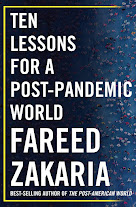
Fareed Zakaria takes a global look at the past to predict the future in “Ten Lessons for a Post-Pandemic World" (W.W. Norton & Company, 2020). In fact, Zakaria takes an out-of-this-world look at the impact of disease, pollution, and climate change on human survival:

“Climate scientists who warn of the dangers of our current path are unconsciously mirroring Nobel laureate Joshua Lederberg’s warnings to us about viruses, back in 1989. Like him, they are urging us to assume that nature is a benign force that has any particular interest in the survival of life on this earth. The climate doesn’t care about us; it is simply an accumulation of chemical reactions that could easily get out of control and destroy the planet and all who live on it. Millions of other planets in other celestial systems may have suffered the same fate. In our own solar neighborhood, NASA’s recent computer modeling suggests that Venus (above) might have been habitable for around 2 billion years, after which a ‘runaway greenhouse gas effect’ led to the scorched and sterile conditions on the Venus of today. We can mitigate the forces that are pushing the earth in a similar direction. If that is not a sound reason for cooperation, then we will not find another.”

Non-cooperation within and between nations can be life-threatening.


Cooperation, on the other hand, can be lifesaving. That’s a chief lesson of the COVID-19 pandemic: telling the truth, marshaling resources, and cooperating together can reduce the number of cases and prevent deaths.


“If people cooperate, they will achieve better outcomes and more durable solutions than they could acting alone,” Zakaria writes, in what sounds a lot like Adm. Mike Mullen’s ‘A Cooperative Strategy for 21st Century Seapower’ from 2007. Zakaria continues, “If nations can avoid war, their people will lead longer, richer, and more secure lives. If they become intertwined economically, everyone ends up better off.” Updated versions of the U.S. Maritime Strategy continue to note the interconnectedness of nations sharing the same oceans.

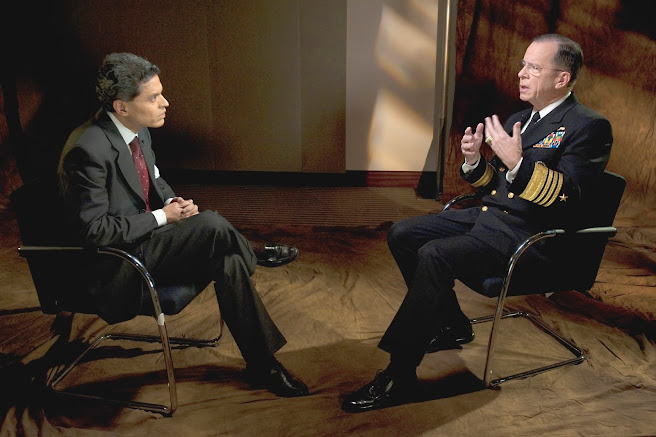
Zakaria interviews then-Chairman of the Joint Chiefs of Staff Adm. Mike Mullen in 2010. They discussed, among other topics, a drawdown of troops in Afghanistan.

Such idealism is not blindfolded. With China’s saber-rattling toward Hong Kong and Taiwan, as well as it’s maritime claims in the South China Sea, the world may be on the verge of another Cold War. Yet Zakaria writes, “Tensions between the United States and China are inevitable. Conflict is not.”

Zakariah shows how a “deeply interconnected” world can prevent wars despite “a real-life butterfly effect,” in which a fluttering butterfly’s –– or bat’s –– wing can supposedly influence the wind and eventually weather patterns on the other side of the world.

“There is a paradoxical feature of pandemics: even though they have come to be named for specific locations, they are decidedly not contained by borders. This has been true for centuries, since the Silk Road caravans and merchant galleys of the medieval world, and especially over the past 150 years since the age of steamships and trains. There was the ‘Russian flu’ of 1889-90, the ‘Spanish flu’ of 1918-19, the ‘Asian flu’ of 1957-58, the ‘Hong Kong flu’ of 1968-69, the ‘Middle East Respiratory Syndrome’ (MERS) of 2012, and now the ‘Wuhan virus’ of 2019-21. By revealing obsession with foreign labels, these names –– even when incorrect as to the origin of the virus –– betray the diseases’ much wider reach. The urge to view a pathogen as coming from abroad is strong, but of course, those diseases have rarely been known by those monikers in the places they’re named for. In Spain, the ‘Spanish flu’ was just the flu.”

Naturally, Zakaria –– a voracious reader –– cites numerous authors and books: William Maxwell’s “They Came Like Swallows,” Katherine Anne Porter’s “Pale Horse, Pale Rider,” Thomas Friedman’s “The Lexus and the Olive Tree,” Francis Fukuyama’s “Political Order and Political Decay,” and Michael Lewis’s “The Fifth Risk,” for example.

Other writers and thinkers he cites include Shakespeare, Clausewitz, Ian McEwan, Yuval Noah Harari, and Doris Kearns Goodwin.


Zakaria quotes Apple CEO Tim Cook, who, like Henry J. Kaiser in the past century, believes that his company’s “greatest contribution to mankind … will be about health.” (Kaiser, who helped shape history in the American West and in World War II, is featured in the most recent Navy Reads post earlier this month.)


It’s in his evaluation of history that Zakaria makes his most insightful conclusions about the importance of international cooperation in the wake of the pandemic –– and toward continued world peace.

“Franklin Roosevelt was assistant secretary of the navy in Woodrow Wilson’s administration and a great admirer of Wilson’s vision of a world ‘made safe for democracy’ He watched that idealism collapse in the years after World War I, leading to an even wider war during his own presidency. But the lesson FDR drew from Wilson’s experiences was to try international cooperation again, this time with America at the center of the new system –– and this time giving the great powers stronger practical incentives to fully commit themselves to the peace. A few months after America entered World War II, when victory was still uncertain and distant, FDR began formulating plans to create international institutions and systems of collective security that made future world wars unlikely. His longtime secretary of state, Cordell Hull, having seen how the trade wars of the 1930s spiraled into hot war, singlemindedly championed a new, international free trade regime. His successors realized this vision in the years after 1945 –– first through the General Agreement on Tariffs and Trade, which evolved into the World Trade Organization.

Roosevelt was known to be an idealist at heart, but his successor, Harry S Truman, had no such reputation. Truman is credited as the hard-nosed realist who dropped the atomic bombs on Hiroshima and Nagasaki, created NATO, worked to contain the Soviet Union, and waged war in Korea. But Truman was also a deeply idealistic man, and he too had drunk from the well of Wilsonian internationalism.”

Truman, when asked why he strongly supported the United Nations, would quote from Alfred Lord Tennyson’s poem Locksley Hall,” a poem which foresaw a world where cooperation reigned and nations formed a federation based on peace, commerce, and “universal law.”


Twice in this book, Zakariah recalls Dwight D. Eisenhower’s visit to the U.S. military cemetery at Colleville-sur-Mer in Normandy (above) on the twentieth anniversary of D-Day. In an interview with Walter Cronkite, Eisenhower, who as president had called for abolishing nuclear weapons worldwide and strengthening the UN, spoke to Cronkite about the 9,000 American bodies buried there: “These people gave us a chance, and they bought time for us, so that we can do better than we have before … So every time I come back to these beaches, or any day when I think about that day 20 years ago now, I say once more we must find some way to work to peace, and really to gain an eternal peace for this world.”


“Ten Lessons” advocates for people listening to experts –– and experts listening to people. One lesson is that “what matters is not the quantity of government but the quality.” Another is about the reality of virtuality: “Life is digital.” Still another is recognizing the rise of ultranationalism and that “the world is becoming bipolar” as well as more unequal.

U.S. Marine Corps Cpl. Larry Hunter, an energy NCO with Headquarters Battalion, Marine Corps Base Hawaii, monitors as a child spins a questionnaire spin wheel during an Earth Day event, Apr. 23, 2019 about the importance of energy conservation, recycling, and protecting the environment. (Sgt. Zachary Orr)


But the most important lesson, one that permeates the whole book, is the importance of the world’s interconnectedness and need for cooperation.


George W. Bush initiated a war on AIDS in Africa. Obama/Biden led the global battle to contain the Ebola virus in Africa. Unfortunately, in early 2020, despite declaring war on COVID-19, the Trump administration failed to acknowledge and confront the threat and provide a centralized plan for testing, tracing, and telling the truth.

“By the middle of 2020, tragically, with the pandemic raging across most of its fifty states –– long after Europe and East Asia contained their outbreaks –– America had no attention for anything or anyone else, except to bash Beijing. The Trump administration is not wrong to critique China’s handing of COVID-19. But coming from such a messenger, the message lands with a thud. A lifelong friend of America, the former Australian prime minister Kevin Rudd wrong in Foreign Affairs of his horror and disappointment over how far America has fallen: ‘Once there was the United States of the Berlin airlift. Now there is the image of the USS Theodore Roosevelt (CVN-71) crippled by the virus, reports of the administration trying to take exclusive control fo the vaccine being developed in Germany, and federal intervention to stop the commercial sale of personal protective equipment to Canada. The world has been turned on its head.’”

At the beginning of March, 2020, only a few people in the United States had died from COVID-19, but the number of cases was beginning to grow exponentially. By the end of April, just after the United States commemorated the 50th anniversary of Earth Day, there were more than 1 million cases in the U.S. and more than 60,000 deaths –– despite messages from President Trump that everything was under control, the virus would go away, people should take Hydroxychloroquine, and we should try injecting bodies with disinfectants (one year ago this week).

A runner pushes through the last 100 meters of a 5K Earth Day Fun Run at Marine Corps Air Ground Combat Center, Twentynine Palms, April 2014. (Cpl. Ali Azimi)

One year later, on Earth Day 2021, there have been nearly 570,000 American deaths. But a coordinated vaccination campaign is working now to reduce cases and fatalities. Unfortunately, the world has suffered 3.1 million deaths due to the novel coronavirus pandemic, and new variants threaten everyone.

“Ten Lessons” presents the stark realities and possibilities ahead; Zakaria warns about the near certainty of another pandemic this century in a connected world. But he also presents an optimistic message about the possibilities ahead if the nations of the world become more educated, more equal, and more committed to cooperation to confront existential threats, including global climate change.


Idealism is not dead. Hope is alive. And the opportunity for lifesaving cooperation is here now despite –– and because of –– the pandemic.

Saturday, February 6, 2021

A Heated Senate; ‘No Sense of Decency’

Review by Bill Doughty

Another book adds to the understanding of McCarthyism and how it infected the body politic in the United States but failed to destroy the U.S. military and other pillars of democracy –– despite leaving lasting ailments.


Robert Shogan presents vignettes and the cast of characters in “No Sense of Decency: The Army-McCarthy Hearings: A Demagogue Falls and Television Takes Charge of American Politics” (Ivan R. Dee Publisher, 2009).

Shogan shows how the U.S. Senate in the early 1950s, aided and abetted by a willing media, fueled McCarthy’s conspiracy theories and attacks on democracy under the veil of patriotism. President Eisenhower said, “It saddens me that I must feel ashamed for the United States Senate.”


McCarthy’s legacy is one of lies and prevarication, breaking of norms, disrespect for rules and codes of conduct, prioritizing personality over substance, and a love for power and personal ambition over public interest.


In our previous post, we covered other parallels between McCarthyism and Trumpism as revealed in Larry Tye’s “Demagogue.” Shogan’s “No Sense of Decency" reveals more links and parallels. 


For instance:


Gen. George Marshall
McCarthy’s slander of war heroes, including General Marshall, a leader in World War II and a chief military advisor to President Truman as well as Secretary of State (p. 75) reads like Donald Trump’s reported disrespect for fallen soldiers and his slander of Senator John McCain, a Navy veteran and Vietnam War POW.


McCarthy attacked opponents’ family members, including Maj. Gen. Miles Reber’s brother as part of his Big Lie conspiracies. (p. 146)


Despite haranguing people who used the fifth amendment, McCarthy became known as the “Fifth Amendment Senator” when he, himself, was under investigation. (p. 244)


McCarthy weakened and divided his Republican Party but ironically brought about some bipartisanship in how the Senate eventually dealt with him, leading to a vote for censorship. (p. 248)


Shogan writes:

“The Senate faced a tortuous choice. For many of its members, conscience and a sense of obligation toward the legislative body whose prerogatives McCarthy now professed to be defending inclined them in favor of censure. But for many –– including those leading toward censure –– political considerations raised a red flag. McCarthy may have lost ground with the majority of Americans, but he still had a hard cadre of supporters, and these partisans felt bound even closer by the threat of censure.”

Sen. Joseph McCarthy
In the end, McCarthy refused to apologize.“He now wanted to become a victim and to use his martyrdom to expand and strengthen his own personal political base outside the Republican Party,” Shogan writes.


The characters in the Senate seventy years ago during the McCarthy hearings included young John F. Kennedy, democratic leader Lyndon B. Johnson, Richard M. Nixon, Stuart Symington, Everett Dirkson, Margaret Chase Smith, and Prescott Bush (father and grandfather of future presidents). Many of the senators were military veterans of World War II; some fought in World War I or in earlier conflicts.


Studying the list of senators from the 82nd and 83rd Congress (during McCarthy’s reign of terrorizing), it’s fascinating to see how many were born before the turn of the 20th century. Their parents or grandparents fought in or lived through the Civil War. The oldest senator in the group, Theodore F. Green of Rhode Island, was born in 1867 and served as a first lieutenant in the Spanish-American War.


Senator John F. Kennedy
All of the senators lived through the 1918 pandemic, including JFK, born May 29, 1917 and Russell Billiu Long, born Nov. 3, 1918. Long, who served as a Navy lieutenant in World War II, commanded a landing craft transport vessel. (He was the son of Louisiana governor and senator Huey Long.) None lived long enough to see the current coronavirus pandemic.


“No Sense of Decency” is a well-written, fast-paced accounting of the people, legacy, politics, and characters surrounding Joe McCarthy and McCarthyism.


“The politics of fear and paranoia, while they ebbed and flowed, never really went away,” Shogan concludes.


Reading about the history of the Cold War in general and McCarthyism in particular provides an insight to help understand current surrealism –– as well as other isms and ailments in its wake.

Saturday, January 30, 2021

Parallels of Trumpism/McCarthyism

Review by Bill Doughty

Some isms are based in fear, hate, anger, paranoia, and ignorance. They take hold because they operate in emotional shadows rather than in the light of logic. McCarthyism is worth studying because of obvious parallels that would eventually be revealed nearly seven decades later in Trumpism.

Far from being a caricature, Senator Joe McCarthy, junior Republican senator from Wisconsin through most of the 1950s, was “more layered and counterintuitive than the two-dimensional demagogue enshrined in history.”


Author Larry Tye gives a colorful biography of the senator with new information from recently revealed personal and professional papers, financial files, previously sealed Senate subcommittee testimony, and medical records from Bethesda Naval Hospital. 


“Demagogue: The Life and Long Shadow of Senator Joe McCarthy” (Houghton Mifflin Harcourt, 2020) shows that McCarthy was a hard-working “whizkid” entrepreneur and good student at Marquette University who became an attorney and circuit court judge and then a United States Marine before campaigning (while in uniform) for the U.S. Senate.


Some family members and friends knew McCarthy as tender and supportive in private. But his public persona was one of “a tyrant who recognized no restraints and would do anything –– anything –– to win.” He blamed his “roughness in fighting the enemy to his training in the Marine Corps.”

“Barely three years into Joe’s judicial term, the Empire of Japan sucker punched the United States of America, unleashing a crippling assault on the naval fleet at Pearl Harbor and letting loose a stampede of American boys raring to pound back. Judges like Joe, however, were deemed to be doing their part already, and most watched from the sidelines with nobody doubting their manliness or their patriotism. That was not enough for Joe McCarthy. He believed in public service, which was one reason he’d run twice for office at Marquette and two more time soon after graduation. He was also unabashedly ambitious, which had him eyeing Carl Zeidler, the wunderkind mayor of Milwaukee, who could someday be a rival for statewide office and who, in early 1942, scored page-one headlines by enlisting in the Navy. There was always more than one thing driving Joe, and now it was defending his country and one-upping his imagined opponent. The way to do that, he reasoned, was to sign on with the most hallowed of the armed services: the leathernecks of the US Marines.”

McCarthy in the Marines
Military records show McCarthy joined as a first lieutenant, but in “his first wartime fib” he claimed he joined as a “buck private.” McCarthy would lie about a leg injury he claimed to receive in combat but which he actually got 600 miles away, slipping and falling as a “pollywog” in a crossing-the-equator initiation aboard USS Chandeleur (AV-10). There were other embellishments and distortions about his time in uniform.


McCarthy’s active duty service lasted only 29 months, and the Marine Corps accepted his resignation March 29, 1945, just before the battles of Iwo Jima and Luzon. McCarthy then returned to the circuit court bench in full military dress uniform and accelerated his campaign for the Senate.


Joe McCarthy and Donald Trump are different in some obvious ways: military service (Trump avoided the draft); family origins (Trump was born rich but McCarthy started as a chicken farmer); complicated relationship with the FBI (McCarthy was friends with Hoover, while Trump fired FBI directors); views on Russia and the Soviet Union (although both opposed communism); and alcohol consumption (McCarthy died of the effects of severe alcoholism, but Trump claims not to drink alcohol).


But McCarthy/Trump parallels, as revealed in “Demagogue,” are astounding –– and plentiful:


Friday, January 15, 2021

The Long Arc: ’What Unites US’


Review by Bill Doughty

The long arc of history bends toward justice, as Martin Luther King observed, but the arc is jagged –– two steps forward, one step backward. Yet with age, education, and knowledge, often comes wisdom and a clear perspective of the way forward to a “more perfect union.”


Dan Rather acknowledges this in his heartwarming book, written with Elliot Kirschner, “What Unites Us: Reflections on Patriotism” (Algonquin Books of Chapel Hill: 2017). Rereading this quietly powerful book is a way to see clearly how we can heal and unite through truth, understanding, and accountability, especially after the attack on the Capitol by domestic terrorists and misguided believers.

Some key insights Rather shares: We can find strength through kindness and diversity. We can be patriotic through empathy and inclusion. We can be responsible citizens by caring for the environment, getting an education, and finding ways to serve. (At right: Service – Sailors aboard USNS Comfort (T-AH 20) evaluate a Guatemalan infant, June 27, 2007, during a humanitarian deployment, DVIDS).


And we can achieve greatness as individuals and as a nation by repairing our faults, to paraphrase de Tocqueville (who the author quotes in his epigraph). Another quote Rather shares is from George Washington, who “in his famous Farewell Address, warned future generations ‘to guard against the impostures of pretended patriotism.’”


What does it mean to love America and to be committed to moving forward along the arc toward justice? “It is important not to confuse patriotism with nationalism,” he writes. “Patriotism –– active, constructive patriotism –– takes work. It takes knowledge, engagement with those who are different from you, and fairness in law and opportunity. It takes coming together for good causes.”


Here’s a found haiku in “What Unites Us”:


We are a nation

not only of dreamers, but

also of fixers


“We have looked at our land and people, and said, time and again, this is not good enough; we can do better,” he writes.


Houston, circa 1935
Rather takes us back to his childhood in 1930s/40s Houston, Texas in “What Unites Us.” He weaves together themes of freedom, community, exploration, responsibility, and character –– in other words, cherished American values and ideals. 

As a child, Rather was an eyewitness to the Second World War on the Homefront. As a young man he enlisted in the Marine Corps. But he regretted having to be forced to leave boot camp after suffering health issues from having contracted rheumatic fever in childhood

Rather found another way to serve in war zones; he became a renowned reporter, following in the footsteps of his hero Edward R. Murrow. Now, at 89 years old, Rather reflects on the American history he has seen and experienced.


Rather shares anecdotes about people he knew on the Homefront after the traumas of the Great Depression in the 1930s and World War II in the early-to-mid 40s, and he explains how the war mobilized and united the nation, especially after Pearl Harbor.

“It is perhaps not surprising that Nazi Germany and Imperial Japan looked at a nation so traumatized and felt they could defeat us. Of course, history turned out differently. The same generation that had been driven to such depths in the 1930s rose up to push back the forces of totalitarianism in a two-ocean global war in the 1940s. Perhaps those authoritarians, who felt no empathy for their own people or those they conquered, underestimated the strength of our empathy. Empathy builds community. Communities strengthen a country and its resolve and will to fight back. We were never as unified in national purpose as we were in those days. What had weakened us had also made us stronger.”

WWII and Korea (“the forgotten war”), he says, were turning points for our nation.

“We have never fully regained the confidence we felt at the end of World War II, or the unity. Korea led to a long and arduous path of questioning our place in the world. We did not always win wars, as we would soon have to relearn in Vietnam. We could not take our destiny for granted, as we began to realize under the shadow of the Cold War. There were deep ruptures and injustices within our nation, as we would see when the national spotlight shifted from the fissures of McCarthyism to the difficult struggle for civil rights.”

Truman integrated the military in 1948
Peaceful demonstrations and street marches against poverty, racism, voter suppression, and the Vietnam War were part of the jagged arc toward justice in the 60s, but courageous decisions made decades earlier paved the way. “In 1948, President Harry Truman would desegregate the armed forces, six years before Brown v. Board of Education ended segregation in our public schools.”

“Indeed, this sweep of empathy continued after the war. One of the best foreign policy efforts in American history was to help rebuild Europe and Japan. Our enemies became our friends through acknowledgment of the common bonds of humanity. The postwar world order was built on that foundation. And when the GIs returned home, we treated them empathetically as well. The Servicemen’s Readjustment Act of 1944, more commonly known as the GI Bill, was one of the greatest pieces of social legislation in our nation’s history. Among other benefits, the GI Bill ensured that servicemen’s tuitions to college or technical school were fully paid. Empathy makes for wise foreign and domestic policy.”

Nixon is interviewed by Rather in the White House, Jan. 2, 1972.
Rather showcases the steady, courageous, and audacious leadership of Presidents Abraham Lincoln, Teddy Roosevelt, Truman, FDR, JFK, and LBJ. Those leaders stand in sharp contrast to any president who lies, cheats, threatens, and incites violence in order to get elected or try to stay in power.

Reflecting on the situation in the early 70s, after Nixon resigned in the face of impeachment and Navy veteran Vice President Gerald Ford assumed office, Rather writes, “The steadiness of the nation contrasted sharply with the increasing unsteadiness of President Nixon –– the full measure of which we would not comprehend until after he’d left office.”


“We would do well to study our history,” Rather observes. “For in it lies not only evidence of American greatness, but also the need for humility.”


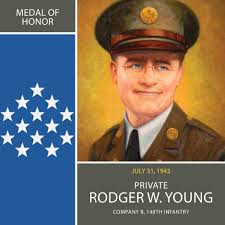
He reminds us of humble American hero Rodger Young, an Army soldier of the Ohio National Guard who fought and died in the Pacific War during the Battle of Munda Point in the Solomon Islands. 


In the Battle of Munda Point, Private Young, shot twice by machine gun fire, continued to move forward, firing his rifle and throwing hand grenades to take out an enemy pillbox and save his team. Young was posthumously awarded the Medal of Honor. 


Rather speaks with reverence about visiting cemeteries in Normandy and Honolulu. Rather's/Kirschner’s prose is crisp and unsentimental, but there are still glimmers of poetic insight.


Here is another found haiku in “What Unites Us”:


We live in debt to

those who have served and died, a

debt tallied in blood


Rather reveals truly patriotic American values –– perfect for this challenging time in the wake of a failed coup attempt, in the middle of a deadly pandemic, and as we confront an ongoing threat to our Constitution and democratic republic. Dan Rather provides a strong and hopeful commitment to truth, justice, and accountability in 2021 in this uplifting book. He helps smooth the jagged edges of the long arc of history.


National Memorial Cemetery of the Pacific, "Punchbowl Crater," Oahu, Hawaii, with Diamond Head in the background.

Panoramic view of the "National Memorial Cemetery of the Pacific" at Punchbowl Crater, Oahu, Hawaii, 2 September 1949, four years after the end of World War II. Fleet Admiral Chester W. Nimitz, USN, made a speech at the dedication ceremony.