Showing posts with label USMC. Show all posts

Wednesday, April 6, 2022

‘Where Law Ends’ / Seeds of Ukraine Invasion

Review by Bill Doughty––

There’s a scene in “Where Law Ends: Inside the Mueller Investigation” by Andrew Weissmann (Random House, 2020) in which Vietnam Veteran Robert Mueller leads his Special Counsel team in a celebration of the Marine Corps Birthday, something Mueller had done since his days as director of the FBI. Semper Fi.

“On November 10, [2018], Mueller held his last U.S. Marine Corps Birthday celebration –– an annual event he had commemorated at the Bureau and now in the Special Counsel’s Office. The whole office attended, cake was served, and –– as tradition would have it –– the first piece was handed from Mueller to Ben Cohen (our security officer), symbolizing the passing of the torch from the oldest to the youngest marine. The tradition was lovely, and we all knew it would be our last with the office and Mueller.”

The birthday commemoration occurred during the fraught days of Special Counsel team interviews with a key figure in events that would lead to the first impeachment of Donald Trump.

Paul Manafort, Trump’s campaign manager, was accused of coordinating a meeting at the Trump Tower in June 2016 between Russian operatives, including Natalia Veselnitskaya and other Russians, and members of the Trump campaign, including Donald Trump Jr. and Jared Kushner. 


Manafort coordinated also with Russian intelligence officer Constantin Kilimnik, providing internal polling information to a foreign entity; Manafort pleaded guilty in federal court to obstruction of justice and conspiracy. He comes across in “Where the Law Ends” as a simultaneously pathetic loser, smooth Svengali, and evil liar.


Weissmann outlines how Manafort worked with Ukrainian oligarchs and Russian officials in an attempt to divide Ukraine after the Ukrainian people voted Russia’s puppet Viktor Yanukovych out of office. We see the seeds of Putin’s invasion plans –– planted years ago and fertilized during the Trump administration.

“Russia had sought for years to control Ukraine, as Putin needed that territory to transmit oil and gas to Europe. But Ukraine needed Russia even more, as it obtained basically all of its energy from that nation. Russia had enjoyed de facto control of Ukraine when Yanukovych was president, funneling him millions of dollars in bribes to curry his favor. But after Yanukovych’s overthrow, Russia no longer had such a willing puppet under its control. Thus, Russia had turned to brute force: its infamous invasion of Crimea, a region of eastern Ukraine, in 2014 –– the one that had outraged most Western democracies, but which candidate Trump oddly had regarded as no big deal.

“The proposal for Russia to take over the eastern half of Ukraine was the Crimea invasion on steroids. Russia would annex the country, reinstall its favorite figurehead, and thus control the economic heart of the country. Notably, Manafort and Kilimnik’s proposal explained that, for such a move to succeed, it would need the consent of the United States. It called on Trump to give Russia an approving ‘wink’ –– the word the proposal used –– and, furthermore, to appoint Manafort to negotiate the logistics with Russia on America’s behalf. In a separate email, Kilimnik endorsed Manafort for this role; Manafort would be able to deal with Russia at the ‘very top level,’ Kilimnik explained…

“The facts we’d established, even amid Manafort’s attempts to muddy them were staggering. On August 2, if not earlier, Russia had clearly revealed to Manafort –– and, by extension, to the Trump campaign –– what it wanted out of the United States: ‘a wink,’ a nod of approval from a President Donald Trump, as it took over Ukraine’s richest region.

“It was a tremendous thing for Russia to ask for. It would seem to require significant audacity –– or else, leverage –– for another nation to even put such a request to a presidential candidate. This made what we didn’t know, and still don’t know to this day, feel monumentally disconcerting: namely, why would Trump ever agree to this? Why would Trump ever agree to this Russian proposal if the candidate were not getting something in return? Both Manafort and Trump were too transactional to give away something for nothing.”

Trump, Manafort and Ivanka Trump (Shealah Craighead)
Weissmann’s book was written prior to Trump’s pardons of people involved in coordination with Russia to help him get elected: Michael Flynn, George Papadopoulos, Alex van der Zwann, Roger Stone, and Paul Manafort (along with dozens of other pardons).

Regarding Manafort, Weissmann says Judge Jackson’s expression of disapproval of Manafort’s crimes were incisive and “managed to articulate a central and dismaying truth about our entire experience at the Special Counsel’s Office.”

“She spoke of Manafort’s numerous lies, and his multiple obstructions of our investigation –– both through his own willful deceit and by coaching witnesses to lie for his protection. He’d done the latter, Judge Jackson noted, while he was under indictment and out on bail. Finally, she explained that Manafort had even lied to the government about telling the truth: claiming that he would finally cooperate with our investigation only to obfuscate and impede it further. ‘It is hard to overstate the number of lies and the amount of fraud and the extraordinary amount of money involved,’ she said. Manafort had not lived an exemplary life. Here was a chastening recognition that his conduct was serious and flagrant, and repeated over years.”

Working with the Russians and on behalf of the Trump campaign, it seems Manafort had sowed the political terrain for an invasion of Ukraine.


The title of Weissmann’s book comes from a John Locke quote, “Where law ends, tyranny begins.”Weissman outlines how Mueller's team faithfully and methodically defended the Constitution (from enemies, both foreign and domestic).


He introduces us not only to key actors in the limelight such as Manafort, Jared Kushner, Donald Trump Jr., and Bill Barr, but also to various members of the Mueller team who worked behind the scenes, sometimes at odds over how to present to the courts the corruption they encountered.


Trump and Barr (Shealah Craighead)
Weissmann begins and ends his narrative with discussion of former Attorney General William Barr, starting with the author’s profound disappointment in how Barr presented a distorted summary of the Mueller Report to the public. Near the end of the book Weissmann lists specifics, point by point, of how Barr misled, obfuscated, and showed a “disregard to the facts and attempted erasure” of the Mueller Report’s findings, even though the report clearly shows coordination between the Trump campaign and Russia.”

Barr had emasculated the special counsel, which he alluded he would do in an AG audition memo he wrote as a private citizen.


“Barr’s gambit –– enabled by [Rod] Rosenstein and his staff –– gave the president a green light to resume conducting himself beyond legal confines,” Weissmann contends.

“And it worked. Three months later [after release of the Mueller Report], on the day after Mueller testified about our report in Congress, the president held up hundreds of millions of dollars in funding to aid Ukraine in its war against Russia –– funding that had been authorized by Congress and previously signed off on by the president himself. Why? Because he wanted the Ukrainian government to open an investigation into his political opponent Joe Biden and his son…

“Still, it is a different investigation that Trump sought from Ukraine that I find even more disturbing. The president leaned on the Ukrainian government to investigate Ukraine’s purported interference in the 2016 U.S. presidential election. These allegations are rooted in Russian disinformation. The unanimous conclusion of our Intelligence Community and Trump’s own experts, like Dr. Fiona Hill, is that Russia interfered with the election; our indictments laid out clear and extensive proof, replete with Russian emails detailing the efforts. We had the facts. Why would Trump raise the boogeyman of Ukraine election interference other than to distract from what Russia had done (and would continue to do)?

“Did Ukraine help Trump in the 2016 election? Of course not. And nothing about Trump’s Ukraine allegations diminished the proof against Russia.”

Historians will value this book a hundred years from now for its first-person findings, eventually leading to the first impeachment (of two) of former President Donald Trump, who solicited a foreign entity (Ukraine) for help in an election campaign. And he would solicit foreign help again and again.

Weissmann’s book is all-the-more relevant after Trump’s recent request, once again, for a foreign entity’s help against his political foe in an interview at the end of March with Real America’s Voice at Mar-a-Lago. Reminiscent of his “Russia, if you’re listening” request in 2016 for dirt on political opponent Hillary Clinton, Trump again asked President Putin of Russia for scandalous information on political opponent President Joe Biden and his son.

Trump, who previously and recently called Putin a savvy genius, lamented not being able to coerce Ukraine for information. And the former president offered this shocking comment about China: “And I won’t even talk about China because they haven’t gone into Taiwan yet.”


At the end of March, two hundred U.S. Marines were deployed to Lithuania on the eastern edge of the NATO alliance. The deployment includes a command-and-control unit for Marine Air Control Group 28 out of Cherry Point, North Carolina.


NATO Mine Countermeasures Group 1 ships sail in formation in Geiranger Fjord, Norway, March 9, 2022, during Exercise Cold Response. NATO
Following Exercise Cold Response training in Norway, ten Marine F-18 Hornet fighter jets from Beaufort, South Carolina, were repositioned to Eastern Europe, according to the Pentagon, which has 14,000 troops stationed in Europe. The U.S. Navy and U.S. Coast Guard have helped or trained with Ukraine, especially since 1997.

Meanwhile, for more than a month valiant Ukrainian military members and civilians are defending their country and are now beating back the Russians, who are committing war crimes against their neighbor.


NATO, reunited and stronger, is supporting the courageous Ukranians. Semper Fi.


In an interview at Mar-a-Lago in March, during Putin's invasion of Ukraine, Trump asks Putin for dirt on Bidens.


Friday, January 15, 2021

The Long Arc: ’What Unites US’


Review by Bill Doughty

The long arc of history bends toward justice, as Martin Luther King observed, but the arc is jagged –– two steps forward, one step backward. Yet with age, education, and knowledge, often comes wisdom and a clear perspective of the way forward to a “more perfect union.”


Dan Rather acknowledges this in his heartwarming book, written with Elliot Kirschner, “What Unites Us: Reflections on Patriotism” (Algonquin Books of Chapel Hill: 2017). Rereading this quietly powerful book is a way to see clearly how we can heal and unite through truth, understanding, and accountability, especially after the attack on the Capitol by domestic terrorists and misguided believers.

Some key insights Rather shares: We can find strength through kindness and diversity. We can be patriotic through empathy and inclusion. We can be responsible citizens by caring for the environment, getting an education, and finding ways to serve. (At right: Service – Sailors aboard USNS Comfort (T-AH 20) evaluate a Guatemalan infant, June 27, 2007, during a humanitarian deployment, DVIDS).


And we can achieve greatness as individuals and as a nation by repairing our faults, to paraphrase de Tocqueville (who the author quotes in his epigraph). Another quote Rather shares is from George Washington, who “in his famous Farewell Address, warned future generations ‘to guard against the impostures of pretended patriotism.’”


What does it mean to love America and to be committed to moving forward along the arc toward justice? “It is important not to confuse patriotism with nationalism,” he writes. “Patriotism –– active, constructive patriotism –– takes work. It takes knowledge, engagement with those who are different from you, and fairness in law and opportunity. It takes coming together for good causes.”


Here’s a found haiku in “What Unites Us”:


We are a nation

not only of dreamers, but

also of fixers


“We have looked at our land and people, and said, time and again, this is not good enough; we can do better,” he writes.


Houston, circa 1935
Rather takes us back to his childhood in 1930s/40s Houston, Texas in “What Unites Us.” He weaves together themes of freedom, community, exploration, responsibility, and character –– in other words, cherished American values and ideals. 

As a child, Rather was an eyewitness to the Second World War on the Homefront. As a young man he enlisted in the Marine Corps. But he regretted having to be forced to leave boot camp after suffering health issues from having contracted rheumatic fever in childhood

Rather found another way to serve in war zones; he became a renowned reporter, following in the footsteps of his hero Edward R. Murrow. Now, at 89 years old, Rather reflects on the American history he has seen and experienced.


Rather shares anecdotes about people he knew on the Homefront after the traumas of the Great Depression in the 1930s and World War II in the early-to-mid 40s, and he explains how the war mobilized and united the nation, especially after Pearl Harbor.

“It is perhaps not surprising that Nazi Germany and Imperial Japan looked at a nation so traumatized and felt they could defeat us. Of course, history turned out differently. The same generation that had been driven to such depths in the 1930s rose up to push back the forces of totalitarianism in a two-ocean global war in the 1940s. Perhaps those authoritarians, who felt no empathy for their own people or those they conquered, underestimated the strength of our empathy. Empathy builds community. Communities strengthen a country and its resolve and will to fight back. We were never as unified in national purpose as we were in those days. What had weakened us had also made us stronger.”

WWII and Korea (“the forgotten war”), he says, were turning points for our nation.

“We have never fully regained the confidence we felt at the end of World War II, or the unity. Korea led to a long and arduous path of questioning our place in the world. We did not always win wars, as we would soon have to relearn in Vietnam. We could not take our destiny for granted, as we began to realize under the shadow of the Cold War. There were deep ruptures and injustices within our nation, as we would see when the national spotlight shifted from the fissures of McCarthyism to the difficult struggle for civil rights.”

Truman integrated the military in 1948
Peaceful demonstrations and street marches against poverty, racism, voter suppression, and the Vietnam War were part of the jagged arc toward justice in the 60s, but courageous decisions made decades earlier paved the way. “In 1948, President Harry Truman would desegregate the armed forces, six years before Brown v. Board of Education ended segregation in our public schools.”

“Indeed, this sweep of empathy continued after the war. One of the best foreign policy efforts in American history was to help rebuild Europe and Japan. Our enemies became our friends through acknowledgment of the common bonds of humanity. The postwar world order was built on that foundation. And when the GIs returned home, we treated them empathetically as well. The Servicemen’s Readjustment Act of 1944, more commonly known as the GI Bill, was one of the greatest pieces of social legislation in our nation’s history. Among other benefits, the GI Bill ensured that servicemen’s tuitions to college or technical school were fully paid. Empathy makes for wise foreign and domestic policy.”

Nixon is interviewed by Rather in the White House, Jan. 2, 1972.
Rather showcases the steady, courageous, and audacious leadership of Presidents Abraham Lincoln, Teddy Roosevelt, Truman, FDR, JFK, and LBJ. Those leaders stand in sharp contrast to any president who lies, cheats, threatens, and incites violence in order to get elected or try to stay in power.

Reflecting on the situation in the early 70s, after Nixon resigned in the face of impeachment and Navy veteran Vice President Gerald Ford assumed office, Rather writes, “The steadiness of the nation contrasted sharply with the increasing unsteadiness of President Nixon –– the full measure of which we would not comprehend until after he’d left office.”


“We would do well to study our history,” Rather observes. “For in it lies not only evidence of American greatness, but also the need for humility.”


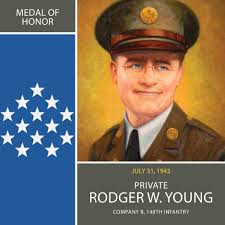
He reminds us of humble American hero Rodger Young, an Army soldier of the Ohio National Guard who fought and died in the Pacific War during the Battle of Munda Point in the Solomon Islands. 


In the Battle of Munda Point, Private Young, shot twice by machine gun fire, continued to move forward, firing his rifle and throwing hand grenades to take out an enemy pillbox and save his team. Young was posthumously awarded the Medal of Honor. 


Rather speaks with reverence about visiting cemeteries in Normandy and Honolulu. Rather's/Kirschner’s prose is crisp and unsentimental, but there are still glimmers of poetic insight.


Here is another found haiku in “What Unites Us”:


We live in debt to

those who have served and died, a

debt tallied in blood


Rather reveals truly patriotic American values –– perfect for this challenging time in the wake of a failed coup attempt, in the middle of a deadly pandemic, and as we confront an ongoing threat to our Constitution and democratic republic. Dan Rather provides a strong and hopeful commitment to truth, justice, and accountability in 2021 in this uplifting book. He helps smooth the jagged edges of the long arc of history.


National Memorial Cemetery of the Pacific, "Punchbowl Crater," Oahu, Hawaii, with Diamond Head in the background.

Panoramic view of the "National Memorial Cemetery of the Pacific" at Punchbowl Crater, Oahu, Hawaii, 2 September 1949, four years after the end of World War II. Fleet Admiral Chester W. Nimitz, USN, made a speech at the dedication ceremony.