Showing posts with label Philippines. Show all posts

Sunday, September 11, 2022

September Remember: USS Midway in Japan

by Bill Doughty––

I was attending school in Tokyo and living in Yokosuka in 1973 when USS Midway (CV-41) arrived in Yokosuka –– the first U.S. aircraft carrier to be stationed in Japan as part of the Forward-Deployed Naval Forces. It was a big deal, less than thirty years after World War II, and just months after the U.S. military departed Vietnam.


Midway was commissioned 77 years ago, Sept. 10, 1945, just eight days after Imperial Japan surrendered. Stationing the ship in Japan was hugely symbolic; Midway is named for the historic and pivotal battle in 1943 that turned the tide in WWII.


USS Midway (CV-41) arrives in Yokosuka, Oct. 7, 1973. Photo from Midway cruise book. (Ryo Isobe, DVIDS)
But that’s only one reason the carrier’s arrival in Yokosuka was opposed by many Nihonjin, sometimes violently.

Hundreds of Japanese citizens, loudly opposed to America’s war in Vietnam, came to Yokosuka in 1973 to protest the arrival of Midway.

I remember scores of demonstrators in headbands and helmets, faces covered, white-knuckled fists gripping bamboo poles. The demonstrators assembled by the Yokosuka JNR station and marched to the closed gates of the base. Japanese police in riot gear formed a human shield. Marine guards stood ready behind them. Some radical demonstrators attacked the police and were repelled with fire hoses.


Midway had been a recent (and repeated) participant in what was then called the Vietnam Conflict, a war for which the ship received the Presidential Unit Citation from President Nixon in early 1973.


Two years later, Midway would join with other ships of the U.S. 7th Fleet in Operation Frequent Wind, the evacuation of Saigon.


Three years after Midway’s arrival in Yokosuka, the United States celebrated its bicentennial, 1776-1976. By then, I was just out of college and contributing stories to the Seahawk base newspaper on my way to becoming editor and eventually a public affairs officer.

Early in its career, Midway participated in historic operations in the Caribbean, near the Arctic, throughout the Mediterranean, and in both the Atlantic and Pacific, including near North Korea.

Midway would go on to participate in various peacekeeping operations, including Operation Desert Shield and Desert Storm, after Iraq failed to obey a United Nations ultimatum to withdraw from its invasion of Kuwait.


Just as it did in the evacuation of refugees after the fall of Saigon, Midway played a key role with other ships in rescuing evacuees from the Philippines in Operation Fiery Vigil after the eruption of Mt. Pinatubo. That was in June of 1991.


I was still living in Yokosuka and working for the Navy when USS Midway departed Yokosuka for the final time in August 1991. The workhorse aircraft carrier was headed to retirement 31 years ago this month –– via Pearl Harbor, Seattle, and Bremerton –– eventually to San Diego.


USS Midway arrives in Pearl Harbor, August 23, 1991.
By 1991, more Japanese people came to realize the value of having a strong U.S. Navy presence, working cooperatively with the Japan Maritime Self-Defense Force to maintain freedom of the seas. 

Just as the United States Constitution was a model for Japan’s form of government, the United States Navy served as a model for the JMSDF –– with direct help and guidance from Adm. Arleigh A. Burke.


Over many years, Yokosuka has held hugely popular base open-house events, inviting tens of thousands of Japanese citizens onto the base to participate in games, enjoy food booths, attend concerts, and go aboard U.S. Navy ships.


The most popular draw at base open-house events? Tours of an aircraft carrier.


After Midway’s departure, other carriers followed its lead to become forward-deployed in Japan: USS Independence (CV-62), USS Kitty Hawk (CV-63), USS George Washington (CVN-73), and USS Ronald Reagan (CVN-76).


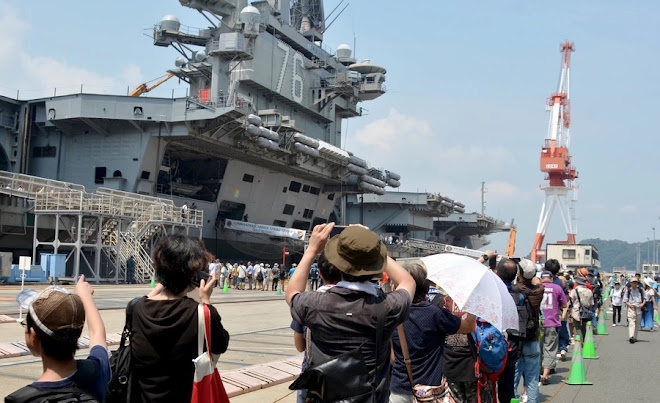
Japanese guests line up to board USS Ronald Reagan (CVN-76), October 10, 2015, during Yokosuka's Friendship Day open-base event. (MC1 Peter Burghart)

Open-base events were suspended for a time in the aftermath of attacks on the United States by religious zealots –– Islamist terrorists –– on September 11, 2001. (I remember the gates being locked down for weeks. Everyone who lived off base were required to park a few miles away and were offered rides to work or schools on base in carefully screened shuttle buses.)


In September 2003, USS Midway departed its temporary home of Bremerton, WA, to become a museum and memorial in San Diego. It welcomes an average of more than one million visitors per year. As with the USS Arizona Memorial in Pearl Harbor, many of the visitors to the USS Midway Museum include people from Japan who come to pay respect and learn about history.


Operation Sandy (Midway Museum Archives)
The museum offers a robust website highlighting the ship’s proud legacy, including operations in the Arctic, Taiwan Strait, and Vietnam, among others. I found some fascinating Midway photos available for download from Flikr, courtesy of the Museum. Some of the photos on the museum’s site include ringside views of Operation Sandy, the world’s first test-firing of a ballistic missile from a ship at sea.

There are numerous resources on the museum’s website, including videos and first-person accounts. This line stands out: “When history speaks, turn up the volume.”


In reading the history of the USS Midway, we can see the evolution of the modern Navy, from the immediate postwar, through the entire Cold War, and operations in Vietnam. But the ship is remembered most fondly, perhaps, for its role in helping people and promoting peaceful protection, especially for eighteen years in Yokosuka, Japan.


USS Midway’s strategic role in the Cold War, is a key part of James D. Hornfischer’s fascinating “Who Can Hold the Sea: The U.S. Navy in the Cold War, 1945-1960” (Bantam Books, 2022).


I have a two-part review of Hornfischer's final work posted in recent weeks. Hornfischer has been a favorite over the years. In May 2012, he offered a guest mini-review of five books he recommended to Navy Reads.


Saturday, July 30, 2022

Smedley Butler: Remember 'Making and Breaking'

Review by Bill Doughty––

“Gangsters of Capitalism: Smedley Butler, the Marines, and the Making and Breaking of America’s Empire” by Jonathan M. Katz (St. Martin’s, 2021) shows why we need to study history as it was, not as we want it to be.

This book toggles between the past and present as award-winning journalist Jonathan M. Katz follows the path of Smedley Butler, United States Marine, a twice-awarded recipient of the Medal of Honor. He fought in China, Cuba, Haiti, Nicaragua, and Philippines; spied for the Navy in Mexico; and he served in World War I in France. 


Along the way, he helped oversee building and protecting the Panama Canal, which was envisioned by Alfred Thayer Mahan and Theodore Roosevelt. As a young Marine officer, Butler had been ordered to dig a much smaller canal across a tiny isthmus on the island of Culebra in the Caribbean.

“On a sweltering day in December 1902, Smedley Butler was standing waist-deep in a watery ditch. He dunked his shovel into the mud. Mosquitoes darted across the rust-colored ripples. Their bites itched like poison. He couldn’t decide what he hated more: this marshy hell, the solid rock his unit had to ship through he day before, or the admiral whose idea it had been to build this stupid canal in the first place.”

Katz’s superb writing is illuminated by the author’s access to Butler family letters and by his extensive travels in the footsteps of Smedley Butler.


Katz provides relevance and context in his visits to battlefields in Cuba with Public Affairs Officer MCC Barbara Meeks, to war-torn regions in China and the Philippines, and to the Marine Corps museum at Quantico, Virginia, as just a few examples.

We get some of the richest reporting and historical connections when Katz returns to Haiti. He lived there for several years and was there for the devastating earthquake of 2010. (Katz is also author of “The Big Truck That Went By” about the earthquake and humanitarian response.)


“Gangsters of Capitalism” opens with a Haitian proverb as the book’s epigraph, which also happens to be a found haiku:


...one who deals the blow

forgets. The one who carries

the scar remembers


Butler developed trust and confidence with local people in Haiti, those who would “remember.”


While he and his Marines could be ruthless in combat, their power could be tempered with diplomacy and paternalistic compassion. 

“Butler’s insights became the key to securing America’s imperial foothold in Haiti. Though Butler did not realize it at the time, he was helping invent a new approach to warfare. It would eventually be dubbed counterinsurgency: the combination of military, political, and psychological method employed by an occupying power with the goal of holistically defeating an armed resistance.”

The method would be fine-tuned as counterinsurgency doctrine: COIN.

Smedley Butler
Butler also served as commandant at Quantico and San Diego, and he took a leave of absence from the Marines to become Chief of Police in Philadelphia during the nation’s failed experiment with Prohibition. Katz shows how the militarization of policing got its start in the name of “law and order.”

The book reads like a Netflix series, each chapter an episode leaving readers hungry for the next. China might take more than one episode. Same for the Philippines. Central America could be a whole season itself.


If read chronologically, “Gangsters” shows Butler’s evolution from warrior for corporations to warrior for peace. He came to see imperialism and fascism overseas return to American shores as authoritarianism and nationalism at home. He foresaw the coming of another World War in a final eruption of colonialism and revanchist expansionism.

“Butler could not see the irony: that the imperialism he had helped foster was a direct catalyst of the World War. The conflict erupted in 1914 as a fight between empires: Germany and Austria-Hungary on one side; Britain, France, and Russia on the other. All had spent decades in a complex global struggle for colonies, resources, and prestige –– a struggle that the Americans (and Butler personally) had been parties to. The older empires, especially the British, were filled with anxiety over new competitors to their global supremacy. The Germans, as the United States’ fellow latecomers to global expansion, were reading Alfred Thayer Mahan’s tracts on sea power and empire when they declared: ‘We demand a place for ourselves in the sun.’…

Butler foresaw another war coming out of the Great War and out of the era of great empire (an era Putin's Russia seems to aspire to in 2022).

“…It was not a fight over a particular colony or sea lane that sparked the cataclysm into which millions of American families were now sending their sons, but imperial arrogance, mistrust, and the accelerating war machines that made those empires run.”

In the last ten years of his life, Butler fought against imperialism and tyranny, according to Katz, where the primary beneficiaries of authoritarianism and tyranny were banks, businesses, big oil, and bought-and-paid for politicians. His support for Bonus Marchers in Washington is recounted in a previous Navy Reads review.


Because he was loved and trusted by Veterans, an attempt was made to recruit Butler in 1934 to help set up a Fascist dictatorship in the United States, subverting the will of voters. The proposal was allegedly funded by a shadowy group backed by big business and the American Liberty League. Butler reported the coup proposal to Congress. But –– unlike the current Select Committee’s hearings into the January 6, 2021 insurrection –– a full investigation was not conducted.


A YouTube interview with Katz by “Democracy Now!” (below) features a clip of retired Major General Smedley Butler, who talks about why he reported the coup attempt: “My main interest in all this is to preserve our democratic institution. I want to retain the right to vote, the right to speak freely, and the right to write,” Butler proclaims.


YouTubers can find a longer conversation with the author on the Marines Memorial Club.

Katz writes to help readers understand history “as it was” and accept the reality of past mistakes in order to prevent history from repeating.


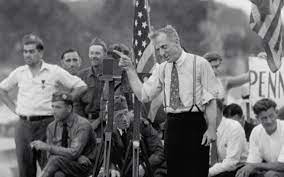
Butler speaks to Veterans July 19, 1939 –– ninety years ago this month.
Noting that Smedley Butler has no huge statue in his name, Katz asks a question that can apply to monuments honoring leaders of the Confederacy.  “… Why does America celebrate the generals who oversaw death and destruction on a massive scale, while forgetting the exceptional few who spent their later years trying to stop them?”

Interestingly, after retiring from the Marine Corps, Butler campaigned unsuccessfully for the Senate as a Republican from Pennsylvania.


This week, Pennsylvania Republican Senator Patrick Toomey led 40 other Republicans in voting down PACT burn pit legislation that would help wounded Veterans. The Promise to Address Comprehensive Toxics Act includes the "Camp Lejeune Justice Act" to help Marines and families.


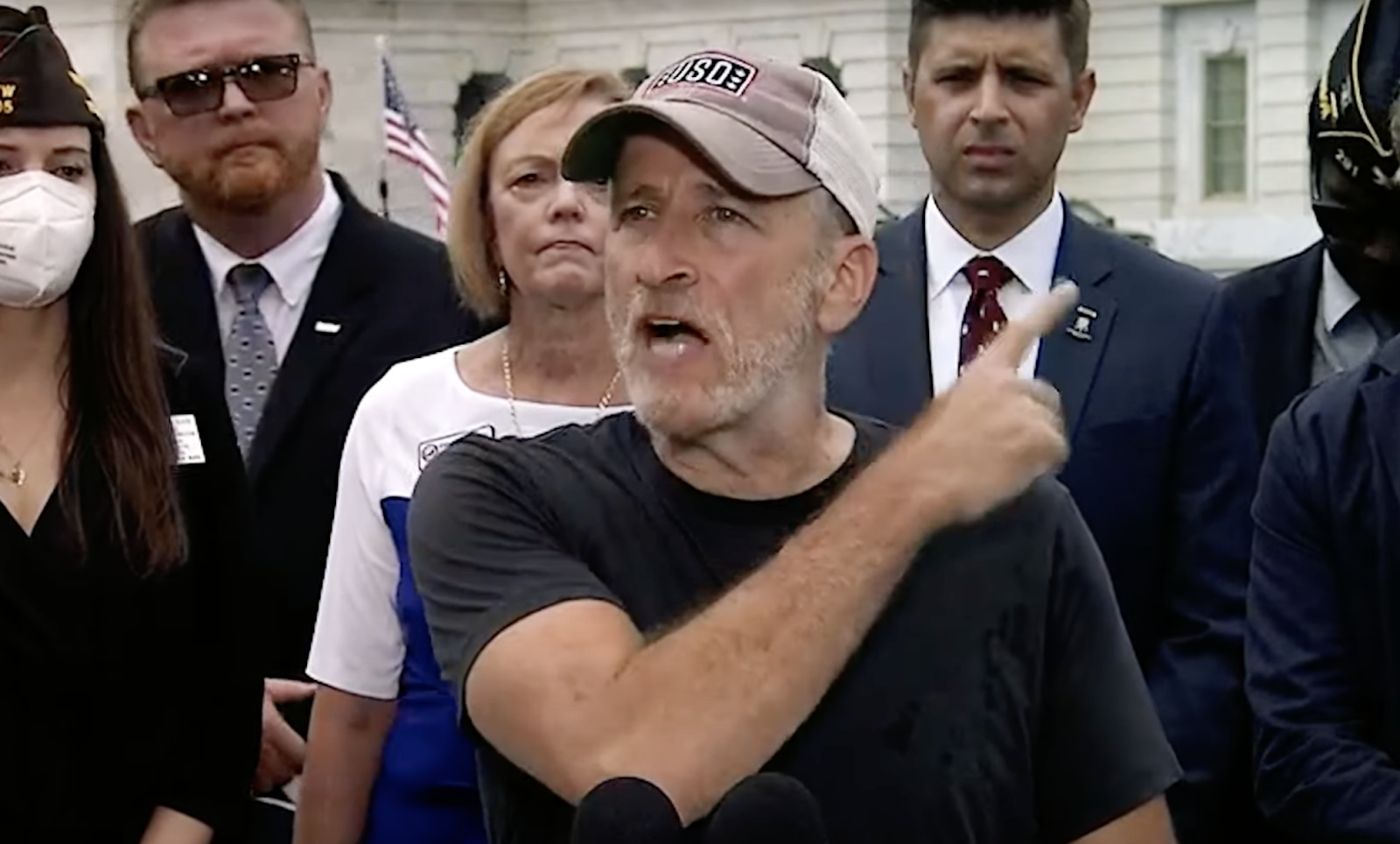
John Stewart speaks for Veterans July 28, 2022.
Jon Stewart, sounding every bit like Maj. Gen. Smedley Butler, stepped up to a microphone alongside Veterans and their loved ones to condemn the vote.

In reading this sweeping book of history, it’s amazing how many times the Navy is mentioned.


Navy readers will also be fascinated by Katz’s take on Mahan; Secretary of the Navy Josephus Daniels; Gen. Joseph H. Pendleton; Roger Leslie Farnum; Jose “Pepe” Azueta; Chiang Kai-shek; Gen. John Lejeune; and Commanders in Chief William McKinley, Theodore Roosevelt, William Howard Taft, Woodrow Wilson, Herbert Hoover,Franklin Delano Roosevelt, George H. W. Bush, and Donald J. Trump.

Sunday, December 13, 2020

‘Twilight of the Gods’ a Toll Masterpiece

Review by Bill Doughty

This 900-plus-page book took some time to read. Not just because of the length, but also because it was so damn good. Parts demand to be read and reread.


Ian W. Toll completes his “unexpected” trilogy of the history of World War II in the Pacific in “Twilight of the Gods: War in the Pacific, 1944-1945” (W.W. Norton, 2020), a book that brings in new archived material, information, and reports, including from former Imperial Japan about their “demented” war and efforts to brainwash their people.


Standouts in the book are the depiction of the kamikaze fighters in the skies and also on land and at sea; the details of fighting in the Philippines, Iwo Jima, and Okinawa; and the description of military leaders, both American and Japanese.


Here’s his description of Lt. Gen. Kuribayashi, for example:

“In June 1944, two days before U.S. forces had stormed ashore on Saipan, a new commanding general flew into Iwo Jima. Lieutenant General Tadamichi Kuribayashi was a stout man of medium height, aged fifty-three, with a small, trim mustache. He was one of the star officers of the Japanese army, having distinguished himself in staff jobs and in the field. While serving as military attaché in Washington in 1928-1929, he had mastered English and traveled widely through the United States. He had commanded a cavalry regiment at Nomonhan, Manchuria, during the undeclared war between Japan and Russia in 1938-1939. After 1941, he had served as chief of staff of the South China Expeditionary Force in Canton. More recently, he had transferred to Tokyo to command the Imperial Guard, a prestigious posting that brought him into direct contact with the emperor. His new command gave him dominion over the 109th Division and the Ogasawara Army Corps, which included all garrison forces in the Bonin Islands. Upon his departure from Tokyo, Prime Minister Hideki Tojo had instructed Kuribayashi to ‘do something similar to what was done in Attu.’ That amounted to a suicide order: that Kuribayashi must defend the island to the last man.”

The Imperial Japanese Navy built suicide submarines and speedboats and gliders to attack or defend. The civilian populace, even school children, were trained in hand-to-hand combat and told to prepare for “the glorious death of the 100 million.”


That’s another standout theme in this book: the role of the press, propaganda, and psychological operations.


“Twilight” illuminates the importance of truth-telling and the role of the press. There is a thin line between freedom of the press, for example, and fear mongering, censorship, and aiding the enemy. What is in the public interest? How important is national morale? Should the president be concerned about not inciting panic? Will an informed public be more supportive if people are told the truth?


Admiral E. J. King, Chief of Naval Operations, at first wary of the press, quickly saw the value of conducting in-person secret press briefings. He met with reporters over beer and canapés at Nelie Bull’s House to provide context to some of FDR’s, his, and Nimitz’s decisions. In return, he “acquired a fund of goodwill in the Washington press corps.”


That goodwill helped steer Congress away from military unification, in effect putting all military resources under the Army and risking the creation of an overly powerful Pentagon. 


For understandable operational security reasons, Admiral Nimitz and his team in Hawaii were low-key and hesitant to provide information and details of the war.


Gen. Douglas MacArthur
Meanwhile, across the Pacific, Gen. Douglas MacArthur openly attracted “carefully managed” press coverage, especially stories that matched his version of the facts. “The thicker they laid on the praise and adulation, the more they would be rewarded with exclusive stories and other desirable privileges” by MacArthur’s censors.

“More than any other American military leader of the war, MacArthur understood the importance of visual imagery. He paid diligent attention to the details of his wardrobe and accessories, which cynics called his ‘props’ –– his battered Philippine field marshal’s ‘pushdown’ cap, his well-worn leather flight jacket, his aviator sunglasses, and his corn-cob pipes, which tended to grow larger over time. During his first days in Australia, he had experimented with an ornate carved walking stick, but discarded it after someone remarked that it made him look older. He was sensitive about his expanding bald spot, and when it was necessary to be photographed without his hat, he took a private moment to comb his hair across the top of his head, leaving a perfectly straight part about two inches above his right ear –– a deftly executed version  of the coiffure known as a ‘combover.”

Photography was also censored, and “most published wartime photographs of MacArthur were taken at a low camera angle, making him appear taller than he was,” Toll writes. His press office was accused of “abusing its powers of wartime censorship to indulge MacArthur’s personal vanity.” Toll writes, “MacArthur was a serial confabulator.” The general’s “moonshining” would be called “gaslighting” today.


Toll convincingly shows how Admiral “Bull” Halsey fell for a Japanese ploy to lure him north during the Battle of Leyte Gulf. This, combined with Halsey failure to dodge a typhoon “when there was still time,” paints him with a different brush then the largely media-created image he had during the war. “But until his death in 1959, the proud old fleet admiral fought a losing rearguard action against the hardening judgment of history.”


By contrast, Admiral Mitscher, who led Task Force 58, comes across as a winner, a leader with grace and compassion. Admiral Spruance is depicted as a bit quirky but also a man of great humility and quiet wisdom. Admiral King, Toll contends, was a careful listener who “considered counter-arguments in good faith.” Of course, Nimitz epitomizes humble but strong leadership.


Navy leaders King, Forrestal, and Nimitz
Secretary of the Navy James Forrestal, strongly supported both the Navy and Marine Corps, and saw the value of the American press in communicating with the public to garner support for the war effort. With helmet on, he stepped onto the sands of Iwo Jima and witnessed the raising of the American flag on Mt. Suribachi by United States Marines. He told General “Howlin Mad” Smith: “‘Holland, the raising of the flag on Suribachi means a Marine Corps for the next 500 years.’”

“The Navy secretary had been pushing for more fulsome publicity in Nimitz’s theater. He had taken a direct hand in streamlining censorship functions, and had pressured the admirals to guarantee overnight transmission of press copy and photographs to newsrooms in the United States. During his current tour of the Pacific, Forrestal had often reminded the navy and marine brass that an epochal political struggle lay ahead over the organization and unification of the armed services, and the postwar status of the Marine Corps was not yet decided. The “500 years” remark this had a contemporary context and subtext: Forrestal meant that the stirring image would strengthen the corps’ claim to an autonomous role in the postwar defense establishment.” 

“A second and more famous flag-raising (top photo) occurred three hours later, when a subsequent patrol of the 28th Marines carried a larger ‘replacement’ flag to the summit of Mt. Suribachi. Associated Press photographer Joe Rosenthal was on hand to record the scene.”


Forrestal, with Admiral Leahy, would play a key role in streamlining eventual surrender and acceptance of the Potsdam Declaration by the proud but divided Imperial Japanese military government.


Meantime, strong Navy and Marine Corps leadership led to victories across and up the Pacific, and Toll takes readers on a gripping journey in the last year of the war. He provides maps of locations, operations and actions, including: Ulithi Atoll, Surigao Strait, Leyte, Marianas, Operation Iceberg, Operational Olympic, Third Fleet Operations Against Japan, and Yamato’s Last Sortie, among others.


This is Toll’s “you-are-there” quality of writing as he describes the destruction of the hapless IJN battleship Yamato (pictured above, photo courtesy NHHC):
“In a second wave of attacks, beginning about forty minutes after the first, the Yamato took five or six more torpedo hits on her port side, and at least one to starboard. Another exploded against her stern, destroying her rudder post and depriving her of steering. SB2C dive-bombers rained heavy armor-piercing shells down along her topside works, while warms of low-flying Hellcats and Corsairs strafed her remaining antiaircraft batteries. Yoshida recalled ‘incessant explosions, blinding flashes of light, thunderous noises, and crushing weights of blast pressure.’ The destroyers Asashimo and Kasumi were badly mauled, and would either sink or be scuttled. The immobilized Yahagi caught four more torpedoes and seven or eight more bombs. Captain Hara, looking fore and aft, judged that his ship was nearly finished. Whitewater towers erupted as torpedoes exploded against the hull. Bomb blasts ejected debris and bodies into the air. Rivets began popping our of the steel deck plates and the bridge began pulsating under his feet. ‘Our dying ship quaked with the detonations,’ wrote Hara. ‘The explosions finally stopped but the list continued as waves washed blood pools from the deck and dismembered bodies fell rolling into the sea.’”

Japanese mother and child photographed amid the ruins of Tokyo, Japan, September 1945, by visiting crewmen of USS THORN (DD-647), NHHC.


The loss of life in a death cult mentality of extreme nationalism and misplaced patriotism comes across as a crushing tragedy, particularly at the end of the war in the Battle of Okinawa, fire bombing of Tokyo, and world-changing atomic bombing of Hiroshima and Nagasaki.


The war was prolonged by Japanese “army hotheads” –– hardliners who attempted a last-minute coup. They spread rumors that Emperor Hirohito’s recorded surrender announcement was “faked.” Senior military leaders “wanted peace, but they could not yet face up to the stark reality of their total defeat.”


In a last-ditch effort to stave off defeat, Imperial Japan tried to make a deal with the Soviet Union, but Stalin opportunistically declared war on Japan, attacking Japan-occupied Manchuria (pictured at left) and northern Korea, then setting sights on Japan’s large northern island: “If the Japanese surrender had been delayed by even a few weeks, Japan’s northern island might have passed [like half of Germany] forty-five years on the other side of the Iron Curtain.”


Another standout insight: Imperial Japan’s propaganda campaign to brainwash its own people was hollow because it was based on lies about the American military; American propaganda, on the other hand, aimed at Japanese citizens in the form of radio broadcasts and leaflets over mainland Japan, was heroic in attempting to achieve a peaceful surrender.

“The surprise and relief felt by the Japanese, upon learning that their former enemies were largely decent and honorable, was accompanied by another sensation. With a sudden rush, ordinary Japanese understood how thoroughly deceived that had been by their own leaders. The propaganda was still ringing in their ears –– they could hardly forget it –– but it all seemed demented in retrospect. The Potsdam Declaration had insisted: ‘There must be eliminated for all time the authority and influence of those who have deceived and misled the people of Japan into embarking on world conquest,’ and the country must be rid of ‘irresponsible militarism.’ The Japanese people would fulfill that condition on their own, regardless of the policies of their postwar government. The wartime military leadership was held in widespread contempt. These attitudes had been prevalent even before the surrender, though never uttered publicly for fear of repression. Now they came to the surface –– potent, instinctive, deeply held hatred of war, and for those who had plunged Japan into it.”

Occupation of Japan was successful because it was based generally on trust, kindness, and honesty –– to build unity. The result is a democratic government of and by the people where today Japan is a key friend and ally of the United States.


For American warfighters, the end of the war was a time for celebration and healing but also frustration. Most service members had to wait for weeks and months before being able to return from overseas. “Bing Crosby’s ballad ‘I’ll Be Home for Christmas’ played in heavy rotation on the Armed Forces Radio Service (AFRS) –– but now, more than ever before, the melancholy refrain seemed to mock their dilemma: ‘if only in my dreams.’”


Toll’s War in the Pacific trilogy deserves to be on any WWII historian’s bookshelf. It is indeed a masterpiece of harrowing history, well told.


ADM Spruance and VADM Wilkinson walk in Yokosuka, Japan, Oct. 1945.

Saturday, September 19, 2020

‘Biography of Resistance’

Review by Bill Doughty

Viruses and bacteria are different but can be interconnected. As the world races for a vaccine and an effective treatment for COVID-19, we have to be alert to the possibility of other types of pandemics, including the possibility of one caused by bacteria, including antibiotic-resistant bacteria. 


Fortunately, brave men and women dedicate their lives to discovering how bacteria evolve and we can protect ourselves. But we must remain humble in our persistence to understand the nature of disease and how to prevent and fight outbreaks.

“Bacteria cares not at all for the politics of nations or the egos of scientists, and in its unrelenting drive to endure, it cares not at all for the timelines of human beings,” H. Muhammad Zaman writes in “Biography of Resistance: The Epic Battle Between People and Pathogens” (HarperCollins; 2020).


Zaman traces the history of antibiotics from ancient history, starting with Hippocrates and Maimonides, through Hooke, Leeuwenhoek, Klebs, Pasteur, Gram, Kitasato, and Nobel laureate Alexander Fleming through World War II, when British bacteriologist Dr. Mary Barber discovered penicillin-resistant bacteria in London in 1946.


Albert Schatz
Zaman features other Nobel laureates Albert Schatz, who discovered streptomycin; Paul Ehrlich, whose “magic bullet” hypothesis paved the way for chemotherapy; and Joshua Lederberg, who discovered bacterial conjugation.

In remarkably readable standalone chapters, Zaman tells the story of the evolution of understanding of disease and resistance. Brigadier General George Sternberg of the U.S. Army, was an early explorer of the cause of disease from bacteria microbes in the late 1800s. He worked in the shadow of Louis Pasteur, nearly simultaneously making similar discoveries.


In September 1918, Lieutenant Governor Calvin Coolidge of Massachusetts, future president of the United States, signed a proclamation shutting down all schools, parks, theaters and other places of congregation as one hundred Bostonians a day died from the Great Influenza Pandemic of 1918 (misnamed the Spanish flu). That pandemic a century ago would kill more than 50 million people worldwide. It provides an insight into the interconnectedness of viruses and bacteria.

“While the world remembers the Spanish flu as the killer, most people didn’t actually die of the viral disease. They died of complications due to pneumonia, a bacterial infection. The flu virus weakened the immune system, providing an opportunity for the pneumonia bacteria to enter and thrive. In the absence of antibiotics to kill the bacteria, pneumonia proved to be a death sentence.”

Fast forward to post-World War II, and the Navy’s Lt. King K. Holmes, an intrepid and fearless scientist, who served with the Public Health Service Commissioned Corps.


A task group of nuclear-powered surface ships operates in formation in the Mediterranean Sea, June 18, 1964. The ships are the aircraft carrier Enterprise (CVAN-65), left; the guided-missile cruiser Long Beach (CGN-9), center; and the guided-missile frigate Bainbridge (DLGN-25), right. (Naval History and Heritage Command)

Holmes served aboard USS Enterprise (CVN-65) and did research in Pearl Harbor, Hawaii, and Subic Bay, Philippines, during the Cold War and in the middle of the Vietnam War.

“So during the war, Holmes was stationed on the USS Enterprise, a naval vessel with an illustrious past. The name has been reserved for special ships over the course of U.S, History –– eight American naval vessels have been given this name, beginning with a British ship that the Americans captured in 1775. At the height of the Vietnam War, the name had been given to one of the prides of the U.S. fleet, the first-ever nuclear-powered aircraft carrier deployed in the Pacific. Holmes was assigned to the preventive medicine unit on the USS Enterprise, where the doctors encountered the problem of recurring infections among the sailors.”

Dr. King Holmes
Holmes helped write worldwide guidelines for the treatment of drug-resistant gonorrhea throughout the world. “Through his research, Holmes realized that discovering new ways to prevent the spread of infections was just as crucial as discovering new lines of antibiotics,” Zaman writes. Earlier this year Dr. King Holmes, University of Washington’s Director of Research and Faculty Development and inaugural Chair of the UW Department of Global Health, was named Distinguished Professor Emeritus.

Not surprisingly, many discoveries in fighting disease and disease resistance came during times of war.

“Wars and infections have always accompanied each other. In the twentieth century, infecting among the wounded created a new challenge as drug-resistant infections became a serious issue for the patients and the army medics. These resistant infections were seen by Cutler in the battlefields of Europe during World War II, were investigated by Holmes during the Vietnam War, and had now appeared in their nastiest form during the Gulf War. Indeed, it is one of the points of war. Unquestionably, when invading Iraq, America, like invaders from time immemorial intended to degrade the country’s ability to resist. The bombs dropped, the weapons used, were for the purpose of inflicting harm and trauma. And during occupation and enforced international isolation, the goal, again, was to inflict on Iraq harms sufficient to cause it to behave in ways more aligned with American interests.”

Acinetobacter baumannii in Iraq became known as “Iraqibacter,” first seen in field hospitals and eventually even at Walter Reed Army Medical Center. “It’s considered opportunistic because it doesn’t case a disease on its own, but if there is an existing infection –– pneumonia or an infected wound, for example –– it thrives.” Though the problem is no longer affecting military personnel, it persists within the local population, according to Zaman, a possible residue war.

“But is war the cause of resistance? Or is there just a correlation between the two? No one can do a clean experiment here to find out. The answer is unclear and perhaps always will be. And the bacteria don’t care. Causation or correlation, they are presented with circumstances and enough of them take advantage. They evolve, and evolve toward resistance. However material ascertaining blame and responsibility for the problem is (and for those suffering, having the answer would be profound), for the ever-increasing population of resistant bacteria, it is of no interest whatsoever.”


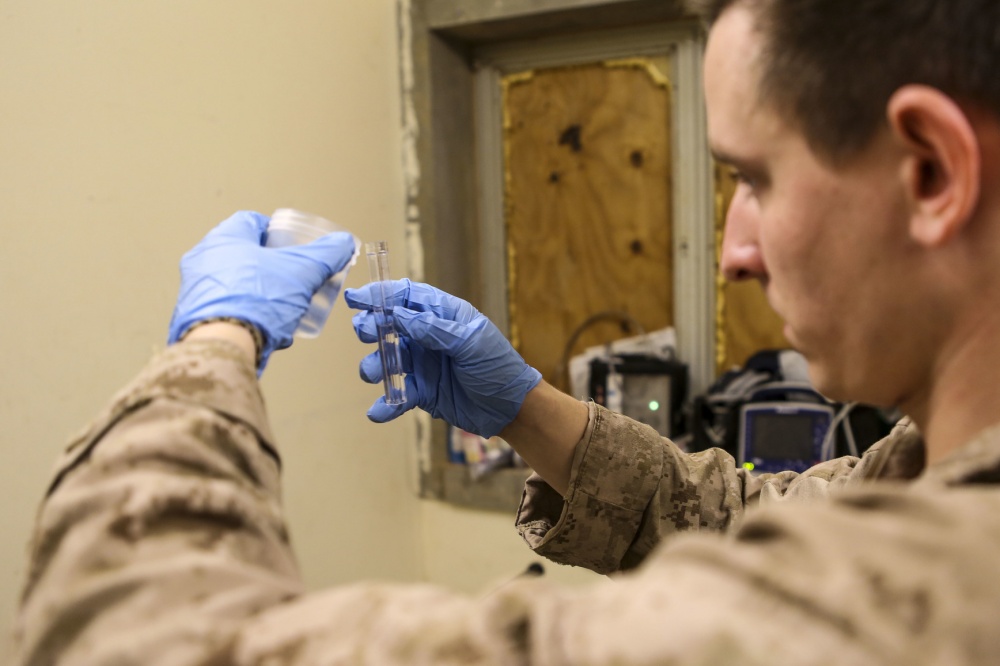
U.S. Navy Seaman Steven J. Madson, a preventive medicine technician, Task Force Al Asad, tests water from a newly functioning well aboard Al Asad Air Base, Iraq, March 3, 2015. The water sample was tested for PH levels, chlorine levels and bacteria to ensure safety of the water supply. (Cpl. Tony Simmons, USMC)

Among the dozens of heroic scientists and thinkers spotlighted in this book is German Wolfgang Witte, who developed vaccines during the Cold War and who faced down pressure from the Soviet Union and German Democratic Republic (East Germany). Witte spoke truth to power about the efficacy of vaccinations against Staphylococcus aureus infections.

“Witte also knew that the Soviets performed unethical clinical trials with its vaccines in orphanages and in prisons, where resistance to TB drugs was particularly high,” according to Zaman. Witte advanced the study of antibiotic resistance in the face of lies of an authoritarian government that tried to control its population with misinformation. Right matters. Truth counts.


Stalinist communism was decidedly anti-genetics and anti-science. Scientists and free-thinkers were persecuted and punished for telling the truth. “But, once more, bacteria don’t care. They obey no borders, harbor no national loyalty, and are always self-preserving, self-advancing, and self-replicating.”


Along the Amazon in Brazil, Dec. 6, 2017. (MC2 Andrew Brame)
“Biography of Resistance” is not only a great history and biography of inspiring scientists, it is also a travelogue throughout the world: Amazon, Mumbai, Western Australia, Mongolia, Nova Scotia, Norway, Denmark, Tokyo, Niger, and Zaman’s home country of Pakistan. Readers discover natures gifts, miracles, and dangers, including the risks of climate change and human manipulation of the food chain using antibiotics on animals.

Zaman writes this about animal-to-human epidemics and pandemics after periodic reports of avian influenza outbreaks in Asia:

“The public was afraid of new diseases jumping to humans from birds, pigs, and cattle. The Food and Agriculture Organization (FAO) saw an opportunity to make animal health and welfare part of the global debate on antibiotic resistance and became an early advocate of One Health, and so did the world Organization for Animal Health (OIE). The CDC also created a One Health office in 2009. For the next several years, pandemic preparedness became an area of focus, including surveillance, diagnostics, and containment.”

Antibiotic resistance became part of the initiative in 2015, and the world became more aware of the dangers of animal-to-human transmission of disease –– and the likelihood of pandemics –– both viral and bacterial, or both. The future depends on understanding and respecting the interconnectedness and interrelatedness of nature.


The Obama-Biden administration staffed and strengthened a pandemic response office that was virtually dissolved by the Trump-Pence administration in 2018.

Saturday, January 27, 2018

Bond of 'Jersey Brothers'

Review by Bill Doughty

After Imperial Japan attacked Oahu, three brothers serving in the Navy experienced the war and witnessed history from distinct vantage points: one aboard USS Enterprise (CV 6), one as an aide to President Franklin D. Roosevelt, and one as a Prisoner of War in the Philippines.
Barton, Bill and Benny before the war

Prior to the war, big brothers Benny Mott (gunnery officer aboard Enterprise) and Bill Mott (a naval intelligence officer) hoped to keep their younger brother, Barton Cross, safe, so Bill recommended Barton become a Supply Corps officer and serve in the  Philippines.

But then, nine hours after Pearl Harbor was attacked, the Japanese bombed and strafed U.S. forces in the Philippine Islands. Barton was wounded and hospitalized in the air attack.
"Their opening salvos went to the heart of the island's air defenses, which proved an easy mark. Despite Washington's urgent, repeated orders to General Douglas MacArthur – at the time the U.S. Army Forces Commander in the Far East – to launch his planes and initiate air operations, beginning minutes after the start of the attack on Pearl Harbor, he did not respond. Nor did he ever issue the order. As a consequence, virtually every U.S. plane at Luzon's primary airfields, Clark Field and Nichols Field, was bombed on the ground, wingtip to wingtip. The army's entire staple of bombers, their payloads full, was wiped out in a matter of hours."
With Army Air Corps protection gone, Navy submarines of the U.S. Asiatic Fleet were vulnerable and had to sortie to Darwin, Australia. 

When it came time for MacArthur to retreat from the Philippines, he ordered the evacuation of Army casualties – but not the Navy's wounded – hospitalized in Manila.

Jersey Brother Barton became a POW, subjected to marches, deprivation and atrocities documented by eye witnesses and other records cited by author Sally Mott Freeman in "The Jersey Brothers: A Missing Naval Officer in the Pacific and His Family's Quest to Bring Him Home" (Simon & Schuster, 2017).

Escape was foremost in POWs' minds, but Imperial Japanese guards had ways of preventing escape:
"Nothing focused the mind on the perils of escape more than the particular return of three prisoners – two army colonels and a navy lieutenant – who were summarily stripped naked, marched across the camp to the entrance, tied up, and flogged to insensibility. They were kicked to their feet, led out the front gate with their hands tied behind them, and strung up to hang from cross-pieces of wood several feet above their heads. A two-by-four was placed beside them, and when any Filipinos passed by on the road, they were summoned by the Japanese guards to pick up the timber and smash each of the hanging prisoners in the face. Then the guards would follow up and lay on their whips."
All three POWs lived for three days before two were shot and the third was beheaded.

Meanwhile, Barton's brothers did everything they could to try to locate him and learn his fate.

Oldest brother, Benny, served aboard Enterprise with Adm. "Bull" Halsey, another native of New Jersey.

Years earlier, when Benny was a midshipman at the U.S. Naval Academy, Halsey commanded the USS Reina Mercedes, the Annapolis station ship, and the two established a relationship at social gatherings for upperclassmen. Both were proud of their state:
"During those more relaxed affairs, Benny and Captain Halsey often discussed navy football and another common passion: the underappreciated virtues of their shared home state of New Jersey. Halsey had relished these chest-beating interludes about the state: 'The home of Alexander Hamilton, Thomas Edison, and Albert Einstein!' he would crow in mock exasperation, drawing wide grins from Benny every time. At Annapolis, Benny and Bill were both known for their proud defense of the Garden State – against routine mockery. They even embraced their nickname, 'the Jersey Brothers,' despite its implicit derision. Was it Halsey who started that? Benny couldn't remember, but it stuck ... Halsey always appreciated Benny's family high notes including the Motts' ancestral link to members of the iconic fraternal order that boarded the tea-laden vessels Dartmouth, Eleanor and Beaver in Boston Harbor in 1773."
USS Enterprise and USS South Dakota engage Japanese ships and planes on Oct. 26, 1942. NHHC.
Benny was aboard Enterprise for the Doolittle Raid on Tokyo and in the Battle of Santa Cruz Islands during the Guadalcanal campaign, described graphically in "The Jersey Brothers." Benny's quarters were destroyed in the attack. "His old surroundings were barely recognizable; the room was a smoky tumult of wet, scorched debris." Other gunners and other ships were not so lucky.
"The reality stunned: at the conclusion of the Battle of Santa Cruz, the USS Enterprise was now the only operational American aircraft carrier in the hostile waters of the Pacific. One by one, every other prewar flattop had either been lost in battle or forced to withdraw for lengthy repairs. Lexington had gone down in May at the Coral Sea battle. Yorktown was lost at Midway less than a month later. On the last day of August in the Eastern Solomons, Saratoga had taken a second devastating torpedo hit and retired to drydock at Pearl Harbor. Wasp, en route to Guadalcanal two weeks later, was fatally struck by three torpedoes. And now Hornet's pyre burned over the horizon."


Using "industrial-grade paint" Sailors aboard "The Big E" painted and erected a large, defiant sign: "Enterprise vs. Japan." 
"Over the course of 1942, Enterprise had been struck a total of six times by Japanese bombs or torpedoes and had suffered hundreds of casualties. The painted sign reflected both the grimness of the situation and the grit of a determined crew: this sole surviving American aircraft carrier in the seventy-million-square-mile Pacific war front was in no mood for backing down."
Benny had a ringside seat to the war in the Pacific. Jersey Brother Bill was an eyewitness to history at FDR's side, principally in the White House Map Room. Bill developed a connection with WInston Churchill and Eleanor Roosevelt. He had to inform the president of the death of the Sullivan brothers, five brothers lost in November 1943 aboard the light cruiser USS Juneau off Guadalcanal.

Adm. Richmond Kelly Turner
Earlier, Bill followed Station Hypo's progress leading to the Battle of Midway. Later, after successfully lobbying to be stationed in the Pacific – closer to his brothers – Bill integrated Navajo Code Talkers so they would be "coordinated properly with their multiple constituents in the amphibious forces complex communication chain."

Bill was there when Adm. Spruance approved the firing of Army Maj. Gen. Ralph Smith in coordination with Adm. Richmond Kelly Turner and Marine Gen. Holland "Howlin' Mad" Smith.

Bill's relationship with the "famously abrasive" Adm. Turner was deep and lasting. We get an insight into the character of Turner, who led amphibious assaults at Guadalcanal and Iwo Jima. Turner supported Bill's efforts to locate his POW brother, Barton, just as Halsey supported Benny's efforts to try to find his Jersey brother.

As a Navy captain and CO of USS Astoria (CA-34) in 1939, Turner visited Japan to return the ashes of Japan's ambassador to the United States and meet with Foreign Minister Arita Hachiro. After the Japan's surrender in 1945, Turner went to the Togo shrine in Tokyo, which he had visited in that diplomatic mission.
"Standing at the Togo shrine, Admiral Turner made this prescient observation: 'If we play our cards well, the Japanese will become our best and most worthwhile friends. They have certain fundamental virtues in their character, which in time, I hope, will be appreciated by all worthwhile Americans. We should be most careful to respect their gods and their traditions, and I hope they will come in time to respect ours.'"
Records retrieved from the Philippines and made available by the Navy's Bureau of Medicine and Surgery, as well as interviews and letters, helped Freeman piece together life for Barton as a prisoner of the Japanese. She recites how prisoners were mistreated, how they survived sometimes for years, and how they made tough choices – whether to attempt escape or remain as prisoners and prevent repercussions on fellow prisoners.

Freeman explores the tensions and turmoil of interservice rivalry during the war, with Gen. MacArthur front and center, saying "The Navy fails to understand the strategy in the Pacific." Much of the author's source material comes directly from the MacArthur Memorial Archives.

Commander in Chief Pacific Fleet and Pacific Ocean Areas Adm. Nimitz confers with south Pacific area officers, possibly aboard USS Argonne (AG-31) at Noumea, New Caledonia, Sept. 28, 1942: Army MGen Richard K. Sutherland, Chief of Staff to General MacArthur; (Nimitz); VADM Robert L. Ghormley, Commander South Pacific Force; and USAAF MGen Millard F. Harmon, CO of U.S. Army Forces South Pacific Area. (Naval History and Heritage Command)
Author Sally Mott Freeman
MacArthur bristled under the shared leadership of Adm. Nimitz in the Pacific. Readers will enjoy a fascinating explanation of the command and control relationship in Chapter 14 (pages 174-5). Chief of Naval Operations Adm. E.J. King considered MacArthur a megalomaniac, according to Freeman, a general who rewarded flattery and other sycophantic behavior by his staff. "It is said that a fool flatters himself, but a wise man flatters the fool."

This book shows us many sides of the war – including a family's deep struggle on the homefront during and after the war. This is a highly recommended, multidimensional study of the Pacific War, which was won by superior sea power. "Without sea power," said Nimitz, we would not have advanced at all."

The afterward and epilogue to this book are well-written, well-researched and personal accounts worth reading and re-reading for anyone interested in treatment of POWs and in the way war can affect families.