Showing posts sorted by relevance for query POW. Sort by date Show all posts

Saturday, November 29, 2014

Haunting Defiance in 'Ship of Ghosts'

Review by Bill Doughty


In "Ship of Ghosts: The Story of the USS Houston, FDR's Legendary Lost Cruiser, and the Epic Saga of Her Survivors" by James D. Hornfischer (2006, Bantam Dell) the author takes readers to sea, to POW camps and into the jungle as he examines key chapters of World War II.


FDR aboard USS Houston 1935.
Ultimately, this book is about unspeakable horrors of war but also the triumph of the human spirit.

Hornfischer begins by showing why USS Houston (CA-30) was President Franklin D. Roosevelt's favorite ship and how FDR knew many of the crew by name. The president would go fishing with Houston's Sailors.

Then the author shows how Japan's search for natural resources fueled the start of the war and set the stage for Imperial Japan's ultimate downfall, despite earlier victories against America's ally China: "A failure of foresight and a shortage of materiél sealed their doom."

That need for oil and other resources continued throughout the war, as Hornfischer writes:
"It was all about China. A world war engulfed the Pacific because Japan had struggled to subjugate its mainland neighbor. Franklin Roosevelt's economic sanctions and oil embargo were punishment for Japan's assault on China, Asia's keystone in the economic world order. Japan's earliest offensives in the southwestern Pacific grew from is need for oil to pursue its war on the continent. Now Japan aimed to strangle China by cutting its essential lines of supply from India and Burma, kept open by threadbare British and American armies."
Japan's army, with its "rigidly hierarchical and ruthless system," where "conceit seemed to flow from the highest levels of the Japanese command," guided the government and justified actions based on ancient martial codes (Bushido) and religious dominion under a belief that the emperor was a descendent from heaven. Those who controlled the military believed God was on their side.
Hornfischer writes powerfully about the sinking of HMAS Perth and then USS Houston in the Battle of Sunda Strait off Java just as he did in "Last Stand of the Tin Can Sailors." We hear the wrench of metal, smell the smoke, see the destruction, feel the loss of equilibrium and experience the fear as Sailors fight and struggle to survive.

Sinking of USS Houston (CA-30) in the Battle of Sunda Strait, 1 March 1942.
Painting by Joseph Fleischman, 1950. Naval History and Heritage Command
Memorable characters include PFC John WIsecup, Cmdr. Arthur L. Maher, Sgt. James "Pack Rat" McCone, S1C Melfred "Gus" Forsman, S2C Otto Scwarz, Sgt. Frank Fujita, Dr. Henri Hekking, Col. Yoshitada Nagatomo, and Capt. Albert H. Rooks and his extended family, among dozens more.

Hornfischer describes life in the POW camps scattered throughout Asia, where "the trick to being in Japanese captivity was to navigate the divide separating subservience and defiance."

Among the stories of torture, disease and death are tales of survival and sabotage against the guards – from stealing supplies, urinating in the captors' bathwater, tampering with equipment and hiding a radio to more serious acts against the enemy at the Nagasaki shipyard and on the railway in Thailand. Hornfischer tells the true story of the construction of the railway for the bridges over Tamarkan and River Kwai – Kwae Noi Bridge.

"One of the traits the Americans seemed to have in common with the Australians was a boundless sense of the possible," according to Hornfischer. Two survivors, 2nd Lt. Roy E. Stensland and Pack Rat McCone, are described as having "a raging mind, mercury in the blood, and a visible unconcern with the personal consequences of rebellion."


Overall, those who had a positive attitude were more likely to survive the ordeal of captivity and the rigors of slave labor. One trick was to frame the experience as "endure" rather than "suffer." POW Frank Fujita saw an opportunity to study anatomy and contemplate life and death. Ray Parkin experienced "a naturalist's reverie" in the teak forest where he found that non-dogma "faith and hope are a couple of unclassified vitamins."
"Even as it tried to kill him, Ray Parkin was enthralled by the wilderness all around him, by the cool blue-green bamboo, by the slapping wings of Asiatic nightjars and hornbills, by the swarms of brownish butterflies, by 'hooded lilies, several iris-like orchids, wild ginger, and banana (which bears no edible fruit), clumps of orchids in the branches of trees like corsages of yellow jonquils. There are waves of perfume in the bush which we sometimes walk into. Cinnamon, chocolate, and one honey-sweet like clematis. Sometimes the early morning dew on the dry bamboo leaves smells like the Australian bush – or is it just nostalgia.' 
"Parkin's 'unclassified vitamins' were all around him, and his obsession to catalog them was the kind of force that gave a man a reason to stay alive. 'Vines are leaping with bright new green leaves a foot or so across. They are heart-shaped – some are like two hearts alongside each other. Trees are blossoming. One purple like lilac, and growing like a giant ti-tree ... There are more bird calls' monkeys call like Swannee whistles – flutelike on a slurred scale. All nature moves and has its bing, and we seem to sit on it like a scab.'"
Hornfischer's prose and choice of colorful quotes are at times artful imagery or – especially in the latter part of the book – careful chronology and documentation, preserving the memory and history of POWs from the War in the Pacific, where Pearl Harbor looms throughout the book and throughout the war as a beginning beacon for all of the war's ghosts.

During the war, in POW camps in Asia service members, treated like slaves, dealt with malaria, cholera, tropical ulcers, monsoons, snakes and primitive dental care – tree sap fillings!


Frequent beatings, abuse and unreasonable expectations, combined with inadequate food rations, were a way of life – and death. Their captors regularly violated the Geneva Convention by placing prisoners next to military targets or transporting them with materiél in "hell ships" subject to attack by American submarines. As the war neared an end the POWs feared they would be killed en masse by their guards.

In 1945 militarists in Japan tried to continue to fight on, still believing in Japan's divine destiny. But as the empire crumbled and B-29s leveled cities in the homeland, Imperial Japan found itself "choking to death on the fumes of the hemisphere-wide wildfire it had started three and a half years before."

Hornfischer proves why he is a favorite with navy leaders, historians and veterans, including Pearl Harbor survivor Ed Vezey. Filled with historical photos, first-source references and an extensive biography, but punctuated with colorful descriptions and vignettes, "Ship of Ghosts" is a top read for anyone interested in WWII history in the Pacific. Read my other reviews and a contribution by the author to Navy Reads.

Wednesday, December 21, 2022

A POW Forgives But Does Not Forget

Review by Bill Doughty––

Christmas time in a Hanoi POW camp could be an especially desolate time, but American prisoners had innovative ways to cope. POWs secretly shared memories, stories, “imaginary gifts,” and even Christmas carols secretly through their tap code or other innovative ways to communicate. A pair of bright red socks became a treasured gift. Chewing gum –– among the rare items not confiscated by the guards –– was like a gift from Santa.


Porter Halyburton recounts, “I shared the gum with others, but I managed to keep my piece of gum going for nearly a month until it disintegrated.”


Two years into his imprisonment at Hoa Lo Prison and the “Hanoi Hilton,” Halyburton received his first care package from home. His devoted wife Marty, who at first had no idea he was alive, sent a hand-knitted green sweater. It was Christmas 1969.

“I also got a new ‘towel’ –– actually a large washcloth –– from the Vietnamese, since mine had become threadbare over the years. It was dark green and perfect for a Christmas tree when it was draped into a cone shape and supported by a stick. Silver gum wrappers were used to make tiny balls for the tree as well as a star on the top, and the red socks became Christmas stockings hanging below the tree, which was placed on a platform below the window in the back of the cell. The window could be opened from the outside by the roving guards but, because the walls were double with an airspace between and quite thick, the guards could not see the tree and decorations below the window. We took it down during the day, but it was a magical sight during the night.”

Lt. Cmdr. Porter Alexander Halyburton was captured in 1967 after his F-4B fighter-bomber went down in North Vietnam. He was released, along with other POWs, in February, 1973, shortly after the United States and North Vietnam signed a Peace Agreement on January 27. (The war wouldn’t end for another two years until the fall of Saigon, April 30, 1975).

His “Reflections on Captivity: A Tapestry of stories by a Vietnam War POW” (Naval Institute Press, 2022), is a gift of memories, reflections, and insights. It evokes both tears of sadness and of joy. Readers will cringe at the torture, depravity, and pain endured by prisoners. But there are also stories of pure genius in the ways the POWs overcame cruelty through resilience, innovation, and sheer grit.


Examples of their innovative inventions include making playing cards, dice, and even a slide rule from bread dough and “ink” from cigarette ashes and pig fat. The men memorized names and details of their fellow POWs for future accountability. They developed amazing ways to communicate through their tap code –– sometimes done through coughing, sweeping, or other ways of making sound. And, when vision wasn’t blocked, they communicated through a “deaf-mute” hand signal code. In “Reflections,” Halyburton shows how in descriptive passages and diagrams.


His most precious gift from home was a photo sent to him in 1969 of Marty and their daughter, Dabney.

He describes living in the past and future to avoid the present, yet ironically the prisoners who survived captivity did so by facing and overcoming their present circumstances with communication, creativity, mutual support, subtle subversion, and a sense of humor.


I laughed out loud at some of the antics Halyburton describes: tricking the guards with American slang, sing-songing and dancing their roll call. But the most shockingly funny story in the book involves a perverted guard and a duck. Guaranteed to crack you up. “Quack, Quack!”


With a generous sharing of his poetry, private thoughts, and journal entries, Halyburton achieves a deep introspection and personal history that helps us understand the experience of prisoners of war in Vietnam. Readers and lovers of books will be pleased to see his references to authors John M. McGrath, Edgar Allan Poe, Jim and Sybil Stockdale, George Hayward, and Viktor Frankl.


Frankl’s “Man’s Search for Meaning” helped Halyburton put his POW experience and survival into context in its examination of human suffering at the hands of others and what it reveals about ourselves, how we react, and whether we have free will and the freedom to choose. “I realized that our lives were determined more by the choices that we made rather than the circumstances of our captivity."

That, he says, was “the first great lesson” he learned from his captivity.

“I learned a second great lesson from my experience, but it did not come until the very end. As I wrote in my journal, when I walked through the gates of the Hanoi Hilton on February 12, 1973, as we were leaving the prison the had symbolized all the misery and hatred that we had endured over those many years, I turned to face the compound and said, ‘I forgive you.’ I did that because I knew I could not and should not carry that hatred back home with me, back to my family and my life of freedom. I realized during the last few hours of my captivity that although hatred had been useful as part of the armor that had protected me from the influence of my captors, it was no longer needed. Hatred is a poison to the soul, mind, and body, and it has been the source of many of the ills in the world throughout most of our history … One must choose to forgive.” 
Reuniting with family, hugging Dabney, in 1973.
The concept of “freedom” is so cherished, we are willing to fight to defend it. Freedom demands responsibility, accountability, and ultimately a reckoning with the truth. In Halyburton’s case, the truth involved forgiveness and letting go of hate.


Speaking of which…


In 2022, we’ve seen a thriving democracy –– Ukraine –– under attack by Putin’s Russia, and we wonder if the world can forgive the unforgettable murder, terrorism, and destruction Putin continues to unleash out of pure hate.


Today, Ukraine’s President Zelensky visits the United States to express his thanks to Americans for our defensive military support, in the name of freedom.


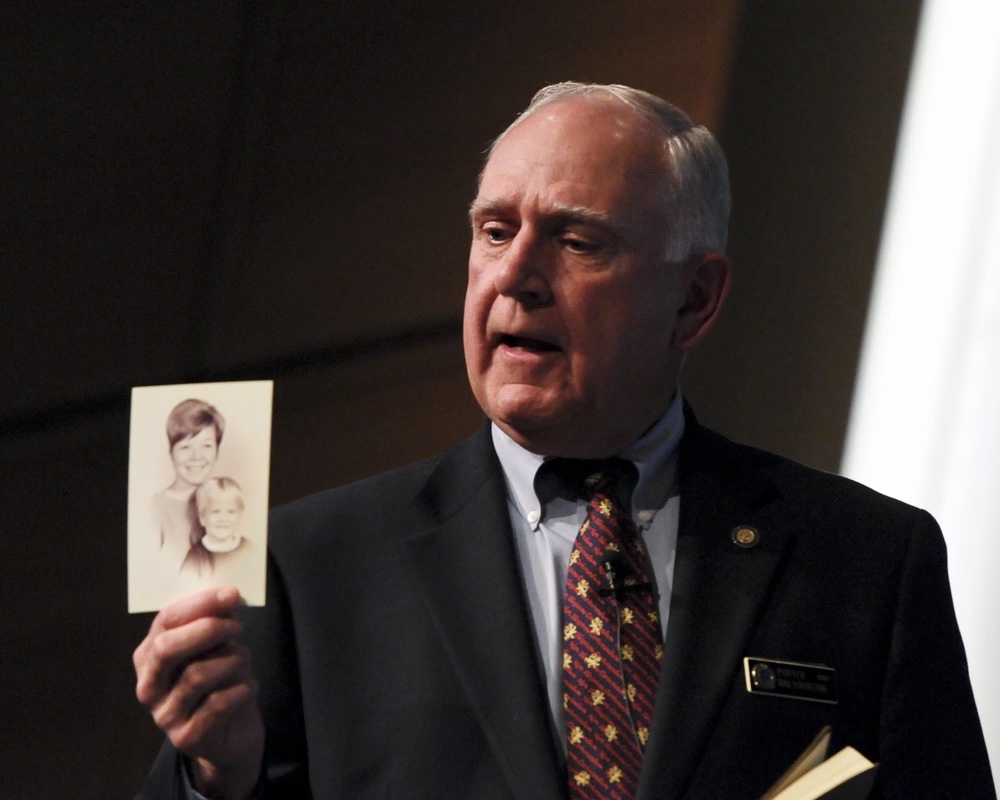
Top photo: U.S. Naval War College Professor Emeritus Porter Halyburton shows a photo of his wife and daughter during a lecture at the Naval War College about his time as a prisoner of war in North Vietnam during the Vietnam War. Halyburton was held captive for seven years in a number of prisons, including the infamous “Heartbreak Hotel” and “Hanoi Hilton.” (MC2 Eric Dietrich)

Saturday, September 11, 2010

‘Beyond Survival’ - Thinking of POWs on 9/11

Review by Bill Doughty

Today we remember the lives lost and damage done in the attacks of nine years ago -- 9/11/2001. Next week, Sept. 17, is national POW/MIA Day. Several weeks ago we ended combat operations in Iraq. It’s timely for a good read by a Vietnam-era POW, for patriots who want to preserve the lessons of history -- Gerald Coffee’s Beyond Survival.


No subject -- sex, religion, torture, fear, feces -- is off limit in Coffee’s reflections on life as a Prisoner of War in Hanoi, North Vietnam from 1966 to 1973.


As a Navy pilot, he flew missions from the deck of USS Kitty Hawk (CV 63). Coffee was shot down and captured in a harrowing encounter. His losses and ultimate triumphs are inspiring.

Coffee introduces us to characters like “Pig Eye,” “Rabbit” and “Louie the Rat.”

Read Beyond Survival and you’ll smell the smells, feel the pain and gain some insights into human nature: the humanity even in a makeshift firing squad; the “kinship of all life” in nurturing a pet bird named Charlie; the collateral, unintended damaging consequences of semantics -- “war” vs. “conflict”; and the brutality of hate.

Coffee reveals the resilient spirit of American warriors and shows the strength of the Code of Conduct as a personal and professional ethos.

He also shows the ingenious codes used by POWs to communicate inside and outside their Hanoi prison, including tapping code, with taps corresponding to letters of the alphabet. POWs may have come up with an early version of texting: TD, TN, TM and YD = Today, Tonight, Tomorrow and Yesterday; GBA = God Bless America. Brushing fingernails against a wall indicated laughing at another prisoner’s coded jokes.

Indomitable spirit... Sense of humor... Inspirational.

Poetry helped him cope. He was inspired by the poem If by Rudyard Kipling:

If you can keep your head when all about you
Are losing theirs and blaming it on you;
If you can trust yourself when all men doubt you,
But make allowance for their doubting too;
If you can wait and not be tired by waiting,
Or, being lied about, don't deal in lies,
Or, being hated, don't give way to hating,
And yet don't look too good, nor talk too wise;
If you can dream - and not make dreams your master;
If you can think - and not make thoughts your aim;
If you can meet with triumph and disaster
And treat those two imposters just the same;
If you can bear to hear the truth you've spoken
Twisted by knaves to make a trap for fools,
Or watch the things you gave your life to broken,
And stoop and build 'em up with wornout tools;
If you can make one heap of all your winnings
And risk it on one turn of pitch-and-toss,
And lose, and start again at your beginnings
And never breath a word about your loss;
If you can force your heart and nerve and sinew
To serve your turn long after they are gone,
And so hold on when there is nothing in you
Except the Will which says to them: "Hold on";
If you can talk with crowds and keep your virtue,
Or walk with kings - nor lose the common touch;
If neither foes nor loving friends can hurt you;
If all men count with you, but none too much;
If you can fill the unforgiving minute
With sixty seconds' worth of distance run -
Yours is the Earth and everything that's in it,
And - which is more - you'll be a Man my son!

After 9/11, it is easy for Americans to hate. As a POW who missed years with his precious family, it would be easy for people like Capt. Jerry Coffee to hate. Instead, he shows that love and true strength of character are the ultimate triumphs over evil.

To learn more about his triumphs, visit Capt. Coffee's website: http://www.captaincoffee.com/

Saturday, January 27, 2018

Bond of 'Jersey Brothers'

Review by Bill Doughty

After Imperial Japan attacked Oahu, three brothers serving in the Navy experienced the war and witnessed history from distinct vantage points: one aboard USS Enterprise (CV 6), one as an aide to President Franklin D. Roosevelt, and one as a Prisoner of War in the Philippines.
Barton, Bill and Benny before the war

Prior to the war, big brothers Benny Mott (gunnery officer aboard Enterprise) and Bill Mott (a naval intelligence officer) hoped to keep their younger brother, Barton Cross, safe, so Bill recommended Barton become a Supply Corps officer and serve in the  Philippines.

But then, nine hours after Pearl Harbor was attacked, the Japanese bombed and strafed U.S. forces in the Philippine Islands. Barton was wounded and hospitalized in the air attack.
"Their opening salvos went to the heart of the island's air defenses, which proved an easy mark. Despite Washington's urgent, repeated orders to General Douglas MacArthur – at the time the U.S. Army Forces Commander in the Far East – to launch his planes and initiate air operations, beginning minutes after the start of the attack on Pearl Harbor, he did not respond. Nor did he ever issue the order. As a consequence, virtually every U.S. plane at Luzon's primary airfields, Clark Field and Nichols Field, was bombed on the ground, wingtip to wingtip. The army's entire staple of bombers, their payloads full, was wiped out in a matter of hours."
With Army Air Corps protection gone, Navy submarines of the U.S. Asiatic Fleet were vulnerable and had to sortie to Darwin, Australia. 

When it came time for MacArthur to retreat from the Philippines, he ordered the evacuation of Army casualties – but not the Navy's wounded – hospitalized in Manila.

Jersey Brother Barton became a POW, subjected to marches, deprivation and atrocities documented by eye witnesses and other records cited by author Sally Mott Freeman in "The Jersey Brothers: A Missing Naval Officer in the Pacific and His Family's Quest to Bring Him Home" (Simon & Schuster, 2017).

Escape was foremost in POWs' minds, but Imperial Japanese guards had ways of preventing escape:
"Nothing focused the mind on the perils of escape more than the particular return of three prisoners – two army colonels and a navy lieutenant – who were summarily stripped naked, marched across the camp to the entrance, tied up, and flogged to insensibility. They were kicked to their feet, led out the front gate with their hands tied behind them, and strung up to hang from cross-pieces of wood several feet above their heads. A two-by-four was placed beside them, and when any Filipinos passed by on the road, they were summoned by the Japanese guards to pick up the timber and smash each of the hanging prisoners in the face. Then the guards would follow up and lay on their whips."
All three POWs lived for three days before two were shot and the third was beheaded.

Meanwhile, Barton's brothers did everything they could to try to locate him and learn his fate.

Oldest brother, Benny, served aboard Enterprise with Adm. "Bull" Halsey, another native of New Jersey.

Years earlier, when Benny was a midshipman at the U.S. Naval Academy, Halsey commanded the USS Reina Mercedes, the Annapolis station ship, and the two established a relationship at social gatherings for upperclassmen. Both were proud of their state:
"During those more relaxed affairs, Benny and Captain Halsey often discussed navy football and another common passion: the underappreciated virtues of their shared home state of New Jersey. Halsey had relished these chest-beating interludes about the state: 'The home of Alexander Hamilton, Thomas Edison, and Albert Einstein!' he would crow in mock exasperation, drawing wide grins from Benny every time. At Annapolis, Benny and Bill were both known for their proud defense of the Garden State – against routine mockery. They even embraced their nickname, 'the Jersey Brothers,' despite its implicit derision. Was it Halsey who started that? Benny couldn't remember, but it stuck ... Halsey always appreciated Benny's family high notes including the Motts' ancestral link to members of the iconic fraternal order that boarded the tea-laden vessels Dartmouth, Eleanor and Beaver in Boston Harbor in 1773."
USS Enterprise and USS South Dakota engage Japanese ships and planes on Oct. 26, 1942. NHHC.
Benny was aboard Enterprise for the Doolittle Raid on Tokyo and in the Battle of Santa Cruz Islands during the Guadalcanal campaign, described graphically in "The Jersey Brothers." Benny's quarters were destroyed in the attack. "His old surroundings were barely recognizable; the room was a smoky tumult of wet, scorched debris." Other gunners and other ships were not so lucky.
"The reality stunned: at the conclusion of the Battle of Santa Cruz, the USS Enterprise was now the only operational American aircraft carrier in the hostile waters of the Pacific. One by one, every other prewar flattop had either been lost in battle or forced to withdraw for lengthy repairs. Lexington had gone down in May at the Coral Sea battle. Yorktown was lost at Midway less than a month later. On the last day of August in the Eastern Solomons, Saratoga had taken a second devastating torpedo hit and retired to drydock at Pearl Harbor. Wasp, en route to Guadalcanal two weeks later, was fatally struck by three torpedoes. And now Hornet's pyre burned over the horizon."


Using "industrial-grade paint" Sailors aboard "The Big E" painted and erected a large, defiant sign: "Enterprise vs. Japan." 
"Over the course of 1942, Enterprise had been struck a total of six times by Japanese bombs or torpedoes and had suffered hundreds of casualties. The painted sign reflected both the grimness of the situation and the grit of a determined crew: this sole surviving American aircraft carrier in the seventy-million-square-mile Pacific war front was in no mood for backing down."
Benny had a ringside seat to the war in the Pacific. Jersey Brother Bill was an eyewitness to history at FDR's side, principally in the White House Map Room. Bill developed a connection with WInston Churchill and Eleanor Roosevelt. He had to inform the president of the death of the Sullivan brothers, five brothers lost in November 1943 aboard the light cruiser USS Juneau off Guadalcanal.

Adm. Richmond Kelly Turner
Earlier, Bill followed Station Hypo's progress leading to the Battle of Midway. Later, after successfully lobbying to be stationed in the Pacific – closer to his brothers – Bill integrated Navajo Code Talkers so they would be "coordinated properly with their multiple constituents in the amphibious forces complex communication chain."

Bill was there when Adm. Spruance approved the firing of Army Maj. Gen. Ralph Smith in coordination with Adm. Richmond Kelly Turner and Marine Gen. Holland "Howlin' Mad" Smith.

Bill's relationship with the "famously abrasive" Adm. Turner was deep and lasting. We get an insight into the character of Turner, who led amphibious assaults at Guadalcanal and Iwo Jima. Turner supported Bill's efforts to locate his POW brother, Barton, just as Halsey supported Benny's efforts to try to find his Jersey brother.

As a Navy captain and CO of USS Astoria (CA-34) in 1939, Turner visited Japan to return the ashes of Japan's ambassador to the United States and meet with Foreign Minister Arita Hachiro. After the Japan's surrender in 1945, Turner went to the Togo shrine in Tokyo, which he had visited in that diplomatic mission.
"Standing at the Togo shrine, Admiral Turner made this prescient observation: 'If we play our cards well, the Japanese will become our best and most worthwhile friends. They have certain fundamental virtues in their character, which in time, I hope, will be appreciated by all worthwhile Americans. We should be most careful to respect their gods and their traditions, and I hope they will come in time to respect ours.'"
Records retrieved from the Philippines and made available by the Navy's Bureau of Medicine and Surgery, as well as interviews and letters, helped Freeman piece together life for Barton as a prisoner of the Japanese. She recites how prisoners were mistreated, how they survived sometimes for years, and how they made tough choices – whether to attempt escape or remain as prisoners and prevent repercussions on fellow prisoners.

Freeman explores the tensions and turmoil of interservice rivalry during the war, with Gen. MacArthur front and center, saying "The Navy fails to understand the strategy in the Pacific." Much of the author's source material comes directly from the MacArthur Memorial Archives.

Commander in Chief Pacific Fleet and Pacific Ocean Areas Adm. Nimitz confers with south Pacific area officers, possibly aboard USS Argonne (AG-31) at Noumea, New Caledonia, Sept. 28, 1942: Army MGen Richard K. Sutherland, Chief of Staff to General MacArthur; (Nimitz); VADM Robert L. Ghormley, Commander South Pacific Force; and USAAF MGen Millard F. Harmon, CO of U.S. Army Forces South Pacific Area. (Naval History and Heritage Command)
Author Sally Mott Freeman
MacArthur bristled under the shared leadership of Adm. Nimitz in the Pacific. Readers will enjoy a fascinating explanation of the command and control relationship in Chapter 14 (pages 174-5). Chief of Naval Operations Adm. E.J. King considered MacArthur a megalomaniac, according to Freeman, a general who rewarded flattery and other sycophantic behavior by his staff. "It is said that a fool flatters himself, but a wise man flatters the fool."

This book shows us many sides of the war – including a family's deep struggle on the homefront during and after the war. This is a highly recommended, multidimensional study of the Pacific War, which was won by superior sea power. "Without sea power," said Nimitz, we would not have advanced at all."

The afterward and epilogue to this book are well-written, well-researched and personal accounts worth reading and re-reading for anyone interested in treatment of POWs and in the way war can affect families.

Sunday, April 27, 2014

10 Reasons to Say 'Bravo Zumwalt'

by Bill Doughty

Adm. Elmo "Bud" Zumwalt Jr.:
  1. Became the first CO of a warship built from the keel up as a guided-missile destroyer, USS Dewey; was the youngest officer in the modern Navy to achieve flag rank and the youngest to become CNO.
  2. Fought for Strategic Arms Limitation Talks that would not give the Soviets an advantage; protected civilian control of the military under the Constitution before and during Watergate; and promoted peace through strength through a maritime balance.
  3. Broke down racial barriers. On his watch: The first African American admiral, opening of rates to minorities (including Filipinos, traditionally restricted to stewards), and increased minority enrollment in the Naval Academy; with respect to equal opportunity, he said, "equal means exactly that."
  4. Promoted women's rights. On his watch: The first woman admiral, first women to serve aboard ships (as part of a pilot program that led to women being able to serve aboard surface ships) and first women naval aviators.
  5. Accelerated "Vietnamization" turnover program to get the United States military out of the Vietnam War.
  6. Took a systematic rather than parochial approach to acquisition: pushed for development and use of the F-14 as a fighter jet for all services, advocated for Trident submarines, and championed littoral warfighting capabilities.
  7. Did away with "Mickey Mouse" rules, regulations and instructions he said were "irritating and unproductive barnacles"; directed that Sailors could take civilian clothes aboard ship, for example; communicated directly with Sailors in "rap sessions" and through Z-grams; and helped the Navy come to terms with the realities of an all-volunteer force.
  8. Improved Sailors' and families' quality of life, targeting sea-shore rotations, operational schedules and homeporting; established the ombudsman program; and fought for veterans, especially wounded warriors.
  9. Achieved a naval presence in Diego Garcia in the Indian Ocean and in Bahrain and Iceland; and deployed warfighting-ready ships forward, including USS Midway (CV 41) to Yokosuka Japan.
  10. Was honored with official christening of namesake DDG 1000 April 12, 2014.
Take Adm. Zumwalt's autobiography "On Watch," add the best of "My Father, My Son," written with his son Lt. Elmo Zumwalt (and most of the extended family and with help from John Pekkanen), and then add a healthy dose of context, insight and good writing -- and you have Larry Berman's "Zumwalt: The Life and Times of Admiral Elmo Russell 'Bud' Zumwalt, Jr."

Berman's book begins at the end. The first chapter focuses on the great admiral's death and funeral honors. Readers can start at Chapter 2 and jump right into his life and achievements.

Zumwalt graduated from the Naval Academy just six months after the attack on Pearl Harbor and headed straight for the Solomons Campaign, Guadalcanal and the Battle of Savo Island, where he witnessed death and destruction.

Later, aboard USS Robinson he fought in the battle of Surigao Straits. He received the Bronze Star for meritorious conduct in action during torpedo attacks against enemy battleships. 


At the end of World War II USS Robinson was assigned to Shanghai and captured a fleeing Imperial Japanese Navy gunboat Ataka. Zumwalt was assigned as the prize captain of the Ataka, and he brought it up the mine-filled Yangtze River to Shanghai.

Berman introduces us to Zumwalt's close-knit family, including wife, Mouza, who he met in Shanghai. His beloved Mouza was the daughter of a French father and Russian mother who had fled Siberia after the 1917 Revolution and lived in Manchuria before the Japanese invaded. (To learn more about the family's trials and tribulations over several generations, read "My Father, My Son," which delves deeper into how the family was impacted by Agent Orange and other legacies of Vietnam. "My Father, My Son" includes mini essays by family members, shipmates and friends.)

After WWII Zumwalt studied the USSR at the Naval war College "as a way of understanding the dynamics of the Soviet system." An early shore assignment to the Bureau of Personnel gave him insights into institutionalized discrimination by the Navy in the early 50s. A later tour at BuPers as detailer would give him an opportunity to analyze how the bureaucracy constrained innovation and resolution of the Navy's personnel problems.


SECNAV John Chafee, CNO Adm. Zumwalt, CJCS Adm. Moorer and SECDEF Melvin Laird.
Zumwalt served throughout the Cold War, both aboard ships, including off the coast of North Korea, and in the corridors of the White House, including during the Cuban Missile Crisis, where he drafted orders on behalf of Assistant Secretary of Defense for International Affairs Paul Nitze and President Kennedy to give the commander in chief, Atlantic Fleet.  He also drafted the letter under Secretary of Defense Robert McNamara's instructions that was given to Soviet prime minister Nikita Khrushchev.

The power of Berman's biography of Zumwalt is in its behind-the-scenes interactions between the Admiral and his advocates and adversaries -- on one side, George C. Marshall, John Chafee, Paul Nitze ("Socrates to Zumwalt's Plato"), Melvin Laird, Creighton Abrams and Gerald Ford; on the other side, Hyman Rickover, George Anderson, Donald Rumsfeld, Henry Kissinger and Richard Nixon.


In this biography as in the two autobiographies, Zumwalt is open, forthright and strongly opinionated. Some readers will not agree with all of his opinions, but everyone can respect his fearlessness in speaking his mind and fighting for what he believed to be right.

Zumwalt championed a leadership style that was inclusive and humane. He backed the chain of command but encouraged communication up and down the chain, not just down. He listened to his Sailors. He had faith in the American people and in citizens' rights to know what their government was doing in their name. Berman shows us how he ensured his legacy of innovation, equal opportunity and humane leadership would continue after his career in the Navy.


Promoting Rear Adm. Alene Duerk
Berman's book is an in-depth biography of the CNO who not just reformed but really revolutionized the Navy at a time of great transition for the nation and the military.  Vice Adm. Earl Frank "Rex" Rectanus wrote, "'Father of the Modern Navy' will remain a unique epitaph to this man."

Among Zumwalt's famous Z-grams was Z-57, eliminating what he called "Mickey Mouse" rules, but which went out as "Demeaning and Abrasive Regulations." Berman, who refers to Zumwalt as "Bud" to distinguish him from other family members, writes:
"Z-57 liberalized regulations and practices in twelve areas: style of hair, beards, sideburns, civilian clothes, uniforms for trips between home and base and when visiting commissaries and snack bars, attire for enlisted men at officers' clubs, salutes, motorcycles, conditions for leave, and overnight liberty. It's impact spanned the oceans. Inside the Hanoi Hilton, longtime POW James Stockdale tapped on the wall in Morse code to ask a recent arrival if there was any news from home. 'Got a new CNO, named Zumwalt. No more Mickey Mouse or chickenshit.' Stockdale could not know that Bud was wearing a POW bracelet imprinted with Stockdale's name. Once home, Zumwalt gave Stockdale the bracelet. 'No single memento of my return or imprisonment will have as profoundness [sic] of meaning comparable to this emblem of your faith in me," wrote Stockdale. On October 11, 1995, Stockdale gave Bud a copy of his book, 'Thoughts of a Philosophical Fighter Pilot.' The handwritten inscription read, 'For my Boss at a crucial time, Bud Zumwalt. It was he more than any other man who gave me a boost when I came out of prison, and the confidence to press ahead in the Post-Vietnam years.'"
USS Zumwalt (DDG 1000)
Along with reading about the christening of USS Zumwalt (DDG 1000) this month, reading Berman's 2012 account of the life and times of Admiral Elmo Zumwalt Jr. helps us understand the lasting influence he had in a time of great turmoil.

According to Rear Adm. Thomas Rowden, Director of Surface Warfare, N96, writing for NavyLive blog, "Like the admiral, this ship named in his honor challenges conventional wisdom. Unlike any other destroyer ever built, USS Zumwalt is the most advanced warship in the world and represents a great technological advancement in United States naval shipbuilding."

Thursday, February 21, 2019

John Kerry's Character Forged in Vietnam

Review by Bill Doughty

After returning to the States, decorated Swift Boat skipper John Forbes Kerry took a stand against the Vietnam War nearly 50 years ago. Some fellow veterans of the "America, Love It or Leave It / America, Right or Wrong" mindset never forgave him.

On the other hand, Kerry believed this about America: "When right, keep it right, and when wrong, make it right."

He believes the truth, like freedom and democracy, is worth fighting for.

"Every Day is Extra" (Simon & Schuster, 2018) is a remarkably readable and compelling personal journey of a life dedicated to service, honor, diplomacy and keeping America great.

Kerry, like most Americans, is from an extended family of immigrants. "Perhaps the sea was in our blood," he writes. "Not only did our passions always stay connected to the ocean, but the original journey by which we came to America (was also) by sea..." Kerry's love of the sea informed his choice on which service he joined. 

"On February 18, 1966 I raised my right hand and took the oath to enlist in the U.S. Naval Reserve." Kerry prepared to attend Officer Candidate School in Newport Rhode Island.

But he remembered Mark Twain's admonition: "Never let school get in the way of an education."

Kerry's Naval Education

His first ship was USS Gridley (DLG 21), which was "an introduction to hands-on responsibility. The first thing I noticed when I stepped aboard was how big and clean it was."
"I took the Gridley responsibilities seriously. One of the most important lessons learned in OCS is that you don't walk in as the new kid with a pair of bars on your shoulder and start ordering people around. I've seen so many guys screw up, thinking that just because they're an officer, they're automatically in charge. Wrong. The bars represent an opportunity to learn how to be an officer. Some guys don't see it that way, and folks resent the hell out of them. The sergeants in the Marines and the chief petty officers in the Navy are the guys who know the ropes. You just have a college degree and four months of OCS; you really don't know anything, especially compared with the chief petty officers twice your age who have been in the Navy for twenty years. To be successful, listen to them."
Kerry in Vietnam
Another thing Kerry learned in the Navy is "that no one prospered unless everyone prospered. One of the great lessons of the service is that no one does well or right by doing alone."

He recounts his first full deployment:
"When we set out from San Diego in February 1968, I was full of anticipation for the adventure. We sailed away from the California coast in a four-ship group – one frigate, Gridley, and three destroyers – steaming in formation to Pearl Harbor. Just getting one or two nights away from the coast was magical. In all our training runs we had stayed pretty close to California. Now we were cranking up speed, heading west across the Pacific Ocean, honking along with the ship plowing through rolling waves as the sunset lit us up in bursts of crimson and orange. We created an enormous wake. I stood on the fantail feeling the ship vibrate and churn beneath my feet, watching the ocean race by at a pretty good clip."We were the squadron flagship for this convoy, so we took the lead position in a diamond formation. Standing on the bridge on a 535-foot Navy frigate moving at over 20 knots; sensing the harmony of ship, ocean and sky; feeling the ship shudder as it rises and falls with the waves; and watching the sun set into the horizon and looking for a green flash is a pretty damn good sight. It's why people go to sea and never get over it, why, as John Masefield wrote, men 'must go down to the seas again, for the call of the running tide, / Is a wild call and a clear call that may not be denied.'"
Kerry takes us aboard his swift boat and into bone-jarring combat in 1969, including a heart-pounding description of how he chased and killed an enemy combatant.


Admiral Elmo Zumwalt, future Chief of Naval Operations, then-commander of all naval forces in Vietnam, said Kerry's mission that day, "stood out among heroes as acts of total heroism."
Lt.j.g. Kerry stands with his swift boat crew in Vietnam.

In Vietnam, Kerry remembers how he received news of the deaths of friends and the assassinations of Bobby Kennedy and Martin Luther King Jr. in 1968. MLK's self-described "maladjusted" stand for justice – and against the war in Indochina – influenced Kerry's thinking.

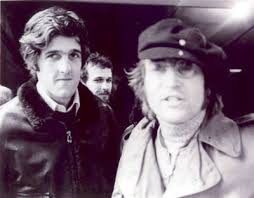
At a peace rally, young John Kerry introduced John Lennon.
The mid to late 60s was a watershed time for the United States as the nation dealt with Civil Rights, the Vietnam War and "electrifying change" in culture brought about by Dylan, the Beatles and the Rolling Stones.

Kerry's "maladjustment" flowered after his return Stateside. 

John Kerry's Found Haiku

Remembering his fallen comrades and the service members still serving in Vietnam, he marched, spoke and eventually testified to Congress against the war, offering this "found" double haiku:

How do you ask a
man to be the last man to
die in Vietnam?

How do you ask a
man to be the last man to
die for a mistake?

His leap into politics eventually led to a successful campaign to become the junior senator of Massachusetts.

Kerry was sworn in to the Senate by then-Vice President George H. W. Bush, who "loved the Navy as I did," Kerry remembers.

Kerry and McCain
He describes the vivid characters he worked with as a fellow senator: Max Cleland, Ted Kennedy, John McCain, John C. Stennis, Joe Biden, Robert Byrd, Jesse Helms, Strom Thurmond and John Glenn, among many others.

He remembers a time of collaboration, cooperation and compromise in Congress, when senators placed the needs of the nation above their own, including during investigations. He also relearned lessons from Vietnam: to compartmentalize in order to stay on track.

An Early Mueller Prosecution

Oliver North, USMC
Kerry, along with Senators Inouye, Mitchell, Nunn and Sarbanes, served at the heart of the Senate's Iran-Contra investigation during President Reagan's second term. Col. Oliver North had arranged for arms sales to Iran to fund military support to the cocaine-growing Contras in Nicaragua's civil war.
"I knew of Oliver North. We were the same generation and had both fought in Vietnam. He had come home from the war a decorated combat vet, with a Silver Star, Bronze Star, and two Purple Hearts. I didn't know what his politics were, but I respected his service and his courage. I wondered how someone with his credentials could be led down a path of illegality. The Marines live by a code. If what we were hearing was true, a Marine should have been horrified."
As part of the investigation, Kerry followed the money.

Robert Mueller, USMC
"We discovered a shady and unsavory bank with an innocuous acronym: BCCI. It stood for the Bank of Commerce and Credit International. BCCI was a dream for criminals and money launderers, and it was hiding in plain sight ... We learned that the CIA had prepared hundreds of reports outlining the criminal connections of BCCI. Thankfully, the Department of Justice soon had a new head of its criminal division: my St. Paul's classmate, a Vietnam veteran and a diligent law enforcement professional named Bob Mueller. Our subcommittee's two staffers had exposed the perfidy of BCCI, and I felt vindicated when Mueller assigned thirty-seven prosecutors to the case. By July 1991, regulators had seized the bank. BCCI was dead."
The ghost of BCCI would later come back a decade later in the wake of 9/11 in how al-Qaeda funded its terrorism. "When my investigation and Robert Mueller's prosecution shut down BCCI, it cut off Osama bin Laden's foothold in Sudan; now we needed to go after the entire dirty financial network that operated in the shadows," Kerry writes.

Smears and Retaliation

In 1996, Kerry was challenged for reelection by William Weld, former governor of Massachusetts. During the campaign, political operatives and a reporter, who was classmate of Weld, questioned Kerry's military record.

Kerry and Zumwalt.
In response, Admiral Zumwalt led a contingent of commanders who had oversight of swift boat shoreline operations to set the record straight. They conducted a press conference at the Charleston Navy Yard, "where USS Constitution stands as a reminder of our country's naval origins."

"Every Day Is Extra," includes a contemporaneous message about Kerry's key swift boat operation from then-Capt. Roy Hoffmann commending the mission: "The extremely successful raid and land sweep conducted along the Rach Dong Cung which demonstrated superb coordination and aggressive tactics stands as a shining example of completely overwhelming the enemy."

Decades later, when Kerry ran for president against George W. Bush, Hoffmann was recruited by anti-Kerry forces. Those forces were led by several principals: Ted Sampley, a "self-appointed POW activist (who) profited grossly" from myths and lies about POW/MIAs; John O'Neill, an ally of Nixon and Chuck Colson; and Jerome Corsi, an anti-Obama birther theorist and close associate of Roger Stone.

Kerry visits Afghanistan April 9, 2016. (Photo by SSgt Tony Coronado, USAF)
O'Neill and Corsi wrote the smear-book, "Unfit for Command," which was discredited by Zumwalt's previous statements, Navy and Coast Guard records, John McCain's testimony, and Sailors who served with Kerry during the missions for which he was decorated.

"It was extraordinary," Kerry writes about Hoffman, Sampley, O'Neill and Corsi. "They were lying about me, lying about themselves, lying about history – a history they knew was documented, in some cases by themselves, but always by the Navy they purported to love and respect."

To Tell the Truth

Respect for truth, honor and justice is a theme that runs through Kerry's life and this book.

For example, he explains why he felt it was important to take on BCCI with Robert Mueller:
"Because if you start backsliding and trimming on the rule of law, you contribute to the inexorable deterioration of democracy. Corruption is cumulative. I believed the rule of law has to mean something in the United States. If we knowingly turn a blind eye on the rich and powerful, enabling them to escape accountability while two-bit criminals go to jail for years, we create a tiered system of justice. That is no justice at all."I had learned a great deal as an investigator, both in Iran-Contra and in BCCI. I'd been reminded that when you push hard for truth, people who are invested in lies or in convenient avoidance resist, and they retaliate. But truth is worth fighting for; truth is the American bottom line."
"Every Day Is Extra" opens with a poignant recounting of the death of Kerry's father. Scattered throughout the book are the shadows of combat deaths, cancer diagnoses and the losses of friends and family members "...so many of life's sad, sudden turns."

Senator John Kerry participates in a remembrance ceremony at Utah Beach, June 6, 2011. Kerry joined paratroopers from the U.S. Army, U.K, Germany, and France in honoring those who fought and died in Operation Overlord, the D-day landings. Senator John Kerry, chairman of the Senate Armed Force Committee, was the senior U.S. representative at the ceremony. (Photo by Staff Sgt. Felix Fimbres, U.S. Army)
A deeply personal encounter comes with Kerry and Teresa Heinz Kerry visiting Normandy Beach. I won't ruin the experience, made better with Kerry's context and nuanced prose, but you can find the passage on page 209 of the 2018 hardbound edition.

A thorough report of John Kerry's time in Vietnam and his journey to warrior diplomat and healing with friend and colleague John McCain is presented in Douglas Brinkley's "Tour of Duty: John Kerry and the Vietnam War" (HarperCollins, 2004).

According to Thomas Cutler, author of "Brown Water, Black Berets," "Douglas Brinkley's vivid rendition of brown-water operations in 'Tour of Duty' rings true, with all the sights, the sounds, and the smells that make it such a unique experience. But this is far more than another war story. It is an account of a young man's journey through his own 'heart of darkness,' ultimately emerging with his soul intact and his need to serve undiminished, ready to wage a different kind of war."

U.S. Secretary of State John Kerry crosses the brow of the Avenger-class Mine Countermeasures ship USS Devastator (MCM 6) April 7, 2016 at Naval Support Activity Bahrain in the U.S. 5th Fleet area of operations. (U.S. Navy photo by Mass Communication Specialist 2nd Class Ryan D. McLearnon)

Secretary of State John Kerry lays a wreath Aug. 13, 2014 at the USS Arizona Memorial. Kerry visited U.S. Pacific Command to discuss cooperation strategy in the Asia-Pacific region. (U.S. Navy photo by Mass Communication Specialist 1st Class Jay M. Chu)

Kerry signs the Paris Climate Agreement while holding his granddaughter, Apr. 22, 2016.