Showing posts with label Colin Powell. Show all posts

Tuesday, October 19, 2021

The Will of an ‘Unruly Torrent’

Review by Bill Doughty––

Venerable thinker George Will unleashes a storm of opinions in “American Happiness and Discontents: The Unruly Torrent, 2008-2020" (Hachette Books, 2021), proving he is still sharp in his observations while cemented in his positions of right and wrong.


This is a book of nearly two hundred essays about everything from military history and life-and-death issues to Will’s thoughts about the Beach Boys, Baptists, baseball, and blue jeans. (Regarding the latter, he claims to have only one pair, worn only once. He believes men should dress like Fred Astaire, women like Grace Kelly.)

While Will shares some acerbic humor, mostly he offers a ribbon of melancholy that ties these essays together. So many in this collection are devoted to past wars and their aftermath. Others lament culture wars still happening. And a final section, “Farewells, Mostly Fond,” features obituaries, including to fellow conservatives William F. Buckley, Charles Krauthammer, Gerald Ford, and George H.W. Bush, as well as, surprisingly, liberal-of-liberals George McGovern.


The most poignant remembrance is the final essay in the book, written July 6, 2008. Will honors the memory of Army Lieutenant Colonel Jim Walton, killed in Afghanistan. The essay is also a tribute to casualty assistance calls officers, CACOs, including LtCol Walton’s spouse, Sarah, herself a CACO who had to receive the terrible news of her husband’s death.


An epigraph by CACO Maj. Steve Beck, United States Marine Corps, at the beginning of the Walton essay contains a “found haiku”:


...curtains pull away.

They come to the door. And they

know. They always know


George Will concludes his Walton essay –– and his book –– with this:

“When the Army CACOs came to the Arlington door or Sara Walton, my assistant, she was not there. She rarely forgot the rule that a spouse of a soldier in a combat zone is supposed to inform the Army when he or she will be away from home. This time Sarah forgot, so it took the Army awhile to locate her at her parents’ home in Richmond.

“Her husband, Lieutenant Colonel Jim Walton, West Point Class of 1989, was killed in Afghanistan on June 21. This week he will be back in Arlington, among the remains of the more than 300,000 men and women who rest in the more than 600 acres where it is always Memorial Day. This is written in homage to him, and to Sarah, full sharer of his sacrifices.”*

George Will
Sacrifice on behalf of the nation is tied to the ribbon of sadness in the nearly 500 pages of this collection.

Will writes in “A Nation Not Made by Flimsy People” of the grit required to win the Revolutionary War. Readers will be reminded of the great historian David McCullough’s “1776,” one of the first books we featured on Navy Reads.


In “The Somme: The Hinge of World War I, and Hence of Modern History” he contextualizes the “reverberations” of that war. The First World War influences Will’s thinking and inspiration for topics, including in the penultimate essay, “The Last Doughboy.”


In “Haunted by Hue” and “Vietnam: Squandered Valor” he properly acknowledges the sacrifices of brave young Americans, while castigating the mendacity of the power structure that sent them to a war that was ultimately a “tragedy,” including for the people of Vietnam.


Color guard of 442nd in 1944

In “The 442nd,” written in 2010, he pays tribute to the most decorated unit for its size in American history, the Japanese-American soldiers who fought against Fascism and Nazism in Europe in WWII while many of their families were imprisoned in internment camps back in the States. George Will met some of these patriotic veterans.

“Such cheerful men, who helped to lop 988 years off the Thousand Year Reich, are serene reproaches to a nation now simmering with grievance groups that nurse their cherished resentments. The culture of complaint gets no nourishment from men like these who served their country so well while it was treating their families so ignobly. Yet it is a high tribute to this country that it is so loved by men such as these.”

Will has no time for political correctness and what’s now called “cancel culture.” He takes on some of the debates about political and social topics dominating college campuses. On the other hand, he also has no tolerance for racism, terrorism in the name of religion, and attacks on democracy.


He shows how the values of Frederick Douglass won out over Woodrow Wilson's bigotry. But he has little compassion or understanding for renaming professional sports teams such as the former Washington Redskins or for “coercing” bakers who refuse, for religious reasons, to provide a cake for a same-sex wedding. 


He celebrates books and “binge reading” while condemning new technologies and platforms that rewire the brains of young people, shorten attention spans and erode the ability to think critically and independently.

To say George Will is sometimes like the grouchy old man yelling at youngsters to get off his lawn is to state the obvious. But he cares about what he believes in, and he communicates with passion and conviction. His ribbon leads through a pursuit of happiness that ends ultimately to a reward for readers.


*(Lost at first reading is George Will’s epigraph to the entire book: “For Sarah Walton –– To whom I am indebted for her many years of indispensable assistance. And to whom the nation is indebted.”)


Grieving and Honoring
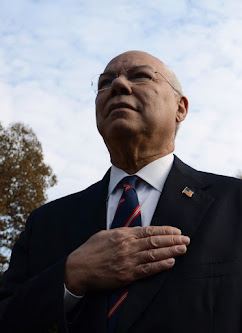

Colin Powell
I finished this book as I heard the news of an icon of conservative leadership passed away: former Secretary of State and Chairman of the Joint Chiefs of Staff Gen. Colin Powell. Flags fly at half staff for the great principled patriot and warrior-diplomat. But General Powell would want us to pay tribute to the person he most looked up to and respected in his life, his wife Alma. Powell told author Bob Woodward that Alma was his moral compass and inspiration.

Alma Powell is sponsor of USS Kearsarge (LHD-3). She is also the namesake of Kearsarge's airfield. 


According to the Navy, "Throughout her life of civic leadership [Alma] Powell has helped young people in need of educational resources for more than four decades. While serving as Chair of the Board of Directors for America’s Promise Alliance, a non-profit organization dedicated to improving the education opportunities of disadvantaged children, Ms. Powell helped to lead more than 450 partner network’s efforts to help tens of thousands of young people by connecting them with resources essential for academic success."


Capt. Neil Koprowski, commanding officer of the Wasp-class amphibious assault ship USS Kearsarge (LHD 3), delivers remarks during an airfield dedication ceremony in honor of Alma J. Powell, May 28, 2021. Alma Powell, Kearsarge’s ship sponsor, is a military spouse, a civic leader and civil rights activist who has advocated for women, children, and minorities for more than four decades, and has helped tens of thousands of disadvantaged people around the world. (MCSN Gwyneth Vandevender)

TOP PHOTO:
Gen. Colin L. Powell speaks at the 26th National Memorial Day Concert on the West Lawn of the U.S. Capitol in Washington, D.C., May 24, 2015.to help unite the country in remembrance and appreciation of the fallen and to serve those who are grieving. (MC1 Daniel Hinton)

Saturday, March 6, 2021

‘How to Lead’ -– Attributes


Review by Bill Doughty

What makes a good leader? What attributes can be found in successful ethical leadership? Listen to this.


David M. Rubenstein hears from renowned leaders in “How to Lead: Wisdom from the World’s Greatest CEO, Founders and Game Changers” (Simon & Schuster, 2020). He interviews people like Bill and Melinda Gates, Gen. David Petraeus, Speaker Nancy Pelosi, and President George W. Bush, and others. He arranges the interviews in six categories: visionaries, builders, transformers, commanders, decision-makers, and masters.

According to Rubenstein, here are attributes of a good, successful leader: luck, focus, persuasiveness, a desire to succeed, pursuit of something unique, willingness to work long hours, ability to keep learning (“nothing focuses the mind like a good book”), integrity, humble demeanor, credit-sharing, ability to keep learning, responding to crises, and rising from failure.


“Failure teaches humility and exponentially enhances the desire to succeed the next time,” he writes.


Dr. Anthony Fauci, interviewed in this book, gives this advice about good leadership: “You don’t dictate to people. But if you let them know what your vision is, hire the best people, and then don’t get in their way, those are the qualities of a good leader.”


As for other advice in responding to crises, Rubenstein writes:

“Leaders are most needed when crises occur, as we have been reminded this year during the COVID-19 pandemic and the nationwide protests over the death of George Floyd. Rising to the occasion when an existential crisis occurs can mark a leader forever –– Lincoln holding his country together during the Civil War or Churchill rallying his country to fight the Nazi attacks.”

Powell, Bush and Schwarzkopf attend a memorial service in Kuwait, Jan. 26, 2001. (Sgt. B. Beach)
In an interview with Gen. Colin Powell (former Chairman of the Joint Chiefs and former Secretary of State), Rubinstein listens to how the United States responded to a crisis –– Iraq’s invasion of Kuwait leading to the first Gulf War during George H. W. Bush’s administration.

Powell said every good leader must have a strong vision and understand “why we are here” and then instill that understanding of “why” through all levels of the organization or team. 


“That’s what leadership is all about –– inspiring others,” he says.


Powell discusses how United States Marines achieved the mission in the first Gulf War, not only following their initial orders but also seizing an opportunity to advance when they saw the chance. Agility and nimbleness are good attributes for any leader.


Powell also takes questions head-on about his role in the second Gulf War, in which the CIA provided information Powell then relayed to Congress about weapons of mass destruction in Iraq –– as justification for an invasion. He offers a thoughtful and critical analysis.


Cadet Dalton MacAfee receives the Mike Krzyzewski Teaching Character Through Sport Award May 6, 2019 at West Point Military Academy. (PO1 Bryan Ilyankoff)

Interviewing Coach Krzyzewski (“Coach K”) of Duke basketball, Rubenstein asks about what he rightly calls “one of the greatest games ever played”: the 1992 semi-final game between Duke and Kentucky. Kentucky scored an improbable basket in the last seconds of overtime, putting them up by one point. With 2.1 seconds left in the game, Duke had the ball and called a timeout.

Coach K  remembers, “The very first thing a leader has to show is strength, so I met them as they were coming to the bench, and I said, ‘We’re going to win. We are going to win.' Then he called up a creative play –– Grant Hill passing 75 feet to Christian Laettner at the top of the key for a turnaround jump shot. Duke won the game and went on to win the championship thanks to their leader’s confidence.


Among this book’s eclectic group of leaders –– including Condoleeza Rice, Justice Ruth Bader Ginsberg, Yo Yo Ma, Robert F. Smith, and James A. Baker III –– is an unexpected but rewarding choice of subjects: Lorne Michaels, creator and producer of Saturday Night Live. SNL has catapulted the careers of Bill Murray, Eddie Murphy, Steve Martin, Will Ferrell, Tina Fey, Billy Crystal, Chris Rock, Julia Louis-Dreyfus, Amy Poehler, Kristin Wiig, Jimmy Fallon, Seth Meyers, Kate McKinnon, and scores of other comedians, talk show hosts, and actors.

Second Lieutenant Leah Davis speaks with actor Bill Murray, at the Wrenwoods Golf Course, Joint Base Charleston, S.C., Aug. 17, 2012. Murray participated in the golf tournament sponsored by the Airlift/Tanker Association. (SSgt. Katie Gieratz)


Michaels discusses the challenges of leading generations of creative people. “You try to create a culture where everyone feels they’re heard,” he says. “You lead by example.” He admits to being “ruthless” in ensuring the show is good. He is equally ruthless in ensuring everyone’s voice is heard and in being flexible enough to adapt quickly to change. He listens. To everyone.

It’s interesting to hear also about the history of how SNL got started; its ties to Johnny Carson, Howard Cosell, and first host George Carlin; and how the show and comedy itself has evolved over nearly 50 years.


Most of the very best leaders, by the way, have another important attribute: a sense of humor.


Robert M. Gates praises this book in a prominent blurb: “A wonderfully entertaining book about leaders from very different professions and walks of life … Rubenstein discerns the attributes of leadership they all have in common. ‘How to Lead’ is an exceptionally instructive and inspirational book.”


Chief of Naval Operations (CNO) Adm. Mike Gilday uses the 1MC to address the crew aboard the Freedom-class littoral combat ship USS Billings (LCS 15). Gilday visited Naval Station Mayport Mar. 3, 2021 to engage with Sailors, speak to local Navy leaders, and tour a number of commands in the area. (MC3 Austin Collins/Released)

Wednesday, February 12, 2020

A Groundbreaking 'Double Victory' – NMAAHC

Review by Bill Doughty

U.S. Navy Capt. Brian O. Walden, right, directs the U.S. Navy Ceremonial Band as they play "Hail to the Chief" during the groundbreaking ceremony for the Smithsonian NMAAHC in Washington, D.C., Feb. 22, 2012. (Photo by Chief Musician's Mate Stephen Hassay)
The U.S. Navy Ceremonial Band played "Hail to the Chief" as President Barack Obama and first lady Michelle Obama arrive on stage for the historic groundbreaking ceremony for the Smithsonian National Museum of African American History and Culture during Black History Month, Feb. 22, 2012.

Among the museum's exhibitions, collections, photos and other treasures are tributes to – among others – Medal of Honor recipients, the Tuskegee Airmen, Mess Attendant Doris "Dorie" Miller, and the overall "African American Military Experience."

Visitors view an exhibit about the legacy of Mess Attendant Doris “Dorie” Miller at the Smithsonian NMAAHC, Nov. 1, 2016. Adm. Nimitz presented Miller with the Navy Cross for his extraordinary courage during the Dec. 7, 1941 Japanese attack on Pearl Harbor. (U.S. Navy photo by Arif Patani)
The museum's "Official Guide" (Smithsonian Institution, 2017) shows various galleries and collections – floor-by-floor – and provides context within a history of overcoming slavery and the struggle to achieve civil rights and equality. "The United States was created in this context, forged by slavery as well as a radical new concept, freedom."

The museum represents the triumph of that concept promised in the Declaration of Independence and guaranteed in the Constitution – a democratic republic under the rule of law, not under a dictator or monarch. E pluribus unum: out of many, one.

First envisioned in 1915 after World War I, the creation of the museum was a nearly century-long struggle with lots of fits and starts. Congress finally authorized legislation in 2001, signed by President George W. Bush, to create a presidential commission that came back with a strong recommendation backed by Representatives John Lewis and J.C.Watts as well as Senators Sam Brownback and Max Cleland leading to enactment of a public law to bring the museum to life.

The guidebook takes visitors floor by floor to expansive open areas of discovery, art and education.

On the third floor of the museum, "Double Victory: The African American Military Experience" starts with the American Revolution and the War of 1812, into the Civil War and other conflicts, and through both world wars and the Cold War. Wartime military service has proven to be a catalyst for progressive social change throughout U.S. history.
"During the Revolutionary War, thousands of African Americans served as soldiers in the American colonial armies, including Jack Little, whose 1782 pay certificate for his service in the 4th Connecticut is on display here ... The War of 1812, sometimes referred to as the Second War of Independence, opened the ranks of the U.S. Navy to skilled African American seamen ... The Civil War was one of the most pivotal events in American history, and the Union victory that established the possibility of freedom for all depended on the service and sacrifice of tens of thousands of black soldiers, many formerly enslaved."
Museum artifacts include those of the "Buffalo Soldiers," Harlem Hellfighters of WWI, Tuskegee Airmen of WWII, U.S. Marine drill instructor Sgt. Maj. Edgar P. Huff of the Korean War, Air Force General Lloyd "Fig" Newton of the Vietnam War, as well as Vietnam Veteran Maj. Gen. Charles F. Bolden, a Marine Corps aviator who became an astronaut and the first black administrator of NASA.

Portrait photo of retired U.S. Marine Corps Maj Gen Charles Frank Bolden Jr. hours before his induction into the National Aviation Hall of Fame in Ft. Worth, Texas, Oct. 27, 2017. Bolden was nominated by President Barack Obama and confirmed by the U.S. Senate as the 12th Administrator of the National Aeronautics and Space Administration in 2009 to advance the missions and goals of the U.S. space program. (U.S. Marine Corps photo by Sgt. Cristian Bestul)

Other modern leaders of note featured in the "Double Victory" displays include Gen. Colin Powell, Gen. Hazel Johnson-Brown, and Adm. Michelle Howard.

The official guide is a good read prior to a visit to the museum, and is an invaluable companion for a self-guided tour. With cutaway floor maps and clear color-coded guides, this book offers behind-the-scenes stories about the exhibitions and collections. Of course there's also a downloadable mobile app for Apple IOS and Android to navigate the museum. Visitors can go to the Rosa Parks display, Martin Luther King Jr. tribute, Michael Jordan section, or George Clinton's actual P-Funk Mothership.

A highlight is the exhibition of artifacts recovered by maritime and archeology teams from the Slave Wrecks Project, including from the wreck of Portugese slave ship São José-Paquete de Africa, which sank in a storm off the coast of Cape Town, South Africa Dec. 27, 1794.

The recovery of artifacts from the wreck and collaboration with international teams features prominently in the biography of the NMAAHC founding director Lonnie Bunch III, "A Fool's Errand: Creating the National Museum of African American History and Culture in the Age of Bush, Obama, and Trump" (Smithsonian Books, 2019).

Bunch describes the trials and tribulations of creating the museum and speaks most poignantly of retrieving artifacts related to the São José project in a visit to Africa:
"Finding relics from the São José was the goal of my journey, but I discovered so much more about Mozambique, about slavery in South Africa, about maritime archeology, and about myself. I knew that relics from the ship such as wood from the hold that we would eventually display was not an inanimate object, but a touchstone to give meaning and humanity to the subject of slavery. It would serve as a totem that would prod Americans to replace the silences that we find so comforting with conversations, though difficult, that could lead to reconciliation and healing."
In his description of the groundbreaking ceremony in 2012, Bunch notes, "The United States Navy Band ... delighted the audience and provided a wonderful musical counterbalance to the array of speakers that included senior Smithsonian colleagues, [former first lady] Laura Bush, then Governor of Kansas Sam Brownback, Reverend Calvin O. Butts III, and Congressman John Lewis."

He has an interesting encounter with President Trump during a tour of the museum which is insightful and worth reading.

Bunch concludes with pride about the museum's relevance globally. Yet, he conveys humility about what the museum can mean for all Americans.

"Museums alone cannot ease the tensions that come from the debates surrounding the fluidity of national identity in the twenty-first century," he writes. 
"... But museums can contribute to understanding by creating spaces where debates are spirited but reasoned. Where contemporary challenges are addressed through contextualization and education. Since its opening, NMAAHC has become a site where rational healing and reconciliation are possible."

Author, historian and educator Bunch became Secretary of the Smithsonian Institution, June 16, 2019. According to his published biography he oversees 19 museums, 21 libraries, the National Zoo, numerous research centers, and several education units and centers.

Visitors tour exhibits at the Smithsonian NMAACH focusing on the African American military experience. (U.S. Navy Photo by Arif Patani)

Wednesday, November 27, 2019

Naval Gazing: 'Sailing True North'

DC2 Reginald Selgren looks out at the horizon on the flight deck of USS Stockdale (DDG 106) while underway in the Pacific Ocean. (MC3 Abigayle Lutz)
Review by Bill Doughty

The deck of a ship provides a platform to simultaneously contemplate eternity and look within to understand our place in the universe.
"... any sailor can walk out on a rolling deck at night and stare at the distant point where the sky meets and sea and recognize that we are merely the smallest part of a huge and diverse universe that stretches forever unto the mind of God, and which will last far beyond the age of human beings. This combination of attributes – the endless vision of eternity dangling before our eyes – creates a deepening of character in the best of sailors ... and deepen our own characters."
Adm. James Stavridis, USN (ret.), brings us aboard with short biographical stories in "Sailing True North: Ten Admirals and the Voyage of Character" (Penguin Press, 2019). The bios and stories illustrate key character traits: creativity/innovation, resilience, humility, balance, honesty, empathy, justice, decisiveness, determination, and perspective.


Stavridis poses with instructors at the Naval Surface and Mine Warfighting Development Center in 2018. (Lt. M. Stroup)
Contemplating "great deep waves" and endless stars above and over the horizon provides perspective through deep reflection. 

Stavridis laments shortened attention spans and constant distractions in recent years that prevent us from reflection and true awareness. The antidote: reading, thinking and learning – reflection.

We can see the future and understand the present by looking into the past as well as the horizon. 

Through personal anecdotes and stories from history, Stavridis teaches about how to achieve a good character and practice good leadership.

Reagan, Lehman and Rickover in 1982.
He compares humble Rear Adm. Grace Hopper with irascible Adm. Hyman Rickover and offers a powerful story of Rickover's confrontation of Secretary of the Navy John Lehman and President Reagan in the Oval Office. Sometimes exemplary (and often flawed) character traits are illustrated in sea stories about such diverse figures as Themistocles, Zheng He, Sir Francis Drake, Mahan, Zumwalt and Nimitz ("In so many ways he was the greatest of the Navy's admirals").

Among the character traits that seem to really set the good apart from the bad are humility, justice, empathy and honesty. "Truth matters for us all," Stavridis writes, "but especially for leaders whose decisions shape the world. Character that is built around a respect, really a veneration, for the truth is the sort of character to have."

As for empathy, this trait when conducted – like gazing at the horizon from a ship's deck – helps us get out of our own skulls, escape the notion that we are the center of world. In that context, Stavridis introduces us to the "brilliant and memorable" speech by David Foster Wallace, delivered at Kenyon College in 2005, "This is Water."


Wallace calls for valuing lifelong education, caring for others, and awareness in living "life BEFORE death." Wallace demands we question what we worship and be open to new ideas. "Blind certainty," had says, is "a close-mindedness that amounts to an imprisonment so total that the prisoner doesn't even know he's locked up."
"If you worship money and things, if they are where you tap real meaning in life, then you will never have enough, never feel you have enough. It's the truth. Worship your body and beauty and sexual allure and you will always feel ugly. And when time and age start showing, you will die a million deaths before they finally grieve you. On one level, we all know this stuff already. It's been codified as myths, proverbs, clichés, epigrams, parables; the skeleton of every great story. The whole trick is keeping the truth up front in daily consciousness. Worship power, you will end up feeling weak and afraid, and you will need ever more power over others to numb you to your own fear. Worship your intellect, being seen as smart, you will end up feeling stupid, a fraud, always on the verge of being found out. But the insidious thing about these forms of worship is not that they're evil or sinful, it's that they're unconscious. They are default settings."
Obviously, Stavridis is open to inspiration from diverse sources in order to overcome our personal default settings. 

Two of Stavridis's mentors, Secretary of Defense Leon E. Panetta and Chairman of the Joint Chiefs of Staff Adm. Mike Mullen, testify at a hearing of the Senate Armed Services Committee on the U.S. strategy in Afghanistan and Iraq, Sept. 22, 2011. (PO1 Chad McNeeley)
"True North" reveals the author's mentors Adm. Mike Mullen, Gen. Colin Powell, and secretaries of defense Bob Gates and Leon Panetta. We read profiles on Adm. Bill McRaven and Adm. Michelle Howard, and we get quotes from Coach John Wooden, Shakespeare and Oscar Wilde.

Wilde's quote, by the way, is a found haiku:


"We are all in the
gutter but some of us are
looking at the stars"

Stavridis offers a wealth of books in his "selected bibliography and further reading." 

"True North" is worth a place on any sailor's bookshelf and is recommended for anyone interested in what it takes to lead an examined life as a good leader.

Happy Thanksgiving indeed.

Sunday, September 11, 2016

Words of Inspiration on 9/11 + 15

Review by Bill Doughty

William Safire's compilation of great speeches brings together Western-centric wisdom and inspiration in the 1,157-page tome, "Lend Me Your Ears: Great Speeches in History" (W. W. Norton & Company, 2002). Here are just a few excerpts:

Former Secretary of the Navy Theodore Roosevelt (prior to becoming President), April 10, 1899:

"The army and the navy are the sword and the shield which this nation must carry if she is to do her duty among the nations of the earth."

President John F. Kennedy at Amherst College, Oct. 27, 1963:

"I look forward to a great future for America––a future in which our country will match its military strength with our moral restraint, its wealth with our wisdom, its power with our purpose ...  And I look forward to an America which commands respect throughout the world not only for its strength but for its civilization as well."


Gen. MacArthur at West Point, May 12, 1962
Gen. Douglas MacArthur at West Point, May 12, 1962:

"'Duty,' 'honor,' 'country'––those three hallowed words reverently dictate what you want to be, what you can be, what you will be. They are your rallying point to build courage when courage seems to fail, to regain faith when there seems to be little cause for faith, to create hope when hope becomes forlorn."

President Franklin D. Rooselvelt at his first inauguration, March 4, 1933:

"This great nation will endure as it has endured, will revive and will prosper. So, first of all, let me assert my firm belief that the only thing we have to fear is fear itself––nameless, unreasoning, unjustified terror which paralyzes needed efforts to convert retreat into advance."

Senator Robert F. Kennedy, on the assassination of Martin Luther King, Jr., April 4, 1968:

"What we need in the United States is not division; what we need in the United States is not hatred; what we need in the United States is not violence or lawlessness but love and wisdom, and compassion toward one another, and a feeling of justice towards those who still suffer within our country, whether they be white or they be black."


Elizabeth Cady Stanton
Elizabeth Cady Stanton at the Women's Suffrage Convention of 1868:

"With violence and disturbance in the natural world, we see a constant effort to maintain an equilibrium of forces. Nature, like a loving mother, is ever trying to keep land and sea, mountain and valley, each in its place, to hush the angry winds and waves, balance the extremes of heat and cold, of rain and drought, that peace, harmony, and beauty may reign supreme. There is a striking analogy between matter and mind, and the present disorganization of society warns us that in the dethronement of woman we have let loose the elements of violence and ruin that she only has the power to curb. If the civilization of the age calls for an extension of the suffrage, surely a government of the most virtuous educated men and women would better represent the whole and protect the interests of all than could the representation of either sex alone."

President Thomas Jefferson at his first inauguration, March 4, 1801:

"Let us then, fellow citizens, unite with one heart and one mind; let us restore to social intercourse that harmony and affection without which liberty and even life itself are but dreary things. And let us reflect that, having banished from our land that religious intolerance under which mankind so long bled and suffered, we have yet gained little, if we countenance a political intolerance, as despotic, as wicked, and as capable of as bitter and bloody persecutions."

President Abraham Lincoln at his first inauguration, March 4, 1861:


President Woodrow Wilson
"We are not enemies but friends. We must not be enemies. Though passion may have strained, it must not break our bonds of affection. The mystic chords of memory, stretching from every battlefield and patriot grave to every living heart and hearthstone all over this broad land, will yet swell the chorus of the Union, when again touched, as surely they will be, by the better angels of our nature."

President Woodrow Wilson addressing Midshipmen at the U.S. Naval Academy, June 2, 1916:

"I congratulate you that you are going to live your lives under the most stimulating compulsion that any man can feel, the sense, not of private duty merely, but of public duty also. And then if you perform that duty, there is a reward awaiting you which is superior to any other reward in the world. That is the affectionate remembrance of your fellow men––their honor, their affection. No man could wish for more than that or find anything higher than that to strive for."


Gen. Colin Powell
Gen. Colin Powell presenting the commencement address at Howard University, May 14, 1994:

"Racism is a disease you can help cure by standing up for your rights and by your commitment to excellence and to performance. By being ready to take advantage of your rights and opportunities that will come from those rights. Never let the dying hand of racism rest on your shoulder, weighing you down. Let racism always be someone else's burden to carry. As you seek your way in the world, never fail to find a way to serve your community. Use your education and your success in life to help those still trapped in cycles of poverty and violence. Above all, never lose faith in America. Its faults are yours to fix, not to curse. America is a family. There may be differences and disputes in the family, but we must not allow the family to be broken into warring factions."


Daniel Webster
U.S. Representative Daniel Webster at the Bunker Hill Monument, June 17, 1825:

"We may hope that the growing influence of enlightened sentiments will promote the permanent peace of the world ... Our proper business is improvement. Let our age be the age of improvement. In a day of peace let us advance the arts of peace and works of peace ... Let us cultivate a true spirit of union and harmony."

The themes here are courage over fear, unity over disharmony, human rights as universal ideal, service as sacred duty, and permanent peace as our collective ultimate goal.

Sunday, February 2, 2014

Football Dreams: Navy's First Black Admiral


Review by Bill Doughty

Long before becoming Navy's first black admiral, Samuel L. Gravely Jr., had his sights set on becoming a football coach.  He loved the game, but his father -- "deathly afraid" about injury -- didn't want him to play.  Gravely Sr., a World War I veteran and Pullman Porter, thought his son's future lay with the Post Office.
Gravely's biography, "Trailblazer: The U.S. Navy's First Black Admiral," is the heartfelt tale of how education, hard work, perseverance and luck came together for a remarkable and inspirational leader, whose training to become an officer actually preceded the Golden Thirteen (first naval officers).

Gravely played football despite his father's fears.  He had to hide his uniform behind the refrigerator during high school -- till his father found it.  

After high school he attended the all-black Virginia Union University in his hometown of Richmond Virginia where football changed his life.
"One difference from high school was that I was able to play football without my father knowing it.  The college had a gym with lockers, so it was no longer a case of trying to hide my uniform at home.  One of the football trips in 1940 had beneficial consequences down the road.  At the time, my sister Christie was going to school at Virginia State College in Petersburg.  I went over there once with a bunch of football players, and my sister introduced me to one of her roommates, Alma Clark.  Several years later, Alma and I were married..."
One year later, World War II started in the Pacific with Imperial Japan's attack on Pearl Harbor of December 7, 1941.  Gravely enlisted in the Navy after the Navy announced a new policy (April 7, 1942) that it would accept black Sailors into general service ratings).
As a young man in 1942.


It was a giant leap for the young man whose only life experiences were in the segregated south where every school he attended was all black and where he had to sit in the back of the streetcar or bus but in the front of the train, "which was the first place the coal hit."

At Great Lakes Naval Training Station and Hampton Institute Gravely excelled in study, but learned "I wasn't as technically minded as I thought I was."  He came out as a nonrated fireman. The East Coast would have seemed like a natural selection as a duty station.

"But I was influenced by one of my roommates to look in another direction," Gravely writes.  "[Roger] Gibbons had been a schoolteacher.  He'd been one of the great football players of Prairie View A&M, a black college in Texas ..." Gibbons suggested they take Horace Greeley's advice and "Go West, young man." They asked for and got orders to San Diego, which at the time was even more segregated than Richmond, he writes.

Gravely studied at UCLA. He considered his future and began taking premed classes, temporarily questioning his childhood dream of becoming a football coach.

He followed opportunity back to New York and Asbury Park, New Jersey and excelled as a midshipman, studying at Columbia University.  He expresses regret that instead of an assignment at sea in 1944 he was assigned to teach back at Great Lakes.

Alma and Sam Gravely married on Feb. 12, 1946, Roanoke, VA.
Soon, though, Gravely was serving aboard PC-1264, a submarine chaser homeported at Staten Island, New York City and operating along the East Coast, especially near Florida.  PC-1264 and USS Mason were the only two combatant ships with black officers aboard during WWII.

When PC-1264 went to Norfolk for a shipyard period to prepare for deployment to the Pacific, Gravely struck up a friendship with a worker there and joined his semi-pro football team, the Brown Bombers.  Sadly, while on liberty in Miami, he was arrested for "impersonating an officer" because the white military policeman had never seen a "Negro Navy officer."

After WWII, like a lot of his contemporaries, Gravely decided to leave the military and use the GI Bill to continue his education.  He attended Virginia Union and got serious about his studies, majoring in history.  And he played football.  His coach was Sam Taylor, who had been the coach for his former roommate Roger Gibbons at Prairie View.

Another turning point came in 1949 when Gravely was invited to come back on active duty.  The year before President Harry S. Truman issued an executive order (9981) which said, "It is hereby declared that there shall be equality of treatment and opportunity for all persons in the armed services without regard to race, color, religion, or national origin."

It was also a turning point for civil rights in the nation. Like a quarterback (Russell Wilson) and his father would ask in the next generation: "Why not me?  Why not us?"

Gravely became a coach and leader not of football players but of Sailors.  He would go on from recruiter duty to serve aboard the battleship USS Iowa, heavy cruiser USS Toledo, USS Seminole and USS Theodore E. Chandler.  He would serve throughout the Korean, Vietnam and Cold Wars.

USS Falgout in Pearl Harbor
He made history January 31, 1962 when he became CO of USS Falgout in Pearl Harbor.  "I guess it's been said that this was the first time a black had command of a U.S. Navy ship since Robert Smalls captured a small frigate out of the Charleston Harbor and turned it over to the Union forces during the Civil War," Gravely writes.

In 1963 he was invited to the White House where he and Alma met President Kennedy and Vice President Johnson.  He was in Washington DC as part of the Emancipation Proclamation centennial celebration.

Gravely next served at the Naval War College and Defense Communications Agency.  He commanded USS Taussig and then USS Jouett, a guided-missile frigate, later redesignated a guided-missile cruiser.

In 1971, Gravely was frocked to rear admiral, blazing another trail for naval officers.  He served as Director of Naval Communications and Commander of Cruiser-Destroyer Group Two and then Eleventh Naval District.  

In September 1976, back in Pearl Harbor, Gravely assumed command of U.S. Third Fleet, based in Hawaii. (Since then C3F has relocated to San Diego.)

Details of Gravely's assignments, new technologies, housing challenges, duty in the Pacific, "racial disturbances in the fleet," and the profound influence of CNO Adm. Zumwalt and his Z-grams are all included in "Trailblazer."

In addition to his accomplishments, Gravely shares his challenges and personal tragedies.  In 1978 his son Robbie was killed while driving on Ford Island in Pearl Harbor.

"Trailblazer" is written with Paul Stillwell, who in the preface notes that Gravely was born just 60 years after the Civil War.  The afterward is a very personal account by Alma B. Gravely, written in 2010, of her life together with her "Sammie."  Admiral Gravely passed away in 2004.

In 2009, the Samuel L. Gravely Jr. Elementary School was dedicated in Prince William County, Virginia.  Inside the front door of the school is the motto that Alma says expresses the admiral's philosophy:  "Success = Education + Motivation + Perseverance."

The dust jacket of "Trailblazer," published by the Naval Institute Press, notes:  "The U.S. Navy commissioned the guided-missile destroyer USS Gravely (DDG 107) in 2010 in tribute to a man who relished destroyer service and set an example for generations of Navy men and women."  Read a 2014 Naval History Blog post here, written by historian Dr. Regina T. Akers.

And on a separate note, about football...
(Samuel L. Gravely Sr.'s concerns about the dangers of football, expressed to his son more than 70 years ago, are echoed all over the news this Superbowl weekend as Russell Wilson and the Seattle Seahawks defeated Peyton Manning and the Denver Broncos. President Obama said if he had a son he wouldn't let him play tackle football, and even Brett Favre said something similar as more information comes out about the long-term damage to the brain, including memory loss, from concussions. Fans know the story of Junior Seau and they are hearing from Joe Namath and other former players.  Troy Aikman and John Lynch, high-profile Fox broadcasters, are asking for more information from the NFL. Don't expect the NFL to be complacent or take safety for granted. Already, the game has evolved thanks to new rules and steep fines against violent hits, helmet-to-helmet contact and late hits and other unsportsmanlike conduct. Too much money is at stake for the game to not evolve further. Imagine how much football has already progressed and changed for the better since it began, thanks to instant replay, for example.  As for the violence, just watch rugby to see how physical a game can be without as many serious injuries. BD)