Showing posts sorted by relevance for query eleanor roosevelt. Sort by date Show all posts

Saturday, March 21, 2015

W20: Put Eleanor on $20 Bill?

By Bill Doughty – 
Eleanor's school portrait, 1898.

Eleanor Roosevelt championed civil rights, equality for women and the role of the Navy in the 20th century. She transformed the role of First Lady and was a key communicator between government and the people through her daily newspaper column, essays and broadcasts.

No wonder she's one of the candidates in a grassroots public effort to see a woman pictured on a new twenty dollar bill. Among those being considered are Alice Paul, Soujourner Truth, Elizabeth Cady-Stanton, Rosa Parks, Rachel Carson and Patsy Mink, among others.

Some of Eleanor Roosevelt's writing is included in "Aunt Lute's Anthology of U.S. Women Writers, Volume Two," published in 2008.

In 1943, as Americans of Japanese ancestry served in Europe and the Pacific while others were imprisoned in camps, the First Lady expressed her thoughts. At first wrestling with the contradictions, she ultimately faced the hypocrisy of the War Relocation Act in this conclusion to her essay:
"Japanese-Americans may be no more Japanese than a German-American is German, or an Italian-American is Italian. All of these people, including the Japanese-Americans, have men who are fighting today for the preservation of the democratic way of life and the ideas around which our nation was built." 
"We have no common race in this country, but we have an ideal to which all of us are loyal. It is our ideal which we want to have live. It is an ideal which can grow with our people, but we cannot progress if we look down upon any group of people among us because of race or religion. Every citizen in this country has a right to our basic freedoms, to justice and to equality of opportunity, and we retain the right to lead our individual lives as we please, but we can only do so if we grant to others the freedoms that we wish for ourselves."
In an essay, "Freedom: Promise or Fact," also written in 1943, Eleanor Roosevelt begins, "If I were a Negro today, I think I would have moments of great bitterness. It would be hard for me to sustain my faith in democracy and to build up a sense of goodwill toward men of other races."

She imagines herself a black man facing the injustices of an unequal and segregated society.
"In a comparatively short period of time the slaves have become free men – free men, that is, as far as a proclamation can make them so. There now remains much work to be done to see that freedom becomes a fact and not just a promise for my people.
Eleanor Roosevelt visits a Works Progress Administration Negro nursery school
 in Des Moines, Iowa, June 11, 1936. (Photos courtesy of FDR Library).

"I know, however that I am not the only group that has to make a similar fight. Even women of the white race still suffer inequalities and injustices, and many groups of white people in my country are slaves of economic conditions. All the world is suffering under a great war brought about because of the lag in our social development against the progress in our economic development."
The Aunt Lute anthology is a mind-opening compilation with works from hundreds of compelling women authors and poets.

For more writings from Eleanor Roosevelt, The George Washington University offers a comprehensive site dedicated to her work.

Within weeks of the end of World War II, on October 4, 1945, Roosevelt wrote: 
"Army and Navy nurses are still on duty in every branch of the service. As of June 30, 1945, 65,216 were still on duty with the services."

"These women know better than most of us what war exacts in blood and pain from all young men, and they will continue to be reminded of it. In veterans' hospitals and in civilian hospitals and homes, they are going to meet the aftermath of war as long as this generation lives. In that respect, therefore, they have a great contribution to make to peace. I hope their organizations will be strong and that they will act not only in the interests of nurses, but take their position as citizens of influence in the affairs of the whole nation."
On October 15, 1949 – four years after the war, two days after the Navy's 174th Birthday – and in the midst of the Revolt of the Admirals, she showed her support for sea and air power and encouraged joint cooperation:
"I was brought up by my husband to have a great affection for the Navy. As he had been much influenced in his early days by Alfred Thayer Mahan's books, he naturally thought that a strong Navy was essential to defense.

"There was a time when navies were not considered so important. Armies were more important. Later, the navy came into its own and now perhaps air forces have superseded both armies and navies. But no one will deny, I think, that the proper combination of all three is what really safeguards a nation.

"The decision as to the relative power and kind of power to be given to each one of the services must rest with our military chiefs. There must be a joint decision arrived at by the chiefs of the Army, Navy and Air Force. This is one place where personal jealousies, either for yourself or for your particular branch of the service, cannot be allowed to supersede the overall good of the nation."
Adm. Nimitz briefs FDR, Gen. MacArthur, and Adm. Leahy in Hawaii, July 28, 1944.
On February 23, 1960, on the eve of Fleet Admiral Nimitz's 75th birthday, Roosevelt wrote a glowing tribute to the military statesman.

Reading her essay on the former Pacific Fleet Commander, one can imagine Eleanor proposing Nimitz's visage on our money (an idea that would have been repellent to the proud but extremely humble admiral).

The folks at Womenon20s.org argue that the $20 bill is the perfect choice to honor women on our paper money. The number 20 has significance as the centennial of women's right to vote approaches in 2020. Also, with respect to Andrew Johnson, currently depicted on the $20 bill, the W2 site notes:
"Andrew Jackson was celebrated for his military prowess, for founding the Democratic party and for his simpatico with the common man. But as the seventh president of the United States, he also helped gain Congressional passage of the 'Indian Removal Act of 1830' that drove Native American tribes of the Southeastern United States off their resource-rich land and into Oklahoma to make room for white European settlers. Commonly known as the Trail of Tears, the mass relocation of Indians resulted in the deaths of thousands from exposure, disease and starvation during the westward migration."
The proposal to replace the face of President Andrew Johnson with that of a woman would be a sea change, since U.S. paper money has featured the same individuals – all white men – since 1929.

Pictured at right: Eleanor Roosevelt and Navy/WWII veteran (and future president) Senator John F. Kennedy in New York, New York, October 11, 1960. (Photos courtesy of FDR Library)

“No one can make you feel inferior without your consent.” – Eleanor Roosevelt


Thursday, April 25, 2019

The Only Thing We Have to Fear

Reviews by Bill Doughty
Middle Age artist Hieronymous Bosch evoked fear and evil in his art hundreds of years ago.

Fear is corrosive. It eats away at a democracy. It feeds anger and hate. Sometimes it's necessary, but often fear is overhyped and misplaced, according to evidence provided by such critical thinkers as Steven Pinker, George Will, Bill Nye, Tom Hanks and Barry Glassner.

Fear is appealing and easy to access; the amygdala is immediate. The news media are rewarded by hyping fear: "If it bleeds, it leads." Autocrats foment fear to gain support. Fear works. 

Author Glassner reminds us in "The Culture of Fear":
"Samuel Coleridge was right when he claimed, 'In politics, what begins in fear usually ends up in folly.' Political activists are more inclined, though, to heed an observation from Richard Nixon: 'People react to fear, not love. They don't teach that in Sunday school, but it's true.' That principle, which guided the late president's political strategy throughout his career, is the sine qua non of contemporary political campaigning. Marketers of products and services ranging from car alarms to TV news programs have taken it to heart as well."
Glassner's national bestseller, featured in "Bowling for Columbine," is "The Culture of Fear: Why Americans are Afraid of the Wrong Things: Crime, Drugs, Minorities, Teen Moms, Killer Kids, Mutant Microbes, Plane Crashes, Road Rage, and So Much More" (Basic Books/Perseus, 1999). [Note: I pulled this book of the shelf to see how it could add context to the review of "Enduring Ideals," which follows this review; Glassner recently updated his work, and I'm looking forward to seeing his perspective twenty years later.]


Don't Believe the Hype

If people are afraid of the "wrong things," constantly sensationalized in the media and by some self-serving politicians, what are the "right things?" 

In "The Culture of Fear," Glassner tries to answer two questions: "Why are Americans so fearful lately, and why are our fears so often misplaced?" He concludes that instead of worrying about statistically minuscule threats, we should take "decisive action to quash – problems such as hunger, dilapidated schools, gun proliferation, and deficient health care for much of the U.S. population."
"Will it take an event comparable to the Japanese attack on Pearl Harbor to convince us that we must joint together as a nation and tackle these problems? At the start of the new century it ought to be considerably easier for us to muster our collective will and take decisive action than it was for our own parents and grandparents six decades earlier. This time we do not have to put our own lives or those of our children at risk on battlefields halfway around the globe."
It's interesting to read Glassner's perspective, published two years before 9/11 and the subsequent U.S. invasion of Iraq.

He looks back to 1938 and the famous Orson Welles broadcast of an adaptation of H.G. Wells's "War of the Worlds." The broadcast created panic in New Jersey because of it's hyper-realistic presentation of actual "fake news." Glassner contrasts the hyper-fear of a Mars attack with the actual dangers of the rise of fascism in Europe at the time.


Commitment to Freedom

Meanwhile, nearly 80 years ago, President Franklin Delano Roosevelt was alarmed – but not fearful – about the rise of Fascism, especially the threat of Nazism to Western democracies, as well as the militarization of Imperial Japan.
Franklin Delano Roosevelt

On January 6, 1941, eleven months before the Japanese attack on Pearl Harbor, FDR gave his Four Freedoms speech. An examination of the speech's concepts is presented in a stunning coffee-table book, "Enduring Ideals: Rockwell, Roosevelt & the Four Freedoms" (Abbeville Press Publishers, 2018).

The book offers beautiful art by Norman Rockwell and other contemporaries, especially from World War II, as well as photos, sketches, source material and reimagined art inspired by the concepts of liberty that could be guaranteed by democracy.

Along with the finely reproduced art are insightful essays to give context and history.

William J. Vanden Heuvel, former deputy U.S. representative to the United Nations, writes:
"(In) the address to the United States Congress that history knows as the Four Freedoms speech ... the president asked not only his countrymen and women but also the people of the world to understand that the terrible scourge of war could be justified to our children's children only if we in faith and honor determined to create a different world to assure the peace of humankind. That world, Roosevelt proposed, should be based on the Four Freedoms – freedom of speech and expression, freedom of worship, freedom from want, freedom from fear. In the world of the time of the president's speech, however – beset by war, oppressed by Nazi domination, brutalized by racist thugs – every tenet of democracy was threatened and ridiculed."President Roosevelt's power as a speaker lay in his ability to present profound ideas in simple language."
Clockwise from top left: Freedom from fear, freedom from want, freedom of religion and freedom of speech.

Rockwell's power as an artist transformed Roosevelt's words into pictures, even if the artist's paintings were imperfect in capturing the diversity and potential of America then and especially now. Rockwell hired people to pose and painted from staged photographs, so his realism wasn't quite real, and his staging might be considered hokey and corny in a post-Vietnam War and post-9/11 America.

Nevertheless, according to another essayist in this volume, Mark Shulman, "Rockwell translated FDR's lofty language into imagery that appealed to Americans' better angels and inspired the kinds of sacrifice necessary to fund the (Second World) war, to fight it, and to persevere in the face of horrifying adversity." 

In the wake of the First World War and the Great Depression – and in the growing shadow of an approaching WWII – FDR succeeded in coming to the aid of Great Britain.

Roosevelt and his team negotiated the U.S. Navy destroyers-for-bases initiative and lend-lease act while prying Americans, influenced by Charles Lindbergh, away from isolationism in the America First movement. 

Essayist Stephane Grimaldi writes, "Norman Rockwell embodied the American people who had to resign themselves to the need to defend the universal ideals of justice, peace, and prosperity. But President Roosevelt had to convince citizens that a foreign war was necessary. After all, aren't oceans the last bastion against tyranny?" Not really.

Imperial Japan's attack on Pearl Harbor and other parts of Oahu on Dec. 7, 1941 forced the nation to confront the realities and dangers of foreign threats in the Pacific and Europe. Rockwell's paintings, produced in 1942, were in part a mission statement outlined by Roosevelt for the United States and its Allies.

Rockwell's Rosie the Riveter, part woman, part man.
Essayist Jan Eliasson writes, "...while oceans may separate people, there is not that much that sets hopes and dreams apart."

This book blends history and shows the power of art, including in shaping public opinion. Some surprises included in this book:
  • Rockwell's portrait of tough and gritty Rosie the Riveter, literally transgender because Rockwell used a woman's face and a man's body as real-life models; 
  • Rockwell turning down a request to paint recruiting art during Vietnam;
  • an interview with Ruby Bridges (the black girl in the iconic and powerful 1963 Rockwell painting "The Problem We All Live With") revealing that her father fought and was wounded in the Korean War; 
  • the effects of Rockwell's art on Mahatma Gandhi, Nelson Mandela, and the United Nations; 
  • how FDR, a former Assistant Secretary of the Navy, was inspired by President Lincoln and the Gettysburg Address in developing the four freedoms concept; and
  • Eleanor Roosevelt's role in translating FDR's mission statement into a Universal Declaration of Human Rights.

Commitment Against Fear

Essayist Allida Black insists we recognize the role FDR's widow, Eleanor Roosevelt, played after WWII in perpetuating the concepts and ideals of the four freedoms. Black shows Ms. Roosevelt's "concrete" achievement in putting the four freedoms into action:
"If FDR gave us the vision that Rockwell immortalized on canvas, ER insisted that American's recognize what it meant. 'It is not only in war ... that we fight for freedom,' she wrote, shortly after Rockwell's paintings appeared in the Saturday Evening Post. 'When the war is over, the four freedoms will not have been won, we shall simply have dominated their more aggressive enemies. At all times, day by day, we have to continue fighting for freedom of religion, freedom of speech, freedom from fear, and freedom from want – for these are things that must be gained in peace as well as in war.'"
"Ultimately," Black writes, "Eleanor Roosevelt's commitment changed the world." The same can be said, to a degree, about Norman Rockwell who confronted fear in various forms before and after the war.

But fear, according to essayist Daisy Rockwell, the artist's granddaughter, "is now threatening all four of the freedoms Norman Rockwell enshrined."

Daisy Rockwell contends, "Since 2001, Americans have in fact been encouraged to live their lives in fear." She says, "A terrorist, by definition, is someone whose goal is to incite fear. Fear leads to chaos."

It can be argued that the attacks of 9/11 and Russian attacks on our political system and culture are forms of terrorism designed to cause fear and division leading to an erosion of freedom and unity.

As usual, the antidote to the corrosion of fear is found in education and critical thinking. So is art. "If you see something, say something" becomes, according to Daisy Rockwell, "see something, paint something.

Bill Nye says, "see something, think something."

Hieronymous Bosch's weird and fearful Vision of Hell.
Norman Rockwell's concept of the Golden Rule, a core concept for the Four Freedoms – universally applied.

Monday, April 5, 2021

‘Forging the Trident’ –– TR and Navy Infrastructure

Review by Bill Doughty

Theodore Roosevelt was appointed as Assistant Secretary of the Navy in April 1897, 124 years ago this month. In that position and later as President of the United States, TR helped build the infrastructure of the modern Navy. But, in his attempt to fortify deterrence, did he build inadvertently toward war a generation later?


Editors John B. Hattendorf and William P. Leeman draw up their own blueprint of TR's history with the Navy. They deploy a team of scholars, historians, and essayists to construct an argument for TR’s remarkable role to transform the Navy in “Forging the Trident: Theodore Roosevelt and the United States Navy” (Naval Institute Press, 2020). In complementing essays, various authors show TR’s leadership and influence after the Civil War, through the Spanish-American War and World War I, and –– through his cousin FDR –– in World War II.

TR was born three years before the start of the Civil War. His father was an ardent supporter of the Union, but members of his mother’s family were part of the Confederacy. In fact, his maternal grandparents were slave owners, and his uncles served in the Confederate navy, which is where TR acquired his love of ships and the open ocean.


The authors of “Forging the Trident” show how TR, who came from the party of Abraham Lincoln, negotiated and cajoled to keep the South and North united. Author Sarah Goldberger writes about the politics of reconciliation in “An Indissoluble Union.”

“Upon Roosevelt assuming the presidency, southern Republicans immediately approached him on the importance of taking control of the Republican Party in the South. John Wise, a lawyer from Virginia who now lived in self-appointed exile in New York, brought Roosevelt up to date on the sad state of affairs in Virginia –– that the commonwealth, like the other southern states, would soon disfranchise black voters. Some Republicans –– ‘Lily Whites,’ as they were called –– believed that this was perhaps a good thing, as it would make white men more likely to join the Republican Party; other Republicans saw the elimination of the black voters as fatal to the party. Wise, who considered himself in the latter category, served as the attorney of a group of black plaintiffs who fought disfranchisement. As president, Roosevelt became immersed in the very complex intersection of southern racial politics and federal patronage. Although the majority of federal employment now required civil service examinations, there was still patronage enough to bestow, such as the coveted position of local postmaster.”

TR became determined to change the system of discriminatory and patriarchal patronage into a merit-based system that rewarded performance.


“Roosevelt was determined to appoint only the most qualified people,” Goldberger writes. He invited Booker T. Washington to dinner at the White House to help judge African American appointees, but the backlash from white Southerners was extensive (and would have a lasting effect until the Nixon presidency).

TR delivers a speech on U.S. naval preparedness, Haverhill, MA, 1902.

Following in the footsteps of Lincoln, TR put his faith in the Constitution, the Union, and progressive values. He was also a champion of the environment as a true conservative and conservationist. And he strongly supported the Navy throughout his life.


Under TR’s leadership, the Navy enacted the Personnel Act of 1899. He wanted every Navy officer to be an engineer. He saw the advent of submarines and supported the possibility of developing “flying machines,” including for the Navy. Roosevelt communicated –– like few before him –– the need for public support for the Navy and understanding of its global maritime mission.


In “Checking the Wake While Looking Beyond the Horizon,” David Kohnen observes this about infrastructural changes in the Navy and nation after the Civil War as the country looked beyond its own borders:

“The naval outlook of Roosevelt reflected the confidence associated with industrialization and economic prosperity. Americans viewed the U.S. Navy as a symbol of national unity, as the Reconstruction era culminated in the stunning success of the Spanish-American War. The oceanic borders having been connected with the transcontinental railroad, the armored warships driven by coal-fired steam propelled the U.S. Navy forward in the global maritime arena. The economic rise of the United States remained closely connected to the watery lines of maritime communications –– as the empires of Europe and Asia also competed for economic dominance through naval power.”

Forward-thinking Roosevelt believed in having an international profile. And he strenuously promoted naval innovation.


TR
Under TR, the Navy shifted from coal to oil, deployed wireless communication, and developed new gunnery for its large battleships. “Forging the Trident” explains in several essays how Lt. Cmdr. William S. Sims –– with the support and protection of Roosevelt –– became more influential than most admirals and captains in the era of change in the early 20th century, often in the face of opposition from older traditionalists.


The ghost of Adm. Alfred Thayer Mahan haunts this book. In fact, Mahan’s name appears in all but one chapter. TR owed much to Mahan. But, as president, Roosevelt saw that the great geostrategic theorist was also a bureaucratic authoritarian whose “apostasy” stood in TR’s way. So, in order to advance many of the new technologies and strategies of the time, TR gently nudged him into retirement.


Kohnen writes, “As for Mahan, in late 1914 he died, as did the era of coal and multi-caliber battleship guns … The death of Mahan enabled the generation of Sims to pick up the torch in defining the future of American sea power.” 


Volatility extended to the top level of Navy leadership. Historian Branden Little lays out a fascinating review of TR’s turnover of SECNAVs –– six men served as Navy Secretaries during TR’s time as president.


FDR
In another chapter, “Legacy,” Craig Symonds presents an thoughtful look at the similarities as well as the differences between TR and his cousin FDR. “Among their shared values was a belief that government had both the authority and responsibility to proactively improve the lives of American citizens.”


Both men held the same jobs, and both had to be reigned in during their tenures as Assistant Secretary of the Navy. FDR, who married TR’s niece Eleanor, shared “Uncle Ted’s” deep love of the maritime service. He continued TR’s commitment to preparedness of a powerful, modern fleet able to have an impact on the international stage. As presidents, however, FDR proved to be more cerebral and cautious –– and perhaps more effective than TR as a communicator and consensus-builder. FDR, working with allies and former enemies, built a lasting infrastructure of a post-war era of peace for Europe and Asia.


Navy Reads readers may find James R. Holmes’s essay to be the biggest gem in this collection. It appears in chapter 9 and is titled “Why Deterrence Failed: The Imperial Japanese Navy, Strategic Memes, and the Great White Fleet.” 


Using Richard Dawkins’s insights about memes –– published in “The Selfish Gene” –– as a way to explain the history, psychology, and sociology leading to WWII, Holmes examines TR’s strategy to deploy the Great White Fleet as a “Big Stick” intended to show the world the power, prestige, and peacekeeping abilities of the United States.


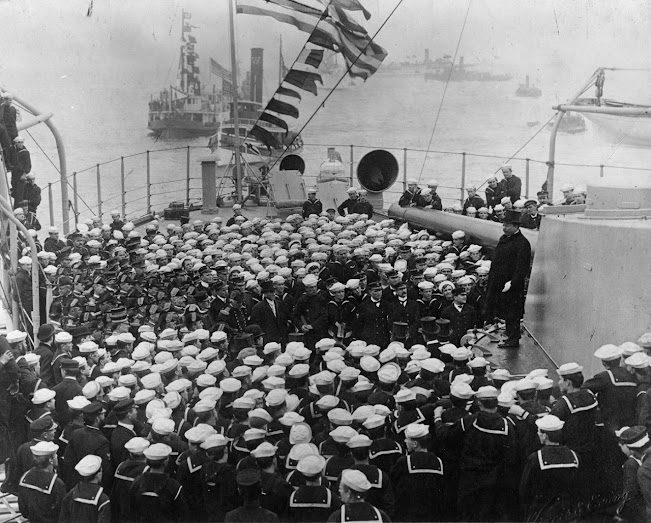
President Theodore Roosevelt addresses sailors on the after deck aboard USS Connecticut (Battleship #18), in Hampton Roads, Virginia, Feb. 22, 1909. (NHHC)

But was the GWF actually a deterrent? TR may not have fully appreciated the nationalism memes running through Japanese society after the IJN’s victories in the Sino-Japanese War, 1894-95, and Russo-Japanese War, 1904-05, which “forged the IJN’s access-denial strategy.” TR believed the circumnavigating voyage would foster peace. “The truth is murkier,” Holmes says. In the end, the GWF “message” may have piqued Japan’s pride and hubris –– an incentive for militaristic Japan to build the IJN even stronger, leading to an inevitable clash over Hawaii and the Pacific during FDR’s presidency.

Holmes’s conclusions –– and the legacy of both TR and FDR –– are relevant when thinking about innovative infrastructure initiatives in the United States in 2021.

“Few institutions are are exempt from bureaucratic dynamics –– or stasis. Dynamists typically fare better in armed competition than services set in their ways. Perhaps the way to remain supple and innovative is for top leaders to inscribe one indelible precept on the institutional culture, setting it above all others: No Precept Is Forever. That is one meme worth making permanent. The Imperial Japanese Navy offers an example to avoid –– or to exploit if some future foe appears likewise prone to fixed ideas.”

Reading “Forging the Trident” is like sitting alone with gifted historians and informed communicators telling you about how a great president served as a key architect of the modern Navy at the beginning of the last century. Editors Hattendorf and Leeman have succeeded in designing an indispensable edition –– and addition –– to the Roosevelt bookshelf. No precept is forever, but some concepts can last and improve over time.


OYSTER BAY, New York (Oct. 26, 2018) Cmdr. Julie Schmidt (right), the commanding officer of Navy Operational Support Center Long Island, and Cmdr. Christopher Kendrick, the executive officer of Navy Recruiting District New York, saluting a presidential wreath after placing it beside the grave of President Theodore Roosevelt in Youngs Memorial Cemetery. Students from nearby Theodore Roosevelt Elementary School were on hand to place flowers and play "Taps" to commemorate his birthday. (U.S. Navy photo by Bruce Howard/Released)

Sunday, July 8, 2018

Destroyers for Democracy / SCOTUS Legacy

Review by Bill Doughty


U.S. and British sailors examine destroyers prior to transfer in 1940.
It's hard to imagine the depths of fear and fascism washing over the world in the wake of the Great Depression and approach of war in the 1930s, a fear that intensified in 1941 when Imperial Japan attacked Pearl Harbor and Hitler declared war on the United States.

America had sided with Great Britain, with President Franklin D. Roosevelt providing 50 World War I navy destroyers to fight German submarines in exchange for the use of military bases on British territories in the Caribbean and western Atlantic.

The man who made that deal happen, despite entering a "sea of troubles" was new U.S. Attorney General and head of the Department of Justice, Robert Houghwout Jackson.

Jackson's story, intertwined with FDR's, is captured in "That Man: An Insider's portrait of Franklin D. Roosevelt" by Robert H. Jackson, edited and introduced by John Q. Barrett (Oxford University Press, 2003). Barrett cobbles together Jackson's manuscript with Jackson's oral history narrations and adds key documents and explanations.

The destroyers for bases deal, including the behind-the-scenes machinations between FDR and Churchill, will be interesting to Navy readers. So will Jackson's insider insights as WWII became a reality.

By the summer of 1941 Hitler had crushed Poland, Denmark, Norway, Belgium, the Netherlands, Luxembourg, France, Yugoslavia and Greece. Jackson writes:
"By June 15, conquest and demoralization had so far subdued France that the French fleet, under the ambiguous Admiral Jean Francois Darlan, seemed likely to be surrendered and thus added to the German and Italian navies. Churchill again cabled Roosevelt ... The specter of overwhelming German naval power, added to her seemingly irresistible air and land forces, deeply troubled the President. If the Germans should capture the French fleet, it – with Germany's own and that of Italy, and with probably cooperation from Japan – would leave the United States to face alone a most formidable naval and air power. But in the early days of July, Britain, defying what seemed to be forces as inexorable as fate and risking alienation fo the French people, boldly attacked and largely disabled the French fleet so that it could no longer be of any substantial service to Hitler. Britain won not only our admiration for her courage and audacity but our gratitude as well."
By the way, a great movie released last year, highly recommended, is "The Darkest Hour," directed by Joe Wright, written by Anthony McCarten and starring Gary Oldman as Winston Churchill. It's a slice of history as Churchill deals with challenges and the need for toughness in his first weeks as Prime Minister. Churchill was elected to the position after serving as First Lord of the Admiralty, the U.S. counterpart to Secretary of the Navy.

In "That Man" Jackson shows the back and forth between Churchill and FDR. 
"Churchill," Jackson writes, "seemed not to comprehend the very different constitutional and political position of President Roosevelt, who was bound by a written Constitution separating executive from legislative power and putting in Congress the control of disposal of government property."


Churchill reads
Eventually, Jackson worked out a legal transaction that helped both nations and navies. His artful deal assisted European Allies at a critical time and helped set the stage for American involvement in the war.

"That Man" gives us a front-row seat to the impact of the attack on Hawaii of Dec. 7, 1941 and its reverberations across the world to the White House.
"I think Pearl Harbor was a great shock to the President – that with all the war talk there had been, he did not believe Japan would make a surprise attack. Of course it was a great embarrassment to him ... How long the war would last and what the prospects were, I did not have much opinion. I was baffled. Our intelligence had proved to be wrong on nearly everything. American intelligence services let us down at every point. I had heard in Cabinet discussions the views that had come from our intelligence services. We had enormously underestimated the strength and striking power of Hitler. We had overestimated the staying power of France. We had overestimated the strength of England. We had overestimated the attitude and stamina of Belgium. We had terribly underestimated Japan, at least her immediate striking power. We had terribly underestimated the power of Russia ... The conquest of Russia was expected to be a very short matter. Based on such information as I had, it was a very dark prospect indeed. I was very pessimistic about it. It looked like a very long war and a war that would be terrifically costly in lives because Hitler would have to be dislodged from the position that he held. We had to wage a war of attack. The foolish optimism that had prevailed, such as the invincibility of the American navy and this and that, all went out of Washington very fast. In place of it, a very deep pessimism came in. There was talk about a war of a decade and all that. In the early part of December and the following months, spirits were pretty low here."
Daughter Mary and son Bill flank Irene and new Supreme Court Justice Robert Jackson, June 2041.
During the war, FDR appointed Jackson to the Supreme Court, but Jackson did not always side with the president. He recognized the importance of balance and separation of powers and the overriding authority of the Constitution.

For example, Jackson was in the minority in the Korematsu decision by the Court, arguing against the constitutionality of FDR's decision to imprison Americans of Japanese Ancestry in concentration "internment" camps, an order based on unfounded fear of a racial minority and one FDR would later admit was a mistake.

Robert H. Jackson had close personal ties to the Navy and the extended Roosevelt family. He knew "quite well ... the old gentleman" Josephus Daniels, Secretary of the Navy, who he first met in 1913. He conferred with Secretary of War Henry Stimson, Under Secretary of State Sumner Welles and newspaper editor and Secretary of the Navy Frank Knox.


Jackson at FDRs naval conference with Henry Stimson, Sumner Welles and Frank Knox.
Jackson's daughter, Mary, married a Navy physician. Jackson's son, Bill, earned a law degree and entered the Navy as an ensign. Bill later married Theodore Roosevelt's grandaughter. 

Both TR and FDR served in the position of assistant secretary of the Navy early in their government service. According to Jackson, FDR embraced innovation in the 30s and 40s:
"Roosevelt was not over-awed by military or naval rank and did not feel any sense of inferiority in the presence of a general or an admiral ... The Navy was his special interest, and at Cabinet meetings we sometimes referred to it as his branch of the service. He had the general conception of naval power that was set forth in the late nineteenth century by Admiral Alfred Thayer Mahan, but he was not blind to the significance of the growth of air power. He knew that that opened a new chapter and called for new techniques. He was interested in the most minute developments of new weapons and new strategies, even new tactics. My impression was that Roosevelt had no lack of respect for the training, judgment and advice of his generals and his admirals on the special subjects that were within their technical competence, but that as Commander-in-Chief he was more apt than most presidents to assert his personal authority over the military, naval and air authorities."
Jackson is a fascinating figure in history for his role in the New Deal, as solicitor general and attorney general, as Supreme Court justice and then for a time as chief prosecutor for the United States in the Nuremberg Trials of Nazi leaders.


Jackson, who began a successful career as a country lawyer, never finished law school.

A justice for the people, Jackson opposed indiscriminate wiretapping and invasions of citizens' privacy.

"It seemed to me that wire tapping was a source of real danger if it was not adequately supervised, and that the secret of the proper use of wire tapping was a highly responsible use in a limited number of cases, defined by law, and making wire tapping criminal outside of those purposes or limits," Jackson said.

A Wave-Top Read on Jackson

A wonderful book for young readers makes a good companion read to "That Man." It's Gail Jarrow's "Robert H. Jackson: New Deal Lawyer, Supreme Court Justice, Nuremberg Prosecutor" (Calkins Creek, 2008).

Jarrow explores Jackson's early life in western Pennsylvania and New York as a devoted reader and, in high school, a skilled debater, often benefiting from the wisdom of mentors. In just just a couple of hundred pages we get a wave-top view of his life, culminating in his role at Nuremberg and final years on the Court. She writes:
"Nuremberg had shown Robert Jackson how easily a dictator like Hitler could seize power. The lesson stayed with him when he returned to the Supreme Court. He was determined to protect each person's rights and freedoms from an overpowering government. Yet Jackson didn't want the government to be so weak that it couldn't keep the country secure. Twice in his lifetime, he watched Germany take over Europe. Now Communist Soviet Union was moving to control the free countries in Eastern Europe."
Earlier in his tenure in a First Amendment case he led the majority 6-3 opinion in West Virginia State Board of Education v. Barnette, siding with Jehovah's Witness schoolgirl plaintiffs against the West Virginia Board of Education. The students had been suspended for not putting their hands on their hearts and participating in the Pledge of Allegiance.

Jackson took a different stand in Terminiello v. City of Chicago. The case involved a priest issuing what today would be considered hate speech.


Gail Jarrow
"Catholic priest Arthur Terminiello gave a political speech in a Chicago auditorium in February 1946," Jarrow writes. "During his speech, Terminiello verbally attacked Jews and blacks and called former First Lady Eleanor Roosevelt a Communist." More than a thousand angry people protested outside. Some pounded on the doors and threw rocks. The priest "urged his supporters to use violence against the 'slimy scum' protestors."

In the ensuing riot Terminiello was arrested and fined $100. He took his case through the judicial system to SCOTUS. The Court sided 5-4 against Chicago and for the priest, saying the First Amendment protected his freedom of speech.

"Jackson strongly opposed the majority's decision," Jarrow reports.

She quotes Jackson: "No mob has ever protected any liberty, even its own, but if not put down it always winds up in an orgy of lawlessness which respects no liberties ... The choice is not between order and liberty [of the citizen]. It is between liberty with order and anarchy without either. There is a danger that, if the Court does not temper its doctrinaire logic with a little practical wisdom, it will convert the constitutional Bill of Rights into a suicide pact."

In the same year as the Terminiello decision was announced, by the way, the United States formed the North Atlantic Treaty Organization. NATO was created by the United States, Canada, and several Western European partner nations after WWII to provide collective security against the Soviet Union.

Jackson, who lived through two world wars and the Cold War, was on the Supreme Court during the Korean War. 

He heard a pivotal case called Youngstown Sheet & Tube Company v. Sawyer. President Truman had ordered the government to take over the steel mills during the war in response to threats of a steelworkers' strike. By 6-3, the Court decided the Constitution did not give the president the authority to take private property without the consent of Congress.
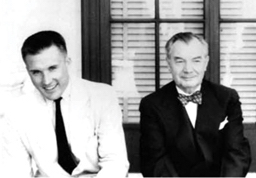
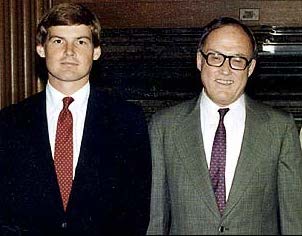
Above: Rehnquist and Jackson; below: Roberts and Rehnquist.

"This ruling," Jarrow said, "brought the three branches of government into balance again and became the basis for many later Court decisions."

In one of his final cases, recovering from a heart attack, Jackson was part of one of the most important cases in U.S. history, Brown v. Board of Education.

The year before he'd heard the reasoned arguments of then-attorney Thurgood Marshall against school segregation. "Jackson made up his mind that the Court should reverse the 1896 Supreme Court ruling Plessy v. Ferguson," Jarrow writes. The decision, issued by Chief Justice Earl Warren, was unanimous.
Jackson did not achieve his dream of becoming chief justice, but his legacy was profound.
"Although Robert Jackson never became chief justice, he is connected to a line of chief justices. His law clerk in 1952-1953 was William Rehnquist, who served as chief from 1986 to 2005. When Rehnquist died in 2005, his former law clerk John Roberts took the position. Robert Jackson dedicated his life to the law, first as a lawyer, then as a judge. He believed that the basis of a government was its laws, not the whims of its leaders. Shortly before his death, he wrote: 'There are only two real choices of government open to a people. It may be governed by law or it may be governed by the will of one or of a group of men. Law, as the expression of the ultimate will and wisdom of the people, has so far proven the safest guardian of liberty yet devised.'"
Jarrow's biography includes a timeline, notes, bibliography, index and resources for more information. Among the resources are oral histories, presidential libraries (Wilson, Hoover, Roosevelt, Truman and Eisenhower) and the Robert H. Jackson Center of Jamestown, New York – www.roberthjackson.org – a site with comprehensive coverage of the Nuremberg trials of Nazi war criminals.

Jackson saw the value of working closely with Allies. He recognized the dangers of totalitarianism and fascism. And he believed in the awe-inspiring power of Constitutional Democracy. He embraced freedom, rejected fear, spoke truth to power and put his faith in critical thinking.


Robert H. Jackson, Associate Justice of the Supreme Court, in 1953: second from the left, in the back row. Also pictured are, from left, in the bottom row: Felix Frankfurter; Hugo Black; Earl Warren (Chief Justice); Stanley Reed; William O. Douglas. Back row: Tom Clark; Jackson; Harold Burton; Sherman Minton.