Showing posts with label 1776. Show all posts

Thursday, July 27, 2023

Slavery & its Aftermath: Revisiting Lyceum


Review by Bill Doughty––

The shadow of Lincoln looms over some politicians who restrict certain books and the teaching of slavery. Learning about American history, both shiny and tarnished aspects, is key to a strong republic and successful self-government, as suggested in Diana Schaub’s “His Greatest Speeches: How Lincoln Moved the Nation” (St. Martin’s Press, 2021).


Schaub examines three speeches and related dates as “punctuation points”: Lincoln’s Second Inaugural, with themes tied to 1619 and the beginning of the sin of slavery of African Americans in North America; The Gettysburg Address, echoing 1776 and the Declaration of Independence; and young Lincoln's Lyceum speech, bringing forth ideals outlined in the Constitution of 1787: “American purpose and destiny” and respect for law and order.

Lincoln wanted to place slavery “in the course of ultimate extinction.” He wanted progressive perpetuation of the nation in the face of disintegration. He called for a continued pursuit of “a more perfect union.”


This book is essential to understanding the reasons for (1) the insurrection of January 6, 2021, (2) the rise of white nationalism and violent extremism, (3) threats of a potential  autocracy, and (4) the need to defend the Constitution and protect the rule of law, voting rights and personal freedoms.


In his Lyceum address, Lincoln said, “The lawless in spirit are encouraged to become lawless in practice; and having been used to no restraint, but dread punishment, they thus become absolutely restrained. Having ever regarded Government as their deadliest bane, they make a jubilee of the suspension of its operations; and pray for nothing so much as its total annihilation.”


He called such lawlessness “Mobocratic spirit,” in which anger makes restraint more difficult. Lincoln saw “increasing disregard for the law” and risk of despotic autocracy that “fits the very definition of arbitrary rule: unlimited, unrestrained, capricious,” Schaub writes. “By contrast, these constitutionally articulated parts divide and check power through their complex relation to one another.”


Master Chief Marcious Kelley and another Sailor assigned to the Nimitz-class aircraft carrier USS Abraham Lincoln (CVN 72) visit the Martin Luther King Jr. Memorial in Washington D.C., January 27, 2017. USS Lincoln organized a tour for 23 Sailors of the Lincoln Memorial, the Martin Luther King Jr. Memorial and the African-American History Museum. (Matthew Herbst)


Schaub compares Martin Luther King Jr.’s nonviolence with the concept of peaceableness: “Peaceableness is a demanding standard –– more demanding than non-violence since it applies to the attitude of those gathered, not just their actions.” Schaub also analyzes Lincoln's philosophy with the thinking of Frederick Douglass and Malcolm X, more prone to condoning violence than preaching peaceableness.


The Lyceum speech ties back to another great American, President George Washington, and specifically Washington’s Farewell Address and warnings, not only of threats from other nations, but also of divisions from within. Schaub writes:

“Washington warns against sectionalism that would ‘tend to render Alien to each other those who ought to be bound together by fraternal affection’; Lincoln worries about ‘the alienation of their affections from the Government’ –– a generalized, rather than sectional, alienation felt by ‘the American People.’ Washington announces in the strongest terms that compliance with the law and the Constitution is ‘sacredly obligatory upon all’; the lesson in democratic theory is reiterated by Lincoln and supplemented with his call for a ‘political religion’ or ‘reverence’ for the Constitution and laws. Washington inveighs against the dangerous effects of ‘the strongest passions’ and the ‘cunning, ambitious and unprincipled men’ who would ‘usurp for themselves the reins of Government’; Lincoln, too, disparages passion –– calls it ‘our enemy’ –– and puts us on guard against the unbounded ambition of the republic-destroyers.”

The Founders, including Washington and especially Hamilton and Madison, were “aware of the power latent in the love of fame” so they set up a complex system of checks and balances to protect against the rise of a narcissistic ego-driven autocrat. The checks include the legislative, judicial, and executive branches as well as the balance of national/federal and state power.


Navy Recruiter PO Jasmine Allen (CPO Todd Macdonald)
“According to Lincoln,” Schaub writes, “the only restraint upon the incipient tyrant must come from the concerted resistance of … the people.”

In order to progress from slavery, insurrection, racism and discrimination toward that "more perfect union," one needs faith in reason and critical thinking, not in passion and pure emotion.


Lincoln and Washington used the word “passion” in its original meaning, that of strong feelings of a negative nature. Think: January 6th rioters and insurrectionists.


Lincoln said, perhaps presciently, “Passion has helped us [in the Revolutionary War], but it can do so no more. It will in future be our enemy.”


“Passion,” to Lincoln, meant more hate, revenge, and fear –– more divisiveness. He even eschewed compassion, choosing instead to approach issues with logic.


According to Schaub, “Lincoln sought always to lift the slavery debate to the level of principle and unimpassioned reason, avoiding the dangerous ground of compassion, anger, and blame.”


In Lincoln’s case, the strong passions of the mob included vigilantism and lynchings that were happening especially in the South in the aftermath of the Civil War. His description of black bodies hanging from trees like so much Spanish moss reminds people of the Billie Holiday song “Strange Fruit,” Schaub observes.


While the mob’s desire was to crack down on what they saw as crimes, they in fact emboldened the criminals. “When law is disregarded for the sake of justice, that provides license for those who would disregard law for purposes of their own.”

Lincoln believed in obeying even “bad laws” until they could be changed. That is where his and MLK’s philosophy splits. In “Letter from a Birmingham Jail,” King calls for disobeying unconscionable laws but, importantly, disobeying them openly and lovingly.


Yet, Schaub presents an example of Lincoln disobeying a law when the standard for doing so was “too intolerable.” It occurred during the war when the widow of a white officer who died while commanding African American troops pleaded with President Lincoln. She asked for him to help “widows” of fallen black service members who hadn’t been able to marry before going off to war and so were ineligible for death benefits for themselves and their children. Lincoln stepped in “as if there had been a legal marriage” and arranged for help to the widows and orphans.


Schaub quotes Martin Luther King Jr. again later in “His Greatest Speeches”: “injustice anywhere is a threat to justice everywhere.” Schaub writes, “Aware of the inescapable reciprocity of rights –– Lincoln always insisted that it was imperative to restore the belief in universal equality for the sake of white citizens, as well as for the sake of the enslaved people.”


Schaub notes that Lincoln and King are “often viewed as our nation’s greatest moral lights.” The two great men would probably agree on Lincoln’s recommendations for preventing mobocracy and resulting autocracy.


Lincoln’s solutions, as revealed by Schaub:

— Have “reverence for the laws,” recognizing usurpation (wrongfully seizing power) is suicide. 

— Win public sentiment: with it, everything; without it, nothing. 

— Harness personal ambition rather than try to suppress it; steer ambition to the duties of office and the public good. 

— Recognize two fundamental blessings in the United States: Nature and Government: “Both legacies must be transmitted to the next generation.” 

— Be law-abiding, not out of fear but out of reverence. 

— Engage and prove the unproven proposition of the Founders, namely “the capability of a people to govern themselves.” Vote. 

— Become an educated citizenry; more education, more books! [It was remarkable and memorable when former CNO Adm. Jon Greenert unveiled his take on the Navy’s Reading Program in 2012 by standing in front of hundreds of books –– all related to Abraham Lincoln.]

“In his first appearance on the political stage, announcing his candidacy for office in 1832, Lincoln endorsed public education so that citizens might, through the reading of history, ‘duly appreciate the values of our free institutions.’ He makes a similar linkage here, telling us that the system of political institutions serves ‘the ends of civil and religious liberty’ and that the whole elaborate arrangement requires ‘general intelligence’ on the part of the people.”

Lincoln refers to a tangible “fabric of freedom.”


A command ball cap from the Ticonderoga-class guided-missile cruiser USS Gettysburg (CG 64) rests upon on a stone wall on the battlefields of Gettysburg, Pa. The ship’s crew visited and paid honor to the ship’s longstanding ties to its namesake town, July 2, 2015. (MC3 Rachel E. Rakoff)

In “His Greatest Speeches,” Schaub dissects not only the Lyceum speech, but also the most famous American speech, The Gettysburg Address, as well as The Second Inaugural Address, where Lincoln says –– relevant to today’s controversies about what is taught in schools –– achievement of “a just and lasting peace among ourselves” requires reconciliation through what Schaub calls truth-telling and an inquiry into the cause and purpose of the war.”

In other words, we must teach the truth about slavery, the original sin, and take truth out from the shadows.

Tuesday, August 9, 2022

RIP David McCullough Sr.

"It is impossible to conceive that David McCullough is no longer with us. He is among our greatest historians, writing with an almost magical command of language and story." –– Ken Burns

Pulitzer Prize-winning author, historian, and humanist David McCullough inspired me to start this blog in 2009. I have featured his books and inspiration many times on Navy Reads. He will be missed but long remembered. –– Bill Doughty


Monday, July 11, 2022

Washington’s Navy, Privateering & ’Rebels at Sea’

Review by Bill Doughty––

George Washington wasn’t just “father of our country.” He was also father of our Navy, according to “Rebels at Sea: Privateering in the American Revolution” by Eric Jay Dolin (W.W. Norton, 2022).

Washington first dismissed the idea of deploying a seagoing force, especially to face the great Royal Navy. But during a stalemate on land and after listening to advice from his officers, he saw a need for American vessels to capture munitions and other supplies from British ships. So Washington armed and commissioned the schooner Hannah and soon followed up with orders for two more vessels. His ships were not privately operated since sailors were paid from his army’s funds.


While there was a question whether he had authority from Congress, nevertheless Washington moved forward, according to Dolin. “On September 7 (1775), the Hannah set sail. Washington had launched his own navy.” His minuscule naval force joined hundreds of “privateers” operating outside of government control along the Atlantic Coast and beyond.


Early in “Rebels at Sea,” Dolin tells the story of the Machias Affair in Maine/Massachusetts, in which colonists clashed with British autocracy over trade, authoritarian rule, and even voting rights!


The Machias Affair, called by James Fenimore Cooper the “Lexington of the Sea,” was “a clarion signal that Massachusetts men and, more broadly, Americans were ready and able to fight at sea.”

“Privateers were armed vessels owned and outfitted by private individuals who had government permission to capture enemy ships in times of war. That permission came in the form of a letter of marque, a formal legal document issued by the government that gave the bearer the right to seize vessels belonging to belligerent nations and to claim those vessels and their cargoes, or prizes, as spoils of war. The proceeds from the auction of these prizes were in turn split between the men who crewed the privateers and the owners of the ship. Typically, governments used privateers to amplify their power on the seas, most notably when their navies were not large enough to effectively wage war. More specifically, by attacking the enemy’s maritime commerce and, when possible, its naval forces, privateers could inflict significant economic and military pain at no expense to the government that commissioned them. Privateers were like a cost-free navy. One late nineteenth-century historian dubbed them ‘the militia of the sea.’”

There’s no question the maritime militia and other sea fighters made a difference.

“By early 1776, the upstart Americans had made considerable progress in taking the fight to sea. Between state navies, Washington’s navy, privateers from the individual colonies, and the nascent Continental navy, the colonies were demonstrating their maritime creativity and potency. But one major feature of their maritime strategy was conspicuous in its absence: privateers commissioned by Congress.”

And as Britain cracked down further on the Colonies, it only made the Americans’ resolve stronger.


The British Parliament drove the Colonies to codifying privateering when Britain passed the Prohibitory Act in February 1776. Also known as the Act of Independency, Parliament’s act cut off trade, permitted British ships to seize colonial vessels, and allowed American sailors to be impressed –– kidnapped, conscripted, and forced into serving in the Royal Navy.

Within weeks, Congress was ready to order authorization and letters of marque to privateers. It did so April 3, 1776. Privateering, therefore, pushed the Colonies more in the direction of independency. “It was another tear in the gossamer fabric holding the colonies and Britain together,” Dolin writes.

“Congress had no alternative but to provide for the defense and security by authorizing the colonies to fit out privateers to cruise against the enemy,” Dolin writes. He provides a number of surprising anecdotes about people, unknown and well-known, who were involved in privateering.


We learn about black patriot James Forten, whose great-grandfather was brought to the Colonies as a slave and whose grandfather obtained freedom. Forten was one of only a few black families in Philadelphia, where some historians argue the U.S. Navy was born. (A drive to the Philadelphia airport today and a glance toward the East shows the evidence of Philadelphia as a big Navy port.)


Forten served aboard the 450-ton Pennsylvania privateer Royal Louis captained by Stephen Decatur Sr., father of Steven Decatur Jr., hero in the first Barbary War at the turn of the century and later in the War of 1812. Forten went on to become a successful business leader in Philadelphia as the city’s leading sailmaker, according to Dolin.


This book is packed with photos, vignettes, and colorful characters. Thomas Paine, author of the earthshaking “Common Sense,” had a near-death brush with privateering. For a short time Paine was a crew member of the Terrible, a British privateer captained by William Death. Great names.


Check out these names of the privateer ships mentioned in this book: Rattlesnake, Hibernia, Tyrannicide, Black Sloven, Active, Thorn, Revenge, Enterprize, Eaglet, Impromptu, and Grand Turk; sweet names like Betsey, Nancy, Diana, Patty, and Sally, and inspiring names like General Washington, Marquis de Lafayettes, Liberty, Union, Hope, Yankee Hero, Retaliation, and Independence.


Hundreds of privateers and their captains and crews risked a great deal to fight for liberty. “When the United States was only a tenuous idea, they stepped forward and risked their lives to help make it a reality,” Dolin says.


Portrait of John Barry by Gilbert Stuart, circa 1801. (White House, NHHC)
“For many young men, joining a privateer represented an opportunity for adventure and fortune and also, perhaps, a chance to escape stultifying manual labor.” Privateering proved a training ground for the new United States Navy. Consider the names of some crew members, backers, and captains of privateers: John Barry, Thomas Truxton, Silas Talbot, Henry Knox, David Porter (father of Commodore David Porter, of the War of 1812, and grandfather of Adm. David Dixon Porter, hero of the Civil War.)

In 1781, the Privateer Pilgrim captured the Duke of Gloucester with an impressive science library aboard. The great mathematician Nathaniel Bowditch then gained access to the resources to write “The New American Practical Navigator” (1802), known to sailors as “the Bowditch,” a landmark work explaining accurate nautical and navigational information for mariners.


Some powerful leaders backed the concept of privateers. They included John Adams, Thomas Jefferson, Benjamin Franklin (for a time), and, notoriously Benedict Arnold, who helped the British spearhead “the deadliest raid of all,” targeting American patriots at New London.


Some privateers became intertwined with the slave trade. Dolin calls it the “greatest blemish” of privateering.


HMS Jersey, used as a prison ship during the Revolutionary War. Painting by R.B. Skerrett from drawing by one of the prisoners held in captivity there. (NHHC)
Americans captured by the British for privateering usually found themselves in fetid and septic prison ships. Dolin calls the use of the floating prisons, especially the Jersey, “one of the most horrific and shameful chapters in the history of the Revolution.” Dolin's account of the foul and disgusting depravity in the prison ships rivals that of many historians’ descriptions of POW camps. Jersey, nicknamed “Hell Afloat,” held up to 1,200 prisoners, many of whom were mariners who'd served aboard privateers.

Eric Jay Dolin
Privateering, Dolin says, was not the same as piracy since it was federally endorsed. Nevertheless, opposition to the practice grew. “Part of the reason privateering was scorned was that many believed the practice undermined the republican ideals of the Revolution, which called for the sacrifice of private interests in the pursuit of liberty.”

Benjamin Franklin, who supported privateering early on, did an about-face after he saw rampant greed and lawlessness. Another strong opponent was William Whipple Jr., a “fervent patriot devote to the republican ideals of the Revolution, signer of the Declaration, and hero of the Battle of Saratoga.”


Whipple called privateering “the most baneful to society of any that ever a civilized people were engaged in.” Dolin writes about Whipple: “His main concern was that privateers were draining the Continental Navy of men, because so many chose privateering over naval service for financial reasons.”


Navy hero John Paul Jones agreed.


There was much less effectiveness in individual states’ navies or privateers compared with he power of a United naval force. Resources, including sailors, needed to be directed to the Continental Navy, according to Jones, Whipple, and others; the fledgling American navy struggled to survive, some frigates never making it to sea.


Dolin writes: “The American Revolution was the Navy’s first hour, but not its finest.”

“The Continental navy’s record in battle is not an enviable one. Twenty-eight vessels were captured or destroyed, and many others were out at sea, sold, returned to France, or burned to keep them from being taken but he enemy (as in the Penobscot Expedition). Only seven of the original thirteen frigates authorized by Congress actually made it to sea, and one of those survived long enough to witness the victory at Yorktown in 1781, a year in which the entire naval fleet was comprised of only nine vessels, with a total of 164 cannons. The Navy’s only truly large ship, the 74-gun America, took six years to build, and by the time it was ready to sail, in November 1782, the war was essentially over. Instead of fighting for the American cause, America was given to the French as gift. At war’s end just a few navy ships were left. These were sold, and the navy disbanded.”

Carving of Franklin at U.S. Naval Academy, circa early 1900s. (NHHC)
The (non-Navy) privateers, as the “militia of the sea,” were similar to the colonial concept of a non-Army armed citizenry: “A well regulated Militia, being necessary to the security of a free State…” per the Second Amendment. Whipple, Jones, and Franklin saw privateering as more harmful that good. Franklin called it an “abomination.”

Eventually, the new nation would evolve to see the need for unity in the maritime domain. This was especially true as platforms, armaments, logistics, strategies, training, and capabilities modernized.


But in the War of 1812 the Navy was still “puny,” in Dolin’s words. “Just a handful of frigates, sloops, and gunboats.”


So President Jefferson returned to privateering.


“Despite Jefferson’s dream of a privately waged war on the seas,” Dolin writes, “the U.S. Navy, small though it was, had some notable and heroic engagements that burnished its reputation, contributed much to America’s success, and won the respect of the British.”


Privateers proved successful again in those days of wooden boats, but their days were numbered.


Model of privateer Rattlesnake.Scale: 3/16”=1’, built by Raymond W. Stone of the Washington Ship Model Society. (NHHC)

A generation later, the concept of privateering became part of a seditious conspiracy as the Confederacy embraced the strategy. The Confederates’ attempts at privateering were ill-fated, however, as the United States Navy and Union itself in Washington, D.C., grew stronger. Washington's navy became Washington's Navy.


Individual states’ navies were not as strong as the centralized U.S. Navy. Dolin closes his book with this bottom line: “America now has the most powerful navy in the world.”


This review barely scrapes the surface of a book that puts the reader on blood-stained wooden decks, running with the wind, cutlass in hand. Accessible history. Highly recommended.


“Rebels at Sea” dedication: “To librarians everywhere who, through hard work and dedication, support writers, researchers, learners, and book lovers alike. This writer couldn’t have done it without you.”


Adm. James Stavridis (ret.) offers wholehearted endorsement: “Yet another maritime masterpiece by one of the top historians of the oceans! Rebels at Sea is a brilliant exposition of a little-understood and under-appreciated part of the American Revolution underway. Like his earlier works, it is full of fresh thinking and sharply observed anecdotes that both inform and delight. Eric Jay Dolin's books deserve a prominent place on every sailor's bookshelf.” Stavridis is author of "The Sailor's Bookshelf: Fifty Books to Know the Sea," reviewed earlier this year on Navy Reads.

Tuesday, October 19, 2021

The Will of an ‘Unruly Torrent’

Review by Bill Doughty––

Venerable thinker George Will unleashes a storm of opinions in “American Happiness and Discontents: The Unruly Torrent, 2008-2020" (Hachette Books, 2021), proving he is still sharp in his observations while cemented in his positions of right and wrong.


This is a book of nearly two hundred essays about everything from military history and life-and-death issues to Will’s thoughts about the Beach Boys, Baptists, baseball, and blue jeans. (Regarding the latter, he claims to have only one pair, worn only once. He believes men should dress like Fred Astaire, women like Grace Kelly.)

While Will shares some acerbic humor, mostly he offers a ribbon of melancholy that ties these essays together. So many in this collection are devoted to past wars and their aftermath. Others lament culture wars still happening. And a final section, “Farewells, Mostly Fond,” features obituaries, including to fellow conservatives William F. Buckley, Charles Krauthammer, Gerald Ford, and George H.W. Bush, as well as, surprisingly, liberal-of-liberals George McGovern.


The most poignant remembrance is the final essay in the book, written July 6, 2008. Will honors the memory of Army Lieutenant Colonel Jim Walton, killed in Afghanistan. The essay is also a tribute to casualty assistance calls officers, CACOs, including LtCol Walton’s spouse, Sarah, herself a CACO who had to receive the terrible news of her husband’s death.


An epigraph by CACO Maj. Steve Beck, United States Marine Corps, at the beginning of the Walton essay contains a “found haiku”:


...curtains pull away.

They come to the door. And they

know. They always know


George Will concludes his Walton essay –– and his book –– with this:

“When the Army CACOs came to the Arlington door or Sara Walton, my assistant, she was not there. She rarely forgot the rule that a spouse of a soldier in a combat zone is supposed to inform the Army when he or she will be away from home. This time Sarah forgot, so it took the Army awhile to locate her at her parents’ home in Richmond.

“Her husband, Lieutenant Colonel Jim Walton, West Point Class of 1989, was killed in Afghanistan on June 21. This week he will be back in Arlington, among the remains of the more than 300,000 men and women who rest in the more than 600 acres where it is always Memorial Day. This is written in homage to him, and to Sarah, full sharer of his sacrifices.”*

George Will
Sacrifice on behalf of the nation is tied to the ribbon of sadness in the nearly 500 pages of this collection.

Will writes in “A Nation Not Made by Flimsy People” of the grit required to win the Revolutionary War. Readers will be reminded of the great historian David McCullough’s “1776,” one of the first books we featured on Navy Reads.


In “The Somme: The Hinge of World War I, and Hence of Modern History” he contextualizes the “reverberations” of that war. The First World War influences Will’s thinking and inspiration for topics, including in the penultimate essay, “The Last Doughboy.”


In “Haunted by Hue” and “Vietnam: Squandered Valor” he properly acknowledges the sacrifices of brave young Americans, while castigating the mendacity of the power structure that sent them to a war that was ultimately a “tragedy,” including for the people of Vietnam.


Color guard of 442nd in 1944

In “The 442nd,” written in 2010, he pays tribute to the most decorated unit for its size in American history, the Japanese-American soldiers who fought against Fascism and Nazism in Europe in WWII while many of their families were imprisoned in internment camps back in the States. George Will met some of these patriotic veterans.

“Such cheerful men, who helped to lop 988 years off the Thousand Year Reich, are serene reproaches to a nation now simmering with grievance groups that nurse their cherished resentments. The culture of complaint gets no nourishment from men like these who served their country so well while it was treating their families so ignobly. Yet it is a high tribute to this country that it is so loved by men such as these.”

Will has no time for political correctness and what’s now called “cancel culture.” He takes on some of the debates about political and social topics dominating college campuses. On the other hand, he also has no tolerance for racism, terrorism in the name of religion, and attacks on democracy.


He shows how the values of Frederick Douglass won out over Woodrow Wilson's bigotry. But he has little compassion or understanding for renaming professional sports teams such as the former Washington Redskins or for “coercing” bakers who refuse, for religious reasons, to provide a cake for a same-sex wedding. 


He celebrates books and “binge reading” while condemning new technologies and platforms that rewire the brains of young people, shorten attention spans and erode the ability to think critically and independently.

To say George Will is sometimes like the grouchy old man yelling at youngsters to get off his lawn is to state the obvious. But he cares about what he believes in, and he communicates with passion and conviction. His ribbon leads through a pursuit of happiness that ends ultimately to a reward for readers.


*(Lost at first reading is George Will’s epigraph to the entire book: “For Sarah Walton –– To whom I am indebted for her many years of indispensable assistance. And to whom the nation is indebted.”)


Grieving and Honoring


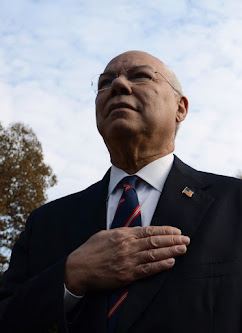
Colin Powell
I finished this book as I heard the news of an icon of conservative leadership passed away: former Secretary of State and Chairman of the Joint Chiefs of Staff Gen. Colin Powell. Flags fly at half staff for the great principled patriot and warrior-diplomat. But General Powell would want us to pay tribute to the person he most looked up to and respected in his life, his wife Alma. Powell told author Bob Woodward that Alma was his moral compass and inspiration.

Alma Powell is sponsor of USS Kearsarge (LHD-3). She is also the namesake of Kearsarge's airfield. 


According to the Navy, "Throughout her life of civic leadership [Alma] Powell has helped young people in need of educational resources for more than four decades. While serving as Chair of the Board of Directors for America’s Promise Alliance, a non-profit organization dedicated to improving the education opportunities of disadvantaged children, Ms. Powell helped to lead more than 450 partner network’s efforts to help tens of thousands of young people by connecting them with resources essential for academic success."


Capt. Neil Koprowski, commanding officer of the Wasp-class amphibious assault ship USS Kearsarge (LHD 3), delivers remarks during an airfield dedication ceremony in honor of Alma J. Powell, May 28, 2021. Alma Powell, Kearsarge’s ship sponsor, is a military spouse, a civic leader and civil rights activist who has advocated for women, children, and minorities for more than four decades, and has helped tens of thousands of disadvantaged people around the world. (MCSN Gwyneth Vandevender)

TOP PHOTO:
Gen. Colin L. Powell speaks at the 26th National Memorial Day Concert on the West Lawn of the U.S. Capitol in Washington, D.C., May 24, 2015.to help unite the country in remembrance and appreciation of the fallen and to serve those who are grieving. (MC1 Daniel Hinton)

Thursday, October 14, 2021

Filling in Gaps in ‘How the Word Is Passed’

Review by Bill Doughty––

At the beginning of “How the Word Is Passed: A Reckoning with the History of Slavery across America” (Hachette Book Group, 2021) author Clint Smith introduces us to Navy veteran David Thorson.


Thorson serves as a tour guide and teacher at Thomas Jefferson’s plantation home outside Charlottesville, Virginia. Smith learns that “prior to becoming a tour guide at Monticello, David served for more than thirty years in the U.S. Navy.”


Monticello
David Thorson’s “peach face, reddened from all the hours spent standing in the sun, was clean-shaven … He spoke with a calm evenhandedness that invited people into discussion, like a professor.”

According to Smith, Thorson became a docent and tour guide at Monticello after retiring from the Navy because of his love of history and interest in Thomas Jefferson.


While giving a tour focusing on Jefferson’s relationship to slavery, Thorson addresses the visitors:

“Slavery’s an institution. In Jefferson’s lifetime it becomes a system. So what is this slave system? It is a system of exploitation, a system of inequality and exclusion, a system where people are owned as property and held down by physical and psychological force, a system being justified even by people who know slavery is morally wrong. By doing what? Denying the very humanity of those who are enslaved solely on the basis of the color of their skin.”

Smith recounts, “In just a few sentences, David had captured the essence of chattel slavery in a way that few of my own teachers ever had.”


During the tour Smith notices how Thorson chooses to refer to the enslaved black people as “human beings” rather than “slaves.” Smith writes, “What reverberated throughout was the humanity of the enslaved people –– their unceasing desire to live a full life, one that would not be defined simply by their forced labor.”

Frederick Douglass
For his part in “How the Word Is Passed,” Smith brings in luminaries from history such as Frederick Douglass and W.E.B. DuBois, as well as respected historians Eric Foner, Annette Gordon-Reed, and Kenneth M. Stampp, to fill in some of the gaps of enslaved people’s lives. Smith presents information to settle debates about the impact of slavery on African Americans, from the founding of the nation through the Civil War and Emancipation and even through the era of Jim Crow, when many whites in southern states still longed for the Lost Cause of the Confederacy.

When it comes to debates about critical race theory or Big Lie / Lost Cause –– and even anti-vaccination stances –– it’s important to not only present facts and tell the truth but also be understanding and empathetic in how you talk to people. According to Smith:

“David sees it as essential that a guide be able to find the balance of telling the truth and not pushing people so much that they shut down. He told me that when you challenge people, specifically white people’s conception of Jefferson, you’re in fact challenging their conception of themselves. ‘I’ve come to realize that there’s a difference between history and nostalgia, and somewhere between those two is memory,’ he said. ‘I think that history is the story of the past, using all the available facts, and that nostalgia is a fantasy about the past using no facts, and somewhere in between is memory, which is kind of this blend of history and a little bit of emotion … I mean, history is kind of about what you need to know … but nostalgia is what you want to hear.'

“What would it take –– what does it take –– to confront a false history even if it means shattering the stories you have been told throughout your life?” Smith asks. “Even if it means having to fundamentally reexamine who you are and who your family has been?”


Smith says the search for truth is worth the pain. “Just because something is difficult to accept doesn’t mean you should refuse to accept it. Just because someone tells you a story doesn’t make that story true.”

In the 1930s and 40s, black men dressed as slaves conducted tours of Monticello, so hearing about David Thorson is evidence of progress, but Smith is careful about too much celebrating about that progress.


“When I think about the history of slavery and racism in this country, I think about how quick we are to expose notions of progress without accounting for its uncertain and serpentine path,” Smith says, reflecting on a visit with his grandparents to the National African American History and Culture Museum. 

In this thought-provoking book Clint Smith travels from Monticello to the Smithsonian’s NAAHCM in Washington, D.C. And he also visits the Whitney Plantation in Wallace, Louisiana; Angola Prison in Louisiana; Blandford Cemetery in Petersburg, Virginia; Monument Avenue in Richmond, Virginia; Galveston Island, Texas; Wall Street and Ellis Island, New York City; and Gorée Island, Dakar, Senegal, Africa.

His journey backtracks the route black Africans took as chattel slaves brought to the colonies in the Americas to create and maintain an economy based largely on cotton, tobacco, and sugar.


Smith’s goal on his trip is to fill in the blanks of history and gaps that separate people. He fills in those blanks and gaps with information, truth, and understanding.


With a journalist’s ear and poet’s eye, he takes readers to uncomfortable places and truths.

  • We confront the fact that Thomas Jefferson kept hundreds of humans enslaved; he also separated families, removing children even under the age of ten from their mothers and fathers.
  • We go to the Whitney Plantation, site of a slave revolt in 1811 on the heels of the Haitian Revolution of 1803; at Whitney, whites decapitated 55 slaves and displayed their heads on posts.
  • We ride to Galveston, Texas, considered by some as the site of the end of slavery and beginning of celebrations now known as Juneteenth.
  • We take a behind-the-scenes tour of Angola, where Smith reveals how mass incarcerations have roots in slavery.
  • We get a comparison of the now-removed Robert E. Lee statue in Richmond with the Statue of Liberty, designed by a French abolitionist –– and we’re reminded that Lady Liberty stands on broken chains as she stands for truth, justice, and democracy.
  • Finally, Clint invites readers with him for an emotional return to Africa as he examines remnants of colonialism and the role of history in accurately reflecting what was once a “system of plunder,” slavery and colonial rule, where “white sugar [and white cotton] means black misery.”

The Statue of Liberty stands for freedom from slavery and the promises of July 4, 1776. (NPS)

Clint Smith
Along Smith’s remarkable journey, he introduces us to individuals who earned their right to provide perspective and context, people like Angola’s Norris Henderson, NYC’s Damara Obi, Dakar’s Hasan Kane, Smith’s grandparents, and Monticello’s David Thorson.

Near the end of his visit to Jefferson’s plantation, Smith seeks out Thorson to get more insight and fill in more gaps.


Smith is intrigued by Thorson’s wisdom about the reality of human imperfection and Thorson’s view on “an idea worth fighting for.”


Smith writes:

“Before I left, I wanted to understand how much David’s role as a former military officer –– responsible for protecting and promoting this country’s foreign policy agenda at home and abroad –– was something that felt, if at all, in tension with his role now. ’I was born in the United States of America. I served the country for thirty years, so I actually believe in the idea of America,’ he said, straightening up in his chair. ‘Are we exceptional? No. Have we had unique advantages based on geography, based on a whole host of factors? Yes. Did a group of people come together in 1776 and conceive of an idea that was pretty radical in its time and then create a system of government, through the Constitution and its amendments, that was pretty radical and pretty novel? Yeah. Have other countries found their own way? Sure. So I believe in the idea of America. I don’t believe that this country was perfect. I don’t believe it is perfect. I don’t believe it’s going to be perfect. I believe that the journey to make this a better place is worth the effort and that the United States, if you conceive it not so much as a place to be in but an idea to believe in, it is worth fighting for.'

Democracy is safe when it’s protected. Truth, honest reflection, and the pursuit of justice must be at the heart of “how the word is passed.”


President Barack Obama and President François Hollande of France tour Monticello, the home of Thomas Jefferson in Charlottesville, Va., with Leslie Bowman, President of the Thomas Jefferson Foundation, Feb. 10, 2014 (Official White House Photo by Chuck Kennedy)